안식일교회는 이미 오래전에 교황권에 점령당했다.....그 신호들.....12/64
안식일교회 대총회는 죽은 송장/시체와 같다.(예수님의전언) 12/64
:::: 내가 지금부터 안식일교회의 타락상을 지적하더라도..........안식일교회가 바벨론이 되었다는 말은 아니다.
이완용이 나라를 일본에 팔아먹었다고해도..........여전히 .....독립운동가가 존재하듯이.....대한제국/대한민국의 맥은 끊어놓을수 없듯이..........
안식일교회의 Bert B. Beach 목사가.......안식일교회를 적그리스도 교황권에 팔아먹을지라도...........'
기타 여러....(안식일 교회의 )대총회 회장이 교회를 바벨론화하는데 일조를 하더라도.........
안식일교회는 여전히 하나님의 백성의 피난처이기 때문이다.
안식일 교회에 분파가 많을지라도..........하나님의 입장에서는 모든 안식일교회가 다 영적 이스라엘 후손이다.
모 안식일 교회가 장남이라면 분파 안식일교회는 차남들이고....
모 안식일교회가.......정실아내라면........분파 안식일교회는 후실아내들이고.....
모 안식일 교회가 ....지주 회사라면.........분파 안식일교회는 자회사들이다.
야곱의 12지파가 .....모두 야곱의 후손이고..........야곱의 집안인것과 마찬가지이다.
다만 모 안식일교회는 ......장남격이고......지주기업이니...
....사탄의 집중공격을 받고.......교황권의 집중포화를 받는것이다.
예수님 당시에도 많은 유대인 분파들이 존재했다........
바리새파,사두개파,엣세네파,.........기타 등등.....
이들이 분파일지라도....여전히 ..........유태인임에 틀림없고..........아브라함을 조상으로 하고.........
모세 5경을 따르는.........즉.........핵심사항에서는........유태인적 공통분모가 있으며.........
이방인과 구별된다는 점이다....
마찬가지로 안식일교회들은 이방인 교회(일요일교회)와 구별된다는 것이다.
1981년에 미국이 교황권의 수중에 떨어졌는데(레이건대통령 취임식의 특이사항이
저들끼리 주고 받는 점령완료 신호/
점령은 그이전에 했더라도)........안식일교회가 점령된것도 그 무렵으로 본다.
Bert B. Beach 목사는 그의 이력으로 보아........교황권의 간첩으로 안식일교회에 침투한것....
Beach 목사외에도 많은 간첩들이 안식일교회에 침투됐을것으로 본다.
아래 영문글은 1985년 루이지애나 대총회때 나온 Beach 목사의 문건 ( 에큐메니칼 운동에 관한것으로......
미국 안식일교회 홈페이지에 현재 버젓이 광고되어 .....누룩을 퍼뜨리고 있다.
세계교회 연합에 참여하지 않는교회는 바벨론이라고......궤변을 늘어놓았다.
비이치 목사는 1962년과 1965년에 안식일교회 대표로 ....교황을 만났고.......1977년5월 18일에는 로마를 방문하여..........
교황에게 금메달을 전달했다.
한편.........1982년 페루 리마에서 각 기독교 교파들이 모여 협정을 맺었는데..........거기에 안식일교회도 참석하여....
협정에 서명했다.
리마의 BEM ( BEM stands for Baptism, Eucharist, and Ministry)협정에 ......3가지 주요 안건중에......침례조항이 있다.....
카톨릭식.....유아침례.....물을 뿌려서 하는 침례를 안식일교회가 인정한것이다.
페루 협정전에는 안식일 교회 로고 그림에........세천사가 그려져 있었는데.......
협정이후에는 ( 지금 쓰고 있는대로).......이교도적 요소들로 바뀌었다.
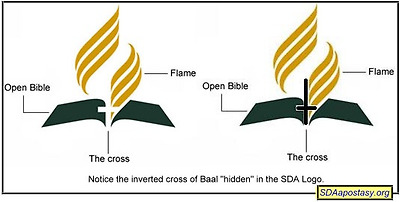
로고에는.....이교도의 신 ,바알의 십자가가 거꾸로 박혀 있다.
그리고 ....세천사 대신에 6개의 물결 무늬로 바뀌었다.
숫자 6은 고대 이교도의 심벌이라는데.......성경에서 보는 6 이라는 숫자의 의미는 .......
이미 잘 알고 있을테고.......
1995년 안식일교회 대총회때......각나라에서 참석했는데......그중에.......바티칸 나라가 참석했다.
노란색과 흰색의 국기.........국기 안에 바티칸 문양이 있다..( 나라 이름이 씌어진 팻말들을 살펴보면......
튀니지아 나라 다음에 바티칸이라 쓴 팻말이 반쪽만 보여서......tican 만 보이고 ...Va 는 가려져 안 보인다 )
Vatican flag flies at the 1995 General Conference of Seventh day Adventists Assembly
- Notice "Yellow and White" flag with Vatican crest

Seventh-day Adventists and the Ecumenical Movement
The General Conference Executive Committee has never voted an official statement regarding the Seventh-day Adventist relationship to the ecumenical movement as such. A book has been written dealing at length with the subject (B. B. Beach, Ecumenism-Boon or Bane? [Review and Herald, 1974]) and a number of articles have appeared over the years in Adventist publications, including the Adventist Review. Thus, while there is not exactly an official position, there are plenty of clear indications regarding the Seventh-day Adventist viewpoint.
Generally, it can be said that while the Seventh-day Adventist Church does not completely condemn the ecumenical movement and its main organizational manifestation, the World Council of Churches, she has been critical of various aspects and activities. Few would wish to deny that ecumenism has had laudable aims and some positive influences. Its great goal is visible Christian unity. No Adventist can be opposed to the unity Christ Himself prayed for. The ecumenical movement has promoted kinder interchurch relations with more dialogue and less diatribe and helped remove unfounded prejudices.
Through its various organizations and activities, the ecumenical movement has provided more accurate and updated information on churches, spoken for religious liberty and human rights, combated against the evils of racism, and drawn attention to socioeconomic implications of the gospel. In all this the intentions have been good and some of the fruit palatable. However, in the total picture, the banes tend to outweigh the boons. We shall examine some of these.
Adventism a Prophetic Movement
The Seventh-day Adventist Church stepped upon the stage of history-so Adventists firmly believe-in response to God's call. Adventists believe, it is hoped without pride or arrogance, that the Advent Movement represents the divinely appointed instrument for the organized proclamation of the "eternal gospel," God's last message, discerned from the prophetic vantage point of Revelation 14 and 18. In the focalized light of its prophetic understanding, the Seventh-day Adventist Church sees herself as the eschatologically oriented "ecumenical" movement of the Apocalypse. She begins by "calling out" God's children from "fallen" ecclesial bodies that will increasingly form organized religious opposition to the purposes of God. Together with the "calling out" there is a positive "calling in" to a united, worldwide-that is, ecumenical-movement characterized by "faith of Jesus" and keeping "the commandments of God" (Rev. 14:12). In the World Council of Churches the emphasis is first of all on "coming in" to a fellowship of churches and then hopefully and gradually "coming out" of corporate disunity. In the Advent Movement the accent is first on "coming out" of Babylonian disunity and confusion and then immediately "coming in" to a fellowship of unity, truth, and love within the globe-encircling Advent family.
In understanding the Adventist attitude toward ecumenism and other mainline churches, it is helpful to remember that the early-Advent movement (characterized by the Millerites) had ecumenical aspects: it arose in many churches. Thus, Adventists came from many denominations. However, the churches generally rejected the Advent message. Adventists were not infrequently disfellowshipped. Sometimes Adventists took with them portions of congregations. Relations became embittered. False stories were circulated, some of which unfortunately still persist today. The pioneers had strong views, and their opponents were no less dogmatic. They tended to look more for what separates than what unites. That was an understandable development. Today, of course, the interchurch climate tends to be more irenic and benign.
What are some of the problems Adventists have with ecumenism? Before we endeavor to give a summary answer to this question, it needs to be pointed out that the ecumenical movement is not monolithic in its thinking, and one can find all kinds of views represented in its ranks (that in itself, of course, is a problem!). We will try to make reference to what can be considered mainstream thinking within the World Council of Churches (WCC), an organization now representing more than three hundred different churches and denominations.
중략................
This study document, intended for internal church use, first appeared in Pattern for Progress, The Role and Function of Church Organization by Walter Raymond Beach and Bert Beverly Beach, was authored by Bert B. Beach, and was released in connection with the General Conference Session New Orleans, Louisiana, June 1985. It is available from the office of Public Affairs and Religious Liberty of the General Conference.
출처.........http://www.adventist.org/beliefs/other-documents/other-doc3.html
-