Up Close with Bees: How to Avoid Stings (Without Running Away!) 🏃♂️🚫
Finding yourself suddenly surrounded by the buzzing of a bee can trigger panic, especially when children are nearby. However, fear is often a poor counselor: most stings occur out of defense, not gratuitous aggression. Here is a complete guide to managing the encounter safely, combining practical tips with scientific insights. 🧠💡
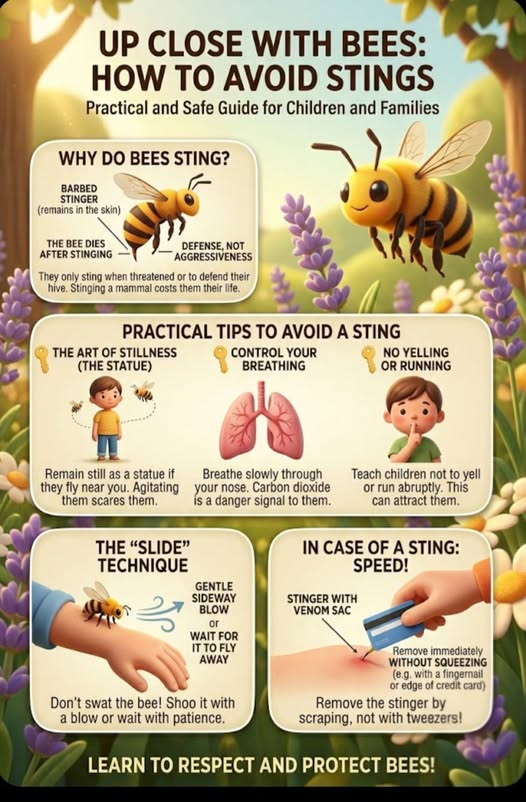
Why Do Bees Sting? The Science Behind the Stinger 🔬🩹
Unlike wasps, which can sting multiple times and are predators, honeybees are generally herbivores and very "economical" with their lives. Stinging a mammal (like us) almost always results in death for the bee: its stinger is barbed and becomes stuck in our elastic skin, tearing away the insect's internal organs when it tries to fly away. 🐝💔
A bee stings only when it perceives a mortal threat to itself or the hive. The stimuli that trigger this behavior are primarily three:
Sudden movements: Seen as a physical attack. 🖐️⚡
Strong odors: Certain perfumes or sweat contain molecules similar to alarm pheromones. 🧴👃
Carbon dioxide: Heavy breathing signals the presence of a predator (such as a bear or a badger). 💨🐻
Practical Tips to Avoid a Sting 💡🛡️
If a bee buzzes around you or lands on you, the goal is to show it that you are neither a flower nor an enemy.
The Art of Stillness (The Statue): This is the most effective trick. If the bee flies near your face, stay still. Waving your hands or trying to swat it will scare it, inducing it to defend itself. If you remain motionless, the bee will realize within seconds that you are not interesting and will leave. 🗿🧘
Control Your Breathing: When afraid, you tend to breathe quickly. The bee perceives the excess CO_2 as a danger signal. Try to breathe calmly through your nose, or look away and blow air out gently. 🌬️😌
No Yelling or Sudden Movements: Children should be taught not to run away screaming. Running creates air currents that can "suck" the bee toward hair or clothing, increasing the risk of accidental contact. 🤐🚫
The "Slide" Technique: If a bee lands on your skin, do not hit it. You can move it away with a light, steady sideways breath, or simply wait for it to take flight on its own. 🍃🌬️
Watch Your Colors and Scents: If you plan a trip to a flowery meadow, avoid very dark or extremely bright clothes (which mimic flowers) and prefer white or beige. Also, sweet perfumes or highly scented sunscreens can pique their curiosity. 👕🌼
Educating the Little Ones: From Fear to Curiosity 👧👦
The best way to protect children is to replace irrational fear with knowledge. Explaining that a bee is like a "little robot of nature" programmed to collect pollen and not to attack us completely changes their perspective. 🤖🌸
The "Stone" Game: Teach children that if a bee gets too close, they can play "stone" or "statue." Whoever stays the stillest wins. This turns a potentially anxious moment into an exercise in self-control. 🪨🏆
Observation from a Distance: Use magnifying glasses to observe bees on flowers from a safe distance (at least one meter). Seeing how busy they are with their work will help children understand that we are not on their minds. 🔍🐝
What to Do if Contact is Inevitable 🆘🩹
If you accidentally enter an area with many bees (perhaps near a water source or a nest), move away by walking slowly toward a shaded area or taking cover in tall vegetation. 🌳🏃♀️
In Case of a Sting: If, despite precautions, a child is stung, speed is essential. Do not use tweezers to remove the stinger, as you would squeeze the venom sac, injecting more toxins. Instead, use a fingernail or the edge of a credit card to scrape away the stinger with a quick lateral movement. 💳☝️
Why Saving Them is Important for Us 🍎🌍
Beyond learning how not to get stung, it is vital to understand why their presence is a gift. Bees are responsible for pollinating about 75% of the world's food crops. Without them, our tables would be much emptier: no apples, strawberries, almonds, or zucchini. 🍓🥗
Additional scientific facts:
Static Electricity: While flying, bees accumulate a positive electrical charge that attracts pollen (which is negatively charged) like a magnet. It is a fascinating physical phenomenon. ⚡🧲
The Waggle Dance: They communicate to their hive mates where food is located through a "figure-eight dance." If you see them moving strangely near a flower, they are likely giving directions to their friends! 💃🗺️
Conclusion: A Pact of Respect 🤝🧡
Ultimately, avoiding a sting does not require expensive tools or armor, but only empathy and calmness. Bees are not enemies to be driven away, but precious allies that share green spaces with us. Respecting their space and their rhythms is the best way to enjoy the beauty of an afternoon outdoors in total safety. ☀️🌼
Remember: A meadow without bees is a meadow that is ceasing to live. Learning to coexist is the first step toward protecting our future
///////////////////////////////////////////////
벌과 가까이: 쏘이지 않는 방법 (도망가지 않고!) 🏃♂️🚫
갑자기 윙윙거리는 벌 소리에 둘러싸이면, 특히 아이들이 근처에 있을 때는 공포에 휩싸일 수 있습니다. 하지만 두려움은 좋은 해결책이 아닙니다. 대부분의 벌침은 무분별한 공격이 아니라 방어적인 행동에서 비롯됩니다. 실용적인 팁과 과학적 지식을 결합하여 벌과의 만남을 안전하게 대처하는 방법을 알아보세요. 🧠💡
벌은 왜 쏘는 걸까요? 벌침에 숨겨진 과학 🔬🩹
여러 번 쏘일 수 있고 포식자인 말벌과는 달리, 꿀벌은 일반적으로 초식성이며 생명을 매우 "효율적으로" 사용합니다. 벌은 포유류(우리와 같은)를 쏘면 거의 항상 죽음에 이르게 됩니다. 벌침은 갈고리 모양으로 되어 있어 탄력 있는 피부에 박히고, 날아오르려는 벌의 몸속 장기를 찢어놓기 때문입니다. 🐝💔
벌은 자신이나 벌집에 치명적인 위협이 있다고 느낄 때만 쏘입니다. 이러한 행동을 유발하는 자극은 주로 세 가지입니다.
갑작스러운 움직임: 물리적 공격으로 인식됩니다. 🖐️⚡
강한 냄새: 특정 향수나 땀에는 경고 페로몬과 유사한 분자가 포함되어 있습니다. 🧴👃
이산화탄소: 거친 호흡은 포식자(곰이나 오소리 등)의 존재를 알리는 신호입니다. 💨🐻
벌에 쏘이지 않는 실용적인 팁 💡🛡️
벌이 주변을 윙윙거리거나 몸에 앉으면, 당신이 꽃도 아니고 적도 아니라는 것을 보여주는 것이 중요합니다.
가만히 있기(정지 자세): 이것이 가장 효과적인 방법입니다. 벌이 얼굴 근처로 날아오면 가만히 있으세요. 손을 흔들거나 벌을 쫓아내려고 하면 벌이 놀라서 자신을 방어하려고 할 것입니다. 가만히 있으면 벌은 몇 초 안에 당신이 관심이 없다는 것을 깨닫고 떠날 것입니다. 🗿🧘
호흡 조절하기: 두려움을 느끼면 호흡이 빨라지는 경향이 있습니다. 벌은 과도한 이산화탄소를 위험 신호로 인식합니다. 코로 차분하게 숨을 쉬거나, 시선을 돌리고 부드럽게 숨을 내쉬세요. 🌬️😌
고함을 지르거나 갑자기 움직이지 않기: 아이들에게는 소리를 지르며 도망가지 않도록 가르쳐야 합니다. 뛰면 공기 흐름이 생겨 벌이 머리카락이나 옷 쪽으로 빨려 들어가 접촉 위험이 커집니다. 🤐🚫
미끄러뜨리기 기법: 벌이 피부에 앉으면 때리지 마세요. 가볍고 일정한 숨을 옆으로 들이쉬어 벌을 밀어내거나, 스스로 날아갈 때까지 기다리세요. 🍃🌬️
색깔과 향기에 주의하세요: 꽃밭으로 여행을 계획한다면, 꽃을 닮은 아주 어둡거나 지나치게 밝은 옷은 피하고 흰색이나 베이지색 옷을 입히세요. 또한, 달콤한 향수나 향이 강한 자외선 차단제는 아이들의 호기심을 자극할 수 있습니다. 👕🌼
아이들 교육: 두려움에서 호기심으로 👧👦
아이들을 보호하는 가장 좋은 방법은 근거 없는 두려움을 지식으로 대체하는 것입니다. 벌은 꽃가루를 모으도록 프로그램된 "자연의 작은 로봇"과 같으며 우리를 공격하지 않는다는 것을 설명해 주면 아이들의 관점이 완전히 달라집니다. 🤖🌸
"돌" 게임: 벌이 너무 가까이 다가오면 "돌" 또는 "조각상" 게임을 할 수 있다고 아이들에게 가르쳐 주세요. 가장 가만히 있는 사람이 이기는 게임입니다. 이 게임은 불안한 순간을 자기 통제력을 기르는 시간으로 바꿔줍니다. 🪨🏆
원거리 관찰: 돋보기를 사용하여 안전한 거리(최소 1미터)에서 꽃 위의 벌들을 관찰하세요. 벌들이 얼마나 열심히 일하는지 보면 아이들은 우리가 벌들의 관심사가 아니라는 것을 이해할 수 있습니다. 🔍🐝
접촉이 불가피한 경우 대처법 🆘🩹
벌이 많은 곳(예: 물웅덩이나 벌집 근처)에 실수로 들어갔다면, 천천히 걸어 그늘진 곳으로 이동하거나 키 큰 풀숲에 숨으세요. 🌳🏃♀️
벌에 쏘였을 경우: 예방 조치를 취했음에도 불구하고 아이가 벌에 쏘였다면, 신속하게 대처하는 것이 중요합니다. 핀셋으로 벌침을 제거하려고 하지 마세요. 핀셋으로 벌침을 누르면 독주머니가 짜여 더 많은 독소가 주입될 수 있습니다. 대신 손톱이나 신용카드 모서리를 사용하여 옆으로 빠르게 움직여 벌침을 긁어내세요. 💳☝️
왜 꿀벌을 보호해야 할까요? 🍎🌍
벌에 쏘이지 않는 방법을 배우는 것 외에도, 꿀벌의 존재가 우리에게 얼마나 소중한 선물인지 이해하는 것이 중요합니다. 꿀벌은 전 세계 식량 작물의 약 75%를 수분하는 역할을 합니다. 꿀벌이 없다면 우리의 식탁은 훨씬 텅 비어 있을 것입니다. 사과, 딸기, 아몬드, 애호박 등을 맛볼 수 없을 테니까요. 🍓🥗
추가적인 과학적 사실:
정전기: 꿀벌은 날아다니면서 양전하를 띠게 되는데, 이 양전하는 자석처럼 음전하를 띤 꽃가루를 끌어당깁니다. 이는 매우 흥미로운 물리적 현상입니다. ⚡🧲
꼬리 흔들기 춤: 꿀벌은 "팔자 모양 춤"을 추면서 벌집 동료들에게 먹이의 위치를 알려줍니다. 꽃 근처에서 꿀벌이 이상하게 움직이는 것을 본다면, 아마도 동료들에게 방향을 알려주고 있는 것일 겁니다! 💃🗺️
결론: 존중의 약속 🤝🧡
궁극적으로 벌에 쏘이는 것을 피하는 데 값비싼 도구나 보호구가 필요한 것이 아니라, 공감과 침착함만 있으면 됩니다. 벌은 쫓아내야 할 적이 아니라, 우리와 함께 녹지 공간을 공유하는 소중한 동반자입니다. 벌의 공간과 생활 리듬을 존중하는 것이야말로 안전하게 오후 시간을 야외에서 즐길 수 있는 최고의 방법입니다. ☀️🌼
기억하세요: 벌이 없는 초원은 생명이 꺼져가는 초원입니다. 공존하는 법을 배우는 것이 우리의 미래를 지키는 첫걸음입니다.