13. M’Naghten’s Case --- 10 Clark and Fin 200 (1843)
1. Fact
M'Naughten, acting under paranoid delusions, believed that the government was persecuting him. Due to these delusions, he attempted to kill the Prime Minister, and instead ended up killing the minister's secretary. He was indicted for the murder of his victim, and medical evidence at the trial demonstrated that although the D had a perception of right and wrong, he was out of control at the time of the events.
2. Issue
1) What rule applies when a person with a limited insane delusion commits a crime.
2) What is the proper jury question when insanity is the defense?
3) How should the question be worded, in order to help the jury determine whether the defendant had the correct mental state when committing the crime?
4) If a person, who is insane, and suffers insane delusions and cannot distinguish between reality and current facts and their delusions, and thus consequently does not understand the consequences or results of their actions, can they then be excused from committing the crime and have their case dismissed?
5) Can a medical expert who only heard the trial evidence (and never saw the prisoner previously) be asked his professional opinion as to the prisoner's state of mind at the time of the offense?
3. Rule
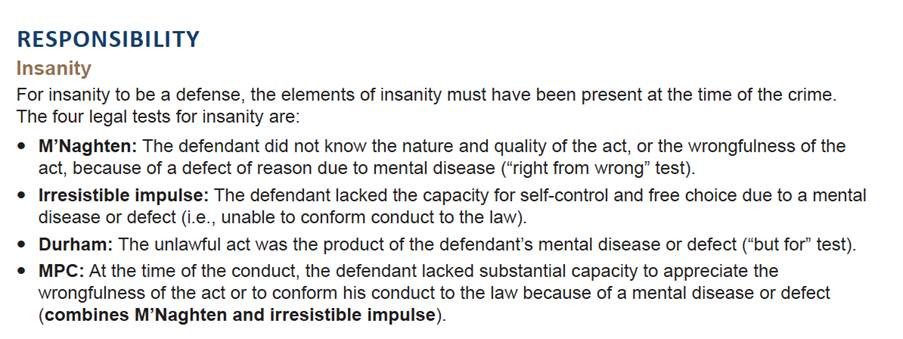
To establish a defense on the ground of insanity, defendant must prove he didn’t understand what he was doing—or didn’t know it was wrong—because of mental disease at the time of committing the act.
Presumption of Sanity: Every man is presumed to be sane until the contrary is proved to the satisfaction of the jury.
The Burden of Proof: The burden of proof for the defense of insanity lies clearly with the defense.
4. Application
① The defendant is still guilty, if he knew when he was committing the crime, that his actions were against the law, even if he believed, because of his delusions, that he was addressing a grievance or acting in the best interest of the public. Even if the defendant truly believed that the Prime Minister was the most evil man alive and hurting the citizens and that it would be good, to murder him to benefit the citizens, this is still going to make the defendant guilty because the defendant knows murder is illegal.
②& ③ The proper test is whether the accused knew the nature and quality of the act, or knew that the act was wrong (in reference to the very act charged). The term "wrong" refers to acting contrary to the law of the land and what one "ought not to do."
The correct legal test is to determine whether the defendant was aware of the nature and quality of his actions, or knew his actions were wrong, as in illegal or morally wrong.
④ We must treat the person, the defendant, as to how they would be treated under the law, if their delusions were actually real. We must treat the defendant under the assumption that their delusions are real or true in facts We must assume the Prime Minister is actually evil, and treat the defendant accordingly, which means murder is still illegal even if the person is bad.
⑤ A doctor, upon hearing the evidence presented, can't be asked his opinion on the defendant's possible mental state, because the truth of the facts, is a duty for the jury (fact-finders). The doctor cannot do the jury's job. When the facts are not in dispute, such as there is definitive proof as to the facts, then the doctor may be asked his opinion on those facts. When there is definitive proof, such as videos, the doctor may then be asked his opinion on what he observes from those videos.
5. Conclusion
Verdict upheld.
6. Classnote/feedback