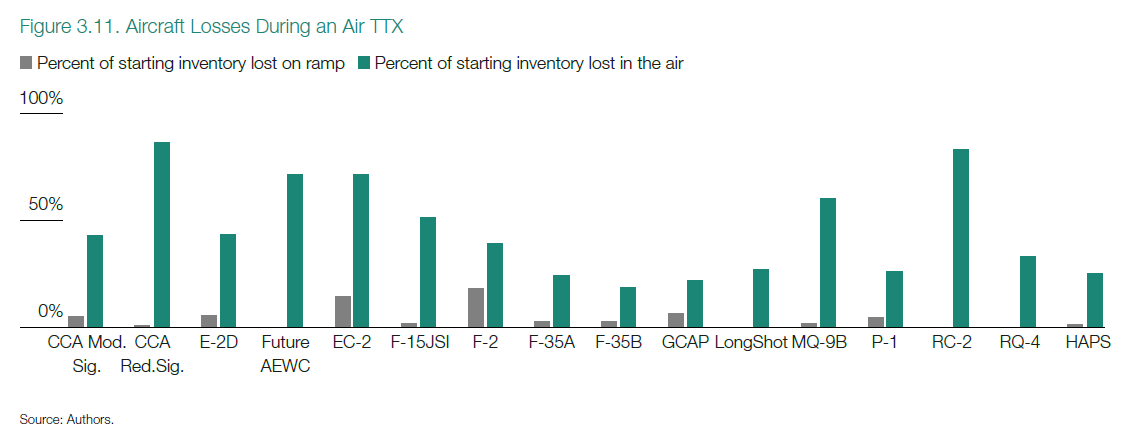
6월에 Hudson Institute가 낸 보고서 Strengthening the Front Line - Transforming the Japan Self-Defense Force for Twenty-First-Century Deterrence에 아마도 비행거리로 보이는 160 ~ 215 NM의 초장거리 공대공 미사일을 서로 쏴대는 시나리오가 나오네요.
VLR SAM은 500 NM 가는 것으로 나왔는데 가는데 15~30분 걸리고 그 사이 표적은 100 NM 움직일 수 있는 것으로 나왔습니다.
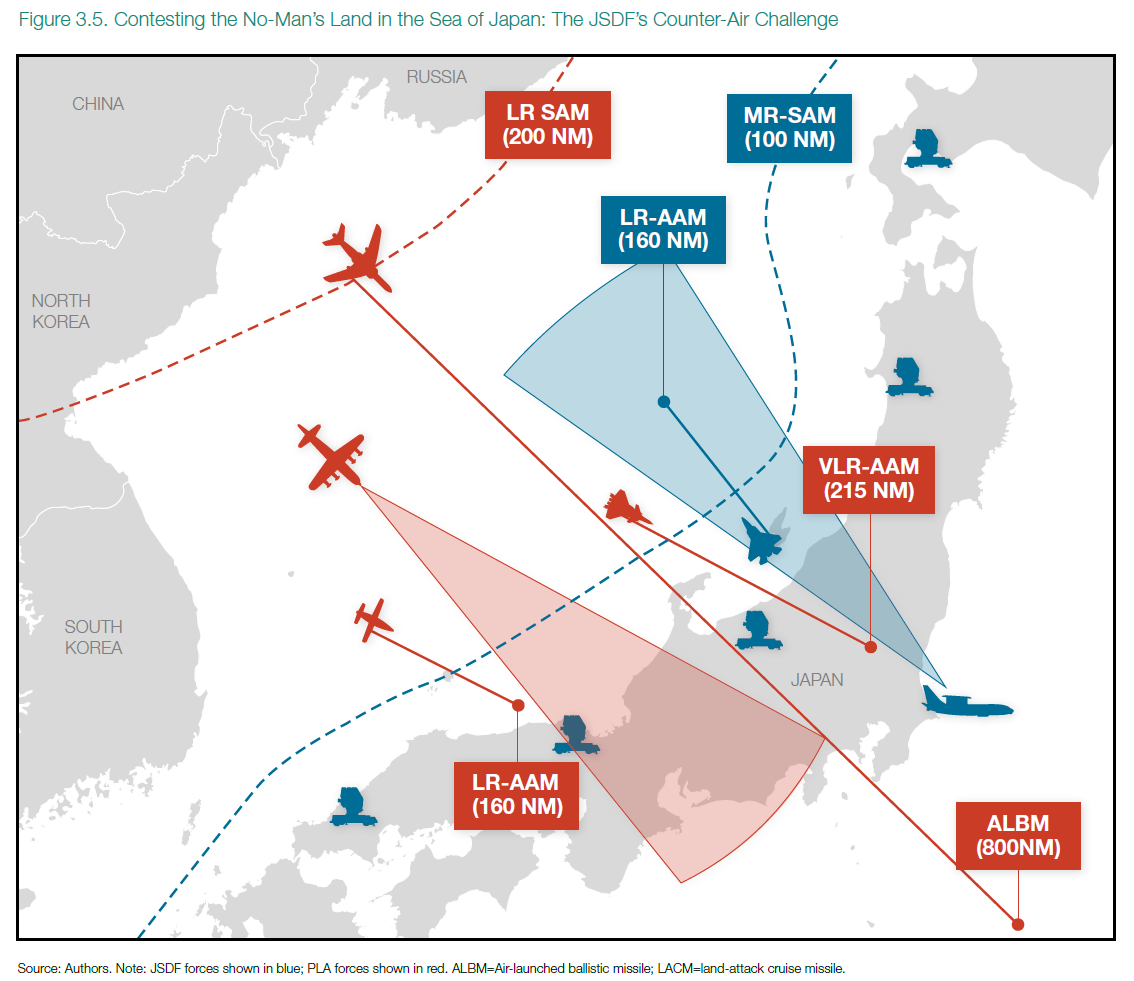
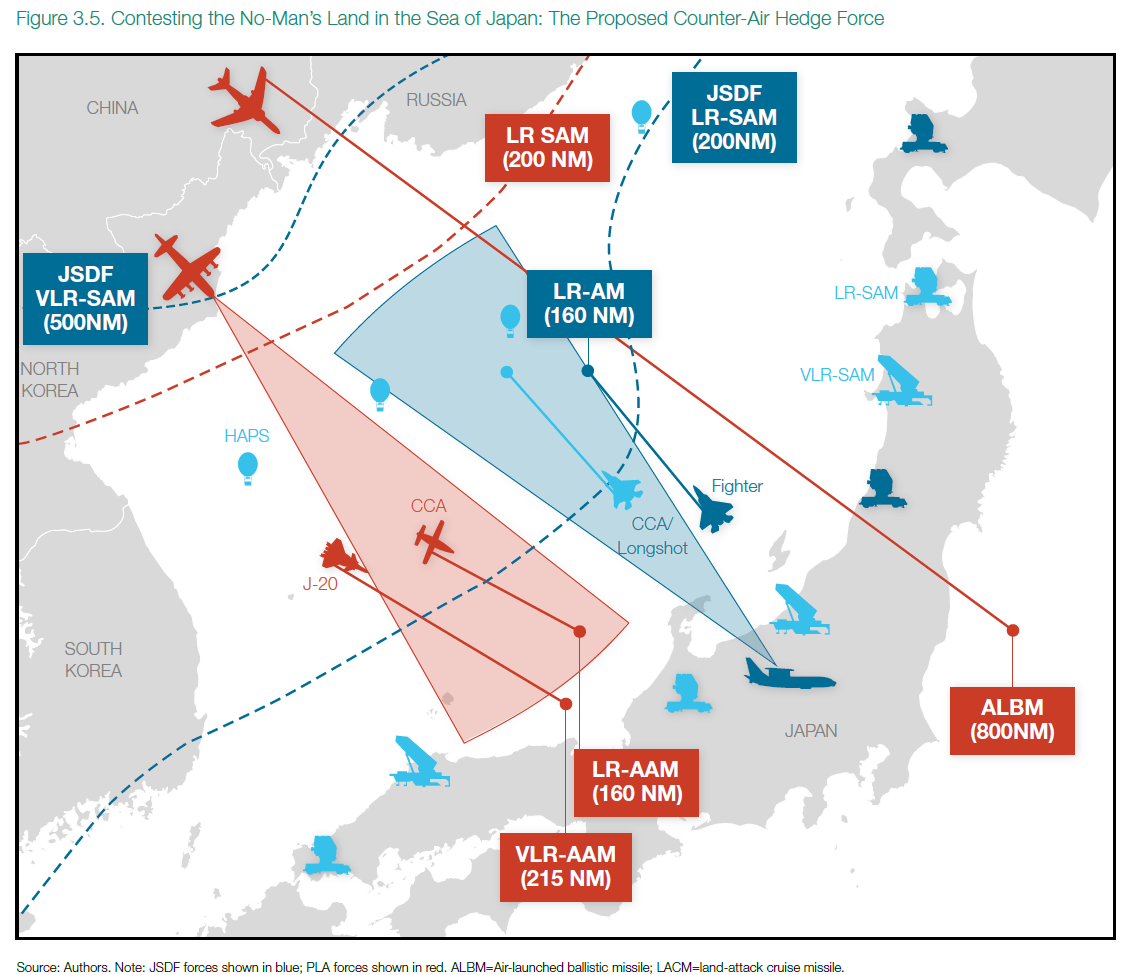
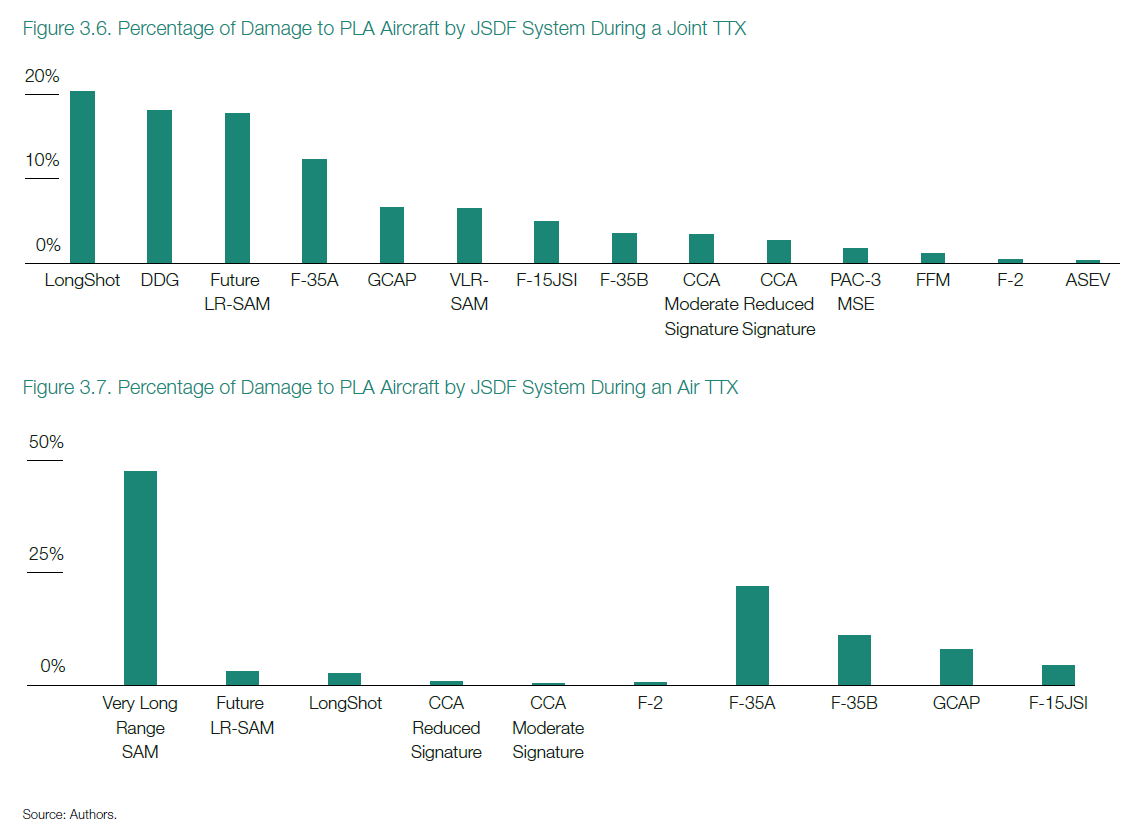
The most promising counter-air solutions from the TTXs focused on three lines of effort, summarized on the right side of figure 3.5. A hedge force (shown in light blue) of ground-based counter-air capabilities, high-altitude balloon sensors, and low-cost CCAs conducted the first two lines of effort, and the third line depended on resilient infrastructure for protraction. Teams employed this scheme in a joint TTX and an air-focused TTX, and figures 3.6 and 3.7, respectively, show the results. Notably, these operational concepts did not employ CCAs in a “Loyal Wingman” approach where the CCAs operate in concert with and are controlled by a manned aircraft. Instead, the Hudson Institute TTXs found that CCAs were more effective if employed independently and far away from JSDF crewed fighters, as described below.
Line of Effort 1: Contesting Airspace in and around Japan
In the first line of effort, teams used long-range SAMs (LR-SAMs) capable of engaging PLA fighter aircraft and creating relative sanctuary in the areas immediately surrounding JASDF basing. With this extra space, the teams could use crewed JSDF fighter aircraft over Japan to conduct VLR- and LR-AAM attacks against PLA fighters and use smaller rockets like the US Advanced Precision Kill Weapon System (APKWS) against PLA OWA drones. Teams complemented their attacks on PLA fighters with uncrewed expendable aircraft to absorb PLA LR-AAM attacks and interfere with PLA fighters. This approach, using CCAs and the LongShot OWA drone stemmed the attrition of crewed JSDF fighters. Although both systems can carry AAMs, they were often shot down before they could launch attacks. As a result, CCAs and LongShot OWA drones were more useful as decoys that could also collide with enemy aircraft.
Teams positioned ground-based SAMs and LongShot launchers along the Japanese coast with small cadres of operators and maintainers, using terrain and camouflage to reduce enemy targeting effectiveness. Teams flew inexpensive CCAs from numerous airfields near Japan’s coast to complement runway-independent LongShot OWA drones.
Figures 3.6 and 3.7 highlight the impact of this approach. During the TTX shown in figure 3.6, PLA fighters attempted to operate in Japanese airspace, resulting in substantial losses to LR-SAMs. During the TTX shown in figure 3.7, PLA fighters remained offshore and outside the weapons engagement zone of JSDF LR-SAMs, reducing their losses but also lowering their ability to attack JSDF aircraft or bases. Although the teams did not move them during these TTXs, ground-based SAM and drone launchers could relocate to further reduce their vulnerability to PLA counterattack.
Line of Effort 2: Countering HVAAs with Long-Range Kill Chains
PLA bombers are the most important air threat for the JSDF to address. They can launch far more ordnance over a longer period than the PLA Rocket Force and can do so from relatively secure airspace around China. Figure 3.8 depicts a typical long-range anti-air kill chain used by the hedge force in figure 3.5 to defeat bombers and other HVAAs at ranges of 300 NM or farther from Japan. In this approach, an uncrewed sensor such as an ultra-long endurance/high-altitude persistent sensor (HAPS) balloon, or aircraft initially detects the HVAA. It then relays the contact to an air combat manager in an AEWC aircraft, like an E-7 or E-2D, or to a unit on the ground, which directs an attack using a very-long-range SAM (VLR-SAM) or a crewed aircraft with a VLR-AAM.
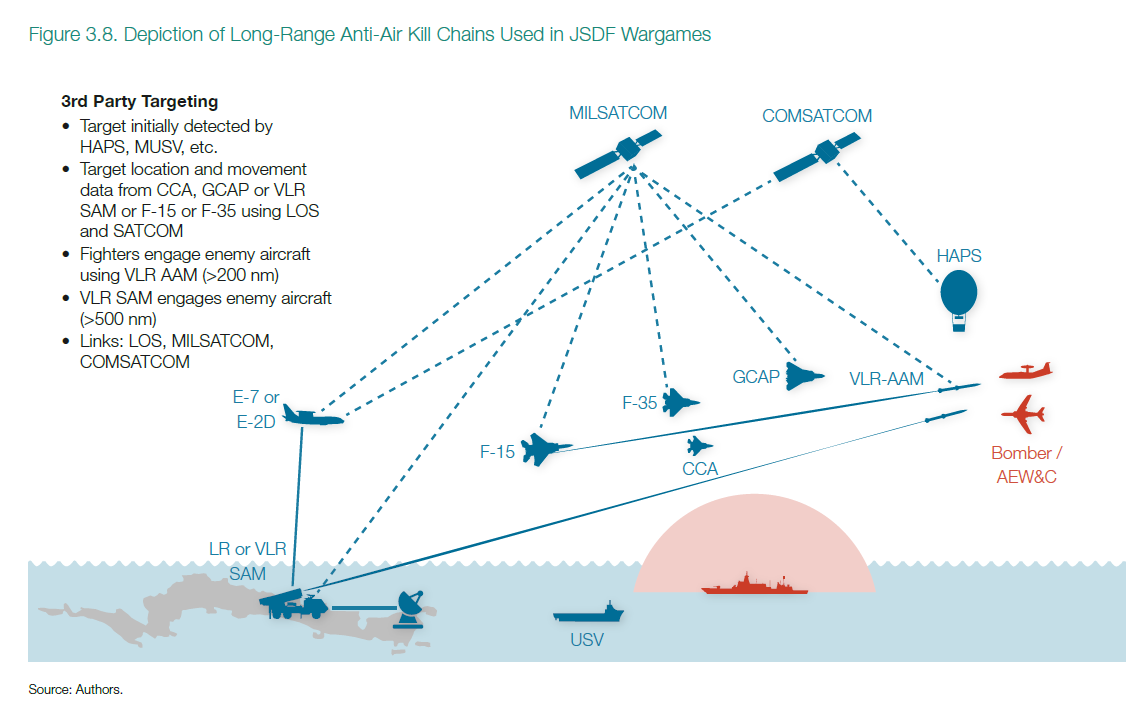
The main challenge with long-range kill chains is providing missiles in transit to the target updated information on the HVAA’s location and movement. A VLR-SAM takes 15–30 minutes to reach its maximum range. During that time, an HVAA would move more than 100 NM. To provide updated targeting information, teams in the TTXs used systems such as ground-based radars, AEWC aircraft, fighters, or CCAs as spotters that would remain in contact with the target until the missile completed the attack.
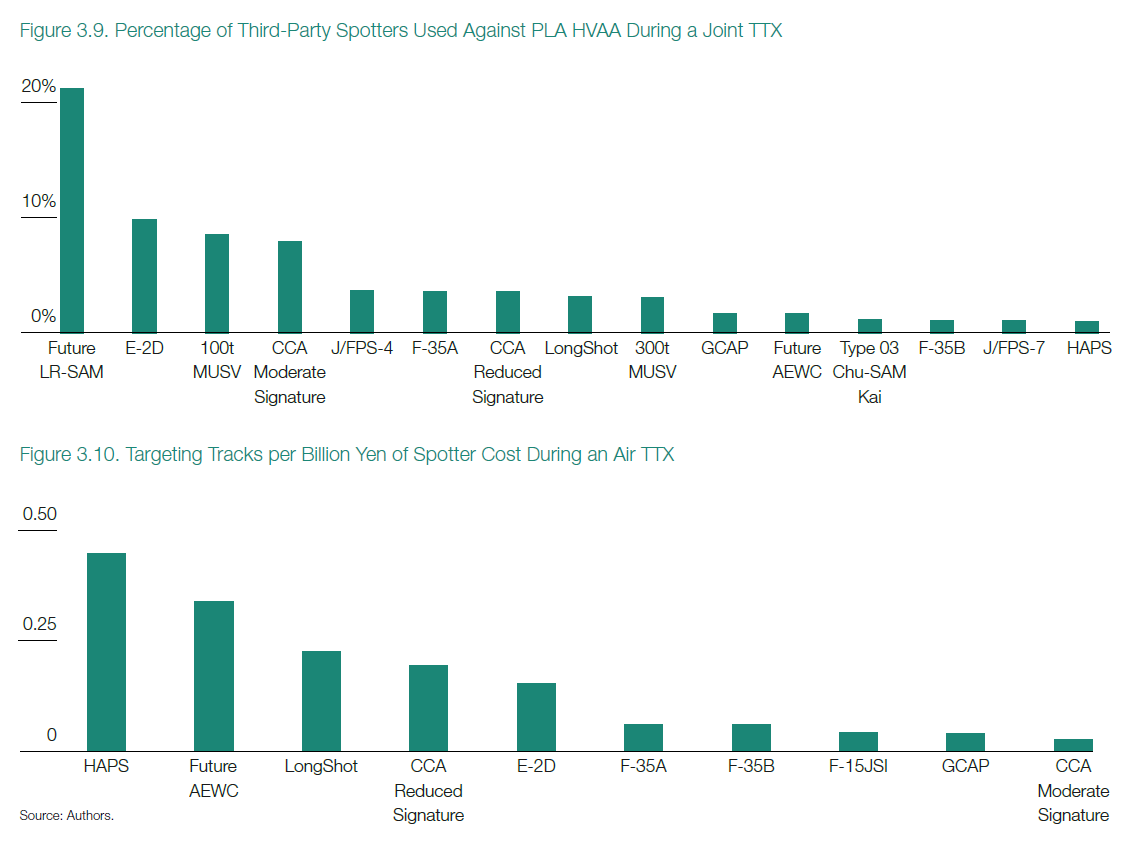
The JSDF will need to invest in targeting systems that can maintain track on enemy HVAAs and be expendable. As shown in figure 3.9 for a joint TTX, spotters providing targeting to long-range counter-HVAA kill chains were often relatively expensive platforms with capable radars. This enabled them to provide high-fidelity and timely data, but also made them vulnerable to counter-detection and attack.
The results shown in figure 3.9, like those from any TTX, arise from unique operational concepts developed by teams. For example, the high percentage of LR-SAMs or 100T MUSVs providing counter-HVAA targeting was driven by the distribution of these systems along the Japanese coast and East China Sea, respectively. This often put them in position to track an HVAA even if they could not engage due to misorientation or a lack of capacity. However, the overall trend was consistent across all the TTXs. Targeting systems often ended up being more capable platforms that carried relatively long-range sensors.
The JMOD should incorporate into its force design expendable targeting platforms that can support long-range kill chains. Figure 3.10 shows the number of targeting tracks generated per billion yen in an air-focused TTX. It highlights how HAPS provided the most cost-effective targeting, although these systems generated only a few percent of the target tracks during the TTX. Other UxS, such as LongShot and reduced-signature CCAs, also provide a good return on investment for targeting, which the JSDF could further increase by focusing them on sensing and eliminating their weapon delivery capabilities. Notably, moderate-signature CCAs did not provide cost-effective targeting because they were relatively expensive and highly vulnerable to counterattack.
As shown in figure 3.9, long-range kill chains also depend on communication networks that can connect sensors with shooters and missiles in contested electromagnetic environments. As described in a later section of this report, teams generally depended on commercial satellite communications because they are widely available and difficult to jam. Long-range engagements also rely on C2 systems that can compose and orchestrate kill chains from dozens or hundreds of available aircraft and weapons.
Line of Effort 3: Protecting Air Forces to Enable Protraction
Destroying PLA HVAAs provided compounding benefits to the JSDF. Shooting down bombers not only stopped their attacks but also prevented them from conducting subsequent attacks. Furthermore, the persistent, credible threat forced PLA bombers to launch from longer ranges. This limited the missiles’ ability to maneuver and provided more opportunities for JSDF air defenses to shoot them down, which reduced the damage to JSDF airfields. Similarly, destroying PLA AEWC capabilities degraded multiple enemy long-range air kill chains. This reduced the PLA’s ability to distinguish JASDF CCAs from fighters, guide its fighters toward JASDF aircraft, or provide targeting updates to VLR-AAMs and LR-AAMs. Together, these measures improved the survivability of JASDF fighters and enabled them to conduct more counter-air operations.