J(H)-36, J-50과는 다른 새로운 무미익형 스텔스 전투기가 포착됐네요. J-50을 개발중인 셴양과는 별개로 청두에서 개발중인 유인기이거나, 혹은 대형 CCA로 추정됩니다.
새로운 중국 스텔스 전술 전투기가 공개되다 토머스 뉴딕, 타일러 로고웨이 12-15분 TWZ 뉴스레터
군사 기술, 전략, 외교 정책 분야의 최신 동향에 대한 주간 통찰과 분석.
최근 공개된 이미지들은 중국이 또 하나의 꼬리날개 없는 스텔스 전투기를 시험 비행 중임을 상당히 명확히 보여주고 있다. 이 기체가 유인 설계인지, 아니면 최신 첨단 드론 중 하나인지는 아직 확실치 않다.
협력형 ‘충실한 동반자(loyal wingman)’ 능력을 갖춘 고성능, 고자율 무인 전투 항공기(UCAV)일 가능성이 크다. 하지만 설계만을 놓고 볼 때, 이 기체는 셴양(Shenyang)의 J-XDS(일부에서는 J-50으로도 불림) 전투기와 유사하거나, 혹은 그보다도 더 직접적으로 경쟁할 수 있는 6세대 유인 전투기일 수도 있다. 청두(Chengdu)의 대형 J-36 전술 전투기와 비교했을 때도 마찬가지다.
이번 최신 개발은 베이징의 군사 항공우주 분야 발전 속도가 얼마나 광적으로 빠른지 다시 한 번 강조하는 사례이다. 여기에는 다양한 드론 프로그램과 첨단 유인 전투기 개발까지 아우르는 폭넓은 활동이 포함된다.
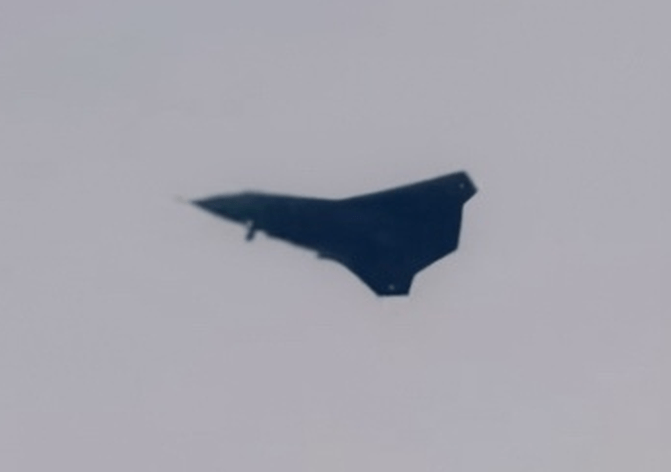
지금까지 공개된 새로운 중국 디자인의 최고 품질 이미지는 이렇다. (출처 X) 현재까지 해당 디자인의 이미지가 최소 다섯 장 관찰되었다. 각각의 경우, 이미지가 언제 어디서 촬영됐는지는 명확하지 않다. 이 이미지들의 품질과 각도는, 수년 전부터 새로운 첨단 중국 군용 항공기가 최초로 ‘유출’될 때마다 등장했던 역사적 전형과 유사하다.
이 이미지들 중 어느 것도 동체 앞부분 윗쪽에 조종석이 존재하는지 확인할 만한 충분한 세부 정보를 제공하지 않는다. 그러나 이 설계가 유인기이든 무인기이든 간에 더 본격적인 기체일 수 있다는 명확한 특징들은 드러나 있다.
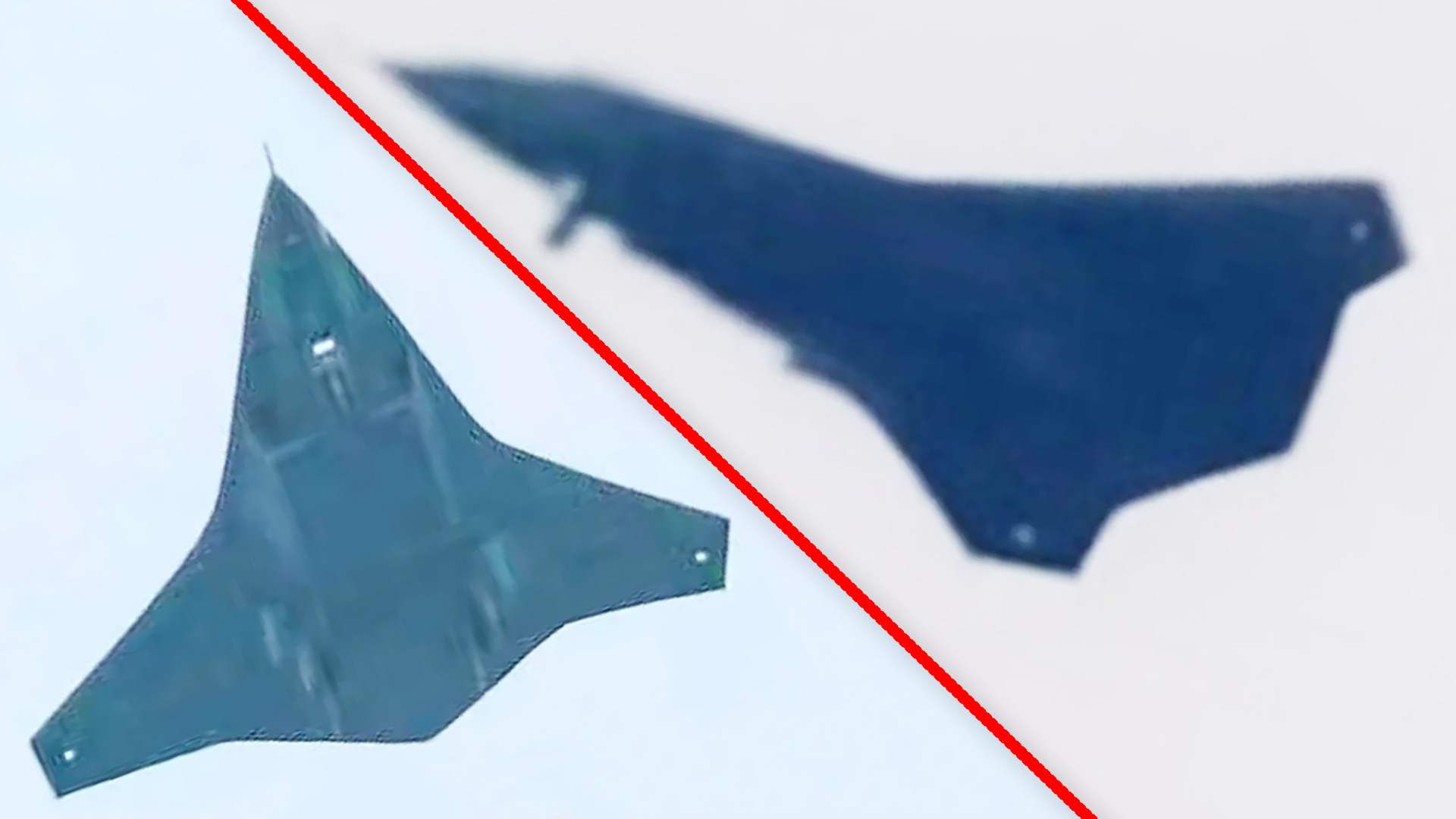
최근 등장한 중국 신형기의 첫 이미지 중 하나. (출처 X) 특징 최근 공개된 이미지 속 항공기는 날카롭게 뻗은 전방 동체와 노즈 섹션이 동체 중간쯤에서 윙(주익)과 자연스럽게 이어져 있다. 크게 후퇴각이 적용된 날개는 양 끝이 잘려 있고, 트레일링 엣지(뒷날개)에는 눈에 띄는 삼각형 연장부가 더해져 ‘W’ 형태 구성이 나타난다. 수직안정판이나 그 외 별도 꼬리날개는 없다. 넓은 동체는 내부 연료와 장비 탑재 능력이 상당할 것으로 보이지만, 무장창의 세부는 하부에서 볼 수 있는 범위 내에서는 확인되지 않는다.
지금까지 공개된 모든 각도에서 이 항공기는 삼륜식(트라이사이클) 착륙장치를 펼친 상태로 나타난다. 노즈기어가 쌍바퀴 구조로 보이는데, 이는 더 무거운 설계나 혹은 항모 운용을 염두에 둔 설계일 수 있다. 노즈에는 공기 데이터 프로브가 부착되어 있는데, 이는 초기 시험비행에서 흔히 볼 수 있는 장치다. 전반적으로 이 설계는 지난해 말 중국이 공개한 두 대의 유인 전투기와 마찬가지로 스텔스 성능 극대화에 초점이 맞춰진 것으로 보인다. 여러 면에서 소위 J-36과 눈에 띄게 유사하다.
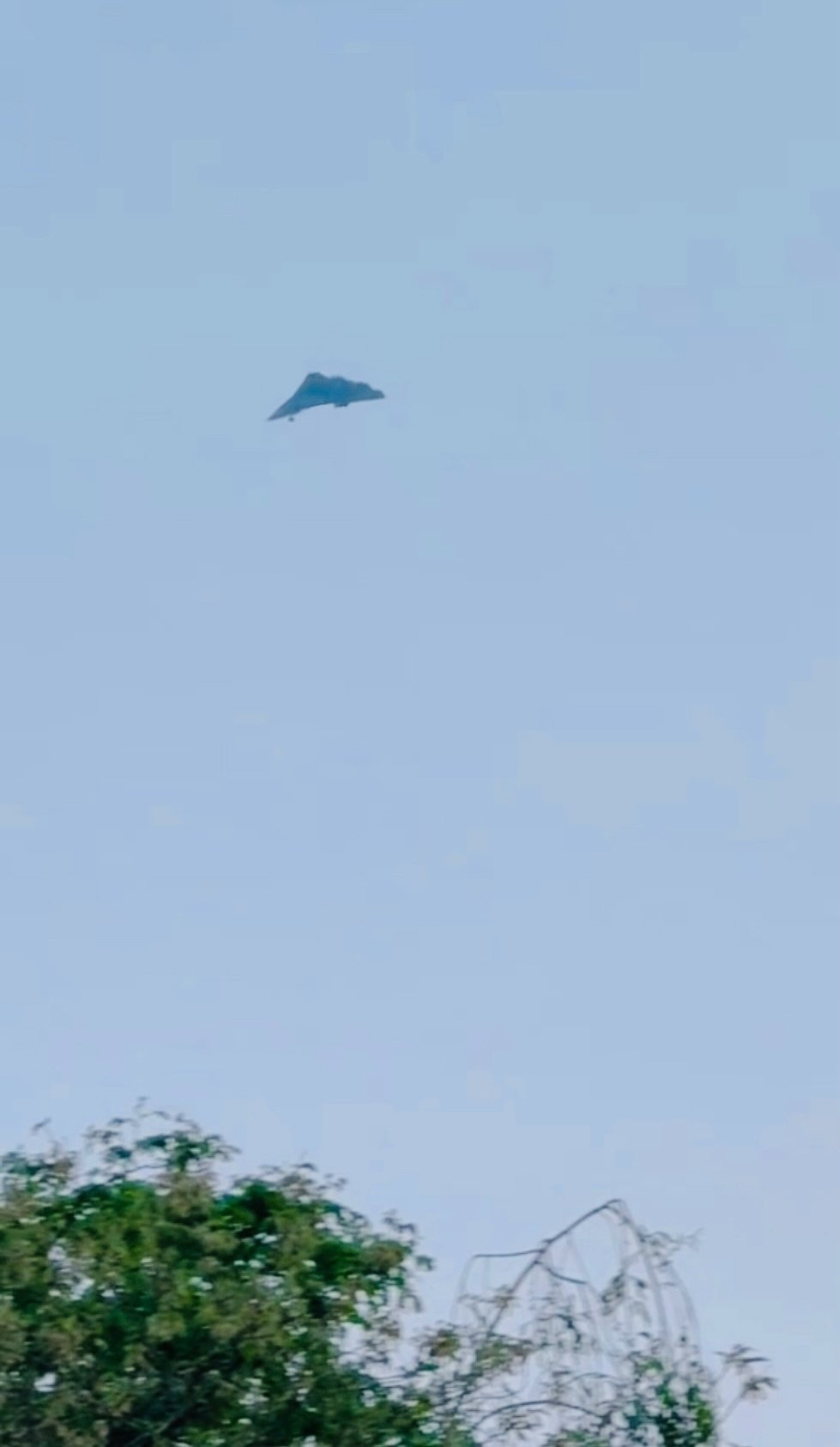
또 다른 신형 중국 항공기 이미지 (출처 X)
앞선 이미지의 클로즈업 버전 (출처 X) 전방과 후방에서 본 모습으로 미루어, 두 개의 엔진 흡입구와 동체 뒷부분의 두 개 ‘혹’이 대략 쌍발 엔진 설계임을 시사한다. 이는 일정 부분 소모가 예상되는 충실한 동반자 드론(로열 윙맨) 설계로는 다소 이례적이지만, 실제 규모나 다른 여러 세부는 아직 명확히 확인할 수 없다.
중국 CCA 설계로 추정되는 기체의 후방 모습 (출처 X)
(이후 내용도 계속해서 이어서 번역해드릴 수 있습니다. 다음 부분을 올려주시면 바로 번역해드리겠습니다.)
유인 전투기 설계 증거
만약 이 새로운 설계에 조종석이 있다면, 이는 이 기체가 셴양 J-XDS/J-50 전투기의 경쟁기종일 수 있다는 가능성을 높인다. 아마도 J-36의 훨씬 더 큰 기체를 만든 청두 항공사가 제작한 기체일 수도 있다.
J-36과 J-XDS가 서로 완전히 다른 등급의 항공기라는 점은 앞서 상세히 설명한 바와 같이 분명하다. 기본 설계나 임무 목표 면에서 이 둘이 직접 경쟁하는 것은 아닐 것으로 보인다. 그런 점에서 청두의 6세대 스텔스 전투기가 셴양의 기체와 경쟁하는 구도는 자연스럽다. 또한 이러한 맥락에서, 이번 신형 기체가 J-36과 여러 면에서 유사한 점 역시 설명이 가능하다. 앞서 언급했듯이, 전체적인 설계는 여러 부분에서 유사하며, 특히 동체 전방과 노즈 섹션, 그리고 엔진 흡입구의 배치 등이 J-36과 닮아 있다. 전체적인 플랜폼(평면 형상)도 비슷하다. J-36보다 작고, 쌍발 엔진을 탑재한 전통적인 전투기 크기의 파생형이 등장하는 것도 전혀 놀라운 일이 아닐 것이다.
J-XDS/J-50과 이 신형 설계 중에서 선택이 이루어진다면, 보다 전통적인 전투기 역할에 적합한 신형 전투기가 탄생할 수도 있다. 이 설계가 항공모함 운용에 최적화된 형태일 가능성도 있다. 또 하나의 중형 6세대 전투기일 가능성도 있지만, 그럴 확률은 상대적으로 낮아 보인다. 현 단계에서 공개된 이미지로는 정확한 기체 크기를 판단하기가 거의 불가능하다.
드론일 가능성에 대한 증거 한편, 중국 항공우주 분야의 오랜 관찰자들 사이에서는 이 신형 항공기가 미 공군의 협업 전투기(CCA) ‘로열 윙맨’ 프로그램에 대응하는 여러 중국 버전 중 하나일 것이라는 추측이 있다. 동시에, TWZ는 좀 더 크고 발전된 무인 전투 항공기(UCAV)일 가능성도 높다고 보고 있다. 이 기체가 CCA 팀 운용 역량을 갖추면서도 독립 작전에도 더 적합할 수 있다는 의미다.
이 웹사이트의 기여자이자 중국 항공 전문가인 안드레아스 루프레히트는, 최근 공개된 영상이 중국의 CCA 설계 중 하나라고 본다고 밝혔다. 다만, 그는 이 기체가 지난달 Y-9 터보프롭 수송기 두 대와 함께 비행하는 장면에서 포착됐던 테일리스(꼬리날개 없음) 설계와는 상당히 다르다고 지적했다. 아래에 첨부된 트윗에서 볼 수 있듯, 그 설계는 변형된 다이아몬드형 델타 플랜폼에 훨씬 단순한 트레일링 엣지가 특징이다.
루프레히트는 이 신형 기체가 유인 전투기, 타격기, 혹은 항모용 가변익 설계라는 일부 소문에 대해 사실이 아니라고 본다. 그는 또 중국 항공 블로그계에서는 신형 6세대 전투기의 ‘로열 윙맨’ 역할을 할 복수의 CCA가 개발 중이라는 루머가 꾸준하다고 전했다. 중국 내에서 이런 드론은 비공식적으로 ‘찻잔’, 유인기는 ‘찻주전자’라 부른다.
이번 신형 기체 공개는, 9월 3일로 예정된 중국의 항일전쟁 승리 80주년 기념 퍼레이드에서 여러 CCA 설계가 대중에 처음 공개될 것이라는 위성사진 공개와 맞물려 있다.
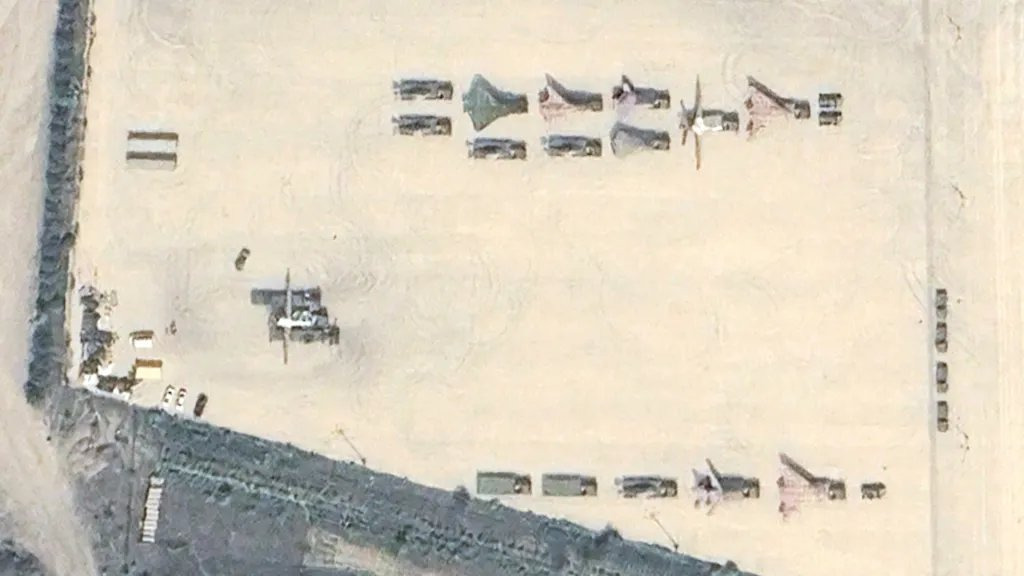
2025년 6월 11일 촬영된 구글어스 위성사진에는, 베이징 북서부 교외 양팡의 한 군사기지에 드론들이 대기하고 있는 장면이 포착됐다. 중국 인민해방군(PLA)은 대규모 퍼레이드 준비를 위해 이 기지를 자주 활용한다.
위성사진에 나타난 양팡 기지의 드론들. Google Earth 위성사진만으로는 해당 기체들이 모형인지, 실물 드론인지 확인할 수 없지만, 총 다섯 종류의 신형 CCA 타입 설계가 포착된 것으로 보인다. (자세한 내용은 이전 보도 참고)
또 같은 사진에는, 대형 탄도미사일 운반·발사 차량을 비롯한 수백 대의 차량, 그리고 기존에 확인된 GJ-11 샤프소드(비행익 스텔스 UCAV) 등 여러 드론 설계도 함께 잡혀 있다.
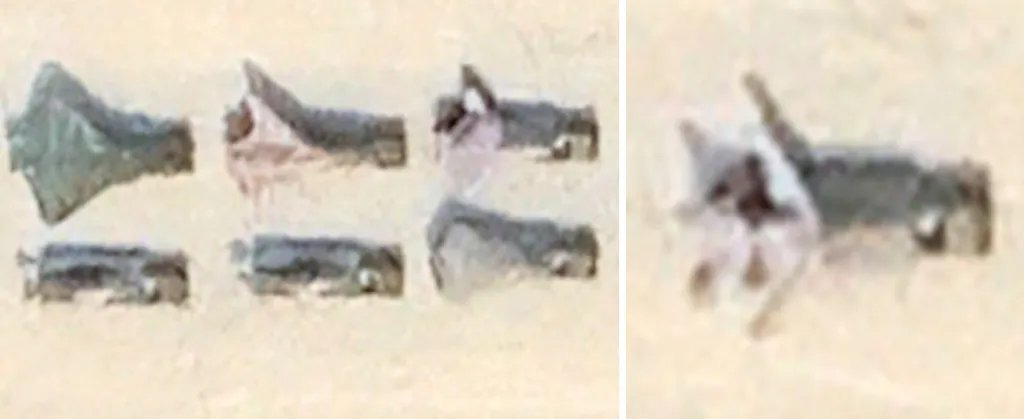
신형 CCA 타입 드론 중 네 기체는 변형 다이아몬드형 델타 및 크랭크드-카이트 윙이 적용된 테일리스 설계로 보이고, 한 기체는 전통적 날개와 꼬리 구조를 갖췄다. 이들 설계의 길이는 약 3038피트(912미터), 날개폭은 2035피트(611미터) 수준이다.
좌측: 2025년 6월 11일 촬영된 네 대의 테일리스 설계 드론 근접 사진. 우측: 전통적 꼬리 구조 설계 드론 근접 사진. Google Earth 이 드론들은 방수포 등으로 부분적으로 가려져 있고, 사진 해상도도 낮아 현재 시험비행 중인 신형 드론과 일치하는지 단정하긴 어렵다. 더 최근 사진(아래)에서도 직접적으로 일치하는 설계는 보이지 않는다. 그러나 이처럼 많은 CCA 설계가 개발 중인 만큼, 모든 기체가 퍼레이드에 포함되지 않는다고 해도 이상할 것은 없다.
어쨌든, 9월 3일 퍼레이드에 CCA 타입 설계가 등장할 것은 확실해 보이며, 당국도 이미 ‘신형 전투 역량’ 전시를 예고한 바 있다.
또 하나 주목할 점은, 올해 초 선양 공장에서 변형 다이아몬드형 델타 플랜폼을 가진 차세대 전투기형 기체(혹은 모형)가 포착됐다는 것이다(TWZ 단독 보도). 이 기체는 유인기인지 무인기인지는 불분명하지만, 길이 약 50피트(15미터)로 양팡 위성사진에 잡힌 CCA 드론들보다 훨씬 크다. 동시에, 그 설계 역시 최근 시험비행이 포착된 두 대의 신형 테일리스 미스터리 기체와도 일치하지 않는다.
2025년 1월 1일 선양 공장에서 포착된 차세대 전투기형 기체(모형). PHOTO © 2025 PLANET LABS INC. ALL RIGHTS RESERVED. REPRINTED BY PERMISSION 이처럼 중국은 ‘로열 윙맨’ 타입 드론과, 유·무인 협동 운용 능력을 동시에 적극 개발하고 있음이 분명하다.
초기부터 연계된 중국 드론 중 대표적인 것이 바로 앞서 언급한 GJ-11 UCAV이다. GJ-11은 중국 무인 전투기 계획의 핵심축으로 널리 알려져 있다. 하지만 GJ-11은 UCAV이자 동시에 CCA이기도 하며, 유인기 팀업 외에 독립작전 등 다양한 임무에 쓰일 것으로 보인다. 이 외에도 중국은 유인기와 연계 운용을 목적으로 한 하위 계열의 무인 설계들을 꾸준히 공개해왔다. 대표적으로 중국항공과기집단(CASC)의 FH-97, FH-97A 등이 있는데, 이들은 각각 크라토스 XQ-58A 발키리, 보잉 MQ-28 고스트뱃의 영향을 강하게 받은 것으로 보인다.
동시에, 유인기가 협업 드론을 직접 운용하는 방식을 도입하는 움직임도 다수 포착되고 있다. 쌍좌형 J-20S 스텔스 전투기는 공식 이미지에서 공중 드론 통제기 역할로 자주 묘사되어 왔으며, 이는 J-20S 공개 당시 TWZ가 이상적으로 본 운용 개념이기도 하다.
KJ-500 공중조기경보통제기 또한 중국이 구상하는 유·무인 전투 생태계의 핵심 노드가 될 전망이다. 베이징은 H-6 미사일 탑재기를 저가 전술드론 발사 플랫폼으로 활용하는 방안도 연구 중이다.
현재 중국 군용 항공의 변화상은 그 자체로 흥미롭다. 다양한 신형 드론 설계의 등장은 경쟁국 입장에서도 심각한 우려의 대상이 될 수 있다. 이 드론들은 미 공군의 CCA 계획과도 여러모로 흥미로운 평행성을 보인다.
미 공군의 경우, 제너럴 아토믹스 YFQ-42A와 안두릴 YFQ-44A 두 가지가 개발 중이며, 내년에 첫 비행이 예정돼 있다. 앞으로 미 공군을 비롯한 미군 각군은 반복적 개발 사이클을 통해 다양한 CCA 기종을 도입할 예정이다. 중국의 최신 개발 상황을 감안하면, PLA 역시 유사한 로드맵을 가동 중일 수 있으며, 9월 3일 퍼레이드에서 더 많은 정보가 공개될 가능성도 있다.
(Anduril/General Atomics) 결국 중국 역시 인공지능과 기계학습 발전을 바탕으로, 유인기와 점점 더 독립적으로 작전 가능한 고성능 드론을 양산하려는 것으로 보인다. 여기에는 네트워크화된 소규모 드론 스웜도 포함되는데, 베이징은 이 역시 적극 추진 중이다.
이 모든 점을 감안할 때, 이번 신형 기체는 GJ-11보다 더 장거리·대형 페이로드 임무에 특화된 고성능 버전일 수도 있고, 소형 CCA보다 훨씬 더 자립적 작전이 가능한 기종일 수도 있다. H-6, J-36, 향후 H-20 폭격기 등 장거리 항공기와의 팀업에 최적화될 수 있다. 다만, 실제 크기에 대한 추가 정보가 나올 때까지는 확언이 어렵다.
분명한 것은, 이번 신형 기체의 등장 역시 중국 군용 항공 분야가 얼마나 빠른 속도로 발전하고 있는지, 또 얼마나 자주 세계를 놀라게 하는지를 다시 한번 보여준다는 사실이다.
문의: thomas@thewarzone.com
New Chinese Stealth Tactical Jet Breaks Cover

New Chinese Stealth Tactical Jet Breaks Cover
We breakdown the possibilities of what this new stealth aircraft could be and its potential mission.
Aug 4, 2025 4:16 PM EDT
Chinese internet
The TWZ Newsletter
Weekly insights and analysis on the latest developments in military technology, strategy, and foreign policy.
Email addressSign Up
Terms of Service and Privacy Policy
Recently emerged imagery largely confirms that China is now test-flying another tailless stealthy combat jet, although it isn’t clear if this is a crewed design or one of its new advanced drones.
A high-performance, highly autonomous uncrewed combat air vehicle (UCAV) with collaborative ‘loyal wingman’ capabilities is a major possibility. Still, based on the design, this could very well be yet another 6th-generation crewed jet — one that is similar to, or even would compete more directly with Shenyang’s J-XDS (also nicknamed the J-50 by some) fighter rather than Chengdu’s massive J-36 super-heavy tactical jet.
This latest development once again underscores the frantic pace of Beijing’s military aerospace developments, which include activities across a wide range of drone programs as well as advanced crewed types.
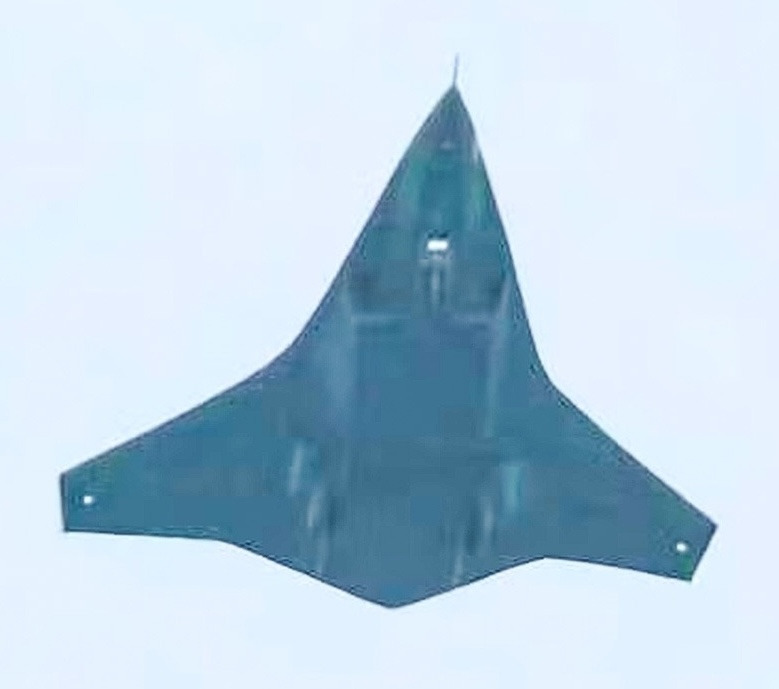
The best image so far of the new Chinese design, provided it’s legitimate. via X
At least five images of the new design have been noted so far. In each case, it’s not clear where or when the imagery was taken. The quality and angles are historically typical of the first ‘leaks’ showing new advanced Chinese military aircraft, a practice dating back many years.
None of the images provide enough detail of the upper part of the forward fuselage to reveal whether or not a cockpit is present. There are clear attributes to this design that point to the possibility that it is a more substantial aircraft, crewed or otherwise.
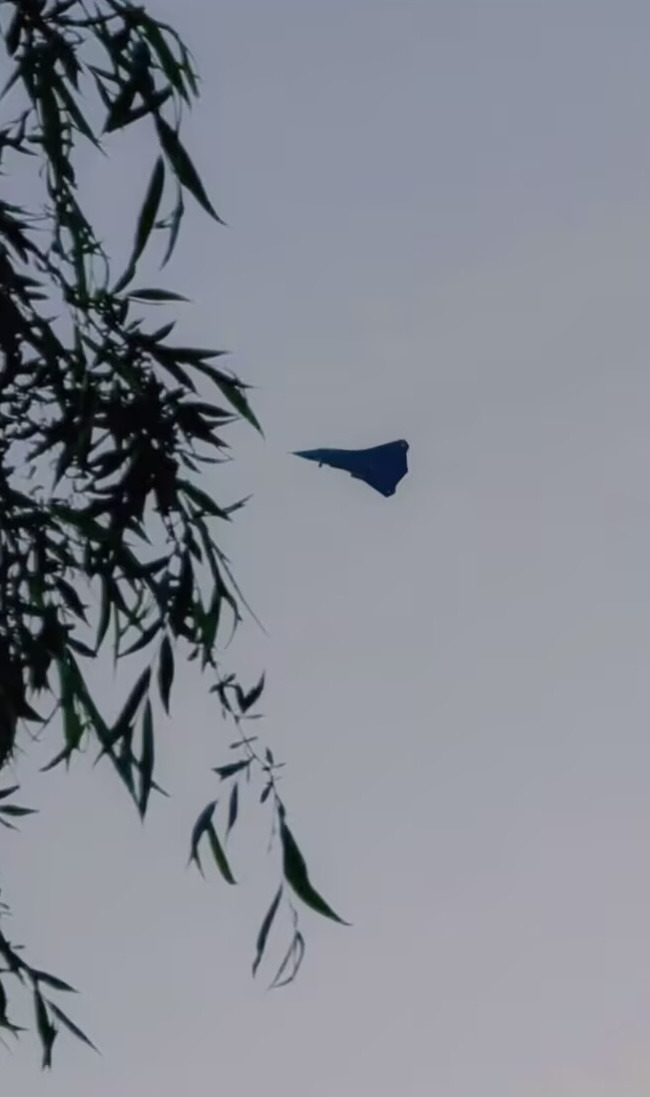
One of the first images of the new Chinese design. via XAttributes
The aircraft seen in the recently emerged images has a notably pointed forward fuselage and nose section that blends into the mid-set wing midway down the fuselage. The highly swept wing has cropped tips, and the trailing edge features a prominent triangular extension, with a ‘w’-like configuration. There are no vertical stabilizers or other separate tail surfaces. The broad fuselage would appear to offer a fairly significant capacity for internal fuel and stores, although details of a weapons bay are not apparent in the available underside view.
In all views thus far, the aircraft is seen with its tricycle-type landing gear extended, and it may feature twin-wheel nose gear, which would be indicative of a heavier design, or perhaps one intended for carrier operations. There is an air-data probe on the nose, a feature consistent with early flight testing. Overall, the design appears to be heavily optimized for low observability, in line with the two crewed combat jets that China debuted at the end of last year, and which you can read about in detail here. In various respects, it shares some striking similarities with the so-called J-36.
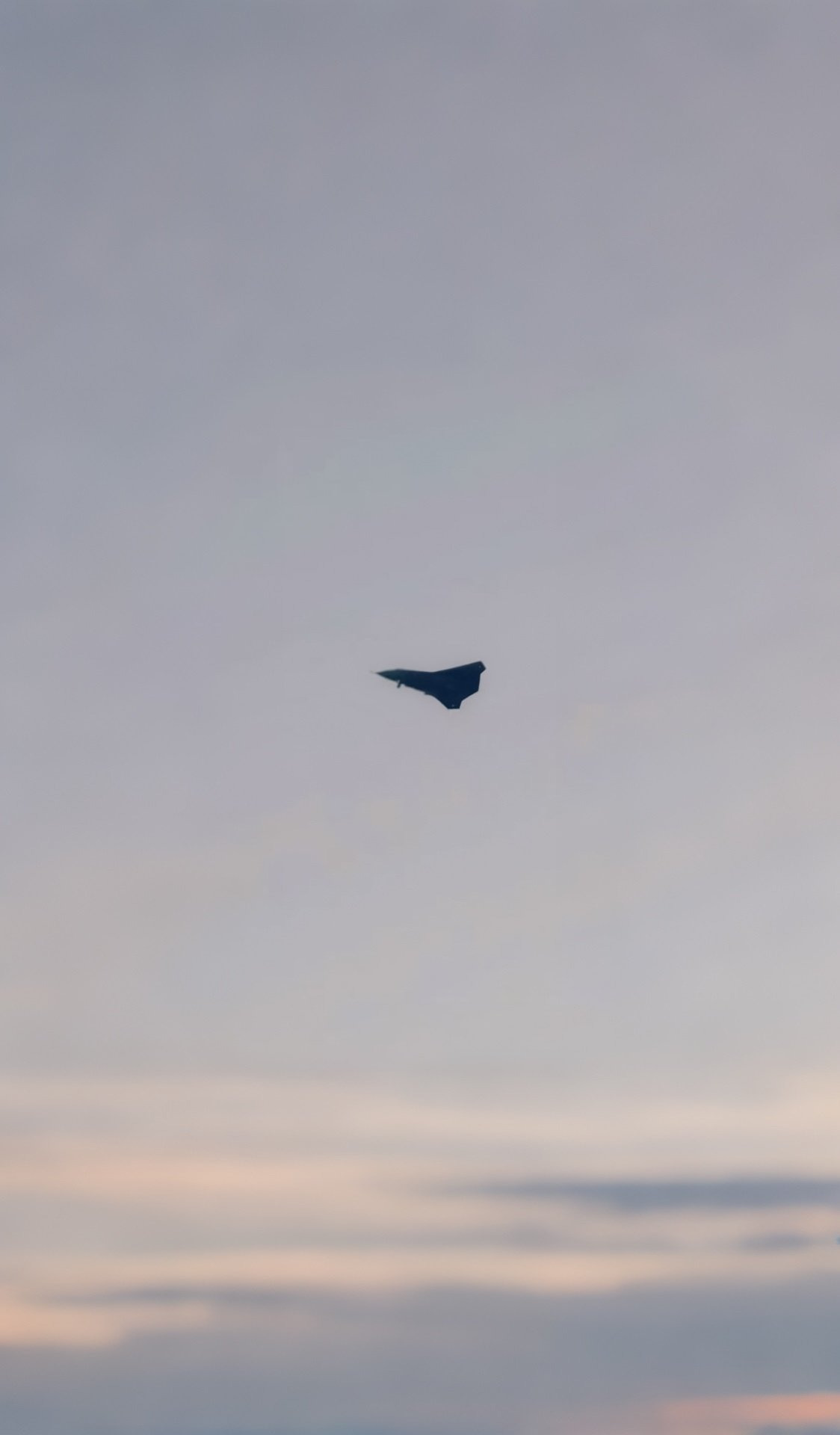
Another image of the new Chinese design. via X
A close-up version of the previous image. via X
Based on the frontal and rear views of the aircraft, two engine intakes and two ‘humps’ over the rear fuselage loosely point to a twin-engine configuration — which would be quite odd for a somewhat attritable loyal wingman drone — although many other details, as well as its overall scale, cannot be verified at this stage.
A rear view of the apparent Chinese CCA design. via XEvidence for a crewed fighter
If the new design features a cockpit, this would raise the possibility that the design may be a competitor to the Shenyang J-XDS/J-50 fighter, perhaps a product of the rival Chengdu Aircraft Corporation, which is also responsible for the much larger J-36.
It is clear that the J-36 and J-XDS are two entirely separate classes of aircraft, as we have described in great detail before, and that they are unlikely to be direct competitors in terms of basic design and mission goals. A Chengdu competitor to Shenyang’s 6th-generation stealth fighter would make a lot of sense in that regard. It would also explain the similarities in the design between this new aircraft and the J-36. As we noted earlier, the general design looks similar in many ways, and especially the forward fuselage and nose section, as well as the general inlet configuration, to the J-36. The overall planform is also similar. A smaller twin-engine traditionally fighter-sized cousin to the J-36 wouldn’t be a grand surprise.
A selection could be made between the J-XDS/J-50 and this new design to yield a new jet for more traditional fighter-type roles. It’s also possible that this is a carrier-optimized design. A medium 6th-generation fighter is another possibility, although this seems less likely. The scale is nearly impossible to judge with the available images.
Evidence for a drone
Meanwhile, there is speculation among some long-term Chinese aerospace observers that the new aircraft is one of multiple Chinese counterparts to the USAF’s Collaborative Combat Aircraft (CCA) ‘loyal wingman’ program. At the same time, it is TWZ‘s opinion that a more substantial and advanced unmanned combat air vehicle is perhaps a strong possibility, one that could still incorporate CCA teaming capabilities, but would also be better suited for independent operations.
Andreas Rupprecht, a Chinese aviation expert and contributor to this website, told TWZ that he thinks the new imagery shows one of the country’s CCA designs, although he notes that it’s significantly different from the tailless design that was spotted flying together with a pair of Y-9 turboprop transports, in imagery that emerged last month. This other design, seen in the tweets embedded below, features a modified diamond-like delta planform combined with a much simpler trailing edge.
Rupprecht views rumors that the new aircraft is a possible crewed fighter or strike aircraft, possibly even a carrier-based swing-wing design, as nothing more than that. He also notes that among the Chinese aerospace blogosphere, there are persistent rumors of multiple CCAs in development to serve as ‘loyal wingmen’ for the new 6th-generation combat jets. Within China, these drones are informally termed ‘teacups,’ in contrast to the crewed ‘teapots.’
The emergence of the new imagery comes soon after satellite imagery showing several likely CCA designs that should be publicly unveiled at an upcoming parade to be held on Sept. 3, marking the 80th anniversary of China’s victory over Japan in World War II.
A Google Earth satellite image taken on June 11, 2025, shows the drones at a military base in Yangfang, a suburb northwest of the Chinese capital of Beijing. China’s People’s Liberation Army (PLA) regularly uses the facility to stage assets and train for large-scale parades.
The drones seen at Yangfang in the June 11, 2025, image. Google Earth
Although it’s unclear from the satellite image whether the aircraft shown are mockups or real drones, there appears to be five new CCA-type designs, as you can read more about in our previous coverage.
In addition, the same image reveals hundreds of vehicles, including what appear to be transporter erector launchers for large ballistic missiles, as well as previously identified drone designs, such as the GJ-11 Sharp Sword stealthy flying-wing uncrewed combat air vehicle (UCAV).
Of those new CCA-type drones in the satellite image, four of them appear to be tailless with modified diamond-like delta and cranked-kite wings, while one looks to have a more traditional wing and tail arrangement. The designs range in length from approximately 30 to 38 feet (nine to 12 meters), and in wingspan from 20 to 35 feet (six to 11 meters).
At left, a close-up showing four possibly tailless designs with modified diamond-like delta and cranked-kite wings in the June 11, 2025, image. At right, a close-up of the design that looks to have a more traditional wing and tail configuration. Google Earth
The fact that the drones in the satellite image are partly concealed by tarpaulins, as well as the relatively low resolution, means it’s not immediately clear if one of them matches the new imagery of the drone being test-flown. A newer image (seen below) offers greater detail, but still there doesn’t appear to be a direct match. However, with so many apparent CCA designs being developed, it wouldn’t be abnormal to not include all of them in the parade.
Regardless, it is now inevitable that CCA-type designs will be part of the Sept. 3 parade, which officials have already said will feature unspecified “new-type combat capabilities.”
It should also be noted that another next-generation fighter-like airframe or mockup with a modified diamond-like delta platform emerged at Shenyang’s main plant earlier this year, as TWZ was first to report. While it’s unclear if this is a crewed or uncrewed design, it certainly appears to be larger (roughly 50 feet/15 meters) than any of the possible CCA drones seen in the satellite image of Yangfang. At the same time, its configuration also doesn’t correspond with either of the two apparent new tailless mystery aircraft that have been seen flying.
The next-generation fighter-like airframe or mockup that was seen at Shenyang’s main plant on Jan. 1, 2025. PHOTO © 2025 PLANET LABS INC. ALL RIGHTS RESERVED. REPRINTED BY PERMISSION
Very clearly, China is busily developing a range of ‘loyal wingman’ type drones, as well as the crewed-uncrewed teaming capabilities that will be required to operate them effectively.
Among the first Chinese drones to be associated with these efforts was the aforementioned GJ-11 UCAV. This is widely understood to be a centerpiece of China’s uncrewed combat aircraft plans. However, the GJ-11 is as much a UCAV as a CCA and will likely have other roles, including independent operations, beyond any teaming duties with crewed aircraft. Beijing has also revealed various other lower-tier uncrewed designs that have been designed specifically to operate in conjunction with crewed aircraft. Examples include the China Aerospace Science and Technology Corporation’s (CASC) FH-97 and FH-97A, which appear to be heavily influenced by the Kratos XQ-58A Valkyrie and Boeing Australia MQ-28 Ghost Bat, respectively.
At the same time, there are many signs of Chinese programs to adapt crewed aircraft to operate closely with collaborative drones. The two-seat J-20S stealth fighter has been regularly depicted in official graphics as an airborne drone controller, a role that TWZ noted would be ideal for it when it first appeared.
The KJ-500 airborne early warning and control aircraft is also widely considered to be envisaged as a key node within China’s future crewed-uncrewed air combat ecosystem. Beijing has also explored using H-6 missile carrier aircraft as launch platforms for lower-end tactical drones, as you can read about here.
Right now, the developments in Chinese military aerospace are fascinating to watch, and the proliferation of new drone designs is likely a particular cause for concern among potential adversaries. These drones also make a highly intriguing parallel to the U.S. Air Force’s CCAs.
The first two of these, the General Atomics YFQ-42A and Anduril YFQ-44A, are in development, with first flights planned for next year. In the future, the U.S. Air Force and other branches of the U.S. military plan to field multiple CCA types acquired through iterative development cycles. The latest developments from China suggest that the PLA might well be planning something similar, and the Sept. 3 parade may well yield still more details in this regard.
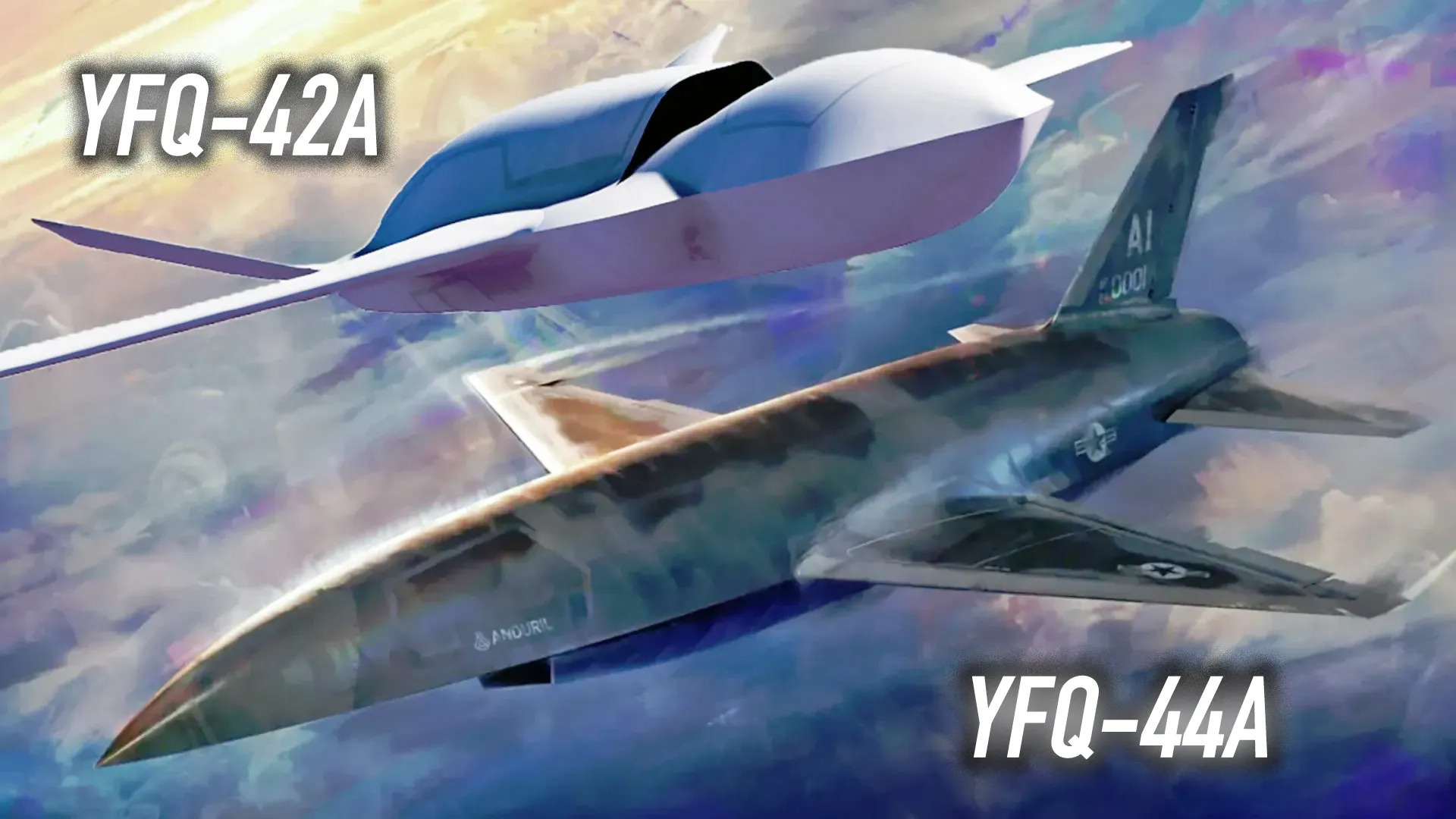
(Anduril/General Atomics)
Ultimately, it seems China is also set on harnessing the potential of advanced autonomous aviation capabilities, aided by developments in artificial intelligence and machine learning, to field drones that will be able to operate increasingly independently from crewed platforms. This could also include networked swarms, something that Beijing is actively working on for smaller-scale drones.
With all this in mind, this aircraft could be a higher-performance counterpart to the GJ-11, capable of flying longer distances with greater payloads than smaller CCAs, as well as being more readily capable of independent operations. This would be a useful companion for longer-range aircraft, like the H-6, J-36, and future H-20 bomber. Until we get a better idea of the scale when it comes to this new aircraft, we just won’t know for sure.
What we do know is that the aircraft seen in the new images once again underlines the rapid pace of development in the Chinese military aerospace sector and its capacity to spring surprises on an increasingly regular basis.
Contact the author: thomas@thewarzone.com

Thomas NewdickStaff Writer
Thomas is a defense writer and editor with over 20 years of experience covering military aerospace topics and conflicts. He’s written a number of books, edited many more, and has contributed to many of the world’s leading aviation publications. Before joining The War Zone in 2020, he was the editor of AirForces Monthly.

Tyler RogowayEditor-in-Chief
Tyler’s passion is the study of military technology, strategy, and foreign policy and he has fostered a dominant voice on those topics in the defense media space. He was the creator of the hugely popular defense site Foxtrot Alpha before developing The War Zone.
댓글
댓글 리스트-
작성자백선호 작성시간 25.08.05 이것도 수직 미익이 없어 보이네요.
-
답댓글 작성자위종민 작성자 본인 여부 작성자 작성시간 25.08.06 F-47이 카나드가 있을지, 무미익일지가 궁금해지네요.
-
작성자강준구 작성시간 25.08.05 중국이 본격적으로 돈을 모아서 최신 무기 개발에 투자한 것이 길게 봐야 2005년부터 20년, 짧게 보면 2010년부터 15년 정도인데, 그동안 비행제어 데이터를 충분히 쌓았을지 모르겠습니다.
미국 만큼 데이터는 없지만, 일단 만들어보자.. 인건지.. -
답댓글 작성자위종민 작성자 본인 여부 작성자 작성시간 25.08.06 슈퍼컴퓨터를 미국보다 더 많이 가졌고, 실기 사이즈 풍동도 충분하니 열심히 데이터를 뽑긴 뽑았을 것 같습니다. 시뮬레이션으로 안되는 것들만 일단 만들어서 날려보고...
-
답댓글 작성자Minowski(김유철) 작성시간 25.08.06 AI를 통해 미국에서 실패했던 X47의 인테이크 설계같은 것도 가능하다라고 주장하고 있으니 조만간 그 결과물을 공개할지도 모르지요.