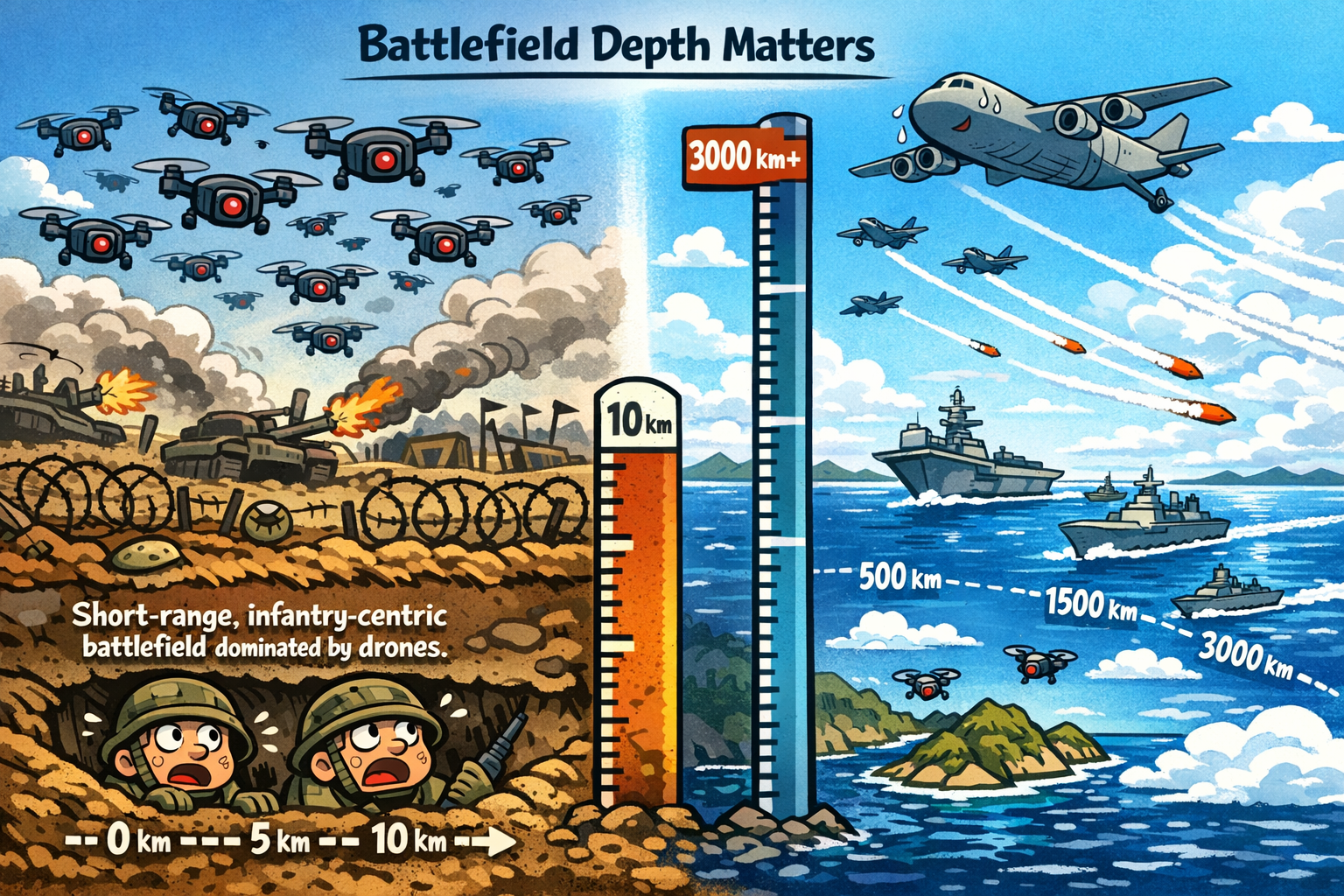
한 달에 세 기사인가 볼 수 있는 포린어페어스 무료구독이 살아있어서 관련 기사를 전문 번역하고, 우크라이나와 태평양전구의 차이점이 드러나게 챗GPT로 캐리커쳐도 그려봤습니다 ㅎㅎ
미국의 드론 환상우크라이나의 교훈이 중국과의 충돌에는 적용되지 않는 이유저스틴 브롱크2025년 12월 15일
2025년 1월, 독일 호엔펠스에서 비행 훈련을 위해 드론을 준비하는 미군 병사2025년 1월, 독일 호엔펠스에서 비행 훈련을 위해 드론을 준비하는 미군 병사챈들러 코츠 병장 / 로이터
저스틴 브롱크는 영국 왕립합동군사연구소(RUSI)의 공군력 및 기술 분야 선임 연구위원이다.
저스틴 브롱크의 다른 글듣기공유 및다운로드인쇄저장
거의 4년에 가까운 전투 끝에, 러시아의 우크라이나 전쟁에서 서방 군대들 사이에서 드론 전쟁의 급속한 확산만큼 큰 주목을 받은 요소는 거의 없다. 2023년 이후, 양측은 전장 전반에 걸쳐 값싼 쿼드콥터형 드론 수백만 대를 배치해 왔다. 전선의 일부 지역에서는 이러한 소형 드론이 현재 전장 사상자의 최대 70퍼센트를 차지한다. 한편 러시아는 거의 매일 밤 우크라이나 도시들을 상대로 수천 대의 프로펠러 추진 일회용 공격 드론인 게란-2와 게란-3을 이용한 장거리 타격을 수행하고 있으며, 우크라이나 역시 러시아의 기지, 공장, 에너지 인프라를 정기적으로 타격하기 위해 자국의 다양한 일회용 공격 드론을 사용해 왔다.
이러한 전개를 지켜보면서, 많은 서방 국방 전략가들은 군사적 우선순위를 전환해야 한다는 긴급한 요구를 제기해 왔다. 6월에 도널드 트럼프 미국 대통령은 드론 생산을 가속화하기 위한 행정명령에 서명했다. 그 이후 미 국방부는 저비용 드론을 미국 무기고에 신속히 통합하기 위한 여러 정책 변경을 단행했으며, 피트 헤그세스 국방장관은 미국이 “드론 지배력”을 확립해야 한다고 촉구했다. 한편 민간 부문에서는 안두릴, 팔란티어, 실드 AI와 같이 무인 군사 기술 개발에 대규모 투자를 해온 소프트웨어 및 AI 기업들이 수익성 높은 새로운 국방 계약을 따내기 위해 경쟁하고 있다. 소형 무인 항공 시스템이 보병 전투 방식 자체를 근본적으로 바꿔 놓았다는 점, 그리고 미 육군과 다른 군종들이 이러한 역량과—더 우려스러운 점으로—대(對)무인기 기술에서 러시아나 중국에 비해 뒤처져 있다는 점은 분명 사실이다.
그러나 AI 기반 드론을 대규모로 획득하면 중국에 대한 미국의 방어력이 강화될 것이라는 가정은 잘못된 것이다. 무엇보다도, 우크라이나 전쟁—근본적으로 육상 중심의 두 군대가 벌이는 소모적이고 결론 나지 않은 투쟁—에서 얻은 교훈은 다른 유형의 분쟁에 직접 적용되지 않는 경우가 많다. 베이징의 군사 자산의 현실과 인도·태평양에서 벌어질 잠재적 충돌의 성격을 고려하면, 그러한 분쟁은 전혀 다른 요인들에 의해 좌우될 것이다. 세계에서 가장 크고 가장 발전된 드론 산업을 보유하고 있음에도 불구하고, 중국은 실제로 유인 군사 장비를 우선시해 왔다. 매년 인민해방군은 최신형이면서 매우 높은 성능을 갖춘 전투기, 대형 군함, 최첨단 지상·해상·공중 발사 미사일 체계를 엄청난 수량으로 인도받고 있다. 만약 미국이 드론 개발과 획득에 지나치게 집중한다면, 인도·태평양 분쟁을 지배하게 될 고급 공군 및 해군 역량에서 인민해방군에 대해 남아 있는 미약한 우위를 잃을 위험이 있다.
돈바스에서 드론이 지배적인 이유
지난 몇 년 동안 군사 분석가들과 방산 업계 경영진들은 서방 군대가 우크라이나의 러시아에 대한 놀라운 방어에서 무엇을 배워야 하는지에 집중해 왔다. 이러한 관심의 결과 중 하나는, 우크라이나에서의 전투 활용이 모호하게 설명된 사례를 근거로 “변혁적”이라고 홍보되는 새로운 방산 제품과 기술이 서방 군대에 과도하게 쏟아지고 있다는 점이다. 실제로 이러한 시스템 중 상당수, 특히 기술 스타트업들이 만든 서방산 드론들은 러시아와 우크라이나 양측의 상존하는 전자전과 혹독한 환경 조건에 직면해 전장에서 효과가 없거나 아예 실패한 것으로 드러났다.
Foreign Affairs This Week 구독편집진이 선정한 주요 기사들을 매주 금요일 무료로 이메일로 받아보세요.
이메일 주소 입력가입하기
이메일 주소를 제공하면 뉴스레터 구독에 Foreign Affairs 개인정보 보호정책 및 이용약관이 적용됩니다.
그러나 더 큰 문제는 우크라이나 전쟁이 인도·태평양 맥락에서 미국과 중국 군대에는 적용되지 않을 여러 특성을 지니고 있다는 점이다. 러시아의 지속적인 우크라이나 지상 침공으로 인해, 북쪽의 하르키우주에서 남쪽의 헤르손까지 600마일이 넘는 길이에 걸쳐 병력이 희박한 전선이 형성되었다. 어느 쪽도 제공권을 확보하지 못했기 때문에, 항공력은 다른 현대 분쟁들에 비해 훨씬 덜 중요해졌다. 러시아와 우크라이나의 기갑 부대와 기타 정예 부대들이 전쟁 초기 단계에서 치명적인 손실을 입은 이후, 어느 쪽도 2023년 중반 이후 대규모 제병협동 기동전을 수행하지 못했다. 그 결과 양군은 지뢰밭을 통과해 고정된 방어선을 시험적으로 공격하기 위해, 전차·포병·드론 지원이 결합된 소규모 보병 부대에 크게 의존할 수밖에 없었다. 진격은 양방향 모두에서 극도로 느리고 비용이 많이 들고 있다.
이러한 조건하에서, 단거리·경량·저가이며 대량 생산되는 쿼드콥터형 드론은 매우 효과적인 것으로 입증되었다. 특히 재래식 포병과 장거리 로켓 포병의 탄약과 발사기가 점점 부족해지면서, 양측은 값싼 드론을 활용해 전선으로부터 6~12마일 이내에서 적의 보급과 전술적 이동을 소모시키고 억제해 왔다. 2024년에 이르러 전선 전투는 실제로 점점 더 많은 드론과 광섬유 드론, AI 보조 종말 유도 영상과 같은 새로운 기술의 지속적인 개발에 의해 지배되기 시작했다. 그물, 전자 교란, 특수 산탄 및 기관포 탄약과 같은 대드론 방어 수단 역시 중요해졌고 빠르게 진화하고 있다. 그러나 많은 능동적 대드론 방어 체계는 전선에 병력이 광범위하게 분산되어 있고 지속적인 소모가 발생하기 때문에 우크라이나에서는 과부하 상태에 놓여 있다.
그럼에도 불구하고, 드론 전쟁의 확산이 2024년과 2025년에 우크라이나군이 러시아군에 맞서 주요 거점을 지키는 데 실패한 주된 이유라고 보기는 어렵다. 대신 결정적인 요인은 러시아가 매주 수백 발씩 Su-34 전투폭격기를 통해 전선에 투하하고 있는 중량 활공폭탄이다. 500kg에서 3000kg에 이르는 이 활공폭탄들은 깊고 견고한 전투 진지조차 파괴할 수 있으며, 참호에 파묻힌 병력을 소형 드론보다 훨씬 효과적으로 살상할 수 있다. 우크라이나는 여전히 전선 후방 40마일 이상 떨어진 곳에서 폭탄을 투하하는 발사 항공기를 요격할 효과적인 수단을 갖추지 못하고 있다. 드론은 전선과 그 주변에서 이동 중인 보병과 차량을 상대로 일상적인 소모의 대부분을 야기하지만, 집중된 활공폭탄 공격은 참호에 배치된 병력에게 훨씬 더 큰 위협을 가한다. 특히 도네츠크주의 언덕 위 도시 차시우 야르와 같은, 중무장된 전략적 요충지를 사수하려는 우크라이나군에게 러시아의 끊임없는 활공폭탄 타격은 매우 큰 어려움으로 작용해 왔다.
태평양의 차이
우크라이나의 작전 환경과는 뚜렷이 대조적으로, 미군과 중국 인민해방군 간의 잠재적 분쟁은 주로 공중과 해상에서 전개될 것이며, 지상군 간의 전투는 대만이나 센카쿠 열도(중국에서는 댜오위다오로 알려짐)와 같은 핵심 도서에 국한될 가능성이 크다. 이러한 맥락에서 미국의 성공은 결정적인 순간에 핵심 지점들에 압도적인 공중 및 해상 화력을 신속하고 반복적으로 투사할 수 있는 능력에 달려 있을 것이다. 이는 수천 마일에 걸친 해양을 가로질러, 수많은 고도로 발전된 중국의 미사일·항공·해상 위협을 상대로 전력을 투사해야 함을 의미한다. 이러한 작전은 고도로 숙련된 인력이 첨단 전투기, 폭격기, 군함을 운용하며 정교하게 동기화된 합동 작전 속에서 상호 지원 행동을 수행하는 것을 필요로 한다. 다시 말해, 이 분쟁은 현재의 전쟁에서 우크라이나나 러시아가 사용하는 전력과는 매우 다른 종류의 전력과 장비를 포함하게 될 것이다.
인도·태평양 분쟁에서 드론은 여전히 지상 및 상륙 작전에서 중요한 역할을 할 가능성이 있다. 예를 들어 대만은 해안에 상륙하는 인민해방군을 저지하기 위해 수십만, 혹은 수백만 대의 소형 드론을 배치할 수 있다면 큰 이익을 얻을 수 있을 것이다. 또한 대만군이 본토나 해안 인근의 함정에서 날아오는 인민해방군의 일회용 공격 드론과 정찰 드론을 지속적으로 요격하고 교란할 수 있는 대드론 역량을 갖추는 것 역시 필수적일 것이다. 그러나 이러한 무인 체계들은 괌이나 그 밖의 먼 미군 기지에서 전력을 투사해야 하는 미 공군과 해군이 제공해야 할 제공권과 궁극적인 해상 지원에는 아무런 도움이 되지 않을 것이다.
인도·태평양에서의 거리는 가혹하다. 현재의 “정교한” 미국 전투기들—F-22, F-35, F/A-18E/F—이 증가하는 중국의 위협에 맞서 갖는 가장 큰 약점은, 그것들이 비싸고 상대적으로 수가 적다는 점이 아니다. 그것은 비교적 제한된 항속거리다. 350~600마일에 불과한 전투 반경 때문에, 이 전투기들은 유효한 기지에서 분쟁 지역에 도달하기 위해 공중급유기에 의존해야 하며, 이는 분쟁 시 중국의 미사일과 전투기 위협에 위험할 정도로 가까이 접근해야 함을 의미한다. 소형 드론은 이 문제를 해결할 수 없다. 우크라이나에서 일반적으로 사용되는 가장 장거리의 광섬유 케이블 장착 1인칭 시점 드론조차 사거리는 약 15마일에 불과하며, 대부분의 소형 FPV는 이보다 훨씬 짧다. 다시 말해, 우크라이나 전투를 이전의 국가 간 전쟁과 크게 구별짓는 그 무기 체계는 중국과 미국 간 분쟁의 결정적인 초기 단계에서는 거의 무관한 존재가 될 것이다.
미국은 축소되고 있으며 점점 노후화되는 재래식 전력 구조를 갖고 있다.
설령 소형 드론을 필요한 거리만큼 신속히 전달할 수 있다 하더라도, 현재 우크라이나에서 양측이 사용하는 어떤 종류의 드론도 중국의 공격으로부터 미군을 효과적으로 방어할 수는 없다. 베이징은 이미 수천 기의 고급 탄도미사일, 극초음속 미사일, 순항미사일을 운용하고 있으며, 이는 미군의 전방 기지, 항공모함, 급유기, 기타 핵심 대형 자산을 타격하는 데 사용될 것이다. 이러한 위협에 대응하기 위해 미군은 필연적으로 패트리엇 PAC-3 MSE, THAAD, SM-6, SM-3와 같은 수백만 달러짜리 미사일 방어 체계에 의존할 수밖에 없다. 점점 더 성능이 향상되는 수백 대의 중국 전투기를 요격하는 데에도 AIM-260 JATM, AIM-174B, AIM-120D AMRAAM과 같은 첨단 공대공 미사일이 대량으로 필요할 것이다. 이러한 미사일들은 유인 전투기에서 발사되든, 향후 AI 기반 무인 체계에서 발사되든 관계없이 대량으로 필요하다. 소형 드론은 고고도·고속으로 운용되는 전투기를 요격할 수 없다.
더 나아가, 인도·태평양에서 훨씬 더 유용할 수 있는 많은 종류의 무인 체계들은 그 자체로 막대한 비용을 수반할 것이다. 예를 들어, 전통적인 전투기를 동반·지원하도록 설계된 자동화 또는 AI 기반 무인 전투기인 스텔스 협동 전투 항공기(CCA)는 기체당 2000만~3000만 달러에 이를 것으로 예상된다. 단순히 전방 센서와 무기 발사 “트럭” 역할을 하도록 의도된 덜 야심찬 설계조차 수백만 달러의 비용이 든다. 이들의 개발과 도입에는 분명 상당한 이점이 있을 수 있지만, 비용 때문에 이를 정기적으로 대규모로 “군집” 운용하거나 소모할 수는 없다.
이러한 체계의 운용에는 또한 비행 준비, 회수, 정비, 전개를 담당할 대규모 인적 자원이 필요하며, 이들은 다른 임무에서 재배치되어야 한다. CCA 역시 인민해방군이 유사한 체계를 개발하고 있기 때문에, 미군의 상대적 지위를 근본적으로 바꾸지는 못할 것이다.
보다 단순한 일회용 공격, 기만, 또는 전방 교란형 드론은 상대적으로 저렴하게 생산될 수 있으며 복합적인 합동 타격 패키지 내에서 중요한 역할을 수행할 수 있다. 그러나 이러한 드론조차도 필요한 사거리와 성능을 확보하려면 개당 수십만 달러가 들 가능성이 크다. 비행 중 AI 기반 군집 행동은 특정 전술 상황에서 이러한 드론이나 미사일의 효과를 높일 수 있겠지만, 필요한 데이터 링크와 처리 능력은 단가를 더욱 높일 것이며, 그 결과 수량은 제한될 것이다. 유사한 목적을 수행하는 무기—지능형 원거리 공격, 기만, 전방 교란—는 ADM-160 MALD-X와 같은 순항미사일과 기만체의 형태로 이미 수십 년간 존재해 왔다. 문제는 이러한 기존 수단들이 역할을 수행할 수 없다는 데 있는 것이 아니라, 미국이 그것들을 충분히 보유하고 있지 않다는 데 있다.
전투 규모의 난제
미국에게 있어, 중대한 동급 경쟁국과의 분쟁은 최근 수십 년간 수행해 온 해외 개입과 대반란 작전과는 전혀 다른 자원 배분을 요구할 것이라는 점은 피할 수 없는 현실이다. 중국과의 어떤 충돌에서도 미군은 방대한 탄약, 예비 부품, 의료 물자, 기타 물류 필수품 비축을 필요로 할 것이다. 현재 워싱턴은 장거리 타격, 대함, 요격 미사일의 핵심 분야에서 심각한 부족 상태에 있으며, 대부분의 동맹국들은 그보다 더 큰 부족을 겪고 있다. 미국은 또한 테러와의 세계적 전쟁 기간 동안 10년 이상 공군과 해군의 현대화를 미뤄온 결과, 축소되고 점점 노후화되는 재래식 전력 구조를 갖게 되었다. 재래식 고급 군사 체계로 “전투 규모”를 회복하는 데 드는 막대한 비용은, 많은 국방 분석가들과 정책결정자들로 하여금 AI 기반 기술, 특히 드론을 통해 “값싼 규모”를 확보할 수 있는 방법을 거의 필사적으로 찾게 만들었다.
이에 비해 인민해방군은 점점 더 규모와 질을 모두 갖추고 있다. 세계 최대이자 가장 발전된 드론 제조 산업 기반을 보유하고 있음에도 불구하고, 중국의 주요 군사적 초점은 유인 전투기, 대형 군함, 첨단 미사일 체계를 더 많이 확보하는 데 있다. 인민해방군 공군은 2030년까지 중국의 주력 5세대 스텔스 전투기인 J-20을 약 1000대 보유할 것으로 예상된다. 중국은 또한 수백 기의 첨단 대함 및 장거리 지대공·공대공 미사일과 매년 수십 척의 첨단 구축함과 순양함을 건조하고 있다. 특히 공대공 및 지대공 미사일 분야에서 이러한 중국 체계들 중 다수는 일부 핵심 영역에서 미국의 동급 체계 성능을 이미 능가하기 시작했다. 이 생산의 거의 전부는 파키스탄과 같은 수출 고객이 아니라 인민해방군에 공급되고 있으며, 이는 대만 점령 시도나 동중국해 및 남중국해에서의 다른 분쟁에서 대거 사용될 가능성이 크다.
이에 비해 록히드마틴의 F-35 전투기는 중국의 J-20A와 J-20S보다 약간 더 높은 속도로 생산되고 있지만, 그 생산량의 일부만이 미군에 의해 구매되고 있다. 미 공군은 2025년에 F-35A를 단 48대만 구매했으며, 현 10년의 나머지 기간 동안에도 이보다 적은 수량을 구매할 계획이다. 미 해군과 해병대는 다른 형식을 도입하고 있지만, 록히드마틴의 현재 생산량 대부분은 유럽과 아시아의 미 동맹국들로 향하고 있다. 기체당 3억 달러가 넘을 것으로 예상되는 차세대 F-47 전투기는 생산형 전투 자산으로서 2030년대 초반이 되어서야 미 공군에 실전 배치될 예정이다. F/A-XX로 불리는 미 해군의 동등한 차세대 프로그램은, 계획이 계속 진행된다는 가정하에, 그보다도 더 늦게 도입될 것이다. 그러나 그 시점에는 이미 비행 시험 중인 중국의 차세대 J-36, J-XDS, J-50 계열도 실전 배치되어 있을 가능성이 크다. 이들은 기체당 성능에서는 F-47보다 다소 뒤질 수 있으나, 더 빠른 속도와 더 많은 수량으로 생산될 가능성이 높다.
중국의 증대되는 군사 역량이 제기하는 도전에 대한 쉬운 해법은 없다.
중국의 고급 역량이 이미 미국을 앞서고 있는 또 다른 분야는 공중 조기경보 및 지휘 체계(AWACS) 항공기다. 이 항공기들은 장거리·광역 레이더 탐지, 전장 관리, 표적 지정을 제공함으로써 공군과 합동군의 전투력을 크게 증폭시키는 핵심 자산이다. 인민해방군은 이미 최신 능동전자주사식 레이더와 첨단 데이터 링크 및 위성 통신 능력을 갖춘 현대식 AWACS를 약 60대 보유하고 있으며, 이는 네트워크 노드로 기능한다. 매년 더 많은 기체가 생산되고 있다.
이에 비해 미 공군은 운용 가능한 AWACS를 단 16대만 보유하고 있으며, 이들마저도 거의 구식이 되었고 심각하게 마모된 E-3G 센트리다. 급격히 줄어드는 이 전력을 대체하기 위해 보잉 E-7A 웨지테일을 도입하려던 계획은, 비용 초과, 지연, 운용 취약성에 대한 우려를 이유로 2025년 6월 헤그세스 장관에 의해 취소되었다. 의회는 11월 미국 정부 셧다운을 종식시키기 위한 초당적 법안에 이 프로그램을 계속하기 위한 4억 달러를 포함시켰지만, 설령 프로그램이 존속하더라도 축소될 가능성이 크고 여전히 상당한 지연에 직면해 있다. 이는 미국이 최소 10년 동안 중국에 비해 공중 센서, 공중 네트워킹 및 전장 관리 노드에서 공백을 겪게 될 것임을 의미한다. 양국 모두 첨단 우주 기반 센서와 네트워킹 역량을 추구하고 있지만, 이는 아직 AWACS의 역할을 대체할 준비가 되어 있지 않다.
불편한 사실은 인도·태평양에서 중국의 증대되는 공중·해상·미사일 역량이 제기하는 도전에 대해 쉬운 해답은 없다는 점이다. 압도적인 수준에서 미군은 대만이나 그 밖의 지역에서 중국의 군사적 공격을 신뢰성 있게 억제하기 위해 공군과 해군에 의존하고 있다. 향후 몇 년 안에 이 위협에 대응하기 위해 합동 전력을 근본적으로 다른 구조로 전환하는 것은 불가능하다. 우크라이나에서의 드론 중심 접근을 대규모로 모방하려는 시도는 문제를 해결하지 못할 것이다. 미국의 군사 및 정치 지도자들은 대신 기존 재래식 공중 및 해상 전력에서 점점 커지고 있는 격차를 메우는 데 집중해야 한다. 이를 위해 워싱턴이 선택할 수 있는 대안은, 기존의 장거리 공대공·지대공·공대지 미사일과 F-35, F-47, B-21 전투기, 그리고 핵 추진 공격 잠수함의 생산 능력을 대폭 확대하고 신속히 조달하는 데 긴급하고 대규모로 투자하는 것 외에는 거의 없다.
이러한 치명적인 부족을 해소하려면 대규모 예산 증액—현 상황에서는 가능성이 낮다—이나 합동 전력 구조의 다른 영역에서의 대폭적인 감축이 필요할 것이다. 그러나 미국이 핵심 분쟁 지역에서 공중 및 해상 우위를 유지하지 못한다면, 나머지 군사 전력 구조는 인도·태평양에서 중국을 상대로 의미 있는 전투력을 발휘하는 데 어려움을 겪게 될 것이다. 수백만 대의 전장용 쿼드콥터와 수만 대의 일회용 공격 드론은 러시아가 우크라이나를, 혹은 그 반대로 패배시키는 데 기여하지 못했다. 설령 미 국방부가 유사한 역량을 확보하더라도, 그것이 인도·태평양에서 중국과의 급속히 악화되는 힘의 균형을 바꾸지는 못할 것이다. 파워포인트 슬라이드에서 AI 기반 드론 군집이 아무리 인상적으로 보이더라도 말이다.
America’s Drone Delusion: Why the Lessons of Ukraine Don’t Apply to a Conflict With China

America’s Drone DelusionWhy the Lessons of Ukraine Don’t Apply to a Conflict With ChinaJustin BronkDecember 15, 2025

A U.S. soldier preparing a drone for a flight exercise in Hohenfels, Germany, January 2025Sgt. Chandler Coats / Reuters
JUSTIN BRONK is Senior Research Fellow for Airpower and Technology at the Royal United Services Institute.
Listen
Share &Download
After nearly four years of fighting, few aspects of Russia’s war in Ukraine have gained as much attention among Western militaries as the rapid expansion of drone warfare. Since 2023, both sides have deployed millions of cheap quadcopter-type drones across the battlefield. In some parts of the front, these small drones now account for up to 70 percent of battlefield casualties. Meanwhile, Russia is using thousands of Geran-2 and Geran-3 propeller-powered one-way attack drones in almost nightly long-range strikes on Ukrainian cities, and Ukraine has been using a wide array of its own one-way attack drones for regular strikes on Russian bases, factories, and energy infrastructure.
Watching these developments, many Western defense strategists have made urgent calls to shift military priorities. In June, U.S. President Donald Trump signed an executive order to accelerate drone production. Since then, the U.S. Department of Defense has made several policy changes to facilitate the rapid integration of low-cost drones into the U.S. arsenal, and U.S. Defense Secretary Pete Hegseth has called for the United States to establish “drone dominance.” In the private sector, meanwhile, software and AI companies that have bet heavily on developing uncrewed military technologies, such as Anduril, Palantir, and Shield AI, are racing to win lucrative new defense contracts. It is certainly the case that small uncrewed aircraft systems have fundamentally changed the way that infantry combat is fought, and that the U.S. Army and other parts of the force are behind on these capabilities—and, more concerning, on counter-UAS technologies—compared to Russian or Chinese forces.
But the assumption that large-scale acquisition of AI-enabled drones will strengthen U.S. defenses against China is misguided. For one thing, lessons from the war in Ukraine—an attritional, inconclusive struggle between two fundamentally land-centric armed forces—often do not apply directly to other kinds of conflicts. The realities of Beijing’s military arsenal and the likely nature of any potential confrontation in the Indo-Pacific mean that such a conflict would be decided by very different factors. Despite having the largest and most advanced drone industry in the world, China has actually been prioritizing crewed military hardware. Each year, the People’s Liberation Army receives eye-watering numbers of modern and highly capable combat aircraft, large warships, and cutting-edge ground-based, maritime, and air-launched missile systems. If the United States focuses too heavily on drone development and acquisition, it risks losing its slim remaining edge over the PLA in the high-end air force and navy capabilities that would dominate any Indo-Pacific conflict.
WHY DRONES DOMINATE THE DONBAS
Over the past few years, military analysts and defense industry executives alike have focused on the lessons that Western militaries should supposedly take from Ukraine’s remarkable defense against Russia. One result of this interest has been an oversaturation of new defense products and technologies that are being marketed to Western militaries as “transformational,” based on vaguely described combat use in Ukraine. In fact, many such systems, especially Western-made drones from tech startup firms, have proved ineffective or even failed outright on the battlefield in the face of omnipresent Russian (and Ukrainian) electronic warfare and hard environmental conditions.
Subscribe to Foreign Affairs This Week
Our editors’ top picks, delivered free to your inbox every Friday.
Sign Up
* Note that when you provide your email address, the Foreign Affairs Privacy Policy and Terms of Use will apply to your newsletter subscription.
A larger problem, however, is that the war in Ukraine features many characteristics that would not apply to U.S. and Chinese forces in an Indo-Pacific context. Russia’s ongoing ground invasion of Ukraine has resulted in sparsely manned frontlines stretching more than 600 miles from Kharkiv Oblast in the north to Kherson in the south. Neither side has achieved air superiority, making airpower far less significant than in other modern conflicts. Since both Russian and Ukrainian armored formations and other elite units suffered catastrophic losses in the early phases of the war, neither side has been able to conduct large-scale combined-arms maneuver warfare since mid-2023. As a result, both armies have had to rely heavily on small infantry units with attached tank, artillery, and drone support to make probing attacks through minefields against fixed defensive lines. Progress is grindingly slow and costly in both directions.
Under these conditions, short-range, lightweight, cheap, and mass-produced quadcopter-type drones have proved highly effective. Especially as conventional artillery and long-range rocket artillery ammunition and launchers have become increasingly scarce, both sides have used cheap drones to inflict attrition and suppress the enemy’s resupply and tactical movements within six to 12 miles of the frontlines. By 2024, frontline combat had indeed come to be dominated by ever greater numbers of drones and the constant development of new technologies such as fiber-optic drones and AI-assisted terminal imaging guidance. Counterdrone defenses such as netting, electronic jamming, and specialized shotgun and cannon ammunition types have likewise become critical and continue to evolve rapidly. However, many active counterdrone defense systems are overstretched in Ukraine due to the widely dispersed nature of forces on the frontlines and constant attrition.
Even so, the expansion of drone warfare is arguably not what has prevented Ukrainian forces from holding key positions against Russian forces in 2024 and 2025. Instead, it is the hundreds of heavy glide bombs that Russia is delivering by Su-34 fighter-bombers against the frontlines each week. These 500kg–3000kg glide bombs can demolish even deep, hardened fighting positions and kill dug-in troops far more effectively than small drones, and Ukraine still lacks an effective way to intercept the launch aircraft that release the bombs from more than 40 miles behind the frontlines. Drones inflict the majority of day-to-day attrition against infantry and vehicles on the move in and around the frontlines, but concentrated glide bomb attacks pose a much greater threat to dug-in troops. Relentless Russian glide bomb strikes on key positions have been particularly difficult for Ukrainian troops fighting to hold heavily fortified strategic locations, such as the hilltop city of Chasiv Yar in Donetsk Oblast.
THE PACIFIC DIFFERENCE
In sharp contrast to the operational conditions in Ukraine, any likely conflict between U.S. forces and China’s People’s Liberation Army would unfold predominantly in the air and at sea, with combat between land forces likely limited to key islands such as Taiwan or the Senkakus (known in China as the Diaoyus). In this context, success for the United States would depend on the ability to rapidly and repeatedly bring decisive airborne and maritime firepower to bear at those key points at critical moments. This would mean projecting power across thousands of miles of ocean against numerous highly advanced Chinese missile, air, and maritime threats. Such operations would require highly trained personnel manning advanced fighter aircraft, bombers, and warships conducting mutually supporting actions in carefully synchronized joint operations. In other words, the conflict would involve very different kinds of forces and equipment from what either Ukraine or Russia is using in the current war.
In an Indo-Pacific conflict, drones would likely still play a significant role in land and amphibious operations. Taiwan, for example, could greatly benefit from being able to deploy hundreds of thousands, or even millions, of small drones to repel a PLA landing force on its beaches. It would also be essential for Taiwanese forces to have counterdrone capabilities that could sustainably intercept and jam PLA one-way attack drones and surveillance drones flying from the mainland or from ships off the beaches. Yet such uncrewed systems would be useless to the U.S. Air Force and Navy in their efforts to assist with air cover and, ultimately, maritime support, which would require projecting power from Guam or other distant U.S. bases.
Distances are punishing in the Indo-Pacific. The greatest shortcoming of the current generation of “exquisite” American fighter aircraft—the F-22, F-35, and F/A-18E/F—against growing Chinese threats is not that they are expensive and comparatively few. It is their comparatively limited range. With combat radii of between 350 and 600 miles, they require aerial refueling tankers to reach contested areas from viable bases, which in conflict would have to fly dangerously close to Chinese missile and fighter aircraft threats. Small drones cannot solve this problem. Even the longest-range fiber-optic-cable-equipped first-person view drones in common use in Ukraine are limited to around 15 miles, and most small FPVs have significantly shorter ranges than that. In other words, the one weapons system that has made combat in Ukraine significantly different from that of previous state-on-state wars would be largely irrelevant in the critical early phases of a conflict between Chinese and American forces.
The United States has a shrinking and increasingly aging conventional force structure.
Even if small drones could be delivered rapidly across the required ranges, none of the varieties currently in use in Ukraine by either side could effectively defend U.S. forces against Chinese attacks. Beijing already operates thousands of high-end ballistic, hypersonic, and cruise missiles that would be used to strike U.S. forward bases, aircraft carriers, tanker aircraft, and other key large assets. To counter such threats, the U.S. military would unavoidably have to rely on multimillion-dollar missile defense systems such as the Patriot PAC-3 MSE, THAAD, SM-6, and SM-3. Intercepting hundreds of increasingly capable Chinese combat aircraft will, likewise, require large quantities of advanced air-to-air missiles such as the AIM-260 JATM and the AIM-174B, as well as the AIM-120D AMRAAM. These will be needed in large quantities regardless of whether they are launched by crewed fighters or, potentially, in the future by AI-enabled uncrewed systems. Small drones simply cannot intercept combat aircraft operating at high altitudes and speeds.
Moreover, the many types of uncrewed systems that would potentially be far more useful in the Indo-Pacific will entail large costs of their own. For example, stealthy Collaborative Combat Aircraft—automated or AI-enabled uncrewed combat aircraft intended to accompany and support traditional fighters—are expected to cost as much as $20 million to $30 million apiece. The less ambitious designs that are intended to be little more than forward sensors and weapon-launching “trucks” will still cost many millions of dollars. There may well be significant benefits to their development and adoption, but they cannot be “swarmed” or expended en masse on a regular basis given their cost.
Operating these systems will also require large numbers of human maintainers, armorers, logisticians, force protection personnel, and other specialists to prepare them for flight, recover them after use, maintain them, and move them to launch locations in theater—personnel who will have to be reassigned from other activities. CCAs also will not fundamentally change the U.S. military’s position relative to the PLA, since China is developing similar systems.
Simpler, one-way attack, decoy, or stand-in jamming-type drones can be somewhat cheaper to produce and could still perform vital roles within a complex joint strike package. But even these drones will likely cost hundreds of thousands of dollars to be able to have the required range and performance. AI-enabled swarming behaviors in flight may increase the effectiveness of such drones or missiles in various tactical situations, but the data links and processing power required will further increase unit cost, and thus quantities will remain limited. Weapons that serve much the same purposes—smart stand-off attack, decoys, and stand-in jammers—have already existed for decades in the form of cruise missiles and decoys such as the ADM-160 MALD-X. The issue is not that these existing tools are unable to perform the required roles; it is that the United States does not have enough of them.
COMBAT MASS CONUNDRUM
For the United States, it is unavoidably clear that a significant peer conflict will require very different resourcing than the overseas interventions and counterinsurgency operations that it has conducted in recent decades. In any confrontation with China, the U.S. military would need vast stockpiles of ammunition, spare parts, medical supplies, and other logistical necessities. Washington currently has significant shortfalls of key long-range strike, antiship, and interceptor missiles, and most of its allies lack them to a greater degree still. The United States also has a shrinking and increasingly aging conventional force structure thanks to more than a decade of deferred air force and navy modernization during the global war on terrorism. The sheer cost of bringing back “combat mass” with conventional high-end military systems has driven an almost frantic search by many defense analysts and policymakers for a way to get AI-enabled technology, including drones, to deliver “cheap mass.”
The PLA, by contrast, increasingly has both mass and quality. Strikingly, despite having by far the world’s largest and most advanced drone-manufacturing industrial base, China’s major military focus is on acquiring more crewed combat aircraft, large warships, and advanced missile systems. The People’s Liberation Army Air Force (PLAAF) is on course to have a fleet of around 1,000 J-20s—China’s primary fifth-generation stealth fighter—by 2030. China is also building many hundreds of advanced antiship and long-range surface-to-air and air-to-air missiles, and tens of advanced destroyers and cruisers per year. Especially in the air-to-air and surface-to-air missile domain, many of these Chinese systems are starting to exceed the performance of their U.S. equivalents in some key areas. Almost all of this production is going to the PLA rather than to export customers like Pakistan, and much of it would likely be brought to bear in any Chinese attempt to capture Taiwan, as well as any other conflict involving Beijing in the East China or South China Seas.
By comparison, while Lockheed Martin’s F-35 fighters are being built at a slightly higher rate than China’s J-20A and J-20S, only some of that production is being purchased by the U.S. military. The U.S. Air Force purchased just 48 F-35As in 2025 and plans to purchase fewer than that in each of the remaining years of the current decade. The U.S. Navy and Marine Corps are acquiring other variants of the fighter, but most of the balance of Lockheed Martin’s current output is destined for U.S. allies in Europe and Asia. The next generation F-47 fighter, which is expected to cost more than $300 million apiece, is not scheduled to enter U.S. Air Force service until the early 2030s as a production standard combat asset. An equivalent next-generation program for the U.S. Navy, called F/A-XX, will come even later still, assuming the program goes ahead. By that point, however, the next-generation Chinese J-36, J-XDS, and J-50 equivalents, all of which are already in flight testing, will likely also be in service. They may be marginally less capable than the F-47 on a per-aircraft basis but they will likely be produced faster and in greater numbers.
There are no easy answers to the challenge posed by China’s growing military capabilities.
Another area in which China’s high-end capabilities are already outstripping those of the United States is in airborne long-range early warning and command system (AWACS) aircraft. These aircraft are huge force multipliers because they provide air forces and joint forces with long-range, wide-area radar coverage for early warning, battlespace management, and targeting. The PLA already has roughly 60 modern AWACS, all equipped with the latest active electronically scanned array-type radars and advanced data link and satellite communications capabilities to act as network nodes. More are being produced each year.
By contrast, the U.S. Air Force has only 16 serviceable AWACS, and these are the nearly obsolete and badly worn-out E-3G Sentry. The plan to acquire the Boeing E-7A Wedgetail to replace this rapidly shrinking fleet was canceled by Hegseth in June 2025, citing concerns over cost overruns, delays, and operational vulnerability. Congress included $400 million to continue the program in the bipartisan bill to end the U.S. government shutdown in November, but even if the program does survive, it may be downsized and still faces significant delays. That means that the United States will face an airborne sensor and airborne networking and battle management node gap with China for at least a decade. Both nations are pursuing advanced space-based sensor and networking capabilities, but these are not yet ready to replace AWACS coverage.
The uncomfortable fact is that there are no easy answers to the challenge posed by China’s growing air, maritime, and missile capabilities in the Indo-Pacific. To an overwhelming degree, the U.S. military relies on its air force and navy to credibly deter Chinese military aggression against Taiwan or elsewhere. There is no way to change the entire joint force to a fundamentally different structure in time to face the threat in the coming years. Trying to replicate Ukraine’s emphasis on drones at a vast scale will not solve the problem. American military and political decision-makers should focus instead on fixing the increasingly large gaps in existing conventional air and maritime forces. To do this, Washington has few alternatives to urgent, heavy investment in far greater production capacity and rapid procurement of existing long-range air-to-air, surface-to-air, and air-to-surface missiles, as well as F-35, F-47, and B-21 combat aircraft and nuclear attack submarines.
Dealing with these critical shortfalls will require either major budget increases—unlikely in the current environment—or major cuts elsewhere in the joint force structure. But unless the United States can maintain air and maritime superiority over key contested areas, it will find that the rest of its military force structure will struggle to produce relevant combat power against China in any Indo-Pacific clash. Millions of battlefield quadcopters and tens of thousands of one-way attack drones have not enabled Russia to defeat Ukraine, or vice versa. Even if the Pentagon acquires similar capabilities, they will not change its rapidly degrading balance of power with China in the Indo-Pacific, no matter how good swarms of AI-enabled drones might look on PowerPoint slides.
댓글
댓글 리스트-
작성자백선호 작성시간 25.12.18 오 감사합니다!!!
-
답댓글 작성자위종민 작성자 본인 여부 작성자 작성시간 25.12.19 좋은 기사 소개시켜 주셨으니 제가 더 감사드려야죠 ㅎㅎ
-
작성자정명기 작성시간 25.12.19 그림 너무 귀여우면서 무서우면서 잘 그려졌네요. 프롬프트 엄청 꼼꼼하게 쓰셨는가봅니다.
-
답댓글 작성자위종민 작성자 본인 여부 작성자 작성시간 25.12.19 내용 요약하고, 핵심 내용 잘 표현할 수 있게 카툰 짜달라고 했더니 프롬프트 잘 만들어 주더라구요 ^^
-
작성자Minowski(김유철) 작성시간 25.12.23 이 글처럼 한 쪽에서는 러우전쟁의 교훈이 과장되었고하고, 최근 NYT 특별논단 처럼 다른 한쪽에서는 러우전쟁 교훈을 살린 군사혁신을 못하고 있다고 하고... 결과는 시간만이 알려주려나요...