DF-61, DF-17, DF-26D같은 신형 탄도탄, 유도탄들을 공개한 건 이해가 되는데, 구닥다리 DF-5C를 왜 공개했는지 모르겠습니다.
평화에 대한 언급이 줄었고, 푸틴과 김정은, 페제쉬키안 등 미국과 척진 국가의 리더들을 초청해 미-중 대결구도에서 선택을 강요하는 메시지를 내보냈다고 평가합니다.
중국의 군사 퍼레이드가 전하는 지정학적 메시지 미국과 중국 간의 대국 경쟁이 행사 전체를贯通하는 중심 줄기였다.
라훌 판데이 2025년 9월 4일
중국의 군사 퍼레이드가 전하는 지정학적 메시지 사진 출처: 러시아 대통령 언론·정보국
9월 3일 톈안먼 광장을 가로지른 군사 퍼레이드에서 인민해방군(PLA)은 100식 주력전차(MBT), YJ-19 및 YJ-20 극초음속 대함미사일, 두 종류의 191식 장거리 로켓포 시스템, 자율주행 4족 “전투견” 로봇 등 최첨단 군사 장비를 선보였다. 이 군사 퍼레이드는 중국의 차세대 고도의 정교하고 기술적으로 강력한 군사 무기를 과시하는 장이 되었다.
그러나 새로운 장비를 통한 군사력 과시를 넘어, 이번 퍼레이드는 강한 상징성과 분명한 전략적 초점을 지녔다. 미국과 중국 간의 대국 경쟁이 행사 전체를貫通하는 중심 줄기로 작용했다.
시진핑 국가주석의 연설은 짧았지만 지정학적 함의로 가득했다. 시 주석의 2015년 군사 퍼레이드 연설은 1,678자였고 “평화”를 18회 언급했다. 반면 2025년 퍼레이드에서의 연설은 945자에 불과했고 “평화”라는 단어는 6회만 사용됐다. 어조의 변화는 명백하다. 이번 퍼레이드는 갈등 회피가 아니라—전략적, 외교적, 기술적으로—갈등에 대비하는 데 초점이 맞춰져 있었다.
과거 순국자들에 대한 경의를 넘어, 시 주석의 메시지는 중국이 스스로의 조건에서 주도할 준비가 되었음을 세계에 당당히 상기시켰다. 그는 “중화민족은 권세와 공갈을 두려워하지 않고 자립자강을 결심한 위대한 민족”이라고 선언했는데, 이는 톈안먼 광장에서 과시된 경성 권력으로 뒷받침되었다. 시 주석은 세계에 “평화인가 전쟁인가, 대화인가 대결인가, 윈윈인가 제로섬인가”라는 선택을 요구함으로써—암묵적으로—미국의 대외정책 접근과 중국의 접근 사이에서 선택하라는 중대한 딜레마를 제기했다. 그는 또한 “중국 인민은 단호히 역사의 올바른 편, 인류 문명과 진보의 편에 서 있다”고 선언해, 다시금 암시적으로 미국 국민은 그렇지 않다는 뉘앙스를 풍겼다.
또 하나의 묵시적 메시지는 강경 반미 성향 지도자들의 참석에서 나왔다. 러시아의 블라디미르 푸틴, 북한의 김정은, 이란의 마수드 페제쉬키안이다. 미국 지도자들은 러시아, 이란, 북한을 종종 ‘악의 축’으로 묶는다. 이들 지도자에게 초대장만이 아니라 전면의 좌석—퍼레이드에서 푸틴과 김정은은 시 주석 양옆에 착석—을 제공함으로써, 중국은 반미 세력 간의 결속이 트럼프 행정부의 일방적 접근에 도전하기 위해 심화되고 있음을 이번 행사를 통해 전달했다.
중앙아시아, 동남아시아, 남아시아는 물론 아프리카, 카리브해, 유럽의 대통령과 총리를 포함해 20개국이 넘는 세계 지도자들이 참석했다. 이들의 참석은 글로벌 사우스와 신흥 강대국들 사이에서 확대되는 중국의 영향력을 정교하게 연출해 보이는 장면이었다.
냉전이 NATO와 바르샤바 조약기구 같은 동맹으로 뒷받침된 양대 진영 간 안보 양극화를 보였던 것과 달리, 오늘날 중국의 접근은 유연하고 거래 지향적인 파트너십 구축을 강조한다. 이 정교하게 구성된 네트워크는 공식 동맹과 파트너십은 결여했지만, 여전히 막대한 정치적 상징성을 지닌다. 이는 조약보다는 영향력, 연결성, 이념적 근접성에 더 중점을 둔 글로벌 권력의 재편을 가리킨다. 두어 도즌이 넘는 해외 지도자들이 중국의 군사 기술을 찬탄하는 광경이 주는 시각적 효과는 분명했다.
기술 측면에서, 퍼레이드는 신구, 재래식과 차세대, 유 manned와 무인 등 폭넓은 무기군을 선보였다. 총 45개 대열이 창안가(창안제)를 행진했으며, 2024년에 신설된 PLA의 세 부대도 포함됐다. 이들 신설 부대—우주군, 사이버공간군, 정보지원군—은 PLA가 미래 전장으로의 결연한 전환을 보여주었다. 이번 퍼레이드는 단지 재래식 군력의 예행연습이 아니라 중국이 21세기의 전쟁과 권력의 진화를 어떻게 바라보는지에 대한 비전이었다.
공개된 군사 장비에는 현재의 미사일 방어 체계를 회피하도록 설계된 차세대 대륙간탄도미사일(ICBM) DF-61이 포함되었다. 신화통신에 따르면, 1970년대 처음 비행한 무기의 현대화 버전인 DF-5C ICBM도 이례적으로 등장해, 중국이 차세대 억제력에 투자하는 동시에 구형 체계를 보존·업그레이드할 수 있음을 보여주었다. 대륙간 사거리를 가진 잠수함발사탄도미사일 JL-3도 등장해, 중국의 보복타격(세컨드 스트라이크) 능력이 더욱 진전되고 신뢰도를 높여가고 있음을 시사했다.
극초음속 능력도 두드러졌다. 극초음속 활공체를 탑재하는 DF-17과, 태평양의 미군 자산을 타격할 수 있어 ‘괌 익스프레스’라는 별명을 가진 DF-26D가 극적인 연출과 함께 행진했다. 이 무기들은 이전에도 공개된 바 있지만, 이번 퍼레이드에서의 재등장은 그 전략적 중요성을 재확인한 것이다. 극초음속 미사일 YJ-17도 첫 공개를 통해, 중국이 이 최첨단 군사 기술 분야에서 선도적 위치를 유지하고 있음을 입증했다.
무인 군사 무기, 즉 드론도 대거 등장했다. 특히 2019년 군사 퍼레이드에서 처음 소개된 GJ-11이 포함되었다. 보도에 따르면 GJ-11은 정밀 타격과 고고도 정찰이 가능해, 무인 체계에 대한 PLA의 의존이 커지고 있음을 부각시켰다.
특히 관심을 끈 것은 HQ-29 표시가 붙은 방공 시스템을 실은 트럭들의 등장이다. 공개적으로 알려진 바는 거의 없지만, 분석가들은 HQ-29가 미국의 SM-3 블록 IIA와 유사하게 중간 단계에서 탄도미사일을 요격하도록 설계되었으며, 중국 체계는 도로 기동식이라는 점에서 전략적 유연성이 크다고 본다.
가장 미래지향적인 전시는 LY-1로 표시된 지향성 에너지 무기에서 나왔다. 중국은 러시아-우크라이나 전쟁과 이스라엘-이란 간 충돌에서 드론 군집으로부터 자산을 보호하는 중요성을 학습했다. 중국은 레이저 시스템을 기동부대에 통합하는 모습을 제시하며, 이 분야에서 대규모 선두를 시사했다.
압도적인 화력 과시에도 불구하고, 지정학적 메시지는 개별 무기 체계 그 자체가 아니라, 대국 경쟁에서 소프트웨어(동조 파트너들과의 파트너십)와 하드웨어(군사 기술적 노하우)를 통합해 중국이 스스로의 미래를 형성하고 있다는 점에 있었다.
이번 군사 퍼레이드는 계산된 지정학적 신호였으며, 세계 정치와 대국 경쟁의 새 국면을 알렸다. 동맹과 파트너십은 상호방위 조약이나 공식 협정이 아니라, 존재감, 참여, 공유 가치로 점점 더 신호된다. 중국의 힘은 미사일과 드론에만 있는 것이 아니라, 미국 주도의 세계 질서에 대한 대안을 모색하는 글로벌 행위자들의 정렬에서도 분명히 드러났다.
PLA 대열이 행진하고 무기들이 지나가는 동안, 세계 지정학의 무게중심은 톈안먼 광장을 가로질러 이동했다. 중국의 퍼레이드는 과거에 대한 향수 어린 경례이자 미래를 위한 로드맵이었다.
The Geopolitical Message of China’s Military Parade – The Diplomat
The Geopolitical Message of China’s Military Parade
The great power competition between the United States and China served as the central thread running throughout the ceremony.
By Rahul Pandey
September 04, 2025
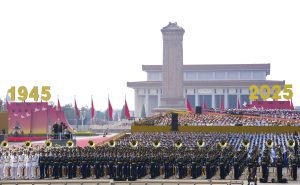
Credit: Russian Presidential Press and Information Office
During the military parade through Tiananmen Square on September 3, the People’s Liberation Army (PLA) introduced cutting-edge military hardware, including the Type 100 Main Battle Tank (MBTs), YJ-19 and YJ-20 hypersonic anti-ship missiles, two types of Type 191 long-range rocket artillery systems, and an autonomous four-legged “combat dog” robot. The military parade thus served as a showcase of China’s next generation of highly sophisticated and technologically powerful military weapons.
But beyond the display of military prowess through new hardware, this parade held both strong symbolism and a clear strategic focus. The great power competition between the United States and China served as the central thread running throughout the ceremony.
President Xi Jinping’s speech was brief but geopolitically charged. Xi’s speech during the 2015 military parade was 1,678 characters long and mentioned “peace” 18 times. By contrast, his address at the 2025 parade was just 945 characters, and the word for “peace” was used only six times. The shift in tone is unmistakable: this parade was not about avoiding conflict, but about preparing for it – strategically, diplomatically, and technologically.
More than just a tribute to past martyrs, Xi’s message was a defiant reminder to the world that China is prepared to lead on its own terms. He declared, “The Chinese nation is a great nation that does not fear power and intimidation and is determined to stand self-reliant and strong,” a comment bolstered by the hard power on display in Tiananmen Square. Xi posed a critical dilemma for other nations by asking the world to choose “between peace or war, dialogue or confrontation, win-win or zero-sum” – implicitly, between the U.S. approach to foreign policy and China’s. Xi further declared that “the Chinese people are firmly on the right side of history and the side of human civilization and progress,” again implying that the American people are not.
Another silent message came from the presence of leaders who are staunchly anti-American: Russia’s Vladimir Putin, North Korea’s Kim Jong Un, and Iran’s Masoud Pezeshkian. U.S. leaders often group Russia, Iran, and North Korea together as an “Axis of Evil.” By giving these leaders not only an invitation but front-row space – Putin and Kim were seated to either side of Xi during the parade – China used the event to convey the deepening alignment among anti-American powers to challenge the Trump administration’s unilateral approach.
More than 20 world leaders were in attendance, including presidents and prime ministers from Central Asia, Southeast Asia, and South Asia as well as Africa, the Caribbean, and Europe. Their attendance was a carefully curated display of China’s expanding influence in the Global South and among emerging powers.
Unlike the Cold War, which saw security polarization between two rival blocs, underpinned by alliances like NATO and the Warsaw Pact, China’s approach today emphasizes forging flexible, transactional partnerships. This carefully constructed network lacks formal alliances and partnerships but still carries enormous political symbolism. It points to a reorganization of global power that is less about treaties and more about influence, connectivity, and ideological proximity. The optics of having over two dozen foreign leaders admire China’s military technology were unmistakable.
In terms of that technology, the parade displayed a wide range of weapons, both old and new, conventional and next-generation, and crewed and uncrewed. A total of 45 formations rolled down Chang’an Avenue, including three newly formed units of the PLA created in 2024. These new units – the Aerospace Force, Cyberspace Force, and Information Support Force – demonstrated the PLA’s decisive turn toward future battlefields. The parade was not merely a rehearsal of conventional might, but a vision of how China sees war and power evolving in the 21st century.
The military hardware unveiled included the DF-61 is a next-generation intercontinental ballistic missile (ICBM) designed to evade current missile defense systems. According to state news agency Xinhua, the DF-5C ICBM, a modernized version of a weapon first flown in the 1970s, also made a rare appearance, demonstrating China’s ability to preserve and update older systems while investing in next-gen deterrence. The JL-3, a submarine-launched ballistic missile with intercontinental range, was also shown, indicating that China’s second-strike capabilities are becoming more advanced and reliable.
Hypersonic capabilities were prominently displayed. The DF-17, which carries a hypersonic glide vehicle, and the DF-26D, nicknamed the “Guam Express” for its ability to strike U.S. assets in the Pacific, rolled past with dramatic flair. Although these weapons have been seen before, their reappearance during this parade reinforced their strategic importance. The YJ-17 hypersonic missile also made its first appearance, proving that China remains a leader in this cutting-edge military technology.
Uncrewed military weapons or drones were also featured heavily, especially the GJ-11, which was introduced during the 2019 military parade. According to media reports, the GJ-11 is capable of precision strikes and high-altitude reconnaissance, highlighting the PLA’s growing reliance on unmanned systems.
What drew particular interest was the presence of trucks carrying air defense systems labeled HQ-29. While little is publicly known, analysts believe the HQ-29 is designed to intercept ballistic missiles in midcourse, similar to the U.S. SM-3 Block IIA system, but with the significant distinction that the Chinese system is road-mobile, offering greater strategic flexibility.
One of the most futuristic displays came from directed-energy weapons labeled the LY-1. China has learned from the Russia-Ukraine war and the Israel-Iran conflict about the importance of protecting its assets from drone swarms. China has presented an integration of laser systems into its mobile forces, suggesting a massive lead in this area.
Despite the overwhelming firepower showoff, the geopolitical message was not about the weapon systems themselves, but about China’s shaping of its future through integrating software (partnerships with like-minded partners) and hardware (military technological know-how) in the great power competition.
The military parade was a calculated geopolitical signal, signaling a new phase in global politics and great power competition. Alliances and partnerships are increasingly signaled through presence, participation, and shared values, rather than mutual defense pacts or formal treaties. The display of China’s strength was evident not only in missiles and drones, but also in the alignment of global actors seeking an alternative to the U.S.-led world order.
As the PLA formations marched and weapons rolled past, the world’s geopolitical center of gravity shifted across Tiananmen Square. China’s parade was both a nostalgic salute to the past and a roadmap for the future.