있긴 있습니다. 그런데, 반감기가 워낙 짧으니 자연상태에서 존재하는 걸 찾는 게 너무 힘드는 거겠죠.
그리고, 헬륨-3가 더 안정합니다.
이건 삼중수소가 베타붕괴해서 더 안정해지는 과정에서 만들어 지기 때문이구요.
중성자수가 많아지면 베타붕괴가 일어납니다. 근데, 그것도 핵자들의 배열상태와도 관련이 있습니다.
때문에 헬륨-6가 반감기가 헬륨-5보다 더 깁니다.
더 자세한 사항은 저도 모르겠습니다.
별 도움은 안되셨을 거 같네요.
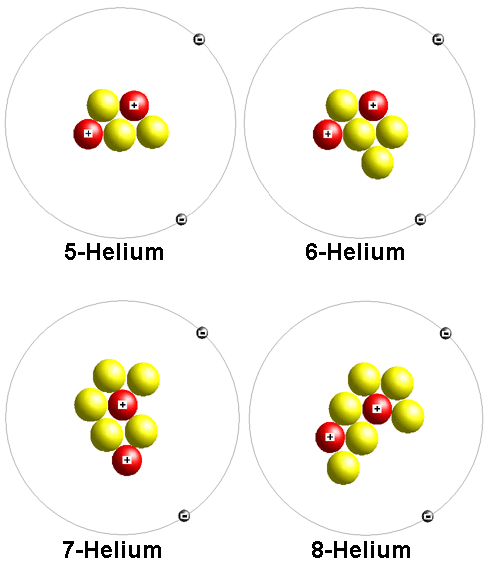
The increased number of protons and neutrons when compared to Hydrogen gives Helium many more possibilities for isotopes where the number of neutrons differs from two. Clearly, the options are one proton (a total of 2 protons + 1 neutron = 3 nuclear particles), or three neutrons or more.
Of all the possibilities, only Helium with one proton instead of two (called 3-Helium) is stable. It is quite rare, making up only 0.0001% of any given sample of Helium.
3-Helium alone is the only stable isotope of this element. There are many others, all with successively larger numbers of neutrons in the nucleus. These are 5-Helium, 6-Helium, 7-Helium, 8-Helium and 9-Helium. How they compare to 4-Helium is presented below:
The instability of the larger Helium nuclei in these isotopes is not linear, and so 6-Helium has a longer half-life than 5-Helium.
http://www.green-planet-solar-energy.com/helium-facts.html