[News Focus] Trade disputes between Korea and Japan show no sign of abating
President Moon Jae-in blames Japan’s export controls for GSOMIA withdrawal
Escalating trade tension between South Korea and Japan shows no sign of abating as two rounds of bilateral talks to resolve disputes triggered by Japan’s export curbs could not reach common ground.
On Tuesday, the two neighboring nations held the second round of talks at the World Trade Organization in Geneva after failing to reach a consensus at the first consultations on Oct. 11.
“During two rounds of six-hour intensive consultations, the two nations became more aware of each other’s measures and positions in the process. But we don’t think the two sides have changed their positions,” Chung Hae-kwan, director general in charge of legal affairs at the Trade Ministry, told reporters at a press briefing in Geneva following a meeting with his Japanese counterparts on Tuesday.
“We pointed out that Japan’s export restrictions were arbitrary and discriminatory. We requested their withdrawal as they do not comply with the export control system,” he added.
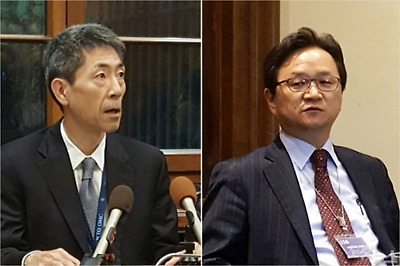 |
| Chung Hae-kwan (right), director general in charge of legal affairs at the Trade Ministry and Junichiro Kuroda, who represents the Japanese Trade Ministry (Yonhap) |
The two rounds of talks were held after Korea complained about the export restrictions to the WTO Dispute Settlement Body, accusing Japan of carrying out politically motivated retaliatory measures.
In July, Japan tightened restrictions on exports to Korea of three high-tech materials: fluorinated polyimides, photoresists and hydrogen fluoride. Previously, Korea’s Supreme Court decided to hold Japanese companies liable for having taken advantage of forced labor during World War II, and the changes to its export control system are widely seen as a form of retaliation.
The trade tension, which apparently stems from political differences, has now spread to the military and security spheres. The General Security of Military Information Agreement is set to expire at midnight Friday, three months after Seoul decided to terminate it after Japan imposed export restrictions.
On Tuesday night in a live televised forum with civilians, President Moon Jae-in said that Japan’s export controls against South Korea are behind Seoul’s decision to ditch GSOMIA.
Japan toughened export restrictions, citing concern about strategic materials being transferred to North Korea or other third countries.
“Isn’t it contradictory to seek the sharing of military information while saying South Korea is not trustworthy in terms of security?” Moon said. “We took measures that we naturally had to take.”
As the two nations failed to settle the matter at the WTO consultations, Korea is expected to request for a panel hearing at the international trade body as the next step.
“We will evaluate the results of today’s consultations and review the available alternatives, including the establishment of a panel,” Chung said.
Under WTO dispute settlement rules, if the two countries do not reach an understanding during bilateral consultations, the complainant can request for a WTO panel at least 60 days after it asks for bilateral consultation, which South Korea had sought on Sept. 11.
Chung said the ministry had not ruled out the possibility of a third round of bilateral negotiations, but it would be “unlikely.”
By Shin Ji-hye (shinjh@heraldcorp.com)
댓글
댓글 리스트-
작성자수친구 작성자 본인 여부 작성자 작성시간 19.11.21 abate 영어
발음미국/영국 [əbéit]
뜻① 완화시키다 ② 누그러지다 ③ 약해지다 ④ 덜해지다 더보기
숙어
abate a person's pain[enthusiasm] 남의 고통을 덜어 주다[열의를 약화시키다].
abate half of the price 가격을 반으로 깎다. -
작성자수친구 작성자 본인 여부 작성자 작성시간 19.11.21
be liable for
영어 뜻~에 대해 책임이 있다 -
작성자수친구 작성자 본인 여부 작성자 작성시간 19.11.21 ditch 영어
발음미국/영국 [diʧ]
뜻① 버리다 ② 도랑 ③ 결석하다 ④ 따돌리다 더보기
숙어
The water flows into the ditch at the edge of the field. 물은 들판 가에서 도랑으로 흘러 들어간다.
Her yard was ditched all about with a dry ditch. 그녀의 마당은 온통 마른 도랑으로 둘러쳐 져 있었다.