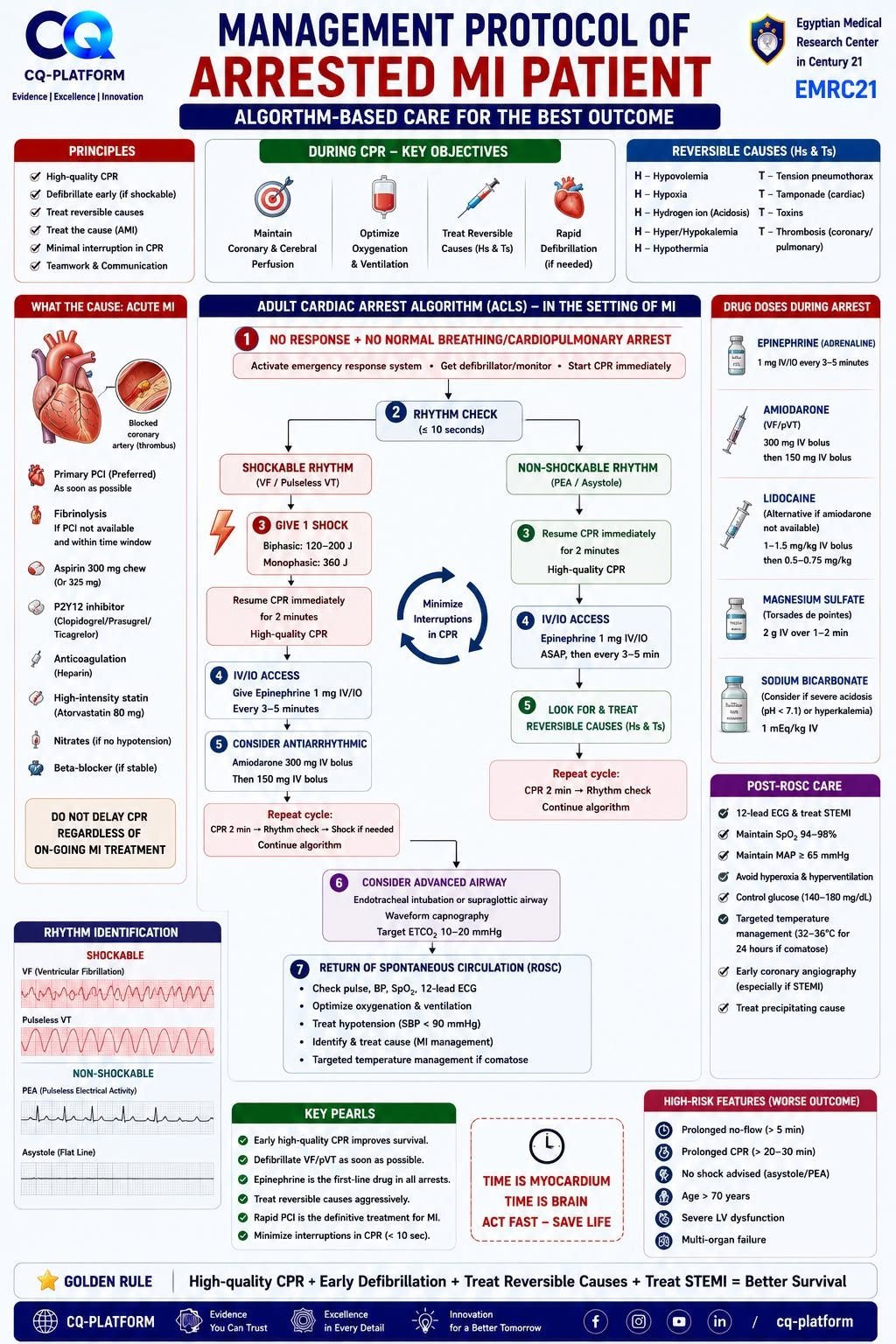
MANAGEMENT PROTOCOL OF ARRESTED MI PATIENT
Time is myocardium… but first, restore circulation.
🧠 Think: Cardiac arrest + MI = dual emergency
⸻
🚨 STEP 1: Recognize arrest
❌ No response + No breathing
→ Activate emergency system
→ Start CPR immediately
⸻
⚡ STEP 2: Rhythm check (≤ 10 sec)
🔴 SHOCKABLE (VF / Pulseless VT)
→ DEFIBRILLATE immediately
⚡ Give shock
→ Resume CPR (2 min)
💉 Epinephrine 1 mg every 3–5 min
💊 Amiodarone if refractory
⸻
⚫ NON-SHOCKABLE (PEA / Asystole)
→ NO shock
→ CPR immediately (2 min)
💉 Epinephrine ASAP (every 3–5 min)
🔍 Search for causes (Hs & Ts)
⸻
🧠 Hs & Ts (Always think reversible):
H: Hypoxia, Hypovolemia, Hydrogen (acidosis), Hyper/Hypokalemia, Hypothermia
T: Tension pneumothorax, Tamponade, Toxins, Thrombosis (MI / PE)
⸻
🫀 STEP 3: Treat the cause (MI)
⚡ After ROSC:
→ ECG immediately
→ If STEMI → Primary PCI ASAP
💊 Start:
* Aspirin
* Anticoagulation
* P2Y12 inhibitor
* Statin
⸻
💉 Drugs during arrest:
* Epinephrine → cornerstone
* Amiodarone → shock-resistant VF/VT
* Magnesium → torsades
⸻
🫁 STEP 4: Airway & ventilation
→ Consider advanced airway
→ Avoid hyperventilation
⸻
🔄 STEP 5: Post-ROSC care
🧠 Optimize oxygenation
🩸 Maintain BP (MAP ≥ 65)
🌡️ Targeted temperature management
🫀 Early coronary intervention
⸻
🔥 Golden rule:
“CPR first… shock fast… treat the cause”
💡 Clinical mindset:
Don’t chase MI before restoring circulation
⸻
#emrc21 #cq_platform #CardiacArrest #ACLS #EmergencyMedicine #Cardiology #MedicalEducation #ClinicalMedicine #USMLE #MRCP #MedStudents #HighYield #Resuscitation #STEMI #MedE