French president on military offensive: 'We are winning in Mali'
작성자B-DRAGON작성시간13.03.14조회수32 목록 댓글 0■French president on military offensive: 'We are winning in Mali'
CNN) -- French-led troops in Mali now control the ancient city of Timbuktu, the city of Gao and the swath in between that was an Islamist stronghold for almost a year, the French Defense Ministry said.
"We are winning in Mali," French President Francois Hollande said at a news conference Monday, but he added that militants still control parts of the north.
READ: Six reasons events in Mali matter
Hollande did not say how long France will maintain troops in its former colony.
The country has 2,150 soldiers on Malian soil, with 1,000 more troops supporting the operation from elsewhere.
The United States has also stepped up its involvement in the conflict by conducting aerial refueling missions on top of the intelligence and airlift support it was already providing.
READ: What's behind the instability in Mali?
Britain said Tuesday it will provide military support but won't take part in combat. The United Kingdom is prepared to deploy up to 40 troops to a European Union military training mission in Mali, and up to 200 troops as trainers in English-speaking West African countries, British Defence Minister Philip Hammond told lawmakers in the House of Commons.
In addition, the European Union said Tuesday it will contribute $67 million to support the African-led International Support Mission to Mali.
READ: U.S. steps up involvement in Mali
The nations are joined together in an effort to prevent the Islamists from turning the once peaceful democracy into a haven for international terrorists.
The Islamic extremists carved out a large portion in northern Mali last year, taking advantage of a chaotic situation after a military coup by the separatist party MNLA. They banned music, smoking, drinking and watching sports on television. They also destroyed historic tombs and shrines there.
But with the French-led offensive sending the militants on the run, residents once again roamed the streets without fear.
Flushing the Islamists out of Timbuktu, Mali's historic cultural center, is a big symbolic gain.
READ: French-led forces in Mali take Timbuktu airport, enter city
Amid international outrage, the Islamists repeatedly targeted Timbuktu's ancient burial sites. They regarded such shrines as idolatrous and thus prohibited by their strict interpretation of Islam.
As a column of military vehicles drove through Gao over the weekend, villagers chanted "Mali! Mali!"
Young men on motorcycles rode alongside the convoy, wildly waving Mali's flag and euphorically praising France and freedom.
Others lined the sides of the street, holding up beer bottles. They could once again drink, free from the oppressive dictates of the Islamists.
READ: Mali's victims speak out
The mayor of Gao returned from exile and addressed the boisterous crowd. No one could hear a word he said. But it didn't matter. He was back -- another sign that normalcy was returning.
Raising money for Mali
Other countries in Africa and around the world have pledged $455 million at a donors' conference for Mali in the Ethiopian city of Addis Ababa.
Among the donors, Japan pledged $120 million, the United States pledged $96 million, pending congressional approval, and the European Union pledged just over $67 million. Senegal, Nigeria and Ghana pledged $3 million each, and China and India pledged $1 million each.
"I thank you on behalf of the people of Mali," Malian President Dioncounda Traore said. He announced plans to hold elections on July 31.
The money will support military efforts led by the African-led International Support Mission in Mali and the Malian army, the work of the Economic Organization of West African States on Mali and humanitarian assistance.
U.N. gears up for returns
More than 380,000 people have fled northern Mali in the last year: 230,000 are internally displaced, and more than 150,000 refugees are in Mauritania, Niger, Burkina Faso and Algeria, the United Nations says.
But now, as French and Malian forces take back ground from militants, the U.N. refugee agency is preparing for the "possible spontaneous return of thousands of conflict-displaced people."
The agency, in a statement, reported that displaced people interviewed in the capital, Bamako, said they hoped to return soon.
"Returns are not yet a wide trend, but they are already being seen in some instances," the agency said.
Displaced people told U.N. interviewers that they hope to return soon to areas such as Gao, Timbuktu and Kidal. U.N. officials say people are returning to Konna, which many residents fled after militants overran that city.
The seizure of Konna, on January 10, prompted the French military intervention in Mali. The town is back under Mali's control.

French President Francois Hollande, left, speaks with soldiers who are due to leave for Mali, during a meeting in Tulle, France, on January 19.


A British army Boeing C-17 cargo plane from British Brize Norton base lands Sunday at the Evreux military base in France to take supplies to Bamako.

The interim president of Mali, Dioncounda Traore, speaks after a ministerial Cabinet meeting in Bamako on Friday, January 11. Malian authorities declared a state of emergency throughout the country on Friday as the army launched a counteroffensive against Islamists who were pushing south.
by cnn
7 March 2013 Last updated at 12:32 GMT
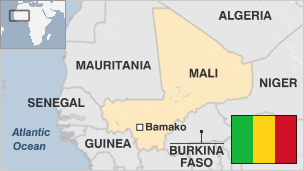
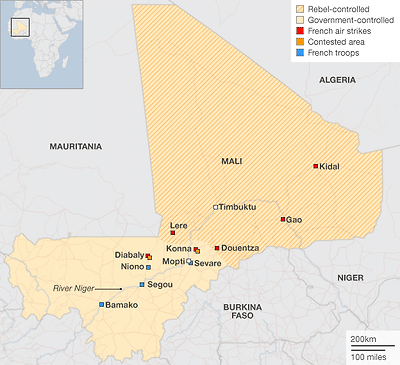
French forces have bombed rebel bases in Mali, where Islamist rebels have threatened to advance on the capital Bamako from their strongholds in the north. France said it had decided to act to stop the offensive, which could create "a terrorist state at the doorstep of France and Europe".
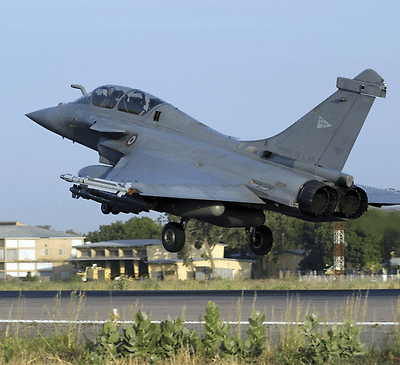
In January 2013, the Islamists captured the central city of Konna. France, responding to appeals for help from the Mali president, has sent about 550 troops to the Mopti and to Bamako, which is home to about 6,000 French nationals. French jets have also launched air strikes.
The landlocked West African country of Mali - one of the poorest in the world - experienced rapid economic growth after the 1990s, coupled with a flourishing democracy and relative social stability.
This all hung in the balance in early 2012, when the steady collapse of state control over the north of the country was followed by an inconclusive military coup and French military intervention against Islamist fighters who threatened to advance south.
For several decades after independence from France in 1960, Mali suffered droughts, rebellions, a coup and 23 years of military dictatorship until democratic elections in 1992.
At a glance
- Politics: Mali was regarded as a model of African democracy until military seized power in March 2012. Tuareg rebels declared the independence of 'Azawad state' in the north, which was quickly taken over by al-Qaeda allies
- Economy: Mali is among the 25 poorest countries. It is highly dependant on gold mining and agricultural exports such as cotton
- International: France responds to a Malian request and swiftly recaptures key cities in the north
- Country profiles compiled by BBC Monitoring
The core of ancient empires going back to the fourth century, Mali was conquered by the French in the middle of the 19th century.
After a brief experiment in federation with Senegal, Mali became independent in 1960.
Although swathes of Mali are barren, the country is self-sufficient in food thanks to the fertile Niger river basin in the south and east.
It is one of Africa's major cotton producers, and has lobbied against subsidies to cotton farmers in richer countries, particularly the US.
A chronic foreign trade deficit makes it nonetheless heavily dependent on foreign aid and remittances from Malians working abroad.
War in the north
In the early 1990s the nomadic Tuareg of the north began an insurgency over land and cultural rights that persists to this day, despite central government attempts at military and negotiated solutions.
The insurgency gathered pace in 2007, and was exacerbated by an influx of arms from the 2011 Libyan civil war.
The Saharan branch of al-Qaeda was quick to move into this increasingly lawless area, and seized control of the Tuareg north after the March 2012 military coup, effectively seceding from the rest of Mali and establishing a harsh form of Islamic law.
The West African regional grouping Ecowas agreed to launch a coordinated military expedition to recapture the north at a meeting in Nigeria in November, with UN backing.
But with preparations expected to take several months, the Islamists took the initiative and began to advance towards the government heartland in the south-west.
Alarmed at the captured of the town of Konna, the government in Bamako asked France to intervene militarily. French troops rapidly overran Islamist strongholds in the north.
Music stars
Despite its political travails, Mali is renowned worldwide for having produced some of the stars of African music, most notably Salif Keita. The annual Festival in the Desert has traditionally celebrated this talent.
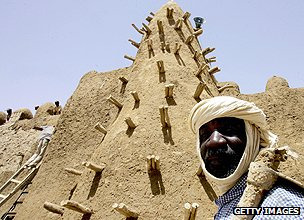
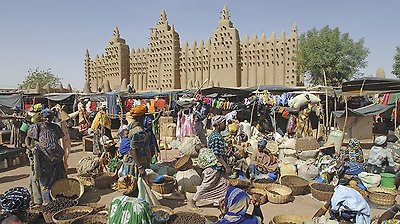 The Great Mosque of Djenne is the largest mud brick building in the world and is a UNESCO-designated World Heritage Site
 by bbc