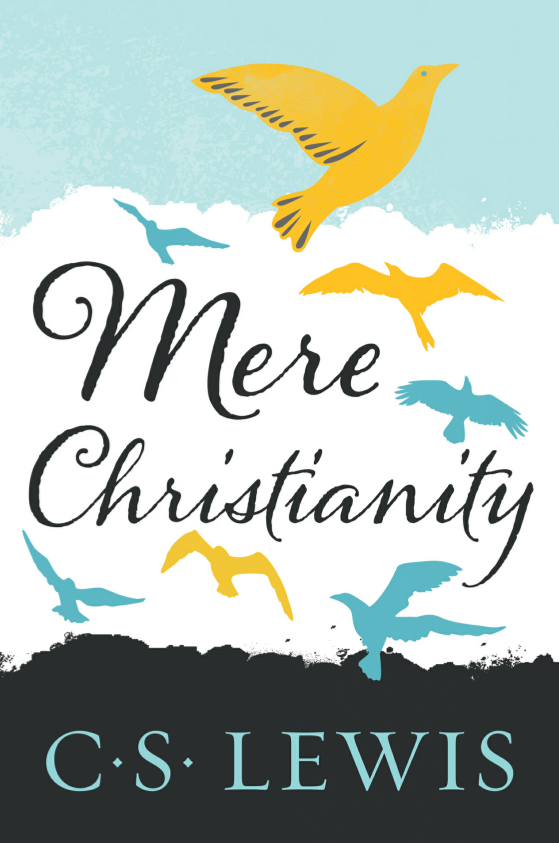
Mere Christianity(1952) - C. S. Lewis
CLIVE STAPLES LEWIS (1898–1963) was one of the intellectual giants of the twentieth century and arguably the most influential Christian writer of his day. He was a Fellow and tutor in English literature at Oxford University until 1954 when he was unanimously elected to the Chair of Medieval and Renaissance English at Cambridge University, a position he held until his retirement. He wrote more than thirty books, allowing him to reach a vast audience, and his works continue to attract thousands of new readers every year. His most distinguished and popular accomplishments include The Chronicles of Narnia, Out of the Silent Planet, The Four Loves, The Screwtape Letters, and Mere Christianity.
Book List of C. S. Lewis
Christian Apologetics and Spirituality (Chronological)
The Problem of Pain (1940) ++++
The Screwtape Letters (with "Screwtape Proposes a Toast") (1942, 1961)
The Abolition of Man (1943)
The Great Divorce (1945) / fiction
The Weight of Glory (1949)
Mere Christianity (1952) ++++
Surprised by Joy (1955)
Reflections on the Psalms (1958) ++++
The Four Loves (1960)
The World’s Last Night (1960)
A Grief Observed (1961) ++++
Letters to Malcolm (1964) ++
Christian Reflections (1967)
God in the Dock (1970)
The Business of Heaven (1984)
A Year with C. S. Lewis (2003)
Preparing for Easter (2017)
Literary Criticism, Essays, and Letters (Chronological)
Spirits in Bondage (1919)
Pilgrim’s Regress (1933)
The Allegory of Love (1936)
The Personal Heresy (1939)
George MacDonald: An Anthology (1946)
Studies in Words (1960) ++++
An Experiment in Criticism (1961) ++++
Poems (1964)
The Discarded Image (1964)
Letters of C. S. Lewis (1966)
On Stories (1966)
Of Other Worlds (1966)
Studies in Medieval and Renaissance Literature (1966)
Letters to an American Lady (1967)
A Mind Awake (1968)
Narrative Poems (1969)
Selected Literary Essays (1969)
The Dark Tower (1977)
Present Concerns (1986)
Words to Live By (1990)
All My Road Before Me (1991)
The Collected Letters of C. S. Lewis, Volume 1 (2000)
The Collected Letters of C. S. Lewis, Volume 2 (2004)
The Collected Letters of C. S. Lewis, Volume 3 (2006)
"Yours, Jack" (2006)
Image and Imagination (2013)
The Screwtape Letters: Annotated Edition (2013) / fiction
The Chronicles of Narnia (Publication Order) / fiction
The Lion, the Witch and the Wardrobe (1950)
Prince Caspian (1951)
The Voyage of the Dawn Treader (1952)
The Silver Chair (1953)
The Horse and His Boy (1954)
The Magician's Nephew (1955)
The Last Battle (1956)
Space Trilogy / fiction
Out of the Silent Planet (1938)
Perelandra (1943)
That Hideous Strength (1945)
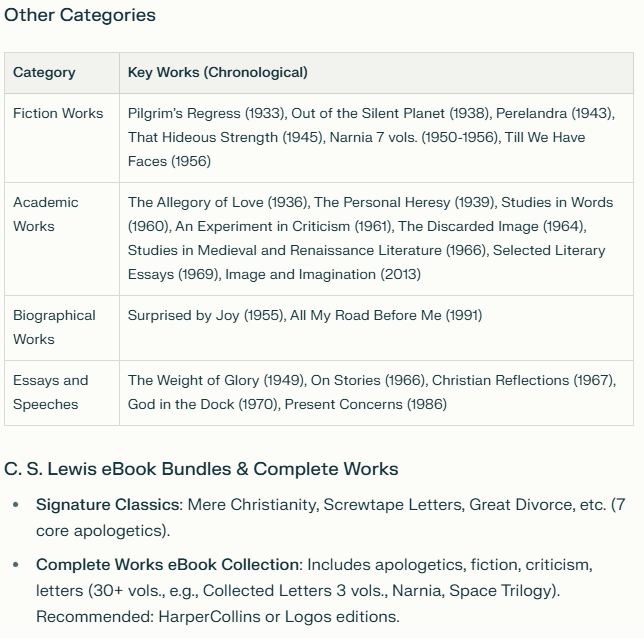
Free C. S. Lewis ebook Download
Mere Lewis: A Quick Guide to His Books, His Life, and Why He Still Matters—Plus Three Bonus Essays by C. S. Lewis
----------------------------------------------------------
Preface of Mere Christianity
The contents of this book were first given on the air, and then published in three separate parts as Broadcast Talks (1942), Christian Behaviour (1943) and Beyond Personality (1944). In the printed versions I made a few additions to what I had said at the microphone, but otherwise left the text much as it had been. A ‘talk’ on the radio should, I think, be as like real talk as possible, and should not sound like an essay being read aloud. In my talks I had therefore used all the contractions and colloquialisms I ordinarily use in conversation. In the printed version I reproduced this, putting don’t and we’ve for do not and we have. And wherever, in the talks, I had made the importance of a word clear by the emphasis of my voice, I printed it in italics. I am now inclined to think that this was a mistake—an undesirable hybrid between the art of speaking and the art of writing. A talker ought to use variations of voice for emphasis because his medium naturally lends itself to that method: but a writer ought not to use italics for the same purpose. He has his own, different, means of bringing out the key words and ought to use them. In this edition I have expanded the contractions and replaced most of the italics by a recasting of the sentences in which they occurred: but without altering, I hope, the ‘popular’ or ‘familiar’ tone which I had all along intended. I have also added and deleted where I thought I understood any part of my subject better now than ten years ago or where I knew that the original version had been misunderstood by others.
The reader should be warned that I offer no help to anyone who is hesitating between two Christian ‘denominations’. You will not learn from me whether you ought to become an Anglican, a Methodist, a Presbyterian, or a Roman Catholic. This omission is intentional (even in the list I have just given the order is alphabetical). There is no mystery about my own position. I am a very ordinary layman of the Church of England, not especially ‘high’, nor especially ‘low’, nor especially anything else. But in this book I am not trying to convert anyone to my own position. Ever since I became a Christian I have thought that the best, perhaps the only, service I could do for my unbelieving neighbours was to explain and defend the belief that has been common to nearly all Christians at all times. I had more than one reason for thinking this. In the first place, the questions which divide Christians from one another often involve points of high Theology or even of ecclesiastical history, which ought never to be treated except by real experts. I should have been out of my depth in such waters: more in need of help myself than able to help others. And secondly, I think we must admit that the discussion of these disputed points has no tendency at all to bring an outsider into the Christian fold. So long as we write and talk about them we are much more likely to deter him from entering any Christian communion than to draw him into our own. Our divisions should never be discussed except in the presence of those who have already come to believe that there is one God and that Jesus Christ is His only Son. Finally, I got the impression that far more, and more talented, authors were already engaged in such controversial matters than in the defence of what Baxter calls ‘mere’ Christianity. That part of the line where I thought I could serve best was also the part that seemed to be thinnest. And to it I naturally went.
So far as I know, these were my only motives, and I should be very glad if people would not draw fanciful inferences from my silence on certain disputed matters.
For example, such silence need not mean that I myself am sitting on the fence. Sometimes I am. There are questions at issue between Christians to which I do not think we have been told the answer. There are some to which I may never know the answer: if I asked them, even in a better world, I might (for all I know) be answered as a far greater questioner was answered: ‘What is that to thee? Follow thou Me.’ But there are other questions as to which I am definitely on one side of the fence, and yet say nothing. For I am not writing to expound something I could call ‘my religion’, but to expound ‘mere’ Christianity, which is what it is and what it was long before I was born and whether I like it or not.
Some people draw unwarranted conclusions from the fact that I never say more about the Blessed Virgin Mary than is involved in asserting the Virgin Birth of Christ. But surely my reason for not doing so is obvious? To say more would take me at once into highly controversial regions. And there is no controversy between Christians which needs to be so delicately touched as this. The Roman Catholic beliefs on that subject are held not only with the ordinary fervour that attaches to all sincere religious belief, but (very naturally) with the peculiar and, as it were, chivalrous sensibility that a man feels when the honour of his mother or his beloved is at stake. It is very difficult so to dissent from them that you will not appear to them a cad as well as a heretic. And contrariwise, the opposed Protestant beliefs on this subject call forth feelings which go down to the very roots of all Monotheism whatever. To radical Protestants it seems that the distinction between Creator and creature (however holy) is imperilled: that Polytheism is risen again. Hence it is hard so to dissent from them that you will not appear something worse than a heretic—a Pagan. If any topic could be relied upon to wreck a book about ‘mere’ Christianity—if any topic makes utterly unprofitable reading for those who do not yet believe that the Virgin’s son is God—surely this is it.
Oddly enough, you cannot even conclude, from my silence on disputed points, either that I think them important or that I think them unimportant. For this is itself one of the disputed points. One of the things Christians are disagreed about is the importance of their disagreements. When two Christians of different denominations start arguing, it is usually not long before one asks whether such-and-such a point ‘really matters’ and the other replies: ‘Matter? Why, it’s absolutely essential.’
All this is said simply in order to make clear what kind of book I was trying to write; not in the least to conceal or evade responsibility for my own beliefs. About those, as I said before, there is no secret. To quote Uncle Toby: ‘They are written in the Common-Prayer Book.’
The danger clearly was that I should put forward as common Christianity anything that was peculiar to the Church of England or (worse still) to myself. I tried to guard against this by sending the original script of what is now Book II to four clergymen (Anglican, Methodist, Presbyterian, Roman Catholic) and asking for their criticism. The Methodist thought I had not said enough about Faith, and the Roman Catholic thought I had gone rather too far about the comparative unimportance of theories in explanation of the Atonement. Otherwise all five of us were agreed. I did not have the remaining books similarly ‘vetted’ because in them, though differences might arise among Christians, these would be differences between individuals or schools of thought, not between denominations.
So far as I can judge from reviews and from the numerous letters written to me, the book, however faulty in other respects, did at least succeed in presenting an agreed, or common, or central, or ‘mere’ Christianity. In that way it may possibly be of some help in silencing the view that, if we omit the disputed points, we shall have left only a vague and bloodless H.C.F. The H.C.F. turns out to be something not only positive but pungent; divided from all non-Christian beliefs by a chasm to which the worst divisions inside Christendom are not really comparable at all. If I have not directly helped the cause of reunion, I have perhaps made it clear why we ought to be reunited. Certainly I have met with little of the fabled odium theologicum from convinced members of communions different from my own. Hostility has come more from borderline people whether within the Church of England or without it: men not exactly obedient to any communion. This I find curiously consoling. It is at her centre, where her truest children dwell, that each communion is really closest to every other in spirit, if not in doctrine. And this suggests that at the centre of each there is a something, or a Someone, who against all divergencies of belief, all differences of temperament, all memories of mutual persecution, speaks with the same voice.
So much for my omissions on doctrine. In Book III, which deals with morals, I have also passed over some things in silence, but for a different reason. Ever since I served as an infantryman in the First World War I have had a great dislike of people who, themselves in ease and safety, issue exhortations to men in the front line. As a result I have a reluctance to say much about temptations to which I myself am not exposed. No man, I suppose, is tempted to every sin. It so happens that the impulse which makes men gamble has been left out of my make-up; and, no doubt, I pay for this by lacking some good impulse of which it is the excess or perversion. I therefore did not feel myself qualified to give advice about permissible and impermissible gambling: if there is any permissible, for I do not claim to know even that. I have also said nothing about birth-control. I am not a woman nor even a married man, nor am I a priest. I did not think it my place to take a firm line about pains, dangers and expenses from which I am protected; having no pastoral office which obliged me to do so.
Far deeper objections may be felt—and have been expressed—against my use of the word Christian to mean one who accepts the common doctrines of Christianity. People ask: ‘Who are you, to lay down who is, and who is not a Christian?’ or ‘May not many a man who cannot believe these doctrines be far more truly a Christian, far closer to the spirit of Christ, than some who do?’ Now this objection is in one sense very right, very charitable, very spiritual, very sensitive. It has every available quality except that of being useful. We simply cannot, without disaster, use language as these objectors want us to use it. I will try to make this clear by the history of another, and very much less important, word.
The word gentleman originally meant something recognisable; one who had a coat of arms and some landed property. When you called someone ‘a gentleman’ you were not paying him a compliment, but merely stating a fact. If you said he was not ‘a gentleman’ you were not insulting him, but giving information. There was no contradiction in saying that John was a liar and a gentleman; any more than there now is in saying that James is a fool and an M.A. But then there came people who said—so rightly, charitably, spiritually, sensitively, so anything but usefully—‘Ah, but surely the important thing about a gentleman is not the coat of arms and the land, but the behaviour? Surely he is the true gentleman who behaves as a gentleman should? Surely in that sense Edward is far more truly a gentleman than John?’ They meant well. To be honourable and courteous and brave is of course a far better thing than to have a coat of arms. But it is not the same thing. Worse still, it is not a thing everyone will agree about. To call a man ‘a gentleman’ in this new, refined sense, becomes, in fact, not a way of giving information about him, but a way of praising him: to deny that he is ‘a gentleman’ becomes simply a way of insulting him. When a word ceases to be a term of description and becomes merely a term of praise, it no longer tells you facts about the object: it only tells you about the speaker’s attitude to that object. (A ‘nice’ meal only means a meal the speaker likes.) A gentleman, once it has been spiritualised and refined out of its old coarse, objective sense, means hardly more than a man whom the speaker likes. As a result, gentleman is now a useless word. We had lots of terms of approval already, so it was not needed for that use; on the other hand if anyone (say, in a historical work) wants to use it in its old sense, he cannot do so without explanations. It has been spoiled for that purpose.
Now if once we allow people to start spiritualising and refining, or as they might say ‘deepening’, the sense of the word Christian, it too will speedily become a useless word. In the first place, Christians themselves will never be able to apply it to anyone. It is not for us to say who, in the deepest sense, is or is not close to the spirit of Christ. We do not see into men’s hearts. We cannot judge, and are indeed forbidden to judge. It would be wicked arrogance for us to say that any man is, or is not, a Christian in this refined sense. And obviously a word which we can never apply is not going to be a very useful word. As for the unbelievers, they will no doubt cheerfully use the word in the refined sense. It will become in their mouths simply a term of praise. In calling anyone a Christian they will mean that they think him a good man. But that way of using the word will be no enrichment of the language, for we already have the word good. Meanwhile, the word Christian will have been spoiled for any really useful purpose it might have served.
We must therefore stick to the original, obvious meaning. The name Christians was first given at Antioch (Acts 11:26) to ‘the disciples’, to those who accepted the teaching of the apostles. There is no question of its being restricted to those who profited by that teaching as much as they should have. There is no question of its being extended to those who in some refined, spiritual, inward fashion were ‘far closer to the spirit of Christ’ than the less satisfactory of the disciples. The point is not a theological or moral one. It is only a question of using words so that we can all understand what is being said. When a man who accepts the Christian doctrine lives unworthily of it, it is much clearer to say he is a bad Christian than to say he is not a Christian.
I hope no reader will suppose that ‘mere’ Christianity is here put forward as an alternative to the creeds of the existing communions—as if a man could adopt it in preference to Congregationalism or Greek Orthodoxy or anything else. It is more like a hall out of which doors open into several rooms. If I can bring anyone into that hall I shall have done what I attempted. But it is in the rooms, not in the hall, that there are fires and chairs and meals. The hall is a place to wait in, a place from which to try the various doors, not a place to live in. For that purpose the worst of the rooms (whichever that may be) is, I think, preferable. It is true that some people may find they have to wait in the hall for a considerable time, while others feel certain almost at once which door they must knock at. I do not know why there is this difference, but I am sure God keeps no one waiting unless He sees that it is good for him to wait. When you do get into your room you will find that the long wait has done you some kind of good which you would not have had otherwise. But you must regard it as waiting, not as camping. You must keep on praying for light: and, of course, even in the hall, you must begin trying to obey the rules which are common to the whole house. And above all you must be asking which door is the true one; not which pleases you best by its paint and panelling. In plain language, the question should never be: ‘Do I like that kind of service?’ but ‘Are these doctrines true: Is holiness here? Does my conscience move me towards this? Is my reluctance to knock at this door due to my pride, or my mere taste, or my personal dislike of this particular door-keeper?’
When you have reached your own room, be kind to those who have chosen different doors and to those who are still in the hall. If they are wrong they need your prayers all the more; and if they are your enemies, then you are under orders to pray for them. That is one of the rules common to the whole house.
---------------------------------------------------------------
Book One
Right and Wrong as a Clue to the Meaning of the Universe
⎷ I am only trying to call attention to a fact; the fact that this year, or this month, or, more likely, this very day, we have failed to practise ourselves the kind of behaviour we expect from other people.
⎷ The point is that they are one more proof of how deeply, whether we like it or not, we believe in the Law of Nature.
⎷ It is only our bad temper that we put down to being tired or worried or hungry; we put our good temper down to ourselves.
⎷ These, then, are the two points I wanted to make. First, that human beings, all over the earth, have this curious idea that they ought to behave in a certain way, and cannot really get rid of it. Secondly, that they do not in fact behave in that way. They know the Law of Nature; they break it. These two facts are the foundation of all clear thinking about ourselves and the universe we live in.
⎷ The Moral Law tells us the tune we have to play: our instincts are merely the keys.
⎷ The Moral Law is not any one instinct or set of instincts: it is something which makes a kind of tune (the tune we call goodness or right conduct) by directing the instincts.
⎷ By the way, the point is of great practical consequence. The most dangerous thing you can do is to take any one impulse of your own nature and set it up as the thing you ought to follow at all costs.
⎷ You might think love of humanity in general was safe, but it is not. If you leave out justice you will find yourself breaking agreements and faking evidence in trials ‘for the sake of humanity’, and become in the end a cruel and treacherous man.
⎷ I conclude then, that though the difference between people’s ideas of Decent Behaviour often make you suspect that there is no real natural Law of Behaviour at all, yet the things we are bound to think about these differences really prove just the opposite.
⎷ The laws of nature, as applied to stones or trees, may only mean ‘what Nature, in fact, does’. But if you turn to the Law of Human Nature, the Law of Decent Behaviour, it is a different matter. That law certainly does not mean ‘what human beings, in fact, do’; for as I said before, many of them do not obey this law at all, and none of them obey it completely. The law of gravity tells you what stones do if you drop them; but the Law of Human Nature tells you what human beings ought to do and do not. In other words, when you are dealing with humans, something else comes in above and beyond the actual facts. You have the facts (how men do behave) and you also have something else (how they ought to behave). In the rest of the universe there need not be anything but the facts. Electrons and molecules behave in a certain way, and certain results follow, and that may be the whole story.* But men behave in a certain way and that is not the whole story, for all the time you know that they ought to behave differently.
⎷ It begins to look as if we shall have to admit that there is more than one kind of reality; that, in this particular case, there is something above and beyond the ordinary facts of men’s behaviour, and yet quite definitely real—a real law, which none of us made, but which we find pressing on us.
⎷ All I have got to is a Something which is directing the universe, and which appears in me as a law urging me to do right and making me feel responsible and uncomfortable when I do wrong. I think we have to assume it is more like a mind than it is like anything else we know—because after all the only other thing we know is matter and you can hardly imagine a bit of matter giving instructions.
⎷ There is nothing progressive about being pig headed and refusing to admit a mistake. And I think if you look at the present state of the world, it is pretty plain that humanity has been making some big mistake. We are on the wrong road. And if that is so, we must go back. Going back is the quickest way on.
⎷ Now, from this second bit of evidence we conclude that the Being behind the universe is intensely interested in right conduct—in fair play, unselfishness, courage, good faith, honesty and truthfulness.
⎷ If the universe is not governed by an absolute goodness, then all our efforts are in the long run hopeless. But if it is, then we are making ourselves enemies to that goodness every day, and are not in the least likely to do any better tomorrow, and so our case is hopeless again. We cannot do without it, and we cannot do with it. God is the only comfort, He is also the supreme terror: the thing we most need and the thing we most want to hide from. He is our only possible ally, and we have made ourselves His enemies.
⎷ My reason was that Christianity simply does not make sense until you have faced the sort of facts I have been describing. Christianity tells people to repent and promises them forgiveness. It therefore has nothing (as far as I know) to say to people who do not know they have done anything to repent of and who do not feel that they need any forgiveness. It is after you have realized that there is a real Moral Law, and a Power behind the law, and that you have broken that law and put yourself wrong with that Power—it is after all this, and not a moment sooner, that Christianity begins to talk. When you know you are sick, you will listen to the doctor. When you have realised that our position is nearly desperate you will begin to understand what the Christians are talking about.
⎷ In religion, as in war and everything else, comfort is the one thing you cannot get by looking for it. If you look for truth, you may find comfort in the end: if you look for comfort you will not get either comfort or truth—only soft soap and wishful thinking to begin with and, in the end, despair.
Book Two
What Christians Believe
⎷ I have been asked to tell you what Christians believe, and I am going to begin by telling you one thing that Christians do not need to believe. If you are a Christian you do not have to believe that all the other religions are simply wrong all through.
⎷ A man does not call a line crooked unless he has some idea of a straight line.
⎷ Reality, in fact, is usually something you could not have guessed. That is one of the reasons I believe Christianity.
⎷ I do mean that wickedness, when you examine it, turns out to be the pursuit of some good in the wrong way.
⎷ Because free will, though it makes evil possible, is also the only thing that makes possible any love or goodness or joy worth having. A world of automata—of creatures that worked like machines—would hardly be worth creating. The happiness which God designs for His higher creatures is the happiness of being freely, voluntarily united to Him and to each other in an ecstasy of love and delight compared with which the most rapturous love between a man and a woman on this earth is mere milk and water. And for that they must be free.
⎷ And what did God do? First of all He left us conscience, the sense of right and wrong: and all through history there have been people trying (some of them very hard) to obey it. None of them ever quite succeeded. Secondly, He sent the human race what I call good dreams: I mean those queer stories scattered all through the heathen religions about a god who dies and comes to life again and, by his death, has somehow given new life to men. Thirdly, He selected one particular people and spent several centuries hammering into their heads the sort of God He was—that there was only one of Him and that He cared about right conduct. Those people were the Jews, and the Old Testament gives an account of the hammering process.
⎷ Yet (and this is the strange, significant thing) even His enemies, when they read the Gospels, do not usually get the impression of silliness and conceit. Still less do unprejudiced readers. Christ says that He is ‘humble and meek’ and we believe Him; not noticing that, if He were merely a man, humility and meekness are the very last characteristics we could attribute to some of His sayings.
⎷ And now, what was the purpose of it all? What did he come to do? Well, to teach, of course; but as soon as you look into the New Testament or any other Christian writing you will find they are constantly talking about something different—about His death and His coming to life again. It is obvious that Christians think the chief point of the story lies there. They think the main thing He came to earth to do was to suffer and be killed.
⎷ The central Christian belief is that Christ’s death has somehow put us right with God and given us a fresh start.
⎷ Theories about Christ’s death are not Christianity: they are explanations about how it works. Christians would not all agree as to how important those theories are.
⎷ And here comes the catch. Only a bad person needs to repent: only a good person can repent perfectly. The worse you are the more you need it and the less you can do it. The only person who could do it perfectly would be a perfect person—and he would not need it.
⎷ Such is my own way of looking at what Christians call the Atonement. But remember this is only one more picture. Do not mistake it for the thing itself: and if it does not help you, drop it.
⎷ The perfect surrender and humiliation were undergone by Christ: perfect because He was God, surrender and humiliation because He was man. Now the Christian belief is that if we somehow share the humility and suffering of Christ we shall also share in His conquest of death and find a new life after we have died and in it become perfect, and perfectly happy, creatures. This means something much more than our trying to follow His teaching. People often ask when the next step in evolution—the step to something beyond man—will happen. But in the Christian view, it has happened already. In Christ a new kind of man appeared: and the new kind of life which began in Him is to be put into us.
⎷ There are three things that spread the Christ-life to us: baptism, belief, and that mysterious action which different Christians call by different names—Holy Communion, the Mass, the Lord’s Supper.
⎷ None of us could prove them by pure logic as you prove a thing in mathematics. We believe them simply because people who did see them have left writings that tell us about them: in fact, on authority. A man who jibbed at authority in other things as some people do in religion would have to be content to know nothing all his life.
⎷ As long as the natural life is in your body, it will do a lot towards repairing that body. Cut it, and up to a point it will heal, as a dead body would not. A live body is not one that never gets hurt, but one that can to some extent repair itself. In the same way a Christian is not a man who never goes wrong, but a man who is enabled to repent and pick himself up and begin over again after each stumble—because the Christ-life is inside him, repairing him all the time, enabling him to repeat (in some degree) the kind of voluntary death which Christ Himself carried out.
⎷ Here is another thing that used to puzzle me. Is it not frightfully unfair that this new life should be confined to people who have heard of Christ and been able to believe in Him? But the truth is God has not told us what His arrangements about the other people are. We do know that no man can be saved except through Christ; we do not know that only those who know Him can be saved through Him. But in the meantime, if you are worried about the people outside, the most unreasonable thing you can do is to remain outside yourself. Christians are Christ’s body, the organism through which He works. Every addition to that body enables Him to do more. If you want to help those outside you must add your own little cell to the body of Christ who alone can help them. Cutting off a man’s fingers would be an odd way of getting him to do more work.
⎷ But I wonder whether people who ask God to interfere openly and directly in our world quite realise what it will be like when He does. When that happens, it is the end of the world. When the author walks on to the stage the play is over.
⎷ Now, today, this moment, is our chance to choose the right side. God is holding back to give us that chance. It will not last for ever. We must take it or leave it.
Book Three
Christian Behaviour
⎷ It seems, then, that if we are to think about morality, we must think of all three departments: relations between man and man: things inside each man: and relations between man and the power that made him.
⎷ The ‘Cardinal’ ones are those which all civilised people recognise: the ‘Theological’ are those which, as a rule, only Christians know about. I shall deal with the Theological ones later on: at present I am talking about the four Cardinal virtues. (The word ‘cardinal’ has nothing to do with ‘Cardinals’ in the Roman Church. It comes from a Latin word meaning ‘the hinge of a door’. These were called ‘cardinal’ virtues because they are, as we should say, ‘pivotal’.) They are PRUDENCE, TEMPERANCE, JUSTICE and FORTITUDE.
⎷ The point is not that God will refuse you admission to His eternal world if you have not got certain qualities of character: the point is that if people have not got at least the beginnings of those qualities inside them, then no possible external conditions could make a ‘Heaven’ for them—that is, could make them happy with the deep, strong, unshakable kind of happiness God intends for us.
⎷ Really great moral teachers never do introduce new moralities: it is quacks and cranks who do that.
⎷ For the longest way round is the shortest way home.
⎷ And that leads on to my second point. People often think of Christian morality as a kind of bargain in which God says, ‘If you keep a lot of rules I’ll reward you, and if you don’t I’ll do the other thing.’ I do not think that is the best way of looking at it. I would much rather say that every time you make a choice you are turning the central part of you, the part of you that chooses, into something a little different from what it was before. And taking your life as a whole, with all your innumerable choices, all your life long you are slowly turning this central thing either into a heavenly creature or into a hellish creature:
⎷ What they are always thinking of is the mark which the action leaves on that tiny central self which no one sees in this life but which each of us will have to endure—or enjoy—for ever. One man may be so placed that his anger sheds the blood of thousands, and another so placed that however angry he gets he will only be laughed at. But the little mark on the soul may be much the same in both. Each has done something to himself which, unless he repents, will make it harder for him to keep out of the rage next time he is tempted, and will make the rage worse when he does fall into it. Each of them, if he seriously turns to God, can have that twist in the central man straightened out again: each is, in the long run, doomed if he will not. The bigness or smallness of the thing, seen from the outside, is not what really matters.
⎷ One last point. Remember that, as I said, the right direction leads not only to peace but to knowledge. When a man is getting better he understands more and more clearly the evil that is still left in him. When a man is getting worse he understands his own badness less and less. A moderately bad man knows he is not very good: a thoroughly bad man thinks he is all right. This is common sense, really.
⎷ Good people know about both good and evil: bad people do not know about either.
⎷ There are two reasons why I do not particularly want to deal with marriage. The first is that the Christian doctrines on this subject are extremely unpopular. The second is that I have never been married myself, and, therefore, can speak only at second hand. But in spite of that, I feel I can hardly leave the subject out in an account of Christian morals.
⎷ The vice I am talking of is Pride or Self-Conceit: and the virtue opposite to it, in Christian morals, is called Humility. You may remember, when I was talking about sexual morality, I warned you that the centre of Christian morals did not lie there. Well, now, we have come to the centre. According to Christian teachers, the essential vice, the utmost evil, is Pride.
⎷ That raises a terrible question. How is it that people who are quite obviously eaten up with Pride can say they believe in God and appear to themselves very religious? I am afraid it means they are worshipping an imaginary God. They theoretically admit themselves to be nothing in the presence of this phantom God, but are really all the time imagining how He approves of them and thinks them far better than ordinary people: that is, they pay a pennyworth of imaginary humility to Him and get out of it a pound’s worth of Pride towards their fellow-men.
⎷ The more you delight in yourself and the less you delight in the praise, the worse you are becoming. When you delight wholly in yourself and do not care about the praise at all, you have reached the bottom. That is why vanity, though it is the sort of Pride which shows most on the surface, is really the least bad and most pardonable sort. The vain person wants praise, applause, admiration, too much and is always angling for it. It is a fault, but a child-like and even (in an odd way) a humble fault. It shows that you are not yet completely contented with your own admiration. You value other people enough to want them to look at you. You are, in fact, still human. The real black, diabolical Pride, comes when you look down on others so much that you do not care what they think of you.
⎷ I wish I had got a bit further with humility myself: if I had, I could probably tell you more about the relief, the comfort, of taking the fancy-dress off—getting rid of the false self, with all its ‘Look at me’ and ‘Aren’t I a good boy?’ and all its posing and posturing. To get even near it, even for a moment, is like a drink of cold water to a man in a desert.
⎷ Do not imagine that if you meet a really humble man he will be what most people call ‘humble’ nowadays: he will not be a sort of greasy, smarmy person, who is always telling you that, of course, he is nobody. Probably all you will think about him is that he seemed a cheerful, intelligent chap who took a real interest in what you said to him. If you do dislike him it will be because you feel a little envious of anyone who seems to enjoy life so easily. He will not be thinking about humility: he will not be thinking about himself at all.
⎷ If anyone would like to acquire humility, I can, I think, tell him the first step. The first step is to realise that one is proud. And a biggish step, too. At least, nothing whatever can be done before it. If you think you are not conceited, it means you are very conceited indeed.
⎷ The first step is to recognise the fact that your moods change. The next is to make sure that, if you have once accepted Christianity, then some of its main doctrines shall be deliberately held before your mind for some time every day. That is why daily prayers and religious readings and churchgoing are necessary parts of the Christian life. We have to be continually reminded of what we believe.
⎷ No man knows how bad he is till he has tried very hard to be good. A silly idea is current that good people do not know what temptation means. This is an obvious lie. Only those who try to resist temptation know how strong it is
⎷ That is why bad people, in one sense, know very little about badness. They have lived a sheltered life by always giving in. We never find out the strength of the evil impulse inside us until we try to fight it: and Christ, because He was the only man who never yielded to temptation, is also the only man who knows to the full what temptation means—the only complete realist. Very well, then. The main thing we learn from a serious attempt to practise the Christian virtues is that we fail.
⎷ I think every one who has some vague belief in God, until he becomes a Christian, has the idea of an exam. or of a bargain in his mind. The first result of real Christianity is to blow that idea into bits.
⎷ One of the very things Christianity was designed to do was to blow this idea to bits. God has been waiting for the moment at which you discover that there is no question of earning a pass mark in this exam, or putting Him in your debt.
⎷ Now, once again, what God cares about is not exactly our actions. What he cares about is that we should be creatures of a certain kind or quality—the kind of creatures He intended us to be—creatures related to Himself in a certain way.
⎷ When the most important things in our life happen we quite often do not know, at the moment, what is going on. A man does not always say to himself, ‘Hullo! I’m growing up.’ It is often only when he looks back that he realises what has happened and recognises it as what people call ‘growing up’. You can see it even in simple matters. A man who starts anxiously watching to see whether he is going to sleep is very likely to remain wide awake. As well, the thing I am talking of now may not happen to every one in a sudden flash—as it did to St Paul or Bunyan: it may be so gradual that no one could ever point to a particular hour or even a particular year. And what matters is the nature of the change in itself, not how we feel while it is happening. It is the change from being confident about our own efforts to the state in which we despair of doing anything for ourselves and leave it to God.
⎷ Christians have often disputed as to whether what leads the Christian home is good actions, or Faith in Christ. I have no right really to speak on such a difficult question, but it does seem to me like asking which blade in a pair of scissors is most necessary. A serious moral effort is the only thing that will bring you to the point where you throw up the sponge. Faith in Christ is the only thing to save you from despair at that point: and out of that Faith in Him good actions must inevitably come. There are two parodies of the truth which different sets of Christians have, in the past, been accused by other Christians of believing: perhaps they may make the truth clearer. One set were accused of saying, ‘Good actions are all that matters.
⎷ The other set were accused of saying, ‘Faith is all that matters. Consequently, if you have faith, it doesn’t matter what you do. Sin away, my lad, and have a good time and Christ will see that it makes no difference in the end.’ The answer to that nonsense is that, if what you call your ‘faith’ in Christ does not involve taking the slightest notice of what He says, then it is not Faith at all—not faith or trust in Him, but only intellectual acceptance of some theory about Him.
⎷ The first half is, ‘Work out your own salvation with fear and trembling’—which looks as if everything depended on us and our good actions: but the second half goes on, ‘For it is God who worketh in you’—which looks as if God did everything and we nothing. I am afraid that is the sort of thing we come up against in Christianity.
Book Four
Beyond Personality: or First Steps in the Doctrine of the Trinity
⎷ The map is admittedly only coloured paper, but there are two things you have to remember about it. In the first place, it is based on what hundreds and thousands of people have found out by sailing the real Atlantic. In that way it has behind it masses of experience just as real as the one you could have from the beach; only, while yours would be a single glimpse, the map fits all those different experiences together. In the second place, if you want to go anywhere, the map is absolutely necessary. As long as you are content with walks on the beach, your own glimpses are far more fun than looking at a map. But the map is going to be more use than walks on the beach if you want to get to America.
⎷ In fact, that is just why a vague religion—all about feeling God in nature, and so on—is so attractive. It is all thrills and no work: like watching the waves from the beach. But you will not get to Newfoundland by studying the Atlantic that way, and you will not get eternal life by simply feeling the presence of God in flowers or music. Neither will you get anywhere by looking at maps without going to sea. Nor will you be very safe if you go to sea without a map.
⎷ If Christianity only means one more bit of good advice, then Christianity is of no importance. There has been no lack of good advice for the last four thousand years. A bit more makes no difference.
⎷ And that is precisely what Christianity is about. This world is a great sculptor’s shop. We are the statues and there is a rumour going round the shop that some of us are some day going to come to life.
⎷ Well, in a certain sense, no doubt we are sons of God already. I mean, God has brought us into existence and loves us and looks after us, and in that way is like a father. But when the Bible talks of our ‘becoming’ Sons of God, obviously it must mean something different. And that brings us up against the very centre of Theology.
⎷ In reality, the difference between Biological life and Spiritual life is so important that I am going to give them two distinct names. The Biological sort which comes to us through Nature, and which (like everything else in Nature) is always tending to run down and decay so that it can only be kept up by incessant subsidies from Nature in the form of air, water, food, etc., is Bios. The Spiritual life which is in God from all eternity, and which made the whole natural universe, is Zoe. Bios has, to be sure, a certain shadowy or symbolic resemblance to Zoe: but only the sort of resemblance there is between a photo and a place, or a statue and a man. A man who changed from having Bios to having Zoe would have gone through as big a change as a statue which changed from being a carved stone to being a real man.
⎷ In other words, as you advance to more real and more complicated levels, you do not leave behind you the things you found on the simpler levels: you still have them, but combined in new ways—in ways you could not imagine if you knew only the simpler levels.
⎷ In God’s dimension, so to speak, you find a being who is three Persons while remaining one Being, just as a cube is six squares while remaining one cube. Of course we cannot fully conceive a Being like that: just as, if we were so made that we perceived only two dimensions in space we could never properly imagine a cube. But we can get a sort of faint notion of it. And when we do, we are then, for the first time in our lives, getting some positive idea, however faint, of something super-personal—something more than a person. It is something we could never have guessed, and yet, once we have been told, one almost feels one ought to have been able to guess it because it fits in so well with all the things we know already.
⎷ You may ask, ‘if we cannot imagine a three-personal Being, what is the good of talking about Him?’ Well, there isn’t any good talking about Him. The thing that matters is being actually drawn into that three-personal life, and that may begin any time—tonight, if you like.
⎷ ⎷ You see what is happening. God is the thing to which he is praying—the goal he is trying to reach. God is also the thing inside him which is pushing him on—the motive power. God is also the road or bridge along which he is being pushed to that goal. So that the whole threefold life of the three-personal Being is actually going on in that ordinary little bedroom where an ordinary man is saying his prayers. The man is being caught up into the higher kinds of life—what I called Zoe or spiritual life: he is being pulled into God, by God, while still remaining himself.
⎷ ⎷ This definition is not something we have made up; Theology is, in a sense, an experimental science. It is simple religions that are the made-up ones. When I say it is an experimental science ‘in a sense’, I mean that it is like the other experimental sciences in some ways, but not in all. If you are a geologist studying rocks, you have to go and find the rocks. They will not come to you, and if you go to them they cannot run away. The initiative lies all on your side. They cannot either help or hinder. But suppose you are a zoologist and want to take photos of wild animals in their native haunts. That is a bit different from studying rocks. The wild animals will not come to you: but they can run away from you. Unless you keep very quiet, they will. There is beginning to be a tiny little trace of initiative on their side.
⎷ When you come to knowing God, the initiative lies on His side. If He does not show Himself, nothing you can do will enable you to find Him. And, in fact, He shows much more of Himself to some people than to others—not because He has favourites, but because it is impossible for Him to show Himself to a man whose whole mind and character are in the wrong condition. Just as sunlight, though it has no favourites, cannot be reflected in a dusty mirror as clearly as in a clean one.
⎷ You can put this another way by saying that while in other sciences the instruments you use are things external to yourself (things like microscopes and telescopes), the instrument through which you see God is your whole self. And if a man’s self is not kept clean and bright, his glimpse of God will be blurred—like the Moon seen through a dirty telescope. That is why horrible nations have horrible religions: they have been looking at God through a dirty lens.
⎷ God can show Himself as He really is only to real men. And that means not simply to men who are individually good, but to men who are united together in a body, loving one another, helping one another, showing Him to one another. For that is what God meant humanity to be like; like players in one band, or organs in one body.
⎷ If Christianity was something we were making up, of course we could make it easier. But it is not. We cannot compete, in simplicity, with people who are inventing religions. How could we? We are dealing with Fact. Of course anyone can be simple if he has no facts to bother about.
⎷ It is a very silly idea that in reading a book you must never ‘skip’. All sensible people skip freely when they come to a chapter which they find is going to be no use to them. In this chapter I am going to talk about something which may be helpful to some readers, but which may seem to others merely an unnecessary complication. If you are one of the second sort of readers, then I advise you not to bother about this chapter at all but to turn on to the next.
⎷ In the Christian life you are not usually looking at Him. He is always acting through you. If you think of the Father as something ‘out there’, in front of you, and of the Son as someone standing at your side, helping you to pray, trying to turn you into another son, then you have to think of the third Person as something inside you, or behind you.
⎷ Now the whole offer which Christianity makes is this: that we can, if we let God have His way, come to share in the life of Christ. If we do, we shall then be sharing a life which was begotten, not made, which always has existed and always will exist. Christ is the Son of God. If we share in this kind of life we also shall be sons of God. We shall love the Father as He does and the Holy Ghost will arise in us. He came to this world and became a man in order to spread to other men the kind of life He has—by what I call ‘good infection’. Every Christian is to become a little Christ. The whole purpose of becoming a Christian is simply nothing else.
⎷ It is as if something which is always affecting the whole human mass begins, at one point, to affect the whole human mass in a new way. From that point the effect spreads through all mankind. It makes a difference to people who lived before Christ as well as to people who lived after Him. It makes a difference to people who have never heard of Him. It is like dropping into a glass of water one drop of something which gives a new taste or a new colour to the whole lot. But, of course, none of these illustrations really works perfectly. In the long run God is no one but Himself and what He does is like nothing else. You could hardly expect it to be otherwise.
⎷ What, then, is the difference which He has made to the whole human mass? It is just this; that the business of becoming a son of God, of being turned from a created thing into a begotten thing, of passing over from the temporary biological life into timeless ‘spiritual’ life, has been done for us. Humanity is already ‘saved’ in principle. We individuals have to appropriate that salvation.
⎷ Of course, you can express this in all sorts of different ways. You can say that Christ died for our sins. You may say that the Father has forgiven us because Christ has done for us what we ought to have done. You may say that we are washed in the blood of the Lamb. You may say that Christ has defeated death. They are all true.
⎷ How would they differ from one another? One does not notice the difficulty at first, of course. One thinks one can form the idea of several ‘sons’. But when I think closely, I find that the idea seemed possible only because I was vaguely imagining them as human forms standing about together in some kind of space. In other words, though I pretended to be thinking about something that exists before any universe was made, I was really smuggling in the picture of a universe and putting that something inside it.
⎷ Christianity thinks of human individuals not as mere members of a group or items in a list, but as organs in a body—different from one another and each contributing what no other could.
⎷ If you forget that he is a different organ from you, if you want to suppress differences and make people all alike, you will become a Totalitarian. But a Christian must not be either a Totalitarian or an Individualist.
⎷ I feel a strong desire to tell you—and I expect you feel a strong desire to tell me—which of these two errors is the worse. That is the devil getting at us. He always sends errors into the world in pairs—pairs of opposites. And he always encourages us to spend a lot of time thinking which is the worse. You see why, of course? He relies on your extra dislike of the one error to draw you gradually into the opposite one. But do not let us be fooled. We have to keep our eyes on the goal and go straight through between both errors. We have no other concern than that with either of them.
⎷ Very often the only way to get a quality in reality is to start behaving as if you had it already.
⎷ And now we begin to see what it is that the New Testament is always talking about. It talks about Christians ‘being born again’; it talks about them ‘putting on Christ’; about Christ ‘being formed in us’; about our coming to ‘have the mind of Christ’.
⎷ It is a living Man, still as much a man as you, and still as much God as He was when He created the world, really coming and interfering with your very self; killing the old natural self in you and replacing it with the kind of self He has. At first, only for moments. Then for longer periods. Finally, if all goes well, turning you permanently into a different sort of thing; into a new little Christ, a being which, in its own small way, has the same kind of life as God; which shares in His power, joy, knowledge and eternity. And soon we make two other discoveries.
⎷ On the other hand, surely what a man does when he is taken off his guard is the best evidence for what sort of a man he is? Surely what pops out before the man has time to put on a disguise is the truth?
⎷ In the same way the suddenness of the provocation does not make me an ill-tempered man; it only shows me what an ill-tempered man I am.
⎷ And if (as I said before) what we are matters even more than what we do—if, indeed, what we do matters chiefly as evidence of what we are—then it follows that the change which I most need to undergo is a change that my own direct, voluntary efforts cannot bring about. And this applies to my good actions too.
⎷ Christ says ‘Give me All. I don’t want so much of your time and so much of your money and so much of your work: I want You. I have not come to torment your natural self, but to kill it. No half-measures are any good. I don’t want to cut off a branch here and a branch there, I want to have the whole tree down. I don’t want to drill the tooth, or crown it, or stop it, but to have it out. Hand over the whole natural self, all the desires which you think innocent as well as the ones you think wicked—the whole outfit. I will give you a new self instead. In fact, I will give you Myself: my own will shall become yours.’
⎷ He says, ‘Take up your Cross’—in other words, it is like going to be beaten to death in a concentration camp. Next minute he says, ‘My yoke is easy and my burden light.’ He means both. And one can just see why both are true.
⎷ I sometimes like to imagine that I can just see how it might apply to other things.
⎷ It might be that when intelligent creatures entered into Christ they would, in that way, bring all the other things in along with them. But I do not know: it is only a guess.
⎷ What we have been told is how we men can be drawn into Christ—can become part of that wonderful present which the young Prince of the universe wants to offer to His Father—that present which is Himself and therefore us in Him. It is the only thing we were made for. And there are strange, exciting hints in the Bible that when we are drawn in, a great many other things in Nature will begin to come right. The bad dream will be over: it will be morning.
⎷ ‘God is easy to please, but hard to satisfy.’
⎷ We may be content to remain what we call ‘ordinary people’: but He is determined to carry out a quite different plan. To shrink back from that plan is not humility: it is laziness and cowardice. To submit to it is not conceit or megalomania; it is obedience.
⎷ If conversion to Christianity makes no improvement in a man’s outward actions—if he continues to be just as snobbish or spiteful or envious or ambitious as he was before—then I think we must suspect that his ‘conversion’ was largely imaginary; and after one’s original conversion, every time one thinks one has made an advance, that is the test to apply. Fine feelings, new insights, greater interest in ‘religion’ mean nothing unless they make our actual behaviour better; just as in an illness ‘feeling better’ is not much good if the thermometer shows that your temperature is still going up. In that sense the outer world is quite right to judge Christianity by its results. Christ told us to judge by results. A tree is known by its fruit; or, as we say, the proof of the pudding is in the eating. When we Christians behave badly, or fail to behave well, we are making Christianity unbelievable to the outside world. The war-time posters told us that Careless Talk costs Lives. It is equally true that Careless Lives cost Talk. Our careless lives set the outer world talking; and we give them grounds for talking in a way that throws doubt on the truth of Christianity itself.
⎷ When we Christians behave badly, or fail to behave well, we are making Christianity unbelievable to the outside world.
⎷ (1) In the first place the situation in the actual world is much more complicated than that. The world does not consist of 100 per cent. Christians and 100 per cent. non-Christians. There are people (a great many of them) who are slowly ceasing to be Christians but who still call themselves by that name: some of them are clergymen. There are other people who are slowly becoming Christians though they do not yet call themselves so. There are people who do not accept the full Christian doctrine about Christ but who are so strongly attracted by Him that they are His in a much deeper sense than they themselves understand. There are people in other religions who are being led by God’s secret influence to concentrate on those parts of their religion which are in agreement with Christianity, and who thus belong to Christ without knowing it. For example, a Buddhist of good will may be led to concentrate more and more on the Buddhist teaching about mercy and to leave in the background (though he might still say he believed) the Buddhist teaching on certain other points. Many of the good Pagans long before Christ’s birth may have been in this position. And always, of course, there are a great many people who are just confused in mind and have a lot of inconsistent beliefs all jumbled up together. Consequently, it is not much use trying to make judgments about Christians and non-Christians in the mass.
⎷ But when we are comparing Christians in general with non-Christians in general, we are usually not thinking about real people whom we know at all, but only about two vague ideas which we have got from novels and newspapers. If you want to compare the bad Christian and the good Atheist, you must think about two real specimens whom you have actually met. Unless we come down to brass tacks in that way, we shall only be wasting time.
⎷ (2) Suppose we have come down to brass tacks and are now talking not about an imaginary Christian and an imaginary non-Christian, but about two real people in our own neighbourhood. Even then we must be careful to ask the right question. If Christianity is true then it ought to follow (a) That any Christian will be nicer than the same person would be if he were not a Christian. (b) That any man who becomes a Christian will be nicer than he was before.
⎷ The truth is that in God’s eyes Dick Firkin needs ‘saving’ every bit as much as Miss Bates. In one sense (I will explain what sense in a moment) niceness hardly comes into the question.
⎷ Christ said ‘Blessed are the poor’ and ‘How hard it is for the rich to enter the Kingdom,’ and no doubt He primarily meant the economically rich and economically poor. But do not His words also apply to another kind of riches and poverty?
⎷ Often people who have all these natural kinds of goodness cannot be brought to recognise their need for Christ at all until, one day, the natural goodness lets them down and their self-satisfaction is shattered. In other words, it is hard for those who are ‘rich’ in this sense to enter the Kingdom.
⎷ And finally, I should not be surprised if, when the thing happened, very few people noticed that it was happening.
⎷ But the new step, the step from being creatures to being sons, is voluntary. At least, voluntary in one sense. It is not voluntary in the sense that we, of ourselves, could have chosen to take it or could even have imagined it; but it is voluntary in the sense that when it is offered to us, we can refuse it. We can, if we please, shrink back; we can dig in our heels and let the new Humanity go on without us.
⎷ They begin where most of us leave off. They are, I say, recognisable; but you must know what to look for. They will not be very like the idea of ‘religious people’ which you have formed from your general reading. They do not draw attention to themselves.
⎷ To become new men means losing what we now call ‘ourselves’. Out of our selves, into Christ, we must go. His will is to become ours and we are to think His thoughts, to ‘have the mind of Christ’ as the Bible says. And if Christ is one, and if He is thus to be ‘in’ us all, shall we not be exactly the same? It certainly sounds like it; but in fact it is not so.
⎷ Sameness is to be found most among the most ‘natural’ men, not among those who surrender to Christ. How monotonously alike all the great tyrants and conquerors have been: how gloriously different are the saints.
⎷ The very first step is to try to forget about the self altogether. Your real, new self (which is Christ’s and also yours, and yours just because it is His) will not come as long as you are looking for it. It will come when you are looking for Him.
⎷ Even in social life, you will never make a good impression on other people until you stop thinking about what sort of impression you are making. Even in literature and art, no man who bothers about originality will ever be original: whereas if you simply try to tell the truth (without caring twopence how often it has been told before) you will, nine times out of ten, become original without ever having noticed it. The principle runs through all life from top to bottom. Give up yourself, and you will find your real self. Lose your life and you will save it. Submit to death, death of your ambitions and favourite wishes every day and death of your whole body in the end: submit with every fibre of your being, and you will find eternal life. Keep back nothing. Nothing that you have not given away will be really yours. Nothing in you that has not died will ever be raised from the dead. Look for yourself, and you will find in the long run only hatred, loneliness, despair, rage, ruin, and decay. But look for Christ and you will find Him, and with Him everything else thrown in.
---------------------------------------------------------------
---------------------------------------------------------------
https://barbaraleeharper.com/2014/05/26/mere-christianity/

Book Review: Mere Christianity
Posted on May 26, 2014

I first read Mere Christianity by C. S. Lewis some seven or so years ago and tried to write a review, but ended up mainly just listing quotes, which is not a review. It wasn’t hard to read or to follow — for the most part Lewis’s thinking was actually pretty easy to track, and he writes in a logical, almost conversational style rather than like a theology textbook. It was more a matter of there being too much to take in and process and too many goods things to share to reduce it to anything like a review. I read a quote by Elisabeth Elliot (which I neglected to keep track of) something to the effect that she could understand Lewis by reading him through the first time, but needed to read him again to be able reconstruct his arguments. I feel the same way. I’m thankful The Cloud of Witnesses Challenge sponsored by Becky at Operation Actually Read Bible spurred me to pick this up again. I feel I got much more from it this time, maybe just because of a second reading, maybe because of several years of (hopefully) maturing in the meantime, maybe because our church has been talking about “Coffee Shop Apologetics” on Wednesday nights using some of Lewis’s material here and there.
It is interesting to read how Lewis came from an atheistic background and what the Lord used to convince him that Christianity was the truth. Although this book is not his “testimony” per se, he does touch on his own personal journey to faith.
The book is divided into four sections: “Right and Wrong as a Clue to Meaning in the Universe,” in which he argues for Christianity and why it is the best solution to universal moral and logical dilemmas, then “What Christians Believe,” “Christian Behavior,” and “Beyond Personality: Or First Steps in the Doctrine of the Trinity.” Originally the various segments were radio talks in the 1940s which were then tweaked to better fit written form.
I have many more places marked than I can possibly share here. Goodreads has a list of several quotes from the book, some you’ll recognize as classic Lewis. One of my favorite quotes about love comes from this book. Here are a few others hat stood out to me:
From the chapter “We Have Cause to Be Uneasy”:
For the trouble is that one part of you is on His side and really agrees with his disapproval of human greed and trickery and exploitation. You may want Him to make an exception in your own case, to let you off this one time; but you know at bottom that unless the power behind the world really and unalterably detests that sort of behaviour, then He cannot be good. On the other hand, we know that if there does exist an absolute goodness it must hate most of what we do. This is the terrible fix we are in. If the universe is not governed by an absolute goodness, then all our efforts are in the long run hopeless. But if it is, then we are making ourselves enemies to that goodness every day, and are not in the least likely to do any better tomorrow, and so our case is hopeless again. We cannot do without it, and we cannot do with it. God is the only comfort, He is also the supreme terror: the thing we must need and the thing we most want to hide from. He is our only possible ally, and we have made ourselves His enemies. Some people talk as if meeting the gaze of absolute goodness would be fun. They need to think again. They are still only playing with religion. Goodness is either the great safety or the great danger -according to the way you react to it. And we have reacted the wrong way.
From the chapter “The Practical Conclusion”:
[The Christian] does not think God will love us because we are good, but that God will make us good because he loves us.
From the chapter “Social Morality”:
I may repeat “Do as you would be done by” till I am black in the face, but I cannot really carry it out till I love my neighbor as myself: and I cannot learn to love my neighbor as myself until I learn to love God.
From the chapter “Sexual Morality”:
We may, indeed, be sure that perfect chastity-like perfect charity-will not be attained by any merely human efforts. You must ask for God’s help. Even when you have done so, it may seem to you for a long time that no help, or less help than you need, is being given. Never mind. After each failure, ask forgiveness, pick yourself up and try again. Very often what God first helps us towards is not the virtue itself but just this power of always trying again. For however important chastity (or courage, or truthfulness, or any other virtue) may be, this process trains us in habits of the soul which are more important still. It cures our illusions about ourselves and teaches us to depend on God. We learn, on the one hand, that we cannot trust ourselves even in our best moments, and, on the other, that we need not despair even in our worst, for our failures are forgiven. The only fatal thing is to sit down content with anything less than perfection.
From the chapter “The Great Sin”:
Pleasure in being praised is not Pride. The child who is patted on the back for doing a lesson well, the woman whose beauty is praised by her lover, the saved soul to whom Christ says, “Well done,” are all pleased and ought to be. For here the pleasure lies not in what you are but in the fact that you have pleased someone you wanted (and rightly wanted) to please. The trouble begins when you pass from thinking, “I have pleased him; all is well,” to thinking, “What a fine person I must be to have done it.”
That was immensely helpful to me. I don’t know if anyone else experiences this, but sometimes when you receive a compliment, then you feel a rush of pleasure, that feel guilty for that pleasure and feel you need to redirect the attention to the Lord, and in trying to do so sound awkward and overly pious. For that reason, when someone, say, sings a solo in church that I enjoyed, I try to tell them it blessed my heart rather than just “I enjoyed your song this morning.” Though I mean the same thing by both sentences, the second one makes people feel awkward and self-conscious. This thought did help me to understand it’s not wrong to feel pleasure in pleasing someone else or accepting a compliment.
From the same chapter:
Do not imagine that if you meet a really humble man he will be what most people call “humble” nowadays: he will not be a sort of greasy smarmy person, who is always telling you that, of course, he is a nobody. Probably all you will think about him is that he seemed a cheerful, intelligent chap who tool a real interest in what you said to him….He will not be thinking about humility: he will not be thinking about himself at all.
From the chapter “Charity”:
Good and evil both increase at compound interest. That is why the little decisions you and I make every day are of such infinite importance. The smallest good act to-day is the capture of a strategic point from which, a few months later, you may be able to go on to victories you never dreamed of. An apparently trivial indulgence in lust or, anger to-day is the loss of a ridge or railway line or bridgehead from which the enemy may launch an attack otherwise impossible.
From the same chapter:
Nobody can always have devout feelings: and even if we could, feelings are not what God principally cares about. Christian Love, either towards God or towards man, is an affair of the will. If we are trying to do His will we are obeying the commandment, ‘Thou shalt love the Lord thy God.’ He will give us feelings of love if He pleases. We cannot create them for ourselves, and we must not demand them as a right. But the great thing to remember is that, though our feelings come and go, His love for us does not. It is not wearied by our sins, or our indifference; and, therefore, it is quite relentless in its determination that we shall be cured of those sins, at whatever cost to us, at whatever cost to Him.
From the chapter “Hope”:
If I find in myself a desire which no experience in this world can satisfy, the most probable explanation is that I was made for another world. If none of my earthly pleasures satisfy it, that does not prove that the universe is a fraud. Probably earthly pleasures were never meant to satisfy it, but only to arouse it, to suggest the real thing. If that is so, I must take care, on the one hand, never to despise, or be unthankful for, these earthly blessings, and on the other, never to mistake them for the something else of which they are only a kind of copy, or echo, or mirage. I must keep alive in myself the desire for my true country, which I shall not find till after death; I must never let it get snowed under or turned aside; I must make it the main object of life to press on to that other country and to help others to do the same.
From the chapter “Faith”:
But supposing a man’s reason once decides that the weight of the evidence is for [Christianity]. I can tell that man what is going to happen to him in the next few weeks. There will come a moment when there is bad news, or he is in trouble, or is living among a lot of other people who do not believe it, and all at once his emotions will rise up and carry out a sort of blitz on his belief. Or else there will come a moment when he wants a woman, or wants to tell a lie, or feels very pleased with himself, or sees a chance of making a little money in some way that is not perfectly fair: some moment, in fact, at which it would be very convenient if Christianity were not true. And once again his wishes and desires will carry out a blitz. I am not talking of moments at which any real new reasons against Christianity turn up. Those have to be faced and that is a different matter. I am talking about moments when a mere mood rises up against it.
Now Faith, in the sense in which I am here using the word, is the art of holding on to things your reason has once accepted in spite of your changing moods. For moods will change, whatever view your reason takes. I know that by experience. Now that I am a Christian I do have moods in which the whole thing looks very improbable: but when I was an atheist I had moods in which Christianity looked terribly probable. This rebellion of your moods against your real self is going to come anyway. That is why Faith is such a necessary virtue unless you teach your moods ‘where they get off,’ you can never be either a sound Christian or even a sound atheist, but just a creature dithering to and fro, with its beliefs really dependent on the weather and the state of its digestion. Consequently one must train the habit of Faith.
From a second chapter titles “Faith”:
And, in yet another sense, handing everything over to Christ does not, of course, mean that you stop trying. To trust Him means, of course, trying to do all that He says. There would be no sense in saying you trusted a person if you would not take his advice. Thus if you have really handed yourself over to Him, it must follow that you are trying to obey Him. But trying in a new way, a less worried way. Not doing these things in order to be saved, but because He has begun to save you already. Not hoping to get to Heaven as a reward for your actions, but inevitably wanting to act in a certain way because a first faint gleam of Heaven is already inside you (emphasis mine).
From the chapter “Nice People or New Men”:
But we must not suppose that even if we succeeded in making everyone nice we should have saved their souls. A world of nice people, content in their own niceness, looking no further, turned away from God, would be just as desperately in need of salvation as a miserable world – and might even be more difficult to save.
For mere improvement is not redemption, though redemption always improves people even here and now and will, in the end, improve them to a degree we cannot yet imagine. God became man to turn creatures into sons: not simply to produce better men of the old kind but to produce a new kind of man…
If what you want is an argument against Christianity (and I well remember how eagerly I looked for such arguments when I began to be afraid it was true) you can easily find some stupid and unsatisfactory Christian and say, ‘So there’s your boasted new man I Give me the old kind.’ But if once you have begun to see that Christianity is on other grounds probable, you will know in your heart that this is only evading the issue. What can you ever really know of other people’s souls-of their temptations, their opportunities, their struggles? One soul in the whole creation you do know: and it is the only one whose fate is placed in your hands. If there is a God, you are, in a sense, alone with Him. You cannot put Him off with speculations about your next door neighbours or memories of what you have read in books. What will all that chatter and hearsay count (will you even be able to remember it?) when the anaesthetic fog which we call ‘nature’ or `the real world’ fades away and the Presence in which you have always stood becomes palpable, immediate, and unavoidable?
There were a very few places I disagreed with him. In “The Perfect Penitent” he thinks the theory “about our being let off because Christ had volunteered to bear a punishment instead of us” is a silly one and says he doesn’t understand the point of punishing an innocent person for a guilty one, though he says he can understand it better in terms of paying a debt. I’m not sure how he could have missed the teaching that God’s just letting us off the hook would be a violation of His justice and righteousness, and Christ’s innocent death satisfied that justice (Romans 3:24-26). In “The Practical Conclusion” he says “a Christian can lose the Christ-life which has been put into him, and he has to make efforts to keep it,” which I would disagree with very much. When we’re saved we are born again: we don’t get unborn. Our spiritual life may get weak and sickly with neglect, and we do need to nurture that life and mature in it, but we don’t lose it. Then in “Counting the Cost” he says that God said in the Bible that we are “gods” and “He will make the feeblest and filthiest of us into a god or goddess, dazzling, radiant, immortal creature…which reflects back to God perfectly (though, of course, on a smaller scale) His own boundless power and delight and goodness)”. I’m not quite sure how to take him there. Both Psalm 82:6-7 and John 10:34-36 have the term “You are gods,” and, frankly, I am not quite sure what is meant in those cases, either. The Bible talks about us becoming one with the Father and Son and becoming partakers of the divine nature, but we don’t become Deity like Christ is. I don’t think Lewis is saying that we do – I am just not sure what he is saying. If you’ve read his Space Trilogy, you know he portrays the mythical gods and goddesses as some kind of created being more powerful than humans but not like angels, either. Perhaps all he is talking about it what we’ll be like in glory: perfected yet still less than God the Father and Jesus Christ. And in “The Practical Conclusion,” he says that three things that spread the “Christ-life” to us are baptism, belief, and communion (the Lord’s Supper). I would say only faith does: the others are matters of obedience and blessing, but they are symbolic and not life-giving in themselves (see the outline for “Why We Know Baptism Does Not Save.”)
Much more could be discussed, on these points or others in the book. Despite those few caveats mentioned, I feel this is a valuable book and one of those Christian classics that everyone should read at least once, probably several times over.
(This will also be linked to Semicolon‘s Saturday Review of Books.)

https://mamabearapologetics.com/book-review-mere-christianity/

https://www.crbcangier.com/post/a-review-of-mere-christianity-by-c-s-lewis

----------------------------------------------------------------
https://youtu.be/3Wc2J_8my14?list=PLS0LOE5V8yUamiYtrBq0BlwipdZTi1-fn