[Commentary]25/04/14 50 years after Pol Pot, April 17 is a day Cambodians would rather
작성자성기화 요셉작성시간25.04.20조회수153 목록 댓글 0Cambodia to quietly commemorate the beginning of the 'Year Zero' tragedy
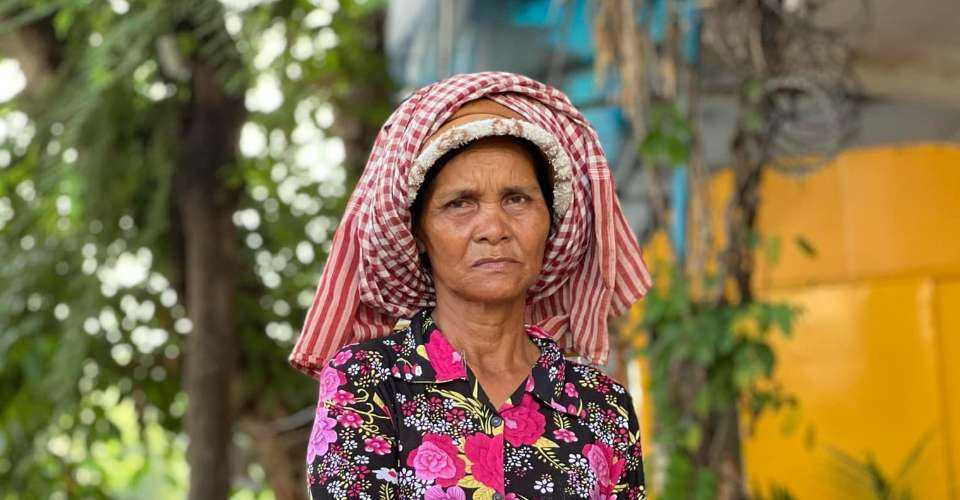
Hin Meng dug dikes with her bare hands. Her entire family died under the Khmer Rouge. (Photo: Vicheka Kol)

Published: April 14, 2025 04:13 AM GMT
Updated: April 14, 2025 05:09 AM GMT
Celebrations heralding a communist takeover of Cambodia on April 17, 1975, soon turned ugly as the Khmer Rouge imposed their dreaded agrarian-based Year Zero policies that left about a third of the population dead and collapsed a nation in less than four years.
Led by Pol Pot and Nuon Chea, the Chinese-backed ultra-Maoists marched into Phnom Penh and almost immediately ordered the city evacuated under the false pretext that the United States was about to bomb.
Hin Meng, 64, remembers, “Everyone was screaming with joy and we celebrated together. I didn’t know they would force us to work so hard and even starve our people to death.”
The Catholic cathedral was torn down, all religions were abandoned, Muslims were forced to eat pork, and policies that ranged from abandoning money to forced marriages and genocides, against the Vietnamese and Muslim Chams, were inflicted.
“We lived in hell. I dug dikes during the Khmer Rouge and carried soil, sometimes with my bare hands,” Hin Meng said, adding her entire family — parents, brothers, and sisters — passed away from illnesses contracted under the Khmer Rouge.
Her sentiments were echoed by Om Narin, 84, who sells water on the streets and looks after her grandchildren in Phnom Penh. She remembers the toll Pol Pot and Nuon Chea took on her family after seizing Cambodia, and quite literally everything in it.
“During the Khmer Rouge, we had no choice,” she said. When we planted potatoes, we couldn’t eat them because everything belonged to the Khmer Rouge, and they would kill us if we ate them. Now, at least I can find something to eat.”
She said her three sons died from illness and a lack of food, and her husband and daughter died under similar circumstances after the Khmer Rouge were ousted by the Vietnamese invasion in late 1978, but the great irony was that she worked as a cook.

“They stayed in a different unit, not far from me. I knew they were sick, but I couldn’t help them. I had to keep doing what the Khmer Rouge told me to do in the kitchen. I don’t like to talk about it much because this still hurts,” she said.
Within weeks of Phnom Penh’s capitulation to the Khmer Rouge, Laos and South Vietnamwould also fall to communism. But policies in Vientiane and Hanoi — after unification of the two Vietnams — were more pragmatic and more tolerant of local culture, religion, and even capitalism.
Cambodian-based French historian, Henry Locard, said no other communist country tried to “ruralize” an entire population like in Cambodia. And there were disastrous consequences.
“All the cities, not just Phnom Penh, but all the provincial capitals were emptied. Nobody has done that. They starved the population,” he said.
“What the Khmer Rouge did was they took all the communist tenets and implemented them 100 percent. Instead of nationalizing main industries, they nationalized everything. They abolished private property. No other communist country abolished all private property.
“Nobody else had done that. They did not scatter the families and introduce forced marriages. They are the only example of communists interfering with sexual life,” he said, adding Catholics would suffer greatly under the Khmer Rouge.
Between 1.7 million and 2.3 million people perished, often slaughtered with an ox-cart axle to the nape of the neck after processing through one of about 200 extermination centers — where victims were tortured and forced to make false confessions — known as santebals.
After the Vietnamese invaded with 150,000 troops, including Khmer Rouge defectors, Pol Pot and Nuon Chea retreated to the west, where they continued to fight the Soviet Union-backed Vietnamese until the end of the Cold War in 1989.
The Paris Peace Accords were signed in 1991, and United Nations peacekeepers arrived the following year, but the war continued until 1998 when Nuon Chea finally surrendered to then prime minister Hun Sen, enabling a UN-backed Khmer Rouge tribunal.
Bradley Murg, an adjunct research fellow with Pacific Forum, said the Cambodian People’s Party (CPP), which has ruled since the Vietnamese invasion, prefers the nation to remember the day the Khmer Rouge were ousted from Phnom Penh on Jan. 7, 1979.
The final capitulation, known as “Win Win,” on Dec. 29, 1998, is also remembered as the day that ended Cambodia’s civil war that began with a Khmer Rouge uprising in 1967.
“Cambodia state legitimization and state-led nationalism is based around 1979 rather than 1975, in the same way as the “Win Win” policy of the late 1990s is a key policy: It is the CPP that liberated Cambodia from the Khmer Rouge, that’s the narrative,” Murg said.
But ordinary Cambodians are just grateful the Khmer Rouge years have been consigned to history, as Hin Meng said: “It was not like now. Even though I earn very little today, I do have freedom and enough food to eat.”
*Vicheka Kol contributed to this story. The views expressed in this article are those of the author and do not necessarily reflect the official editorial position of UCA News.