We need to allow our liturgy to question our biases, enable people to truly experience God’s compassion for all
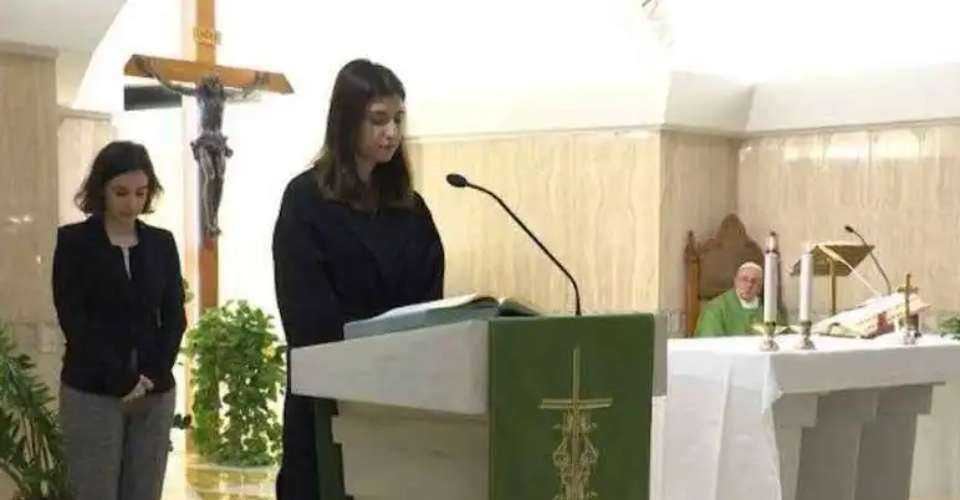
A laywoman reads at Mass in the Casa Santa Marta at the Vatican in February 2020. (Photo: Vatican News)
Published: June 16, 2025 11:43 AM GMT
Updated: June 16, 2025 12:09 PM GMT
In celebration of International Women’s Day in March, our department posted an announcement on our Facebook page that we would celebrate a Women’s Mass. The post also mentioned that during that event, one of my colleagues who self-identified as a queer theologian, would give a sharing.
For us in the department, it was just an ordinary invitation to our academic community to join in the celebration. We were surprised that it elicited more than 1,100 reactions (emoticons), around 90 percent of which were positive, 379 comments, and 293 shares.
What was even more surprising for us were the negative responses, which came mainly from outside our academic community.
For example, one commenter wrote, “The mass is already for all believers. This is reading Marxist DEI ideology into the mass. It is a violent attack against the mass because it claims [the] mass in itself is not a space for woman [sic]. Instead, this statement of a woman’s [sic] mass implies that the mass needs to undergo change in order to be a mass for woman’s [sic] voices. Very dangerous thinking and not Catholic at all.”
Another one chimed in, “Why the use of the term Women’s Mass? Is it not that the mass is for everyone and is already a sacred space? To use such [a] term evokes the idea that there is something wrong with the Eucharist and such use of the term denotes exclusivity, which is contradictory to the nature of the sacrament of unity.”
Still another questioned the self-identification of the sharer as a queer theologian, “Queer theologian? Do we always need to mention the perception we have on [sic] ourselves as if our worth, dignity, credibility, and relevance are based on our gender? This is truly concerning.”
There are many other statements along those lines. Some even questioned the department’s orthodoxy and called on the Diocese of Cubao, which has ecclesiastical jurisdiction over the university, and the Catholic Bishops’ Conference of the Philippines to look into the matter.
Such comments, however, betray not only the ignorance of those people (theological and contextual) but also their ideological biases.

All the different reactions seem to boil down to people’s view of women, the LGBTQIA+ community, and their experiences and roles in the Church.
People who are aware of the lack of participation and power of women in the Church, especially when it comes to decision-making, and of gender-based discrimination that many experience, and who think and feel that there is a need to address them, are appreciative of our department’s initiative.
For those who simply accept the status quo (the received tradition, whether in the Church or society) and don’t question the limited role of women in the Church and the discrimination that people experience, the Mass we organized was dangerous, divisive and perhaps, even heretical.
Given that Philippine society is patriarchal and that Filipino Catholics inherited from Spain their Catholic faith and partly together with it, their machismo culture, perhaps, we should have expected people’s reactions.
It appears that despite the different liberation movements in society, much work remains to be done. The roots of sexism and gender-based oppression still have to be fully uprooted and eradicated. Regrettably, many Filipinos, especially men, including members of the clergy, are not even aware of their sexist attitudes and perspectives.
If there is one institution that is perceived by many as a hindrance to women’s and LGBTQIA+ rights, it is the Catholic Church. With regard to women, the Catholic Church teaches that only men can become ordained ministers. Pope John Paul II asserted that this teaching was a matter of revelation.
Then, more recently, Pope Francis rejected what he called gender ideology, basically reaffirming the heteronormative teachings of the Catholic Church. While the latter showed greater openness to women by, among other things, appointing them to significant positions in the Curia, and the LGBTQIA+ community by reaching out to them, these actions appear inadequate.
There is a push among many critics of the Church’s position for the Church’s leadership to change its teachings with regard to them. However, that does not appear to be happening anytime soon. The majority of Catholics, in my view, consider women’s and men’s roles in the Church and their relationships as complementary, focusing mainly on their biological functions.
This is not surprising since Catholics have been socialized for centuries to think in those categories. Change then will understandably be too slow for many and painful for others.
The reason why we called our celebration a Women’s Mass with a queer theologian as a sharer was precisely because of the undeniable fact that women’s and LGBTQIA+ voices have not been sufficiently listened to in the Church and society.
In certain instances, their voices are even suppressed and their experiences devalued. That is why we wanted to bring to the fore their voices and experiences in the celebration. We have to take their experiences of exclusion, marginalization and oppression seriously.
We need to be empathetic as we do so, and avoid by all means any kind of mansplaining, which they have had too much already in their lives. We also need to consider how Church teachings have prevented them from being able to participate more fully in the Church’s life and from being able to use their charisms for the building up of the community.
The fact is that we have many gifted and qualified lay women in the Church whose abilities and talents are underappreciated and, worse, not tapped at all for the good of the Church. Sadly, it is the whole Church that suffers when it is deprived of all those gifts.
Our ordained leaders and ministers should not be threatened by the gifts of others, especially those of women. Rather, they should rejoice in the diversity of those charisms and be grateful to God for them and to people who want to contribute to the Church.
We — men, women and LGBTQIA+ — are all created in God’s image and likeness. That ought to be enough for us to relate to each other with respect, kindness and compassion. In the face of all kinds of discrimination and prejudice that people suffer, we seem to have forgotten that God creates and loves us individually into existence in our totality.
As St. Paul wrote to the Galatians, in baptism we are clothed with Christ. “There is no longer Jew or Greek, there is no longer slave or free, there is no longer male and female; for all of you are one in Christ Jesus” (NRSV 3,28).
What matters for us in the Church is our common baptism and, because of it, our common dignity as God’s children. It is this truth that we celebrate in a Women’s Mass. The exhortation by the Eucharistic presider to us to go in peace after the final blessing is a challenge for us to build a more Kingdom-like world in which all peoples, including women and LGBTQIA+ persons, experience the fullness of their dignity as beloved in God’s eyes.
We need to allow our liturgy to question our biases, enable people to truly experience God’s compassion for all, transform our mindsets, and inspire and strengthen us in our work to bring about God’s justice in today’s world.
*The views expressed in this article are those of the author and do not necessarily reflect the official editorial position of UCA News.