[Top Stories]25/07/10 Multi-faith youth pilgrimage promotes peace on Korean Peninsula
작성자성기화 요셉작성시간25.07.17조회수66 목록 댓글 0Four-day event organized by Seoul archdiocese included visits to key locations along the demilitarized zone
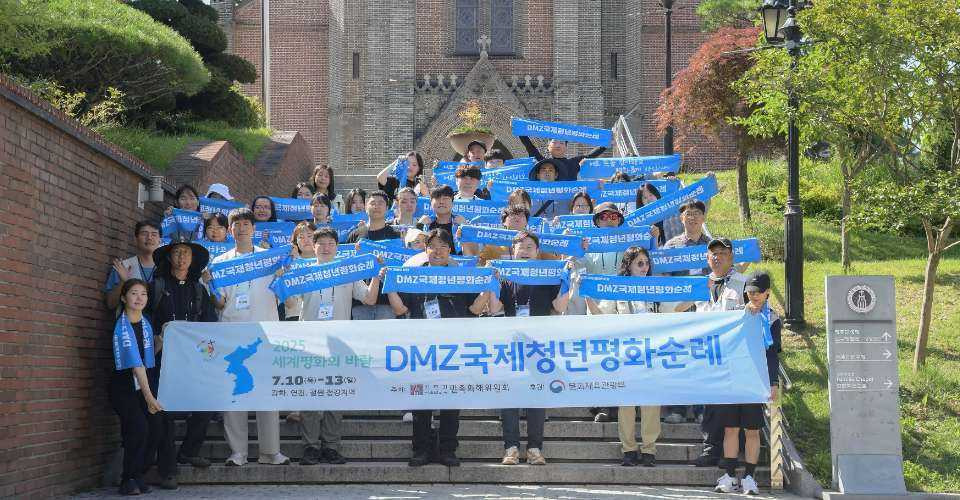
Participants of the 10th DMZ World Youth Peace Pilgrimage pose for a photograph in front of Myeongdong Cathedral in Seoul. (Photo: Korea Reconciliation Committee of the Archdiocese of Seoul)

Published: July 16, 2025 05:12 AM GMT
Updated: July 16, 2025 05:42 AM GMT
Participants of a Catholic Church-led multi-faith peace pilgrimage held at the demilitarized zone (DMZ) between South and North Korea have reiterated the need for peace and solidarity among both nations.
Some 40 participants took part in the “2025 Wind of Peace: DMZ World Youth Peace Pilgrimage,” held from July 10-13, Seoul archdiocese said in a press statement released on July 15.
“There can be no world peace without peace on the Korean Peninsula,” they said in a joint statement.
Oh Hye-in, 19, a non-Catholic and the youngest participant in the group, said: “I could really feel that North and South Korea are inseparable.”
She had arrived for the event on the recommendation of her Catholic aunt and was emotional after observing North Korea from the Odusan Unification Tower.
The group also visited the Jangsan Observatory, which offers a panoramic view of Songaksan in the city of Kaesong and the Masikryong Mountains in the North.
Participants recited St. Francis of Assisi’s “Prayer for Peace,” asking for peace on the Korean Peninsula, Seoul archdiocese said.
The event was organized by the Korea Reconciliation Committee (KRC) of the Archdiocese of Seoul and was sponsored by the Ministry of Culture, Sports and Tourism.

A task force was formed this year, which consisted of youths who participated in previous pilgrimages, to help prepare for the event.
Simon, a task force member and originally from North Korea, said he was initially worried about how the team could make the program better.
“However, we were able to prepare the event through open communication and collaboration with other task force team members, such as the clergy and staff of the KRC of Seoul,” said Simon, who goes by one name.
The event consisted of visits to various locations along the demilitarized zone.
On the first day, the youths visited the Odusan Unification Tower to see the sights across the border in North Korea.
The group then visited Imjingak Park to conduct a walking pilgrimage starting from Imjingak, passing through Fatima Peace Catholic Church and ending at the Jangsan Observatory.
On the second day, they visited the Cheorwon Peace Observatory in Gangwon province.
They then headed to the Sapseulbong Plateau, also known as the “Ice Cream Plateau,” which was the site of intense fighting and fierce artillery exchanges during the Korean War.
The youths later cycled to the “Open the Moon Café,” located near the border and run by
young people from the North who lived in a group home.
The group also visited the crematorium for UN Troops in Yeoncheon and the military cemetery for North Korean soldiers.
Joanna Hwang, a North Korean mother of three who is currently in South Korea, said she found it “hard to imagine that such a place actually existed.”
“The people buried here also had parents, families, and a home,” Hwang said.
Hwan also added that she was deeply moved by the fact that “even though they were enemies, someone took the time to bury and honor the North Korean soldiers.”
On the third day, the youths walked in silence along a 10-kilometer coastal fence path from Nanjeong Reservoir on Ganghwa Island to Gyodongdo Island Manghyangdae Observatory, while praying the rosary.
Teresa, a young Vietnamese woman, said that the pilgrimage was helpful for young Koreans and foreigners who want to understand Korean history better.
“I realized that true peace has nothing to do with who you are or where you come from.
Peace is an understanding that we are all alike and live under the same sky,” Teresa said.
She also urged the participants of the upcoming Catholic World Youth Day 2027 to “pray together for peace and reconciliation on the Korean Peninsula and around the world.”
On the fourth and final day, the group offered Sunday Mass with the intention of peace on the Korean Peninsula and around the world, and also shared their experiences of the previous four days.
The DMZ World Youth Peace Pilgrimage is a key program organized by the KRC of Seoul Archdiocese since 2012 to help youths become “apostles of peace.”
The KRC was established on March 1, 1995, by the late Stephen Cardinal Kim Sou-hwan, the then Archbishop of Seoul and Apostolic Administrator of Pyongyang, on the 50th anniversary of Korea’s liberation and division.
Following the end of Japan’s imperial rule (1905-45), Korea was divided into two parts by the United States and the Soviet Union after World War II.
Several efforts to unify Korea failed over disagreements between the US and Soviet regimes and resulted in the Korean War (1950-53).
North Korean communist forces invaded the South during the war, and the brutal conflict left some 4 million dead and about 10 million families displaced.
The war ended with an armistice, not a peace treaty, on July 27, 1953. It means the nations are technically still at war.