[Commentary]25/07/25 An American pope reluctant to speak English
작성자성기화 요셉작성시간25.07.28조회수443 목록 댓글 0Trying to explain why history's first US-born pope has been shy to use today's global language in public.
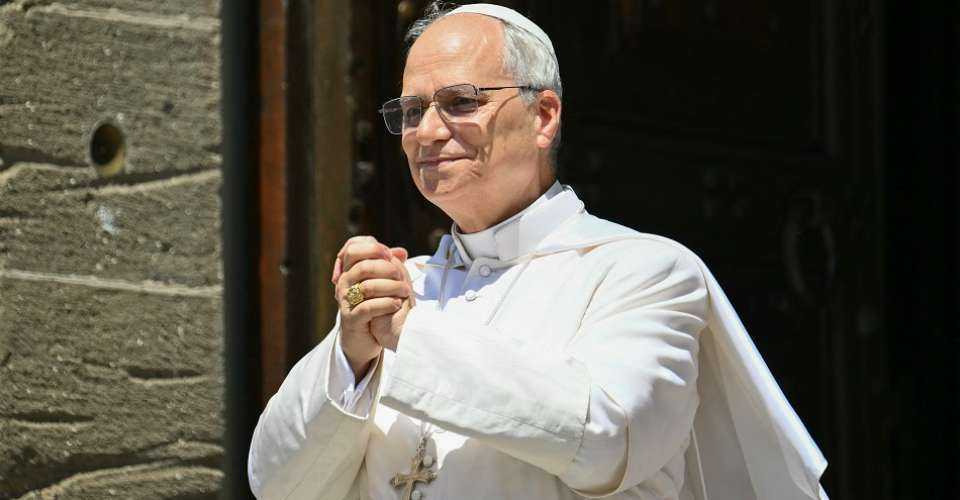
The newly elected Pope Leo XIV, revives a long-standing papal tradition paused under Francis, as Castel Gandolfo prepares to welcome a pope for the first time in over a decade.

Published: July 25, 2025 01:56 PM GMT
Updated: July 25, 2025 02:06 PM GMT
Is it because he does not want to come across as the "ugly" or arrogant American? Or is he trying to make it clear that he understands that his first and most important title is Bishop of Rome, a diocese where the primary and essential language is Italian?
Whatever the reason, Pope Leo, who was born and raised in Chicago, has been very reluctant during these early months of his pontificate to speak publicly in his native English.
"My first thought is that he is attempting to solidify his position with the Roman bureaucracy and the local Church and believes that at this stage he will give his adversaries a cudgel if he appears in public to be 'the American'," said a highly regarded woman theologian in the United States who carefully monitors Vatican affairs.
"Another possibility, which might amuse you as an expat, is that perhaps he went to the missions in the first place to get away from America," she said. "He may associate (using English) on an emotional level with everything he left behind. These aren't always rational choices!" the theologian said.

One of the best Italian journalists specializing in Vatican-Church affairs put it this way:
"It could be that he wants to avoid presenting himself as an American pope; and so already on the evening of his election, he avoided English and spoke, instead, in Italian and Spanish," my esteemed Italian colleague said, making an observation that nobody could disagree with.
Accepting the more traditional duties of the role
He then pointed out that Leo "is very disciplined and accepts the duties of the role without originality – like wearing more traditional papal garments, such as the mozzetta; deferring to the Secretariat of State, the Holy See's primary agency (mainly overseen by Italians) that deals with diplomacy and internal Church affairs.” He then added, "On this second point, I hope that, over time, Pope Leo will rebel, at least a little."
All these observations are true, but they are not sufficient. First of all, Leo is not monolingual, as are many (probably even most) of the Italian officials that work in the Roman Curia, which is the central bureaucracy of the global Church, a Church that – it still has to be pointed out to too many – is not the property of Rome or Italy, but is universal.
Although he is an American, Leo is fluent in several other languages, including Spanish and Italian. Honest observers (including Italians) must admit that the American pope speaks Italian better than his Argentinian predecessor, who was born to Italian immigrants.
Pope Francis spoke a very lively form of Italian, in which he often created novel phrases and invented new words. But his grammar was not top-notch, while Leo's is nearly perfect.
Francis, by the way, also avoided using his native tongue for almost the entire first year of his pontificate, evidently to show the people of Rome and Italy that, as their bishop, he was truly one of them.
Hiding his light under a bushel basket
Based on the reactions of the local people so far, Leo has already achieved this. However, as the chief pastor of the universal Church, the Roman Pontiff must also reach out to those outside of Rome and Italy.

And if he has the talent and ability to do so, he must use other languages that can reach a wider audience. A refusal to do so is, as scripture suggests, like hiding one's light under a bushel basket. This is certainly not an act of humility but one of irresponsibility.
The world, like the Church, is not limited to Rome or Italy. So when the head of the universal Church speaks to the world, it makes sense for him to do so in a language that most of the world understands.
It's estimated that 1.4 billion people speak English as either a first or second language, making it today's lingua franca. Of course, some non-English speakers, especially those within the Roman Curia, continue to view English as an imperialistic language. One can only speculate, but perhaps the pope avoids using English too much to prevent alienating them.
Remember, however, that Latin was also viewed as an imperialistic language in the early centuries after Christ. But that is precisely why the Church adopted it to replace Greek, the language used at its founding. The Church chose the language of the Roman Empire so it could communicate more effectively with the people living in it – most of the population in the known western world at the time.
Just imagine if he had said it in English
No one suggests that Pope Leo should speak only in English. Clearly, most of his duties in his diocese require Italian. The Roman Curia, because of its international role, is a bit different. But let's set that aside.
The bigger issue is when the pope, as the leader of the worldwide Church and some say as a moral voice for all Christianity, addresses world leaders and the international community, as he did last Sunday when he spoke about "the tragic news,” as he called it, that "continues to arrive in these days from the Middle East".
Leo expressed his "profound sadness regarding last Thursday’s attack by the Israeli army on the Catholic Parish of the Holy Family in Gaza City, which, as you know, killed three Christians and gravely wounded others."
Movingly, he specifically named the three people who died and said he was "particularly close to their families and to all the parishioners," pointing out that, "this act adds to the continuous military attacks against the civilian population and places of worship in Gaza."
Then, using forceful words, Leo called for "an immediate halt to the barbarism of the war and for a peaceful resolution of the conflict, renewing an earlier his "appeal to the international community to observe humanitarian law and to respect the obligation to protect civilians, as well as the prohibition of collective punishment, the indiscriminate use of force, and the forced displacement of the population."
Many commentators called his appeal "strong" and "heartfelt." But he issued it in Italian, a language spoken by just over 60 million people who live in Italy. Much of the news media picked it up and translated it into different languages. No one is saying that Pope Leo should not have made this appeal in Italian. But he should have immediately followed it up in English.
Just imagine the impact it would have had! It probably would have been the top story on every news network around the world – especially in Israel, where the war criminal Prime Minister is carrying out the attacks the pope lamented, and in the United States, where the morally corrupt president and his team of terrified sycophants have given the Israeli leader a blank check to carry out his destructive genocide of the Palestinian people.
Ooh là là – there's a precedent
One final thought… There was a time when popes –all of them Italian – used a language other than their own when addressing world leaders or the international community. That language was French.
Until Pope Francis, the Roman Pontiffs had used what was then widely accepted as the world's "diplomatic language" for centuries. The French fought hard to defend their native language and maintain it as the lingua franca on the global stage.
In 2006, French President Jacques Chirac, who had taken a summer semester at Harvard University and was fluent in English, caused a minor diplomatic controversy when he and three of his government ministers walked out of an EU leaders' meeting after a business leader began addressing the group in English.
How times have changed. Emmanuel Macron, the current President of France, often speaks English (in addition to French) when addressing international gatherings or the media.
It's a recognition that if someone is truly committed to effectively communicating a message to a targeted audience, the choice of language is not only practical but also essential.
In the case of the Roman pope, the target audience for his message— which is to preach the gospel and show how it applies to our lives and society— must be as large as possible, especially those 1.4 billion people who are more receptive to English than any other language.
Whether his Italian aides and minders like it or not, Leo should act quickly to ensure he's doing everything possible to reach that audience. That means he must not hesitate to use English on the world stage. He has no reason to apologize for this, nor is he obligated to justify it.
Those with ears to hear and eyes to see understand clearly why this is the most effective way for the leader of global Catholicism to promote and spread the Good News of Salvation in a world increasingly threatened by malicious actors and institutions.