[Commentary]25/10/03 If the Church ignores AI, it will die as a copy
작성자성기화 요셉작성시간25.10.05조회수121 목록 댓글 0The Church cannot step away from AI; it must discern how to incarnate the Gospel within it
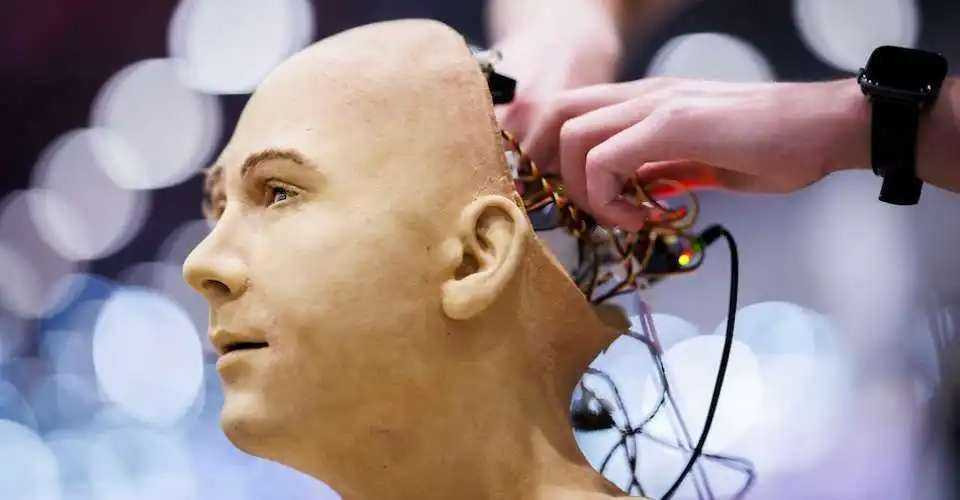
A man works on the electronics of Jules, a humanoid robot from Hanson Robotics that uses artificial intelligence, at a stand during the International Telecommunication Union (ITU) AI for Good Global Summit in Geneva on July 8. (Photo: AFP)

Published: October 03, 2025 10:54 AM GMT
Updated: October 03, 2025 10:57 AM GMT
“Everyone is born as an original, but many people end up dying as photocopies.” These words from St. Carlo Acutis, the first millennial Catholic saint known for his love of the Eucharist and digital evangelization, resonate powerfully today as the Church faces the rise of artificial intelligence (AI).
AI is, at its core, a tool. Like a bicycle, anyone can use it – but without balance, you fall. Raise it to the level of an airplane or spacecraft, and the skills and responsibility required are much greater.
Technology itself is not good or bad. The real question is how people guide and direct it.
AI is essentially a copycat. It imitates human reasoning, structures language, and recombines information based on what it has been trained on. It cannot create meaning in the moral or spiritual sense, but only mirrors what has already been given. That makes it a “faithful apprentice” to whoever wields it.
With vision, precision, and discipline, AI can be a powerful assistant. But with carelessness or ignorance, it becomes nothing more than a loudspeaker for secular culture.
This matters for the Church in Vietnam, which has 7 million followers or 7 percent of the nation's 100 million people. If Catholics are not proactive, the other 93 percent will be shaped by whatever dominates the online world – and many from the 7 percent will follow along.
Pope Francis, in Fratelli Tutti, warns that digital culture can create “echo chambers,” where authentic dialogue vanishes and only pre-programmed voices remain.
If the Church does not enter the digital field with AI as a partner, the weeds of misinformation and secularism will take over. Jesus’ parable reminds us that weeds and wheat grow together (Mt 13:24–30), but if the workers are idle, the whole field risks being lost.

This makes the role of leaders – clergy, religious, and lay apostles – all the more crucial. If they do not learn how to “give AI work,” by crafting precise prompts, training tools for pastoral service, and building guided Catholic chatbots, they leave the mission field empty. And the digital world, unlike traditional fields of ministry, waits for no one.
Every second, billions of data points flood social networks. Where does AI learn? From what already exists. And most of that comes from commercial giants, content manipulators, and ideological engineers. An AI not guided by a true shepherd will inevitably become a “false shepherd,” leading the flock astray.
Here, the theology of the Incarnation offers a compass. God did not reject human culture but entered it to redeem and transform it. The Church cannot step away from AI; it must discern how to incarnate the Gospel within it. St. John Paul once described the Internet as “a new forum leading humanity to Christ” (Message for the 36th World Communications Day, 2002). The same applies today to AI.
The question is not: “Is AI harmful?” The question is: “Do we have the maturity and faith to master it?”
The Compendium of the Social Doctrine of the Church teaches that all technological progress must serve humanity and the common good (no. 179). Technology must not become an idol. Yet neither can the Church lag behind. If left unguided, society risks “dying as a copy” – conformed to artificial values dictated by algorithms.
The Church’s mission is liberation: to awaken each person’s unique dignity as an original, beloved of God. If AI merely copies, then the Church must use it as a mirror to highlight the originality of the Gospel.
Secular society may absolutize AI for profit or power. Atheism may claim it proves humanity’s ability to create a “new god.” But the Catholic faith insists only God is the Creator. AI cannot generate originals. It can only produce copies. Only human beings, made in God’s image, carry unique dignity.
What does this mean in practice for the Church in Vietnam? It calls for a concrete strategy. A framework of seven steps could help:
Train the ‘masters’ before the machines. Priests, religious, and lay leaders must be trained to use AI responsibly, including writing prompts, setting boundaries, and applying ethical principles.
Create a Catholic data ecosystem. AI learns from data. The Church must digitize Scripture, Church documents, and papal teachings, and make them the foundation for Catholic AI tools.
Build Catholic chatbots under authority. Dioceses, parishes, and religious orders can create supervised chatbots to explain catechism, guide prayer, and answer liturgical questions.
Evangelize with AI tools. Utilize AI to produce videos, podcasts, and articles that resonate with young people where they spend their time online. This is a new mission field.
Discern ethically. AI is not a priest. It cannot replace sacraments, prayers, or conscience. It must be guided by Gospel values.
Mobilize the 7 percent. Though small, Vietnamese Catholics can use AI to amplify their witness, becoming salt, light, and leaven in the larger society.
Form a Catholic council on AI and media. A national body of clergy, religious, and lay experts should guide ethical use, provide training, and safeguard Catholic identity.
AI itself does not choose to be wheat or weeds. It reflects its master. Catholics must become those masters — sowing the seeds of the Gospel in digital soil. If we abandon the space, AI becomes a “false shepherd.” However, if we step in, it can serve as a pastoral ally, amplifying the Good News to the farthest reaches of the earth.
St. Carlo Acutis lived as an “original” in the digital world. His question lingers for us: Will the Church in Vietnam allow AI to reduce us to copies - or will we train it to become a tool for authentic witnesses of Christ?
Jos Ho Duc Trung is a layman hailing from Vinh Diocese. This commentary, first published in the Vietnamese-language publication https://gpvinh.org, was summarized, translated, and edited by UCA News. The views expressed in this article are those of the author and do not necessarily reflect the official editorial position of UCA News.