Why are many Malaysian Catholics questioning a Church fluent in dialogue but hesitant in action?
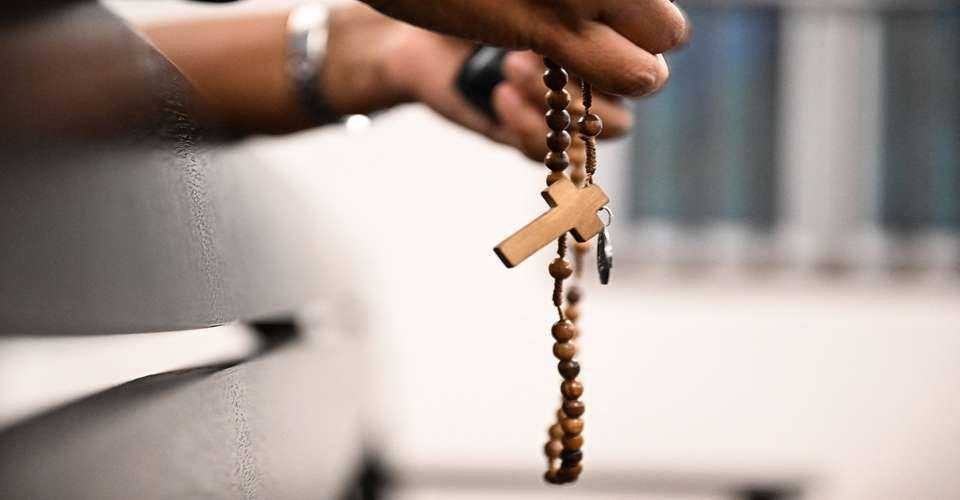
A Catholic holds a rosary with a cross during a Mass held in memory of Pope Francis at Sacred Heart Church in Bentong, Malaysia on April 21, 2025, in this file photo. Malaysia's Catholic Church has long embraced the language of renewal and social justice, but many Catholics now question whether its public witness matches its pastoral rhetoric. (Photo: AFP)

Published: June 05, 2026 04:48 AM GMT
Updated: June 05, 2026 05:24 AM GMT
For decades, the Catholic Church in Malaysia has spoken the language of renewal.
Pastoral plans, diocesan assemblies, clergy conferences and Church seminars have repeatedly returned to familiar themes: “reading the signs of the times,” “journeying together,” “integral human development,” “communion and participation,” and “see, judge and act.”
The language draws heavily from the reforms of the Second Vatican Council and the pastoral vision promoted by the Federation of Asian Bishops’ Conferences (FABC), which has shaped much of the Asian Church’s thinking since the 1970s.

Across Asia, bishops have consistently called for a “Church of dialogue” — one engaged with cultures, religions, the poor and the realities of society.
In Malaysia, these ideas are not unfamiliar. They appear regularly in pastoral reflections, social ministry programs and synodal conversations. Yet for many ordinary Catholics today, especially younger laypeople and those working closely with struggling communities, the repetition increasingly feels detached from lived reality.
The issue is not that the Church talks about justice. The issue is that the Church often appears more comfortable discussing justice than confronting the structures that produce injustice.
More than 60 years after Vatican II and decades after the Asian bishops articulated a vision of a socially engaged Church, many Catholics are quietly asking what that engagement now means in practical terms.
The real signs of the times
The “signs of the times” in Malaysia are neither abstract nor difficult to identify.
They are migrant workers packed into overcrowded dormitories and Orang Asli (native communities) displaced by logging, plantations and development. They are stateless children still denied proper access to education in Sabah. They are urban families struggling with rising costs, underpaid youth burdened by economic insecurity and growing numbers of young Malaysians drifting away from organised religion because institutions no longer appear morally credible, and refugee problems, especially those affecting the Rohingya Muslims.
They are also found in the anxieties surrounding race and religion that continue to shape Malaysian public life.
Temple relocation disputes, controversies over unilateral religious conversions, increasing religious polarisation and political rhetoric built around ethnic insecurity have all contributed to a climate where minority communities often learn survival through caution and silence.
In such an environment, many Catholics increasingly wonder whether the Church still possesses the courage to speak with moral clarity.
A Church shaped by caution
The Malaysian Church has historically preferred careful engagement over confrontation.
There are understandable reasons for this. Christians are a minority in Malaysia, and Church leaders have often prioritised social stability, interreligious harmony and institutional survival.
But caution can also become culture.
This stands in contrast to parts of the wider Asian Church, particularly in the Philippines and South Asia, where Catholic leaders have at times taken far more visible public positions despite political pressure and institutional risks.
In the Philippines, Church leaders openly criticised extrajudicial killings during Rodrigo Duterte’s anti-drug campaign. Cardinal Luis Antonio Tagle warned against a “reign of terror,” while Bishop Broderick Pabillo repeatedly challenged state violence and attacks on dissent.
The Catholic Bishops’ Conference of the Philippines has also spoken out against corruption, disinformation, and efforts to undermine democratic institutions.
In India, several Church leaders and Catholic organisations have publicly voiced concern over rising religious intolerance, mob violence, attacks on minorities and the misuse of anti-conversion laws.
Indian bishops and Church groups have raised concerns over violence against Christians in states such as Manipur; they have criticised growing religious nationalism and communal tensions; spoken against the demolition of churches and harassment of minority communities; defended constitutional secularism and minority protections; expressed alarm over attacks on Dalits and indigenous tribal communities, and challenged discriminatory citizenship debates and communal rhetoric.
Jesuit priest Father Stan Swamy became one of the most internationally recognised Catholic voices for indigenous and tribal rights before dying in custody in 2021 after being arrested under anti-terror laws.
Similarly, churches in Sri Lanka played a major role in demanding accountability after the 2019 Easter bombings, while Catholic leaders in South Korea and East Timor historically participated in democracy and human rights movements.
None of these churches is perfect. All operate within difficult political environments. Yet they demonstrated a willingness to move beyond carefully managed pastoral language into visible public witness.
Social teaching without social risk
In Malaysia, however, Church discourse often remains heavily institutional and academically safe. It speaks eloquently about dignity, solidarity and social justice while stopping short of directly challenging systems that perpetuate exclusion and inequality.
Dialogue remains important. But dialogue cannot become a permanent substitute for public moral witness.
There is a growing perception among many lay Catholics that Church institutions have become more comfortable organising forums, producing pastoral documents and conducting formation programs than taking difficult public positions on issues affecting vulnerable communities.
A seminar alone is not a transformation. A framework alone is not a mission.
The irony is that the Catholic Church already possesses one of the world’s richest traditions of social teaching. From Rerum Novarum to Laudato Si’, Church teaching contains sharp critiques of exploitation, corruption, ecological destruction and political indifference.
Asian bishops themselves have repeatedly called for a “Church of the poor” and a more participatory model of leadership rooted in grassroots realities.
Yet in Malaysia, much of this language remains confined within conference halls, parish programs and carefully managed discussions. The Church discusses poverty while many poor communities continue waiting for stronger institutional solidarity.
This disconnect is becoming increasingly visible to younger Catholics.
Many are not rejecting spirituality itself. Rather, they are questioning institutions they perceive as cautious, bureaucratic and reluctant to take risks. A generation shaped by economic anxiety, political instability and digital transparency is less persuaded by ecclesiastical vocabulary than by visible action.
The deeper issue is whether the Church still understands the disruptive nature of the Gospel.
Jesus did not merely discuss suffering in theoretical terms. His ministry consistently confronted exclusion, hypocrisy and abuses of power. The early Christian community was remembered not for carefully managed dialogue sessions, but for its public witness among the poor, the sick and the socially excluded.
Today, parts of the Church risk reducing the language of justice into institutional jargon detached from daily realities.
A Church that risks something
History rarely remembers religious institutions for the sophistication of their frameworks. It remembers those willing to stand visibly beside vulnerable communities when doing so became uncomfortable or costly.
The challenge facing the Church in Malaysia — and perhaps much of the Asian Church — is therefore not primarily intellectual. Catholic social teaching is already extensive. The deeper question is whether Church institutions are prepared to accept the risks that meaningful public witness sometimes requires.
Catholics in Malaysia are no longer simply asking whether the Church can organise another program on the “signs of the times.”
Increasingly, they are asking whether the Church itself is still willing to respond to the signs standing directly before it.
*The views expressed in this article are those of the author and do not necessarily reflect the official editorial position of UCA News.