Reservation is not about poverty but correcting generations of caste-based exclusion
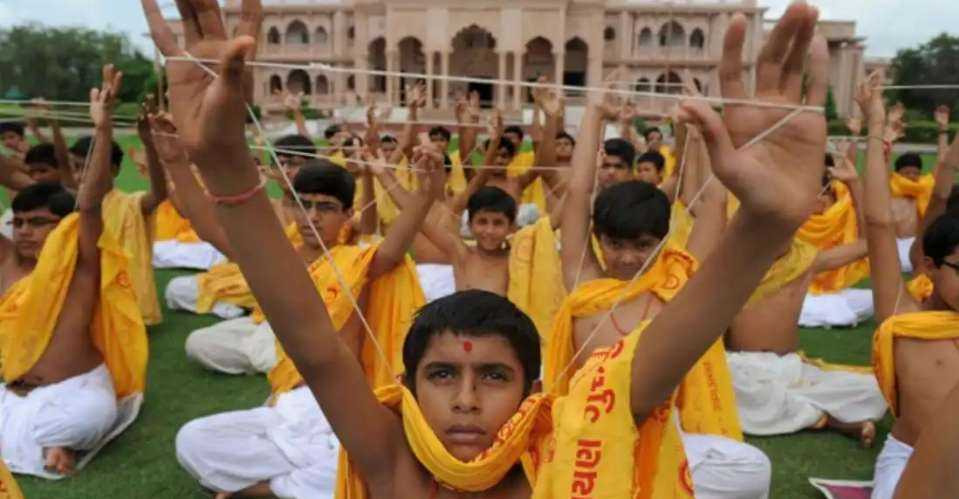
A file image of young Indian Brahmins from the Shree Swaminarayan Gurukul Vishwavidya Pratishthanam (SGVP) participating in the Janoi or 'sacred thread' changing ceremony in Ahmedabad. (Photo: AFP)

Published: June 22, 2026 02:34 AM GMT
Updated: June 22, 2026 02:35 AM GMT
There is a version of this conversation that never happens. The one where someone with every advantage sits quietly with that fact — not in guilt, not in performance — but in genuine reckoning. Where they look at what they inherited and call it by its real name.
A young man did that recently. Fifth-generation educated family. Parents with postgraduate degrees, stable careers, and a home where books were furniture. Many of his friends are first-generation learners whose parents still work the land — not by choice, but because of what was withheld from them across generations.
He named this clearly: Inherited Oppression. Then he said what needed saying. The reservation policy that gives job and education quotas to India’s marginalized people is not a poverty alleviation program. It is affirmative action — designed to bring equity, level the playing field, and create social equilibrium.

I’ve been turning that over ever since. Not because it’s new. Because it’s true, and truth repeated in the right voice at the right moment does something that statistics alone cannot.
The inheritance nobody declares
Think about what gets passed down in a family educated for five generations. Not just money — though often that too. What passes down is subtler and more durable: the instinct to feel at home in formal spaces, the ability to read a room full of gatekeepers, the knowledge of which doors to knock on and how hard.
The grandmother who told her granddaughter that universities were places for people like them. The father whose colleagues became his son’s references before his son had done anything to deserve them. The mother who corrected grammar at dinner, unaware she was conveying power with the salt.
None of this appears on any balance sheet. None of it enters the conversation when we talk about merit. But it is there — accumulating silently across decades, as all inherited wealth does. Except this kind cannot be taxed. Cannot be redistributed. Cannot even be fully seen by those who carry it, which is precisely what makes it so effective.
The child of a first-generation learner is not starting from zero. She is starting in debt — carrying the weight of every door locked before she was born, every generation that was told the room was full.
That is what caste capital means. Not a slur. Not a theory. A description of how advantage actually moves through time, quietly, in the bodies of children who never asked for it and cannot give it back.
The correction, not the cause
Reservation did not create inequality in India. It arrived after centuries of inequality so deep it had stopped looking like a choice and started looking like nature.
Entire communities were excluded from education, from land, from professional life, from the rooms where decisions were made. Not by accident. By architecture. The system was not merely indifferent to certain people — it was constructed to keep them out, with the kind of thoroughness that only comes from long practice and social consensus.
Reservation is what the Indian Constitution said in response: that this cannot continue unremarked, that representation is not a luxury, that dignity does not accrue to the patient.
This is why calling it a poverty alleviation scheme misses the point so completely.
Poverty alleviation addresses what people lack. Reservation addresses why they were made to lack it. The distinction is not semantic. It is the difference between bandaging a wound and asking who inflicted it and why the knife is still out.
Merit — the word that arrives so reliably in these arguments — deserves a direct answer. Merit is not a seed that grows identically in any soil. It needs nutrition: stable homes, consistent schooling, adults who model possibility, the unearned confidence that comes from never once being made to feel like an exception in a room built for others.
Strip that away across generations, measure the harvest, and call the difference natural.
That is not a neutral position. That is a story, told by people who benefit from its being believed.
The forgetting
Something has been lost — and this is the harder thing to say — among young people from Dalits or formerly untouchable castes, indigenous tribal people and other backward communities themselves. A generation raised at enough distance from the sharpest edges of caste exclusion has slowly, without quite noticing, begun to carry the arguments of those who would dismantle the very protections that made their own presence possible.
This did not happen by accident either.
When reservation is taught as an administrative policy rather than a moral response to documented historical crime, the foundation quietly disappears. And without the foundation, the structure above it becomes indefensible — not because it is wrong, but because nobody can remember why it was right.
There are genuine reforms worth demanding. Creamy layer provisions are applied consistently rather than selectively. Sub-categorization to reach the most marginalized within reserved groups, who are often bypassed by those slightly above them.
The exclusion of Dalit Christians and Dalit Muslims from Scheduled Caste benefits — despite facing caste discrimination that did not dissolve at the moment of religious conversion — is a real and inadequately examined injustice that younger voices should be pressing loudly.
But none of that conversation is possible while the foundational purpose is still being misrepresented. You cannot reform something you’ve been persuaded shouldn’t exist. And you cannot see that persuasion happening if you’ve never been taught what it’s trying to undo.
What the tailwind actually feels like
Here is something every serious runner knows. A personal best achieved with the wind behind you and a personal best run directly into it look identical on paper. The clock does not record what the body endured. The time is the time. The effort was not the same.
We understand this in sport without needing to be convinced. We resist understanding it almost everywhere else.
The young man who spoke about caste capital and inherited oppression was doing something that should be ordinary and remains, somehow, rare: he was acknowledging his tailwind. Not apologizing for it. Not flagellating himself in public for the comfort of an audience. Simply seeing it — feeling it on his face, naming it honestly, refusing the familiar comfort of pretending it was just his own legs that got him here.
That refusal is where real progress begins. Not in legislation, not in election cycles, not in the daily friction of social media. In a private moment, when someone chooses accuracy over a flattering story about themselves.
I think about the grandmother again. The one who passed down, without knowing, the certainty that institutions were built for her family. What she gave her granddaughter was real. It was also, in some form, taken — held in trust across generations from families who never got to pass anything down at all, because the doors were locked and the locks were legal.
That is not guilt. That is history. And history, unlike guilt, requires something more than feeling bad.
It requires honesty. Then it requires action.
*The views expressed in this article are those of the author and do not necessarily reflect the official editorial position of UCA News.