
Echinacea (에키네시아)
Keywords: coneflower, American coneflower, cold, flu
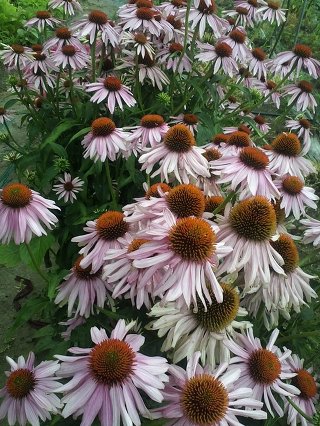
Photography by Robert E. Lyons
On this page:
Introduction (서론)
This fact sheet provides basic information about the herb echinacea—common names, uses, potential side effects, and resources for more information. There are nine known species of echinacea, all of which are native to the United States and southern Canada. The most commonly used, Echinacea purpurea, is believed to be the most potent.
이 자료는 허브식물인 에키네시아에 대한 기초적인 정보를 제공합니다. - 일반적으로 사용되는 이름, 잠재적인 부작용 그리고 추가정보를 얻을 수 있는 기관. 에키네시아엔 9종이 알려져 있습니다. 모두 미국 및 남부 캐나다가 원산지입니다. 가장 흔히 사용되는 것이, 에키네시아 포푸리아ㅡ가 가장 유력한 품종으로 보입니다.
Common Names—echinacea, purple coneflower, coneflower, American coneflower
Latin Names—Echinacea purpurea, Echinacea angustifolia, Echinacea pallida
일반적인 명칭 - 에키네시아, 보라색 콘플라워, 콘플라워, 미국 콘플라워
라틴 명칭- 에키네시아 포푸리아, 에키네시아 앵구스티포리아, 에키네시아 팔리다
What Echinacea Is Used For (에키네시아의 용도)
- Echinacea has traditionally been used to treat or prevent colds, flu, and other infections.
- Echinacea is believed to stimulate the immune system to help fight infections.
- Less commonly, echinacea has been used for wounds and skin problems, such as acne or boils.
- 에키네시아는 전통적으로 감기 및 다른 감염을 치료하거나 막는데 사용됐습니다.
- 에키네시아는 감염의 저항성을 증가시키기 위한 면역시스템을 자극하는 것으로 보입니다.
- 흔하지는 않지만, 에키네시아는 여드름 및 boil과 같은 상처 및 피부상의 문제를 치료하는데 사용됐습니다.
How Echinacea Is Used (사용 방법)
The aboveground parts of the plant and roots of echinacea are used fresh or dried to make teas, squeezed (expressed) juice, extracts, or preparations for external use.
식물의 지상부와 뿌리를 있는 그대로 사용하거니 말려서 차를 만들거나, 압착하여 주스로 만들거나 추출하여 사용합니다. 또는 외용을 위해 ..
What the Science Says (연구 결과)
- Study results are mixed on whether echinacea can prevent or effectively treat upper respiratory tract infections such as the common cold. For example, two NCCAM-funded studies did not find a benefit from echinacea, either as Echinacea purpurea fresh-pressed juice for treating colds in children, or as an unrefined mixture of Echinacea angustifolia root and Echinacea purpurea root and herb in adults. However, other studies have shown that echinacea may be beneficial in treating upper respiratory infections.
- NCCAM is continuing to support the study of echinacea for the treatment of upper respiratory infections. NCCAM is also studying echinacea for its potential effects on the immune system.
- 연구결과에 의하면 에키네시아는 감기와 같은 기관지 감염에 대해 예방을 하거나 효과적으로 치료한다는 것에 대해 상반된 결과를 보여줍니다. 예를 들면, NCCAM의 재정적 지원을 받은 두가지 연구는 에키네시아로부터 어떤 이득도 발견하지 못했습니다. 어린이 감기를 치료하기 위한 에키내시아의 신선하게 압착한 쥬스라든지 성인을 위한 에키네시아 앵구스티포리아의 뿌리와 에키네시아 포푸리아의 뿌리와 허브의 정제되지 않은 혼합물에서 효과가 별 볼일 없었습니다. 그러나, 또 다른 연구는 에키네시아가 호흡기 감염을 치료하는데 약발이 있다고 얘기합니다.
- NCCAM은 호흡기 감염을 치료하기 위한 에키네시아 연구를 재정적으로 꾸준히 지원하고 있습니다. NCCAM 은 또한 면역시스템에 대한 에키네시아의 잠재적인 효과를 검증하기 위해 에키네시아를 연구하고 있습니다.
Side Effects and Cautions (부작용 및 주의사항)
- When taken by mouth, echinacea usually does not cause side effects. However, some people experience allergic reactions, including rashes, increased asthma, and anaphylaxis (a life-threatening allergic reaction). In clinical trials, gastrointestinal side effects were most common.
- People are more likely to experience allergic reactions to echinacea if they are allergic to related plants in the daisy family, which includes ragweed, chrysanthemums, marigolds, and daisies. Also, people with asthma or atopy (a genetic tendency toward allergic reactions) may be more likely to have an allergic reaction when taking echinacea.
- Tell all your health care providers about any complementary and alternative practices you use. Give them a full picture of what you do to manage your health. This will help ensure coordinated and safe care. For tips about talking with your health care providers about CAM, see NCCAM’s Time to Talk campaign.
- 입으로 먹었을 때, 에키네시아는 부작용을 일으키지 않습니다. 그러나, 일부의 사람들에게 알레르기 반응을 나타냅니다. 임상실험에선, 위장에 나타나는 부작용이 가장 일반적입니다.
- 돼지풀, 국화, 메리골드, 데이지를 포함하는 데이지 품종과 관련된 식물에 알레르기 반응을 일으키는 사람들은 에키내시아에 알레르기 반응을 보일 가능성이 있습니다.
- 당신의 헬쓰케어 제공자에게 당신이 사용하고 있는 보완 및 대체(치료) 방법을 모두 얘기해 주세요. 그 사람들에게 당신이 건강을 관리하기 위해 실시하는 것들에 대한 모든 것을 전달해 주세요. 이렇게 하신다면 잘 조율되고 안전한 건강관리를 보장하는데 도움이 될 것입니다.
Sources (출처)
- Barrett BP, Brown RL, Locken K, et al. Treatment of the common cold with unrefined echinacea: a randomized, double-blind, placebo-controlled trial. Annals of Internal Medicine. 2002;137(12):939–946.
- Echinacea. In: Blumenthal M, Goldberg A, Brinckman J, eds. Herbal Medicine: Expanded Commission E Monographs. Newton, MA: Lippincott Williams & Wilkins; 2000:88–102.
- Echinacea. Natural Medicines Comprehensive Database Web site. Accessed at www.naturaldatabase.com on May 11, 2009.
- Echinacea (E. angustifolia DC, E. pallida, E. purpurea). Natural Standard Database Web site. Accessed at www.naturalstandard.com on June 1, 2009.
- Fugh-Berman A. Echinacea for the prevention and treatment of upper respiratory infections. Seminars in Integrative Medicine. 2003;1(2):106–111.
- O'Neil J, Hughes S, Lourie A, et al. Effects of echinacea on the frequency of upper respiratory tract symptoms: a randomized, double-blind, placebo-controlled trial. Annals of Allergy, Asthma, and Immunology. 2008;100(4):384–388.
- Shah SA, Sander S, White CM, et al. Evaluation of echinacea for the prevention and treatment of the common cold: a meta-analysis. Lancet Infectious Diseases. 2007;7(7):473–480.
- Taylor JA, Weber W, Standish L, et al. Efficacy and safety of echinacea in treating upper respiratory tract infections in children: a randomized controlled trial. Journal of the American Medical Association. 2003;290(21):2824–2830 begin_of_the_skype_highlighting 2824–2830 end_of_the_skype_highlighting.
- Turner RB, Bauer R, Woelkart K, et al. An evaluation of Echinacea angustifolia in experimental rhinovirus infections. New England Journal of Medicine. 2005;353(4):341–348.
For More Information
NCCAM Clearinghouse
The NCCAM Clearinghouse provides information on CAM and NCCAM, including publications and searches of Federal databases of scientific and medical literature. The Clearinghouse does not provide medical advice, treatment recommendations, or referrals to practitioners.
Toll-free in the U.S.: 1-888-644-6226 begin_of_the_skype_highlighting 1-888-644-6226 end_of_the_skype_highlighting
TTY (for deaf and hard-of-hearing callers): 1-866-464-3615 begin_of_the_skype_highlighting 1-866-464-3615 end_of_the_skype_highlighting
Web site: nccam.nih.gov
E-mail:
(원문 출처) NCCAM (미국의 국립 보완.대체의학 센터)