글로벌 반도체 조정으로 매도세가 촉발되며 한국 증시는 월요일 급락했습니다.
코스피는 8.29% 급락하며 서킷 브레이커와 사이드카가 동시에 발동되었습니다.
최근 실적 발표 이후 반도체 실적 사이클이 정점에 도달했을 수 있다는 우려가 커졌습니다.
오늘은 코스피가 반등하고있어서 이번 하락은 반도체 사이클 종료라기보다 과열 이후 조정 성격이 강하다는 시각이 강해 보입니다.
KOSPI plunges 8% on concerns over end of chip earnings cycle, interest rate hike
반도체 실적발표 주기 종료 및 금리인상 우려로 코스피 8% 급락
By Jun Ji-hye 전지혜 기자
Published Jun 8, 2026 4:15 pm KST Updated Jun 8, 2026 4:23 pm KST
Won rebounds after authorities warn against excessive FX volatility
외환 변동성 과도 경고 후 원화 반등
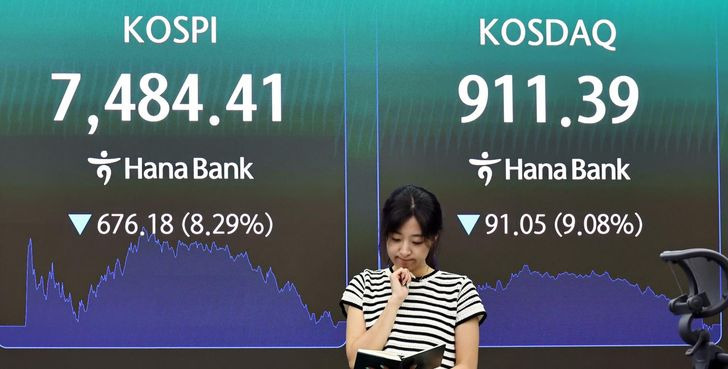
Korean stocks tumbled Monday, as a broad-based correction in global semiconductor shares triggered heavy selling across the market, prompting the activation of both sidecar trading curbs and circuit breakers on the KOSPI and Kosdaq markets.
한국 증시는 월요일, 글로벌 반도체 업계 전반의 조정 국면으로 인해 매도세가 촉발되면서 급락했다. 코스피와 코스닥 시장에서는 사이드카 거래 제한과 서킷 브레이커가 발동되었다.
Attention is centered on whether KOSPI, which has staged a record-breaking rally this year, can resume its upward trajectory after a short-term correction or whether market volatility will intensify further.
올해 사상 최고치를 경신해 온 코스피가 단기 조정 후 상승세를 재개할 수 있을지, 아니면 시장 변동성이 더욱 심화될지에 관심이 집중되고 있다.
The benchmark KOSPI opened 112.50 points, or 1.38 percent, lower at 8,048.09 before extending its losses throughout the session to close at 7,484.41, down 676.18 points, or 8.29 percent.
코스피는 개장 초 112.50포인트(1.38%) 하락한 8,048.09로 출발해 장중 하락세를 이어가다 676.18포인트(8.29%) 하락한 7,484.41로 마감했다.
The index reached an all-time intraday high of 8,933.62 on June 2. After plunging 5.54 percent on Friday, the KOSPI posted losses for a second consecutive session, underscoring growing concerns over a pullback in semiconductor stocks that had fueled the market's recent rally.
6월 2일 코스피 지수는 장중 사상 최고치인 8,933.62를 기록했다. 금요일 5.54% 급락한 데 이어 이틀 연속 하락세를 보이며 최근 시장 상승세를 이끌었던 반도체 관련 주식의 반등에 대한 우려가 커지고 있음을 보여줬다.
Amid heavy selling pressure, trading restrictions kicked in shortly after the market opened, with a Level 1 circuit breaker triggered at 9:03 a.m. and a sell-side sidecar activated at 9:34 a.m.
강력한 매도 압력 속에서 개장 직후 거래 제한 조치가 발효되었다. 오전 9시 3분에 1단계 서킷 브레이커가 발동되었고, 오전 9시 34분에는 매도 측 사이드카가 작동했다.
Circuit breakers are emergency measures that temporarily suspend trading across the entire market when the KOSPI or Kosdaq drops by 8 percent, 15 percent or 20 percent from the previous session's close and remains below those levels for at least one minute.
서킷 브레이커는 코스피 또는 코스닥 지수가 전일 종가 대비 8%, 15%, 또는 20% 하락하고 해당 수준 이하로 1분 이상 유지될 경우 전체 시장의 거래를 일시적으로 중단하는 비상 조치이다.
Trading is halted for 20 minutes under the first and second stages, while a third-stage trigger results in a market shutdown for the remainder of the trading day.
1단계와 2단계에서는 20분간 거래가 중단되며, 3단계에서는 해당 거래일 동안 시장이 완전히 폐쇄된다.
When the circuit breaker was triggered, KOSPI was down 685.85 points, or 8.40 percent, at 7,474.74. It was the third circuit breaker activated on the KOSPI this year and the ninth since the mechanism was introduced. The sell-side sidecar marked the 11th activation on record.
서킷 브레이커가 발동되었을 당시 코스피는 685.85포인트(8.40%) 하락한 7,474.74를 기록했다. 이는 올해 코스피에서 발동된 세 번째 서킷 브레이커이며, 서킷 브레이커 도입 이후로는 아홉 번째이다. 매도측 사이드카까지 포함하면 역대 11번째 발동이다.
Compared with sidecars, circuit breakers are invoked only under more severe market conditions and are therefore relatively rare. The latest trigger came amid a convergence of negative factors, including a weaker won, mounting concerns over additional interest-rate hikes amid elevated inflation and a steep sell-off in major semiconductor stocks on fears that the industry's earnings cycle may have peaked.
사이드카와 달리 서킷 브레이커는 더욱 심각한 시장 상황에서만 발동되기 때문에 상대적으로 드믈다. 이번 서킷 브레이커 발동은 원화 약세, 높은 인플레이션 속 추가 금리 인상 우려, 반도체 업계 실적 사이클 정점 돌파 우려로 인한 주요 반도체 주식의 급락 등 여러 악재가 겹친 가운데 발생했다.
The last two times both a sell-side sidecar and a circuit breaker were activated on the KOSPI on the same day were March 4 and 9, when global financial markets were rattled by the recent outbreak of the U.S.-Iran war.
코스피에서 매도측 사이드카와 서킷 브레이커가 동시에 발동된 것은 최근 미국과 이란의 전쟁 발발로 글로벌 금융 시장이 흔들렸던 3월 4일과 9일 이후 처음이다.
The secondary Kosdaq market also came under heavy selling pressure, opening 42.83 points, or 4.27 percent, lower at 959.61. Losses deepened throughout the session, with the junior bourse closing at 911.39, down 91.05 points, or 9.08 percent, from the previous day.
코스닥 증시 역시 강한 매도세에 휩싸여 42.83포인트(4.27%) 하락한 959.61로 개장했다. 하락세는 장중 내내 이어지며 코스닥은 전날 대비 91.05포인트(9.08%) 하락한 911.39로 마감했다.
A sell-side sidecar was triggered on the Kosdaq at 9:06 a.m. as selling accelerated. Later in the day, a circuit breaker was activated for 20 minutes beginning at 2:35 p.m., temporarily halting trading across the market.
오전 9시 6분, 매도세가 가속화되면서 코스닥에서는 매도 포지션 청산을 위한 사이드카 거래가 발동되었다. 이후 오후 2시 35분부터 20분간 서킷 브레이커가 적용되어 시장 전체 거래가 일시적으로 중단되었다.
It marked the second circuit breaker activation on the Kosdaq this year, following the previous occurrence on March 4.
이는 올해 코스닥에서 서킷 브레이커가 발동된 두 번째 사례로, 앞서 3월 4일에도 발동된 바 있다.
Analysts attributed the steep decline in Korean equities to growing investor concerns that the semiconductor earnings cycle may have peaked following Broadcom's latest earnings report. Expectations for additional interest rate hikes by the U.S. Federal Reserve later this year also dampened risk appetite, while uncertainty surrounding the upcoming initial public offering of SpaceX added to the cautious mood.
분석가들은 한국 증시의 급락 원인을 브로드컴의 최근 실적 발표 이후 반도체 기업들의 실적 호조세가 정점에 달했을 가능성에 대한 투자자들의 우려로 분석했다. 미국 연방준비제도(Fed)의 올해 하반기 추가 금리 인상 기대감 또한 위험 선호 심리를 위축시켰고, 스페이스X의 기업공개(IPO)를 둘러싼 불확실성도 신중한 분위기를 더했다.
Domestic stocks were particularly vulnerable to a correction after posting outsized gains in recent months. As of last week, the KOSPI climbed more than 60 percent from early April, fueled largely by strong advances in Samsung Electronics and SK hynix. The market's heavy reliance on a handful of semiconductor giants left it more exposed when sentiment toward the sector turned negative.
최근 몇 달간 큰 폭으로 상승했던 국내 증시는 조정에 특히 취약한 모습을 보였다. 지난주 기준으로 코스피 지수는 삼성전자와 SK하이닉스의 강세에 힘입어 4월 초 대비 60% 이상 상승했다. 그러나 반도체 대기업 몇 곳에 대한 시장의 의존도가 높아 해당 업종에 대한 투자 심리가 악화될 경우 더욱 큰 타격을 입을 수 있었다.
Adding to the pressure were substantial net sales by foreign investors and a sharp depreciation of the won.
여기에 외국인 투자자들의 상당한 순매도와 원화의 급격한 약세까지 더해져 압박이 가중되었다.
On Monday, the Korean currency opened at 1,555.2 won per dollar, weakening by 16.1 won from the previous session and marking its worst level against the U.S. currency in 17 years and three months. The won subsequently rebounded to close onshore trading at 1,535 per dollar, improving 4.1 won from the previous session.
월요일, 원화는 달러당 1,555.2원으로 개장하며 전 거래일 대비 16.1원 하락, 17년 3개월 만에 최저치를 기록했다. 이후 원화는 반등하여 달러당 1,535원으로 마감하며 전 거래일 대비 4.1원 상승했다.
The rebound came after financial authorities stepped up verbal intervention in the foreign exchange market, pledging to respond firmly to excessive volatility and speculative trading.
금융 당국이 외환 시장에 대한 구두 개입을 강화하고 과도한 변동성과 투기적 거래에 강력히 대응하겠다고 밝힌 후 반등이 나타났다.
In a joint statement, the Ministry of Finance and Economy and the Bank of Korea said recent fluctuations had been amplified not only by market supply and demand but also by speculative transactions such as non-deliverable forwards, adding that they would not tolerate movements deemed excessive relative to economic fundamentals or one-sided market conditions.
재정부와 한국은행은 공동 성명에서 최근의 변동성은 시장의 수급뿐만 아니라 선물환 등 투기적 거래에 의해서도 증폭되었다고 지적하며, 경제 펀더멘털이나 일방적인 시장 상황에 비해 과도하다고 판단되는 움직임은 용납하지 않겠다고 밝혔다.
Despite the sharp market decline, many analysts argued that the selloff reflected profit-taking after an extraordinary rally rather than signaling the end of the artificial intelligence (AI)-driven boom.
시장의 급격한 하락에도 불구하고 많은 분석가들은 이번 매도세가 인공지능(AI) 주도 호황의 종료를 의미하는 것이 아니라 이례적인 랠리 이후의 차익 실현에 따른 것이라고 주장했다.
"Key growth drivers for the industry remain firmly in place, including the expansion of HBM4 supply chains and anticipated shipments of next-generation high-performance GPUs," Kim Joong-won, an analyst at Hyundai Motor Securities, said. "The recent pullback appears to be a short-term adjustment in market expectations rather than evidence that the AI investment cycle is coming to an end."
현대자동차증권의 김중원 애널리스트는 "HBM4 공급망 확장과 차세대 고성능 GPU 출하량 증가 등 AI 산업의 주요 성장 동력은 여전히 견고하다"며, "최근의 하락세는 AI 투자 사이클의 종료를 의미하는 것이 아니라 시장 기대치의 단기적인 조정으로 보인다"고 말했다.
#Semiconductor earnings cycle peak 반도체 실적 사이클 정점 #Interest rate hike concerns 금리 인상 우려 #Circuit breaker / Sidecar 서킷 브레이커 / 사이드카 #Foreign investor sell-off 외국인 순매도 #FX volatility / Weak won 외환 변동성 / 원화 약세