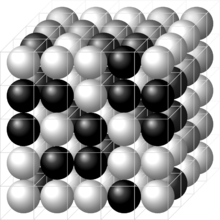
A three-dimensional lattice filled with two molecules A and B, here shown as black and white spheres. Lattices such as this are used - for example - in the Flory–Huggins solution theory
In physics, a lattice model is a physical model that is defined on a lattice, as opposed to the continuum of space or spacetime. Lattice models originally occurred in the context of condensed matter physics, where the atoms of a crystal automatically form a lattice. Currently, lattice models are quite popular in theoretical physics, for many reasons. Some models are exactly solvable, and thus offer insight into physics beyond what can be learned from perturbation theory. Lattice models are also ideal for study by the methods of computational physics, as the discretization of any continuum model automatically turns it into a lattice model. Examples of lattice models in condensed matter physics include the Ising model, the Potts model, the XY model, the Toda lattice. The exact solution to many of these models (when they are solvable) includes the presence of solitons. Techniques for solving these include the inverse scattering transform and the method of Lax pairs, the Yang–Baxter equation and quantum groups. The solution of these models has given insights into the nature of phase transitions, magnetization and scaling behaviour, as well as insights into the nature of quantum field theory. Physical lattice models frequently occur as an approximation to a continuum theory, either to give an ultraviolet cutoff to the theory to prevent divergences or to perform numerical computations. An example of a continuum theory that is widely studied by lattice models is the QCD lattice model, a discretization of quantum chromodynamics. However, digital physics considers nature fundamentally discrete at the Planck scale, which imposes upper limit to the density of information, aka Holographic principle. More generally, lattice gauge theory and lattice field theory are areas of study. Lattice models are also used to simulate the structure and dynamics of polymers. Examples include the bond fluctuation model and the 2nd model.
이징 모형( 통계역학)
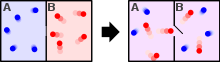
이합체 모형 : 이합체 모형(二合體模型, 영어: dimer model)은 어떤 그래프 위의 완벽 부합들의 공간 위에 정의되는 통계역학 모형이다
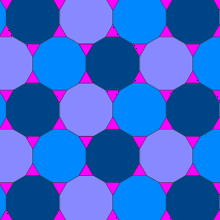
피셔 격자