May 21, 2026
Key Verse 23: “But the one who received the seed on good soil is the one who hears the word and understands it; he produces a crop, yielding a hundred, sixty, or thirty times what was sown.”
Chapters 5 through 7 of the Gospel of Matthew recount how Jesus delivered a long sermon on a hillside near Capernaum, beginning with the Beatitudes. Following this sermon, He healed the sick, continued to teach the Word of God, and called disciples (Chapters 8–12). Jesus thus taught the Word of God abundantly so that His listeners might accept it and bear much fruit from it.
Today’s passage describes how Jesus told the parable of the sower to both the crowd and His disciples. Through this, Jesus sought to reveal the secret of how to bear much fruit from the Word of God that is heard.
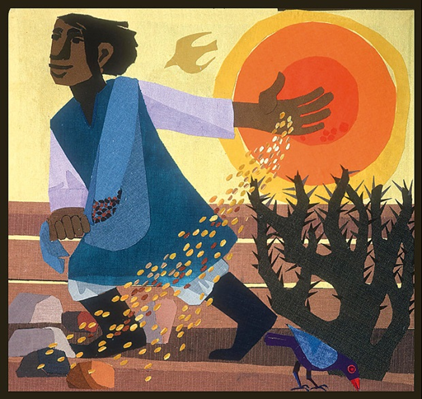
The Sower [1]
In this text, Jesus Christ teaches us that we are sowers—both men and women—scattering seed to reap a bountiful harvest.
Naturally, we desire to bear much fruit and rejoice in it. We want to be loving, kind people and, at the same time, lead as many people as possible to faith in Jesus Christ.
Therefore, using the Parable of the Sower, we want to discover today the secret of how our lives can become fruitful.
1. The Parable of the Sower (1–9)
Today, Jesus goes to the Sea of Galilee. A large crowd gathers around Him; He wants to teach them the Word of God. Since so many people have come, He would actually need a pulpit and a microphone. Unfortunately, He has neither. He spots a fishing boat on the shore, steps into it, and speaks from there to the crowd standing on the bank.
Most of the listeners are poor. They need bread. Some of them are sick. Therefore, they need healing.
Of course, Jesus knows that they need bread and healing. He does not ignore such needs. Yet, He knows what is most important for them. We recall that at the beginning of His ministry, He fasted for forty days and forty nights and was tempted by the devil. The devil suggested to Him: "If You are the Son of God, command that these stones become bread!" Jesus answered, "Man shall not live by bread alone, but by every word that proceeds from the mouth of God" (Matthew 4:4).
Jesus is right. God’s Word is the most necessary and important thing for us humans. Only God’s Word can grant us forgiveness, eternal life, and the Kingdom of Heaven. Only God’s Word can give us a true sense of purpose and the right direction in life. That is why He proclaims God’s Word to the gathered crowd.
He begins to tell a story:
A sower goes out to sow grain. In his joy, he sows almost exuberantly. Consequently, the seeds fall everywhere: on the hard path, on rocky ground, among thorns and thistles, and—thank God—also on good soil.
Then birds come and peck up the seeds lying on the path. The seeds on the rocky ground do sprout, but the sun scorches them, and the seedlings quickly wither because the layer of soil is thin. The seeds that fell among the thistles actually germinate and begin to grow. But the thistles choke the young plants.
However, the seeds that fell on good soil grow up and bear fruit—thirtyfold, sixtyfold, and even a hundredfold.
2. Some who stayed behind and asked questions (10–17)
A large crowd has heard Jesus’ story. They understood it well. It was also clear to them that Jesus would not be giving them bread this time. They say to themselves, "I have heard enough of God’s Word for today—and I understood it well, too. After all, I’m not stupid. So, I’m going to take a break from Bible study for a few weeks. After all, I have to work for my daily bread."
The crowd disperses, and suddenly it becomes very quiet.
But a few people remain behind. They say to themselves, "I didn’t quite understand what Jesus taught. I didn’t fully grasp God’s Word. I would rather stay here and ask Him what He meant by His words."
They ask Jesus, "What does this parable mean in practical terms?"
Jesus is pleased with them and says, "To you it has been given to understand the secrets of the kingdom of heaven, but to them it has not been given" (11).
Here, Jesus reveals two prerequisites for understanding the secret of the kingdom of heaven:
The first prerequisite is to ask Jesus. The majority of the crowd that turned away likely believed they had correctly understood Jesus’ words. Those who stayed, however, sensed that they had not fully grasped Jesus’ parable. They therefore wanted to remain and ask Him about its meaning. They desired to understand the parable correctly and put its teaching into practice.
We recall Jesus’ words: “Ask, and it will be given to you; seek, and you will find; knock, and it will be opened to you” (Matthew 7:7).
It is not a bad thing if we do not understand God’s word immediately. What matters, however, is that we remain willing to learn and ask Jesus about the meaning of His word.
The second prerequisite for discovering the mystery of the Kingdom of God is to remain with Jesus.
At the end of verse 11, Jesus explains that those who did not remain with Him cannot understand the mystery of the Kingdom of God. Whoever remains with Jesus, however, will understand His word, for Jesus explains it to them. Whoever understands His word will believe in Jesus as the Christ and receive eternal life. Whoever believes in Jesus as the Christ and remains with Him will grow well as a disciple of Jesus. Whoever grows well spiritually will bear abundant fruit.
Therefore, we should not be ashamed if we do not immediately understand certain words of Jesus. Instead, we should remain with Him and ask Him. He will certainly explain them to us and help us to bear abundant fruit.
3. The Interpretation of the Parable (13–20)
Jesus explains His parable to those who have remained behind:
The seeds Jesus scatters represent the Word of God. They are of the highest quality. Just as a farmer sows seeds trusting in a rich harvest, so Christ sows His Word with full confidence.
The various types of soil in the parable represent different kinds of people: the hardened, the superficial, the bitter, and the teachable. And the yield depends on the condition of the soil. Likewise, the yield of the divine Word depends on the attitude of the individual's heart.
Some people have a heart—a soil of the heart—that is as hard as a path.
Jesus says, “When anyone hears the word of the kingdom and does not understand it, the evil one comes and snatches away what was sown in his heart: This is the one along whose path the seeds fell” (19).
If the soil of our heart is as hard as paving stones, we cannot receive God’s Word at all. The evil one rejoices greatly at this.
There is an idiom that applies to such a heart: “He has a heart of stone.” It means that a person is hard-hearted, distant, and unapproachable. If the soil of our heart is as hard as paving stones, we cannot receive God’s Word at all. The evil one rejoices greatly at this.
When does our heart become as hard as a path?
Our heart hardens toward God’s Word when we are deeply preoccupied with other things or have no interest in God’s Word. It also hardens when we harbor prejudices against Jesus or God’s Word. Unbelief hardens our heart, as does sin. For example, Pharaoh’s heart hardened as a result of unbelief and sin, becoming as hard as a path. How can we transform our hardened hearts into good soil so that we can receive God’s word and bear fruit? We must break free from whatever holds us captive and repent of our unbelief or our sins. Then our hearts will become good soil for God’s word.
Secondly, Jesus explains the image of rocky ground with its thin layer of soil: “The seeds sown on rocky ground represent the person who hears the word and immediately receives it with joy; yet he has not struck root in God’s word but is fickle. When trouble or persecution arises because of the word, he immediately falls away” (20–21).
The impact of difficulties is comparable to the effect of the sun. The sun is actually good and necessary for a plant, as it provides the energy source for its growth. However, without a sufficiently moist layer of soil, the sun causes the seeds to dry out quickly.
The function of a plant’s roots is to anchor it firmly in the ground and to absorb water and nutrients from the soil. The same applies to us. When we strike our roots deep into God’s word, we receive nourishment and strength and grow well spiritually. In this way, we can withstand storms, mature properly, and bear abundant fruit.
Without being rooted in God’s word, however, we run the risk of easily falling away from the faith as soon as difficulties arise. Therefore, we should examine ourselves to see whether we have truly struck our roots deep into God’s word.
Thirdly, Jesus explains the thorny ground: “The seed falling among the thorns refers to someone who hears the word, but the worries of this life and the deceitfulness of wealth choke the word, making it unfruitful” (22).
Here, Jesus identifies the worries of the world as the first spiritual thorn.
Why do we worry? Naturally, because we have problems. Everyone has problems; in fact, there is not a single person in the world who has absolutely no problems at all. And as soon as one problem is solved, a new one arises.
Consequently, when we worry, we lack both the strength and the heart for God and our fellow human beings. Of course, we should approach the problems we face with prudence. Yet, even in the face of these problems, we are to trust in God. We should not let worry drain our strength; instead, we should place our firm trust in God and resolve our problems with His help.
However, the root cause of our worry is not the problem itself but rather our lack of trust in God. When we worry, we expend three to four times as much energy as we would under normal circumstances. When consumed by worry, we consequently lack the heart and strength for God or other people. Of course, we should strive to solve the problems that arise wisely and effectively. Yet, regardless of the problems, we must place our trust in God. We should not allow worry to rob us of our heart and strength. Instead, we should trust firmly in God and overcome our problems with His help.
Jesus identifies our excessive desire for wealth as the second thorn that renders us unfruitful.
He describes wealth as “deceitful” because money leads us astray. Of course, money can be used to fulfill certain desires. The problem, however, is that many people believe they can fulfill ‘all’ their desires if only they have plenty of money. In reality, money is by no means capable of fulfilling so many wishes. For instance, money cannot buy a faithful spouse or a loyal friend. Instead, money often tempts us to judge others based on their income. Worst of all, however, is our tendency to place our trust in money rather than in God. In this way, money easily becomes our idol.
We must be careful to place our hope not in money, but in God.
According to the Gospel of Mark, Jesus identifies desires as the third thorn (Mark 4:19).
Here, the term “desire” refers both to sexual longing and to the craving for material things—such as houses, cars, and the like. We must not give in to either sexual or material desires. Instead, we should trust that our God will provide for our needs in His own time. We are to live and act before God in this trust. To do so, we must constantly fight the good fight of faith.
How can we transform a heart overgrown with thorns into good soil for God’s Word? We must tear the thorns out of our hearts. If we were merely to cut the thorns off, new thorns would grow back from the stumps. If we remove our worries or desires only superficially, we will soon face problems again. Therefore, we must completely remove the roots of the thorns from our hearts. At the same time, however, we must constantly examine our hearts to see if any thorns remain.
Yet, simply removing the thorns from our hearts is not enough. We should fill our hearts with faith, love, and hope so that the thorns have no chance to take root.
Let us now consider what becomes of the seeds sown on good soil.
In verse 23, Jesus says, "But the one sown on good soil is the one who hears the word and understands it and then also bears fruit; and one yields a hundredfold, another sixtyfold, and a third thirtyfold."
Here, Jesus reveals to us the secret of fruitfulness, "hearing God’s word, understanding it, and bearing fruit."
In this context, the word "understand" encompasses grasping the meaning, believing, and putting it into practice.
Jesus’s word is His counsel to us. When someone says, "I have understood your advice," they mean: "I have understood your advice and intend to follow it."
To bear fruit, therefore, we must hear God’s word, believe it, and obey it. This can be described as the trinity of faith.
How much fruit can we produce when we hear God’s word, believe it, and obey it?
Jesus says that a believer can bear thirtyfold, sixtyfold, or hundredfold fruit—just as a grain of wheat can yield a thirtyfold, sixtyfold, or hundredfold harvest.
We can categorize our fruit into inner fruit and outer fruit.
Inner fruit refers to our transformed inner self—qualities such as love, joy, peace, patience, kindness, goodness, faithfulness, gentleness, chastity, etc. (Galatians 5:22–23).
Outer fruit refers to people who come to faith in Jesus Christ through our direct or indirect help. If we deeply embrace God’s word and obey it, we will—directly or indirectly—lead at least 30 people to faith. Each of these 30 believers will, in turn, lead at least 30 people to faith. That is the wonderful fruitfulness of the seed of faith. That is the Kingdom of God. We need to realize that it is a great blessing to listen to God’s Word, to believe it, and to obey it. Through this, God’s kingdom spreads throughout the whole world. May God bless our prayer for the spread of the Gospel. Amen!
---- ---- ----
Two weeks ago, Andreas asked me to preach in his place today. I considered which text I should preach on. I chose this passage because I wanted to examine myself regarding what has hindered me from bearing much fruit for God.
I reflected on whether I had truly accepted God’s Word and obeyed it.
When I listened to Andreas’s sermon on Sundays, I received grace through God’s Word and took notes in my planner. Yet, by Sunday afternoon, I had completely forgotten the Word of God I had received; I occupied myself with other things. Consequently, the Word bore hardly any fruit in my life.
In a way, I was like a hard path or rocky ground for God’s Word.
That is why I have decided to review the notes from Andreas’s sermon on Sunday afternoons and reflect on what God’s Word has to say to me personally.
May God help me to bear abundant fruit—both inwardly and outwardly—so that I may give glory to God.