June 23, 2026
The faith of the Canaanite woman
Key verses 27–28: “She said, ‘Yes, Lord; yet even the dogs eat the crumbs that fall from their masters’ table.’ Then Jesus answered and said to her, ‘Woman, your faith is great! Let it be done for you as you wish.’ And her daughter was healed at that very hour.”
Prayer is an important part of our life of faith. Unfortunately, we often feel that God remains silent or refuses our request, despite our prayers.
In this story, Jesus initially remains silent despite a woman’s repeated pleas and subsequently appears to reject her request.
How does the woman respond to this?
We want to explore this story more deeply and discover how we can experience Jesus’ help. We want to uncover the secret of answered prayer.
1. The healing of the Canaanite woman’s daughter
Jesus had had confrontations with the Pharisees and scribes on the western shore of the Sea of Galilee. Afterward, He withdrew to the region of Phoenicia.
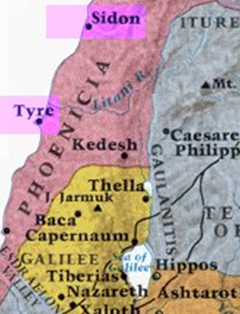
Sidon and Tyre [1]
The coastal strip along the Mediterranean is known as Phoenicia; it included cities such as Tyre and Sidon. Phoenicia roughly corresponds to present-day Lebanon. The ancestors of the Phoenicians were—like the Jews—Semites. Their linguistic roots lay in the Semitic language family, which they shared with the Babylonians, Assyrians, Arameans, Hebrews, Syrians, and others. The Phoenicians engaged in successful maritime trade and established colonies, including Carthage. During the time of Jesus's ministry, they were under Roman rule.


Development of the Phoenician and Hebrew scripts [2]
The language of the ancient Phoenicians was a dialect of Hebrew. The Phoenician script is considered the first alphabetic script in the strict sense of the word. The Phoenician alphabet consists of 22 consonants. The script runs from right to left. The Phoenician script spread widely through the trade networks of Phoenician merchants. The Greek script was a further development of the Phoenician script; building upon it, the Greeks developed their own writing system starting in the 8th century BC. They converted the consonants they did not need into vowels.
Latin, Cyrillic (or Slavic), Coptic, and Aramaic alphabets are derived from the Greek alphabet. This shows us that God used the Semites as a blessing to the world in the cultural sphere as well.
The city of Sarepta was located near Sidon. We recall the story of how the prophet Elijah once stayed with a poor widow in Sarepta and miraculously multiplied her meager supply of flour (1 Kings 17:8 ff.).
Why did Jesus travel to the region of the Phoenicians? Likely because he wanted to withdraw from the territory ruled by Herod Antipas, remain in seclusion there for a time, and prepare for his final struggle (Mark 7:24), since the legalistic Pharisees would not set foot in that pagan territory.
Unfortunately, he could not remain hidden, for a woman learned of his presence. She was a Canaanite—a descendant of the Semitic Phoenicians.
When the woman heard that Jesus was there, she recognized a unique opportunity for her daughter's healing. Yet she did not simply stay at home waiting for Jesus to happen to pass by her door; instead, she hurried to him to seek his help. As soon as she came to Jesus, she began to cry out: “O Lord, Son of David, have mercy on me! My daughter is severely tormented by an evil spirit.”
She called Jesus “Son of David” because she believed in Him as the Messiah, even though many Jews considered Him a false Messiah! This was an encouragement to Jesus.
How did Jesus respond to her plea for help?
At first, He did not answer, even though she kept crying out loudly for His help. God’s silence is often a great test of our faith. Despite His silence, the woman did not stop calling out. She did everything she could to win Jesus over.
Had this woman cried out only a few times and then stopped, Jesus’ disciples likely would not have taken her cause to heart. But because she cried out ceaselessly for help, they found no peace. That is why they urged Jesus to help her—so that she would finally leave and let them be. They said to Jesus: “Grant her request and send her away quickly! Otherwise, she’ll keep shouting after us” (23).
But Jesus remained composed and answered the woman: “It is not right to take the children’s bread and throw it to the dogs.”
By “children,” Jesus meant the Israelites, and by “dogs,” foreigners like this woman. Calling someone a dog was considered a grave insult. Thus, Jesus not only refused the woman’s request but also deeply insulted her.
Naturally, the woman understood these insulting words; yet she believed that Jesus was the Messiah who could heal the sick.
Was the woman angry about His refusal and His insult?
Verse 27 records her reaction: “She said: ‘Yes, Lord. But even the dogs get to eat the crumbs that fall from their masters’ table.’”
She understood how to move Jesus to help. In this way, she was able to receive His help.
Why was she able to receive His help despite His apparent refusal?
I will name three reasons why she experienced Jesus’ help:
2. Three secrets to receiving Jesus’ help
First: because she had great love for her child.
Because she loved her daughter so deeply, she did not feel offended despite the obvious slight from Jesus. Instead, she was determined to receive his help. Her love drove her to come to Jesus and persistently ask for his mercy. Her love enabled her to ask tenaciously for his help—even in the face of his silence.
Love works wonders. Nothing is stronger or closer to God than love. There are many problems in this world. If we view ourselves and others without love, the many problems we face cause us only sorrow. If, however, we possess love, our problems are practically already solved, for love gives us purpose and strength. To solve a problem, one must possess love. Love makes us purposeful and devoted; It gives us hope and strength. It works miracles and brings happiness to our lives.
Secondly, because she had faith in Jesus.
She addressed Jesus as "Lord, Son of David." "Son of David" was the title for the promised Messiah. She had heard of Jesus’ miracles. This led her to consider who Jesus was, and she became convinced that he must be the promised Messiah. That is why she cried out to him: "Lord, Son of David, have mercy on me! Deliver my daughter from the evil spirit."
Her faith was remarkably great. Although the Jewish religious leaders were well acquainted with Jesus’ deeds and teachings, they did not believe in Him. Instead, they regarded Him as a false teacher and sought to accuse Him. Yet this foreign woman believed in Him as the Messiah and in His divine power. Because she loved her child and believed in Jesus as the Messiah, she was determined to receive His help. She therefore came to Him, crying out repeatedly: "Lord, Son of David, have mercy on me!" Her love and faith moved Jesus’ heart, and He answered her: "Woman, your faith is great. Let it be done for you as you wish!"
Now we understand why Jesus had remained silent until then: He wanted to test her faith. He wanted to see whether she would continue to believe in His love and power even in the face of His rejection. Had she doubted His mercy and power, she would have stopped asking; but because she firmly believed in His mercy and power, she did not give up.
Indeed, she held fast to her belief in His mercy and power; nothing could discourage her. She ceaselessly pleaded for His help. Jesus was pleased with her faith; He commended her and healed her daughter.
God’s Word in Hebrews 11:6 states: "Without faith it is impossible to please God, because anyone who comes to him must believe that he exists and that he rewards those who earnestly seek him."
Thirdly, because the woman was humble and wise.
When Jesus said, "It is not right to take the children’s bread and throw it to the dogs," the woman did not take offense. How might she have reacted to Jesus’ words had she been a proud woman? She would surely have been angered and, ultimately, would not have received His help.
But she responded with humility and wisdom. She said: "Yes, Lord. But even the dogs get to eat the crumbs that fall from the table."
She was humble and wise. She acknowledged that she was actually unworthy of receiving Jesus' help. Yet, because she was both humble and wise, she did not take offense; instead, she replied that even a dog receives something from its master's table.
Arrogance and pride often make us prisoners of our own egos, causing us to miss the golden opportunity for divine help and blessing. Humility and wisdom, however, enable us to receive God's help and blessing.
We ought to become humble, wise people and experience God's blessing in abundance.
There is a Korean proverb: "Young stalks of grain stand upright, but ripe stalks bow low." The meaning is this: A person who has truly learned from life's experiences is humble; they listen carefully to the opinions of others and willingly follow good advice. People can become increasingly unyielding as they age, but through the Spirit of God, we should become like ripe stalks of grain. We should ask God to make us humble and wise.
Three Good Things
There is a saying: "Good things come in threes." From the Canaanite woman, we can learn three secrets about how to experience God's help.
First, we should have love. Love gives us motivation and strength. Love works miracles. Nothing is stronger or closer to God than love.
Second, we should have faith in Jesus and His power. When we have faith in Jesus Christ and His power, we please God, and He will surely bless us.
Third, we should be humble and wise. When we are humble and wise, we are not easily hurt but can act wisely. God will certainly bless us.
If we possess love, faith, and humility & wisdom, we can move God's heart under any circumstances so that He blesses us. May God grant us love, faith, humility, and wisdom. Amen!