Jesus' answers to the tax and resurrection questions (Mark 12:13-27)
작성자Stephan Choe작성시간25.07.03조회수196 목록 댓글 0July 3, 2025
Key verse 25: “When they rise from the dead, they will neither marry nor be given in marriage, but they will be like the angels in heaven.”
Many people ask questions about current political issues and also about the world after death. Jesus Christ gives us clear answers to such questions.
Today, we want to get to know Jesus' answers to the two questions, one political and the other our spiritual future.
1 Jesus' answer to the political question (13-17)
The spiritual leaders of the Jews wanted to kill Jesus. However, they held back because they were afraid of the people. However, they were looking for reasons to eliminate Jesus.
This passage begins like this: "And they sent to him some Pharisees and of the Herodians to trap him by a word. And they came and said to him, ‘Teacher (original: 'Rabbi’, i.e., teacher or master), we know that you are true and inquire of no one, for you do not regard the reputation of men, but teach the way of God. Is it right to pay taxes to the emperor or not? Should we pay them or not pay them?" (verses 13-14).
Most of the priests belonged to the Sadducee. They were wealthy, worldly upper classes of the people. They were collaborators with the Romans. Herod's people were pleasure-seekers and collaborated with the Romans.
The Pharisees, on the other hand, were strictly religious people who were dedicated to observing the laws of the Old Testament. The Pharisees, on the other hand, lived ascetically and refused to cooperate with the Romans in any way.
The two groups were actually hostile to each other. But both groups were familiar with the well-known tactic of “divide and conquer”: you ally yourself with one group to defeat another and then use the opportunity to eliminate the allied group as well.
The Pharisees wanted to brand Jesus as a traitor to the God’s people through this question. The Herodians wanted to use this question to prove that Jesus was a rebel against the Romans.
The People from both groups began to tempt Jesus with flattering praise: “Blessed Teacher, we know that you are true and that you teach the truth of God independently of men. Is it right to pay the imperial tax to Caesar or not? Should we pay or shouldn’t we?”
The tax mentioned here was called the “poll tax”. At that time, the payment of taxes, especially the poll tax, was a sensitive issue for Jews. Everyone was obliged to pay this tax, and it fell to the emperor in Rome.
Opinion among the Jews was divided. Herod's people thought that the tax payments to the Romans were justified because the Romans performed military service and ensured peace and order. The Pharisees, on the other hand, believed that the people of God had fulfilled all legal requirements by paying tithes and did not need to pay taxes to the Roman occupiers.
The people of the two groups asked Jesus: “Is it lawful to pay tax to Caesar or not?” (15).
If Jesus answered “no”, Herod's followers would immediately report him to the Roman occupation authorities. If Jesus answered “yes”, the Pharisees could brand him a traitor to his country.
Either way, they thought they had lured Jesus into a trap.
What did Jesus say to them?
Jesus realized their intention and answered them: "Why are you tempting me? Bring me a denar, that I may see it!" (15).
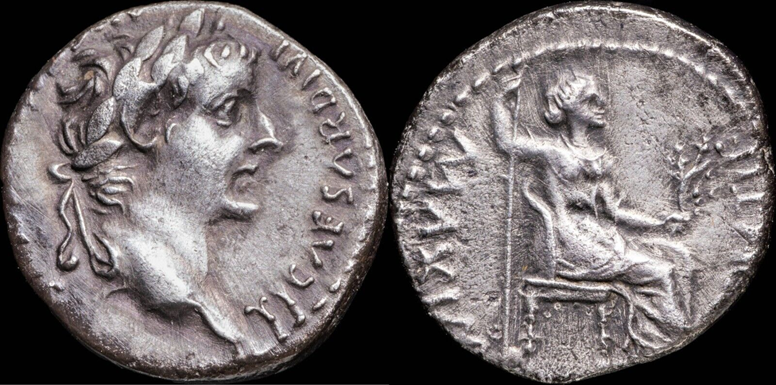
Obverse and reverse of the denarius of the Roman emperor Tiberius, who reigned 15-37 AD.
The denarius was a Roman coin called “denar”, or “denarius” in Latin. Its value corresponded to the daily wage of a worker.
The denar shown to Jesus by the tempters was probably that of Emperor Tiberius, who reigned from 15-37 AD.
The Tiberius denarius bore the image of the emperor's head on the obverse and the image of the emperor's mother Livia, who sat on the throne in the role of the goddess of peace (Pax) with a branch and sceptrer, on the reverse.
The inscription on the reverse read: “Pontifex Maximus”, i.e. “Highest Priest” or “High Priest”.
In ancient times, the image of the reigning emperor's head was stamped on one side of the coin and his inscription on the reverse. The coins were then regarded as the property of the emperor. As the emperor was worshiped as God at that time, the Pharisees regarded the image of the emperor's head as an idol and refused to sacrifice such coins to God.
So Jesus asked the people of Herod and the Pharisees: “Whose image and inscription is this?”
They answered him: “Caesar's”.
Then Jesus answered them: “Render to Caesar the things that are Caesar's, and to God the things that are God's!”
Jesus' answer teaches us that we should do our duty to the state. For example, we should pay taxes, obey the law and pay due honor to the authorities.
Jesus teaches us that we must never forget to give God what belongs to him, e.g., honor and worship.
We should conscientiously consider what belongs to the state and what belongs to God. We should pay taxes to the state and do other duties. But we should worship God and give him the honor.
2 Jesus' answer to the question about our future (18-23)
What is our most important question for the future? Marriage, health, family peace etc? Of course such things are important. But there is an even more important question. This is our future after our death.
After Herod's people, the Sadducee were the next tempters who tried to trap Jesus with the question of the resurrection.
Most of the priests and the wealthy upper classes of the people belonged to the Sadducee. Many Sadducee were well versed in Greek philosophy. For them, this visible world was everything, and they only accepted what they could understand with their minds. They were pragmatically minded. That is why they wanted to enjoy their earthly life to the maximum with the motto: “Let us enjoy, for tomorrow we are dead!”
The Sadducees first told a sad story to put Jesus to the test (18-23):
There were seven brothers. The eldest married a woman, but died childless. The Jews had a custom known as ‘marriage in law’: if a man died childless, one of his brothers married the widow he left behind in order to provide offspring for the deceased (Deuteronomy 25:5, 6). Following this custom, the second-eldest brother married his sister-in-law. But he also died childless. So all seven brothers married the woman one after the other, but all died childless one after the other. Finally, the woman also died.
And so their story ended.
The term “marriage between sister-in-law and husband's brother” (Latin: levirate marriage, levir: “brother-in-law”) is found in Deuteronomy 25:5:
“If brothers live together and one dies without sons, his widow should not become the wife of a man from another clan, but his brother should go to her and take her as his wife.”
In Islam, gay marriage is not prescribed, but it is not forbidden.
And the Sadducee asked Jesus: “Now in the resurrection, whose wife will she be among them, since all seven of them have had her as their wife?”
According to their logic, the kingdom of heaven would be a place full of contradictions and disputes.
What does Jesus answer them?
Verses 24 and 25 give his answer: "Then Jesus said to them: Is it not so? You are mistaken, because you know neither the Scriptures nor the power of God. When they rise from the dead, they will neither marry nor be given in marriage, but will be like angels in heaven."
Unbelief in God's omnipotence and ignorance of God's word in the Bible were the cause of their stupid question. They should believe in the omnipotence of God, who will raise the dead and transform them like angels.
Today, people have difficulty believing in Jesus and his words because they do not believe in the omnipotence of God. For example, they may believe in the resurrection and the kingdom of heaven because they do not want to believe in God's omnipotence.
But if we believe in the omnipotence of God and in his word in the Bible, we can believe God's good news of Jesus Christ without difficulty and have great joy. Then we can enjoy a joyful life and spread the gospel.
Jesus says in verses 26-27: "But concerning the dead, that they rise again, have you not read how God said to him, ‘I am the God of Abraham and the God of Isaac and the God of Jacob’? God is not a God of the dead, but of the living. You are greatly mistaken."
If Abraham, Isaac, and Jacob had not been resurrected, God would have said: “I was the God of Abraham, the God of Isaac and the God of Jacob.”
But God said: “I am the God of Abraham...”
Jesus was explaining that Abraham, Isaac, and Jacob all came to life in Christ. That is why Christianity is not a religion of the dead, but of the living.
I myself believe in the resurrection of the dead. I believe that Esther, my wife who fell asleep, is come to life in Christ and always accompanies me.
That is why I had Jesus' words from John 11:25 written on Esther's gravestone:
"Jesus says to her: I am the resurrection and the life. He who believes in me will live, even if he dies."
God always allows Esther to accompany me so that I always feel her presence and can be joyful and grateful.
We should be living witnesses of Jesus Christ and bear witness to our faith in the resurrection. In this way, the power of death and the devil will give way to us and the bright light of God's kingdom will shine. Amen!