«With impatience, we are waiting for an opportunity to return to Russia», Tillerson told a Russian newspaper earlier this year. According to Lenta, the American oilman No 1 is ready to re-engage in Russia as soon as sanctions are lifted
That opportunity for re-engagement could come soon enough. When installed as Secretary of State in January, the powerful ExxonMobil leader will have the possibility to alter US-Russian relations and seek an end to the sanction regime which for the last two years has stalled international energy projects in the Russian Arctic.
ExxonMobil is among the foreign companies with the biggest stakes in the Russian North, and Tillerson is the man behind it all.
After having successfully developed the Sakhalin-1 project on Russia’s Pacific coast, the company in 2011 signed a comprehensive Arctic cooperation deal with Rosneft. That includes three huge licenses in the Kara Sea, as well as stakes in Western Siberian fields and a project in the Black Sea. In 2013, the cooperation was extended with another seven licenses in areas stretching from the Kara Sea to the Chukchi Sea. The total area covered by the Arctic licenses increased to more than 725,000 square kilometers.
An important milestone for the Russian-US partnership came just weeks before American and European authorities extended their sanctions on Russia in 2014. Then, the Norwegian-owned drilling rig «West Alpha» made a significant discovery in the partnership’s first well, the Unversitetskaya-1. The well holds more than 120 million tons of oil, results showed.
Rosneft President Igor Sechin decided to name the field «Pobeda» (Victory). In a statement, Sechin said the operation was the result of joint efforts.
«This is our united victory, it was achieved thanks to our friends and partners from ExxonMobil, Nord Atlantic Drilling, Schlumberger, Halliburton, Weatherford, Baker, Trendsetter, FMC. We would like to name this field Pobeda,” Sechin underlined.
Russian President Putin granted the projects his full support. As the “West Alpha” spud the Unversitetskaya-1, Putin in a direct televised transmission praised the good relationship with ExxonMobil.
«Today, efficient international cooperation lies to the ground for commercial success, and the businesses, both Russian and foreign companies, perfectly well understand this», Putin underlined, a transcript reads.
«Irrespectively of the current troublesome political state of affairs, pragmatism and common sense prevails, and this is gratifying», he added.
«In our opinion, this is a truly responsible, truly business-like approach, and only this approach can be productive».
The American company got a 33,3 percent stake in the project operating companies, among them Karmorneftegaz, the joint venture established for the development of the Kara Sea licenses. As part of the deals, Exxon took on costs for exploration.
That did not come cheap. According to unofficial estimates, costs for the drilling of the Pobeda well alone amounted to about $600 million.
More drilling was supposed to follow. License obligations include another 14 wells and significant 2D and 3D seismic mapping. That, however, was put on hold because of the sanctions. However, contacts between the companies did not stop.
Over the last two years, significant parts of the companies’ joint license areas have been subjected to seismic mapping.
In addition, the two companies have together established the Arctic Research & Design Center, a St. Petersburg-based entity for research, development and technical services for Arctic oil and gas development. ExxonMobil pledged $200 million in funding for the center’s initial research work.
Resources are abundant. According to Igor Sechin, the oil resources of the Kara Sea alone exceed the ones of the Bay of Mexico, Brasilian shelf, Alaska and northern Canada and can be compared with the resources of Saudi Arabia.
( 3)

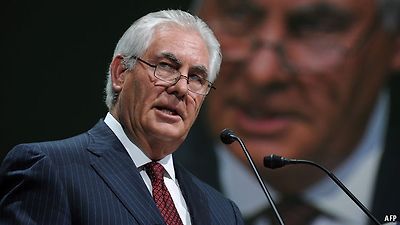
“A DIPLOMAT that happens to be able to drill oil.” That is how Reince Priebus, Donald Trump’s incoming chief of staff, described Rex Tillerson, the boss of ExxonMobil, who was nominated this week as America’s secretary of state. In fact, Mr Tillerson, 64, is an oil driller through and through, has spent 41 years furthering the ambitions of one of the world’s largest private companies, and has often sidelined the American government because he felt ExxonMobil was better able to look after its global affairs itself.
Yet he has a reputation for dependability and small-town Texan values that has enabled him to stand up to, and win respect from, notoriously slippery world leaders such as Vladimir Putin. The question is, will it help him become a good envoy-in-chief for diplomacy’s nemesis, Mr Trump? Or will he also peddle Mr Trump’s “I win, you lose” sense of international relations, with oil interests always in the back of his mind?
For a leader of the world’s corporate elite, Mr Tillerson has parochial roots. Born in Wichita Falls, Texas, he grew up as a Boy Scout, went to the University of Texas, and rides horses in a cowboy hat in his spare time. He has worked at ExxonMobil since 1975, never lived outside America, and speaks with a drawl.
|
|
|
Advertisement |
|
3
카페회원들의 안전을 위해 iframe 태그를 제한 하였습니다. 관련공지보기▶
카페회원들의 안전을 위해 iframe 태그를 제한 하였습니다. 관련공지보기▶ |
Jack Randall, a friend from university days and an oil banker at Jefferies, recounts how Mr Tillerson still spends time after work fixing up the decking on his lakeside home, despite having numerous employees who would do it for him. “He’s a regular guy who has lived the American dream,” he says. “He’s a Texan, an engineer and a Boy Scout. That is where his values come from.”
Yet as an oilman and ExxonMobil’s chief executive since 2006, Mr Tillerson has run operations in some of the most inhospitable parts of the world, from ice-encrusted Sakhalin in the Russian Far East, to poverty-stricken Chad. That has meant dealing with populist strongmen, from Mr Putin to Venezuela’s late leader Hugo Chávez, who he has often cajoled into submission by arguing for the importance of free markets and the sanctity of oil contracts.
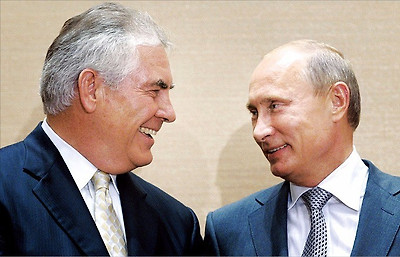
In a book on ExxonMobil, “Private Empire”, author Steve Coll recounts Mr Tillerson’s early dealings with Mr Putin during efforts to rein in an unruly Russian partner, Rosneft, on the Sakhalin development. When Mr Putin offered to write an executive order pushing ahead with the project, Mr Tillerson refused, saying that the Russian president lacked the legal authority to live up to his company’s standards. Though Mr Putin “blew his stack,” he gave in to Mr Tillerson’s demands.
In a later oil era, in 2011, ExxonMobil and Rosneft struck a deal to develop oil in Russia’s Kara Sea, which Mr Putin said could lead to a whopping $500 billion of Arctic co-developments. In 2013 Mr Putin awarded Mr Tillerson Russia’s Order of Friendship. The Arctic deal was scuppered because of American sanctions against Russia, following its annexation of Crimea in 2014, which were opposed by Mr Tillerson. James Henderson, an expert on Russian oil at the Oxford Institute for Energy Studies, says the Kremlin came to respect ExxonMobil under Mr Tillerson, despite the firm’s stubborn belief in its own value system, because it was “dependable”. He says: “Exxon always makes the point very clearly that it all has to be above board. Its terms do not involve brown envelopes under the desk.”
Mr Tillerson’s ties to Mr Putin are likely to complicate his confirmation hearings, especially amid allegations that Russian hackers interfered with America’s presidential election to help Mr Trump. But his defenders are adamant about his integrity. “The chances are better that Mother Teresa was stealing money from her charity than Rex Tillerson will do anything with Putin that isn’t in the best interests of the United States,” Mr Randall says.
What is less clear is how he will deal with America’s traditional allies, such as Europe, who fear Russian meddling in Ukraine, for example. His appointment will rekindle suspicions that American diplomacy is about securing oil and other scarce resources. NGOs allege that ExxonMobil has a poor record of promoting human rights in countries where it operates, and has flip-flopped on climate change.
Yet as well as having an oilman’s resource-hungry mindset, he could also bring useful industry traits to the State Department—and to a Trump presidency. For example, finding and drilling oil requires elaborate modelling—both of underground geologies and messy above-ground geopolitics—to make money over the long-term. He knows that such models are as likely to be wrong as well as right. Reputedly his engineering background makes him a stickler for evidence-based decision-making. He is also considered “patient and unemotional” on ExxonMobil’s side of the negotiating table.
Such traits would make him very different from Mr Trump, who lives by the gut. “Rex is not a guy who wets his finger and puts it up in the air to see which way the wind is blowing, and he’ll tell Mr Trump what he thinks,” Mr Randall says. In some respects his opinions differ from Mr Trump's, too. Though once a climate-change denier, he now believes mankind has helped cause global warming. Last year ExxonMobil supported the Paris agreement on climate change. In the past he has strongly rebuffed calls (recently supported by Mr Trump) to make America energy independent. With luck, he will not only have the tactical skills to further America’s interests abroad. He will also have the integrity to talk sense into his boss.
 기사 이미지 보기


