에덴 프로젝트 Eden Project
※ 실제 영국에서는 이든프로젝트/Eden Project라고 발음.
에덴 프로젝트란 무엇인가?
The Eden Project is a sprawling structure built along the side of a deep pit.
The structure comprises three biomes, areas designed to represent three
distinct climates found around the world.
에덴 프로젝트는 깊은 협곡의 측면을 따라 길 게 건설된 구조물이다. 축축한 열대
생태관은 가장 인상적인 구획으로 여러 개의 돔으로 이루어진 온실이다. 이곳에는
열대우림지역의 생태를 재현해주며 따뜻하고 높은 습도의 조건속에 남미, 아프리카,
아시아, 오스트랄리아에서 옮겨진 수백 종류의 나무와 식물들이 존재한다.
돔은 240m 길이, 55m 높이, 110m 폭을 가지고 있다.
※ <에덴 프로젝트>는 아열대 온실(Humid Tropics Biome)과
온대 온실(Warm Temperature Biome)의 두 부분으로 구성되고
각각 다른 크기의 4개의 온실들로 결합되어 있다.
아열대 온실의 경우 길이 240m, 폭 110m, 높이 50m의 규모로 바나나, 커피, 고무, 대나무 등
전세계의 아열대 식물들과 전통 가옥들로 구성되어 있다. 반면에 온대 온실의 경우
길이 150m, 폭 56m, 높이 35m 규모로 올리브, 포도 등과 같은 지중해 지역 혹은 그와 유사한
기후 조건에서 자라는 식물들로 채워져 있다.

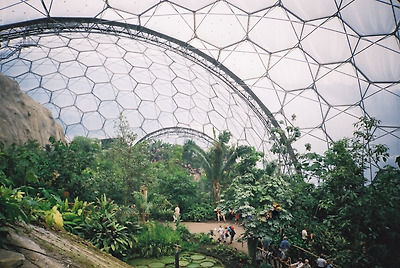
열대우림 구획의 내부전경. 에덴 프로젝트의 중심 부에 위치
열대우림 구획으로부터 방문자는 온대림 구획으로 이동하게 된다. 온대림 구획은
역시 여러 개의 돔으로 이루어져 있으며 세계 온대 우림지역에서 수송된 식물들이
서식하고 있다. 열대우림 지역처럼 온대 우림지역도 높은 연강수량을 보여주고 있다.
에덴프로젝트의 온대우림 구획은 남아프리카, 지중해, 캘리포니아에서 볼 수 있는
식물상을 가지고 있다.
에덴프로젝트의 마지막 단계는 지붕이 없는 구획이다. 콘월 지역의 기후에 맞추어진
구획으로 칠레, 히말라야, 아시아, 오스트랄리아와 유사한 기후이다. 방문자들은
여기에서 인류 역사에서 중요한 역할을 수행한 식물들에 대하여 배울 수 있다.
에덴 프로젝트의 계획자들은 온실의 수집품 이상의 것들을 보게된다. 이들의 목표는
식물들, 인간들, 자원들 사이의 살아있는 관계의 대한 책임있는 관리와 이해를 증진시켜
모두를 위한 지탱가능한 미래를 가능케 하는 것이다. 이들은 매점과 여러 인공조형물들을
설계하였고 수 많은 웍숍과 이벤트를 열어 사람들에게 환경문제에 대한 정보를 준다.
기술적 관점에서 가장 놀라운 것은 거대 규모의 온실이다. 이러한 거대한 기념비적인
구조가 어떻게 작동되는지 알아보도록 하자.
온실의 기본
거대 온실이 어떻게 작동되는지 이해하기 위해 우리는 첫 번째로 온실의 기본 개념을
이해해야만 한다. 가장 기본적인 온실은 견고하고 투명한 재료, 유리나, 비닐 등과 같은,
이우어진 단순한 상자구조이다. 태양 빛이 온실의 투명한 벽을 통해 들어 와서 내부의
온도를 상승시킨다.
태양에서 오는 방사선 에너지는 온실 바닥을 가열시킨다. 바닥은 열에너지를 방출하여
온실 바닥 주위의 공기층을 데운다. 따뜻해진 공기는 차가운 공기보다 더 가볍기 때문에
(낮은 밀도로) 위로 올라가고 차가운 공기는 바닥으로 내려오게 된다.(대류현상) 이러한
과정은 우리 대기에서 항상 일어나고 있다.

|
투명 판 공사 작업 |
온실속에서 식물들은 모두 생존하는데 필요한 태양 빛을 얻게 되지만 자연적인
요소에 완전히 노출될 수는 없다. 더구나 매일 매일 일조량이 다르기 때문에 단순한
유리 상자내의 온도를 조절하기 매우 어렵다. 그래서 동일한 적정 조건을 유지하기
위해 온실은 부가적인 기후조절 장치가 필요하다. 전형적인 온실은 환기시스템을
가지기 때문에 온도가 너무 높게 올라가면 공기는 방출되고 태양빛이 너무 약할 때는
인위적으로 가열된다. 아울러 온실은 땅과 공기의 습도를 유지하기 위한 배관시스템이
필요하다.
온실을 만드는데에는 수 많은 요소들이 필요하다. 이 문제들을 어떻게 다루었을까?

|
투명판 작업 |
돔
에덴 설계자들은 전통적인 유리 혹은 플라스틱을 사용하지 않고 에틸테트라 프루오로
에틸렌(ETFE)을 사용하였다. 이 물질은 매우 강하고 투명하며 가볍기 때문에 온실
제작에 제격이다. 동일한 크기의 ETFE는 동일한 크기의 유리 무게의 1%에 불과하다.
더구나 이 물질은 유리보다 더 절연효과가 뛰어나며 태양의 기후 영향에 더욱 잘 견디어낸다.

|
천장 판넬 작업 |
디자이너들은 ETFE를 이용하여 매우 강한 받침 판을 만들었는데 각 받침판은
3장의 ETFE의 변을 용접하였으며 3장의 판 사이에는 공기를 넣었다. 이 공기 층은
통과하는 빛의 양을 감소시킴 없이 절연효과를 향상시킨다. 날씨가 추우면 더 많은
공기가 공급되어 더 나은 절연성을 가지게 되며 더운 날에는 공기를 빼내 냉각효과를
증진시키게 된다. 디자이너들은 받침 판을 서로 연결하여 측지적인 돔을 제작하였다.
이러한 종류의 구조물은 많은 조각 판넬이 모여 삼각형, 5각형, 6각형 혹은 다각형의
구조로 이루어져 결국은 곡선의 구조를 형성하게 된다. 이러한 디자인은 각 조각은
구부러져 있지 않지만 서로 모여 원형구조를 형성하기 때문에 놀라운 것이다.

|
각 받침판을 강철 틀에 넣는 작업 |
에덴 프로젝트 돔에서 각 판은 강철관으로 만들어진 망에 부착된다. 각 돔은 실제
두 개의 망층으로 이루어져 있다. 윗 쪽은 육각형과 오각형의 판으로 이루져 있고
아래 쪽은 삼각형 판으로 구성되어 있다. 전체 에덴 구조는 625개의 육각형,
16개의 오각형, 190개의 삼각형 판으로 이루어져 있다. 천정의 강철 격자구조는
무개에 비해 믿을 수 없을 만큼 강하다. 667톤의 무게가 전체 구조에 균등하게 퍼져있기
때문에 돔은 오직 바닥 주변만 지탱하면 된다. 돔의 가장 자리는 강한 기초 밧줄에
연결되어 있으며 지하의 콩크리트 벽이 구조물 주변을 둘러 싸고 있다.

|
강철 프레임 구조 건설, 세계 최초의 프리스탠딩 구조 |
이러한 종류의 디자인은 기하학적으로 놀라운 경험이다. 에덴 디자이너들은
컴퓨터 소프트웨어를 이용하여 디자인을 하였다. 이러한 구조물은 지표면
대부분에 쉽게 적용할 수 있는 장점을 가지고 있다. 에덴의 디자이너들은
거대한 공기 방울로 돔을 묘사한다. 디자이너들은 돔을 남향으로 지었기 때문에
하루종일 열에너지를 흡수할 수 있다.

|
|
광포획은 온실 유지의 한 방법이지만 식물이 살기 위해서는 좋은 토양과 충분한
물이 필요하다. 이 문제는 어떻게 해결했을까?
배수관과 기후 통제
에덴 프로젝트를 위해 선택된 지역은 여러 가지 면에서 이상적이다. 그러나 초기에
몇 가지 문제가 있었는데 첫 번째 장애물 중 하나는 토질이었다. 대부분 점토로 이루어져
있었기 때문에 식물 생장에 필요한 영양소가 부족하였다. 따라서 온실을 건조하기 전에
먼저 영양소가 풍부한 토양을 옮겨야 했다.

에덴 프로젝트 건조 전
무려 85000톤의 토양을 퇴비용 토양과 섞어서 비옥하게 만들었다. 건조 초기에
에덴 프로젝트는 다른 장애물을 만났다. 그것 바로 홍수였다. 장마 2달 후
약 43백만 갤론의 물이 바닥에 고였다. 견고한 지반을 만들기 위해 디자이너들은
수로를 디자인하여야 했다. 첫 번째 단계는 웅덩이를 땅속에 만드는 것이 었다.
그리고 이 웅덩이로 물이 빠져나가도록 매트를 만들었다. 매트는 대부분 침전물을
여과할 수 있기 때문에 깨끗하고 여과된 물을 공부할 수 있게 되었다. 고인 물은
다시 에덴 구조로 뿜어 올려졌다. 이곳에서 식물을 위한 관계용으로 사용되며
매초 약 6갤런의 물이 모아졌다. 온실의 천장 역시 물을 수집하여 대기 습도를
맞추기 위해 스피링 쿨러로 보낸다.

|
|
식물, 돔, 토양, 배관과 함께 에덴은 이제 완전히 기능적인 온실이 되었다. 그러나
아직 관계자들은 진행사항을 지켜 보고 있다. 장기적인 성공을 위해 또 다른
부가적인 문제는 무엇이 있을까?
장기적 목적
에덴 프로젝트의 주 목적은 일반 대중에게 자연세계를 교육하는 것이다. 특히,
에덴 건설가들은 방문자들이 지속성 있는 발달(자연 원료의 양심적인 사용으로
미래에서 이용가능하게 유지될 수 있게 하는)에 관한 문제에 직면하기를 원한다.
그리고 더욱 심화된 환경연구와 교육도 이루어지기를 원한다.

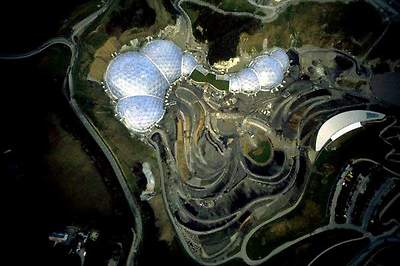
공중에서 바라본 에덴 프로젝트
마직막으로 에덴 프로젝트는 광범위하게 다양한 회사와 조직(이들은 지속적인
발달에 관심을 가지고 있는), 생태 과학, 그리고 많은 관련된 학문영역에 문을
열어놓는다. 프로젝트가 발전하면서 에덴 프로젝트를 만든 사람들은 이 장소가
이러한 문제들에 관심을 가진 모든 사람들의 회합의 장소가 되기를 희망한다.
에덴 팀들은 이미 어린 학생들을 위한 많은 새로운 프로그램을 개발했다.
대부분 전시물들은 해리포터 시리즈와 로알드 달의 고전과 같은 대중적인
아동도서로부터 만들어져 어린아이들이 편안하고 쉽게 과학에 접근할 수
있도록 해준다. 에덴 교육과는 또한 세계 여러 곳에 있는 학교들과 연결시켜주는
프로그램도 가지고 있다. 이러한 방법으로 아이들은 세계 다른 지역의 자연환경을
배울 수 있게 된다. 더구나 그러한 지역의 인간들과의 상호작용과 문화도 역시
배울 수 있을 것이다.

열대성 나비
에덴팀 역시 자체적으로 연구를 계속해갈 것이다. 계속해서 새로운 식물이 투입되고
나비 전문가인 크리스토퍼 우드는 에덴 돔안에 독특한 나비를 도입하고 있다.
식물들에게 피해를 주는 개체군 폭발 증식을 피하기 위해 수컷 나비만 들여오며
만약 나비 프로젝트가 원할히 진행되면 에덴 팀들은 장래에 다른 동물 종들도
도입할 예정이다.
------------------------------------------------------
바이옴은 다양한 크기의 육각형들로 이뤄졌는데,
그 중 가장 큰 바이옴은 대각선 길이가 11미터에 이른다고 합니다.
각각의 육각형들은 아연철관으로 만들어진 프레임 위에, 여러 겹의 ETFE
포일을 덮고 있습니다.
일반적인 온실이라면 유리를 사용했겠지만
그 무게와 구조학상 유리는 처음부터 고려 대상에서 제외되었습니다.
그대신 선택한 소재가 ETFE라는 신물질.
에틸렌 테트라플루오로에틸렌(Ethylene tetrafluoroethylene)이라 불리는
이 신물질은 일종의 신개념 플라스틱으로 유리보다 빛을 더 많이 투과시킬 뿐 아니라
유리의 1/100 밖에 안되는 무게,
정전기가 거의 없어 먼지나 새똥 등이 빗물 등에 쉽게 씻겨 나가는 세척력,
재활용이 가능한 재료로, 그 수명은 최소 30년 이상이라고 합니다.
ETFE는 2008 올림픽 중계로 많은 사람의 눈에 익숙한 베이징 국가 수영 센터(
北京国家游泳中心), 독일 프로축구 바이에른 뮌헨과 TSV1860의 홈 구장
알리안츠 아레나(Alianz Arena)의 외벽과 같은 소재로 에덴 프로젝트에서의 활용이
큰 역할을 해냈다고도 합니다.
-----------------------------------------------------------
Eden Project : ‘인간 + 자연’
식물을 주제로 한 테마파크
-----------------------------------------------------------
만드는 것 이었습니다. 이 거대한 온실 프로젝트는 처음에 반대가 많았습니다.
그러나 지금은 콘월지역을 넘어 영국에서 가장
유명한 온실이 되었습니다.
자세한 내용은
에서 확인할수 있습니다.
온난한 기후의 온실이 있습니다. 이 에덴프로젝트를 위해 영국에서 내놓으라 하는 건축가들이
모여서 만들었다고 하더군요
이 프로젝트를 기획하고 진행한 사람은 Tim Smit 입니다. 2001년 개장한 이 에덴프로젝트는
영국 콘월지역에선 없어서는 안될곳이 되었습니다.
-----------------------------------------------------------
The Eden Project - Home
-----------------------------------------------------------
생태마을, 영국 웨일즈의 ‘대체기술센터’(CAT : Centre for Alternative Technology)
-----------------------------------------------------------
|
제목 : 영국 EDEN PROJECT(에덴 프로젝트) 운영사례
| |||
| 일처리최대용량: 면적 3,559㎢ | |||
|
설치목적: 지구의 환경을 지속가능한 미래로 이끌어 나갈 수 있도록 식물과 인간, 그 리고 자원 사이의 상생관계에 대한 이해와 책임감 증진을 설립 이념으로 함 | |||
|
운영정보요약
1. 소재지
| |||
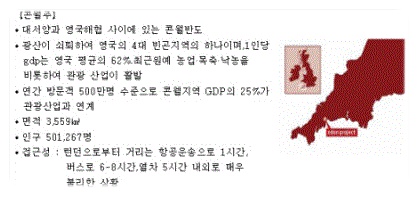
-----------------------------------------------------------
-----------------------------------------------------------
Eden Project
| The Eden project | |
|---|---|
 | |
| General information | |
| Type | Multiple Greenhouse Complex |
| Architectural style | Inspired by J. Baldwin's Pillow Dome[citation needed] |
| Location | St Blazey, Cornwall, UK |
| Coordinates | 50°21′43″N 4°44′41″W / 50.36194°N 4.74472°WCoordinates: 50°21′43″N 4°44′41″W / 50.36194°N 4.74472°W |
| Completed | May 2000 |
| Opening | 17 March 2001 |
| Technical details | |
| Structural system | Steel frame and thermoplastic |
| Design and construction | |
| Architect | Nicholas Grimshaw |
| Structural engineer | Anthony Hunt and Associates |

The Eden Project is a visitor attraction in Cornwall in the United Kingdom. Inside the artificial biomes are plants that are collected from all around the world. The project is located in a reclaimed Kaolinite pit, located 1.25 mi (2 kilometres) from the town of St Blazey and 5 kilometres (3 mi) from the larger town of St Austell, Cornwall.[1]
The complex is dominated by two huge enclosures consisting of adjoining domes that house thousands of plant species,[2] and each enclosure emulates a natural biome. The domes consist of hundreds of hexagonal and pentagonal, inflated, plastic cells supported by steel frames. The first dome emulates a tropical environment, and the second a Mediterranean environment.
Design and construction
The project was conceived by Tim Smit and designed by architect Nicholas Grimshaw and engineering firm Anthony Hunt and Associates (now part of Sinclair Knight Merz). Davis Langdon carried out the project management, Sir Robert McAlpine and Alfred McAlpine[3] did the construction, MERO designed and built the biomes, and Arup was the services engineer, economic consultant, environmental engineer and transportation engineer. Land Use Consultants led the masterplan and landscape design. The project took 2½ years to construct and opened to the public on 17 March 2001.
Site

Layout
Once into the attraction, there is a meandering path with views of the two biomes, planted landscapes, including vegetable gardens, and sculptures that include a giant bee and towering robot created from old electrical appliances.
Biomes


At the bottom of the pit are two covered biomes:
The Tropical Biome, covers 1.56 hectares (3.9 acres) and measures 55 metres (180 ft) high, 100 metres (328 ft) wide and 200 metres (656 ft) long. It is used for tropical plants, such as fruiting banana trees, coffee, rubber and giant bamboo, and is kept at a tropical temperature and moisture level.
The Mediterranean Biome covers 0.654 hectares (1.6 acres) and measures 35 metres (115 ft) high, 65 metres (213 ft) wide and 135 metres (443 ft) long. It houses familiar warm temperate and arid plants such as olives and grape vines and various sculptures.
The Outdoor Biome (which is not covered) represents the temperate regions of the world with plants such as tea, lavender, hops, hemp and sunflowers.
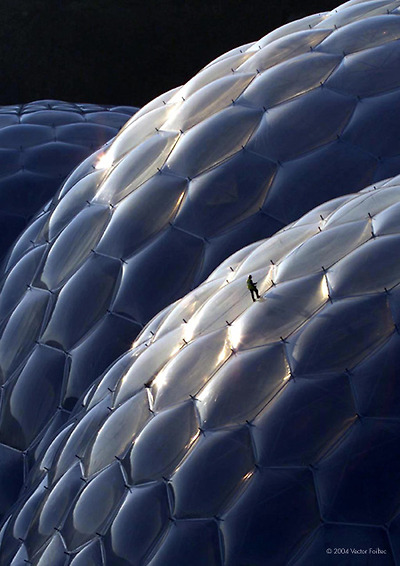
The covered biomes are constructed from a tubular steel (hex-tri-hex) with mostly hexagonal external cladding panels made from the thermoplastic ETFE. Glass was avoided due to its weight and potential dangers. The cladding panels themselves are created from several layers of thin UV-transparent ETFE film, which are sealed around their perimeter and inflated to create a large cushion. The resulting cushion acts as a thermal blanket to the structure. The ETFE material is resistant to most stains, which simply wash off in the rain. If required, cleaning can be performed by abseilers. Although the ETFE is susceptible to punctures, these can be easily fixed with ETFE tape. The structure is completely self-supporting, with no internal supports, and takes the form of a geodesic structure. The panels vary in size up to 9 metres (29.5 ft) across, with the largest at the top of the structure.
The ETFE technology was supplied and installed by the firm Vector Foiltec, which is also responsible for ongoing maintenance of the cladding. The steel spaceframe and cladding package (with Vector Foiltec as ETFE subcontractor) was designed, supplied and installed by MERO (UK) PLC, who also jointly developed the overall scheme geometry with the architect, Nicholas Grimshaw & Partners.
The entire build project was managed by McAlpine Joint Venture.
The Core

The Core is the latest addition to the site and opened in September 2005. It provides the Eden Project with an education facility, incorporating classrooms and exhibition spaces designed to help communicate Eden's central message about the relationship between people and plants. Accordingly, the building has taken its inspiration from plants, most noticeable in the form of the soaring timber roof, which gives the building its distinctive shape.
Grimshaw developed the geometry of the copper-clad roof in collaboration with a sculptor, Peter Randall-Page, and Mike Purvis of structural engineers SKM Anthony Hunts. It is derived from phyllotaxis, which is the mathematical basis for nearly all plant growth; the "opposing spirals" found in many plants such as the seeds in a sunflower's head, pine cones and pineapples. The copper was obtained from traceable sources, and the Eden Project is working with Rio Tinto to explore the possibility of encouraging further traceable supply routes for metals, which would enable users to avoid metals mined unethically. The services and acoustic design was carried out by Buro Happold.
The mechanical and electrical engineering design was by Buro Happold. At the insistence of architect Jolyon Brewis (Grimshaw) the photovoltaic (PV) array on the roof of the core building was arranged in an inclined circle for aesthetic reasons. However this arrangement ensures that more than half of the panels never receive direct sunlight. At the time of installation the electrical engineer making connections deemed that it was not worth while to connect these panels, as their potential to generate electricity was so limited. The value of the panels at the time of installation was around £260,000.[citation needed]
Environmental aspects
The domes provide diverse growing conditions, and many plants are on display.

The Eden Project includes environmental education focusing on the interdependence of plants and people; plants are labelled with their medicinal uses. The massive amounts of water required to create the humid conditions of the Tropical Biome, and to serve the toilet facilities, are all sanitized rain water that would otherwise collect at the bottom of the quarry. The only mains water used is for hand washing and for cooking. The complex also uses Green Tariff Electricity — the energy comes from one of the many wind turbines in Cornwall, which were among the first in Europe.
Controversially, one of the companies the Eden Project currently partners with is the British mining company Rio Tinto Group.[4] Rio Tinto is set to begin mining in Madagascar for titanium dioxide. This will involve the removal of a large section of coastal forest, and may cause extensive damage to the unique biodiversity of the Malagasy flora and fauna.[5]
In December 2010 the Eden Project received permission to build a geothermal electricity plant which will generate approx 4MWe, enough to supply Eden and about 5000 households.[6]
History
The clay pit that houses the structures was in use for over 160 years.[7] In 1981, the pit was used by the BBC as the planet surface of Magrathea in the 1981 TV series of the Hitchhiker's Guide to the Galaxy.[8] By the mid 1990s the pit was all but exhausted.[9]
The initial idea for the project dates back to 1996, with construction beginning in 1998. The work was hampered by torrential rain in the first few months of the project, and parts of the pit flooded as it sits 15m below the water table.[9]

The first part of the Eden Project, the visitor centre, opened to the public in May 2000. The first plants began arriving in September of that year,[9] and the full site opened on 17 March 2001.
The Project hosted the "Africa Calling" concert of the Live 8 concert series on 2 July 2005. It was also used as a filming location for the 2002 James Bond film, Die Another Day (starring Pierce Brosnan). It also provided some plants for the British Museum's Africa garden.
In 2005, the Project launched "A Time of Gifts" for the winter months, November to February. This features an ice rink covering the lake, with a small café/bar attached, as well as a Christmas market. Cornish choirs regularly perform in the biomes.
On 6 December 2007, the Eden Project invited people all over Cornwall to try to break the world record for the biggest ever pub quiz as part of its campaign to bring £50 million of lottery funds to Cornwall.[11]
In December 2007, the project failed in its bid for £50 million of funding, after the Big Lottery Fund popular vote,[12] when it received just 12.07% of the votes, the lowest for the four projects being considered.[13] Eden wanted the money for Edge, a proposed desert biome.[citation needed].
In December 2009, much of the project, including both greenhouses, became available to navigate through Google Street View.
In the media

- Robin Kewell (Ed.): Eden. The inside story. St Austell n.d.: The Eden Project. (DVD)
- Alan Titchmarsh: The Eden Project. United Kingdom: Acorn Media, 2006. OCLC 225403941
- The Eden Radio Project - Every Thursday Between 5.30 and 7pm on Radio St Austell Bay
- Die Another Day: Graves' diamond mine
Eden Sessions
Since 2002, the Project has hosted a series of musical performances, called the Eden Sessions. Artists have included Amy Winehouse, James Morrison, Muse, Lily Allen, Snow Patrol, Pulp, Brian Wilson and The Magic Numbers. 2008's summer headliners were: The Verve, Kaiser Chiefs and KT Tunstall. Oasis were also set to play in the summer of 2008, but the concert was postponed because Noel Gallagher was unable to perform after breaking three ribs in a stage invasion incident several weeks before. The concert was instead played in the summer of 2009.[14] 2010 saw performances from artists including Mika, Jack Johnson, Mojave 3, Doves, Paolo Nutini, Mumford & Sons and Martha Wainwright.
The 2011 sessions were headlined by The Flaming Lips, Primal Scream, Pendulum, Fleet Foxes and Brandon Flowers with support from The Horrors, The Go! Team, OK Go, Villagers, and The Bees.[15]
The 2012 Eden sessions were headlined by:[16] Tim Minchin, Example, Frank Turner, Chase & Status, Plan B, Blink-182, Noah And The Whale & The Vaccines.
Jequirity bracelet recall
In December 2011 a recall was issued for bracelets sold at the Eden Project and other retailers across the UK that were made of the highly poisonous beans of the Abrus precatorius plant.[17] The beads could potentially have been dangerous if ingested. The Eden Project offered full refunds for the bracelets, recommending that customers who had bought such bracelets over the past two years returned them.
See also


References
- ^ Ordnance Survey (2005). OS Explorer Map 107 - Fowey, Looe & Lostwithiel. ISBN 0-319-23708-7.
- ^ "Rainforest Biome". Eden project. http://www.edenproject.com/come-and-visit/whats-here/rainforest-biome/index.php. Retrieved 2011-10-11.
- ^ "Our history". Eden project. http://www.edenproject.com/whats-it-all-about/behind-the-scenes/our-history/index.php. Retrieved 2010-09-27.
- ^ Mentioned by the official web site.
- ^ Madagascar's unique forest under threat - The Guardian, UK, 2005-08-07
- ^ "BBC News - Eden Project geothermal plant plans to go ahead". BBC Online. 18 December 2010. http://www.bbc.co.uk/news/uk-england-cornwall-12026753. Retrieved 18 December 2010.
- ^ http://www.edenproject.com/whats-it-all-about/behind-the-scenes/about-us/our-story
- ^ Turner, Jenny (3 October 2009). "Does the Hitchhiker's Guide to the Galaxy still answer the ultimate question?". The Guardian (London). http://www.guardian.co.uk/books/2009/oct/03/hitchhikers-guide-galaxy-douglas-adams.
- ^ a b c http://www.edenproject.com/whats-it-all-about/behind-the-scenes/10th-birthday/10th-birthday-timeline
- ^ Heather Jansch - Sculptor - Bronze & Driftwood Horse Sculptures
- ^ The Eden Project - Eden raises the bar for the Edge in the world’s biggest-ever pub quiz
- ^ "Routes scheme tops lottery vote". BBC News. 12 December 2007. http://news.bbc.co.uk/1/hi/uk/7140621.stm. Retrieved 2008-02-03.
- ^ "The People's 50 Million - Sustrans' Connect2 wins £50 million prize". The Big Lottery Fund. http://www.biglotteryfund.org.uk/prog_the_peoples_50_million.htm. Retrieved 2008-02-03.
- ^ Eden Project press release on the Oasis rescheduling
- ^ Line-up of bands for the 2012 Eden Sessions festivals at the Eden Project, Cornwall
- ^ [1]
- ^ http://www.edenproject.com/product-recall-strung-seed-bracelet
Further reading
- Richard Mabey: Fencing Paradise: Exploring the Gardens of Eden London 2005: Eden Project Books. ISBN 1-903919-31-2
- Hugh Pearman, Andrew Whalley: The Architecture of Eden. With a foreword by Sir Nicholas Grimshaw. London 2003: Eden Project Books. ISBN 1-903919-15-0
- Tim Smit: Eden. London 2001: Bantam Press.
- Eden Team (Ed.): Eden Project: The Guide 2008/9. London 2008: Eden Project Books.
- Paul Spooner: The Revenge of the Green Planet: The Eden Project Book of Amazing Facts About Plants. London 2003: Eden Project Books.
- Philip McMillan Browse, Louise Frost, Alistair Griffiths: Plants of Eden (Eden Project). Penzance 2001: Alison Hodge.
External links
 |
Wikimedia Commons has media related to: Eden Project |
- EdenProject.com — The project's official website
- Eden Sessions Website Official site for live gigs
- Cornwall Council to give a £360,000 grant to the Eden Project (Jan 2006). News article from Cornwall Council
- Webcam of the Eden Project BBC Webcam link
- Article about the Eden Domes (PDF file 5.1 MB)
- Webpage about the construction of the Eden Project Biomes
- HortiMaX official site
- Eden Project Books
-----------------------------------------------------------
===========================================================
Creating Eden in Cornwall: the civil and structural design of the Eden Project
Ingenia: Ingenia's aim is to publish
stimulating and informative articles across
the whole range of engineering disciplines
Article - Issue 7, Feb 2001
Creating Eden in Cornwall: the civil and structural design of the Eden Project
Alan C. Jones FIStructE
Download article (610KB)
Introduction
Adisused clay pit in Cornwall is now home to two massive, state-of-the-art greenhouses, a 2300 seat amphitheatre and extensive visitor facilities. The Eden Project is one of the UK’s major Millennium Projects; it tells the fascinating story of man’s relationship with and dependence on plants. It is a non-profit, charitable, scientific organisation with a commitment to communicate with the public through entertainment, education and involvement.
The architect Jonathan Ball and Tim Smit, who restored Cornwall’s Lost Gardens of Heligan, co-founded the project in 1994. From the start the Eden Project aimed not simply to entertain, but to ‘promote the understanding and responsible management of the vital relationship between plants, people and resources, leading towards a sustainable future for all’ (Mission Statement). The Millennium Commission awarded the project a grant of £37.5 million in 1997, which represents just under half the total cost. The rest has been contributed by numerous organisations and individuals. Already over 500,000 visitors have been to the partially open site and seen the giant greenhouses under construction; this augurs well for the future of the project, which has to fund itself after the official opening in May.
The site
Initially, the brief stated the project must be located in Cornwall, for a number of reasons: the mild climate is unmatched in Europe; it is an area of high unemployment which will benefit from the presence of the project; a number of sites could be identified which were relatively easy to access by road and rail and were close to centres of population. After reviewing the available sites over a two-year period the Bodelva Pit was chosen, located about 5 km east of St Austel. This China Clay pit had been worked for over a century, was approaching the end of its commercial life and was due for decommissioning. Hence, the benefit of land reclamation was added to this list. The pit’s steep, south-facing walls would provide sun and shelter for the ‘global garden’ they would contain.
The Bodelva pit lies within the eastern end of the St Austell granite in a zone of biotite granite. The rock mass encountered on site has been classified into four different grades: Grade 1 which is fresh, unaltered rock through to Grade IV, a highly kaolinised plastic material which can be moulded by hand. The pit covers an area of about 22 hectares and varies in depth from 30 to 70 metres.
We used a digital ground model, based on aerial survey data, to sculpt the pit. The model, created with Microstation and In-roads software, allowed a detailed evaluation of cut and fill operations to take place. As part of the environmental statement for the project, an undertaking was given that the exporting or importing of fill material would be kept to a minimum. This obviously also had important commercial advantages. The landscape architect developed his scheme and provided outlines to be fed into the model. After several iterations, we obtained a balance. Approximately 800,000 cubic metres of material were moved to create the final profiles. No material was exported. The only materials imported were aggregates for concrete, hardstandings and drainage together with organic matter to construct the topsoil and planting medium.
Water management was also important to the long-term stability of the site. The base of the pit is around 30 metres below the natural water table in the area. Stormwater run-off is controlled by bunded swales and ditches interlaced with the car park terraces and landscaped areas. These store water in the short term and augment the retention provided by a series of storage lakes. The stormwater system is designed to contain a 1:100 year storm event. The final pumped outlet into the Bodelva brook to the south of the site is thus strictly regulated to prevent flooding downstream in compliance with Environment Agency flow restrictions.
The buildings
The principal buildings are the greenhouses, or biomes. They are designed to provide two climate zones, one modelled on the Humid Tropics (HTB) and the other a Warm Temperate (WTB) or Mediterranean climate.
The HTB is up to 110 metres wide, 55 metres high and 240 metres long. Along its length, it rests on all four designated grades of granite, passing from unaltered rock, across the kaolinised clay materials and back to unaltered rock. At the base of the pit it sits on up to 12 metres of fill material. Whilst slightly smaller in form, the WTB (65 x 35 x 150 m) has a similar formation. The Visitor Centre, positioned on the south-west face to give views over to the biomes and external landscaping, sits on a new plateau cut into the side of the pit and extended with fill material reclaimed from the car parking areas.
Structural form
During the early scheme development period, we realised that the exact profile of the pit would not be known until construction commenced. Initial schemes for the biomes used curved, arched trusses at regular intervals reaching from the base of the pit on to the cliff face. Each truss therefore had a unique profile and associated span. It was critical from both commercial and aesthetic criteria that the pit shape was maintained whenever possible. Wholesale reshaping was not an option. Very little repetition or rationalisation of trusses could be achieved. With the constantly changing topography, as mining continued, it was inevitable that several redesigns would be necessary before the final geometry could be confirmed.
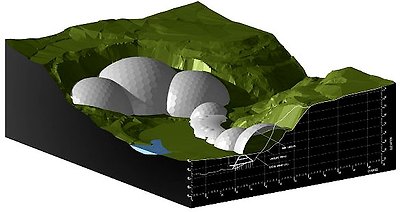
At this point, the design team proposed a radical change to the basic form of the biomes. They developed a series of intersecting domes of varying diameter. The idea was that once the size and relative position of the domes had been determined the shape of the pit became of secondary concern. The structural form of the domes could be confirmed and the intersection line between superstructure and ground determined the position of foundations and extent of cladding. This enabled the team to proceed with design development of the biome envelope before the final survey of the pit was available.
One of the principle criteria in the client’s brief was to maintain the transparency of the envelope at a maximum. In order to achieve this, the selected cladding material had to provide very high levels of light transmission and the structural elements had to be kept to minimum size and number.
After a prolonged study of various geometrical arrangements for a spherical surface, we selected a geodesic arrangement. By adopting the hexagon form derived by Buckminster Fuller, we were able to achieve an even distribution of structural members. By varying the frequency of sub-divisions in each dome, cladding panel sizes can be adjusted to give optimum form and light levels. The original scheme utilised a single layer, unbraced threedimensional space-frame structure with 500 mm diameter circular hollow sections. The envelope was tendered as two packages, steel and cladding. The successful contractor, Mero Gmbh, offered a combined package supplying both frame and cladding. Their proposal incorporated a space truss system, developed over many years. The two-layer structure uses the geometry given in the tender for the outer layer with a combination of hexagons and triangular elements forming a semi-braced inner layer. The combined system is referred to as a hex-tri-hex arrangement. The outer members are 193 mm diameter circular hollow sections with semi-fixity developed at the nodes whilst the inner members are around 114 mm diameter circular hollow sections with pin-ended connections from the Mero system.
The proposed alternative offered considerable reductions in the weight of steel, although fabrication complexity and the number of nodes increased considerably. The number of nodes in the system has a significant effect on cost, as does the size of the cladding panels. The larger the panels, the fewer the number of nodes and generally, the cheaper the cladding. Hence our objective was to develop cladding panels to be as large as possible.
The cladding system
The system we chose to clad the biomes is a pneumatic structure of ‘cushions’. Each cushion is contained within one module of the structure in the form of either a hexagon, pentagon or triangle. On the largest domes, we have used hexagonal cushions up to 10.9 metres across points. The panels are formed from multiple layers of Ethyltetraflouroethylene (ETFE) foil. The foil is extremely thin: each layer is between 50 and 200 µm thick, giving very high levels of light transmission in both the visible (94–97%) and ultraviolet range (83–88%).
The cushions are held in extruded aluminium perimeter frames using a ‘luff’ groove and bolt rope-type detail, known as a keder, derived from sailing and fabric structure technology. The frames are in turn bolted to brackets on the tubular steel structure at regular intervals. Even with such large panels, the whole cladding system only weighs around 15 kg/m2 – a considerable weight saving on the equivalent glass envelope. Thermal insulation values are as good as double glazing and in some instances better than triple glazing when used horizontally.
The ETFE is a modified copolymer which is extruded into a thin film. This means the surface is extremely smooth and when coupled with the antiadhesive properties of the material, gives a self-cleaning surface. Rain washes off any dirt such as bird droppings and the need for regular cleaning is minimal. The material is unaffected by UV light, atmospheric pollution or weathering and extensive testing has shown an anticipated life expectancy in excess of 40 years. At Burgers Zoo in Arnhem, Holland, buildings with foil roofs have been in use as plant houses for over 20 years. The foil panels themselves weigh only up to 50 kg, making replacement a much easier operation than with glass. It is also possible to effect short-term repair in situ using adhesive ETFE tape.
The system is considered to be environmentally friendly. Although the raw ingredients include natural resources such as gas, oil and other minerals, the quantities used are relatively small per square metre of envelope. The manufacturing process does not involve significant use of additives (unlike PVC, for instance) and the foil is recyclable. The inflation units consume energy to maintain the air pressure within the system but the increased light transmission compensates for this in reduced artificial lighting requirements.
Environmental loads
The combination of a lightweight steel frame and cladding system (with a combined weight of around 40 kg/m2 of surface area) makes the effect of environmental loads on the structure all the more critical. To achieve the most efficient solution possible, we assessed snow and wind loads in detail in accordance with the current British Standards. We evaluated the consequences of drifting snow accumulating between cushions, or in the valleys between domes. Wind loads were impossible to assess accurately from the standards because of the unique topography of the site and the complex geometrical shape. Therefore we conducted a detailed study using scale models of the development in the wind tunnel at British Maritime Technology Ltd. This demonstrated that the profile of the pit shelters the buildings from the extremes of wind. As the pit is over 60 metres deep and the highest biome is only 50 metres to the apex, the whole development could be considered to be below ground level. The results of the tests supported this, giving design wind pressures well below those initially predicted.
Geometry
Once we had established the type of cladding and intensity of environmental loads, the design team concentrated on deriving the optimum geometrical arrangement for the spherical structures. The object was to utilise the largest cushion possible in order to maximise light transmission and to minimise cost: large cushions mean fewer connections in the steelwork and reduced length of aluminium framing. The line of intersection between domes posed a particular problem. It was not possible to align the nodes on either side and this was exacerbated as the geometry of each dome had been scaled to give suitable cushion dimensions. We introduced tubular lattice arches to accommodate this and pick up individual node points. The arches are fabricated in segments from curved tubes and site-welded together.
When the pit was handed over for construction, a full topographical survey was performed to confirm the shape of the areas most recently worked. The digital ground model was integrated with the superstructure model to give an intersection line, which formed the setting out for the foundations.
Analysis
The biomes are supported on a concrete ‘necklace’ which follows the perimeter of the buildings, hugging the contours of the site. The in situ reinforced concrete strip is generally 2.0 metres wide by 1.4 and 1.0 metres deep in the HTB and WTB respectively. We built a three-dimensional analysis model to investigate the interaction between the foundation and the rock mass. We used equivalent spring stiffness to model the varying soil properties of the four grades of granite. Predicted settlements were limited to 25 mm overall, with a maximum differential between adjacent node points of 15 mm. These values were incorporated into the detailed design of the superstructure. At the locations where the foundations passed from the hard granite on to the softer clays, articulation joints were introduced to prevent abrupt changes in level.
During the early foundations design stage the final loads from the steel superstructure were not available from the frame contractor. Anthony Hunt Associates constructed a full threedimensional model of the biomes and performed a preliminary analysis to estimate the foundation loads. These loads were used to design the foundations. Once the final loads were available, a further check was undertaken to ensure the foundation design was acceptable. The model created for the superstructure was then used to perform an independent category III check on the subcontractor’s design.
Cladding design
The design of the ETFE cushions was initially based on theoretical analysis using an iterative solution. It was accepted that the size of the panels was greater than any system previously built by the supplier so a series of physical tests and mock-ups were included in the contract. As a result of these tests, we increased the degree of patterning used to form the cushion profile and omitted the cable net reinforcement in favour of a second top layer of foil. Under negative wind pressures, the principal loads are applied to the top layer of foil and the load capacity can be increased by either providing thicker material or a greater rise in the profile. The former was not recommended as the foil was already 200 µm thick and above this limit, it can become brittle and difficult to weld. As a general rule the cushion profile is based on a maximum of 10% of the span. Above this, the lateral stability of the cushion under transverse loads is unpredictable. Hence the adoption of two separate layers of foil. On the inner layer, which experiences principally snow and positive wind pressures but no transverse loads, the load capacity was achieved by increasing the patterning of the profile to give a rise of 15% of the span under full load conditions. Cable net reinforcement on the inside of the cushions is still required adjacent to the valleys between domes to support the high loads generated by drifting snow. Under normal operating conditions, the cushions will be inflated to a nominal pressure of 250 pascals above atmospheric. In the event of heavy snow, the pressure will be increased to 400 pascals to prevent deflation under sustained load.
Site work
Work commenced on site in November 1998 and the first operation was the construction of structural embankments to support the biomes. To create the new ground profile, up to 15 metres of fill was placed in the base of the pit, in an operation described by the client as ‘reversing the mining process’. The principle reason for this was to achieve acceptable gradients on paths and access routes down into the pit and to provide level areas for planting within the landscape. The lower foundations of both biomes rest on top of the fill. Without special measures the settlement under the load would have been far in excess of the limits set for the envelope design. In parallel with work inside the former quarry, we created car parks and visitor access roads on the excavated terraces formed around the pit rim.
We established a site laboratory to identify and monitor the quality of fill material available on site. Fills were graded into two types: ‘acceptable’ fill for the embankments and roads and ‘general’ fill for other areas of soft landscaping. A system of ground anchors was installed, through the foundation strip into the fill, so that the foundation could be preloaded before erection of the envelope commenced. This removed any remaining short-term settlements within the embankments.
Once the embankments had been formed and the consolidation process had commenced, work began on the slope stabilisation and re-profiling of the pit walls. We used a variety of techniques depending on the grade of the underlying granite and the steepness of the slope. For example, all slopes in the Grade III and IV granite up to 50o were achieved by battering the profile and spray-applying a carefully selected mix of grass, shrub seed and fertiliser in an hydrated adhesive gel, to bind the surface. This planting established itself very quickly, taking only days to green up the slopes and becoming a firm carpet of grass in a few weeks.
On completion of the slope stabilisation and when settlement monitoring indicated that the consolidation of the fill had effectively ceased, the construction of the foundation necklace began. The complex geometry made conventional drawing methods insufficient as a form of communication with site. A series of three-dimensional coordinates was provided, giving alignments similar to those used in road construction. These were fed directly into electronic distance-measuring equipment and set out point by point. Despite the horrendous access problems the foundations were completed on programme, in 12 weeks.
Dome assembly
This began with the assembly of a vast birdcage scaffold used as temporary support for the erection of the biome frames. Beginning with dome A of the HTB in the west and dome H of the WTB in the east, the space frame was assembled from a kit of individually labelled parts. The primary elements were shipped to site pre-finished by hot dip galvanising. Nodes were prefinished with a zinc rich paint system. Elements were lifted into position initially by mobile crane and on the larger dome in the HTB using a tower crane on piled foundations.
The aluminium cladding frames are bolted to the top boom elements on the ground before erection, leaving only the corner units to be installed at high level. As each dome, and sufficient areas of the adjacent dome to ensure stability, were completed, the birdcage was removed to allow installation of the pneumatic cushions. Cushions are installed using rope access techniques, working from the perimeter up to the apex. Each cushion is flaked (loosely folded) and then stowed into a PVC bag before being winched to its location on the frame. Teams of rope access technicians fit the cushions within the aluminium perimeter frames by slipping lengths of small aluminium extrusions on to the keders and clipping them into the cladding frames. Final weather seals are effected with corner node and extrusion capping pieces, secured by self-drill/self-tapping screws. Once in place the cushions must be inflated immediately to ensure their structural integrity is maintained. Any flapping in windy conditions would inevitably lead to damage.
Future use and maintenance
The buildings have been generally designed for a 50-year life span. What this means in practice has been debated long and hard, as in all projects! The galvanised finish to the steelwork should last at least 30 years without major treatment or repainting, other than for areas of damage. It was for this reason, and because of the relatively low capital cost, that the galvanised finish was chosen. The cladding system will require regular maintenance of seals etc. but the basic components are expected to last longer than the stated life span (although no guarantees can be given on this). Replacement of cushions will follow a similar approach to the installation and permanent man-safe systems are being provided to achieve this. Internal gantries will be hung from the steel frame below the apex of each dome to allow access to the opening roof vents at high level. The building management team will be briefed to undertake regular inspections of the cushions to identify any damage or air leakages. Any repairs that are necessary will need to be executed promptly to ensure the integrity of the envelope.
Cornwall has had an extremely wet Autumn which has provided the best test of our design for rainwater collection and disposal. There have not been any problems with the system which has proved to be able to cope with the worst rainfall since records were started.
At the time of writing the Visitor Centre is complete and open, the biomes are complete bar a few ventilation openings and the planting and internal paths and water features are well under way. The project is due to be completed and open to the public in March 2001 with a formal opening ceremony in May.
Credits
Client: The Eden Project
Civil & Structural Engineer: Anthony Hunt Associates, Cirencester
Geotechnical Engineers: John Grimes Partnership
Architect: Nicholas Grimshaw & Partners
Landscape Architects: Land Use Consultants
Mechanical & Electrical Engineers: Ove Arup & Partners
Cost Consultant: Davis Langdon & Everest
Project Manager: Davis Langdon Management
Constructor: McAlpine Joint Venture
--------------------------------------
에덴 프로젝트의 민사 및 구조 설계 : 콘월의 에덴 만들기
Article - Issue 7, Feb 2001
Ingenia: Ingenia's aim is to publish
stimulating and informative articles across
the whole range of engineering disciplines
에덴 프로젝트의 민사 및 구조 설계 : 콘월의 에덴 만들기
Creating Eden in Cornwall: the civil and structural design of the Eden Project
앨런 C. 존스 FIStructE Alan C. Jones FIStructE
다운로드 문서 (610킬로바이트) Download article (610KB)
소개 Introduction
콘월의 Adisused 점토 채취장은 이제 대규모, 첨단 온실, 2,300 좌석 원형 극장 및 대형 방문자 시설이있는 곳입니다. Adisused clay pit in Cornwall is now home to two massive, state-of-the-art greenhouses, a 2300 seat amphitheatre and extensive visitor facilities. 에덴 프로젝트는 영국의 주요 밀레니엄 프로젝트 중 하나입니다, 그것은 인간의 관계와 식물에 의존의 매혹적인 이야기를 알려줍니다. The Eden Project is one of the UK's major Millennium Projects; it tells the fascinating story of man's relationship with and dependence on plants. 그것은 오락, 교육 및 참여를 통해 대중과 소통 할 수있는 헌신과 비영리 단체, 자선, 과학 단체입니다. It is a non-profit, charitable, scientific organisation with a commitment to communicate with the public through entertainment, education and involvement.
Heligan의 콘월 (Cornwall)의 분실 정원을 회복 건축가 조나단 볼과 팀 Smit는 1994 년 프로젝트를 공동 설립했습니다. The architect Jonathan Ball and Tim Smit, who restored Cornwall's Lost Gardens of Heligan, co-founded the project in 1994. 처음부터 에덴 프로젝트는 즐겁게하지만, (사명) '모두를위한 지속 가능한 미래 선도, 이해와 식물, 사람과 자원 사이의 중요한 관계의 책임 경영을 촉진하기'를 간단히 목표. From the start the Eden Project aimed not simply to entertain, but to 'promote the understanding and responsible management of the vital relationship between plants, people and resources, leading towards a sustainable future for all' (Mission Statement). 밀레니엄위원회는이 프로젝트가 방금 절반이 전체 비용을 나타내는 1997 년 3천7백50만파운드의 상금을 수여했습니다. The Millennium Commission awarded the project a grant of £37.5 million in 1997, which represents just under half the total cost. 나머지는 많은 조직과 개인이 제시되었습니다. The rest has been contributed by numerous organisations and individuals. 이미 500,000 이상의 방문자가 부분적으로 열려있는 사이트를 방문한 건설 아래에있는 거대한 온실을 본,이 5 월에 공식 오픈 한 후 자체 기금을하는 프로젝트의 미래를 위해 잘 augurs. Already over 500,000 visitors have been to the partially open site and seen the giant greenhouses under construction; this augurs well for the future of the project, which has to fund itself after the official opening in May.
사이트 The site
처음에는 간단한 원인으로는 여러 가지를 들어, 프로젝트가 콘월 (Cornwall)에 위치해야합니다 명시된 : 온난 한 기후는 유럽에서 타의 추종을 불허이며이 프로젝트의 존재의 혜택을받을 높은 실업의 영역이다; 사이트의 숫자가 될 수 도로와 철도로 액세스 할 수 상대적으로 쉽게이었고 인구의 센터에 가까운 된 식별. Initially, the brief stated the project must be located in Cornwall, for a number of reasons: the mild climate is unmatched in Europe; it is an area of high unemployment which will benefit from the presence of the project; a number of sites could be identified which were relatively easy to access by road and rail and were close to centres of population. 두 년 동안 사용할 수있는 사이트를 검토 한 후 Bodelva 구멍은 세인트 Austel의 5km 동쪽에 위치하고 있으며, 선정되었습니다. After reviewing the available sites over a two-year period the Bodelva Pit was chosen, located about 5 km east of St Austel. 이 중국 점토 채취장은 한 세기 이상, 그 상업 삶의 끝을 접근 한 근무 및 폐기에 대한 예정이었습니다 있었다. This China Clay pit had been worked for over a century, was approaching the end of its commercial life and was due for decommissioning. 따라서, 토지 간척의 이익이 목록에 추가되었습니다. Hence, the benefit of land reclamation was added to this list. 애완 동물의 가파른 남향 벽 '글로벌 정원'사람들이 포함됩니다에 대한 태양과 쉼터를 제공합니다. The pit's steep, south-facing walls would provide sun and shelter for the 'global garden' they would contain.
Bodelva 핏은 각섬석 화강암의 영역에서 세인트 Austell의 화강암의 동쪽 끝에서 자리 잡고 있습니다. The Bodelva pit lies within the eastern end of the St Austell granite in a zone of biotite granite. 학년 학년 IV, 손으로 성형 할 수있는 매우 kaolinised 플라스틱 소재에 이르기까지 신선한 상태 그대로 빠짐없이 바위 1. 사이트에서 발생 바위 질량은 네 가지 등급으로 분류되어 The rock mass encountered on site has been classified into four different grades: Grade 1 which is fresh, unaltered rock through to Grade IV, a highly kaolinised plastic material which can be moulded by hand. 피트는 약 22헥타르의 면적과 30~70미터에서 심도 다릅니다. The pit covers an area of about 22 hectares and varies in depth from 30 to 70 metres.
우리는 구멍을 조각하기 위해 공중 조사 데이터를 기반으로 디지털 지상 모델을 사용했습니다. We used a digital ground model, based on aerial survey data, to sculpt the pit. Microstation 및 인 도로 소프트웨어로 만든 모델은, 컷의 상세한 평가를 허용하고 자리를 차지하기 위해 작업을 입력합니다. The model, created with Microstation and In-roads software, allowed a detailed evaluation of cut and fill operations to take place. 프로젝트에 대한 환경 문의 일환으로 사업을 채우는 소재의 수출 또는 수입이 최소로 유지 될 것이라고 주어졌다. As part of the environmental statement for the project, an undertaking was given that the exporting or importing of fill material would be kept to a minimum. 이건 분명히 중요 상업적 이점을했습니다. This obviously also had important commercial advantages. 풍경 건축가는 자신의 스키마를 개발하고 모델에 공급 될 개요를 제공했습니다. The landscape architect developed his scheme and provided outlines to be fed into the model. 몇 가지 반복 후, 우리는 균형을 얻었습니다. After several iterations, we obtained a balance. 재료의 약 80만m3는 마지막 프로필을 만들 이동되었습니다. Approximately 800,000 cubic metres of material were moved to create the final profiles. 어떤 자료는 수출 없습니다. No material was exported. 수입 유일한 자료는 콘크리트, hardstandings 및 표토와 심기 매체를 구성하는 유기 물질과 함께 배출에 대한 집계했다. The only materials imported were aggregates for concrete, hardstandings and drainage together with organic matter to construct the topsoil and planting medium.
물 관리는 또한 사이트의 장기적 안정성에 중요했다. Water management was also important to the long-term stability of the site. 피트의 기반은 지역의 자연 수면 아래 30m에 있습니다. The base of the pit is around 30 metres below the natural water table in the area. Stormwater 실행 - 오프는 주차장 테라스와 조경 공간이 인터레이스 bunded swales와 수도관에 의해 제어됩니다. Stormwater run-off is controlled by bunded swales and ditches interlaced with the car park terraces and landscaped areas. 이 가게의 짧은 기간 동안 물과 스토리지 호수 일련의가 제공하는 유지를 증가. These store water in the short term and augment the retention provided by a series of storage lakes. stormwater 시스템은 1:100 년 폭풍 이벤트를 포함하도록 설계되었습니다. The stormwater system is designed to contain a 1:100 year storm event. 사이트의 남쪽 Bodelva 시내에 최종 펌프 출구 따라서 엄격하게 환경청 흐름 제한을 준수 하류를 홍수 방지하기 위해 조절된다. The final pumped outlet into the Bodelva brook to the south of the site is thus strictly regulated to prevent flooding downstream in compliance with Environment Agency flow restrictions.
건물 The buildings
주요 건물은 온실, 또는 biomes 있습니다. The principal buildings are the greenhouses, or biomes. 그들은 두 기후 지대, 습기 Tropics는 (HTB)와 다른 따뜻한 온대 (WTB) 또는 지중해 성 기후를 모델 하나를 제공하기 위해 설계되었습니다. They are designed to provide two climate zones, one modelled on the Humid Tropics (HTB) and the other a Warm Temperate (WTB) or Mediterranean climate.
HTB는 110m 폭 55m 높이 240m 길이에 달려있다. The HTB is up to 110 metres wide, 55 metres high and 240 metres long. 그 길이를 따라, 그것은 kaolinised 점토 자료와 다시 그대로 바위에 걸쳐, 그대로 바위 전달, 화강암의 네 가지 지정 등급에 달려있다. Along its length, it rests on all four designated grades of granite, passing from unaltered rock, across the kaolinised clay materials and back to unaltered rock. 구덩이의 바닥에서이 채우기 소재의 12까지 미터에 위치해 있습니다. At the base of the pit it sits on up to 12 metres of fill material. 양식에 약간 작을하는 동안, WTB은 (X 35 X 150m 65) 비슷한 형성이 있습니다. Whilst slightly smaller in form, the WTB (65 x 35 x 150 m) has a similar formation. biomes 및 외부 조경에 전망을 버릴 줄 남서부 얼굴에 위치 방문객 센터, 구멍의 측면에 잘라 주차 지역에서 매립 채움 재료로 확장하는 고원에 자리 잡고 있습니다. The Visitor Centre, positioned on the south-west face to give views over to the biomes and external landscaping, sits on a new plateau cut into the side of the pit and extended with fill material reclaimed from the car parking areas.
구조 양식 Structural form
초기 계획 개발 기간 동안, 우리는 건설 시작 때까지 구멍의 정확한 프로필이 알려져되지 않을 것이라고 깨달았습니다. During the early scheme development period, we realised that the exact profile of the pit would not be known until construction commenced. biomes에 대한 초기 계획은 절벽에 구멍의 바닥에서 도달 정기적으로 곡선, 아치 트러스를 사용했습니다. Initial schemes for the biomes used curved, arched trusses at regular intervals reaching from the base of the pit on to the cliff face. 각 트러스 따라서 고유 한 프로필과 관련 스팬했다. Each truss therefore had a unique profile and associated span. 이 구덩이 모양은 가능하면 유지되었다고 상업 및 미적 기준 모두에서 중요했다. It was critical from both commercial and aesthetic criteria that the pit shape was maintained whenever possible. 재편 도매는 옵션이 아니 었습니다. Wholesale reshaping was not an option. 트러스의 거의 반복 또는 합리화를 달성 할 수 있습니다. Very little repetition or rationalisation of trusses could be achieved. 광산이 지속적으로 끊임없이 변화 지형으로,이 최종 형상이 확정되기 전에 몇 가지 다시 디자인이 필요 할 거 랬어. With the constantly changing topography, as mining continued, it was inevitable that several redesigns would be necessary before the final geometry could be confirmed.
이 시점에서, 디자인 팀은 biomes의 기본 폼에 급진적 인 변화를 제안했다. At this point, the design team proposed a radical change to the basic form of the biomes. 그들은 직경을 변화의 돔을 교차 일련의 개발했습니다. They developed a series of intersecting domes of varying diameter. 아이디어는 크기와 돔의 상대적 위치가 결정 보니 구멍의 형상 보조 우려가되었습니다 것이 었습니다. The idea was that once the size and relative position of the domes had been determined the shape of the pit became of secondary concern. 돔의 구조 형식은 확인하고 상부 및 접지 사이의 교차로 라인은 cladding의 기초와 범위의 위치를 결정 할 수있다. The structural form of the domes could be confirmed and the intersection line between superstructure and ground determined the position of foundations and extent of cladding. 이 구멍의 최종 조사를 사용할 수 전에 biome 봉투의 디자인 개발을 진행 할 수있는 팀을 활성화. This enabled the team to proceed with design development of the biome envelope before the final survey of the pit was available.
클라이언트의 브리핑에서 주요 기준 중 하나는 최대의 봉투의 투명성을 유지하는 것이 었습니다. One of the principle criteria in the client's brief was to maintain the transparency of the envelope at a maximum. 이 달성하기 위해, 선택한 cladding 재료는 빛이 전송 매우 높은 수준을 제공했고 구조 요소는 최소 크기와 수에 보관했다. In order to achieve this, the selected cladding material had to provide very high levels of light transmission and the structural elements had to be kept to minimum size and number.
구형 표면을위한 다양한 기하학적 배열의 연장 연구 후에, 우리는 측지 배열을 선택했습니다. After a prolonged study of various geometrical arrangements for a spherical surface, we selected a geodesic arrangement. Buckminster 풀러에 의해 파생 된 육각형 형태를 채택함으로써, 우리는 구조 회원의에도 분배를 달성 할 수있었습니다. By adopting the hexagon form derived by Buckminster Fuller, we were able to achieve an even distribution of structural members. 각 돔에서 하위 부서의 주파수를 변화함으로써, cladding 패널 크기가 최적의 형태와 빛을 수준을 제공하기 위해 조정할 수 있습니다. By varying the frequency of sub-divisions in each dome, cladding panel sizes can be adjusted to give optimum form and light levels. 원래 계획은 단일 층, 500 밀리미터 직경의 원형 중공 섹션과 unbraced threedimensional 공간 프레임 구조를 활용. The original scheme utilised a single layer, unbraced threedimensional space-frame structure with 500 mm diameter circular hollow sections. 봉투는 두 패키지, 강 및 cladding으로 tendered되었습니다. The envelope was tendered as two packages, steel and cladding. 성공 계약자, Mero GmbH는, 프레임과 cladding 모두를 제공 결합 된 패키지를 제공했습니다. The successful contractor, Mero Gmbh, offered a combined package supplying both frame and cladding. 그들의 제안은 오랜 세월에 걸쳐 개발 한 공간 트러스 시스템을 통합. Their proposal incorporated a space truss system, developed over many years. 두 레이어 구조는 반 브레이스 내부 층을 형성 육각형과 삼각형 요소의 조합으로 외부 층의 부드러운에 주어진 도형을 사용합니다. The two-layer structure uses the geometry given in the tender for the outer layer with a combination of hexagons and triangular elements forming a semi-braced inner layer. 결합 시스템은 헥스 - 트라이 - 진수 배열로 언급됩니다. The combined system is referred to as a hex-tri-hex arrangement. 외부 회원은 내부 구성원하면서 노드에서 개발 반 정착과 193mm 직경의 원형 중공 섹션있는 Mero 시스템에서 핀 엔드 연결과 114mm 직경의 원형 중공 섹션에 있습니다. The outer members are 193 mm diameter circular hollow sections with semi-fixity developed at the nodes whilst the inner members are around 114 mm diameter circular hollow sections with pin-ended connections from the Mero system.
제조 복잡성과 노드의 수가 상당히 증가하지만 제안 된 대안은, 강철의 무게에 상당한 감소를 제공. The proposed alternative offered considerable reductions in the weight of steel, although fabrication complexity and the number of nodes increased considerably. cladding 패널의 크기가 수행으로 시스템의 노드 수는, 비용에 큰 효과가 있습니다. The number of nodes in the system has a significant effect on cost, as does the size of the cladding panels. 패널 크고 적은 노드와 일반적으로 저렴 cladding의 수. The larger the panels, the fewer the number of nodes and generally, the cheaper the cladding. 따라서 우리의 목표는 패널이 최대한 크게 cladding 개발하는 것이 었습니다. Hence our objective was to develop cladding panels to be as large as possible.
cladding 시스템 The cladding system
우리가 biomes을 입고하도록 선택한 시스템은 '쿠션'의 공압 구조입니다. The system we chose to clad the biomes is a pneumatic structure of 'cushions'. 각각의 쿠션은 육각형, 국방부 또는 삼각형 중 하나의 형태로 구조 중 하나가 모듈 내에 포함되어 있습니다. Each cushion is contained within one module of the structure in the form of either a hexagon, pentagon or triangle. 가장 큰 돔에, 우리는 점에서 10.9 미터 육각 쿠션을 사용했습니다. On the largest domes, we have used hexagonal cushions up to 10.9 metres across points. 패널 Ethyltetraflouroethylene (ETFE) 호일의 여러 층에서 형성된다. The panels are formed from multiple layers of Ethyltetraflouroethylene (ETFE) foil. 호일은 매우 얇은입니다 : 각 층은 볼 (94-97%) 및 자외선 범위 모두에서 빛을 전송 매우 높은 수준 (83-88%)을 제공 50 ~ 200 μm 두께입니다. The foil is extremely thin: each layer is between 50 and 200 µm thick, giving very high levels of light transmission in both the visible (94–97%) and ultraviolet range (83–88%).
쿠션은 항해와 직물 구조 기술에서 파생 keder로 알려진 '러프'그루브와 볼트 로프 형 상세를 사용하여 압출 알루미늄 경계 프레임에서 개최됩니다. The cushions are held in extruded aluminium perimeter frames using a 'luff' groove and bolt rope-type detail, known as a keder, derived from sailing and fabric structure technology. 프레임 정기적으로 관형 철강 구조에 브라켓에 고정 차례에 있습니다. The frames are in turn bolted to brackets on the tubular steel structure at regular intervals. 심지어 같은 대형 패널과 함께 전체 cladding 시스템은 15 ㎏ / m 2 주위에 무게 - 동등한 유리 봉투에 저장 상당한 무게를. Even with such large panels, the whole cladding system only weighs around 15 kg/m 2 – a considerable weight saving on the equivalent glass envelope. 보온 값은 이중창으로하고 수평 사용 트리플 유약보다 더 나은 어떤 경우에서와 같이 좋습니다. Thermal insulation values are as good as double glazing and in some instances better than triple glazing when used horizontally.
ETFE는 박막에 압출입니다 수정 공중 합체입니다. The ETFE is a modified copolymer which is extruded into a thin film. 이것은 표면이 매우 부드러 우며 재료의 antiadhesive 속성과 결합 할 때 자기 청소 표면을 제공합니다 것을 의미합니다. This means the surface is extremely smooth and when coupled with the antiadhesive properties of the material, gives a self-cleaning surface. 비는 새의 배설물과 정기적으로 청소의 필요성 최소한 같은 흙을 씻는다. Rain washes off any dirt such as bird droppings and the need for regular cleaning is minimal. 소재는 UV 빛, 대기 오염이나 풍화 및 광범위한 테스트를 40 년 초과 예상 수명을 보여준 영향을받지 않습니다. The material is unaffected by UV light, atmospheric pollution or weathering and extensive testing has shown an anticipated life expectancy in excess of 40 years. 아른헴 (Arnhem), 네덜란드의 버거 동물원에서 호일 지붕으로 된 건물은 20 년 넘게 공장 건물로 사용되어 왔습니다. At Burgers Zoo in Arnhem, Holland, buildings with foil roofs have been in use as plant houses for over 20 years. 호일 패널 자체 교체 유리보다 훨씬 쉽게 작업을 만드는까지만 50kg까지 무게. The foil panels themselves weigh only up to 50 kg, making replacement a much easier operation than with glass. 이 접착제 ETFE 테이프를 사용하여 현장에서 단기 수리에 영향을하는 것도 가능합니다. It is also possible to effect short-term repair in situ using adhesive ETFE tape.
이 시스템은 환경 친화적 인 것으로 간주됩니다. The system is considered to be environmentally friendly. 원시 재료 이러한 가스, 석유 및 기타 광물 등 천연 자원을 포함하지만, 사용 수량 봉투 평방 미터 상대적으로 작은 수 있습니다. Although the raw ingredients include natural resources such as gas, oil and other minerals, the quantities used are relatively small per square metre of envelope. 제조 과정은 첨가제의 중요한 사용은 포함되지 않습니다 (PVC와 달리, 예를 들어)와 호일이 재활용된다. The manufacturing process does not involve significant use of additives (unlike PVC, for instance) and the foil is recyclable. 인플레이션 단위는 시스템 내의 공기 압력을 유지하기 위해 에너지를 소비하지만, 증가 빛 전송 감소 인공 조명 요구 사항이에 대한 보상. The inflation units consume energy to maintain the air pressure within the system but the increased light transmission compensates for this in reduced artificial lighting requirements.
환경 부하 Environmental loads
경량 스틸 프레임과 cladding 시스템의 결합 (약 40kg / 표면 영역의 m 2 결합 된 무게 포함), 구조에 대한 환경 부하의 효과가 모든 더 중요한 수 있습니다. The combination of a lightweight steel frame and cladding system (with a combined weight of around 40 kg/m 2 of surface area) makes the effect of environmental loads on the structure all the more critical. 가능한 한 가장 효율적인 솔루션을 달성하기 위해, 우리는 현재 영국 기준에 따라 자세히 눈과 바람 하중을 평가합니다. To achieve the most efficient solution possible, we assessed snow and wind loads in detail in accordance with the current British Standards. 우리는 쿠션 사이에 축적 떠도는 눈의 결과를 평가하거나, 돔 사이의 계곡 인치 We evaluated the consequences of drifting snow accumulating between cushions, or in the valleys between domes. 바람로드 때문에 사이트 및 복잡한 기하학적 모양의 독특한 지형의 기준에서 정확히 평가하는 것은 불가능했다. Wind loads were impossible to assess accurately from the standards because of the unique topography of the site and the complex geometrical shape. 따라서 우리는 영국의 해양 기술 (주)에서 바람 터널에서 개발 규모 모델을 사용하여 상세한 연구이 입증를 실시 그 바람의 극단적에서 애완 동물 보호소의 프로필이 건물. Therefore we conducted a detailed study using scale models of the development in the wind tunnel at British Maritime Technology Ltd. This demonstrated that the profile of the pit shelters the buildings from the extremes of wind. 피트가 60여 m 깊이이며, 가장 높은 biome는 꼭대기에 불과 50m 거리이기 때문에, 전체 개발은 지상 수준 아래로 간주 될 수 있습니다. As the pit is over 60 metres deep and the highest biome is only 50 metres to the apex, the whole development could be considered to be below ground level. 테스트의 결과는 잘 처음 예측 그 아래 디자인 바람 압력을주는이 지원. The results of the tests supported this, giving design wind pressures well below those initially predicted.
기하학 Geometry
일단 cladding, 환경 부하의 강도의 유형을 설립했고, 디자인 팀은 구면 구조에 대한 최적의 기하학적 배열을 파생 집중. Once we had established the type of cladding and intensity of environmental loads, the design team concentrated on deriving the optimum geometrical arrangement for the spherical structures. 오브젝트가 빛 전송을 극대화하고 비용을 최소화하기 위해 가능한 한 최대 규모의 쿠션을 사용하는 것이 었습니다 : 대형 쿠션은 가얼 및 알루미늄 프레임의 감소의 길이 이하의 연결을 의미합니다. The object was to utilise the largest cushion possible in order to maximise light transmission and to minimise cost: large cushions mean fewer connections in the steelwork and reduced length of aluminium framing. 돔 사이의 교차로의 라인은 특정 문제를 제기. The line of intersection between domes posed a particular problem. 그것은 양쪽에 노드를 정렬 할 수 없습니다이고 이것은 적절한 쿠션 크기를 제공 확장 된 각 돔의 형상으로 악화되었다. It was not possible to align the nodes on either side and this was exacerbated as the geometry of each dome had been scaled to give suitable cushion dimensions. 우리는이를 수용하고 개별 노드 포인트를 데리러 관 격자 아치를 도입했습니다. We introduced tubular lattice arches to accommodate this and pick up individual node points. 아치는 곡선 관의 세그먼트에서 가공 함께 사이트 용접되어 있습니다. The arches are fabricated in segments from curved tubes and site-welded together.
피트는 건설 넘겨 받았을 때, 전체 지형 설문 조사는 가장 최근에 작업 영역의 모양을 확인하기 위해 수행되었다. When the pit was handed over for construction, a full topographical survey was performed to confirm the shape of the areas most recently worked. 디지털 접지 모델은 기초를 잘 설정을 형성 교차로 라인을 제공하기 위해 상부 모델과 통합되었습니다. The digital ground model was integrated with the superstructure model to give an intersection line, which formed the setting out for the foundations.
분석 Analysis
biomes는 사이트의 윤곽을 안고, 건물의 주변을 따라 콘크리트 '목걸이'에 지원됩니다. The biomes are supported on a concrete 'necklace' which follows the perimeter of the buildings, hugging the contours of the site. 현장 철근 콘크리트 스트립의는 일반적으로 HTB와 WTB 각각 깊은 1.4 및 1.0 미터 폭 2.0 미터 거리에 있습니다. The in situ reinforced concrete strip is generally 2.0 metres wide by 1.4 and 1.0 metres deep in the HTB and WTB respectively. 우리는 재단과 바위 질량 사이의 상호 작용을 조사하기 위해 3 차원 해석 모델을 만들었습니다. We built a three-dimensional analysis model to investigate the interaction between the foundation and the rock mass. 우리는 화강암의 네 등급의 다양한 토양 특성을 모델링하기 위해 이에 상응하는 봄의 강성을 사용했습니다. We used equivalent spring stiffness to model the varying soil properties of the four grades of granite. 예상 정착지은 15 mm의 인접 노드 지점 간의 최대 차이와 전반적인 25mm로 제한했다. Predicted settlements were limited to 25 mm overall, with a maximum differential between adjacent node points of 15 mm. 이 값은 상부의 세부 디자인에 통합되었습니다. These values were incorporated into the detailed design of the superstructure. 재단은 부드럽게 점토에 하드 화강암에서 전달 위치에서 발음의 관절은 수준의 갑작스런 변화를 방지하기 위해 도입되었습니다. At the locations where the foundations passed from the hard granite on to the softer clays, articulation joints were introduced to prevent abrupt changes in level.
초기 기초 디자인 단계에서 철강 상부에서 최종로드는 프레임 계약자에서 사용할 수 없습니다. During the early foundations design stage the final loads from the steel superstructure were not available from the frame contractor. 앤서니 사냥 연결합니다 biomes의 전체 threedimensional 모델을 구축하고 기초 하중을 추정 할 수있는 예비 분석을 수행했습니다. Anthony Hunt Associates constructed a full threedimensional model of the biomes and performed a preliminary analysis to estimate the foundation loads. 이로드는 기초를 설계하는 데 사용되었습니다. These loads were used to design the foundations. 최종로드 가능했던되면, 더 검사가 기초 디자인 수용하기 위해 수행되었다. Once the final loads were available, a further check was undertaken to ensure the foundation design was acceptable. 상부 위해 만든 모델은 다음 독립적 인 카테고리 III는 하청의 디자인을 확인 수행하는 데 사용되었다. The model created for the superstructure was then used to perform an independent category III check on the subcontractor's design.
디자인을 Cladding Cladding design
ETFE 쿠션의 디자인은 처음이 솔루션을 반복하여 이론적 분석을 기반으로합니다. The design of the ETFE cushions was initially based on theoretical analysis using an iterative solution. 이 패널의 크기가 물리적 테스트 및 모형 일련의이 계약에 포함 된 수 있도록 이전에 공급자에 의해 지어진 어떤 시스템보다 더 큰이라고 인정했다. It was accepted that the size of the panels was greater than any system previously built by the supplier so a series of physical tests and mock-ups were included in the contract. 이 테스트의 결과로, 우리는 쿠션 프로필을 구성하는 데 사용하고 호일의 두 번째 상단 층의 유리 케이블 망 보강을 생략 패턴의 정도를 증가했다. As a result of these tests, we increased the degree of patterning used to form the cushion profile and omitted the cable net reinforcement in favour of a second top layer of foil. 부정적인 바람 압력에서 교장 선생님로드는 호일의 상단 레이어에 적용되고 부하 용량은 어느 두꺼운 소재 나 프로필에 더 큰 상승을 제공하여 증가 할 수 있습니다. Under negative wind pressures, the principal loads are applied to the top layer of foil and the load capacity can be increased by either providing thicker material or a greater rise in the profile. 호일이 이미 200 μm 두께이고이 제한 위는 용접 할 부서지기 쉬운 어려운 될 수 있으므로 전자는 권장되지 않았습니다. The former was not recommended as the foil was already 200 µm thick and above this limit, it can become brittle and difficult to weld. 일반적으로 쿠션 프로필 기간의 10 %의 최대에 기반을두고 있습니다. As a general rule the cushion profile is based on a maximum of 10% of the span. 이 위, 횡 방향 하중 아래에 쿠션의 측 방향 안정성은 예측할 수 있습니다. Above this, the lateral stability of the cushion under transverse loads is unpredictable. 그래서 호일의 두 별도의 레이어의 채택. Hence the adoption of two separate layers of foil. 주로 눈과 긍정적 인 바람의 압력 있지만 횡 방향 하중을 경험 내부 층에, 부하 용량은 전체 부하 조건 하에서 스팬의 15 %의 상승을 제공하는 프로파일의 패턴을 증가에 의해 달성되었다. On the inner layer, which experiences principally snow and positive wind pressures but no transverse loads, the load capacity was achieved by increasing the patterning of the profile to give a rise of 15% of the span under full load conditions. 쿠션의 내부에 케이블 망 강화는 여전히 눈을 떠에 의해 생성 된 높은 하중을 지원하기 위해 돔 사이의 계곡에 인접 필요합니다. Cable net reinforcement on the inside of the cushions is still required adjacent to the valleys between domes to support the high loads generated by drifting snow. 정상 작동 조건에서 쿠션이 대기 위 250 파스칼의 공칭 압력 증가합니다. Under normal operating conditions, the cushions will be inflated to a nominal pressure of 250 pascals above atmospheric. 폭설의 경우, 압력이 지속 부하 수축을 방지하기 위해 400 파스칼로 증가 될 것입니다. In the event of heavy snow, the pressure will be increased to 400 pascals to prevent deflation under sustained load.
사이트 작업 Site work
작업 확인 N 1998 년에 사이트에 시작하고 첫 번째 작업은 biomes을 지원하는 구조 제방의 건설이었다. Work commenced on site in November 1998 and the first operation was the construction of structural embankments to support the biomes. 새로운 땅에 프로필을 만들려면 채움의 최대 15 미터 거리에서 '광산 과정을 역전'로 클라이언트에 의해 설명하는 작업에서, 구덩이의 바닥에 배치되었습니다. To create the new ground profile, up to 15 metres of fill was placed in the base of the pit, in an operation described by the client as 'reversing the mining process'. 이에 대한 주요 이유는 안식일에 구덩이에 경로 및 액세스 경로에 대한 허용 그라디언트를 달성하고 풍경을 내 심기를 수준의 지역을 제공하는 것이 었습니다. The principle reason for this was to achieve acceptable gradients on paths and access routes down into the pit and to provide level areas for planting within the landscape. 채우기의 상단에 두 biomes의 나머지의 낮은 기초. The lower foundations of both biomes rest on top of the fill. 특별한 조치없이 부하에 따라 화해가 훨씬 봉투 디자인에 설정된 제한을 초과했을거야. Without special measures the settlement under the load would have been far in excess of the limits set for the envelope design. 전 광산 내부 업무와 병렬로, 우리는 애완 동물 림 주위에 형성된 발굴 테라스에서 주차장 및 방문자 접속 도로를 만들었습니다. In parallel with work inside the former quarry, we created car parks and visitor access roads on the excavated terraces formed around the pit rim.
우리는 사이트에서 사용할 수 채우기 재료의 품질을 파악하고 모니터하는 사이트 연구소를 설립했다. We established a site laboratory to identify and monitor the quality of fill material available on site. 제방 및 도로와 '일반'는 부드러운 조경의 다른 영역에 대해 작성에 대한 '허용'채움 : 채워은 두 가지로 등급이되었습니다. Fills were graded into two types: 'acceptable' fill for the embankments and roads and 'general' fill for other areas of soft landscaping. 지상 앵커의 시스템은 봉투 발기가 시작하기 전에 기초를 미리로드 할 수 있도록 채우기에 기초 스트립을 통해 설치되었습니다. A system of ground anchors was installed, through the foundation strip into the fill, so that the foundation could be preloaded before erection of the envelope commenced. 이 제방 내에 남아있는 단기 합의를 제거했습니다. This removed any remaining short-term settlements within the embankments.
제방이 탄생했고, 통합 과정이 시작했다되면, 작업이 구덩이 벽의 경사 안정화하고 다시 프로파일을 시작했다. Once the embankments had been formed and the consolidation process had commenced, work began on the slope stabilisation and re-profiling of the pit walls. 우리는 기본 화강암의 등급과 경사의기구에 따라 다양한 기술을 사용했습니다. We used a variety of techniques depending on the grade of the underlying granite and the steepness of the slope. 예를 들어, 최대 50o의 학년 III 및 IV의 화강암의 모든 슬로프 프로필을 했어도하고 표면을 구속 할 충분한 접착 젤의 잔디, 관목 종자 및 비료의 엄선 믹스를, 스프레이 - 적용하여 달성되었다. For example, all slopes in the Grade III and IV granite up to 50o were achieved by battering the profile and spray-applying a carefully selected mix of grass, shrub seed and fertiliser in an hydrated adhesive gel, to bind the surface. 이 심기는 녹색까지 슬로프를에만 일을 복용하고 몇 주에 잔디 확고한 카펫되고, 매우 빨리 그 자체를 설립했다. This planting established itself very quickly, taking only days to green up the slopes and becoming a firm carpet of grass in a few weeks.
경사 안정화 완료와 화해 모니터링 채우기의 통합을 효과적으로 중단했다고 표시 할 때, 기초 목걸이의 건설이 시작되었습니다. On completion of the slope stabilisation and when settlement monitoring indicated that the consolidation of the fill had effectively ceased, the construction of the foundation necklace began. 복잡한 기하학 사이트와의 통신의 한 형태로 기존의 그리기 방법이 부족했다. The complex geometry made conventional drawing methods insufficient as a form of communication with site. 입체 좌표의 시리즈는 도로 건설에 사용 된 것과 유사한 정렬을 제공 제공되었습니다. A series of three-dimensional coordinates was provided, giving alignments similar to those used in road construction. 이러한 전자 거리 - 측정 장비에 직접 공급하고 포인트 지점을 설정했다. These were fed directly into electronic distance-measuring equipment and set out point by point. 끔찍한 액세스 문제에도 불구하고 기초는 12 주, 프로그램에 완료되었습니다. Despite the horrendous access problems the foundations were completed on programme, in 12 weeks.
돔 조립 Dome assembly
이 비계가 biome 프레임의 발기에 대한 임시 지원으로 사용 광대 한 새장의 조립하기 시작했다. This began with the assembly of a vast birdcage scaffold used as temporary support for the erection of the biome frames. 돔을 시작으로 동쪽에있는 WTB의 서쪽과 돔 H의 HTB의이 공간 프레임이 개별적으로 표시된 부품 키트에서 조립되었다. Beginning with dome A of the HTB in the west and dome H of the WTB in the east, the space frame was assembled from a kit of individually labelled parts. 기본 요소는 핫 딥 도금에 의해 사전 완료 사이트에 출하되었다. The primary elements were shipped to site pre-finished by hot dip galvanising. 노드는 아연 풍부한 페인트 시스템으로 prefinished했다. Nodes were prefinished with a zinc rich paint system. 요소는 모바일 크레인 의해 쌓아 재단에 타워 크레인을 사용하여 HTB의 큰 돔에서 처음 위치로 나왔어요. Elements were lifted into position initially by mobile crane and on the larger dome in the HTB using a tower crane on piled foundations.
알루미늄 cladding 프레임은 모서리 단위 높은 수준에 설치 될 남겨두고 발기하기 전에 지상에서 상단 붐 요소에 고정되어 있습니다. The aluminium cladding frames are bolted to the top boom elements on the ground before erection, leaving only the corner units to be installed at high level. 각 돔, 안정성을 보장 할 수있는 인접 돔의 충분한 영역이, 완성 된 바와 같이, 새장은 공기 방석의 설치를 허용하도록 삭제되었습니다. As each dome, and sufficient areas of the adjacent dome to ensure stability, were completed, the birdcage was removed to allow installation of the pneumatic cushions. 방석까지 꼭대기에 주변에서 작업, 로프 액세스 기술을 사용하여 설치됩니다. Cushions are installed using rope access techniques, working from the perimeter up to the apex. 각각의 쿠션은 flaked (느슨하게 통합)와 다음 프레임에서의 위치에 winched되기 전에 PVC 가방에 몰래 따라 온입니다. Each cushion is flaked (loosely folded) and then stowed into a PVC bag before being winched to its location on the frame. 로프 액세스 기술자의 팀 keders에 작은 알루미늄 extrusions의 길이를 넣어서 cladding 프레임으로를 클리핑하여 알루미늄 주변 프레임 내에서 쿠션에 맞게. Teams of rope access technicians fit the cushions within the aluminium perimeter frames by slipping lengths of small aluminium extrusions on to the keders and clipping them into the cladding frames. 최종 날씨 물개가 self-drill/self-tapping 나사에 의해 고정 코너 노드와 압출 상한 작품과 영향을하고 있습니다. Final weather seals are effected with corner node and extrusion capping pieces, secured by self-drill/self-tapping screws. 일단 자리에 쿠션들은 구조적 무결성을 유지하기 위해 즉시 증가 할 수 있어야합니다. Once in place the cushions must be inflated immediately to ensure their structural integrity is maintained. 모든 바람 조건에서 펄럭이 필연적 손상으로 이어질 것입니다. Any flapping in windy conditions would inevitably lead to damage.
미래 사용 및 유지 보수 Future use and maintenance
건물은 일반적으로 50 년 수명을 위해 설계되었습니다. The buildings have been generally designed for a 50-year life span. 어떤 연습이 방법은 모든 프로젝트에서와 같이 긴 및 하드 논의되었습니다! What this means in practice has been debated long and hard, as in all projects! 가얼에 아연 도금 마무리는 피해 지역 이외의 주요 치료 페인트 칠을 다시없이 최소 30 년 동안해야합니다. The galvanised finish to the steelwork should last at least 30 years without major treatment or repainting, other than for areas of damage. 그것은이 이유 였고, 때문에 상대적으로 낮은 자본 비용, 아연 도금 마무리가 선택되었는지. It was for this reason, and because of the relatively low capital cost, that the galvanised finish was chosen. cladding 시스템은 바다 표범 등의 정기적 인 유지 보수를 필요로되지만 기본 구성 요소 (보장이에 제공 할 수 없습니다하지만) 더 이상 언급 수명보다 지속 할 것으로 예상됩니다. The cladding system will require regular maintenance of seals etc. but the basic components are expected to last longer than the stated life span (although no guarantees can be given on this). 쿠션의 교체가 설치 이와 유사한 접근 방식을 따라하고 영구적 인 인간이 안전 시스템은이를 위해 제공되고 있습니다. Replacement of cushions will follow a similar approach to the installation and permanent man-safe systems are being provided to achieve this. 내부 gantries는 높은 수준의 개방 지붕 통풍구에 대한 액세스를 허용하도록 각 돔의 꼭대기 아래에있는 강철 프레임에서 매달려 될 것입니다. Internal gantries will be hung from the steel frame below the apex of each dome to allow access to the opening roof vents at high level. 건물 관리 팀은 어떠한 손상 또는 공기 leakages을 식별 할 쿠션 정기적으로 검사를 수행 할 설명이있을 것입니다. The building management team will be briefed to undertake regular inspections of the cushions to identify any damage or air leakages. 필요한 모든 수리는 봉투의 무결성을 보장하기 위해 즉시 실행해야합니다. Any repairs that are necessary will need to be executed promptly to ensure the integrity of the envelope.
콘웰이 빗물 수집 및 처리에 대한 설계의 가장 좋은 테스트를 제공하고 있습니다 매우 서부 유럽 표준시 가을 있었다. Cornwall has had an extremely wet Autumn which has provided the best test of our design for rainwater collection and disposal. 기록이 시작 된 이후 최악의 강우량에 대응 할 수 있도록 입증 한 시스템에 문제가 없었습니다. There have not been any problems with the system which has proved to be able to cope with the worst rainfall since records were started.
방문자 센터를 쓰고있는 현재에 완전하고 운영되며, biomes이 완료 바에는 몇 환기 구멍 나무 심기 및 내부 경로와 물 특징도 진행 중에있다. At the time of writing the Visitor Centre is complete and open, the biomes are complete bar a few ventilation openings and the planting and internal paths and water features are well under way. 이 프로젝트는 5 월에 공식 개막식과 함께 2001 년 3 월 완료하고 일반에 공개 될 예정입니다. The project is due to be completed and open to the public in March 2001 with a formal opening ceremony in May.
크레딧 Credits
클라이언트 : 에덴 프로젝트 Client: The Eden Project
토목 및 구조 엔지니어 : 안소니 사냥 어소시에이츠, Cirencester Civil & Structural Engineer: Anthony Hunt Associates, Cirencester
지반 공학회 : 존 그라 임스 파트너십 Geotechnical Engineers: John Grimes Partnership
건축가 : 니콜라스 Grimshaw & 파트너 Architect: Nicholas Grimshaw & Partners
가로 건축가 : 토지 사용 컨설턴트 Landscape Architects: Land Use Consultants
기계 및 전기 엔지니어 : Arup & 파트너 Ove Mechanical & Electrical Engineers: Ove Arup & Partners
비용 컨설턴트 : 데이비스 랭던 & 에베레스트 Cost Consultant: Davis Langdon & Everest
프로젝트 관리자 : 데이비스 랭던 관리 Project Manager: Davis Langdon Management
생성자 : McAlpine 합작 Constructor: McAlpine Joint Venture
===========================================================