What is SIL
Safety Integrity Level(SIL) is a reliability indicator required for Safety Instrumented Function(SIF).
The required SIL value depends on the level of risk to be protected by the SIF and is determined based
on a number of factors including development process and safety life cycle management. Established in the IEC 61508/IEC 61511 standards, the SIL varies from 1 to 4 and a high SIL corresponds to a high
reliability requirement.
안전무결성등급(SIL)은 안전계장기능 (SIF)에 요구되는 신뢰성 지표를 나타냅니다. 요구되는 SIL 값은 SIF를 통해 감소되어야 하는 위험수준에 좌우되며, 개발과정 및 안전 수명 사이클 관리를 포함한 여러 가지 요인에 기초하여 결정됩니다. IEC61508/IEC61511에 따라 SIL값은 1에서 4의 범부로 나뉘어지며 높은 SIL 값은 높은 신뢰도 요건에 대응합니다.
SIL Benefits
- To ensure that the SIF implementation is risk-based and hence not over-engineered accounting for all other safegards provided, reducing also overspending in protections for low risk;
- To ensure that sufficent risk reduction will be implemented as part of the design and throughout the entire safety life cycle;
- To ensure adequate maintenance for the instrumentation systems according to safety requirements
- SIF의 수행은 위험(Risk)에 근거하기 때문에 보호장치(Safeguard)의 중복을 피하고, 낮은 위험에 대한 과도한 예방을 감소시켜 줍니다.
- 설계의 일부분으로써 또한 안전수명 주기 전반에 걸쳐 충분한 위험감소를 보장해 줍니다.
- 안전 요구사항에 따라 계장 시스템에 대한 적절한 유지보수를 가능케 해줍니다.
SIL Classification
The SIL Classification for safety instrumented fuctions(SIFs) is the process of determining the amount by which each SIF must reduce the risk from the hazard(s) against which it provides protection, with the
required risk reduction expressed as an integrity level. Such assessment will be made for 3 types of risk.
SIF에 대한 SIL 등급 평가는 각 SIF가 감소시켜야 할 위험수준을 결정하는 과정입니다. 이러한 평가는 아래 세가지 형태의 위험에 대하여 진행됩니다.
- Risk to the health and safety of people, assessed as a safety integrity level requirement (SIL)
- Risks to the environment, assessed as an environmental integrity level requirement (EIL)
- Risks to the assets or commercial/financial interests of Company assessed as a asset integrity level (AIL)
- 안전무결성등급(SIL)에 의해 평가되는 개인의 건강 및 안전에 대한 위험
- 환경무결성등급(EIL)에 의해 평가되는 환경에 대한 위험
- 자산무결성등급(AIL)에 의해 평가되는 기업의 자산이나 상업적/재무적 이해관계에 대한 위험
When to use RGM & LOPA?
Risk Grapth Method(RGM) is a comparatively quick but coarse method of assessment which is deliberately conservative and tends to over-estimate the required risk reduction and therefore the integrity level
required. It is undersirable to specify unnecessarily high integrity levels because integrity levels greater
than IL1 have significant implications for CAPEX and OPEX, so all functions which are assessed by the
risk graph method to require IL2 + will be re-assessed by Layer Of Protection Analysis(LOPA). LOPA is
a more time consuming but also a more discriminating method of assessment, which enables additional
risk mitigation factors not considered by the risk graph method to be taken into account so is less
pessimistic and often allow the required integrity level to be reduced.
위험그래프법(Risk graph method, RGM)은 상대적으로 신속한 방법이기는 하지만 요구되는 위험감소를 보수적으로 평가하는 경향이 있어 무결성등급이 과대 평가될 수 있습니다. IL1을 상회하는 무결성 등급은 자본비용(COPEX)과 운영비용(OPEX)에 중요한 영향을 주므로 무결성등급이 불필요하게 높게 제시되는 상황은 바람직하지 않습니다.. 따라서 위험 그래프법을 통해 IL2+로 평가된 SIF들에 대해서는 방호계층분석법(LOPA)을 이용하여 재평가하게 됩니다. 방호계층분석법(Layer Of Protection Analysis, LOPA)은 시간 소모적인 방법이지만 위험그래프법에 의하여 반영되지 않는 위험완화 요소를 추가적으로 고려할 수 있어 한층 차별화된 평가방법론으로 덜 보수적이며 종종 무결성등급을 감소시키게 합니다.
SIL Verification
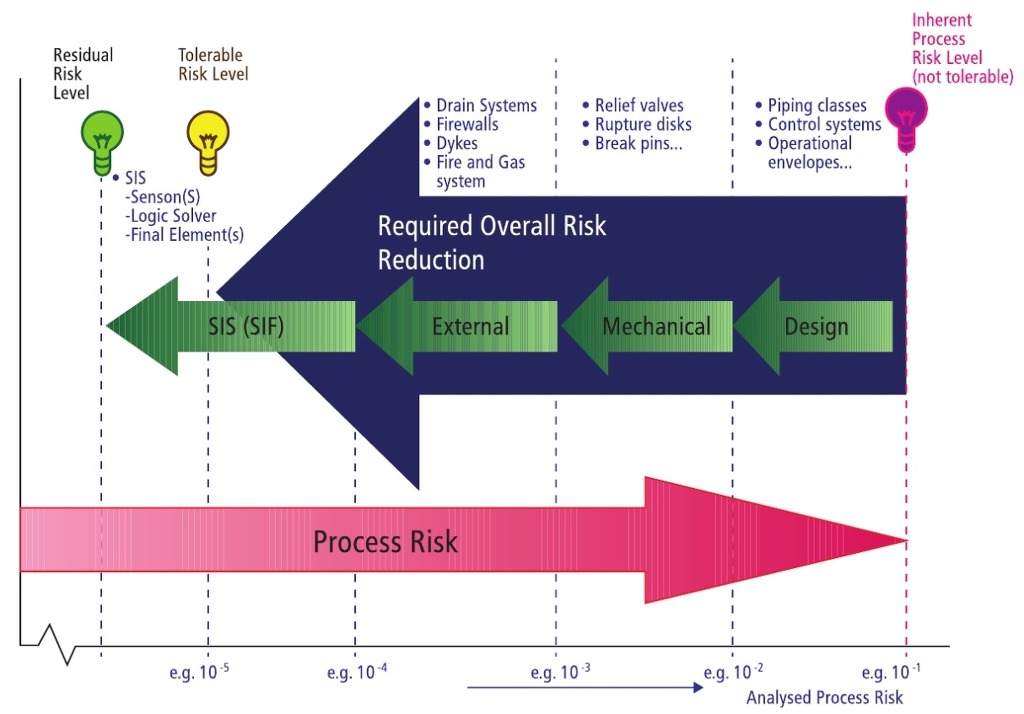
The purpose of the SIL Verification is to demonstrate that the identified Safety Instrumented Functions
(SIFs) during the SIL Classification are capable of achieving the required SIL. Specifically its objectives
are ;
- to evaluate the probability of Failure on Demand(PFD) for the SIFs for eht current design
- to conduct verification on the current design's ability to meet the SIL requirements for the SIF that will be determined through a preceding SIL Classification study.
SIL 검증은 SIL 등급 평가과정에서 확인된 SIF들에 대해 요구 SIL 등급의 만족여부를 입증하는 것이 목적입니다. 구체적으로 현재 설계된 SIF의
- 작동 요구 시 고장확률(Probability of Failure on Demend ; PFD)을 평가하고
- 현 설계가 선행 SIL 등급 평가에서 결정될 요구 SIL등급을 만족시킬 수 있는지를 검증하게 됩니다.
SIL Project References
- UAE Mifta P&W company(Mirfa IWPP) SIL Classification by Dr. Cho Chul-Kun (2015)
DNV GL Korea의 안전무결성등급(SIL) 전문가
▲ 성 명 : 조 철 군 박사 / 그룹리더(Principal Engineer) ▲ 학력 및 경력 : Arizona State University, 화학공학과, 공정설계 및 관리 ▲ HAZOP/HAZID Chairman, QRA, SIL Analysis, RBI ▲ 이메일 및 연락처 : 02-724-8050 Chul.Kun.Cho@dnvgl.com |
▲ 성 명 : 박종인 박사 / 그룹리더 (Principal Engineer)
|

▲ 성 명 : 최인환 박사 / Senior Engineer ▲ 학력 및 경력 : 한국과학기술원(KAIST) 해양시스템공학 공학박사
|