
ALARM MANAGEMENT
Overview
The alarm management is a guide for the design, development, procurement, operation, maintenance
and management of industrial alarm system. The alarm management includes techniques, tools,
standards, and procedures that improve the operations of process plants by improving the effectiveness of alarm systems.
Alarms have key tasks for the operator that alerts a change, informs the nature of the change and guide to take correct action. With appropriate alarm management alarms stay desired function over time. While increased nuisance alarms result in distraction the operator.
One of contributory factor in continuing major incidents was poorly prioritized alarms resulting in flooding of alarms in upset condition e.g. Longford Refinery Incident in 1998, Texas City Refinery Explosion
in 2005 and Buncefield Oil Storage Site in 2005.
Alarm management는 industrial alarm system의 설계, 개발, 구매, 운전, 유지보수 및 관리에 대한 안내입니다.
Alarm management는alarm system의 유효성개선을 통해 공정산업의 운전성을 개선하는 기술, 도구, 표준 및 절차서를 포함 합니다. Alarm의 주요 기능은 운전자에게 공정변화와 그 유형에 대해 알리고 적절한 행동을 취하도록 하는 것입니다. 적절한 alarm management를 통해 alarm은 요구되는 기능을 지속할 수 있습니다. Nuisance alarm
(성가신 alarm)의 증가는 운전자의 업무를 방해합니다. 지속적으로 발생하고 있는 중대사고의 주요 원인 중 하나는 비정상적인 상황에서 우선순위가 제대로 분류되지 않는 alarm과 그로 인한 alarm의 홍수였습니다. 그 예로 Longford 정유공장 사고 (1998), 텍사스 시티 정유공장 폭발 (2005), Buncefield 오일 저장소 사고 (2005)등이 있습니다.
|
As is |
To be | |
|
The costs of
poor alarm performance : several key alarms operator's display handling |
|
Good reasons to conduct Alarm Management Study : number and costs of incidents |
|
| ||
|
A Company : | ||
|
B Company : | ||
|
C Company : concentrated maintenance and reduced downtime | ||
|
D Company
(Design) : 18 ea, Medium 100 ea, Low 378 ea after Alarm Rationalization & Prioritization Study. |


|
As is |
To be |
|
|
좋지 않은 alarm 의 결과 : 해석 도표의 불분명한 표시 |
|
Alarm Management
Study를 하는 이유 : |
|
|
||
|
A사 : 집중할 수 있어 효율성 증가 |
||
|
B사 : |
||
|
C사 : 증가 집중, downtime 감소 |
||
|
D사 (Design) : 378개로 우선 순위가 부여 되었다. |


DNV GL Services
DNV GL can provide alarm management services throughout alarm life cycle for operating companies and EPC companies. Our services perform based upon international standards – IEC 62682, ISA 18.2 and
EEMUA 191.
- Philosophy : A document that establishes the basic definitions, principles, and processes to design, implement, and maintain an alarm system.
- Identification : DNV GL services can provide alarm identification methods. including hazard and operability study (HAZOP) and safety integrity level (SIL).
- Rationalization (Prioritization) : The process to review potential alarms using the principles of the alarm philosophy, to select alarms for design, and to document the rationale for each alarm. The service will be performed as a form of workshop. (The process of assigning a level of operational importance to an alarm.)
- Alarm review : The design of the alarm system is verified against the defined requirements.
- All the services previous steps are applicable for the alarm systems already in operation.
DNV GL은alarm life cycle 동안 alarm management service를 제공합니다. 본 service는 IEC 62682, ISA 18.2, EEMUA 191의 국제 규격에 따라 수행됩니다.
- Philosophy : alarm system의 정의, 규칙, 설계, 반영 및 유지보수를 작성해 드립니다.
- Identification : hazard and operability study (HAZOP)와 safety integrity level study(SIL)를 통해 alarm의 원인과 결과를 알아내는 일입니다.
- Rationalization (Prioritization) : 설계를 위한 alarm을 선택해서 alarm philosophy의 규칙에 따라 잠재적인 alarm을 review하고 각 alarm에 대해 근거를 서류화하는 절차 입니다. Workshop의 형태로 진행 됩니다. (alarm의 운전상 중요도에 따라 level을 부여합니다.)
- Alarm review : 설계된 alarm system이 정의된 요구사항을 충족하는지 확인하는 증명하는 일입니다.
- DNV GL의 모든 service는 운전중인 모든 alarm 시스템에 적용 가능합니다.
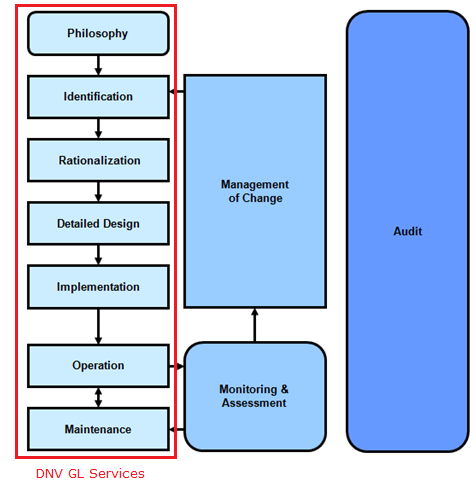
Alarm Management Life Cycle (ISA 18.2)
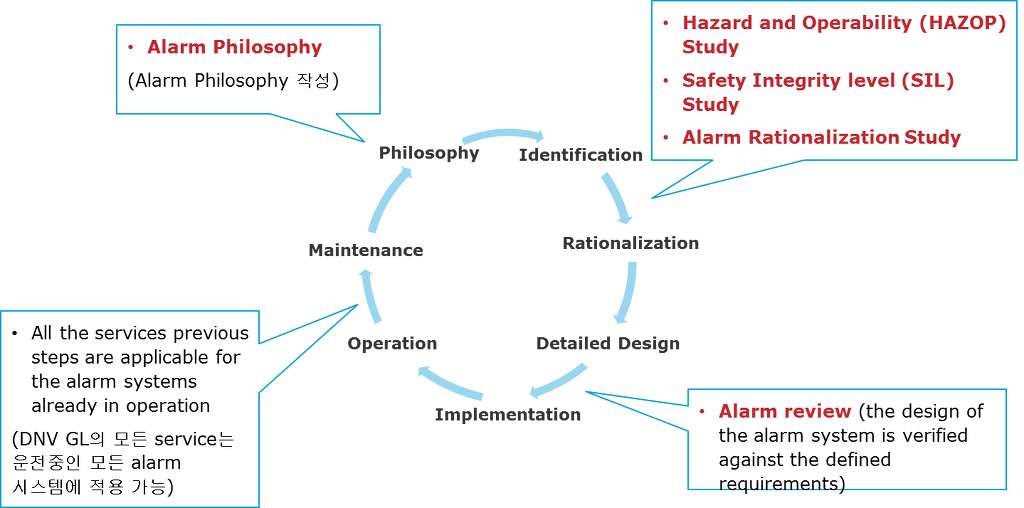
DNV GL Services in Alarm Management Life Cycle
Benefits
From alarm management alarms can be properly prioritized and effectively working as it is intended in
design. Good alarm management can lead to the operator to do the appropriate action to prevent,
control and mitigate in abnormal situations.
Alarm management를 통해 alarm은 설계 시 의도한 대로 우선순위가 분류되고 유효하게 작동될 수 있게 됩니다.
Good alarm management는 비정상적인 상황을 방지, 조절, 완화하기 위해 운전자가 적절한 행동을 취할 수 있도록 해줍니다.
References
- Rumaitha Shanayel Facilities, UAE, Alarm Management Study (Alarm Rationalization) (2015)