The Economist Articles for Oct. 3rd week : Oct. 20th(Interpretation)
작성자Statesman작성시간24.10.11조회수143 목록 댓글 0The Economist Articles for Oct. 3rd week : Oct. 20th(Interpretation)
Economist Reading-Discussion Cafe :
다음카페 : http://cafe.daum.net/econimist
네이버카페 : http://cafe.naver.com/econimist
Leaders | An echo and a choice
The Trumpification of American policy
No matter who wins in November, Donald Trump has redefined both parties’ agendas
Oct 10th 2024
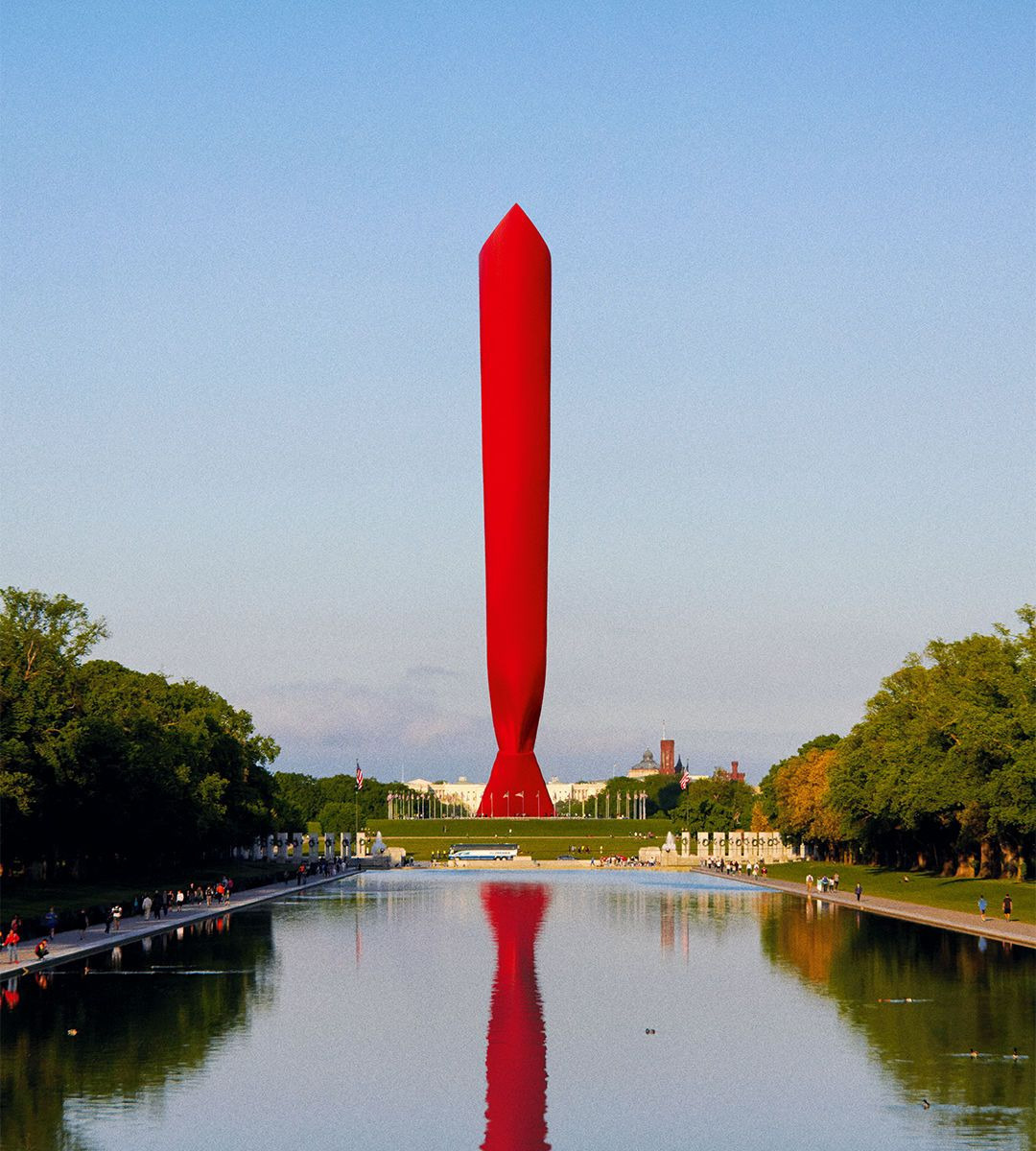
THE CHOICE facing America in less than a month will not be made by voters weighing rival sets of policies. Kamala Harris’s plans lack detail; Donald Trump’s are sometimes untethered from reality—and in any case divisions over culture motivate voters more than tax policy. Yet the choice matters hugely in policy terms, for America and the rest of the world. This aspect of the election has been under-covered relative to fantasies about what Haitian migrants in Ohio have for lunch. Our current issue, which contains eight concise policy briefs on the areas where we think the election will make the most difference, is intended as an antidote to that.
Our list is selective: we have left out subjects where the contrast between the two candidates is stark, but which have no direct bearing on public policy. These include the candidates’ characters, what the election would mean for institutions and even for American democracy. Nor have we included abortion, where the candidates’ different views are unlikely to translate into markedly different policies thanks to a Congress that neither party is likely to dominate. Strip those things out, important as they are, focus on policies that are in the president’s gift instead, and the result is surprising. Whoever gets to 270 electoral-college votes on November 5th, Mr Trump’s ideas will win. He, not Ms Harris, has set the terms of this contest. American policy has become thoroughly Trumpified.
Take Ms Harris’s domestic platform. Her immigration policy is to endorse the most conservative bipartisan reform proposal this century. Its provisions include shutting down asylum applications when the flow of irregular migrants is high. Her trade policy involves keeping, in modified form, most of the tariffs Mr Trump imposed in his first term. On tax, Ms Harris would keep most of the cuts Mr Trump signed in 2017 (raising rates only for those who earn over $400,000). On energy, she has become a convert to fracking and has been part of an administration that has seen America pump more oil and gas than ever before. Because America is so partisan, and Mr Trump is such a polarising figure, Ms Harris has been able to borrow parts of Mr Trump’s first-term agenda without most people noticing.
This policy-poaching makes political sense. Mr Trump moved onto Democrats’ turf first, love-bombing trade unions and scrapping Republican plans to trim public spending on pensions and health care. Because the election will be fought in six or seven swing states, all of which were a couple of percentage points more Republican than the national average in 2020, Ms Harris’s quiet adoption of Trumpier positions could help her win. Yet the result is that a candidate who lost the last election, whose party was trounced in the 2018 midterms—a candidate who has never won the popular vote and probably never will—has remade American policy in his image.
The same is true in foreign policy. The two candidates have different approaches: one is built on values and alliances; the other on asking what the world can do for America. If Mr Trump wins, nervous speculation over America’s commitment to NATO will come back; with Ms Harris it is not in doubt. Yet there is surprising overlap. Mr Trump adopted a more confrontational approach to China than any recent president, even if his policies were in practice less scary than they sounded. The administration Ms Harris has been part of has been less verbally antagonistic but tougher in practice, banning technology exports to China and placing huge tariffs on imports of Chinese electric vehicles. On the Middle East, Ms Harris has not let Mr Trump outflank her on the right, despite pressure from within her own party to cut arms supplies to Israel. Nor does she seem in a hurry to revive the deal with Iran that Mr Trump tore up; this week she called the Islamist regime America’s greatest adversary. Here too, Mr Trump has set the terms.
Support for Ukraine is where the gap seems widest. Ms Harris has been part of an administration that has led the Western effort to help Ukraine defend itself against Russia’s unprovoked invasion. She would continue to supply Ukraine with arms and cash, as long as Congress let her do so. Mr Trump’s policy is extraordinarily vague: he says only that the war would not have broken out on his watch and that he would end it swiftly. He does not say how, and his refusal to say which side he would like to win adds to fears that he would urge Ukraine to settle on Russia’s terms. Such a catastrophic betrayal is not certain, however. Even Mr Trump may worry that letting Russian tanks roll over more of Ukraine would make him look weak.
A choice and an echo
The second thing that is clear from our policy briefs is that while Ms Harris has moved towards the Donald Trump of the first term, Mr Trump has become more extreme, even compared with his prior self. On trade he said earlier this year he favoured a 10% universal tariff on imports and has now upped that to 20%. He wants a tariff of 60% on all Chinese imports. On tax he now wants to cut everything in sight, making all the 2017 cuts permanent and reducing corporate taxes further. The Committee for a Responsible Federal Budget reckons that his plans would add twice the amount to the national debt that Ms Harris’s would (and hers are hardly restrained). On immigration, 2024 Trump is more extreme than 2016 Trump. He always needs a new big promise, and this time it is not merely a wall but mass deportation. Some of his policies are extreme by omission: he has no discernible plan for reducing CO2 emissions, or for helping the country adapt to climate change.
Next week we will look more closely at how the two candidates’ policies might affect the economy. For all Mr Trump’s claims that President Joe Biden has “destroyed” it, America’s economy is currently the envy of the world. Yet it is striking how little faith either candidate places in the things that made it great, such as openness to trade, talent and competition . Clearly, Ms Harris would not seek to shut America off as vigorously as Mr Trump would. But whoever wins in November, the Trumpification of American policy seems likely to continue. ■
Finance & economics | Free exchange
Why economic warfare nearly always misses its target
There is no such thing as a strategic commodity
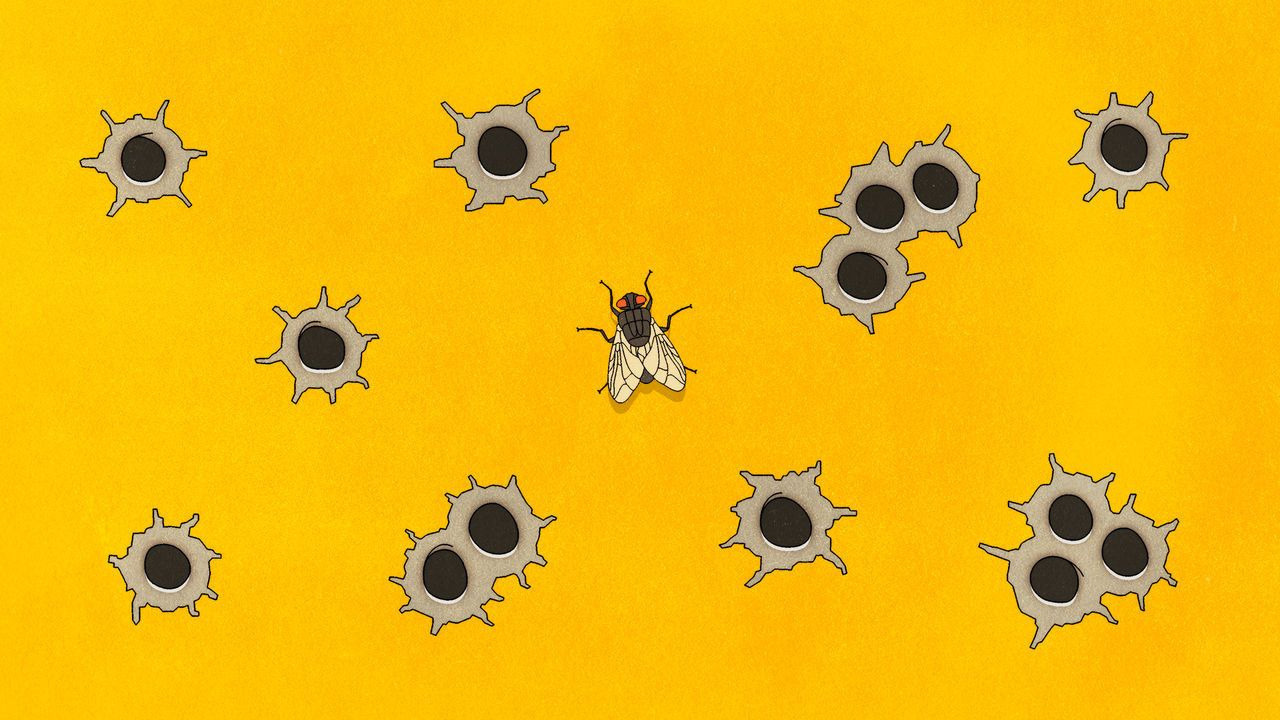
Illustration: Alvaro Bernis
Oct 3rd 2024
Between August and October 1943 American warplanes repeatedly bombed Schweinfurt, in southern Germany. The Bavarian town did not host army HQs or a major garrison. But it produced half of the Third Reich’s supply of ball bearings, used to keep axles rotating in everything from aircraft and tank engines to automatic rifles. To Allied planners, who had spent months studying the input-output tables of German industry, the minuscule manufacturing part had the trappings of a strategic commodity. Knock away Germany’s ability to make them, the thinking went, and its military-industrial complex would come crashing down.
The operation was costly for the Americans, with heavy losses of aircraft and crew. But it was effective: in just a few months Bavaria’s ball-bearing prowess was reduced to rubble. Yet soon it became clear that, despite Schweinfurt’s obliteration, German factories kept cranking out Messerschmitts and machine guns at just the same pace. America’s Strategic Bombing Survey, carried out in the aftermath of the war, found “no evidence that the attacks...had any measurable effect on essential war production”.
In the decades since, versions of this story have played out many times, most recently with America’s sanctions against Russia and its measures against China. Adversaries in both cold and hot wars have tried to deprive each other of a strategic commodity, only to succeed in one sense (access to that commodity was reduced) and fail in another (the crunch did not bring about economic collapse or military capitulation). In a book to be published next year, Mark Harrison and Stephen Broadberry, two British scholars, use a theory first set out in the 1960s by Mancur Olson, an economist, to explain this paradox. The concept of a strategic commodity, they argue, is an illusion.
A good is often described as “strategic”, “vital” or “critical” when it is thought to have few substitutes. America and China have strategic reserves of petroleum, because their leaders think oil cannot easily be replaced, at least in the short run. Some minerals are deemed critical because you cannot build a viable electric car without them. But Olson reckoned very few goods, if any, are truly strategic. Instead, there are only strategic needs: feeding a population, moving supplies, producing weapons. And no amount of pounding, literal or figurative, seems able to alter the target countries’ ability to meet those needs, one way or another.
To understand why that is, return to the classic definition of what, supposedly, constitutes a strategic good. The starting premise is that a class of goods exists for which there are no substitutes. But substitutes nearly always exist; and if a good really cannot be replaced in the short term, in the longer run it almost always can be. Make a commodity scarce or dear enough, a microeconomist might infer, and the mix of inputs needed to produce output start shifting naturally.
The way Germany responded to its wartime ball-bearing crunch illustrates these mechanics. It was quickly discovered that, in many cases where manufacturers used to swear by ball bearings, simple bearings would suffice. For the uses that remained, extensive stockpiles could be drawn upon, which bought time to build replacement plants and, eventually, engineer ball bearings out of many military supplies.
The lesson Olson took from all this is that the cost imposed on those losing access to a resource, however key, is not the sudden collapse of every industry that depends on it but the more affordable cost of finding workarounds. Over time such costs usually accrue, slowing growth, but they are hardly ever enough to capsize an economy. This suggests that another commonly used economic concept—that of the “supply chain”—is too narrow at best. Modern economies look more like webs, where the severing of one link is rarely sufficient to compromise the entire structure.
Olson could not have foreseen that economic warfare would develop into the sophisticated tit-for-tat of trade and financial sanctions that has been on full display since Russia’s full-scale invasion of Ukraine in 2022. The commodities those target come in many forms, from credit and energy to “dual-use” goods and software. Their aim, not always explicit, is generally to change the behaviour of their targets and deter others from mimicking them. Export restrictions work directly, by blocking shipments of certain goods to the problematic party, while other sanctions seek to limit access to hard currency by making it harder for their targets to export lucrative goods. Often a combination is used.
Despite its growing complexity, however, this economic arsenal—largely controlled by America—has mostly misfired. Early attempts were already disappointing. A study in 2007 by researchers at the Peterson Institute for International Economics looked at 174 sanctions campaigns waged worldwide between 1915 and 2000, of which 162 took place after 1945. It found that such sanctions achieved their goals in part or in whole in only one-third of all cases. Success was more likely when goals were narrowly defined, the target state was already economically weak and there was no history of previous antagonism with the enforcing party.
The net effect
This explains why sanctions against Russia, a hostile state flush with cash, were never going to meet their broad goals. In 2022 excitable analysts predicted that Russia was on the brink of a 1998 moment (when it slid into financial chaos) or even a 1917-style revolution (when economic implosion caused the end of tsarism). The resilience of Russia’s economy has confounded expectations. It has dodged sanctions partly by substituting goods it could no longer source. It also found new trading buddies—not least China—to replace those it had lost. In a webby world, the notion of “strategic partner” looks increasingly transient, too. ■
United States | Lexington
Shirley Chisholm is still winning
The first black woman to run for president taught a lesson in making political change
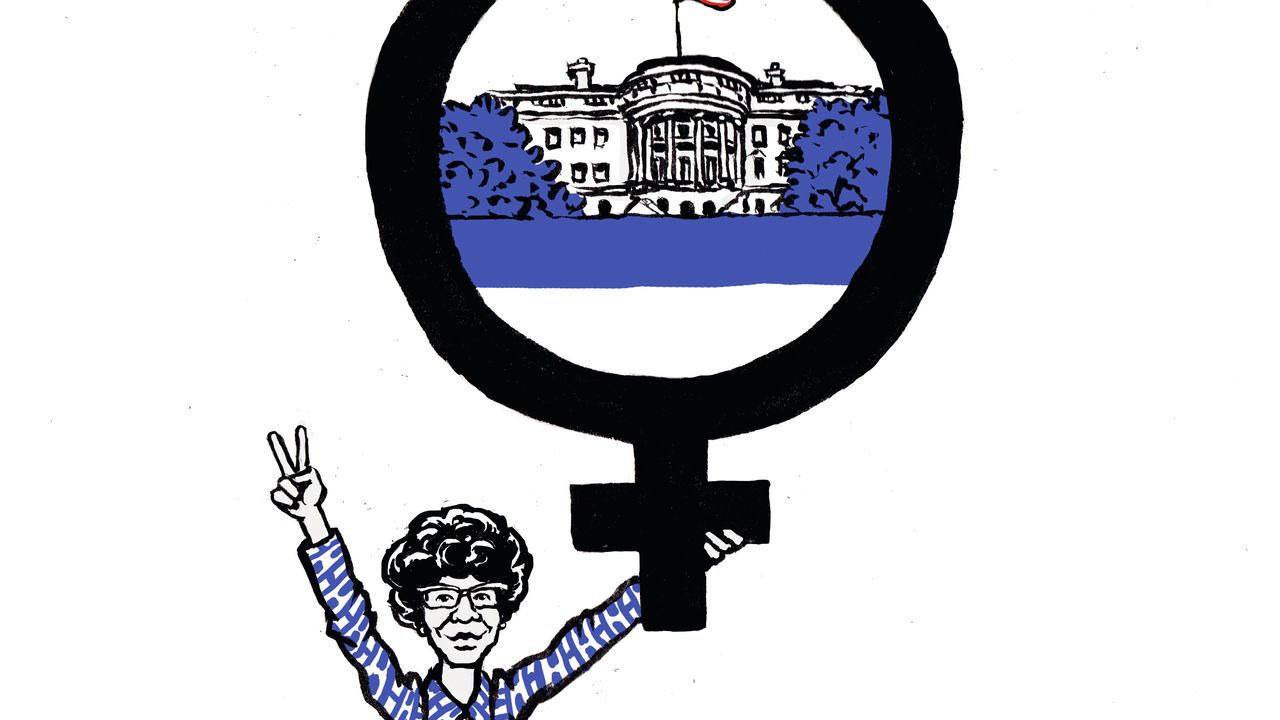
Illustration: David Simonds
Oct 10th 2024
Acynic might gaze at the photograph and sigh that nothing changes in American life: a black woman, a candidate for president, stands before a crowd with a determined look on her face, above a poster extolling a woman’s right to choose abortion. “Defend the Right,” it reads in part. The photograph, in black and white, is from 1972. It hangs in an exhibition at the Museum of the City of New York about Shirley Chisholm, the first black woman to seek the nomination of a major party.
An idealist, however beleaguered, might instead see an image that captures what it takes to make change in American life. Unlike this year, when Kamala Harris, as the Democratic nominee, is running neck-and-neck with former President Donald Trump, no one had any hope then that Chisholm, the first black woman to serve in Congress, had a chance of winning the Democratic nomination, let alone the presidency. Even she didn’t. Instead, she saw herself, as she put it, as “a catalyst”, pushing against sexism and racism to expand Americans’ idea of what was just and what should be possible. “I ran”, Chisholm wrote in “The Good Fight”, her account of the campaign, “because someone had to do it first.”
She lost that race, but more than half a century on is still gaining ground in the one she really cared about. “She opened up a portal for many to follow,” says Yvette Clarke, a congresswoman whose district in Brooklyn, New York, contains part of Chisholm’s old one, and who can remember, back when she was seven, the excitement in her home about Chisholm’s candidacy. “If she didn’t have the courage to take on the battle”, Ms Clarke adds, “who knows when we would have come to this day.” A documentary about Chisholm from 2004 captures her philosophy and her fierceness. “Don’t forget to study hard,” she instructs a group of black children. “I’m paving the way for you. So don’t disappoint me.” In 2019 Ms Harris told the Grio, a news site, that she stood on Chisholm’s shoulders, and that her example taught that “you claim that podium as yours. And you don’t ask anybody permission.”
Ms Harris has not stressed the precedent-setting nature of her candidacy, emphasising Americans’ needs rather than her (and their) chance to make history. Chisholm, who died in 2005, did not have the option. “A new hat—rather, a bonnet—was tossed into the Democratic presidential race today,” Walter Cronkite said on CBS when she declared that she was running. For her part Chisholm said she was “the candidate of the people of America”.
Like Ms Harris, whose father is from Jamaica, Chisholm, born in Brooklyn 100 years ago next month, had Caribbean roots. Her mother was a native of Barbados and her father of British Guiana. He worked as an unskilled labourer and she as a seamstress, and to save enough to house and educate their growing family they sent young Shirley and her two sisters off to Barbados in 1928 to live with family for seven years. Chisholm ascribed her success partly to the strict British education she received there. It also accustomed her to the idea of black people in authority, and probably accounted for her rat-a-tat elocution, her habit of speaking of herself in the third person and, though she never weighed much more than a hundred pounds, her intimidating, regal bearing. Gloria Steinem, an ally, once said her decision to wear a dress rather than blue jeans to the first press conference of the National Women’s Political Caucus (NWPC), which Chisholm co-founded, was “entirely due to Shirley Chisholm”, of whom she was always afraid.
Chisholm graduated from Brooklyn College and became a nursery-school teacher, then director of a nursery school. She involved herself in Democratic politics, dominated in Brooklyn by white, Irish-American men, and eventually helped found an insurgent group to elect black candidates. In 1964 she became the second black woman elected to the New York State Assembly, and then, in 1968, the first elected to Congress. Her legislative experience turned Chisholm into “a militant” who saw American politics as “a beautiful fraud”. Political organisations protected the powerful, she concluded, and, white or black, male or male (alternatives were scant), politicians put their party first.
Don’t call me “surely”
“Of my two ‘handicaps’, being female put many more obstacles in my path than being black,” she wrote in her memoir, titled after her slogan, “Unbought and Unbossed”. She saw America as “racist all the way through”, a place where a mere “accident of pigmentation” carried terrible weight. “I can feel in myself sometimes an anger that wants only to destroy everything in its path,” she wrote. Yet she believed the American system was so flexible there was almost no limit to its possibility for reform: “I love America not for what she is,” she wrote in “The Good Fight”, “but for what she can become.” In her era, whose echoes seem to be growing louder even as it recedes in living memory, young Americans—newly conscious of racial inequities, anxious about economic dislocation brought on by new technology, radicalised by war abroad, disappointed in their elders—seemed certain to demand profound change, even as they aged. That’s what she thought, anyway.
The Democratic field was crowded with white men, ranging from stalwart liberals such as Hubert Humphrey to the segregationist George Wallace. Chisholm ran a shoestring campaign that relied almost entirely on volunteers. Shut out of a debate, she got a court order for equal time on television. She beat several serious contenders, and though she accumulated 152 delegates that was not enough to extract the policy commitments she hoped for from the nominee, George McGovern. Most of the otherwise male Congressional Black Caucus chose not to support her, and even the NWPC deserted her for McGovern, though in the end he did not deliver the abortion-rights plank they wanted in the party platform. That struggle would continue into the future, too. ■
The Americas | Stubborn brutality
The beating of Argentina’s former first lady fits a shameful pattern
Progress against the scourge of violence against Latin American women has been patchy

Photograph: Johis Alarcon/Panos
Oct 10th 2024|Lima, Mexico City and São Paulo
On October 1st Mexico’s first female president, Claudia Sheinbaum, was sworn into office. Flanked by female soldiers, she declared that it was “time for transformation” and “time for women”, before sending a raft of bills to Congress designed to improve their lot. Meanwhile, at the other end of the continent, Argentina’s former president, Alberto Fernández, has been accused of domestic abuse in a case which has shocked the region. Photos found on his secretary’s phone showed his former partner, Fabiola Yañez, with bruises on her face and body. Leaked audio files appear to capture Mr Fernández telling the former first lady to “go to hell, you and all your offspring, you dumb bitch”. Mr Fernández denies all charges.
This pair of events illustrates the gap between rhetoric and reality in Latin America when it comes to the treatment of women. Countries across the region have passed laws against domestic violence in recent decades. Shelters for abuse victims have popped up; hotlines to report crimes have become more common. Yet the outcome is disheartening. While the killing of women has decreased somewhat, the murder of women in their homes rose by 9% in the decade to 2020. Domestic abuse in some Latin American countries remains unusually common for their level of development. The region has more laws on the books that specifically criminalise femicide—the killing of women—than anywhere else in the world. But this rebranding has helped little, if at all. In Mexico, where nine women are killed on an average day, just 1% of femicides end in a conviction (the rate is similar for all murders).
According to the World Bank, almost one-third of women around the world have been physically, psychologically or sexually assaulted at least once during their lifetime (the share is around a fifth in rich countries). The vast majority of assaults are committed by current or former intimate partners. The regions with the highest levels of gender violence are sub-Saharan Africa, South Asia and Oceania, but some countries in Latin America stand out. Some 60% of women in Bolivia say they have been physically abused by their partner at least once. In Ecuador, 40% say the same. In Mexico and Honduras nearly six women per 100,000 are murdered every year. The global average hovers around two per 100,000.
The impunity enjoyed by abusers is one of the main factors behind continued violence. In some cases perpetrators get away with it thanks to connections with politicians, lawyers or drug gangs. Wendy Figueroa Morales, the director of Mexico’s network of shelters for women, reckons that more than a third of those who have sought refuge in her havens have been abused by men with links either to organised crime or politicians. In one case which reached Mexico’s Supreme Court in 2015, the murderer, who worked at the office of a state attorney-general, was initially able to pass his wife’s death off as a suicide. Bolivia’s former president, Evo Morales, who wants to run for office again next year, is being investigated for allegedly raping a 15-year-old girl, who subsequently gave birth to his child. Mr Morales calls the allegations “political persecution”.
Sexism is rampant. In a study of almost 5,000 young men and women in Latin America conducted in 2017 by Oxfam, almost two-thirds of boys aged 15-19 said that when a woman says no to sex, she really means yes. In a poll last year, nearly 40% of Peruvians agreed that a woman should obtain her partner’s permission before leaving the house to see family or friends. In another survey, almost a third said that a woman is somewhat to blame if she goes to a party alone and is raped.
These attitudes appear to cause foot-dragging and indifference from the authorities when responding to crimes against women, granting further protection to abusers. Disdain reaches the top level of power. When Eyvi Agreda, a 22-year-old Peruvian woman, was killed in 2018 by her stalker, Carlos Hualpa—he doused her in petrol and set her on fire on a bus—the then president, Martín Vizcarra, initially responding by saying, “We feel very sad but sometimes that’s the destiny of life and we have to accept it.”
Measuring machismo
The violence is not evenly distributed, either geographically or socioeconomically. Poverty, alcohol consumption and lower levels of education are all associated with higher levels of violence against women. Women moving along migration routes are particularly vulnerable. Diego Battistessa of Carlos III University in Madrid has documented the death, killing or disappearance of at least 500 Venezuelan women along migration routes since September 2019. The real number is probably much higher. Many others are raped.
Charities operating near the Darién Gap, a treacherous stretch of jungle between Colombia and Panama which many Venezuelan migrants cross to reach the United States, say that the level of sexual violence they have seen in recent years is comparable to that observed in war zones.
Murky data, and the reality that many women do not report abuse, mean that it is difficult to discern which interventions are working to reduce violence. Government investment in reporting hotlines and awareness campaigns at least lead to more abuse being reported. In Brazil, after President Luiz Inácio Lula da Silva came to power in January 2023, he boosted funds for the women’s ministry by 400m reais ($70m) over four years. Among other things, the money is being used to employ more people on a domestic-abuse hotline and to spread awareness about its existence. Calls increased from 82,000 in 2022 to 114,000 so far in 2024, according to Denise Motta Dau, Brazil’s national secretary for combating violence against women.
But these reports rarely inform investigations into murder or abuse. Just three out of 19 countries in Latin America use data from previous complaints of violence when investigating femicides. Those that do show that complaints often precede more serious violence. In Uruguay in 2022 some 37% of women who were murdered had made formal complaints before their partner killed them.
What would do most to reduce violence against women would be a combination of better-trained prosecutors who can achieve even moderate conviction rates, and education that deters machismo. Unfortunately, that transformation is likely to be a long time coming. ■
Asia | Doing the locomotion
New railways could transform South-East Asia
China is keen to assist

Photograph: Hu Chao/Xinhua/Eyevine
Oct 10th 2024
Few better ways exist to see Vietnam than to travel on its north-south railway. It was originally built by French colonialists, and its trains pass rice paddies, verdant mountains and spectacular coastlines as they go from Hanoi, the capital, to Ho Chi Minh City. However, the trains move at a leisurely 30 miles (50km) per hour. Rather than spend 36 hours on the train, most people take a two-hour flight.
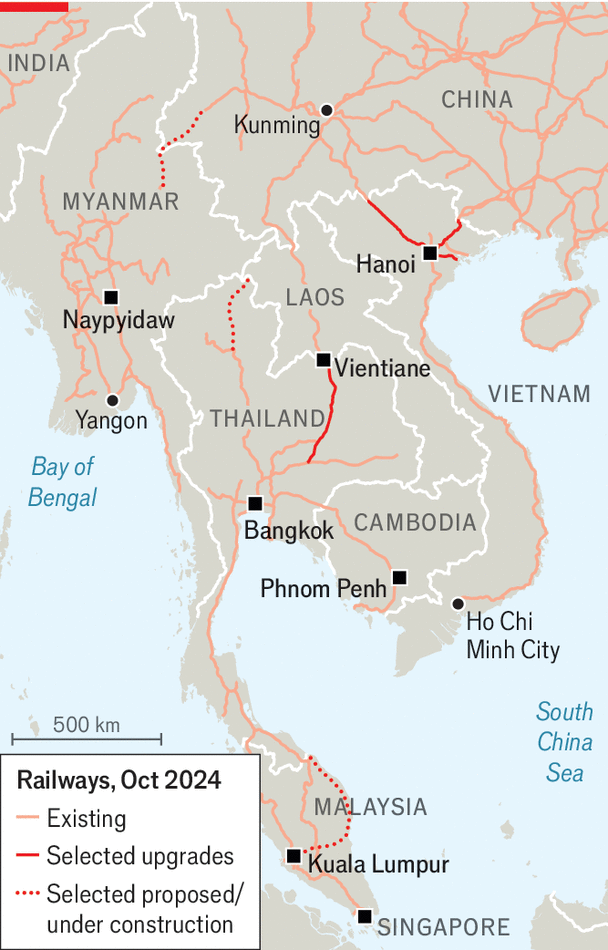
All across South-East Asia railways are old and slow, and tend not to connect with one another. The region has only 24,000km of railway lines—roughly the same as Mexico, which has a land mass half its size. For decades bigwigs at the Association of South-East Asian Nations, an intergovernmental forum that aspires to increase trade, have talked up the goodies that might flow from laying a lot more track. Wheels are slowly starting to turn.
Map: The Economist
One accelerant has been the completion, in 2021, of a semi-high-speed line from Kunming in southern China to Vientiane in Laos. The idea for a long time has been that this could become the first stretch of a line that would run all the way to Singapore (see map). Its inauguration has generated momentum elsewhere, says David Lampton of Johns Hopkins University. Thailand has said it is speeding up construction of a high-speed railway into Laos; Malaysia is reviving long-stalled plans to build a $25bn line south to Singapore; Vietnam has just announced plans for two railways that will run from Hanoi to the Chinese border. Last year Indonesia launched its first high-speed service between the cities of Jakarta and Bandung.
To expand their networks, South-East Asian countries need expertise and money. China is offering both. Though it now talks much less than it did about its Belt and Road investment initiative, China remains by far the biggest foreign provider of finance for South-East Asian infrastructure. As of 2022 it was involved in two dozen of the region’s 34 biggest projects (those costing more than $1bn), reckons the Lowy Institute, an Australian think-tank. Six of them, equivalent to 60% of total commitments, were railways.
Foreign fields are attractive to Chinese rail companies, which have mostly finished rigging up their own country’s high-speed network. And South-East Asia is a particular priority for the government. Improving freight there would benefit Chinese companies that are moving factories to the region. Last year Chinese firms coughed up a third of all the foreign investment that went into South-East Asia’s manufacturing sector, up from 18.5% in 2019.
Delays doubtless lie ahead. Infrastructure projects that are backed by China tend to fall through a lot more often than others, notes the Lowy Institute. It reckons that between 2015 and 2021 only a third of the funds China said it was committing to infrastructure in South-East Asia actually ended up flowing into something that got finished. This is in part because China likes to get involved in the most ambitious projects, which are most vulnerable to slippage or downsizing. But it is also because big Chinese investments are controversial, and tend to get re-examined when governments change.
A Chinese-backed rail line that is due to connect Malaysia’s east and west coasts has caused no end of rows since it was announced in 2016. Its plans have been reconfigured several times. Last year the Philippines, which has only a few hundred kilometres of railway, said it would no longer seek Chinese help to construct three new rail lines (fear of getting in hock to China, and anger over disputes in the South China Sea, may have played a role). Yet it insists it has other options: officials said they would instead seek funding from India, Japan or South Korea. Perhaps one day South-East Asia’s stunning vistas will whizz past travellers—in the blink of an eye.■
Middle East & Africa | War in the Middle East
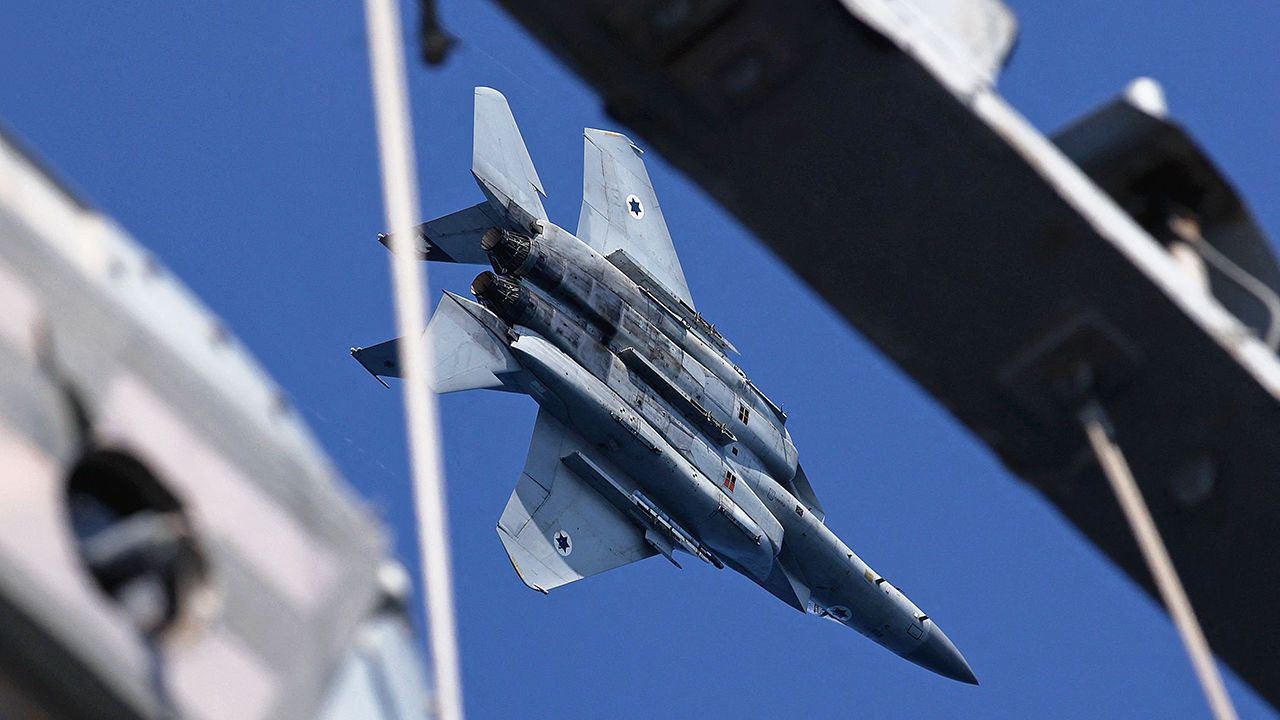
Israel has these four options for attacking Iran
Its politicians, and some generals, are gung-ho that the moment has come
Photograph: AFP
Oct 10th 2024|JERUSALEM
At least twice in the past, in 2010 and 2011, Israel’s generals have been ordered by the prime minister, Binyamin Netanyahu, to prepare for imminent strikes on Iran. In both cases the security chiefs questioned the legality of the order, given without the necessary cabinet authorisation. In neither instance did Israel go to war with the Islamic Republic.
Today Israel is once again on the verge of thumping Iran. This time Mr Netanyahu will have no problem getting approval from a cabinet which if anything is even more gung-ho than he is. Nor are the leaders of Israel’s armed forces as opposed to such action as before. And this time Israel believes the odds are in its favour.
Read all our coverage of the war in the Middle East
Israel’s leaders reckon that the 181 ballistic missiles fired by Iran at Israel on October 1st leave them with little alternative but to hit back. What form the retaliation takes could have wide-ranging implications for the Middle East and beyond.
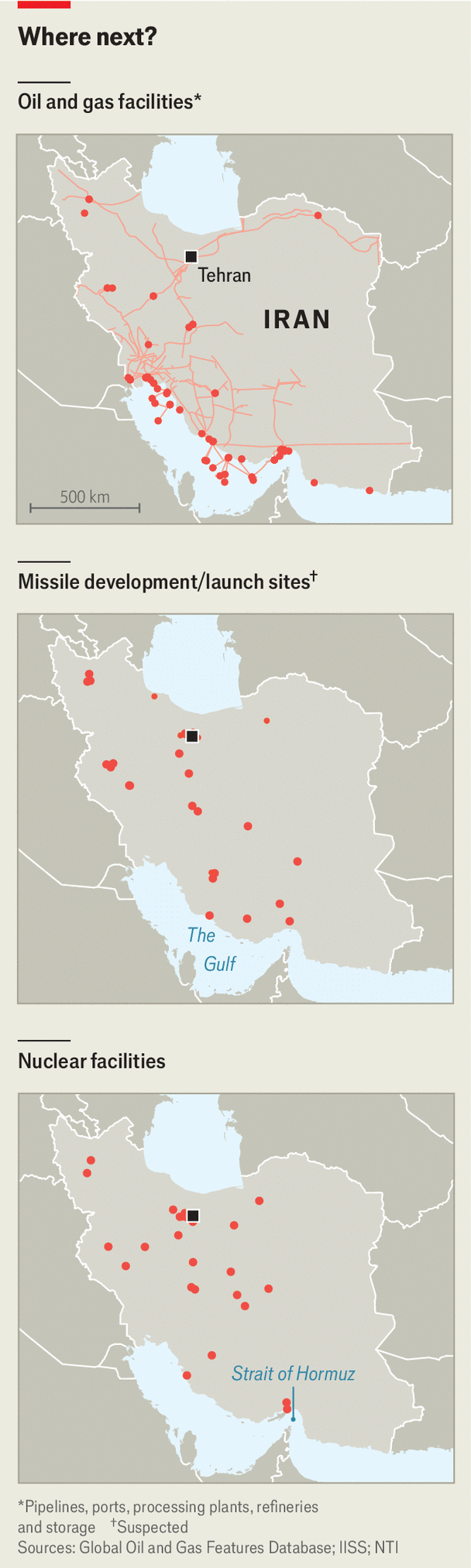
Four types of targets are being considered. Mr Netanyahu has long favoured bombing the sites where Iran enriches uranium and carries out research for its nuclear programme. But these are dispersed around the country (see map) in heavily fortified locations deep underground. Doing significant damage would require large numbers of bunker-busting missiles launched from dozens of aircraft operating at least 1,200km (750 miles) away from Israel. Israel’s air force is the most powerful in the region but it may be difficult for it to set back Iran’s nuclear programme by more than a few months.
Map: The Economist
A more vulnerable strategic target would be Iran’s main ports, specifically the oil terminals which provide most of Iran’s foreign-currency income. Israeli strategists believe that destroying them would deal a severe blow to Iran’s already shaky economy. This, they hope, might provoke further unrest within Iran. Some dream that it could even lead to the regime’s downfall.
A third choice would be to target the country’s leaders directly, just as Israel has attacked the leaders of Iran’s proxies and allies, Hizbullah in Lebanon and Hamas in Gaza. This would be tricky, as Iran’s most senior figures would almost certainly retreat to secret protected locations if an Israeli strike looked imminent. And the impact of such attacks is always uncertain. The question of who will replace Iran’s ageing supreme leader, Ali Khamenei, is already a subject of much deliberation there.
Israel’s most obvious military response would be a tit-for-tat strike on Iran’s missile bases. This option would arguably be the least likely to provoke yet another missile salvo from Iran. But Mr Netanyahu believes that Israel has a historic chance to reshape the region. And this time some of his generals, though not all, agree. They think that the fact that Israel has withstood two major salvoes of Iranian missiles (the first in April) with barely any casualties or serious damage proves that Israel can withstand whatever Iran throws at it.
Those in favour of hitting Iran’s nuclear programme and economic infrastructure also believe that Israel has a rare momentum behind it, having in the space of weeks decapitated the main leaders of Hizbullah, Iran’s most powerful client militia in the region, and having destroyed a large proportion of its missile arsenal, too. Those missiles were supplied to Hizbullah by Iran to act as a deterrent against Israel attacking the Islamic Republic. Much of that deterrent has gone up in smoke.
So why, more than a week after Iran’s missile attack, has Israel not yet struck back? Not everyone in Israel’s security circles is in a rush to change the Middle East. Several of the country’s generals are counselling caution. For a start, they believe that Israel cannot afford to launch a campaign of this magnitude without co-ordinating with its main ally, the United States. But President Joe Biden has publicly spoken out against an Israeli attack on Iran’s oil infrastructure, since that risks causing global energy prices to soar on the eve of America’s elections. So far the president has also been against an Israeli attack on Iran’s nuclear facilities.
Despite the support worth nearly $18bn that America has given Israel in the past year, and although American planes and warships played a big part in intercepting Iran’s missiles, Israel has yet to share its plans with its closest ally. Mr Netanyahu even vetoed a proposed trip by Yoav Gallant, the defence minister, to Washington to discuss the options. Meanwhile, in televised statements Mr Netanyahu has promised the Iranians they will be free of their regime “a lot sooner than people think” and has exhorted the Lebanese to “free your country from Hizbullah”.
On October 9th Mr Netanyahu spoke by phone with Mr Biden for almost an hour. They spent most of the call discussing the possible strikes but did not seem to reach any kind of agreement.
There are Israeli defence officials who worry that provoking an all-out war with Iran, while Israel is still fighting Hamas in Gaza and has launched a ground invasion against Hizbullah in southern Lebanon, would stretch resources dangerously thin. Some generals warn of squandering the gains already made.
But since the disaster of October 7th 2023, the credibility of Israel’s military and intelligence chiefs in standing up to the prime minister has diminished. Like Mr Netanyahu, they seem ready to risk a devastating conflagration in order to transform their legacy from having overseen Israel’s greatest debacle to becoming the victors of a regional war. Like him, they may yet fall victim to their own hubris. ■
Europe | The French budget
France stares into a “colossal” budgetary abyss
A fragile new government must try to plug the hole. Fast
Illustration: Federico Yankelevich
Oct 9th 2024|PARIS
When a fresh-faced Emmanuel Macron swept into presidential office for the first time, in 2017, he hoped for a grand European bargain. France, which had not balanced a government budget since 1974, would fix its public finances and restore its credibility with its thrifty neighbour. In return, Germany, the euro zone’s biggest economy, would cede ground on French ideas for European integration, such as joint borrowing. Initially the bargain worked. In 2018 and 2019 France cut its annual deficit to below the EU’s limit of 3% of gdp. In 2020, nudged by the need to respond to the pandemic, the EU issued its first big joint bond.
Now, however, that bargain is falling apart. After snap legislative elections in July returned a hung parliament, a new minority government is trying to keep a coalition together that, awkwardly, relies for its survival on the tacit support of Marine Le Pen’s hard right. Michel Barnier, the new conservative prime minister, is confronting a fiscal crisis. France’s “colossal” deficit and debt, he declared on October 1st, is a “sword of Damocles” hanging over the country. In 2024, he said, the deficit will exceed 6% of GDP (next to 5.1% forecast earlier this year) and remain at 5% in 2025. It will fall back to 3% only by 2029, two years after Mr Macron’s previous government had promised. Government debt could reach 115% of GDP by the end of 2025.
France needs a squeeze. In the budget for 2025, which Mr Barnier was due to present to cabinet on October 10th, he was expected to unveil a massive €60bn ($66bn) in savings, or 2% of GDP: two-thirds in spending cuts, a third in tax increases.
On spending, Mr Barnier wants to delay raising public pensions in line with inflation for six months (saving €3bn) and impose widespread cuts on government departments (saving some €20bn). Other savings will come from local government, business subsidies and other measures. On the revenue side, proposals will include a temporary super-tax on firms with more than €1bn in turnover (raising €8bn) and on households earning over €500,000 (raising €2bn-3bn from some 65,000 households). Without these efforts, says Laurent Saint-Martin, the new budget minister, the deficit could reach 7% next year.
France’s neighbours are watching with a mix of weary familiarity and sharpening dismay. When asked this week about France’s deficit, Christian Lindner, Germany’s finance minister, replied drily: “We should all realise that the credibility of public finances vis-à-vis the capital markets is not to be trifled with.” On September 26th, for the first time since 2008, the yield on France’s ten-year government bonds exceeded Spain’s, usually considered riskier by investors. Mr Barnier knows he cannot get this moment wrong.
This year’s swollen deficit is partly the result of economic weakness, which depresses tax revenues and increases benefit costs. The underlying cause, though, is the overhang of generous state spending linked to covid-19 and the inflation surge prompted by Russia’s invasion of Ukraine. When the pandemic broke, Mr Macron vowed to protect the French “whatever it costs”. This became a guiding principle. Small firms were kept afloat after lockdowns ended. Untargeted caps on energy-price rises are still being phased out.
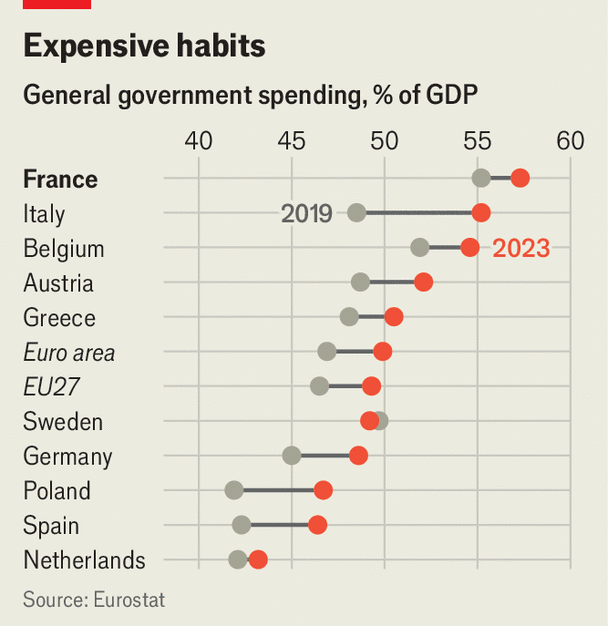
Chart: The Economist
France spent a bigger share of GDP on such measures than Germany or Spain. The French did benefit. When Germany went into recession in 2023 the French economy kept growing, albeit by only 0.9%. But the fiscal cost of support just for households came to €69bn in 2022 and 2023 combined, says the Bank of France. And at 59% of GDP in 2021, the state already claimed a greater share of spending in France than any other OECD country.
Mr Barnier now needs to make his eye-watering budget savings while running a precarious minority government. The left will reject almost anything it tries. This puts the government’s ability to manoeuvre in Ms Le Pen’s hands. Parliament must approve the budget by December.
Paradoxically for a conservative, Mr Barnier will have less trouble getting new taxes through. Despite France’s unhappy record as the OECD country with the highest tax take as a share of GDP, tax increases on profits and the rich always go down well. “He’s doing a Hollande,” says a Macronist figure, referring to the previous Socialist president, François Hollande. Mr Macron used tax stability to make France more investor-friendly; many of his centrist deputies are now worried.
Nobody, however, will relish spending cuts, even if in reality some of the “savings” are in fact slower increases in spending. IFRAP, a think-tank, calculates that the €40bn of savings will actually result in year-on-year cuts to budgets of closer to €15bn. Already Ms Le Pen has called the planned delay to raising pensions “stealing” from the elderly. Mr Barnier’s plans also rely, flimsily, on some classic but largely empty fallbacks, such as a clampdown on fraud. If he cannot secure parliamentary approval, he may have to resort to forcing the budget through using emergency measures, which would put his government’s survival on the line.
France is under close scrutiny. The European Commission has already put the country on formal watch, and will want evidence that it is not only serious about fixing public finances but intends to continue with reforms. France needs the commission’s permission to delay obeying EU rules until 2029. Three ratings agencies are also each due to report on France’s credit rating this month and in November.
The more Mr Barnier takes over domestic policy, the more Mr Macron will turn to European and foreign affairs. The president has lost none of his ambition to reinforce European “strategic autonomy”. Yet this agenda, and his hopes of fresh joint borrowing and a bigger EU budget, depends on his credibility. As Mujtaba Rahman, European head of Eurasia Group, a consultancy, puts it: “If your own house is in disrepair, it is difficult to ask your neighbours to raise more debt.” Mr Macron is still one of Europe’s main thinkers about how to face up to the continent’s fragile future. But France’s perilous finances undermine his ability to do much about it. ■
International | Elections everywhere
Over a billion have voted in 2024: has democracy won?
Half the world has had elections so far this year
Illustration: Edmon de Haro
Oct 6th 2024
In little less than a month, when Americans go to the polls to choose their next president, democracy will face its most important test in a year in which it is being put through its paces like never before. What happens in America—a superpower that embodies liberty for many people—could sway perceptions of the health of democracies around the world. A messy or violent outcome would inspire autocrats everywhere and undermine faith in the ideal of rule by the people. Conversely, a well-run election in which the loser gracefully concedes would strengthen the green shoots of a democratic recovery evident in some countries amid the biggest year of elections in history.
No fewer than 67 countries with a total population of about 3.4bn people have already held national elections this year. Those with another 440m people will let their citizens have their say before the end of 2024. At the start of the year The Economist suggested this “vote-a-rama” would be a “a giant test of nerves”. After all, when looking at areas such as voting, the press and repression of minorities, the number of countries where freedom has declined has been greater than the number where it has improved in each of the past 18 years, according to Freedom House, an American think-tank. One in three people voting in 2024 lives in a country where the quality of elections has measurably deteriorated in the past five years.
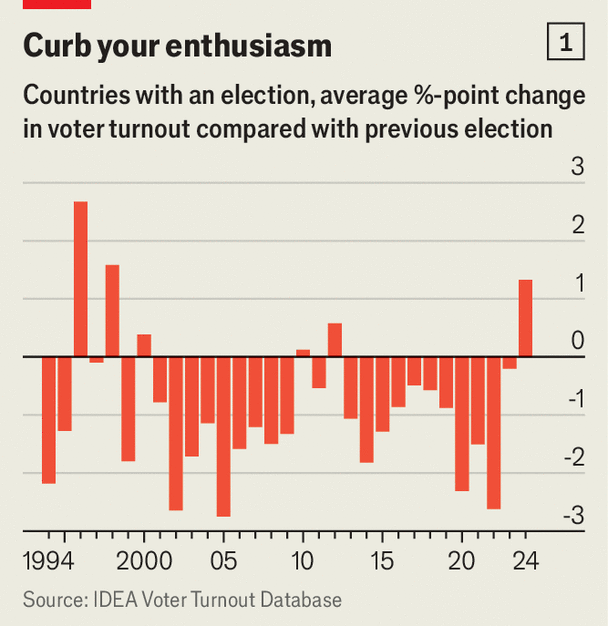
Chart: The Economist
So what is evident so far, given that almost 90% of votes around the world have been cast and tallied? Democracy has proved to be reasonably resilient in some 42 countries whose elections were free, with solid voter turnout, limited election manipulation and violence, and evidence of incumbent governments being tamed. Yet there are signs of fresh dangers, including the rise of a new generation of innovative tech-savvy autocrats, voter fragmentation and departing leaders trying to rule from beyond the political grave.
Start with the good news. Voter turnout has risen for the first time in two decades, based on the average for all countries that have held elections, signalling engagement by citizens in the political process (see charts 1 and 2). Among those categorised as “full democracies” by our sister company, the Economist Intelligence Unit (EIU), turnout held steady; in “flawed democracies” it rose sharply, by three percentage points. Turnout rose in many countries, including France, Indonesia, South Korea and Mexico, and even in the world’s dreariest poll, the European Parliamentary election, which had the highest participation rate since 2004.
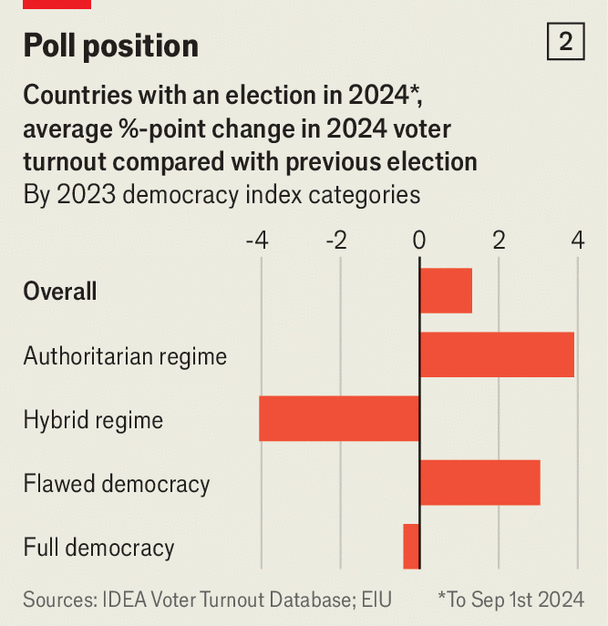
Chart: The Economist
A second reason for optimism is that efforts to undermine elections often failed. Going into 2024, many observers worried that disinformation campaigns fuelled by social media and artificial intelligence might dupe voters. “I don’t see a lot of evidence for that,” says Kevin Casas-Zamora, of the International Institute for Democracy and Electoral Assistance, an intergovernmental organisation. Subversion by hostile states seems to have a limited effect. In Taiwan voters chose William Lai Ching-te to be president, despite Chinese intimidation. Moldova has been busy countering Russian subversion ahead of its presidential election and a referendum on whether to include the goal of EU membership in its constitution, both scheduled for October 20th. It recently exposed a $15m Russian vote-buying scam.
Independent institutions often stood up for liberal values. In Senegal a strongman’s ambition to rule indefinitely was rebuffed by the country’s top court, its sinews stiffened by pro-democracy protesters. After a poll eventually took place, voters made Bassirou Diomaye Faye Africa’s youngest democratically elected leader, aged 44. In most places elections became more peaceful. Demonstrations and violence have fallen on average, compared with the previous election, across a sample of 27 countries for which data exist, according to an analysis by The Economist (see chart 3).
The third reason for optimism is that voters held leaders accountable, either by removing them from office or by eliminating their parliamentary majority. There was a swing against incumbents in well over half of the democratic elections held so far this year (excluding those for the European Parliament). In Britain the opposition Labour Party won the largest majority of parliamentary seats since 1997. In South Korea the incumbent People Power Party was given a drubbing in April amid corruption allegations.
Moscow rules
In several huge emerging economies where the health of democracy had been in question, incumbents were emphatically rebuked by the electorate. South African voters, fed up with corruption and incompetence, stripped the ruling African National Congress (ANC) of its parliamentary majority for the first time since the end of apartheid in 1994, forcing the once dominant party to form a coalition to remain in government. Narendra Modi, India’s strongman prime minister, lost his parliamentary majority in June, despite stoking Hindu nationalism and enjoying the support of a pliant media outlets. He, too, must now rule through a coalition. Even Turkey’s autocratic president, Recep Tayyip Erdogan, who won re-election last year in a poll marred by intimidation and rule-bending, was humbled this March when his party was defeated in local elections in the major cities.
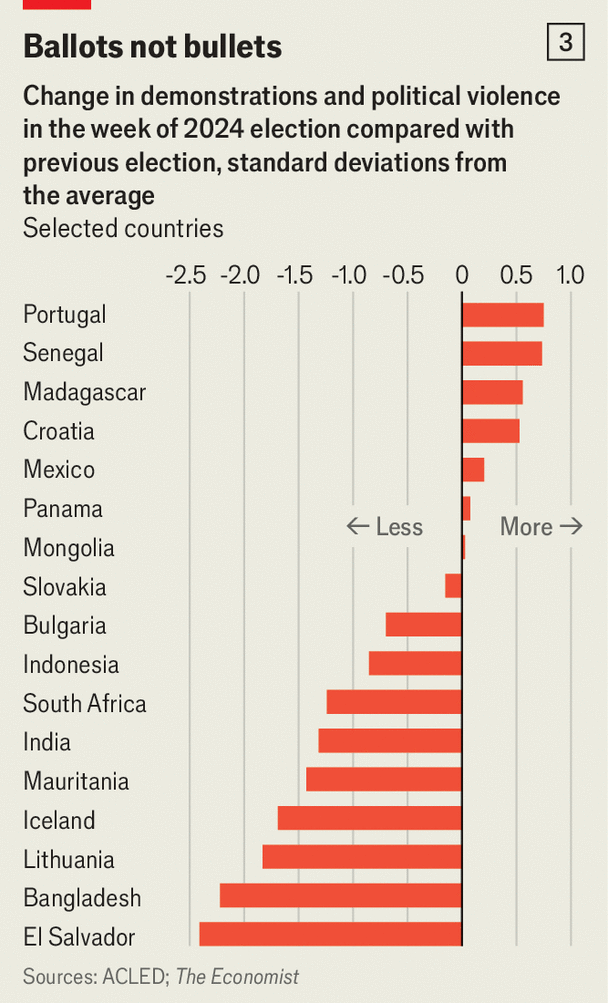
Chart: The Economist
Even as democracy has triumphed in some respects, both familiar and new dangers loom. Old-school dictators prevented or rigged polls in some countries. Juntas in Burkina Faso and Mali indefinitely postponed the elections—and transitions back to civilian rule—that had been scheduled for this year.
Other regimes held sham elections. Amid a war that has killed or injured 500,000 Russians, Vladimir Putin won a mere 88% of votes in elections in March, the biggest victory in post-Soviet Russia. The death of his most credible political opponent, Alexei Navalny, in prison before the vote, was an “unfortunate incident”, Mr Putin said. Paul Kagame, who has called the shots in Rwanda since 1994, walked away with 99% of votes in a rigged presidential election in July.
The charade was so brazen in Algeria that even Abdelmadjid Tebboune, the incumbent president, was surprised to have won 95% of the votes. He issued a statement with his opponents accusing the election authority of “inaccuracies, contradictions, ambiguities and inconsistencies”. In Venezuela Nicolás Maduro, the ruling dictator, fabricated election results and later forced his opponent to flee.
Ballot-stuffing in rigged elections means that in some autocracies, the official turnout rose. Intriguingly, in regimes that the EIU classifies as “hybrid” (those that sit somewhere between flawed democracies and outright dictatorships) turnout fell sharply, by an average of four percentage points. This suggests that voters are disillusioned. In Bangladesh, for example, the paltry turnout rate of 42% amounted, in effect, to a vote of no confidence in Sheikh Hasina, the longtime ruler who was later forced to flee the country in August after massive protests.
Alongside old-school autocrats arresting opponents and Putin-style vote-rigging, there are signs of novel threats to democracy. One is that even where incumbents leave office, they still seek to control their successors. Indonesia had a free election in February and Joko Widodo, the president, is set to leave office in October (despite speculation that he wanted to govern beyond his term limit). But there are signs that he wants to hold sway over the next administration through his son, who was elected as vice-president, and through his influence over Indonesia’s dominant parties. In Mexico a free election was won by Claudia Sheinbaum, a protégée of the outgoing strongman president, Andrés Manuel López Obrador. Yet many Mexicans suspect he may try to exert power from behind the throne because he crushed judicial independence just weeks before he is due to leave office in October and he still has huge influence over his party’s congressional caucus.
Authoritarian innovators are also on the rise: populists who command vast fanbases. El Salvador’s ruler Nayib Bukele has come up with a new formula for Latin American electoral success: social-media savvy plus the mass incarceration of suspected gangsters. He has subverted the constitution, bypassing presidential term-limits, stacking the high court and appointing his secretary as the interim president. Yet he is also genuinely popular, with his draconian-but-effective crackdown winning him 85% of the vote in February.
Old continent, new problems
A final, growing, concern is the splintering of parties and voting patterns in Europe, which has become the dominant pattern on the continent. Although a free and fair expression of democratic intent, it is making the job of governing harder. Germany’s unwieldy ruling coalition is racked by internal conflicts. In France, it has taken more than two months to form a functional government after a polarised parliamentary election in July that saw hard-right and hard-left parties gain support at the expense of the centre. In the Netherlands a technocrat had to be sworn in as prime minister in July because the ruling parties were unable to agree on who would lead them. The poor performance of coalition governments may in turn fuel voter cynicism and boost support for disruptive outsider parties. In Germany support for the hard right and hard left surged in three state elections in September.
So far democracy has—just about—passed the giant test of nerves it has faced in 2024. A lawful, peaceful transfer of power in America would further boost confidence around the world in the enduring resilience of political freedom. Sadly, that is not guaranteed. ■
Business | Schumpeter
Masayoshi Son is back in Silicon Valley—and late to the AI race
This isn’t the first time the Japanese tech investor has missed the hot new thing
Illustration: Brett Ryder
Oct 10th 2024
MASAYOSHI SON is a man of contrasting superlatives. At the height of the dotcom bubble in early 2000 the Japanese technology mogul was briefly the world’s richest person, before losing $77bn in paper wealth, more than anyone before. In 2021 SoftBank Group, his telecoms-and-software conglomerate turned investment powerhouse, reported the biggest annual net profit in the history of Japan Inc, followed a year later by the second-biggest loss. His $20m wager in 2000 on Alibaba, a tatty online marketplace that grew into China’s mightiest e-emporium, counts as one of the best in the annals of venture capital (VC); his later $16bn punt on WeWork, an office-rental startup with tech pretensions, is an all-time dud. He has been called a “genius” and “dumb money”.
Such wild swings of fortune would wear anyone out. And in November 2022 they exhausted even the indefatigable Masa, as the billionaire is known. On an earnings call the then 65-year-old announced that though he would remain in charge, future updates on SoftBank’s finances and strategy would be presented by his chief financial officer. This was out of character for a hyperactive bundle of vanity who has unironically likened himself to Napoleon. And, like the Corsican’s periodic retreats, it did not last. In June a re-energised Mr Son told an audience of SoftBank’s shareholders that all his past wagers were “a warm-up for my great dream to realise artificial superintelligence”.
To get the main act going, on October 2nd SoftBank splurged $500m on a tiny stake in OpenAI, in a $6.6bn funding round that valued the world’s leading generative-AI model-maker at $157bn. Earlier Mr Son put a similar sum in Wayve, a self-driving car startup, a smaller one in Perplexity, a gen-AI search engine, and talked of raising much larger amounts—perhaps $100bn—to build a rival to Nvidia, the champion of AI chips. After mentioning AI more than 500 times in earnings presentations between 2017 and 2020, Mr Son is getting down to business. He looks hopelessly late.
That seems odd for someone who tends to gaze far into the future. Aged 19 he drew up a 50-year plan to build a corporate empire; in his 50s he stretched the horizon out to 300 years. Throughout his life, chronicled in “Gambling Man”, an engaging new biography by Lionel Barber, former editor of the Financial Times, looking ahead was often preferable to contemplating the there and then. His earliest memories are suffused with the stench of pigs his family reared to make ends meet. Disdain from native Japanese, in whose eyes ethnic Koreans like him were second-class citizens, lingered long after his father turned pork profits into a thriving gambling business, which bankrolled young Masa’s desire to complete high school and university in California. Even a brush with death, from hepatitis in the mid-1980s, and two with bankruptcy—in the dotcom crash and the financial crisis of 2007-09—did little to elevate the here and now in Mr Son’s estimation.
At times inveterate futurism paid off. It alerted him early to the promise of software, the internet and smartphones, each of which made him a fortune and, more deliciously given the discrimination his family endured, shook up Japan’s stolid corporate establishment. On these big things he has been “spectacularly right”, says Alok Sama, a former Morgan Stanley banker who worked for Mr Son between 2014 and 2019. Yet a fixation on the future can obscure aspects of the present, over which he keeps tripping up.
One blind spot is politics. His $22bn takeover in 2013 of Sprint was predicated on a merger with T-Mobile, another wireless provider, which the Obama administration blocked. Though the deal went ahead under Donald Trump, Mr Son called his misreading of the regulators “one of the biggest mistakes of my life”.
If so, he did not learn from it. In 2020-21 he was caught out by a crackdown on tech in China, where SoftBank is the biggest foreign venture investor. Bets on firms like Didi, a ride-hailing giant, soured. Its stake in Alibaba lost two-thirds of its value. In 2022 trustbusters blocked the $40bn sale of Arm, a chip-designer SoftBank bought in 2016 for $32bn, to Nvidia. The rift between China and the West is engulfing TikTok and could hurt the $230bn valuation of its Chinese parent, ByteDance, in which SoftBank is a shareholder. America, where SoftBank makes a lot of its investments, may look askance at a firm that is teaming up with Alat, a Saudi industrial-automation venture that also has ties to a blacklisted Chinese maker of surveillance gear.
Mr Son is likewise inattentive to profitability. Growth, his idée fixe, is all well and good. But a business needs steady returns if it is to be a going concern, let alone last three centuries. In their absence SoftBank relies on borrowed money. Despite paying down a chunk of this lately with proceeds from the sale of Alibaba shares and the flotation of Arm, it still ranks as the world’s 11th-most-indebted non-financial firm—and has stakes in two of the top ten, Deutsche Telecom and T-Mobile. The gyrating price of SoftBank stock, against which some debt is secured, could mean margin calls whenever markets wobble. This ties Mr Son’s hands precisely when he could be buying up stocks and startups on the cheap.
The curse of long-sightedness
Instead, he often mistimes bets and overpays. SoftBank’s $100bn Vision Fund, the biggest in VC history and stuffed with money from the Gulf, went shopping in the late 2010s when valuations of startups like WeWork were especially frothy. In 2019 the vehicle sold its entire 5% stake in Nvidia for $3.6bn; today it would fetch $160bn. SoftBank backed OpenAI in the same round as Fidelity, a lumbering asset manager. “Tells you everything,” sneers a VC veteran. Investors in SoftBank are scathing in their own way. Its shares trade at more than a 50% discount to the net value of its assets, implying a lack of faith in Mr Son’s futurology. Minding your feet can be as important as admiring the horizon. ■
Business | Bartleby
When workplace bonuses backfire
The gelignite of incentives
Illustration: Paul Blow
Oct 10th 2024
“If you have a dumb incentive system, you get dumb outcomes.” The late Charlie Munger was endlessly quotable, but this pearl of pith from the famed investor is one that every manager should remember.
There are plenty of dumb examples to choose from. Some are apocryphal: the Soviet nail factory that produced a single, uselessly gigantic nail to meet its tonnage quota. Others are not. Wells Fargo, a previously well-regarded American retail bank, was notoriously embroiled in scandal after blunt cross-selling targets pushed its employees to open unauthorised deposit accounts and issue unwanted debit cards. Silly financial incentives in health-care systems can help explain everything from once-elevated rates of Caesarean-section births in Iran to woefully inadequate dental treatment in Britain.
The trouble is that it is not always easy to work out what dumb looks like. A study published in 2017 by David Atkin of the Massachusetts Institute for Technology and his co-authors found that many football manufacturers in Sialkot, Pakistan were oddly slow to adopt a new technology that reduced the amount of synthetic leather wasted during their production. The reason? Workers who were paid by the ball were not keen to spend time that could otherwise have been used to earn money on learning new techniques. In theory, a piece-work incentive scheme makes perfect sense for this kind of repetitive activity; in practice, it was the firm that paid their workers by the hour which quickly embraced the new technology.
A couple of recent studies underline the risk that incentives will have unintended consequences. One, from Jakob Altifian and Dirk Sliwka of the University of Cologne and Timo Vogelsang of the Frankfurt School of Finance and Management, tested the effect of paying an attendance bonus on levels of absenteeism. They did so by randomly assigning apprentice workers at a German retailer to two groups which offered a financial reward or some extra holiday, respectively, for a perfect attendance record. Neither reward reduced absenteeism, and the monetary bonus had precisely the opposite effect: it actually increased rates of absenteeism by 50% on average.
To work out what was going on the researchers surveyed employees after the experiment had ended. They found that the introduction of a bonus shifted workers’ perceptions of what counted as acceptable behaviour. The message that attendance warranted a reward made people feel less obliged to come in and less guilty if they threw a sickie. The effect was particularly pronounced for the most recently hired employees, and higher rates of absenteeism persisted even after the bonus had been removed. The power of incentives to change social norms can be helpful: an attendance bonus has been shown to work in circumstances where widespread absenteeism is a real problem. But the starting-point matters.
A second study, by Luan Yingyue and Kim Yeun Joon of the Cambridge Judge Business School, tested the effects of making co-operativeness a formal job requirement. Expectations of being helpful to colleagues were added to the job descriptions and performance appraisals of engineers working in a research-and-development (R&D) centre at a chemicals company in East Asia. (A second R&D centre in the company acted as a control.)
Surveys of affected employees found that the motivation to help changed once it was part of the job, from an intrinsic drive to be co-operative to a desire to show off to the higher-ups. The type of help that people offered their colleagues changed as a result: there were more frequent instances of helpful behaviour but the quality of assistance that people actually gave each other went down. “How can I help as long as it doesn’t involve too much effort?” is a very watery form of collaboration.
These examples confirm both the wisdom of Munger’s aphorism and the difficulty of anticipating how incentives will play out. Dumbness may become apparent only over time, so pilot schemes and rigorous review processes are essential. As Stephan Meier, an academic at Columbia Business School, argues persuasively in “The Employee Advantage”, a new book, people are motivated by many more things than moolah. Rewarding people for doing things they would anyway can easily backfire. As Munger might have said, incentives should be approached like gelignite—with enormous care. ■
Finance & economics | Buttonwood
Why have markets grown more captivated by data releases?
Especially when the quality of statistics is deteriorating
Illustration: Satoshi Kambayashi
Oct 10th 2024
EIGHT-THIRTY in the morning on the first Friday of every month is a special time for bond traders: it’s when America’s Bureau of Labour Statistics usually releases its monthly jobs data. Despite the vast sums that some hedge funds spend on alternative data, landmark releases like the employment report or the consumer-price index (CPI) can still convulse markets. When the September payrolls numbers, released on October 4th, blew past expectations, bond yields jumped by eight basis points (0.08 percentage points). Stocks spiked, too, though the move was short-lived.
News has always driven markets, but curiously the importance of big data releases has grown substantially in recent years. Analysis by The Economist finds that, over the past year, bond-market moves in America have been twice as large on days with major data releases or Federal Reserve decisions as on other days, while equity-market moves have been two-thirds larger (see chart). In both cases, these were substantially above the historical norm.
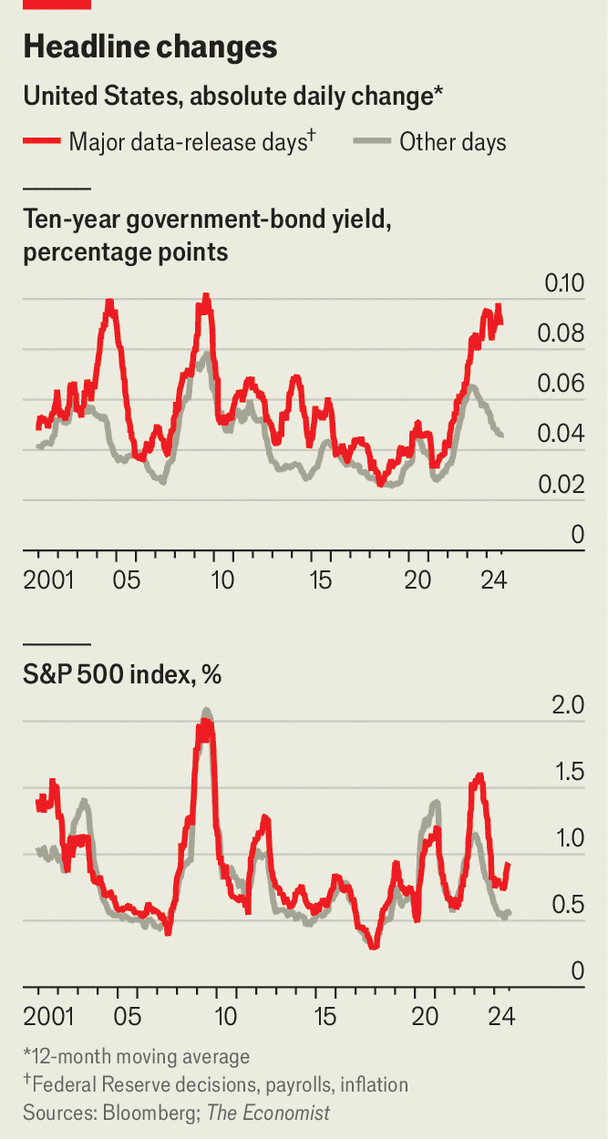
Chart: The Economist
Why, then, have markets decided to take hard facts much more seriously? Part of the story is probably that the global economy has been so bizarre in recent years: a pandemic, vast fiscal stimulus, a war-fuelled spike in commodity prices. When events are so far outside the historical norm, the impulse to latch on to the certainty of new data is understandable.
Another spur has been higher inflation. Inflation is easy to ignore when it is bouncing around 2% or so, as it was for most of the 2010s. Doing so is harder when it has only just come down from a 40-year high. That puts more attention on data directly related to inflation, such as CPI releases or wage numbers, but also changes how all other data is interpreted. Over the past few years markets have see-sawed between seeing strong jobs and growth numbers as reassuring indicators of a strengthening economy, or as troubling signs of an overheating and inflation-prone one.
Another, more recent shift has been growing recession angst. Over the summer America triggered two well-known indicators of recession: the Sahm Rule (a sharp rise in unemployment) and the un-inversion of the yield curve (when the interest rate on short-term bonds falls back below the rate on long-term bonds). The differences between decent and underwhelming economic news, often fine, start to matter a lot more to those looking closely for early signs of a crash. Those fears have abated slightly as some firmer growth numbers in America have come through more recently.
One irony is that markets have decided to lean harder on economic data just as the quality of statistics has started to fall. Response rates to many government surveys have been plummeting since the pandemic. In America, high and disputed rates of illegal migration have messed with the quality of some jobs numbers. Britain’s data problems may be even worse. Some of its central bankers, in more candid moments, admit to largely ignoring the unemployment data; it’s now simply too choppy to be helpful.
If Buttonwood had to guess, markets’ current obsession with totemic data releases probably won’t last. The most plausible route for the American economy over the next year or so is a gradual normalisation to a dull, slow but still-growing baseline. That’s the sort of environment in which fine gradations in economic news tend to matter less.
There are other reasons to expect interest in big data drops to fade. Third-party data is often already nearly as good as the official stuff, and released much faster. There are a few exceptions—the jobs numbers from ADP, a payrolls manager, have tended to be a pretty poor guide to the real thing—but the quality of alternative data is generally getting better. For the moment, though, traders are stuck waiting at their Bloomberg terminals for the 8.30am news. Late risers in America can at least take solace that they don’t live in Britain, which puts out economic data at 7am. ■
Finance & economics | Free exchange
Can the world’s most influential business index be fixed?
Two cheers for the World Bank’s new global business survey
Illustration: Álvaro Bernis
Oct 10th 2024
Everybody loves a league table. Across areas as varied as sports, education and consumer goods, competitive rankings have a magnetic appeal. The question of what or who rose, fell or clinched the top spot can lend a sense of drama to even the most strait-laced subjects.
The World Bank’s “Doing Business” reports, published each year from 2003 to 2020, are a case in point. The annual check-ups gave countries a single score based on various measures, including the ease of registering property, access to credit and enforcing contracts, to determine which were most business-friendly. The index became a gold standard for policymakers and analysts all over the world. Higher spots were fiercely protected by those who had them, and coveted by those who did not.
The project was engulfed in scandal and put on ice in 2021. World Bank staff had come under pressure to fiddle with some countries’ data. An internal probe eventually determined that scores given to China, Saudi Arabia, the United Arab Emirates and Azerbaijan had been manipulated improperly, and judged that the work culture of the team assembling the reports was toxic.
The replacement for the index, Business Ready (B-Ready), was revealed on October 3rd. Gone is the single beguiling table. In its place are three lists, covering regulation, public services and operational efficiency. The report this year covers just 50 economies, owing to the increased burden of assessment, including surveys of almost 30,000 businesses around the world. The number of economies covered is set to rise to around 180 in two years’ time. The report now covers big businesses as well as small and middling ones. And it goes beyond the more focused measurement of how easy it is to operate a business: the assessment now includes a range of “social benefits”, from collective-bargaining rights for workers to various measures of environmental sustainability.
Is the new effort an improvement? Beyond the scandal which killed it, Doing Business faced three main areas of criticism. The first was the ability of governments to game it. Countries made small and cosmetic changes to climb up the table. Some even had government units responsible for improving their position. The ranking became a powerful example of Goodhart’s law: once a measure becomes a target, it ceases to be a good measure.
The second problem was the survey’s methodological pitfalls. Doing Business scores were sometimes wildly out of step with other evidence. A study by Mary Hallward-Driemeier and Lant Pritchett of Georgetown University and the London School of Economics, respectively, noted that scores in Doing Business often bore no relation even to the bank’s own surveys of enterprises. Doing Business, for example, suggested that the median time to receive a building permit around the world was 177 days, whereas the bank’s own survey suggested it was 30 days.
The third flaw, and the most difficult to resolve, was the ranking’s inherent subjectivity. In creating any index, decisions must be made on what matters, and why. How important is the uninterrupted supply of electricity, or the enforcement of intellectual-property rights? Other issues are even thornier: how should an international institution like the World Bank approach questions of minimum wages, labour rights or the taxation of capital? These things matter when it comes to running a company, but are subject to fierce political debate, too.
The scorecard in resolving the first two challenges is clearly positive. The data available from the new surveys will be far richer. Whereas many of the Doing Business indicators were based on rules and regulations, B-Ready scores will be more informed by survey data indicating the reality on the ground. Previously, data collection in each country focused on one or two large cities; India’s score was based on results from Delhi and Mumbai. B-Ready will cast a wider net. The change not only makes the evidence collected more likely to reflect reality, but makes it more difficult to game the rankings.
When it comes to subjectivity, the World Bank has opted for a fudge that some will find unsatisfying. In creating three separate indices, it has removed the monomaniacal attention on the single ranking that undermined the former reports. But by combining various social goals (worthy or otherwise) with the bread-and-butter questions about the ease of establishing and running a business, the question of what the aggregates actually seek to measure has become muddier.
Nevertheless, the benefits of the new approach outweigh its flaws. The stronger evidence offered by B-Ready’s extensive surveys is of more value than the World Bank’s own judgment as to which elements are most important. The bank contributes more by collecting and publishing its ample supply of data for free than by deciding how it should be interpreted.
Doing the business
The higher-quality information now available will also be used by all manner of index-builders, from think-tanks to charities, that do not face the same political constraints as a multilateral institution. External indices of everything from economic freedom and tax competitiveness to corporate social responsibility and corruption will be improved by the better evidence the survey provides.
There is another reason to welcome the new approach. Under the old one, the relentless focus on fiddling index rankings may have reduced the appetite for real reforms. Indeed, research by Tamanna Adhikari of the Central Bank of Ireland and Karl Whelan of University College Dublin suggests that an increase in a country’s Doing Business score actually seemed to have at least a short-term negative impact on GDP growth. Eliminating such pernicious incentives alone would make for a substantial upgrade. ■
Science & technology | The 2024 Nobel prizes
AI wins big at the Nobels
Awards went to the discoverers of micro-RNA, pioneers of artificial-intelligence models and those using them for protein-structure prediction
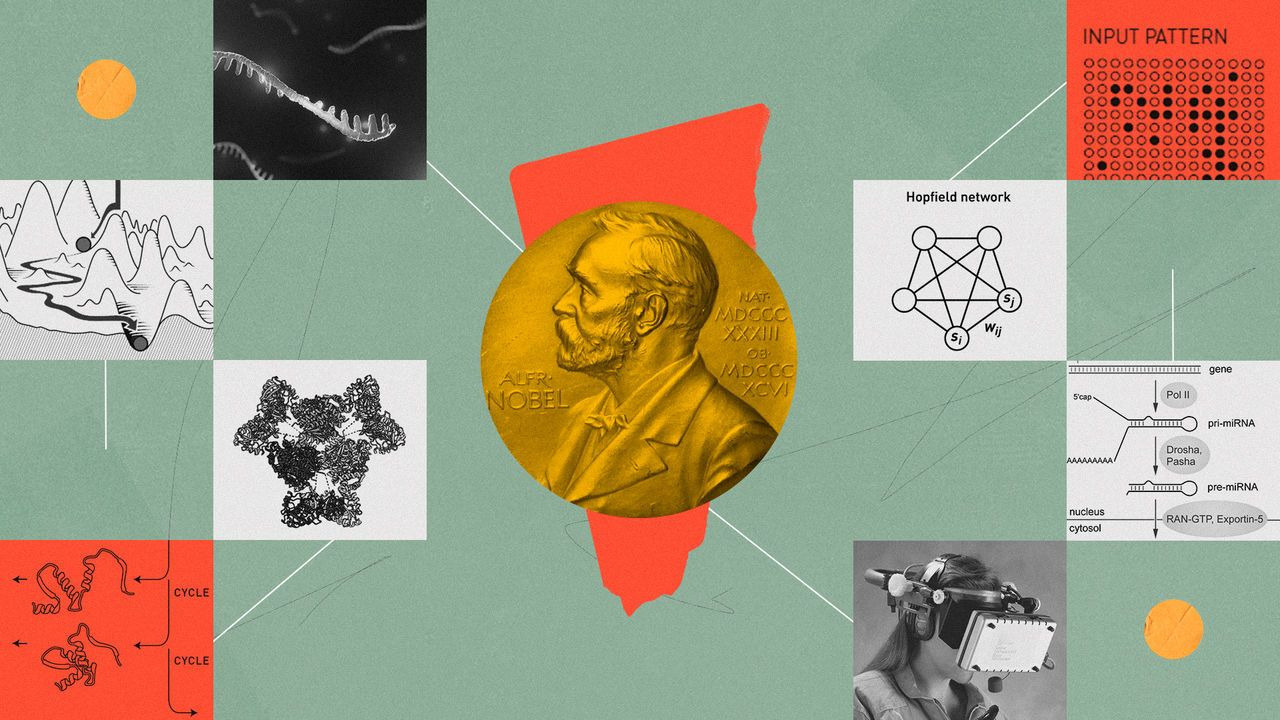
Illustration: Javier Palma
Oct 10th 2024
The scientific Nobel prizes have always, in their way, honoured human intelligence. This year, for the first time, the transformative potential of artificial intelligence (AI) has been recognised as well. That recognition began on Tuesday October 8th, when Sweden’s Royal Academy of Science awarded the physics prize to John Hopfield of Princeton University and Geoffrey Hinton of the University of Toronto for computer-science breakthroughs integral to the development of many of today’s most powerful AI models.
The next day, the developers of one such model also received the coveted call from Stockholm. Demis Hassabis and John Jumper from DeepMind, Google’s AI company, received one half of the chemistry prize for their development of AlphaFold, a program capable of predicting three-dimensional protein structure, a long-standing grand challenge in biochemistry. The prize’s other half went to David Baker, a biochemist at the University of Washington, for his computer-aided work designing new proteins.
The AI focus was not the only thing the announcements had in common. In both cases, the research being awarded would be seen by a stickler as being outside the remit of the prize-giving committees (AI research is computer science; protein research arguably counts as biology).
Boundary-pushing
Such flexibility is not unprecedented. In 1973, for example, three pioneering students of animal behaviour, who worked on honeybees, geese and sticklebacks, were shoehorned into the physiology category. The award to Drs Hinton and Hopfield, however, recognises achievements with more profound consequences.
Both researchers did their crucial work in the early 1980s, at a time when computer hardware was unable to take full advantage of it. Dr Hopfield was responsible for what has become known as the Hopfield network—a type of artificial neural network that behaves like a physical structure called a spin glass, which gave the academy a tenuous reason to call the field “physics”. Dr Hinton’s contribution was to use an algorithm known as backpropagation to train neural networks.
Artificial neural networks are computer programs based loosely on the way in which real, biological networks of nerve cells or neurons are believed to work. In particular, the strengths of the connections (known as weights) between “nodes” (the equivalent of neurons) in such networks are plastic. This plasticity grants a network the ability to process information differently in response to past performance; or, in other words, to learn. Hopfield networks, in which each node is connected to every other except itself, are particularly good at learning to extract patterns from sparse or noisy data.
Dr Hinton’s algorithm turbocharged neural networks’ learning ability by letting them work in three dimensions. Hopfield networks and their ilk are, in essence, two-dimensional. Though they actually exist only as simulations in software, they can be thought of as physical layers of nodes. Stack such layers on top of one another, though, and train them by tweaking the weights as signals move both backward and forward between the layers (ie, back-propagated as well as forward-propagated) and you have a much more sophisticated learning system.
Dr Hinton also, for good measure, tweaked Dr Hopfield’s networks using a branch of maths called statistical mechanics to create what are known as Boltzmann machines. (Statistical mechanics, which underlies modern understanding of the second law of thermodynamics, was invented by Ludwig Boltzmann, a near contemporary of Alfred Nobel.) Boltzmann machines can be used to create systems that learn in an unsupervised manner, spotting patterns in data without having to be explicitly taught.
It is, then, the activities of these two researchers which have made machine learning really sing. AI models can now not only learn, but create (or, for sceptics, reorganise and regurgitate in a most sophisticated manner). Such tools have thus gone from being able to perform highly specific tasks, such as recognising cancerous cells in pictures of tissue samples or streamlining mountains of particle-physics data, to anything from writing essays for lazy undergraduates to running robots.
Dr Hinton, whom the academy’s detectives tracked down to a hotel in California to deliver the glad tidings, and who gamely agreed to answer questions from the press, despite the time difference, seemed both worried and proud about his achievements. He fretted, as many in the field do, about how machine intelligence that outstripped the human variety would then go on to treat its creators. But he also mused that by assisting mental labour, AI might have as big an effect on society as the Industrial Revolution’s assistance of physical labour has had.
Such musings were timely. Not 24 hours later, the academy would recognise research conducted, with the help of AI models, on the structure of proteins.
Return to the fold
Proteins are the main chemical building blocks of life. They are made up of smaller molecules called amino acids, arranged in long chains which fold in highly complex and specific ways. A protein’s final folded form determines its biological function. In other words, to understand proteins—and, by extension, biology—one must understand their structure.
Dr Baker achieved such understanding through doing. In a landmark paper from 2003, he succeeded in designing a completely new protein. Using a computer program he had named Rosetta, he found an amino-acid sequence capable of folding in ways not seen in nature. Once the sequence was recreated in the lab and the protein formed, he determined its final structure using a technique called X-ray crystallography: it was a close match to what he had set out to make. Rosetta, now called Rosetta Commons, has subsequently become a software package used by protein chemists around the world, and computational protein design has assisted in everything from vaccine development to the detection of toxic chemicals.
Going the other way, and predicting a protein’s structure from its amino-acid sequence, is a problem that took even longer to crack. Given the near-limitless number of configurations into which a protein can fold—by some estimates, as many as 10300 for a single complex protein—even computers had limited success. DeepMind’s AlphaFold 1 and 2 (both artificial neural networks), made public in 2018 and 2020 respectively, were the first to even get close. AlphaFold 2 now has a database of more than 200m protein structure predictions, with a prediction accuracy approaching 90%.

Illustration: Javier Palma
Though Sir Demis and Dr Jumper have featured on various contender lists this year, many wondered if it was too soon for AlphaFold to be recognised. Yet it has already had real impact: DeepMind says that some 2m scientists already use it in their research. AlphaFold 3, released in May, goes beyond proteins to predict the structure of a host of other biomolecules, such as DNA, as well as small molecules that might function as drugs. It can also predict how different molecules with different structures fit together, such as how a virus’s spike protein might interact with antibodies and sugars found in the body.
By choosing, for the first time, to honour work performed with an AI model, the committee has opened the door for more such prizes in the future. That is just as well; AI has been seeping into all areas of science for some time now, as Dr Baker illustrated when he was phoned up during the committee’s press conference. He said that AlphaFold has inspired him to make generative-AI models that can design new proteins. “Our new AI methods are much more powerful,” he said.
Mega-important
The prize for physiology or medicine, for its part, eschewed any mention of AI. It was also immune to charges of genre-bending, continuing the academy’s trend of increasingly recognising the smallest advances at the molecular and cellular level—rather than work on physiology or organs—because it is on these microscopic scales that the most exciting scientific frontiers are to be found.
The joint winners were Victor Ambros at the University of Massachusetts Medical School and Gary Ruvkun at Massachusetts General Hospital for their discovery of micro-RNA (miRNA) and its role in “post-transcriptional gene regulation”. These are a class of small molecules composed of only 20 to 24 nucleotides (the A, C, G, U letters of the genome), and they play a key role in how cells work.
Inside the nucleus of every human cell is a full set of instructions—the genome—for creating a person. A key question in biology is how the same set of genes and instructions can lead to such different types of cells in the body, from muscle to liver cells by way of the neurons found in the brain. The answer is that not all the genes within a nucleus are translated into protein. Different types of cells follow their own developmental pathways by using only those genetic instructions relevant to their growth and development. The selection necessary for each cell type is controlled in part by the miRNA molecules discovered by Drs Ambros and Ruvkun.
They work primarily by binding to target parts of another molecule within cells, known as messenger RNA (mRNA)—which carries information from the DNA of the genome to the protein-making factories within cells. By interfering with mRNA molecules, miRNA can alter or prevent the production of proteins. Underscoring the growing importance of this area of molecular biology, mRNA was itself the subject of the Nobel prize last year.
Finding miRNAs, in 1993, paved the way to the understanding, today, that there are over a thousand of these small molecules within our cells. The discovery has had far-reaching implications in biology. Abnormal regulation by miRNA molecules can contribute to cancer and epilepsy. Mutations in genes that code for miRNA molecules have been found to cause conditions such as congenital hearing loss and are thought to be involved in the pathology of many eye disorders, such as cataracts, glaucoma and macular degeneration. The miRNA molecules are also thought to be important in numerous bone diseases, such as osteoporosis, osteosarcoma and bone metastasis.
Drs Ambros and Ruvkun—who worked at the same lab in the late 1980s at the Massachusetts Institute of Technology—discovered miRNA molecules using a key tool of biological inquiry: the roundworm Caenorhabditis elegans. They were studying two mutant strains of worms that had defects in the genes that dictated how the animals developed and worked. In doing so, the researchers showed that a gene called lin-4 produced an unusually short RNA molecule that did not code for any proteins and which seemed to inhibit the activity of another gene.
In awarding the prize, the Karolinska Institute’s Nobel committee noted that when the scientists published their results, they met an “almost deafening silence from the scientific community”. The unusual mechanism of gene regulation in C. elegans was assumed to be a peculiarity of that organism, not relevant to humans or other more complex organisms. That view eventually shifted, as it became clear that genes that encode for miRNAs were found throughout the animal kingdom.
Novo Nordisk, a Danish pharmaceutical giant, is one of the firms trying to make medicines using miRNAs. This year it acquired Cardior, a German firm, whose lead drug candidate, CDR132L, works by blocking a particular miRNA in the hope of helping patients with chronic heart failure and cardiac hypertrophy (thickening and stiffening of the walls of the heart).
This year’s prize highlights the continuing trend of recognising discoveries at the molecular level. Recently, several Nobel prizes have been awarded to technologies that have had obvious clinical applications, such as cancer immunotherapy (in 2018) and gene editing (in 2020). It is perhaps no surprise that, as the technology for molecular and genetic research has improved, scientists are gaining ever more insight into cellular function, and are therefore able to make more profound and useful discoveries with them.
Nobel pursuits
For the growing number of researchers around the world who rely on AI in their work, the lasting message of this year’s awards may be a different one: that they, too, could one day nab science’s most prestigious gongs. For his part, said Dr Jumper, “I hope...that we have opened the door to many incredible scientific breakthroughs with computation and AI to come.” ■
Culture | From witchcraft to woke
How humans invented good and evil, and may reinvent both
Over thousands of years humans domesticated themselves

Illustration: Patrick Leger
Oct 4th 2024
The Invention of Good and Evil. By Hanno Sauer. Translated by Jo Heinrich. Oxford University Press; 416 pages; $29.99. Profile; £25
Trial by boiling water was not as bad as it sounded. In medieval Europe, those accused of grave crimes might be ordered to plunge an arm into a bubbling cauldron to retrieve an object. If they were scalded, that was God’s way of revealing their guilt. The chance of acquittal would seem to be zero, but 60% of those who underwent this ordeal got off. How come?
The answer is that defendants believed in divine judgment. The guilty, convinced that God knew all, confessed to avoid the extra punishment of scalding. The innocent assumed they would be acquitted, so they refused to confess. The priests who prepared the cauldron knew this, and did not want to undermine their own authority by condemning someone who might later prove innocent. So they did not heat the water as much as they pretended to.
Hanno Sauer of Utrecht University has made a heroic effort to chart how morality has changed since the first humanlike animals began to populate Africa 5m years ago, and to predict how it might change in the future. It is a rich, complex narrative, full of unexpected twists like the inquisitors’ tale. His book is as sweeping as Steven Pinker’s “The Better Angels of Our Nature” or Yuval Noah Harari’s “Sapiens”. He is less optimistic than Mr Pinker, who describes a dramatic reduction in violence over millennia, and more tightly focused on ethics than Mr Harari. He blends insights from evolutionary biology, cognitive science and anthropology to ask what makes people good, evil, or a bit of both?
Much of his argument hinges on a trait that sets humans apart from other animals: the extraordinary complexity of their social relations. People’s early ancestors lived in an unstable environment, the African savannah, and developed “an unusually spontaneous and surprisingly flexible capacity for co-operation”.
Since a hunting party might be successful one week but return empty-handed the next, rules emerged about sharing meat with the wider group, to maximise every member’s chance of survival. Competition with other bands of hunter-gatherers over territory swiftly turned violent, however. “Inwardly, our ancestors were family-centric pacifists, but outwardly, they were gangs of murderers and plunderers,” the author writes.
Wars ravaged hunter-gatherer societies yet involved great individual altruism. When each person’s survival depends to a large degree on the clan’s, people have an incentive to co-operate selflessly to defend it. From an evolutionary perspective, such self-sacrifice made sense only if the beneficiaries were closely related.
Early hunter-gatherer bands probably included no more than 150 or so people. To collaborate in larger groups, people needed new rules, vigorously enforced. This is perhaps why all human societies have devised ostentatiously nasty punishments. Cave paintings from 20,000 years ago depict ritual garrotting; in ancient Greece torturers roasted victims in a hollow bronze bull, their screams being amplified by the bull’s horns.
“A species that kills its most [aggressive] members over hundreds of generations creates a strong selection pressure in favour of peacefulness, tolerance and impulse control,” reckons Mr Sauer. In effect, “We domesticated ourselves.” When it is socially required, humans can show enormous restraint and consideration; unlike, say, chimpanzees, which if crammed together on an aeroplane for a long flight would undoubtedly kill each other. Humans “are to chimpanzees as golden retrievers are to wolves”, argues Mr Sauer.
Back to the future
Rules against killing strangers allowed people to co-exist in much larger societies. This, in turn, fostered the development of sophisticated cultures. Just as science depends on the steady accumulation of thousands of small innovations, so culture evolves over time, with ideas accumulating and being refined from one generation to the next. This process yields plenty of rotten customs, such as female genital mutilation, but also the benefits of everything from reading and music to cities and double-entry book-keeping.
For millennia, the kinship group was the most important social unit, and morality was understood largely as the duties owed to one’s relatives. But in Europe the Roman Catholic church blew this system apart with a series of reforms that ended around 500 years ago. It banned cousin marriage and changed inheritance rules, encouraging people to choose their own spouses and bequeath assets as they pleased. This weakened kinship groups (which relied on cousin marriage to keep property within the clan) and fostered a more individualistic morality. People became more likely to feel guilt (at having done something wrong) than shame (because their aunts disapproved). The effects of these reforms can still be measured in Italy: people in the provinces that were under stronger papal control 500 years ago are more likely to donate blood even today.
The rise of individualism paved the way for modernity, with contract-based business, participatory politics, impersonal bureaucracies and the pursuit of science unconstrained by religious dogma. This has made the world richer, and richer countries are happier than those that remain poor.
The idea that rules can govern a society has spread far beyond Europe, albeit unevenly. Fully 70% of Norwegians say they trust strangers, whereas only 5% of people from Trinidad and Tobago agree. Mr Sauer thinks universal norms will probably keep spreading but is unsure. As the Holocaust proved, humankind’s ancient suspicion of out-groups has not vanished, and skilful demagogues can harness it in catastrophic ways. Examples are too numerous to list.
Looking at the past five years, the author finds much to worry about. “Morality seems to be boiling over” in the West, he writes. People’s moral vocabulary has become “mangled”. Woke activists describe words as “violence” and use this claim to try to justify restrictions on free speech. They also divide the world simplistically into “oppressors” and “oppressed”, sometimes ascribing original sin by skin colour. And political tribes of left and right have come to see the other lot not merely as misguided, but evil.
Yet despite the fury of the culture wars, Mr Sauer sees “an enormous…unrealised potential for reconciliation”. After hundreds of thousands of years of evolution, people share more moral values than they think, and this could help them cast off the identity politics that tells them they are enemies. “Between the extremes of ‘being on time is white supremacy’ and ‘we must revitalise Western Christianity’s cultural hegemony,’ there is a silent majority of reasonable people,” he concludes. He is surely right. ■
Obituary | Two towers of white spray
Yoshioka Masamitsu saw Pearl Harbor from the air
The last of the attackers on the “day of infamy” died on August 28th, aged 106

Photograph: ©JAPAN Forward
Oct 9th 2024
As he SLID into his bunk in the aircraft-carrier Soryu, on the night of December 6th 1941, Bombardier Yoshioka Masamitsu was struck by a thought. He didn’t have much time left, because tomorrow he was likely to die. He would die in Hawaii, because that was where Japan had decided to hit America. Such an attack would unleash a gigantic war. Of course it was an honour to be chosen for this mission, and his parents would be proud of him if he died that way. But he was 23, and the thought made all the blood drain from his head. Other crewmen and bombardiers might stoically turn on themselves the pistols they had been issued with, in case they were captured by the enemy. He had a pistol himself. But death did not appeal to him at all.
For weeks the Imperial Japanese Navy had been building up to attack. Besides the Soryu, five other aircraft-carriers had gathered in the Kuril Islands with more than 300 warplanes. Emperor Hirohito had ordered on November 5th that if talks with the Americans broke down, America should be attacked by the end of the month. The talks concerned an oil embargo by the Americans on Japan, to deter it from military adventures in Asia. Two years before Yoshioka had been deployed on the Soryu against the Chinese Nationalists, who were resisting Japanese conquest. But that was a regional war. What threatened now was something even bigger.
Before dawn, having slept at least a little, he went out on deck to watch the torpedo being loaded onto his plane. It was still dark, but the missile gleamed silver. That made him realise it was the real thing. In training, because torpedoes were scarce and expensive, they had used wooden canisters with a warhead filled with water, not explosives. After every drop, they fished them from the sea again. The torpedoes themselves were much less important than learning how to fly fast, flat and low above the sea, sometimes as low as 12 metres, getting the angle just right, before releasing them.
Now they would be dropped on America: specifically on the Pacific Fleet moored at Shinjuwan, or Pearl Harbor. That information had filtered to him and his comrades extremely slowly. Just before they sailed from the Kuril Islands, on November 26th, they were told to pack shorts. That seemed to mean they were going south. But then the pipes were lagged with asbestos, which suggested somewhere colder. In the bar and at deck smoking-breaks he and his comrades speculated constantly. He himself had been switched quite suddenly, that year, from navigation to torpedo training. So deployment was imminent, somewhere. But it couldn’t be America, because America, up until recently, still supplied the petrol for their planes.
Just after dawn, with a stiff east wind and choppy seas, he climbed into his craft. It was a Nakajima B5N2, much better than the rickety old biplanes he had spent his time repairing when, at 18, he first joined up. Day after day he would enviously watch as the airmen flew off in newer models. The Nakajima, though, was no more airtight than most of the planes of the time. Gaps all over the body let in the disgusting firework-smell of gunpowder or anti-aircraft fire. Roaring engine noise and the echoing wind drowned out almost all other sound—except the worst of all, the bang! of his plane being hit. Added to all this, the 800kg weight of a real torpedo made his plane tip to the rear. He was so burdened on take-off that he sank at first two metres below deck-level, before he could get the nose up and away.
He, his pilot and his rear-gunner flew steadily to the east. They were in radio silence, with him as navigator calculating the route by the flight time (110 minutes), distance (220 nautical miles) and the position of the Soryu as they left. Otherwise, they flew into the glare of the sun. That glare changed to towering white cumulus clouds; then to billowing black smoke from American ships that had already been hit. He sent his torpedo down and, looking back, saw two slim columns of spray shoot 30 metres from the water. A direct hit! Right on target!
Then he saw something else. The battleship, which was already listing, had no barrels on the gun-turrets. It was the USS Utah, a training ship which had been stripped of its weapons a decade before. During torpedo training he and his comrades had been told to memorise the silhouette of the Utah, so that they could avoid it. Somehow—sun-dazzle, perhaps—he had not. His elation turned in an instant to horror at his mistake.
He got back safely that day. War had now started between Japan and America, and would last for four years, but he had a lucky one. When the Soryu was sunk at the Battle of Midway in 1942, he was on shore leave. When fighting became intense round the Palau Islands, he was recovering from malaria. His plane was grounded, short of parts, when kamikaze tactics came in. Enemy bullets streamed towards his plane once, heading for his face, but passed by on either side. His plane was pierced by cannon-fire, but it hit none of the crew, and the fuel tank it struck was empty. He never took such luck for granted, nor stopped being scared.
He increasingly felt shame, though, that he had survived. And not merely survived, but to a great age, still straight-backed, lucid, mobile and dapper. For decades he worked in the Maritime Self-Defence Force, the post-war version of the emperor’s proud navy. And he remained unceasingly, though silently, aware of all who had died around him. His brothers in arms, of course. But also the sailors they had killed, young men like him, faithfully carrying out their orders. Fifty-eight crew had died when he torpedoed the Utah. If he ever visited Pearl Harbor—which he doubted he would, as he wouldn’t know what to say—he wanted to visit their graves to pay his respects. As it was he added them to his prayers at the Yasukuni shrine, with the fervent hope that there would be no more wars. ■