The Economist Articles for Feb. 2nd week : Feb. 9nd(Interpretation)
작성자Statesman작성시간25.01.31조회수454 목록 댓글 0
The Economist Articles for Feb. 2nd week : Feb. 9nd(Interpretation)
Economist Reading-Discussion Cafe :
다음카페 : http://cafe.daum.net/econimist
네이버카페 : http://cafe.naver.com/econimist
Culture | World in a dish
Tofu: never judge a food by its political reputation
Think outside the white plastic box. Here is a carnivore’s guide to tofu
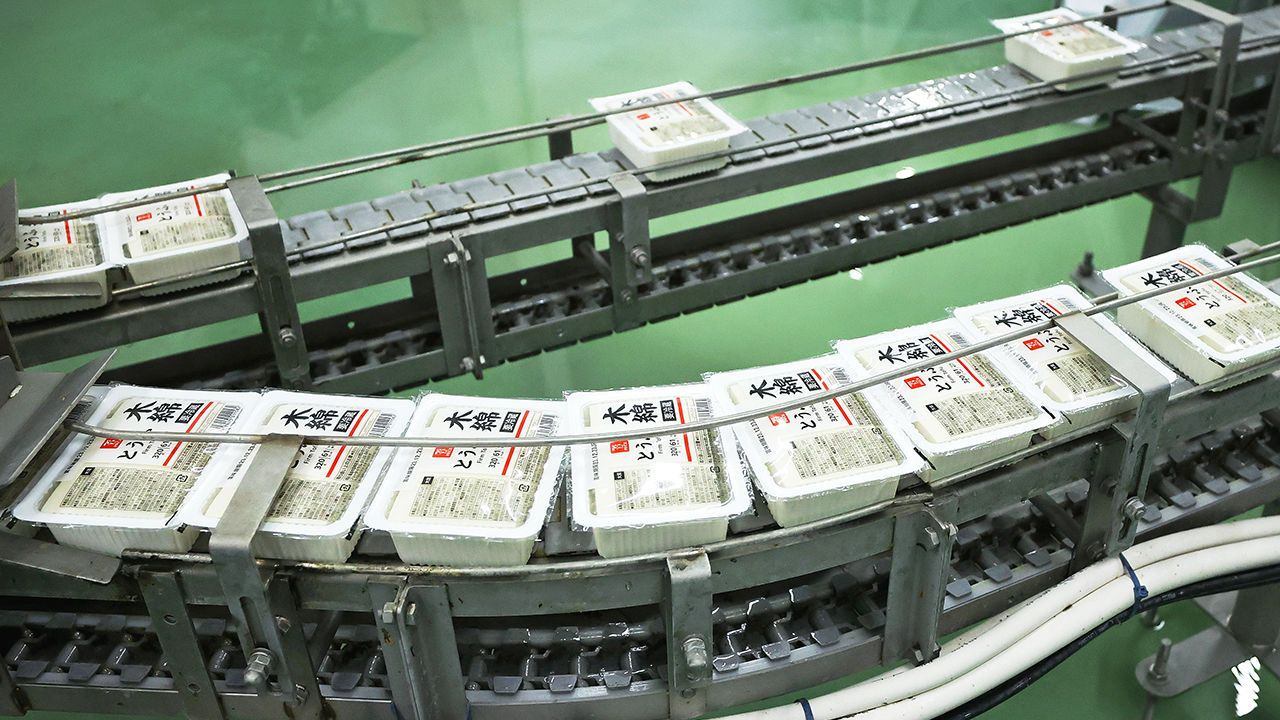
Photograph: Getty Images
Jan 27th 2025|NEW YORK
SUELLA BRAVERMAN, Britain’s former home secretary, blamed “Guardian-reading, tofu-eating wokerati” for a protest that closed a bridge. Ted Cruz, a conservative American senator, complained that Democrats want Texas “to be just like California, right down to tofu”. Across the West, eating tofu is seen as leftist, weak and somehow unmanly. This view is silly, and carnivores who hold it are depriving themselves of a healthy, delicious and adaptable source of protein.
Tofu—rich in calcium, protein and a variety of minerals—remained obscure in the West until counterculture looked east in the 1960s; Asians have eaten it for millennia. In some Asian languages, the words for “tofu” and “cheese” are similar, and they have strikingly similar production methods. (Animal milk and soy milk are heated, inoculated with a coagulant, pressed and shaped into solid form.) Just as cheeses differ markedly in taste and texture, tofu takes a variety of forms, from delicate silken tofu—delicious as a dessert when dressed with syrup—to the refrigerated boxed-in-water versions.
To detractors, what all these forms share is blandness and virtue. Tofu is wobbly and tasteless; people eat it only because they feel they should or, having sworn off meat for ideological reasons, they must. In a new book, “Tofu: A Culinary History”, Russell Thomas, a journalist, argues that bean curd deserves better than its worthy reputation. The first step in enjoying it is getting politics out of the kitchen and appreciating its endless versatility. Boosters do tofu no favours by calling it a “meat substitute”—generally, it is not. Nobody will ever mistake pressed bean curd for a seared steak.
But for carnivores who want to reduce their meat consumption, tofu can prove a surprisingly delicious stand-in. Extra-firm tofu, crumbled into a skillet, sautéed until dry and well-seasoned, makes a taco filling reminiscent of Mexican chorizo. Coated in cornstarch, shallow-fried and sauced, it makes a crisp, light stir-fry. Thawed tofu has a porous resilience that soaks up sauce, making it perfect for stews.
But tofu need not stand in for meat; across Asia, people see no contradiction in eating both meat and tofu, even in the same dish. In mapo tofu, a Sichuanese favourite, chewy nubs of ground beef or pork swimming in a fiery sauce complement silken tofu’s yielding delicacy. Soft tofu cut in squares makes a bed for a whole steamed fish bathed in chillies and garlic.
Smoked or pressed tofu, with its firm and meaty texture, stir-fried with pork and celery, offers a quick and gentle lunch, served over rice. And though tofu sticks may look shiny and more like industrial products when packaged and dried, paired with chunks of pork belly in a spiced broth, they make a winter stew hearty and delicious enough to convert the most ardent tofuphobe—and remind you never to judge a food by its political reputation. ■
Leaders | Sticky tape
Around the world, an anti-red-tape revolution is taking hold
Done right, deregulation could kick-start economic growth
Jan 30th 2025
IN HIS OWN inimitable style, President Donald Trump has identified something he dislikes and approached it with a wrecking-ball. Deprived of American funding by an executive order, aid programmes around the world are on the brink of collapse. But for the intervention of a judge at the 11th hour on January 28th, large parts of America’s federal government might have suffered a similar fate.
However, when it comes to another kind of cutting—of rules, rather than spending—Mr Trump is part of a global trend. From Buenos Aires and Delhi to Brussels and London, politicians have pledged to slash the red tape that entangles the economy. Javier Milei has wielded a chainsaw against Argentine regulations. Narendra Modi’s advisers are quietly confronting India’s triplicate-loving babus. Rachel Reeves, Britain’s chancellor, plans to overhaul planning rules and expand London’s Heathrow Airport. Even Vietnam’s Communists have a plan to shrink the bureaucracy.
Done right, the anti-red-tape revolution could usher in greater freedom, faster economic growth, lower prices and new technology. For years excessive rules have choked housebuilding, investment and innovation. But Mr Trump risks giving deregulation a bad name. His impulse to start by demolishing essential functions of government before reinstating the ones he likes is a formula for human misery and economic harm. The question is how to make reform bold enough to count, but coherent enough to succeed.
Ambition is needed because of the sheer quantity of today’s rules. As our Briefing sets out, Americans spend a total of 12bn hours a year complying with federal rules, including those on marketing and selling honey, and following standards on the flammability of children’s pyjamas. The federal code runs to 180,000 pages, up from 20,000 in the 1960s. In the past five years the European Parliament has enacted more than twice as many laws as America. Businesses are required to make painstaking sustainability disclosures, filling in more than a thousand fields on an online form—an undertaking that is estimated to cost a typical firm in Denmark €300,000 ($310,000) every year. In Britain, well-meaning rules protecting bats, newts and rare fungi combine to obstruct, delay and raise the cost of new infrastructure.
This proliferation of red tape reflects how the world is changing. The rise of the internet means that countries need codes to protect people from online scams; the warming planet demands rules to limit carbon emissions. Governments, petitioned by interest groups, often find it convenient to load the cost of compliance onto others. After the global financial crisis dented faith in capitalism, trusting the market to encourage good behaviour has seemed naive. Voters have also sought more regulation. As they have grown older and richer, they have more to lose and have called on governments to protect their backyards and their nest eggs.
The trouble is that, even as particular groups benefit from each rule, society at large bears its costs. In much of the rich world getting anything built has become a daunting task, keeping house prices high. Highway projects suffer cost overruns and delays as they contend with endless judicial reviews. Proposals to dig mines in America, even for the metals needed for the energy transition, spend nearly a decade in permitting hell. Over-regulation most hurts small businesses, which lack compliance departments, deterring innovative newcomers from setting up shop. Incumbents, meanwhile, feel less incentive to invest because they know they are sheltered. And rules beget rules, as regulators find new things to regulate. Lumbered by regulation and ageing populations, economic growth and productivity in the rich world have slowed to a crawl.
That is why deregulation is so important. You need only look at history to see that it can be a magic potion which peps up the animal spirits. Margaret Thatcher’s Britain, India in the early 1990s and southern Europe in the 2020s all sped ahead after their leaders undertook pro-market reforms. Under Mr Milei, Argentina is growing again; deregulation has brought the prices of some imports down by fully 35%.
This is a rare moment when politicians of all stripes have got religion. On the right over-regulation has sparked a backlash that prizes economic freedom. On the left politicians have realised that, with high interest rates and towering public debt, rapid growth is the only way to make welfare states affordable.
Yet the path ahead is strewn with pitfalls. The conundrum is how to be bold without being reckless. If Mr Trump and his advisers persist in slashing indiscriminately at the state, firing workers and freezing federal loans and grants in the belief that this will unshackle the economy, they are making a grave mistake. Rules and government are essential in any society. Redistribution makes America fairer, and so more stable. Without rules on food safety, road markings or bank capital, and the bureaucrats to enforce them, life would be shorter and less secure.
Elsewhere the danger is timidity, especially in slow-growth Europe, which sorely needs its own Department of Government Efficiency (DOGE) to cut back the bureaucratic undergrowth. That will require political courage. Each piece of deregulation brings small benefits to many, but imposes larger losses on a concentrated few, so reforms are often stymied by incumbent businesses, trade unions or environmentalists. No wonder then that, by the imf’s reckoning, half of all electricity and labour-market reforms for older workers discussed in the rich world over the past 30 years were never implemented.
Sticky tape
One example to follow is Argentina. Mr Milei’s team came into office having spent 18 months working out how to extract the government from areas where it did not belong. Once in power, they wasted no time in using bold strokes to reset expectations about the economy. Europe needs DOGE-type ambition, while America needs Milei-type preparation. The danger is that neither will get this right. ■
Leaders | Seek and ye shall find
The real meaning of the DeepSeek drama
The Chinese model-maker has panicked investors. But it is good for the users of AI
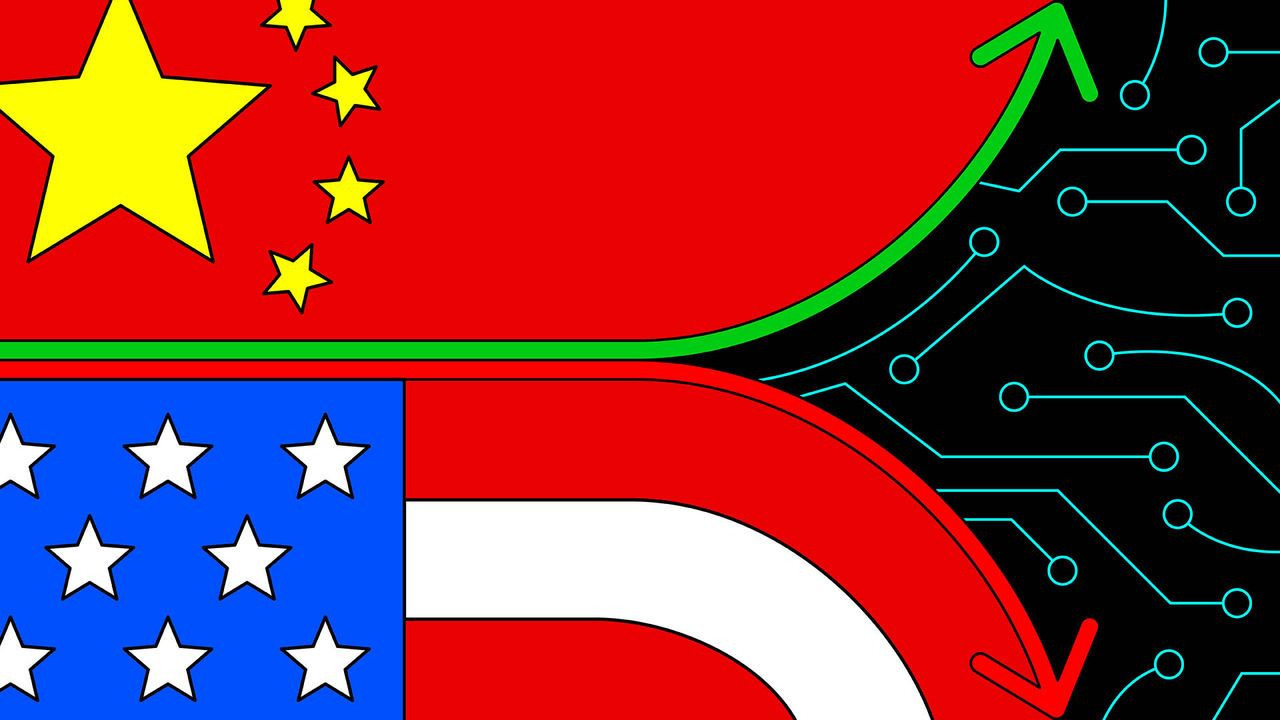
Illustration: Rose Wong
Jan 29th 2025
The market reaction, when it came, was brutal. On January 27th, as investors realised just how good DeepSeek’s “v3” and “R1” models were, they wiped around a trillion dollars off the market capitalisation of America’s listed tech firms. Nvidia, a chipmaker and the chief shovel-seller of the artificial-intelligence (AI) gold rush, saw its value fall by $600bn. Yet even if the Chinese model-maker’s new releases rattled investors in a handful of firms, they should be a cause for optimism for the world at large. DeepSeek shows how competition and innovation will make ai cheaper and therefore more useful.
DeepSeek’s models are practically as good as those made by Google and OpenAI—and have been produced at a fraction of the cost. Barred by American export controls from using cutting-edge chips, the Chinese firm undertook an efficiency drive, even reprogramming the chips it used to train the model to eke out every drop of power. The cost of building an AI model that can stand toe-to-toe with the best has plummeted. Within days of its release, DeepSeek’s chatbot was the most downloaded app on the iPhone.
The contrast with America’s approach could not be starker. Sam Altman, the boss of OpenAI, has spent years telling investors—and America’s new president—that vast sums of money and computing power are needed to stay at the forefront of AI. Investors have accordingly been betting that a handful of firms stand to reap vast monopoly-like rents. Yet if fast followers such as DeepSeek can eat away at that lead for a fraction of the cost, then those potential profits are at risk.
Nvidia became the most valuable listed company in the world thanks to a widespread belief that building the best AI required paying through the nose for its best chips (on which its profit margins are reported to exceed 90%). No wonder DeepSeek’s success led to a stockmarket drubbing for the chipmaker on January 27th. Others in the data-centre business are also licking their wounds, from Siemens Energy (which would have built the turbines to power the build-out) to Cameco (which would have provided the uranium to fuel the reactors to turn the turbines). Had OpenAI been listed, its stock would surely have taken a tumble as well.
Yet there are far more winners than losers from the DeepSeek drama. Some of them are even within tech. Apple will be cheering that its decision not to throw billions at building AI capabilities has paid off. It can sit back and pick the best models from a newly commoditised selection. Smaller labs, including France’s Mistral and the Emirati TII, will be racing to see if they can adopt the same improvements, and try to catch up with their bigger rivals.
Moreover, efficiency gains are likely to result in greater use of ai. The Jevons paradox—the observation that greater efficiency can lead to more, not less, use of an industrial input—may come into play. The possible applications for a language model with computing costs as cheap as DeepSeek’s ($1 per million tokens) are vastly more numerous than those for Anthropic’s ($15 per million tokens). Many uses for cheaper AI are as yet unimagined.
Even Nvidia may not suffer too much in the long run. Although its market clout may be diminished, it will continue to sell chips in vast quantities. Reasoning models, including DeepSeek’s R1 and OpenAI’s o3, require much more computing power than conventional large language models to answer questions. Nvidia will be hoping to supply some of that.
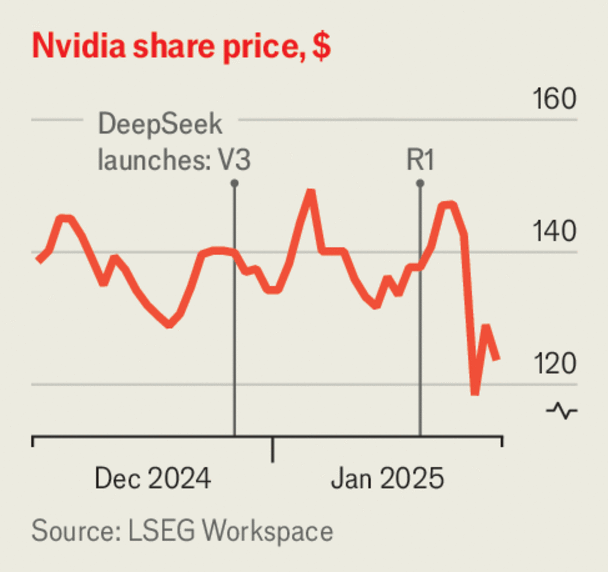
Chart: The Economist
However, the real winners will be consumers. For AI to transform society, it needs to be cheap, ubiquitous and out of the control of any one country or company. DeepSeek’s success suggests that such a world is imaginable. Take Britain, where Sir Keir Starmer, the prime minister, has unveiled a plan to use AI to boost productivity. If he does not need to pay most of the efficiency gains back to Microsoft in usage fees, his proposal has a better chance of success. When producers’ rents vanish, they remain in the pockets of users.
Some have begun to suggest that DeepSeek’s improvements don’t count because they are a consequence of “distilling” American models’ intelligence into its own software. Even if that were so, r1 remains a ground-breaking innovation. The ease with which DeepSeek found greater efficiency will spur competition. It suggests many more such gains are still to be discovered.
For two years the biggest American ai labs have vied to make ever more marginal improvements in the quality of their models, rather than models that are cheap, fast and good. DeepSeek shows there is a better way. ■
Leaders | Dealmaking in the Middle East
How to use “maximum pressure” to stop an Iranian bomb
The Islamic Republic is closer than ever to obtaining nukes
Photograph: Reuters
Jan 30th 2025
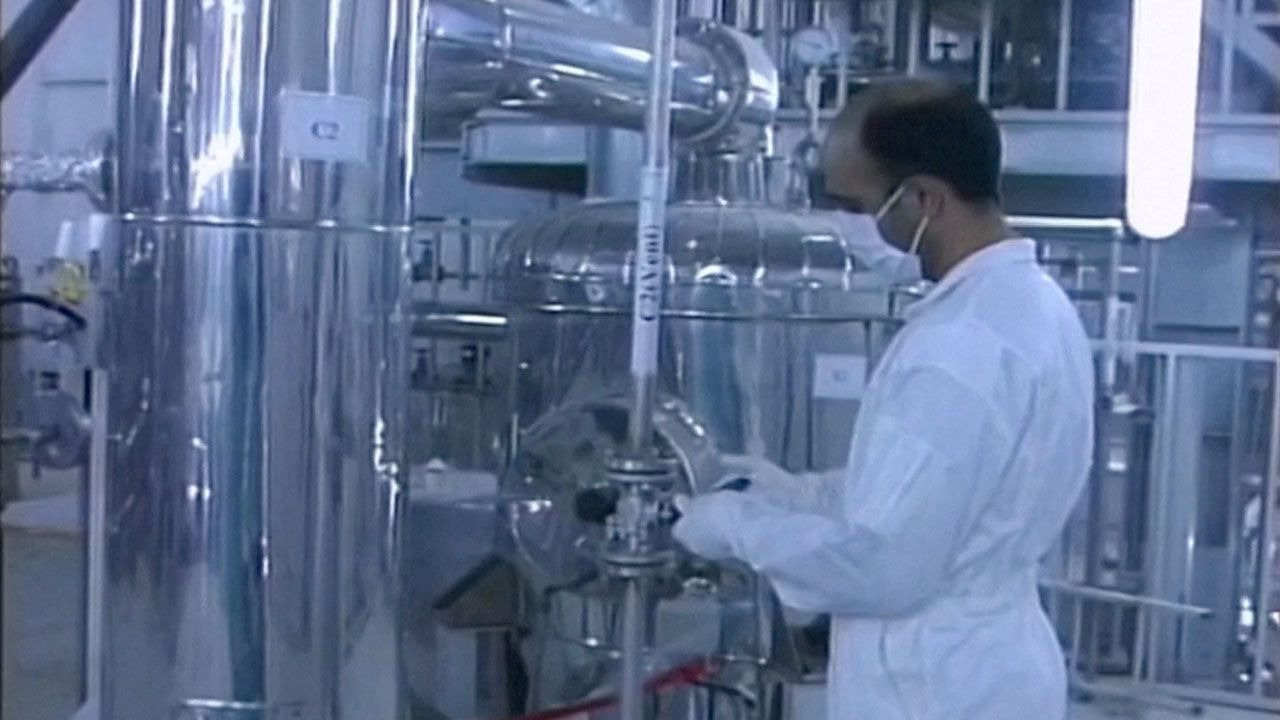
AT HOME AND abroad, Iran is in trouble. In the space of less than a year, the country has lost one president, three allies (the leaders of Syria, Hamas and Hizbullah), several missile-production sites and all its best air-defence systems. It has a moribund economy, a growing energy crisis and a restive population. Small wonder the regime is relying on one of the few arrows left in its quiver—its nuclear programme.
The Islamic Republic is closer to a bomb than ever before, as our interview with the world’s nuclear watchdog explains. Since President Donald Trump in 2018 pulled America out of a multilateral nuclear deal, the JCPOA, Iran has accumulated uranium and centrifuges that can enrich it to weapons-grade. Last October it could enrich uranium for five bombs in about a week, if it chose to do so. Its capacity to enrich uranium to 60%, near weapons-grade, has risen five-fold since then. To have a usable weapon, it would still need to make an explosive warhead that could fit onto a missile. That could take 12-18 months.
What is to be done? Hawks in Israel’s government want to bomb Iran’s nuclear sites. They have already smashed Hamas and Hizbullah, Iran’s proxies, whose capacity to retaliate against Israel on Iran’s behalf is hugely diminished. Direct Israeli strikes against Iran in April and October were devastatingly effective, destroying a good part of its air-defence systems. Israeli spies have turned Iran’s circles of power inside out. All Israel needs, they argue, is for America to supply some bunker-busting bombs and to help parry the inevitable Iranian retaliation. Why not settle the issue once and for all?
Strikes against Iran’s nuclear facilities should not be ruled out. But Mr Trump should reject entreaties for action now. An attack would be highly risky: it could cause regional mayhem, sucking in America for years. And even a sustained campaign of bombing by America would not be able to destroy Iran’s nuclear know-how. Meanwhile, there is an opportunity for diplomacy. To his credit, Mr Trump seems keen to take it.
One element of this is to make a credible threat of increased sanctions and the reinstatement of the “maximum pressure” policy of his first term. This makes sense. The Biden administration foolishly turned a blind eye to Iranian oil-smuggling, emboldening the regime. Helpfully, under what remains of the jcpoa, over the next eight months the remaining Western signatories, Britain, France and Germany, can choose to trigger a reimposition of UN sanctions on Iran, turning up the heat further.
But if Mr Trump’s tougher approach is to bear fruit it must have a coherent objective. Some hardliners would like to try to use economic pressure to topple the Iranian regime. That is understandable—it is a decaying theocracy, hated by many of its people and facing a looming succession crisis. But if it is pushed into a corner, it may lash out. Right now, its leaders have not decided to make a final dash for a bomb. Mr Trump’s aim should be to keep it that way.
Even as he raises the pressure, he should make clear that he will offer Iran a deal that includes sanctions relief and support for its ongoing normalisation of ties with Saudi Arabia, providing the regime meets two tests. First, a major curtailment of the nuclear programme. Any new deal would not be as comprehensive as the one signed in 2015—the International Atomic Energy Agency now has gaps in its knowledge of how Iran has produced components for its centrifuges, for instance—but it would be better than the status quo, in which the path to a bomb is shortening every day.
Second, Mr Trump should demand that Iran permanently stops stirring up so much trouble across the region. With its one formal ally overthrown (Syria’s tyrant Bashar al-Assad), and its extremist friends in Gaza and Lebanon mauled, the Islamic Republic’s “axis of resistance” is severely weakened. Iran will not abandon its foreign allies entirely. It has huge political sway in Iraq, and will not sever ties with its clients there. But any deal should require it to end military support for Hamas, Hizbullah and Yemen’s Houthis.
This would be an ambitious agenda—a “more for more” deal, requiring each side to make more concessions than they did for the JCPOA in 2015. Iran distrusts Mr Trump, who in his first term tore up the old nuclear deal and assassinated the general who masterminded Iran’s regional meddling. Mr Trump has cause to loathe Iran’s rulers, who plotted to murder him in 2024, according to federal prosecutors. Still, America’s president has bargaining power. The uranium is piling up. Israel is straining at the leash. And the clock is ticking. ■
United States | Murder mystery
An alternative theory to explain America’s murder spike in 2020
What if it wasn’t about policing?

Dial MPhotograph: Alamy
Jan 30th 2025|BOSTON
You might call it a new golden age. America’s economy is strong, overdose deaths are falling and crime rates are down. For the second consecutive year murders in America have plummeted. The surge in violence in 2020, which was the deadliest year in over two decades, may now seem like a distant memory to some. Yet for criminologists and policymakers the question of what caused that spike in the first place remains unanswered.
A popular theory, advanced prominently by Heather Mac Donald of the Manhattan Institute, a think-tank, is that it was caused by a “George Floyd effect”. The theory is as follows: after the murder of Floyd by police officers in Minneapolis in 2020, police lost trust in high-crime communities and among African-Americans, leading to lower clearance rates for murders. When people think they will not get caught, they commit more crime. Another version of the Floyd effect thesis holds that police officers, beset by rising public hostility, deliberately pulled back from high-crime neighbourhoods, for fear of being prosecuted for doing their jobs. Either way, protests against police brutality lead directly to more murders, a bitter unintended consequence for the protesters and, perhaps, evidence of the kind of soft liberalism from big-city Democrats that Donald Trump was elected to expunge.
A recent report from the Brookings Institution, a think-tank, advances an alternative theory. Rohit Acharya and Rhett Morris, the report’s authors, argue that the rise in murders began in April 2020, about six weeks before the murder of Mr Floyd. They contend that high unemployment and school closures in poor neighbourhoods, both brought about by covid-19 and the policy response to it, left teenage boys idle. This, not the Floyd effect, was responsible for the murder spike. This would suggest an awful trade-off: those early lockdowns saved many lives, but they also may have resulted in more murders.
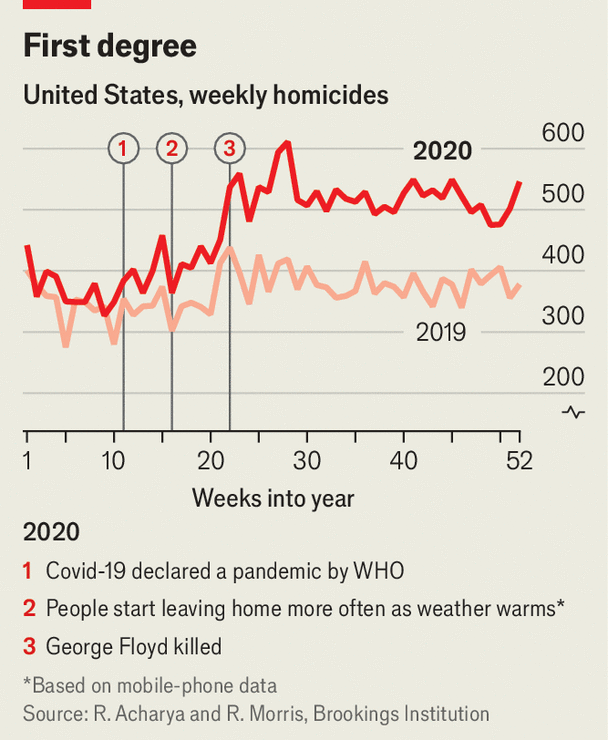
Chart: The Economist
Using weekly national homicide data, Messrs Acharya and Morris show that throughout the summer of 2020 murders rose 30% compared with the summer of 2019. Crucially, they do not find an inflection point around the end of May, when Mr Floyd was killed. Across the six weeks preceding his death national weekly murders increased by around 17 murders per week, a rate 70% greater than the same period in 2019. And during the six weeks following his death, murders rose at a similar rate.
What, then, caused this increase? The authors theorise that the economic circumstances of the pandemic are to blame. Criminologists concur that, in general, poverty correlates with crime rates. In Atlanta, 65% of all homicides occur in neighbourhoods where at least 30% of the population lives below the poverty line. Nearly every big American city displays this trend. Poorer neighbourhoods were also disproportionately affected by the pandemic: job losses and high-school dropout rates were far higher. Cities with a greater share of young men living in these conditions saw larger increases in homicides in 2020.
Juveniles typically commit few murders. Though roughly half of murders go unsolved and not all jurisdictions report the age of the murderer, the available data suggest that fewer than 10% of homicides are committed by those under the age of 18. Yet between 2019 and 2020 juveniles accounted for an estimated 15-20% of the overall surge. That seems consistent with the idea that closed schools and idle teenage boys are a big part of the story.
Criminologists tend to be wary of single explanations. “It’s very difficult to come up with a definitive conclusion about what happened in 2020, because so many things changed at the same time”, says Aaron Chalfin, a criminologist at the University of Pennsylvania who was not involved with the Brookings report. He notes that, in the past, unemployment rates have not correlated with murder rates, although that does not necessarily mean no such relationship arose during the pandemic. And teasing out the interactions between variables is trickier still. Were school closures in poorer neighbourhoods responsible for juveniles committing more murders, or was it school closures plus fewer police officers patrolling the streets?
The research, says Neil Gross, a professor of criminology at Colby College (who was also not involved in the study), suggests that the nature of social ties in poor areas matters. Crime is often lower where “people know their neighbours and can look out on the street for errant teenagers and contact their parents”, says Mr Gross. That suggests yet another potential suspect: such neighbourhood watchers were locked down at home. ■
United States | Lexington
Donald Trump’s Defining Decade
Will America’s president overcome the 1970s, or just refight its battles?

Illustration: David Simonds
Jan 30th 2025
Donald Trump invoked the 1890s in laying out the agenda for his second term. But from his demand for the Panama Canal to his declaration of a national energy emergency to his order releasing the records of the assassination of John F. Kennedy to the music he grooved to at his inaugural balls, Mr Trump, in his first days back in office, has instead evoked a different decade: the 1970s, formative years for him, and for America.
It was in 1971 that Mr Trump, then in his mid-20s, moved from Queens into Manhattan, taking a rent-stabilised studio apartment with a view of a water tank. He had ambitions to turn his father’s Brooklyn-based business building middle-class housing into something grander. By the decade’s end he would be a millionaire in his own right, married to a glamorous immigrant and a fixture at clubs like Studio 54, with growing celebrity for projects such as his eponymous tower rising on 5th Avenue.
As he exited the 1970s in his mid-30s, the apprentice years of adulthood behind him, Mr Trump, like many Americans, had reasons to be cynical about politics and business, to be fearful of inflation and oil scarcity and urban crime, to be drawn to conspiracy theories, to think America had lost the national self-assurance of his childhood in the 1950s. During what Tom Wolfe branded “The ‘Me’ Decade”, amid revelations of dirty deeds by sainted figures, as Americans more freely embraced and divorced each other, old ideas about duty and service came to seem like frauds. “Forget foundationless traditions, forget the ‘moral’ standards others may have tried to cram down your throat,” advised one bestseller in those years, “Looking out for Number One”.
“The 1970s were daunting and frightening because habits and institutions that had succeeded brilliantly for half a century suddenly sputtered,” David Frum writes in his history of the decade, “How We Got Here: The 70s”. “Never—not even during the Depression—had American pride and self-confidence plunged deeper.” The disillusion, fear and reaction of those years hardened into the worldview that has carried Mr Trump twice to the Oval Office.
At the start of the 1970s Mr Trump met Roy Cohn, the man who probably influenced him more than anyone besides his father, sharpening his reflex to fight all comers for every advantage, as he is doing now as president. A ferocious New York lawyer, Mr Cohn became Mr Trump’s mentor, “introducing him to the netherworld of sordid quid pro quos that Cohn ruled”, wrote Mr Trump’s dogged biographer, Wayne Barrett, in “Trump”. Over the course of the 1970s Mr Trump became the largest individual donor in New York state and local elections. “I can buy a US senator for $200,000,” he once told an associate back then.
Revelations spilling out of the Watergate investigations were teaching all Americans similar lessons, and implicating more than just President Richard Nixon. America’s great corporations for years had evaded the law with donations to politicians of both parties. Not only Nixon had secretly recorded meetings in the Oval Office. So had Lyndon Johnson and John Kennedy.
In 1976 Congress for the first time created a permanent committee to oversee the intelligence agencies, and it revealed shocking secrets about coups and assassinations by the CIA. Then came revelations about the FBI. Robert Kennedy himself had ordered wiretaps on Martin Luther King. As suspicions of skulduggery grew, Congress in 1976 ordered investigations into the assassinations of John Kennedy and King. Hollywood seized on the spectre of rot in America’s foundations for the plots of such movies as “Three Days of the Condor”, about CIA murders of Americans, “Chinatown” and the “Godfather” series. Mr Trump’s response in 2017 when an interviewer called Vladimir Putin a killer—“You think our country’s so innocent?”—was straight out of the 1970s.
Government was coming to seem not just corrupt but incompetent. New York City teetered at the edge of bankruptcy as officials struggled to stem rising theft and homicide. “Welcome to Fear City” read pamphlets bearing a death’s head that police officers in casual clothes handed out to tourists in 1975. During a citywide blackout in 1977, chaos swept the streets, resulting in hundreds of injuries to police officers and thousands of arrests for looting. One might well have called it American carnage.
Four years of the condor
Nationally, new laws in the 1960s led to a surge in immigration in the 1970s, and illegal immigration along with it. Backlash was building against new rights granted to non-citizens, as it was against policies meant to advance integration and equality such as affirmative action and busing. Mr Trump first hired Cohn to defend him against a Justice Department suit accusing the Trumps’ company of excluding black renters. Asked at a deposition in 1974 when the first black people moved into one of his projects, Mr Trump replied, “I don’t care and I don’t know.” He was insisting on the same sort of “colour-blindness” he declared in his inaugural address this month to now be government policy.
Mr Trump once lamented that during the 1970s America lost “the feeling of supremacy that this country had in the 1950s”. In the 1970s, ceding control of the Panama Canal divided conservatives. In a televised debate with Ronald Reagan, William Buckley, the founding editor of National Review, said turning the canal over would bring Americans “increased security and increased self-esteem”. Time has proved him correct as far as security goes. But to many on the right the treaty with Panama became an exhibit of the same weakness that led to failure in Vietnam and the Iranian hostage crisis. Mr Trump’s pledge to retake the canal is a direct assault on the 1970s, and it underscores a basic question about his second term: will he lead Americans to transcend that decade at last, or to wallow in it? ■
United States | Aid and a bet
America’s foreign aid pause puts lives at risk
Donald Trump sought disruption. He hurt America first.
Down with this kind of thingPhotograph: Getty Images
Jan 30th 2025|Damascus and Washington
THE SPRAWLING al-Hol camp in north-eastern Syria is part of a network of prisons holding tens of thousands of detainees and family members from Islamic State’s jihadist “caliphate”, which was smashed by America and its allies in 2019. Western securocrats have long worried that prisoners might break out and wreak bloody havoc, in Syria and abroad. Such fears have intensified given the turmoil after the fall of Syrian dictator, Bashar al-Assad, in December.
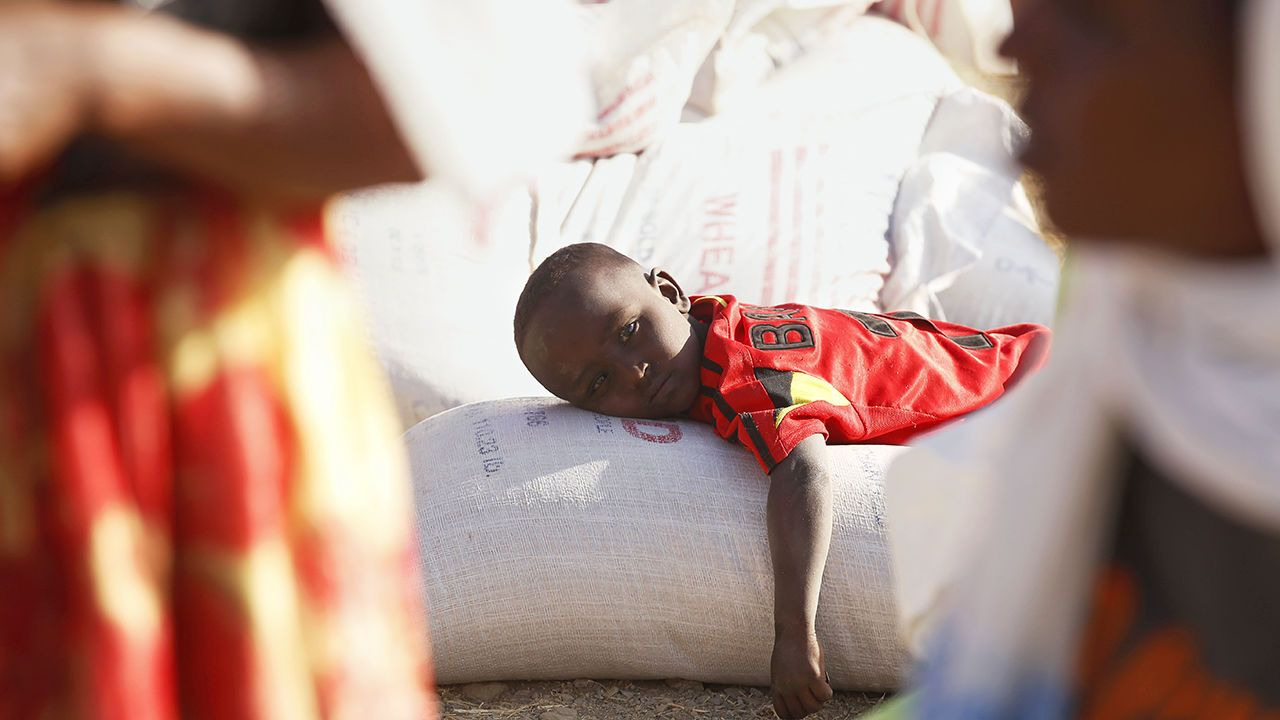
There could scarcely be a worse time for the Trump administration to order, as it did on January 24th, an immediate halt to almost all aid work—at al-Hol and around the world—pending a 90-day review to ensure foreign assistance aligns with America First principles. The only exceptions were aid for Israel and Egypt (mostly military) and “emergency food aid”. Waivers could subsequently be issued on a case by case basis.
America is by far the world’s largest aid donor, spending $68bn in fiscal 2023, the most recent year. The US accounts for about 40% of all humanitarian assistance provided by governments. The announcement of an abrupt cutoff of much of this money hit humanitarian agencies like an earthquake. American-funded projects wobbled and some risked collapse.
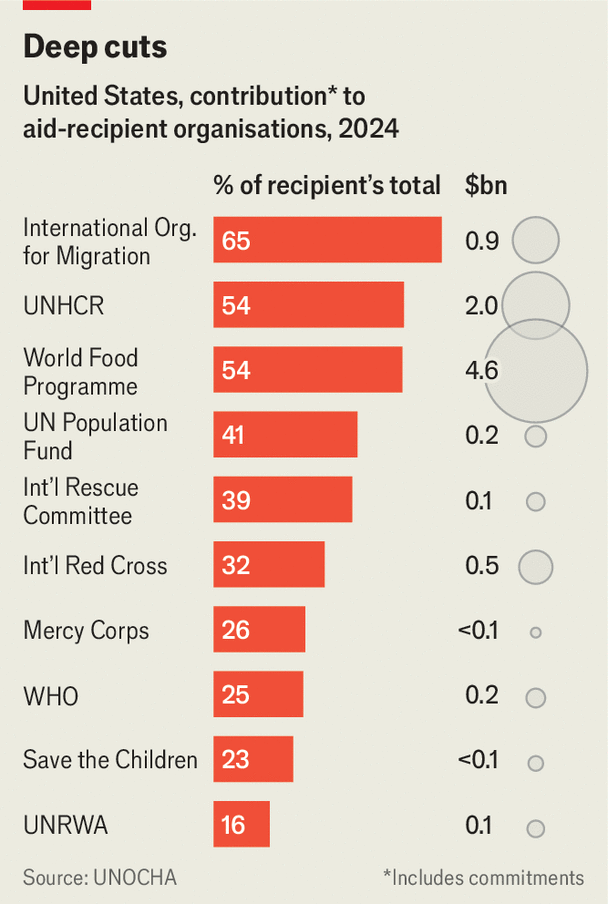
Chart: The Economist
The affected work included the distribution of antiretroviral drugs for people infected with HIV under a scheme known as PEPFAR, credited with saving some 26m lives since 2003; medical services for Rohingya refugees in Bangladesh; mine-clearing in South-East Asia; reconstruction of bombed-out energy infrastructure in Ukraine; pro-democracy work in Russia’s near-abroad; and much more.
“Every dollar we spend, every program we fund, and every policy we pursue must be justified with the answer to three simple questions: Does it make America safer? Does it make America stronger? Does it make America more prosperous?” the state department said.
Among the casualties were groups working at al-Hol, home to about 40,000 Islamic State (IS) fighters and their relatives, among them European women who married combatants and bore their children. The Kurdish-dominated Syrian Democratic Forces (SDF), which controls north-eastern Syria, is in charge of security at the camps. But aid workers speak of a free-for-all within. Women loyal to IS hold sway with guns and train a new generation of ideologues. The perimeter is pierced by tunnels, allowing weapons in and inmates out. Killings are commonplace. Children are sold as fighters. “It’s more an IS base than a prison,” says a Western researcher.
Blumont, the American firm that manages al-Hol (and a smaller camp called Roj) under a state department contract, says its teams left the camps when they received the stop-work order, and arranged for other groups to provide “very much reduced basic services”. Some humanitarian groups said they were issuing termination letters for their staff. On January 27th Blumont received a 14-day waiver and said its staff returned the next day.
Amid chaos and an outcry that countless lives were at risk, Marco Rubio, the secretary of state, later widened exemptions to include “life-saving humanitarian assistance”. This includes “medical services, food, shelter, and subsistence assistance, as well as supplies and reasonable administrative costs.” Programs would not be funded if they involved abortion, family-planning, transgender surgeries or other aid deemed not to be life-saving.
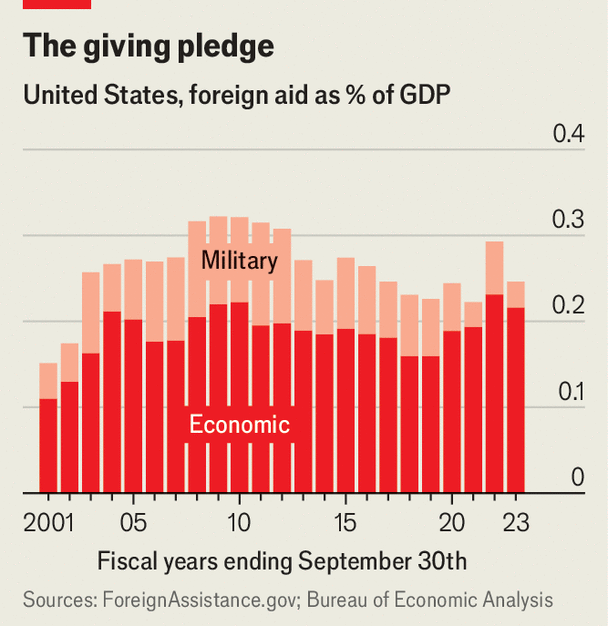
Chart: The Economist
Even with this concession, aid groups say confusion abounds. “Does work on clean water count as life-saving aid?” asked an official in one large ngo. Some projects were being closed because of the uncertainty. The status of PEPFAR is unclear.
Waivers apparently still need to be issued case-by-case. Whether the government has the staff to process them quickly is another question. Few of the state department’s political appointees have yet arrived. USAID, the main American development agency, has furloughed hundreds of senior staff and contractors. One spoke of a “sad and apocalyptic” atmosphere.
The state department says the full halt was necessary because “it is impossible to evaluate programs on autopilot”, arguing that those running them have little incentive to give details if the money keeps flowing. It claims to have already saved about $1bn, halting things such as the delivery of condoms to Gaza, sex education globally and clean-energy programmes for women in Fiji. The department offered no details to support its $1bn estimate.
Al-Hol offers just one example of how stopping work suddenly for such dubious reasons is an avoidable act of self-harm. “Without aid, it’s difficult to maintain the security of the camps,” says Ali Rahmoun, a spokesman for the Syrian Democratic Council, the political wing of the SDF. “The jihadists won’t just be a problem for Syria but for the region and even Europe.”
Americans would be in danger, too. Shamsud-Din Jabbar, a 42-year-old US army veteran, rammed his Ford pickup into a crowd in New Orleans on New Year’s Day, killing 14. He was killed by police. In his vehicle they found IS’s black flag. ■
The Americas | Champion decarboniser in the making?
Brazil’s ragged finances are holding back its green ambitions
The transformation of its largest private port has lessons for the country’s aspirations
Photograph: Getty Images
Jan 30th 2025|Port of Açu
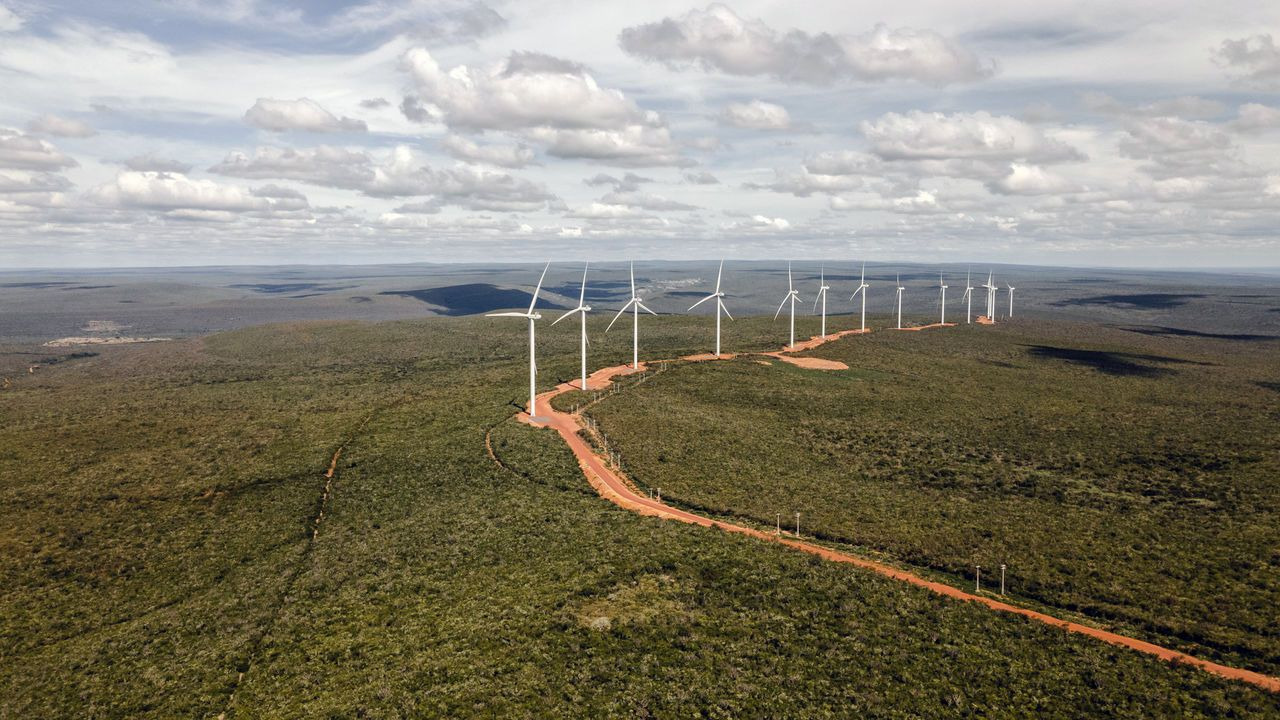
Visitors to the Port of Açu may struggle to determine its industrial nature. No warehouses or piles of containers block the view of the Atlantic Ocean. Swathes of restored restinga, a local broadleaf forest, hug the shoreline, which bustles with loggerhead turtles. A different story is suggested only by the gigantic ships that dot the sea’s horizon.
The port, 320km (200 miles) north-east of Rio de Janeiro, is the world’s largest support facility for offshore oil extraction. Dreamed up a decade ago by an eccentric Brazilian billionaire as a way to meet Chinese demand for commodities, Açu is now among the world’s largest private ports. It handles more than 30% of Brazil’s crude-oil exports and 7% of its iron ore.
But Açu’s focus is shifting. In the past three years the port has signed contracts worth some $5bn to lease land for factories that will make wind turbines, as well as facilities for the production of ammonia, sustainable aviation fuel (SAF) and pure metallic iron, the main ingredient for producing low-carbon steel. Investment in green infrastructure at the port now outstrips that for fossil fuels.
Clean and getting cleaner
The port is a microcosm of Brazil’s economic aspirations. Long a major exporter of grains and raw materials, the country now wants to use its abundance of renewable energy to attract firms seeking to reduce their carbon footprint, and to manufacture and export higher-value-added goods. It is a decent plan. Reducing the carbon emissions of the most energy-intensive sectors of the economy—aviation and shipping, or the manufacturing of cement, steel and chemicals—requires huge amounts of cheap, clean energy, as well as abundant biomass.
Few countries have as much of either as Brazil does. More than 85% of its electricity is generated without burning fossil fuels, a share almost three times higher than the global average. Most of this comes from hydropower, but wind and particularly solar are catching up fast. By 2040 the costs of producing solar and wind energy are expected to fall by 46% and 27%, respectively.
This would make Brazil one of the cheapest places in the world to produce green hydrogen, which is created by using renewable energy to split water into its component molecules of hydrogen and oxygen. According to Felipe Diniz of Mirow, a consulting firm in Rio de Janeiro, it would cost about $4.50 per kilogram to make the stuff in Brazil today. He says this could fall to $1.70 within a decade, as wind and solar become cheaper. Brazil’s production costs would be in line with places like Saudi Arabia, north Africa and Chile.
Burning hydrogen is one of the few ways that the most energy-intensive sectors can decarbonise. Steel, for example, is made by burning coking coal in a blast furnace to heat and reduce iron oxide into metallic iron, which is then flushed with oxygen to purify it. But this process releases vast emissions of carbon dioxide. That can be avoided by burning hydrogen instead of coal. Brazil is the world’s second-largest producer of iron ore, which it exports to countries like China, Japan and South Korea. It wants to process more of it at home. Vale, the world’s largest iron-ore miner, is expected to open a clean ore-processing plant at the Port of Açu in 2028.
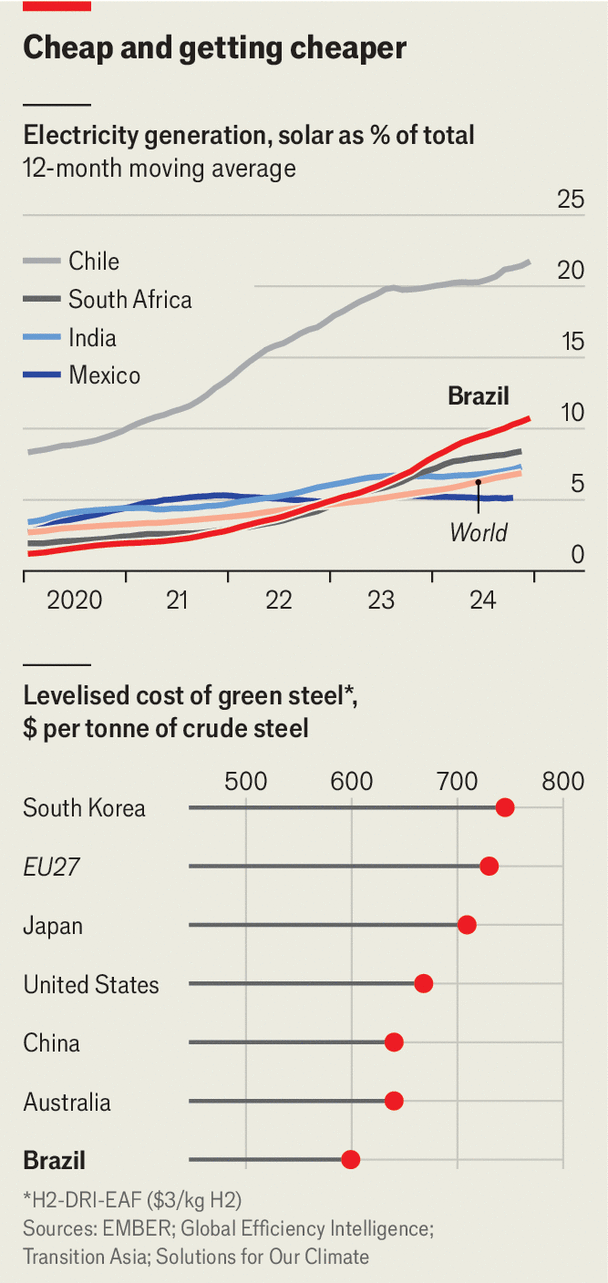
Chart: The Economist
Steel exports may not be far off. McKinsey, a consultancy, estimates that producing clean metallic iron in Brazil could cost $465 per tonne by 2030, compared with $560 for a similar process in the EU. Global Efficiency Intelligence (GEI), an energy consultancy based in San Francisco, reckons it will be cheaper to make green steel in Brazil than in China, Japan, the United States, South Korea, Australia or the EU, mainly because of the lower cost of green hydrogen (see chart).
Brazil also wants to make SAF. Its forestry and agribusinesses generate 2bn tonnes of organic waste each year, which is potential feedstock. The EU and the International Civil Aviation Organisation, a standards-setting body, are both nudging airlines to use SAF. From this year, all flights originating in the EU—around a third of the global total—must contain at least 2% SAF in their fuel mix; this will rise to 20% by 2035 and 70% by 2050.
According to Thiago Sinzato of Rystad Energy, a Norwegian consultancy, global demand for SAF is expected to reach 5m barrels per day by 2050. Brazil could make up 1.3m barrels of that. “It would be easy for Brazil to become the world’s biggest SAF producer,” he says. Since 2022 Brazil’s firms have announced over $4bn in biofuel investments, including in SAF.
Money problems
Its technical foundations for a green-production boom may be sound, but Brazil’s economic travails are an obstacle. The high cost of finance is putting off bigger investments in capital-intensive projects. The real was the world’s worst-performing major currency last year, losing more than 20% of its value against the dollar.
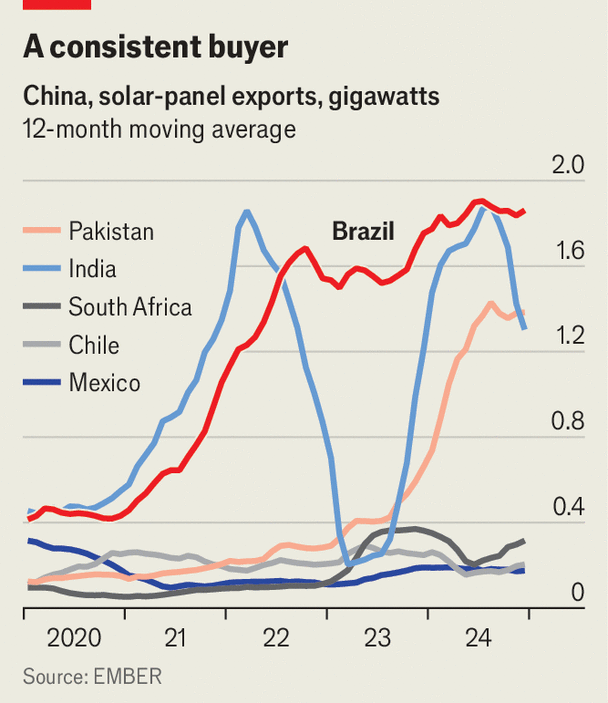
Chart: The Economist
The slump was fuelled by panic about the spending plans of Luiz Inácio Lula da Silva, the left-wing president. Markets believe he is not serious about balancing the books, even as Brazil’s budget deficit reaches 10% of GDP and gross debt nears 90% of GDP. An industrial-policy programme announced last year, involving billions of reais, supported that belief. Even as most central banks cut interest rates, on January 28th Brazil’s was raised to 13.25%, among the highest in the world.
The picture may not improve in 2025. The most cherished policies of Donald Trump, America’s president, to deport immigrants and impose tariffs, will probably strengthen the dollar. The real will slide further, and investors may look elsewhere. Brazil has great expectations for its role in decarbonising the world. But if it cannot convince investors to keep money in the country, its hopes will come to naught. ■
Asia | After the attempted coup, then what?
Who is Lee Jae-myung, South Korea’s possible next president?
The Economist interviews the divisive progressive leader
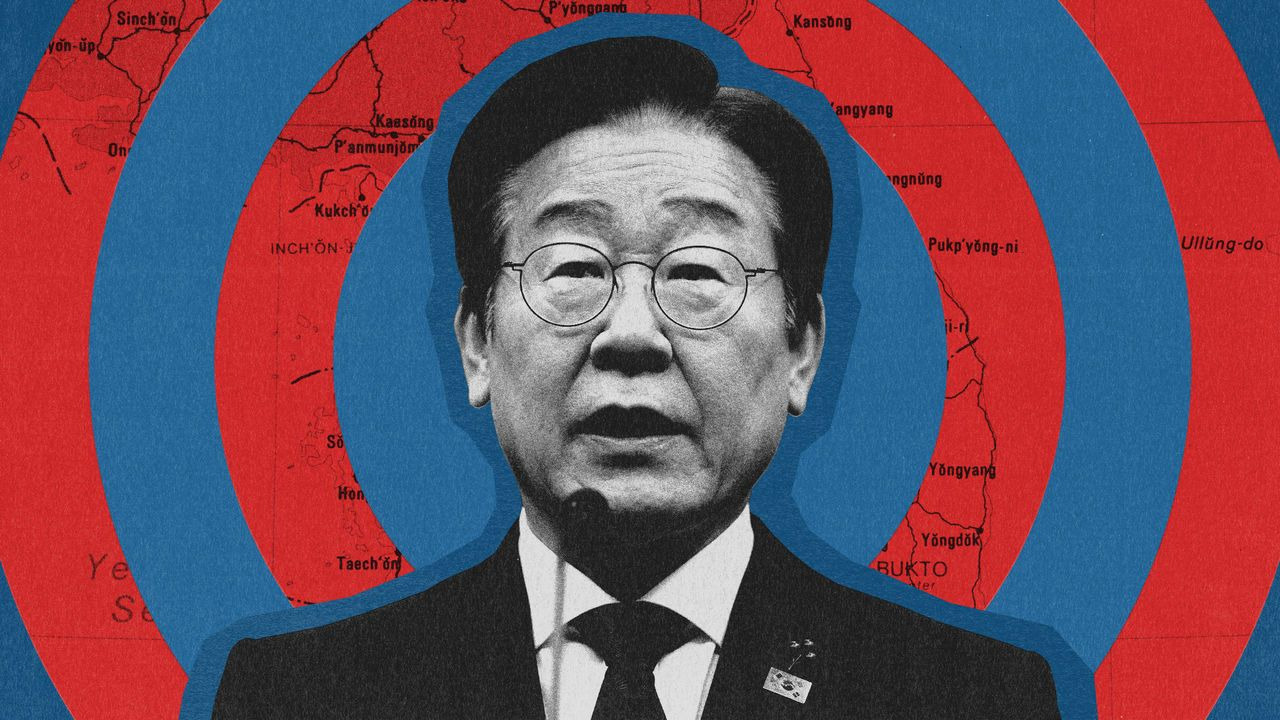
Photograph: Chantal Jahchan
Jan 30th 2025|Seoul
WHEN SOUTH KOREA’S president, Yoon Suk Yeol, sent troops streaming into the country’s National Assembly on December 3rd, Lee Jae-myung turned on his livestream. Viewers watched on a shaky smartphone camera feed as the head of the country’s largest opposition force, the Democratic Party (DP), scaled the walls of parliament to help stop the attempt to impose martial law. That Mr Yoon thought he could use force to control modern-day South Korea, a wealthy democracy with a rich civic consciousness, is “just absurd”, says Mr Lee, who lost narrowly to Mr Yoon in presidential elections in 2022.
Two months have now passed since that fateful night. South Korea is still in limbo, with both Mr Yoon and his prime minister suspended from office and the government led by its second acting president. Yet as the cases against Mr Yoon move forward—an impeachment trial in the constitutional court is under way and prosecutors indicted him on January 26th on criminal charges of insurrection—the country is increasingly turning its attention to what comes next. Speaking to The Economist in a conference room inside the same National Assembly building, Mr Lee is confident, composed and quick to smile. He says the urgent task is to “restore constitutional order” and skirts questions about running again. But if a presidential vote were held today, he would be the favourite, with big implications for South Korea’s future direction.
Mr Lee’s ascent is far from guaranteed. He faces serious legal problems of his own. He has been charged with a spate of alleged crimes linked to a development project during his time as mayor of Seongnam, his hometown south of Seoul, and to illegal fund transfers to North Korea. In November he was found guilty of election-law violations for lying during the previous presidential campaign; if the conviction is upheld on appeal, he would be barred from running for several years. He denies wrongdoing and his allies remain confident that the appeals process will buy him enough time to stand in new elections. But the allegations have made him a divisive figure. Ahead of parliamentary elections last year, Mr Lee survived an assassination attempt by a knife-wielding extremist.
South Korea remains deeply polarised. In recent weeks public opinion has swung against the DP, which had opened up a wide lead over Mr Yoon’s People’s Power Party (PPP) in December. Some recent polls even show the PPP neck-and-neck with the DP; Mr Lee narrowly beats potential PPP opponents in hypothetical head-to-head races. Such shifts are a sign that voters, who are frustrated with the ongoing turmoil, once viewed his party as an opposition force but now see it as “the leadership force who needs to take responsibility”, Mr Lee reckons.
Recently Mr Lee has been trying to cast himself as a responsible choice to lead the country’s recovery. His life story is the stuff of Dickensian dreams. His parents cleaned public toilets. Instead of going to secondary school he worked in factories. He educated himself and entered law school, becoming a labour activist and human-rights lawyer who advocated for the working classes. As he rose through the political ranks, he developed a reputation as an effective, if slippery, operator. “He is a problem-solver, rather than an ideological agitator,” says Moon Chung-in, an adviser to Moon Jae-in, the DP president from 2017 to 2022. “For him, interests matter more than values.”
That image is central to his pitch to voters. Mr Lee says his party’s guiding value is “pragmatism”. Once known for progressive policies such as a universal basic income, he has tacked to the centre on economics. He speaks of the importance of “restoring growth” and “growing the pie”. In a press conference on January 23rd that looked like a soft campaign launch, he praised the private sector, highlighted the importance of capital markets and called for a results-oriented politics that moves beyond ideologies and factions.
He sends a similar message on foreign policy. South Korea’s left traditionally favours engagement with North Korea, mistrusts Japan (because of its colonial-era abuses) and, though in favour of the alliance with America, seeks balance between it and other powers such as China and Russia. American officials fret that a new DP administration will mean kowtowing to China and an end to the trilateral co-operation between America, South Korea and Japan that flourished under Mr Yoon. Japanese leaders are bracing for a return to tetchy relations. The first unsuccessful impeachment motion brought against Mr Yoon included a section excoriating him for pursuing a “bizarre Japan-centred foreign policy” and for “antagonising” North Korea, Russia and China.
In meetings with foreign diplomats Mr Lee has tried to dispel those presumptions. The foreign-policy section was stripped from the second, ultimately successful impeachment motion. Mr Lee positions South Korea firmly as a “member of the liberal democratic camp”. Since the previous DP administration, the security environment around South Korea has changed, narrowing the potential room for manoeuvre. The public has soured markedly on China, warmed towards Japan and increasingly tuned out North Korean provocations—shifts that Mr Lee, an acute observer of voter moods, has surely noticed. But even a more pragmatic DP leader will still deviate from South Korea’s current course.
Consider Mr Lee’s remarks on South Korea’s three big interlocking challenges. The most fundamental is relations with North Korea. Previous DP administrations pursued a “sunshine policy” aimed at projecting warmth to foster peace. Last year Kim Jong Un, North Korea’s dictator, declared that the two Koreas were no longer one divided country but two enemy states—in effect slathering on a thick layer of sunscreen and donning dark glasses. Mr Lee acknowledges that relations are “hostile”. But he contends that the balance of deterrence and dialogue has become skewed. South Korea’s own formidable armed forces, its alliance with America and its growing security co-operation with Japan mean that “we are already plenty strong enough militarily to deter North Korea.” What is needed now is to “communicate and engage”, he argues.
The most sensitive foreign-policy issue is Japan. The walls of the room where Mr Lee sits are lined with portraits of past progressive leaders stretching back to Kim Gu, a famed activist who fought for Korean independence from the Japanese empire. But given present-day geopolitical realities, Mr Lee has “no objections” to deepening relations with Japan and continuing the trilateral co-operation. Japan’s defence build-up does not pose a threat to South Korea, as relations are at present “not hostile”, he says. “I used to think that Japan was a country full of very strange people who invaded South Korea, committed horrific human-rights violations, and yet never properly apologised for it,” he recalls. But after visiting the country during his time as a lawyer, “I was shocked by Japanese people’s diligence, sincerity and courtesy” and came to see that the relationship “has ultimately been distorted by politics”.
Nonetheless, he criticises Mr Yoon’s “excessively submissive attitude” towards the former coloniser. The “emotional conflict” between Japan and South Korea “has not disappeared but was just hidden away”. As a party, the DP is still shrill on disputes with Japan. One recent statement calls the Japanese government “truly despicable” for asserting sovereignty over the Dokdo islands, which South Korea controls but Japan claims (and calls Takeshima).
The most difficult issue is calibrating relations with America and China. “Why are we bothering China? We should just say ‘xie xie’ (thank you) and ‘xie xie’ to Taiwan as well,” Mr Lee declared during a campaign stop last year, to the dismay of many in America. “Why do we care what happens to the Taiwan Strait? Shouldn’t we just take care of ourselves?” He says that the comments simply meant that South Korea “needs to be practical in its diplomacy” and to avoid “worsening relations [with China] to the point that it harms our national interest”. That is unlikely to please China hawks in the new Trump administration. Navigating superpower competition may make defending democracy at home look like the easy part. ■
China | Purge, purge, pardon
China needs its frightened officials to save the economy
After years of being hounded by anti-graft authorities, many are too afraid to act
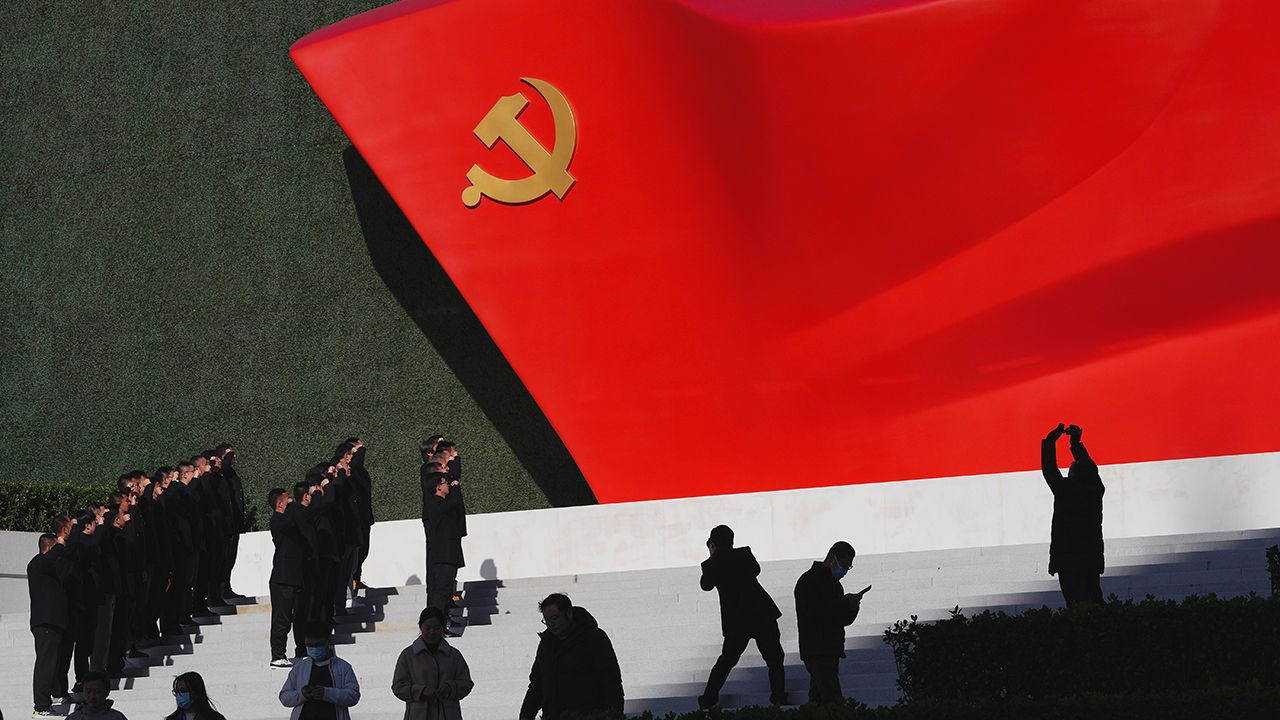
Photograph: AP
Jan 30th 2025|BEIJING
OVER THE past decade, as Chinese governance has become more politicised and a fear of punishment has taken hold, local officials have changed the way they do things. Many are holding more meetings and issuing more documents—but much of this is just show, according to Hanyu Zhao, a scholar who tracks the bureaucracy. The burden of looking busy is often passed down to lower-level cadres, some of whom, at least, are getting creative. In one example highlighted by Ms Zhao, a group of them were required to hold two (unnecessary) meetings each day as part of an anti-poverty campaign. Instead they met once every three days, taking six photos per meeting with different outfits, lighting and seating.
Local officials once helped to drive China’s economic growth. In the 2000s they fiercely competed to crank up GDP, scrambling to attract investment to provinces, cities and villages. But when Xi Jinping came to power in 2012, he worried that freewheeling officials were feathering their own nests and creating financial risks. More scrutiny of their behaviour and harsher punishments for their mistakes followed. As a result, many local officials now choose to act only in a superficial manner—or not at all—lest they invite scrutiny from the Communist Party’s investigators.
The party, though, urgently needs local officials to regain their enthusiasm and help China out of its economic rut. Growth is flagging amid weak consumption, a property slump and a lack of jobs. The government is trying to stimulate the economy. It approved 4trn yuan ($550bn) of “special bonds” for local officials to use on infrastructure projects in 2024. But they were sluggish both in issuing the bonds and in getting projects started. Some 2.3trn yuan of the funds were still unused as of October, according to the latest data from despairing central authorities.
At the annual session of China’s parliament in March, the government is expected to approve an even higher bond quota for local officials to use on a greater range of projects, including industrial parks, hospitals and care facilities for the elderly. It will also expand a “cash for clunkers” scheme, which subsidises households and firms to trade in consumer goods and factory equipment for newer gear. That scheme is funded by the central government but depends on local officials to carry it out, with more funding to be allocated for those who do a good job.
There is much to do, then, and little time to do it. But officials’ spirits will be hard to revive. For the past decade the party’s anti-corruption arm, the Central Commission for Discipline Inspection (CCDI), has sown fear across the bureaucracy. It has punished more than 6m officials, from high-ranking “tigers” to low-ranking “flies”. Local administrations are now wary of doing anything that might lead to accusations of graft. So lately the CCDI has been handing down punishments for laziness, too. Last year it disciplined 94,000 officials for “irresponsibility”, “inaction” and “pretending to work”, more than twice the number the year before.
The party is also trying a softer approach, which is perhaps overdue. Mr Xi expressed concern about his anti-corruption campaign’s effect on morale way back in 2016. In a speech that year he said inspectors must distinguish between well-meaning but unwise conduct and genuine corruption. In particular, he expressed sympathy for unintentional mistakes, errors made from lack of experience and hiccups when experimenting in new areas without clear rules. The policy became known as the “three distinctions”. In recent years it has gained more prominence in state media. Last July it was mentioned at a big party meeting that set out economic priorities for the next five years.
To implement the three-distinctions policy, the CCDI sometimes waives punishments if there are mitigating circumstances. For example, officials in the central city of Yichang were placed under investigation for rushing through a high-speed rail project without following the correct procedures. But they were let off with a slap on the wrist because the error helped the city “seize development opportunities”, according to a report by the authorities. Other local officials have been forgiven for botching investment projects if they were judged to be for the good of the economy, rather than personal gain.
Let’s chat
The party must “combine strict management with warm care…so cadres will be eager to forge ahead,” Mr Xi has said. Perhaps with that in mind the CCDI has been holding what it calls “heart-to-heart” talks with cadres. Such conversations are “both a science and an art”, according to a guide posted online. It suggests inspectors should build rapport by asking about an official’s children and hobbies. If necessary, it says, interrupt them with a “light cough” rather than a word, to avoid causing offence. “I am grateful to the [CCDI] for reminding me through heart-to-heart talks that slacking off is irresponsible,” one official in the region of Guangxi told state media last year. “I will correct my mistakes without delay.”
Another aspect of the CCDI’s new approach has been to stamp out false accusations of corruption. In 2023 a man in the city of Linzhou was sentenced to 18 months in prison for falsely claiming that a village party boss consorted with criminals and extorted money from farmers. Since the beginning of last year, Zhejiang province, in eastern China, has exonerated 2,802 falsely accused officials.
Inspectors are still struggling to strike the right balance between harshness and mercy, admitted a commentary in a party-run magazine in September. They often err on the side of being strict, it said, because of “cognitive biases”. In other words, old habits die hard. The anti-corruption campaign shows no signs of letting up. Last year the CCDI punished a record 889,000 officials, 46% more than the year before. That trend must reverse before there is any chance of morale improving, says Alfred Wu of the National University of Singapore. “If I were a public official, I still wouldn’t dare to do much.” ■
Middle East & Africa | Love ‘em or hate ‘em
Syria’s new rulers say they are keen to integrate foreign fighters
Outsiders continue to see them as a threat
Photograph: AP
Jan 27th 2025|IDLIB
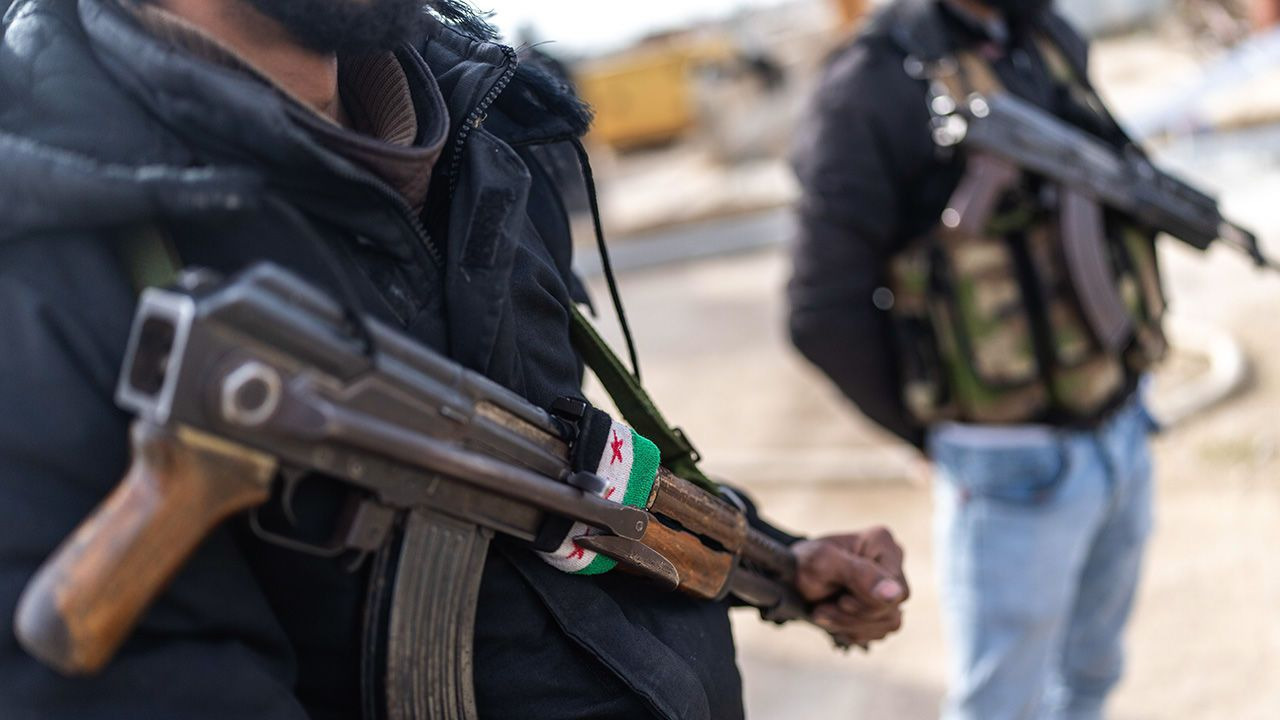
The mandi chicken, a Yemeni dish, in the Emad Eddin restaurant in Idlib is a favourite among Uyghur jihadists. On a recent afternoon, a group of them eat next to a Chechen fighter. The diners’ faces and accents are so diverse it might be a restaurant in an airport, were it not for the patrons’ fatigues and automatic weapons.
Also eating there is Abu Obeida, a former it worker from London who came to Syria in 2013. He and the others are known as muhajiroun—“emigrants”, foreign fighters who came to Syria during its long civil war. In their home countries many are regarded as a threat to national security. The British government revoked Abu Obeida’s citizenship in 2017, alleging that he had links to al-Qaeda.
Abu Obaida denies being a fighter. He says he came as a humanitarian worker; for the past seven years he has been teaching English. He is challenging the British government’s decision in court, but is realistic about his chances of being allowed to return. Nor would he necessarily want to. He married a Syrian woman; they have four children. “I dream of going back to see my family for a short trip,” he explains, “but I’d like to stay and become Syrian.”
Tens of thousands of foreign fighters were lured to Syria by the radicalism of Islamic State (is) and its declaration of a caliphate in Iraq and Syria in 2014. Those militants were key to the group’s attempts to launch terrorist attacks on Western states. Today, most are dead or in Kurdish prisons in eastern Syria. But others who joined less radical groups, including Hayat Tahrir al-Sham (hts), the Islamists now in charge of Syria, focused on fighting Mr Assad and building lives there, rather than international terrorism.
Ahmad al-Sharaa, Syria’s de facto new leader, has tried to clamp down on groups with transnational aspirations such as Haras al-Deen, the official al-Qaeda affiliate in Syria. Mr Sharaa’s attitude is “either you abide by our Syria-centred strategy, or you leave, or you face arrest,” explains Thomas Pierret, an expert on Syrian Islamists. “So I think they’ve already got rid of the most problematic people,” he says.
Only a few thousand foreign fighters are still active in Idlib, one Western intelligence official estimates. Mr Sharaa insists that those remaining will not be a worry. He may be right. “There’s a track record of them not being involved in any security incidents outside Syria now, especially since the break from al-Qaeda,” says Aaron Zelin of the Washington Institute, a think-tank, who has followed hts closely.
More than that, Mr Sharaa sees Syria’s foreign fighters as an integral part of his country’s struggle. A Turk and a Jordanian are among his closest confidants. He is also said to be fond of the Turkistan Islamic Party (tip), a group of Uyghur fighters which aims to set up an Islamic state in Xinjiang and other parts of Central Asia, and whose members have proved indispensable on Syria’s battlefield. “These people are part of our revolution. They [foreign countries] have nothing to worry about. We will give them passports. We will Syrian-ise them,” insists an official from hts.
Mr Sharaa’s drive for integration is not unprecedented. Bosnia granted citizenship to hundreds of jihadists who fought for it in the 1990s. “Granting citizenship is not so new; the whole world does it,” says Obayda Amer Ghadban, another researcher of Syrian armed groups.
Not everyone is as sanguine. Mr Sharaa’s appointment of several foreigners to key positions in the new defence ministry has alarmed some governments, especially in the Gulf. In the end, the reaction of foreign governments to the foreign fighters in the new Syria may decide their fate. Their continued presence may undermine Syria’s efforts to end its isolation. China is likely to object to the thousands of Uyghur fighters in Syria, while the Egyptian and Jordanian governments are edgy about their nationals being given official posts. If he is serious about rebuilding Syria, Mr Sharaa may have to choose between his foreign fighters and his new friends abroad. ■
Europe | Rebuilding the left
The French government’s survival is now in Socialist hands
Moderates attempt to move away from the radicals
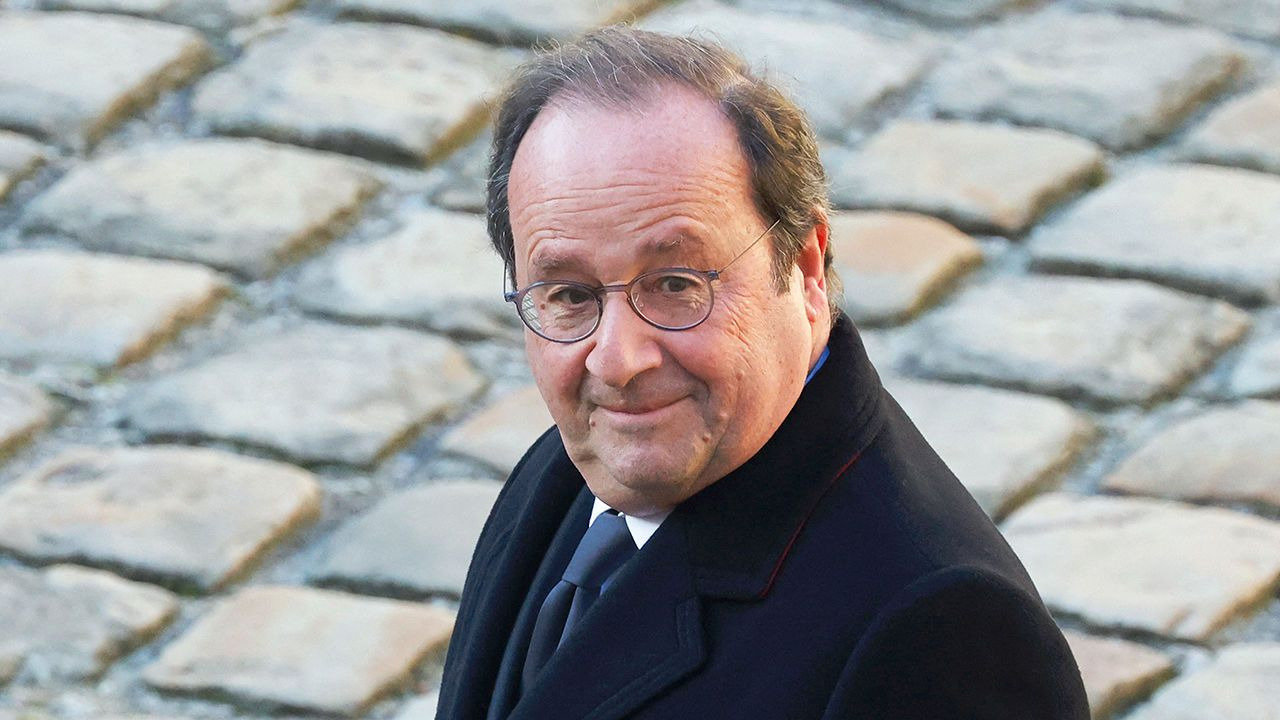
Remember me?Photograph: AFP
Jan 26th 2025|Paris
THREE YEARS ago the French Socialist Party was crushed into irrelevance. The party that supplied two modern presidents—François Mitterrand (1981-95) and François Hollande (2012-17)—and nine prime ministers became as invisible in parliament as in public debate. Its presidential candidate in 2022, Anne Hidalgo, secured less than 2% of the vote. Its contingent in the National Assembly was swallowed up into a left-wing alliance dominated by the hard left’s firebrand leader, Jean-Luc Mélenchon. He engineered the downfall of the previous minority government, under Michel Barnier, in December.
Now, for the first time in years, the party has been propelled to the centre of political attention. Mr Barnier’s successor, the centrist François Bayrou, is trying to get a much-delayed budget for 2025 through parliament—and to survive in his job. Without the Socialists’ votes, the hard left and hard right together do not have the numbers to bring Mr Bayrou down. A no-confidence vote in the government could take place in early February.
The first hint that the Socialists may be freeing themselves from Mr Mélenchon’s grip came on January 16th. In December all four parties in the alliance voted to topple Mr Barnier. A month later, only three of them—Unsubmissive France (LFI), the Greens and the Communists—voted to eject his successor. To Mr Mélenchon’s consternation, 58 out of 66 Socialist deputies, including their leader, Olivier Faure, refused. They abstained after Mr Bayrou agreed to trim some proposed spending cuts in the budget and to reopen talks on the retirement age. The Socialist Party has “quit the spiral of radicality, which it never believed in”, argued Zaki Laïdi, a political scientist, and Daniel Cohn-Bendit, a former Green politician, in Le Monde. Now it is “back in the political game”.
With a fresh spring in his step, Mr Faure has since been seeking further concessions. The party threatened to go into reverse, and vote against the government, if it did not get them. Part of this may be bluff. But part of it also reflects splits within the party about how far to distance itself from the follies of the hard left, and make the Socialists electable again.
Behind these latest manoeuvres also lies a wily old-timer: Mr Hollande (pictured). A mere backbench deputy since he returned to national politics in 2024, the 70-year-old has a long history of rivalry, and accommodation, with Mr Bayrou. In 2012 the centrist backed Mr Hollande for the presidency; the Socialist may now be returning the favour. “The Socialists have taken a major decision,” he told a newspaper, by rejecting “the posture of LFI, whose only objective is to block institutional life and provoke a presidential election.” Mr Hollande, say friends, has his eye on running for the presidency in 2027, when the incumbent, Emmanuel Macron, is barred from a third consecutive bid.
The Socialists are teetering on the edge. Younger radicals, fed up with the Hollande generation, want to topple the government. Mr Faure’s leadership is fragile and his job is on the line at an upcoming party congress; he cannot afford to upset too many of them. Chloé Morin, a political scientist, argues that it would be a mistake to expect an emancipation from the alliance. It is rather, she says, a “duel for influence” between the Socialists and LFI, and between Mr Hollande and Mr Mélenchon.
Moderate Socialists have long struggled to impose pragmatic politics on a party perpetually drawn to anti-capitalist thinking. Faced with Marine Le Pen’s hard right, a united left remains a potent electoral force. The party is now weighing its quest for electoral respectability at the centre against tactical calculations that threaten to pull it back to the extremes. ■
Europe | Charlemagne
Meet Europe’s Gaullists, Atlanticists, denialists and Putinists
As Donald Trump returns, so do Europe’s old schisms over how to defend itself
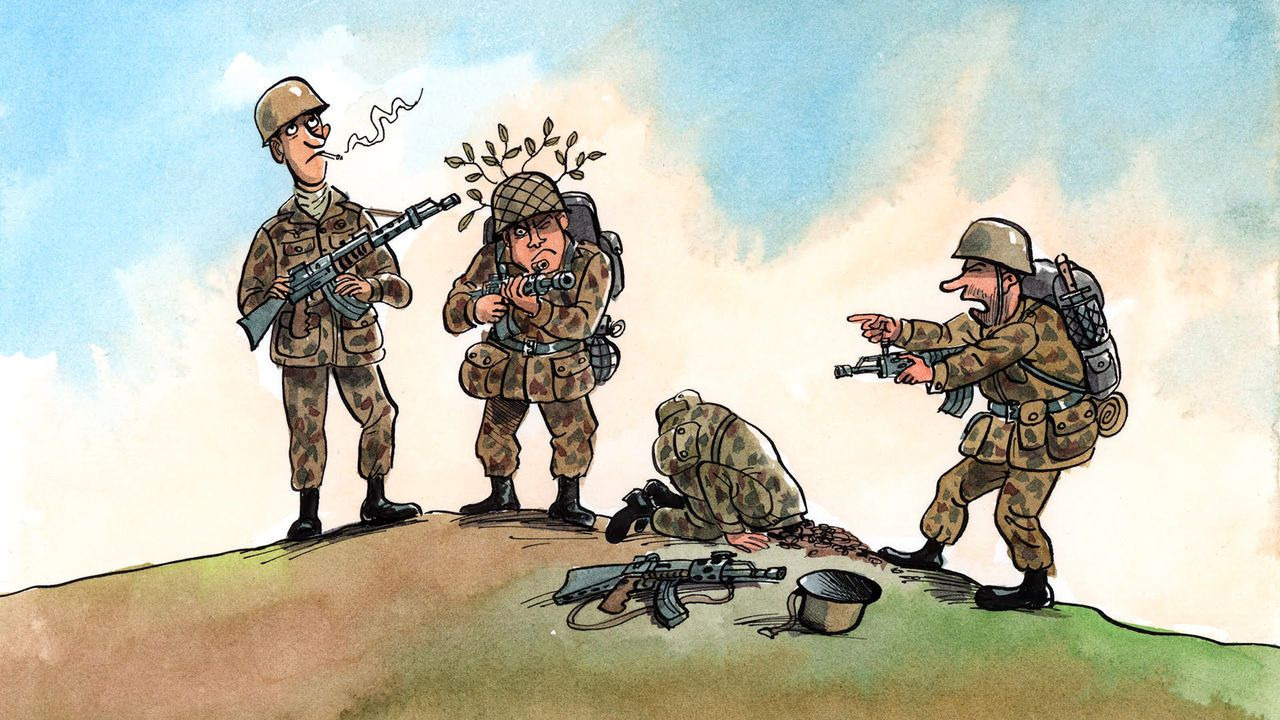
Illustration: Peter Schrank
Jan 30th 2025
Can a country still call itself an ally of America if America is threatening to annex part of its territory? Such a question might once have seemed ripe for a Gitane-puffing philosophe to ponder in a Saint-Germain-des-Prés café circa 1968. It has gained fresh relevance in recent weeks as Donald Trump has made repeated threats to seize Greenland, currently an autonomous region of Denmark. At first Europeans convinced themselves that the returning American president’s designs on the island were merely part of his patter, something that could be ignored as safely as his suggestion in 2020 that injecting bleach might cure covid. (It doesn’t.) Now nobody is sure. After a reportedly fiery phone call with Mr Trump, Mette Frederiksen, the prime minister of Denmark, has criss-crossed Europe this week to shore up support in Paris, Berlin and Brussels. The French foreign minister volunteered to send troops to Greenland, just in case. Channelling his inner Jean-Paul Sartre, a European diplomat quipped: “With allies like Donald Trump, who needs enemies?”
The prospect of war between America and an ally in Europe still seems mercifully distant. But the return of Mr Trump has stirred the debate over how Europe should defend itself. A rethinking of the continent’s “security architecture”, as NATO types put it, has been near the top of the agenda ever since Russia launched its full-scale invasion of Ukraine three years ago. Yet a ramp-up in military spending across the continent has thus far not been matched by a grand new vision of keeping Europe safe. On February 3rd European Union leaders will meet in Brussels both to take stock of the situation and to pitch fresh ideas. (Sir Keir Starmer, Britain’s prime minister, will join part of the meeting, as will NATO’s secretary-general, Mark Rutte.) Under the spotlight, all sides will emphasise they stand united. Behind closed doors the divisions that plagued the bloc during Mr Trump’s first term will come back to the fore. To understand Europe’s future direction, meet its Gaullists, Atlanticists, denialists and Putinists.
The Gaullists, as the name suggests, are the intellectual descendants of the prickly French leader who resented America’s tutelage of Europe and went so far as to pull France out of NATO’s military arm in 1966. Charles de Gaulle’s successor as French president, Emmanuel Macron, has no wish to leave the military alliance—but argued during Mr Trump’s first term that NATO was experiencing “brain death”. Europe thus needs to find a way to achieve “strategic autonomy”, the ability to act on its own, if its interests diverge from its big transatlantic ally. Whoever sits in the White House, America is pivoting to other priorities, notably Asia. Europe at the very least must hedge its bets. To best ensure autonomy, European defence budgets should be increased—and, preferably, spent on European kit, insist the Gaullists. Old pipe dreams of an EU army occasionally get an airing, too.
The Atlanticists think Europe going it alone is mad. Poland is the standard-bearer of the NATO-first club, which takes in much of northern and central Europe. Preserving the relationship with America is their top priority. This engagement can essentially be bought with defence contracts. As the Polish foreign minister, Radoslaw Sikorski, recently put it: “Europe’s deal with the US up to now might be crudely characterised as follows: ‘You help defend us, we buy your weapons.’” Mr Trump’s transactional instincts do nothing to undermine that arrangement. On the contrary, bigger defence budgets would result in bigger orders of F-35 jets and the like. Even if dealing with a volatile American president is less than ideal, Atlanticists admit, it is still preferable to relying on militarily impotent European allies. If Russia is intent on further military action in Europe by the end of the decade, as some spooks posit, NATO has to be improved rather than replaced. Buying European defence kit is a laudable idea in the long term, but if done too hastily would mean relying on French and German defence contractors whose products will be delivered only after Russian troops have marched into the Baltics. Focusing too much on EU schemes will make co-operating with Britain harder, too.
Both the Gaullists and the Atlanticists agree that more defence spending will help—either to keep America sweet, or towards achieving European autonomy. Mr Trump wants Europe to go from a spending target of 2% of GDP to 5%; NATO leaders meeting in June are expected to settle on a long-term objective of 3.5%. That summit promises to be an awkward moment for Europe’s third camp, the denialists, whose defence strategy amounts to planting their heads in the sand, ostrich-style. How else to explain that two of the EU’s four biggest member states, Italy and Spain, spend under 1.5% of GDP on defence?
As infuriating as denialism can be to Gaullists and Atlanticists, it is still better than the final camp. An arc of Putinist leaders stand ready to foil EU schemes that rile Russia, whose strongman president the likes of Viktor Orban in Hungary and Robert Fico in Slovakia seem to want to emulate. (They think of themselves as Trumpian: same difference, some might say.) Though small, their camp is growing and any of them can derail EU measures that require unanimity, such as imposing sanctions or aiding Ukraine.
How many divisions does Europe have?
All countries contain bits of the four factions in their political establishment. (Germany, set to get a new chancellor following elections on February 23rd, is hard to place in any camp for now.) Even if Europeans were to agree on an overarching defence plan, the thorny question of how to pay for it would then need to be resolved. Some cash-strapped countries could afford to spend more on defence only if funding came through borrowing the money jointly at EU level, a non-starter for fiscal hawks. That would open up another can of divisions for future summits to ponder. ■
International | Baby-making boom
As adoptions collapse, demand for international surrogacy is soaring
Yet it is facing a growing backlash from religious conservatives and some feminists

Illustration: Katherine Lam
Jan 30th 2025
WHEN SHAKIR MOHAMED and his male partner wanted to start a family in London, they looked to adopt a child. But faced with a laborious process and long waiting times, they instead turned to surrogacy. Last year their son Nico was born to a woman in America who agreed to carry their child for a fee, and who still stays in touch with them.
Acts of kindness, such as hers, ought to be celebrated; in their own small way they each increase the sum of joy in the world by incubating children for families that, for various reasons, can’t do so themselves. Worldwide, that joy adds up to a small city’s worth of new families created through 30,000 surrogate births a year.
Yet instead of being universally celebrated, surrogacy faces a growing backlash from religious conservatives, who see it as a violation of the natural order, and from some feminists, who worry that it exploits women, especially when they are paid to be surrogate mothers. In October Italy, which has banned surrogacy since 2004, imposed perhaps the world’s most uncompromising restrictions by declaring it a “universal crime”. This wording “puts surrogacy on a par with genocide and crimes against humanity”, noted Dafni Lima of Durham University’s law school. The law makes it an offence for Italians to have surrogate babies abroad, even in countries where it is legal to do so, that is punishable by up to two years in jail and a fine of up to €1m ($1.04m). In December the Supreme Court in Spain, which also bans surrogacy, ruled against the practice abroad, arguing it “violates the moral integrity of the pregnant woman and the child”.
The result of this backlash is a complicated muddle of national laws that puts prospective parents in peril of prosecution and babies of being left parentless and stateless. These restrictions are also pushing surrogacy underground, or to unregulated countries, and into the hands of criminals and human traffickers, where it is far more likely that surrogate mothers will be exploited and abused.
Though surrogacy dates back at least to biblical times—the book of Genesis tells the story of Abraham impregnating his wife’s servant, Hagar, to bear a child for the couple—it was only in the mid-1980s that IVF allowed “gestational” surrogacy, whereby a woman could carry a child who was not related to her. Before then, childless couples who wanted families would generally have had no alternative but to apply to adopt. Yet demand has long outstripped supply. According to one study published in 2006, there were around 1m parents in America who wanted to adopt a child, yet only 51,000 children were placed with agencies for adoption each year.
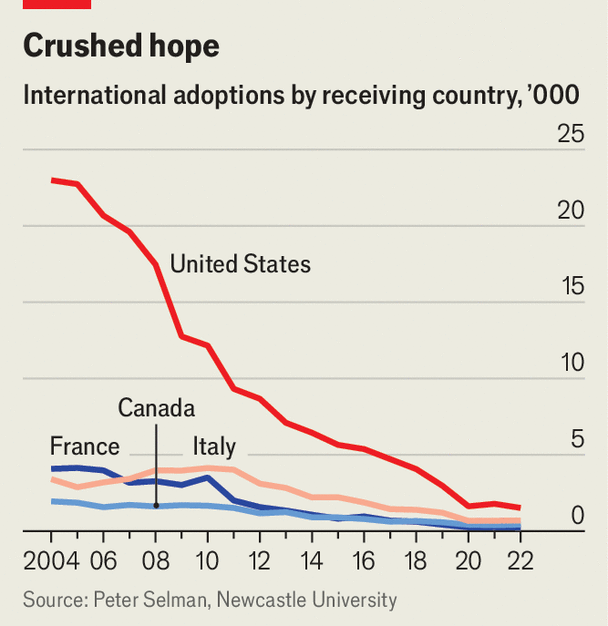
Chart: The Economist
The answer, for many, was to look abroad. In 2004 international adoptions peaked at 45,000, mainly from poor or war-torn countries. Yet a series of scandals involving child-trafficking, kidnapping and baby-farming prompted tighter regulation and/or outright bans, such as one imposed by China last year. The result has been a collapse in cross-border adoptions—in 2022 there were just 3,700 worldwide—stranding hundreds of thousands of children in orphanages (see chart). It is a decline that will not be reversed, says Peter Selman, a professor at Newcastle University and an authority in this area.
Domestic adoptions have fallen over recent decades in a number of rich countries, partly because of the introduction of needlessly stringent rules on the suitability of parents. In parts of Britain, for example, local authorities insist that each child must have their own bedroom. Moreover, the amount of time children spend in care before being placed with a family has gone from months to years, leaving many traumatised and institutionalised. Mr Mohamed and his partner worried whether they were equipped to provide the support such children would need.
Baby be mine
As rich-world adoption has plummeted, demand for surrogacy has grown. It has also been fuelled by rising infertility, an increase in the acceptability of singles and gay couples choosing to have children, and the spread of information on the internet.
In Britain the number of surrogate births recognised by courts increased almost four-fold over a decade, to 449 in 2022 from 117 in 2011. Surrogacy is also increasingly global. In America, where some states allow women to be paid to carry a child (known as commercial surrogacy), almost a third of such pregnancies are for foreign parents. Many are from countries such as China or France, which ban all forms of surrogacy. Others are from countries like Britain, which allow only “altruistic” surrogacy, whereby mothers may be paid no more than their reasonable extra expenses. Like Nico’s, around half of surrogate births recognised in Britain in recent years took place abroad.
There are no reliable worldwide statistics. Sam Everingham, who founded Growing Families, a non-profit organisation in Australia that helps people navigate international surrogacy, estimates around 30,000 babies a year are born from international surrogacy. Other estimates are higher. Global Market Insights, a data firm, reckons this market was worth more than $14bn in 2022 and forecasts its value will rise to $129bn in 2032.
This rapid growth is bringing to the fore legal and moral quandaries that are similar to those that plagued, and then largely destroyed, international adoption: the potential for abuse when high demand in rich countries finds supply in poorer, unregulated one; whether it is ethical to pay for children; and how surrogacy, commercial or altruistic, affects women’s autonomy over their own bodies and the identity and well-being of the children they bear.
Some, such as Giorgia Meloni, Italy’s prime minister, are implacably opposed to the very idea of a woman carrying a baby for someone else under any circumstances. “Human life is priceless and is not a commodity,” she tweeted after Italy declared surrogacy a universal crime.
Critics also argue that it harms surrogate mothers and their children. One study found that surrogates are more likely to experience pregnancy complications than mothers who use IVF or conceive naturally. They are also more likely to give birth prematurely. “We can’t step on the rights of children and women...for the desires of some couples to have children,” says Olivia Maurel, who was born in America through surrogacy, but now campaigns against it.
Yet the wider body of research, including a systematic review of 47 studies in 12 countries, does not support the claim that acting as a surrogate has a negative effect on women, according to a paper published in 2024 in the BMJ, a British medical research journal. Instead, the evidence suggests that most surrogate mothers in countries such as America, where it is well regulated, found the experience rewarding. Moreover, blanket bans tend to push surrogacy to places where there is no regulation, and thus greater potential for abuse. “Hoping it goes away isn’t going to happen,” says Natalie Gamble, a British lawyer.
A related argument is over whether it is unethical or exploitative to pay surrogates. A number of countries besides Britain allow only altruistic surrogacy. These include Canada, Denmark and New Zealand. Such arrangements challenge the notion that all surrogates are poor uneducated women exploited for money, says Sarah Jones, the CEO of Surrogacy UK, a non-profit outfit. Ms Jones ought to know: she has been a surrogate five times. But few women are as altruistic as she is, which is one reason why half of Britain’s surrogate babies are born abroad.
America, Mexico, Colombia and Georgia are among the countries that have booming commercial-surrogacy industries. In America, where the rules are set by each state, this is a highly professional business with protection for mothers and the intended parents. California, a liberal surrogacy-friendly state, uses orders that establish the intended parents as legal parents before the birth. This makes it a popular destination, but also an expensive one, with costs of up to $200,000. This is increasing demand for cheaper—and often unregulated—destinations such as Mexico and Colombia, with costs of around $90,000 and $65,000 respectively.
Race to the bottom
Yet this can lead to a downward spiral into more unregulated and underground markets. “When a ‘new’ destination becomes popular, it can often be overtaken by demand, leading to longer waiting times and pushing costs upwards—meaning it then becomes likely that another new destination will emerge,” notes Kirsty Horsey, a law professor at the University of Kent.
Alejandra Vera, a lawyer and director of an NGO that works to protect women’s rights in Cúcuta, Colombia, says surrogates are sometimes vulnerable women who are trafficked across the border from Venezuela. There surrogacy costs around $65,000, but only a fraction of this is ever paid to the surrogate herself. The rest goes to agencies, lawyers and middlemen. Contracts can force the woman to give up her right to end the pregnancy. Maternity clinics give out flyers advertising the service at their doors. “They know they can get desperate women there,” she says.
No regulation, poor young populations, and fertility clinics galore mean that African countries like Nigeria, Uganda and Kenya are also becoming popular hubs. Olaronke Thaddeus, the founder of Meet Surrogate Mothers, a clinic in Lagos, Nigeria, says when she opened in 2013 she had one couple visit that entire year. Now she welcomes 200-300 potential parents a year, most of whom come from America, Britain, Canada and continental Europe. She declines to say how much she charges or how much she pays surrogate mothers, insisting that her service is “priceless”. The clinic maintains strict confidentiality so the intended parents never meet the surrogate mother—even at the birth.
Some argue that the only way to prevent abuses is through an international treaty, along the lines of the Hague Convention of 1993, which regulated international adoptions. Making surrogacy universally legal, safe and paid could maximise the joy it brings and minimise the risk of it causing harm. That seems fanciful. Years of work on a convention by an intergovernmental group has stalled: countries are still far too divided over whether surrogacy should be legalised or outlawed to even begin to sensibly regulate it. ■
International | The Telegram
A big, beautiful Trump deal with China?
Washington hawks puzzle over calls for China to help in Ukraine, and hints of a possible TikTok reprieve
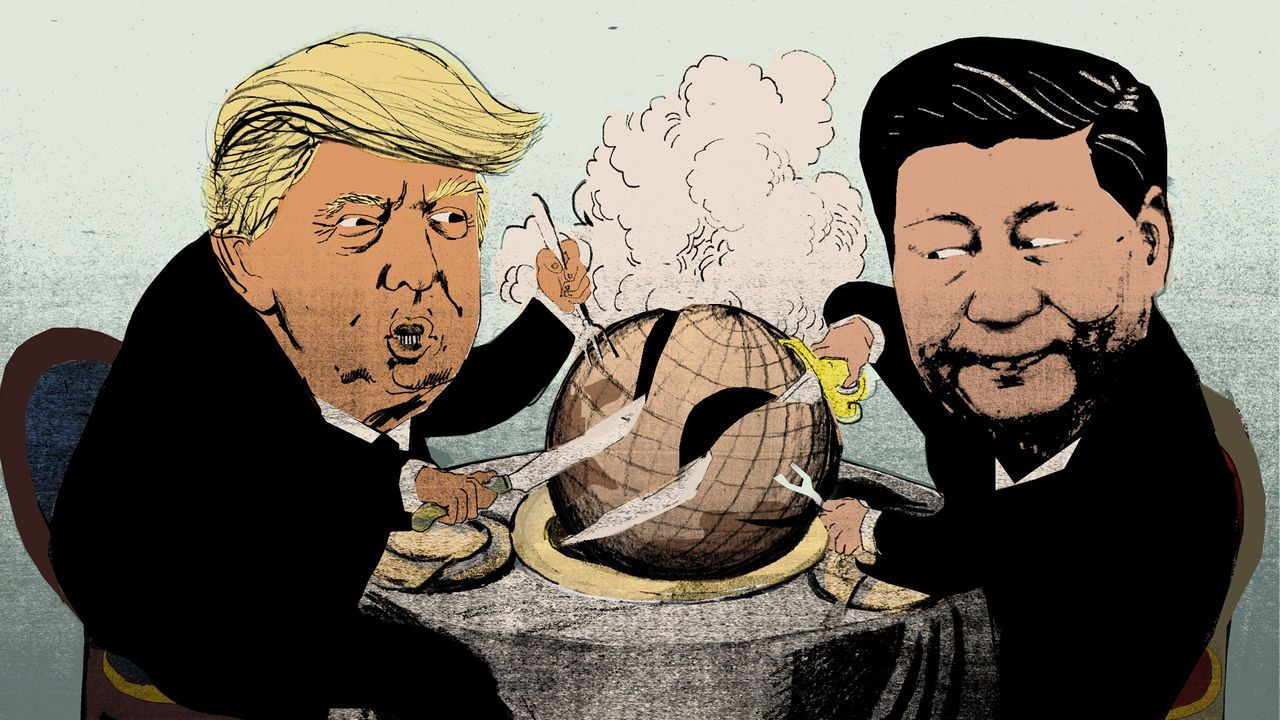
Illustration: Ellie Foreman-Peck
Jan 28th 2025
IT SOUNDS ODD, but hints keep piling up that President Donald Trump is tempted by a big, beautiful deal with China’s Xi Jinping. That runs counter to campaign-trail vows to hit China with crippling tariffs. A great-power bargain that Mr Xi could accept—perhaps bundling economic trade-offs with a divvying-up of the world into spheres of influence—would surely outrage hawkish Trump aides, from the national security adviser, Mike Waltz, to the secretary of state, Marco Rubio. Congress would be appalled and allies in Europe and Asia aghast. And yet Mr Trump keeps signalling that he is in dealmaking mode. He has invited China to help with peacemaking in Ukraine, says he would rather not impose swingeing Chinese tariffs and questioned whether TikTok, a Chinese-owned app, really harms American national security.
Well-connected officials and scholars in America, China and Europe are thinking hard about “G2” talks and how far they could get. Converging world views make a deal conceivable, for Mr Trump’s might-makes-right outlook resembles Mr Xi’s. Diverging national interests are the obstacle. There is, for instance, a winner-takes-all edge to some important technological contests, from the race to dominate artificial intelligence to competitions over space warfare. That places severe limits on co-operation.
In Washington, conventional conservatives draw comfort from the first Trump presidency. They admit that, in private, Mr Trump made startling statements about China. The memoirs of former aides describe Mr Trump scorning the democratic island of Taiwan as a small and troublesome place, just off the coast of mighty China. There are accounts of Mr Trump telling Mr Xi he was right to lock up Muslim Uyghurs in the western region of Xinjiang. But in the end, conservatives counter, Mr Trump approved tough China policies, selling weapons to Taiwan, calling repression of Uyghurs a genocide and curbing technology exports.
Today a conventional spin can be put on Mr Trump’s approach to Ukraine. China has leverage over President Vladimir Putin as a vital energy buyer and supplier of components for Russian armsmakers. Maybe Mr Trump just wants China to stop exporting weapons parts and tell Mr Putin to stop fighting. Alas, soothing spin must reckon with something jarring: Mr Trump’s echoing of Chinese talking points about the war. In early January he said he could “understand” why Russia feels threatened by potential NATO membership for Ukraine. Days after his inauguration he told Fox News that Ukraine’s president, Volodymyr Zelensky, should have sued for peace and not fought back after being invaded by “much more powerful” Russia. Mr Trump called the conflict a costly mistake, allowed to drag on because America “started pouring equipment” into the war. That is the line peddled in world capitals by Chinese envoys for three years, almost verbatim.
Chinese experts welcome a chance for dealmaking. Currently, Russia is heavily reliant on China, says Yang Cheng, a professor at Shanghai International Studies University and former Chinese diplomat in Moscow. But the gains from that dependence are outweighed by harm to China’s ties with America and Europe, where China is wrongly seen as being in lockstep with Russia, he argues. A role in Ukraine peace talks would be a “proving-ground” for China’s diplomacy, and bolster its ambitions to be recognised as a “provider of public goods for global governance”.
China’s price for help could be a new joint communiqué in which America unequivocally “opposes” Taiwanese independence, shifting from its stance of “not supporting” the island’s claim to statehood, suggests Xiang Lanxin, a Shanghai-based veteran of high-level, semi-official talks between America and China. An American “No” to independence would advance China’s core interests, he says, transforming politics inside the island and pouring cold water on Western governments that have taken up Taiwan’s cause as a test of democratic solidarity. In return, China might divert exports from America to other markets and avoid mounting challenges to the dollar’s global dominance. As for Mr Trump’s swaggering ambitions in his near-abroad, neither Panama nor Greenland are “vital” Chinese interests, while his upsetting of allies is “great” for China, says Professor Xiang.
As a senior colonel in the People’s Liberation Army (PLA), Zhou Bo oversaw Chinese peacekeeping missions. If invited by the warring parties, China “stands ready” to send thousands of PLA monitors to Ukraine, perhaps with Indian and Brazilian counterparts, he says. That would avoid the presence of peacekeepers from NATO countries, which Russia would surely oppose. It would also be a “win” for China, showing the world that it stands on “the moral high ground”, suggests the retired officer, now at Tsinghua University’s Centre for International Security and Strategy.
Nobody knows where this will go
Westerners are now squabbling among themselves. Germany’s chancellor, Olaf Scholz, is said to see advantages in China sending peacekeepers to help monitor a Ukraine armistice, perhaps in blue UN helmets. Yet when a German grandee publicly raised the idea at the World Economic Forum in Davos, he was excoriated for “pathetic” European buck-passing by a flinty Stanford academic.
Might China hawks constrain Mr Trump? Their clout depends on whether Mr Trump moves to unleash them or not, says Christopher Johnson, a former CIA China analyst and presidential briefer. Pragmatic Mr Trump keeps charge while he senses a deal he can sell as a win. When talks bog down, he hands them to underlings. That explains get-tough policies from his first administration.
In truth, the big obstacle to dealmaking may be China’s long-term distrust of America, and the rigidity of policymaking under Mr Xi. That is an odd source of hope for Washington’s China hawks and alarmed Western allies. These are strange times.■
Business | Bubble trouble
DeepSeek sends a shockwave through markets
A cheap Chinese language model has investors in Silicon Valley asking questions

Illustration: Rose Wong
Jan 27th 2025
It did not take much for the euphoria over artificial intelligence (AI) to turn into alarm. On January 27th stockmarkets in America and Europe convulsed. The share price of Nvidia, America’s AI-chip champion, fell by 17%, erasing $600bn of market value, the biggest one-day loss in the history of America’s stockmarket. Other businesses in the AI supply chain, from data-centre landlords to makers of networking gear, suffered a similar fate.
The cause of investors’ panic was DeepSeek, an obscure Chinese hedge fund turned AI startup that has blown analysts away with its latest large language model, R1, released on January 20th. Consumers have flocked to DeepSeek’s chatbot, which last weekend became the most downloaded app on iPhones. Innovative techniques have allowed the firm to train AI models that perform about as well as the most sophisticated Western ones with only a fraction of the computing power—and therefore a fraction of the cost.
In the following days, calm returned to markets. Share prices halted their descent, and in some cases partially regained their losses. Yet the episode is set to leave a lasting impression on investors, who have been forced to rethink who will profit most from AI, and consider what would happen were the bubble to burst.
The sprawling AI supply chain consists of hundreds of firms. Some of them, such as Nvidia, produce the hardware that sits inside data centres. Others rent out that gear as cloud-service providers (Amazon, Microsoft and Google). Model-makers (OpenAI and Anthropic) train AI systems in the cloud, and software firms (Salesforce and SAP) build applications on top of those models to sell to customers.
The clearest losers from DeepSeek’s breakthroughs are suppliers of AI hardware. If training models requires less computing power, then fewer chips and related equipment will be sold. Nvidia, which before the carnage on January 27th was the world’s most valuable firm, looks particularly exposed. Its most advanced chips, which are widely used in developing cutting-edge AI models, are said to generate gross margins in excess of 90%. If demand for them falls, the company’s monopoly-like margins will be squeezed.
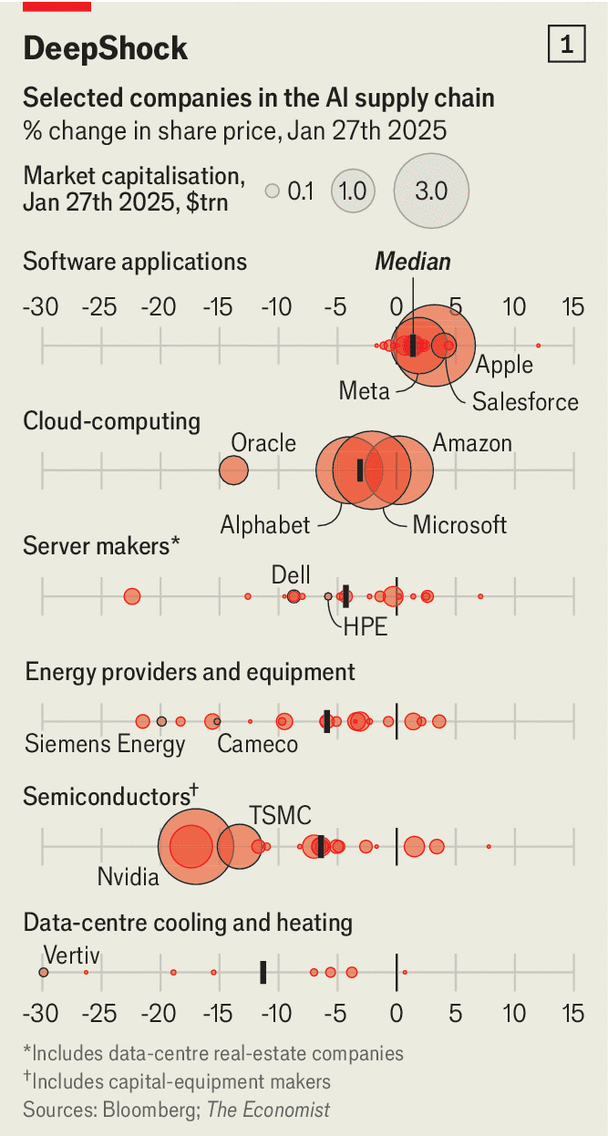
Chart: The Economist
Nvidia’s rivals, such as AMD, will also feel the pressure, though their valuations have not been as frothy. Share prices of AI-chip firms suffered a median decline of 6% on January 27th (see chart 1). The value of TSMC, a Taiwanese firm that makes most of the world’s cutting-edge semiconductors, tumbled by 13%.
Other suppliers of AI hardware are also being reassessed by investors. HPE and Dell, two American electronics firms that make server racks that sit inside data centres, saw their share prices sink by 6% and 9%, respectively, on January 27th. Chips need to talk to each other to train leading-edge models, which is why the value of Arista, a maker of networking gear, plunged by more than a fifth during the rout. Vertiv and Modine Manufacturing, two firms that make cooling equipment to stop AI chips from overheating, both lost over a quarter of their value.
Energy firms, too, have been caught up in the bloodbath. Many investors had assumed that training cutting-edge AI models would require ever greater amounts of electricity. But DeepSeek has thrown this into doubt. The share prices of Siemens Energy, a maker of electrical equipment, and Cameco, a producer of uranium used for nuclear power, fell by 20% and 15%, respectively, during the rout.
Another group of losers are the model-makers, such as the privately held OpenAI and Anthropic, whose businesses risk being undercut. They have been burning through cash, and could find it harder to raise capital now that DeepSeek has shown it is possible to do more with less.
Yet cheaper AI models will also create winners. Firms that build software applications on top of them, such as Salesforce and SAP, will benefit from falling costs. Many of these companies saw their share prices jump this week as others plunged. Apple, maker of the iPhone, may be another winner. It has not invested as heavily in AI infrastructure or model-making. Cheaper AI may also lead to a wave of new consumer apps, which could help perk up sluggish sales of its iPhones.
What all this means for the cloud giants is harder to predict. Alphabet, Amazon and Microsoft operate across the AI supply chain. Their software applications, such as Microsoft’s Copilot, may become more profitable as cheap models become more prevalent. But they have also invested in model-making, both directly (Alphabet has a large in-house team) and indirectly (through their stakes in startups such as OpenAI and Anthropic).
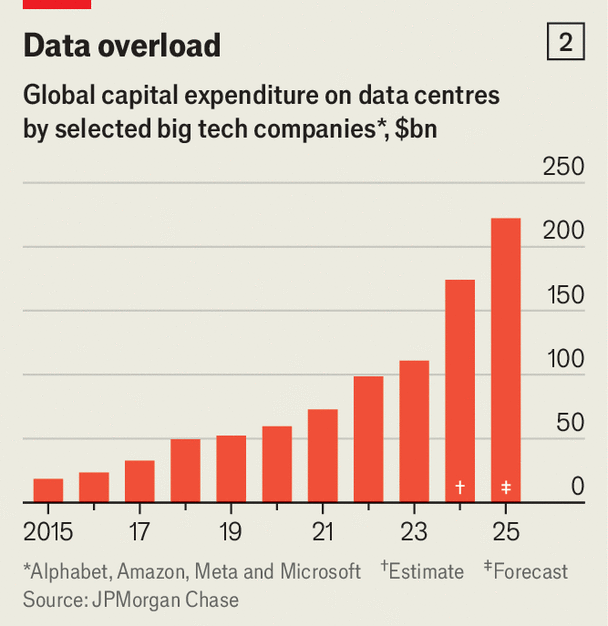
Chart: The Economist
They have poured vast sums into AI infrastructure, too. Last year the combined spending on data centres by the cloud trio and Meta (which has also been developing AI models) reached about $180bn, an increase of 57% on 2023 (see chart 2). Although shareholders might welcome a reprieve from further capital spending, they may now be wondering what will become of the investments made to date.
The cloud giants have also been venturing into chip design, in an effort to reduce their reliance on Nvidia. Mario Morales of IDC, a research firm, notes that their semiconductor-engineering teams are each now roughly as big as that of a large chipmaker. Investors seem to think that these ambitions will be cut back. During the rout the share prices of Broadcom and Marvell, two firms that help the cloud giants design their own chips, fell by 17% and 19%, respectively. That contrasts with the share prices of the cloud giants, which fell slightly (in the case of Alphabet and Microsoft) or not at all (for Amazon).
Plenty in the industry remain bullish. SoftBank, a spendthrift Japanese investor, is reportedly in talks to plough $15bn-25bn into OpenAI. On January 29th Mark Zuckerberg, Meta’s boss, said his firm would invest “hundreds of billions” of dollars in AI over the long term.
One reason is that so-called reasoning models, including OpenAI’s o3 and DeepSeek’s own R1, are deploying much more computing power at the inference stage, where the model responds to questions, to generate better answers. That could help offset decreases in the use of computing power for training.
Another source of optimism relates to demand. On January 29th Microsoft said that the growth of its AI cloud revenue— 157%, year on year, for the quarter—was constrained by supply, not demand. Some have argued that as AI models become cheaper to train, usage will rise further.
Yet other hurdles remain to adoption. America’s Census Bureau surveys firms about their use of AI. Of those that have no plans to use it in the next six month, only 4% cite cost as the reason. The vast majority think that AI simply does not apply to their business.
If DeepSeek’s innovations lower the cost of AI by orders of magnitude, companies may well discover new applications for the technology. Reasoning models will help, too, by improving the performance of AI models. Any effect on demand, however, will take time to materialise. And as the market turbulence demonstrates, investors are getting jittery. Their patience may not last for ever. ■
Business | Flying high
DeepSeek poses a challenge to Beijing as much as to Silicon Valley
The story of Liang Wenfeng, the model-maker’s mysterious founder

Photograph: Anthony Gerace
Jan 29th 2025|Shanghai
With the release of its latest artificial-intelligence (AI) model, DeepSeek, an obscure Chinese firm, has laid waste to several years of American policy meant to hold back Chinese innovation—and, in the process, blown a hole in the valuations of companies from Nvidia, America’s AI-chip champion, to Siemens Energy, a manufacturer of electrical equipment used in data centres. In demonstrating its ability to innovate around American export restrictions, DeepSeek has raised doubts as to whether access to piles of cutting-edge semiconductors and related equipment is as important as previously thought when it comes to training AI models.
The man at the centre of it all is Liang Wenfeng, DeepSeek’s 40-year-old founder. It is unclear how much he has relished the global market turmoil he has unleashed. A high-school classmate who recently spoke to local media said Mr Liang was hiding out in his home town for the lunar new year, which started on January 29th. Playfully mocked on Chinese social media for his skinny, pale appearance, Mr Liang remains a mystery to most people. Those who have had professional dealings with DeepSeek say he is obsessed with human-like artificial general intelligence (AGI) and the impact it could have on the world. In his pursuit of it, DeepSeek’s founder is up-ending ideas about technological progress both in the West and China.
Public information on Mr Liang is scant. Born into a family of teachers in an impoverished village near the southern city of Zhanjiang in 1985, he was a gifted student. A former instructor claimed he mastered university-level maths in middle school. In 2002 he gained entry into an electronic-information degree at Zhejiang University, a prestigious school in the eastern city of Hangzhou. A master’s degree at the same university, under a well-known machine-vision scientist, exposed him to the field of AI.
At the time, Hangzhou was a bustling hub for internet technology and home to rising companies such as Alibaba, an e-merchant. Mr Liang and several classmates remained in the city and began experimenting with quantitative investing models, which do not rely on company fundamentals but on crunching reams of data. In 2013 Mr Liang and three classmates launched an investment group called Yakebi in an attempt to monetise the trading models they had built.
Two years later Mr Liang co-founded High-Flyer, a quantitative hedge fund that grew rapidly alongside dozens of similar firms during a period of deregulation and market volatility in China. In 2021 it claimed to be managing as much as 100bn yuan ($14bn), though it appears to have rapidly shrunk in size in the latter half of that year. Quant funds have routinely tussled with Chinese regulators, who view them as profiting from market routs. Industry insiders say High-Flyer made a name for itself as one of the most aggressive quant funds, regularly drawing the ire of securities regulators.
DeepSeek’s origins lie in an effort to improve High-Flyer’s algorithms. In 2019 the firm invested 200m yuan to set up a separate unit to develop its own deep-learning platform, called “Fire-Flyer 1”. The fund poured 1bn yuan into the effort in 2021 in order to launch a second iteration armed with 10,000 of Nvidia’s A100 graphics-processing units. This made High-Flyer an outlier: at the time just four other firms in China held such large arsenals of powerful chips, all of which were tech giants such as Alibaba. DeepSeek was made a standalone company in 2023.
It delivered its first jolt to the market in May last year, when it released an ultra-cheap chatbot based on its V2 model. That kicked off a price war in China’s AI industry, forcing the country’s biggest tech firms—Alibaba, Baidu, ByteDance and Tencent—to lower their own prices.
By Mr Liang’s own telling, this was not a ploy to capture more users. In July he said costs had fallen as DeepSeek explored new model structures, something that set it apart from others. Although rival Chinese AI firms have been conducting their own research into models, their disadvantage in computing power, owing to American export restrictions, has led them to focus more on creating clever applications that use the technology. Many Chinese AI companies have used Llama, the family of large language models developed by Meta, an American social-media firm, as a basis for their applications.
Deep thoughts
For Mr Liang, developing models using less computing power is an essential step in pursuit of his longer-term objective. “Our goal is AGI, which requires us to explore new model structures to achieve superior capabilities within limited resources,” he has told local media.
DeepSeek’s new R1 model, which has shocked the West, suggests it is making progress. The company says it cost less than $6m to train, a tiny fraction of comparable models from firms such as OpenAI, maker of ChatGPT. Sam Altman, OpenAI’s boss, has called R1 “impressive” (though he has also promised to produce “much better models”, adding that it is “legit invigorating to have a new competitor”).
DeepSeek certainly has its doubters. Early testing seems to confirm that R1 is as powerful as its maker says it is. But some have questioned whether the firm has underplayed the number of high-end chips it used to develop the model, even if others argue its claims are plausible. There is also speculation that DeepSeek has trained its models by studying the results of American ones, a process known as “distillation”. OpenAI has said it has evidence that points to DeepSeek distilling its models, in violation of its terms of service.
Even if DeepSeek’s efficiency gains are not as impressive as thought, they still pose a challenge to thinking both in Silicon Valley and Beijing. Chinese state media has been quick to champion DeepSeek as a national asset in the country’s fight for AI supremacy. Mr Liang was invited to meet with Li Qiang, China’s premier, on January 20th, alongside a handful of other entrepreneurs.
Yet as Zhang Zhiwei of Pinpoint Asset Management, an investment firm, points out, DeepSeek’s achievements did not emerge from one of China’s myriad government-backed research institutes or state-controlled companies. Mr Liang seems to control most of the shares in DeepSeek, and has steered clear of China’s state-dominated venture-capital industry.
Mr Liang views China’s role over the past 30 years as that of a technological “follower”, building on foundations developed in the West. The gap between America and China is between “originality and imitation”, he said in an interview with local media in July. Nvidia’s success, he argues, has not relied solely on its own performance, but also on technological collaboration among Western companies. China’s efforts to imitate Western computing power have fallen short, in his view, because it lacks this type of collaboration, despite a capital-intensive state-led effort to create one. DeepSeek may not be a wake-up call only for Silicon Valley, but also for China’s leaders in Beijing. ■
Business | Bartleby
The allure of the company town
Lego, Corning and the survival of an old idea
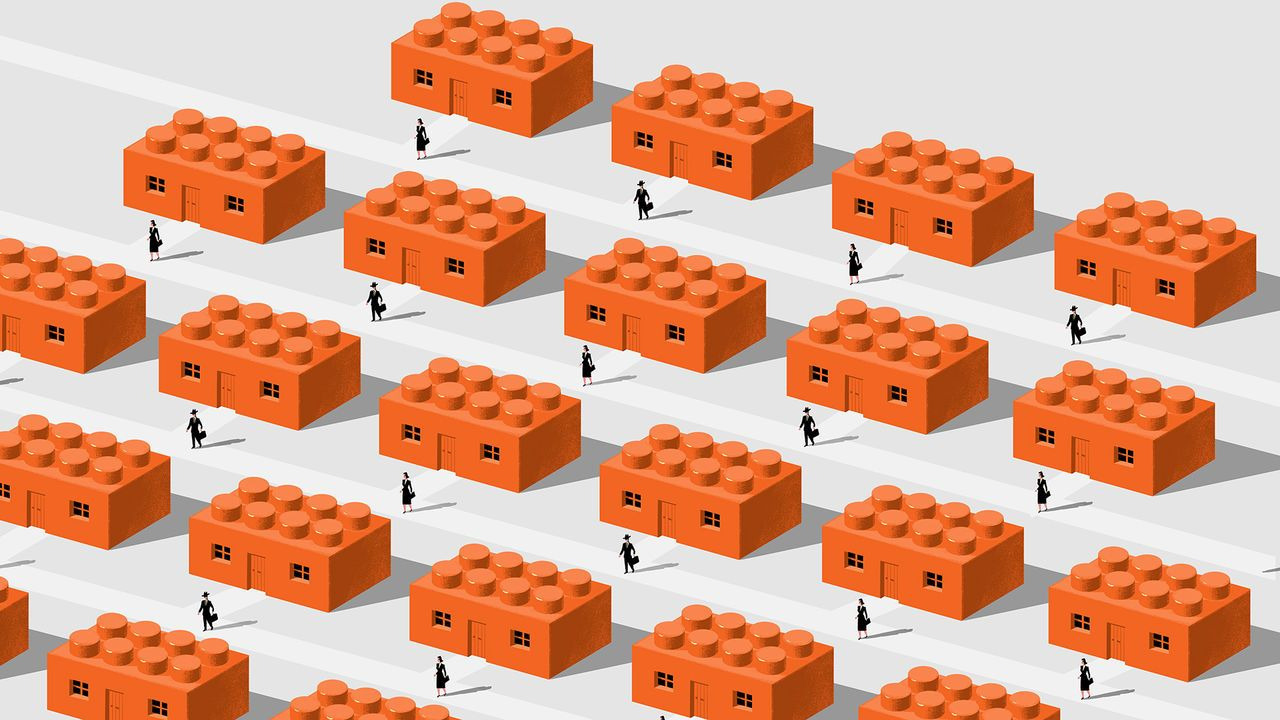
Illustration: Paul Blow
Jan 30th 2025
Billund is a small town in Denmark with a population that stands at a little over 7,000 people. It is also the birthplace and headquarters of the world’s largest toy company. If you live in Billund, there is a decent chance you or one of your family works for Lego. If you visit for work, you are probably going to Lego’s offices (passing a sign near the entrance that instructs “Play on the grass”). If you go there as a tourist, you are almost certainly going to a Lego-themed attraction. The noun you hear most often is “brick”.
Corning is a small town in upstate New York, with a population of around 10,000 people. There, the noun you hear most often is “glass”. The town bestowed its name on one of the world’s leading glass companies, which moved there in 1868 and still has its headquarters in Corning. The “Little Joe” tower, where glass was once stretched into long, thin tubes to be cut into thermometers, is the town’s most obvious landmark. If you visit for work, you are probably there to see a Corning employee. If you are going for fun, you are doubtless headed for the Corning Museum of Glass.
Company towns conjure up a bygone era: the textile hub of Lowell in Massachusetts, built by the Boston Manufacturing Company in the 19th century, or the faded coal town of Gary in West Virginia, named for the then chairman of US Steel, the company that built it. They are out of whack with prevailing economic wisdom. Cities are where “agglomeration” spurs innovation: a larger population means that more people come together to swap ideas. A bigger labour pool makes it easier for managers to hire people. For employees, too, there are obvious risks in living in a place that is dependent on a single firm.
But as the examples of Billund and Corning show, company towns are not just relics of the industrial past. Hershey, in Pennsylvania, is still the home of the chocolate firm that created it. In Germany Wolfsburg is dominated by Volkswagen. Bentonville, the town in Arkansas where Sam Walton opened his first store, is synonymous with Walmart. Elon Musk is reportedly building a town in Texas to house employees of his various firms.
And even if theory suggests that company towns have downsides, they also have some advantages. Firms can easily draw on their heritage to instil a sense of culture among workers: Lego’s corporate museum in Billund is located in the old family home of the company’s founder. Employees in company towns have fewer alternatives. Low rates of attrition do not just lessen the costs and disruption that stem from replacing people. They also lead to deeper institutional memories and stronger relationships: retired Corning scientists act as mentors to current ones, for example. Confidentiality is also easier to maintain in comparatively remote places. Bill Gates’s decision to base Microsoft in Seattle rather than Silicon Valley was partly because it was easier to keep secrets there.
Company towns seem to favour a more insular type of innovation as a result. A paper published in 2009 by Ajay Agrawal of the University of Toronto and his co-authors looked at North America’s most inventive locations. By examining citations of prior patents, the researchers found that large firms in company towns drew disproportionately on their own previous work to make breakthroughs. New patents were in turn more likely to be cited by other inventors within the same firm than were patents filed in more diverse locations.
Being the boss of a big firm in a small town is likely to change the way that decisions are made. If the consequences of corporate decisions affect your neighbours, friends and family members, the incentives to make more considered choices are sharper. There is proxy evidence for this in research into the decision-making of hometown CEOs, who are likely to have a greater attachment to the place where their company is located and more concern for their local reputation. Studies show that hometown bosses are less likely to cut research-and-development budgets in response to short-term pressures or to take corporate risks in the form of, say, greater leverage. Whether that sounds like long-termism or timidity depends partly on your point of view.
Company towns can seem strange—cultish, even—to outsiders. God only knows what it is like to live in Billund if you don’t like Lego or Corning if you’re not a fan of glass. But their persistence is not just an accident of history. They have qualities that are worth reflecting on. ■
Business | Schumpeter
What Elon Musk should learn from Larry Ellison
The founder of Oracle has demonstrated remarkable staying power
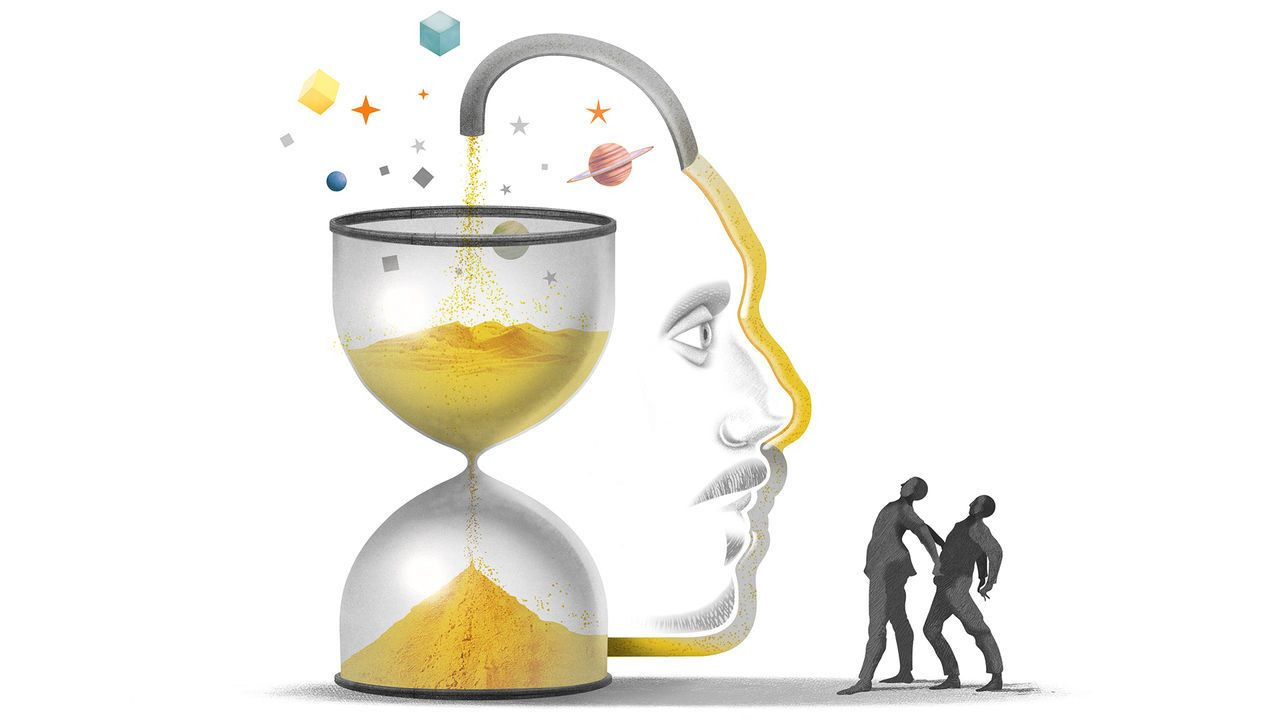
Illustration: Brett Ryder
Jan 30th 2025
DEATH DOESN’T make sense to Larry Ellison. Especially if it is premature like that of his doting adoptive mother, of kidney cancer when he was 20 years old. Even mere ageing is an irritant to the co-founder of Oracle. The 80-year-old tech billionaire simply has no time for it. He is too busy calling the shots at the business-software giant he started in 1977 and jostling for a spot in Silicon Valley’s race into the future, powered by daily workouts, fish, green tea and a fridgeful of self-belief.
The past few weeks have been full of ups and downs for Mr Ellison. On January 21st he stood next to Sam Altman, an artificial-intelligence wunderkind, and Masayoshi Son, a hyperactive Japanese tech investor, as President Donald Trump unveiled the “Stargate” project to keep America First in AI by building vast data centres to house cutting-edge models, such as those of OpenAI, Mr Altman’s $157bn startup. The cloud infrastructure would be provided not by Microsoft, hitherto OpenAI’s exclusive cloud partner, but by Oracle. The market value of Mr Ellison’s firm surged by nearly $40bn, to $522bn. His personal fortune, derived primarily from his 41% stake in Oracle, exceeded $210bn.
Then came the stumble, when a whizzy Chinese firm called DeepSeek shook investors’ belief in the need for Stargate-sized number-crunching—and in Oracle’s valuation. Even so, Mr Ellison remains the world’s fifth-richest man, and Oracle the third-biggest software firm. He has a thing or two to teach fellow tech titans, in particular his friend Elon Musk, about staying power. And it isn’t all about diet and exercise.
Messrs Ellison and Musk have plenty in common besides fabulous wealth and what appears to be genuine mutual affection. They have shared commercial interests. Between 2018 and 2022 Mr Ellison sat on the board of Tesla, Mr Musk’s electric-car company, and at one point owned a 1.5% stake. He also chipped in $1bn when Mr Musk was buying Twitter, which he has since rechristened X. On January 28th Oracle announced a partnership with SpaceX, Mr Musk’s rocketry firm, to offer business software via SpaceX’s Starlink satellites.
Both men are technologists with an eye for the next big thing. In the 1970s Mr Ellison spotted the commercial potential of “relational” databases, which allow users to easily cross-reference digital information, before anyone else; in the 2000s Mr Musk proved similarly farsighted about electric cars (with Tesla) and reusable rockets (with SpaceX). Both counted Uncle Sam as an early customer: the CIA for Mr Ellison and NASA for Mr Musk. In recent years both grew frustrated with lefty California and moved their firms’ headquarters to business-friendlier states.
Although Oracle and Tesla are listed, each is run like a private business, even if it sometimes upsets Wall Street in the short run. Each came to dominate its market. By 2012 Oracle was selling 43% of all database-management software by value, reckons Gartner, a research firm. A decade later Teslas accounted for one in five of all battery-powered cars bought worldwide.
A joke about Oracle’s founder is that the difference between him and God is that the Almighty doesn’t think he is Larry Ellison. Mr Musk relishes comparisons to Tony Stark, aka Iron Man, a Marvel superhero—more apt for someone who prefers comic books to the Bible but no less presumptuous. Neither likes delegating. Although Mr Ellison has handed over the CEO reins to an able lieutenant, Safra Catz, the closest he has to a true succession plan is funding anti-ageing research. Mr Musk is a micromanager to the bone. And neither is gracious about rivals, though Mr Ellison’s squabbles with Bill Gates in the 2000s, when Oracle and Microsoft vied for enterprise-software supremacy, now look gentlemanly compared with Mr Musk’s expletive-filled rants on X against anyone who disagrees with him on anything.
This points to the first big difference between the two, one which Mr Musk should note if he wishes to keep going strong in the 2050s, when he is Mr Ellison’s age. The younger mogul is easily distracted. He has spread himself thin between cars, rockets, X (as owner and power user), a tunnels business and a computer-brain-interface firm, plus a side hustle of streamlining the federal bureaucracy on behalf of Mr Trump. Mr Ellison, by contrast, displays a singleminded devotion to Oracle.
Leisure doesn’t suit Larry
This has come at the cost of his relationships—a handful of marriages ended in divorce—and philanthropic endeavours, one of which was run for a time by a writer at The Economist. But it has worked for Oracle, which despite recent wobbles is worth nearly three times as much as in the late 2010s, when Mr Ellison returned to arrest its slide into irrelevance in the cloud era.
Though Oracle’s share of its core database market is down to 17%, behind Microsoft and Amazon, its cloud revenues are growing by over 30% a year, much faster than at its bigger rivals. The firm is in the running to buy TikTok’s American business, which its servers already host, if the app’s overlords in Beijing bless a sale rather than face a Congress-mandated ban.
The second lesson is about discretion. Mr Ellison’s brash corporate persona conceals an intensely private man whose non-business views are almost as invisible as his company’s ubiquitous software. His longtime support for Republicans, including Mr Trump, has not made him sworn enemies among Democrats—wise for someone whose firm has lots of public-sector clients. It is easy to imagine a Democratic administration taking issue with Mr Musk, likewise a big government contractor with SpaceX. His journey from blue to MAGA red is littered with smouldering bridges beyond repair. But for others, like the 39-year-old Mr Altman, there is still time to learn. ■
Business | Driving off a cliff
No one gains from American tariffs on cars from Mexico and Canada
Donald Trump’s levy will hit his country’s carmakers hardest
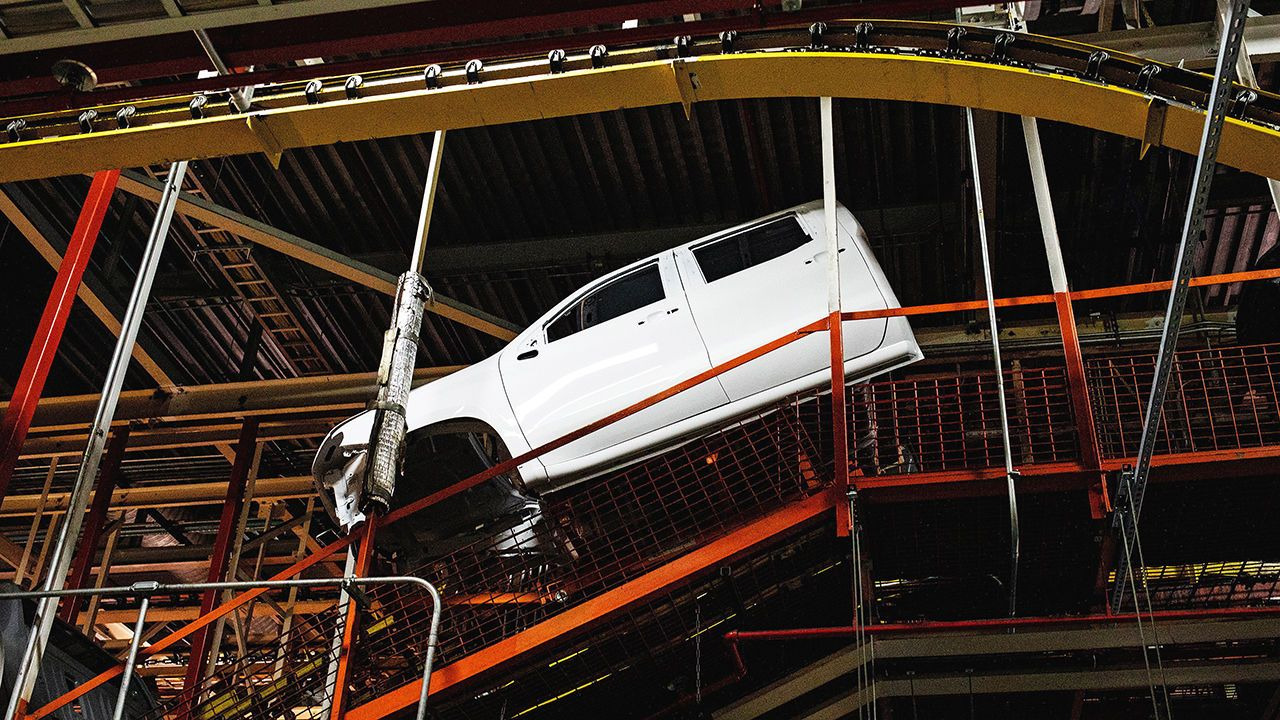
DownshiftPhotograph: Getty Images
Jan 30th 2025
The flurry of executive orders issued by Donald Trump on his first day back as president showed the high priority he places on making America’s borders less porous. His efforts to “repel the disastrous invasion of our country” by migrants and drugs from Mexico and Canada may soon include stemming the passage of cars. A promise to impose sweeping tariffs on “day one”, including a 25% levy on goods from the two countries unless they do more to stop the flows of people and illegal drugs, was pushed back, but only to February 1st. Whether tariffs are imposed then or at a later date, the consequences for the car industry would be immense.
Carmaking across North America is as complex and interconnected as the components of a combustion engine. The industry has spread across the region on the back of free-trade deals, first with Canada in 1965, then with the inclusion of Mexico in the North American Free-Trade Agreement in 1994. (NAFTA was replaced by the United States-Mexico-Canada Agreement, USMCA, in 2020.) As the industry became ever more global and competitive, American firms, seeking cheaper manufacturing, looked south. Last year 3.6m cars, around half of America’s car imports by value, arrived from its two neighbours, some 2.5m of them from Mexico.
Making those cars, which accounted for 22% of sales by volume in America and 16% by value, has given rise to complex supply chains that straddle both frontiers, built up over decades. In 2024 automotive exports from Mexico and Canada to their neighbour were worth around $200bn, with as much as half of that being components for vehicles assembled in America. The upshot is that Mr Trump’s proposed tariffs would have a “massive impact” on the car industry, according to S&P Global Mobility, a data provider. Daniel Roeska of Bernstein, a broker, describes the effect even more succinctly: a “disaster”.
Detroit’s big three would bear the greatest burdens. Around two-fifths of the cars sold in America by Stellantis (whose largest shareholder, Exor, is a part-owner of The Economist’s parent company) come from Mexico and Canada, according to Bernstein. For General Motors (GM), the share is nearly a third. Ford is more insulated. Only a quarter of its sales cross America’s borders, and these are largely smaller, cheaper vehicles such as the Bronco Sport and Maverick. gm and Stellantis, by contrast, import their lucrative Silverado and Ram pickup trucks, respectively, into America.
The impact would be so severe that a 25% tariff would wipe out Detroit’s profits if its three car firms took no action to raise prices or alter production, estimates Barclays, a bank. It would inflict a blow on other carmakers, too. Tesla, Elon Musk’s electric-car company, makes its cars in America but brings in up to a quarter of components from Mexico. European and Asian carmakers rely on Mexico to varying degrees as well. Volkswagen is the most exposed. Mexican production makes up over two-fifths of its American sales.
Foreign carmakers have also been threatened by Mr Trump with separate tariffs on imports from elsewhere. These would cause additional pain. America is the main destination for automotive exports from Europe, accounting for a fifth by value, some €56bn ($60bn), in 2023, according to Oxford Economics, a consultancy. Tariffs on these exports would hit Germany’s three big carmakers hard. In total, exports to America account for nearly 10% of the sales of bmw and Mercedes-Benz, and 15% for vw. Bernstein reckons that a 20% tariff would cost VW €3.3bn if it did not pass it on in higher prices.
Consumers would undoubtedly share the suffering. The likely outcome is that the price of the average car in America would rise by $3,000, says Wolfe Research, a consultancy. Higher prices would hit overall sales just as the industry faces other potential upheavals. Mr Trump has signalled his intention to ease emission regulations and eliminate sales subsidies on electric vehicles (evs). Slowing the transition to battery power would add more complications for carmakers, particularly Ford and gm, which have invested heavily in ev production both at home and across America’s borders.
The tariffs would put carmakers in a quandary. It is highly unlikely that the duties, if implemented, would stay for ever, says Bernstein’s Mr Roeska. But it is not clear how long they would last. The mere threat to Colombia of tariffs and other sanctions in a dispute over returning migrants on January 26th, for instance, was enough to cause the South American country to back down in just hours.
Bordering on the ridiculous
If tariffs lasted only for a few weeks, until Mr Trump wrung concessions on migration and drugs that he could present as a victory, they would still be highly disruptive. If they persisted, it might be possible to relocate some production to America. But reconfiguring factories and supply chains takes time, and would raise costs permanently. One theory is that there is another motivation for the threats: that they act as a bargaining chip to bring forward a renegotiation of the usmca, currently up for review in 2026, on terms far more favourable to America, with a view to advancing Mr Trump’s goal of bringing manufacturing back home. He has argued that tariffs are the only way to save America’s auto industry. But they could also cause a car crash. ■
Finance & economics | Free exchange
Tech tycoons have got the economics of AI wrong
Following DeepSeek’s breakthrough, the Jevons paradox provides less comfort than they imagine
Illustration: Álvaro Bernis
Jan 30th 2025
Even as economic growth was just taking off, some economists were already pessimistic. Coal, wrote William Stanley Jevons in 1865, is “the mainspring of modern material civilisation”. Yet it was finite and would soon run out. Although more could be found by digging deeper, it would be increasingly expensive to extract and these higher costs would reduce the competitiveness of Britain’s manufacturers. After all, in other countries the black fuel was still in sight of daylight. Efficiency gains—using less coal to produce the same amount of stuff—would not save the country. Indeed, cleverer use of limited resources would simply provide an incentive to burn even more coal, which would, paradoxically, lead to an even faster use of British reserves. There was no escape, the Victorian economist believed. Coal would be exhausted and the country was likely to “contract to her former littleness”.
The Jevons paradox—the idea that efficiency leads to more use of a resource, not less—has in recent days provided comfort to Silicon Valley titans worried about the impact of DeepSeek, the maker of a cheap and efficient Chinese chatbot, which threatens the more powerful but energy-guzzling American varieties. Satya Nadella, the boss of Microsoft, posted on X, a social-media platform, that “Jevons paradox strikes again! As AI gets more efficient and accessible, we will see its use skyrocket, turning it into a commodity we just can’t get enough of,” along with a link to the Wikipedia page for the economic principle. Under this logic, DeepSeek’s progress will mean more demand for data centres, Nvidia chips and even the nuclear reactors that the hyperscalers were, prior to the unveiling of DeepSeek, paying to restart. Nothing to worry about if the price falls, Microsoft can make it up on volume.
The logic, however self-serving, has a ring of truth to it. Jevons’s paradox is real and observable in a range of other markets. Consider the example of lighting. William Nordhaus, a Nobel-prizewinning economist, has calculated that a Babylonian oil lamp, powered by sesame oil, produced about 0.06 lumens of light per watt of energy. That compares with up to 110 lumens for a modern light-emitting diode. The world has not responded to this dramatic improvement in energy efficiency by enjoying the same amount of light as a Babylonian at lower cost. Instead, it has banished darkness completely, whether through more bedroom lamps than could have been imagined in ancient Mesopotamia or the Las Vegas sphere, which provides passersby with the chance to see a 112-metre-tall incandescent emoji. Urban light is now so cheap and so abundant that many consider it to be a pollutant.
Likewise, more efficient chatbots could mean that AI finds new uses (some no doubt similarly obnoxious). The ability of DeepSeek’s model to perform about as well as more compute-hungry American AI shows that data centres are more productive than previously thought, rather than less. Expect, the logic goes, more investment in data centres and so on than you did before.
Although this idea should provide tech tycoons with some solace, they still ought to worry. The Jevons paradox is a form of a broader phenomenon known as “rebound effects”. These are typically not large enough to fully offset savings from improved efficiency. Usually they are examined by academics and policymakers keen to use less energy: environmental worries about peak coal turned into worries about peak oil and then into worries about greenhouse gases. Sometimes the effect is straightforward: tighter fuel standards, designed to lower emissions, lead American drivers to travel longer distances. Sometimes it is less direct: better-insulated houses have increased the size of windows in Europe, offsetting efficiency gains. Sometimes it is macroeconomic: less energy use by one industry frees up supply for another. The Jevons paradox occurs when the sum of all the rebounds is larger than the initial energy savings—and it is really quite rare.
How confident should Mr Nadella be that AI will turn out to be one of the instances where the Jevons paradox applies? The overall size of a rebound effect ultimately depends on the structure of demand: if the good in question can easily substitute for others, then the bounce-back will be bigger. If it is a luxury good—one for which demand rises faster than income—then again there will be more of a rebound effect. Cristina Peñasco and Laura Díaz Anadón of the University of Cambridge have looked at home insulation in Britain and found that the rebound effect is also more significant for poorer households than richer ones, since richer ones are already closer to their desired temperatures.
Got the morbs
Basing the bull case for AI on the Jevons paradox is, therefore, a bet not on the efficiency of the technology but on the level of demand. If adoption is being held back by price then efficiency gains will indeed lead to greater use. If technological progress raises expectations rather than reduces costs, as is typical in health care, then chatbots will make up an ever larger proportion of spending. At the moment, that looks unlikely. America’s Census Bureau finds that only 5% of American firms currently use AI and 7% have plans to adopt it in the future. Many others find the tech difficult to use or irrelevant to their line of business.
“Coal in truth stands not beside but entirely above all other commodities,” Jevons wrote in 1865. “It is the material energy of the country—the universal aid—the factor in everything we do. With coal almost any feat is possible or easy.” His paradox applied to the black fuel because it was energy that was the fundamental driving force of the industrial economy. For the moment, at least, the tools produced by hyperscalers are nothing of the sort. The intended message of Mr Nadella’s tweet was not subtle: don’t sell your Microsoft stock. He may have been right, but that would have been for reasons other than the Jevons paradox. ■
Finance & economics | Buttonwood
Why your portfolio is less diversified than you might think
The most important idea in modern finance has become maddeningly hard to implement

Illustration: Satoshi Kambayashi
Jan 30th 2025
What is the best piece of investment advice you could fit into a single, short sentence? “Buy stocks” wins points for brevity and high returns. “Buy American stocks”, if given at almost any point over the past few decades, would have done even better. “Don’t waste money on stockpickers’ fees” deserves an honourable mention. Here is a less punchy suggestion: “A diversified portfolio can have the same returns as a concentrated one, with less risk.”
Diversification is such an important idea in modern finance that it is easy to forget its age. The economist it is most associated with is Harry Markowitz, who won a Nobel prize for setting out its maths in the 1950s. But the practice, if not the theory, was popular long before that. During the first heyday of financial globalisation, in the early 20th century, European investors could hardly get enough of foreign assets. A survey by Charles Conant, a journalist, published in 1908 estimated that between a quarter and a half of the average British portfolio was invested abroad. In French and German portfolios, overseas allocations were around a third and a half, respectively. Such cosmopolitanism was then shattered by war, hyperinflation, capital controls and the Depression.
More than a century on, and despite present-day worries of financial fragmentation, holding a varied portfolio is easier than ever. Foreign assets can be bought at the tap of a trading app, while cheap index funds give investors instant exposure to thousands of stocks in dozens of countries. The idea of diversifying across asset classes as well as geographies—via the classic 60/40 portfolio of stocks and bonds, for instance—is firmly in the mainstream. More exotic choices such as commodities and cryptocurrencies have become more accessible to retail investors, too, and private assets may eventually follow suit.
Unfortunately there is a catch, and it is a big one. Building a portfolio that looks diversified has become a cinch. Building one that is actually diversified, in the sense that its components offset each other’s risk, has become much harder.
Diversification gets its magic from the fact that the prices of different assets do not all move together. The market values of a gold mine in Kazakhstan and a recruitment firm in San Francisco, for instance, will fluctuate for very different reasons even if they both have similar returns. Hold shares in both and there is a chance that a sharp drop in one will be cushioned by a rise in the other. Hold lots of uncorrelated assets and you get this effect writ large: a portfolio with a return that is the average of its constituents’ but with a lower volatility. The less correlated the assets’ returns, the greater the magic.
Yet just as it has become easier to invest in a wide array of assets, the correlations between them have shot up. These are measured on a scale from -1 to 1. A pair of prices that always move in opposite directions—in other words, a diversifier’s dream—scores -1. Prices that move in lockstep, offering no diversification benefit, score 1. In the 1970s, before the re-globalisation of finance gathered pace, the average correlation between pairs of share indices for developed markets was 0.37. By 2021 it was 0.75. For pairs of emerging-market indices the average correlation rose from 0.05 to 0.49. As the barriers separating them have come down, markets that once moved almost independently now increasingly ebb and flow together.
It seems, therefore, that geographical diversification has followed a trajectory which is wearily familiar to financial historians. When few investors could manage the trick, it was a stellar idea. Once it was popular and available to the mass market, its dynamics were distorted and the benefits started to fade. A similar fate befell the Buffettian strategy of buying undervalued “cigar-butt” stocks, after automated screening made them easy to identify and hence vanishingly rare. In the case of diversification, once investors started spreading their capital across stockmarkets, they all began to resemble each other.
What stings even more is that diversification across asset classes has become more difficult, too. Between 2000 and 2021 stocks and bonds listed in America complemented each other excellently, with an average correlation of -0.29. Since 2022, when both crashed together, that has risen to around 0.7. There is still some benefit to spreading your portfolio across different regions and asset classes. But given the gains have shrunk so much, it is no wonder investors are chasing after ever more esoteric products. ■
Finance & economics | The merge
Will America’s crypto frenzy end in disaster?
Donald Trump’s team is about to bring digital finance into the mainstream

Illustration: Juanjo Gasull
Jan 26th 2025|New York
“Get your $TRUMP now,” came the message from America’s president-elect three days before his inauguration. The commander-in-chief’s meme cryptocurrency, the aggregate value of which has so far peaked at almost $15bn, is far from the only sign of the administration’s ardour for digital assets. One new government department (DOGE) has been christened after another meme coin. It is now quicker to list people close to the president who do not have significant financial interests in crypto than those who do. For anyone not paying attention, an executive order on January 23rd made things clear: digital assets, it announced, would play “a crucial role in innovation and economic development in the United States, as well as our Nation’s international leadership”.
Chart: The Economist
What does this spectacular merger of hype cycle and national governance mean for American finance? The Biden administration had worked hard to prevent the crypto industry from infiltrating Wall Street. Tight rules made it prohibitively expensive for banks to hold digital assets on behalf of clients, and stopped them from pioneering their own crypto products, such as stablecoins (tokens pegged to the dollar or other assets). The Federal Deposit Insurance Corporation (FDIC), a watchdog, obstructed dozens of such projects on the basis that it did not know how digital assets ought to be treated in regulatory filings. Now, on many issues, banks and the crypto industry are pushing in the same direction, and face little resistance. Expect, as a consequence, new and enormously profitable forms of risk-taking to emerge. In time, there will also be furious debates when digital upstarts, who have the full favour of the White House, come to clash with veterans of American banking.
The cryptofication of mainstream finance is already under way. On January 21st Travis Hill, interim chair of the FDIC, declared that he wanted regulation of crypto to be more transparent, and that all law-abiding customers should have access to bank accounts. Crypto advocates are hopeful the new administration will bring an end to “debanking” (when someone is denied or loses access to banking services owing to legal concerns). The industry has been particularly vulnerable to this because of fears about money-laundering. Then on January 23rd the Securities and Exchange Commission, America’s main markets regulator, altered its guidance so that financial institutions no longer have to account, on their own balance-sheets, for crypto assets held on behalf of customers.
Chart: The Economist
These changes will affect just about every institution on Wall Street. Brian Moynihan, chief executive of Bank of America, has said banks will embrace cryptocurrencies, such as stablecoins, that can facilitate transactions. Many are experimenting with crypto tokens that convey ownership of shares in money-market funds. They are also set to begin building up their trading and custody of crypto assets as soon as they can be certain about the details of the new regulatory regime.
To enable this focus on digital assets, some institutions will probably purchase crypto firms. Dylan Walsh of Oliver Wyman, a consultancy, thinks that there could also be an acquisition spree in the opposite direction, with digital-asset companies buying mainstream outfits. A few crypto firms could even attempt to purchase institutions with banking licences, allowing them to take deposits and offer loans. The result would be much more overlap between the crypto industry and traditional finance. It would then be difficult for any future Democratic president to change course on crypto. “As a practical matter it’s much harder for regulators to un-ring the bell,” notes Julie Andersen Hill of the University of Wyoming.
Reasons for FUD
Traditional finance and the crypto industry are not aligned on every issue, however. The biggest point of contention concerns the Federal Reserve’s payment rails. Around 9,000 firms hold master accounts with the central bank. Such accounts enable their owners to make payments without use of an intermediary, reducing the expense and complexity of transactions. Custodia Bank, a crypto-focused outfit that holds a depository licence in Wyoming, applied for a master account in 2020, only to be rejected. Kraken Financial, another crypto firm, made its own application four years ago. It is still awaiting a decision from the Fed.
Traditional banks are happy with this state of affairs. The Bank Policy Institute and American Bankers Association, two lobby groups, have supported the Fed’s right to block access to master accounts. They have stressed the need to guard against credit, cyber-security and reputational risk, especially relating to money-laundering and terrorist financing. Banks also gripe that they face higher regulatory standards than other fintech firms. In contrast, Caitlin Long, chief executive of Custodia, has complained that mainstream lenders are gatekeeping access to the country’s financial rails. The argument is likely to run and run. Although Mr Trump may select appointees to the Fed’s board in part on their attitude to widening access to the central bank’s payment infrastructure, only two positions will be up for grabs in the next four years, since the Fed’s seven governors serve staggered 14-year terms.
Many will be glad of such obstacles to the administration’s agenda. Michael Barr, departing head of financial supervision at the Fed, has warned about the dangers of the cryptofication of finance. The industry has a dubious reputation for a reason: Sam Bankman-Fried, founder of FTX, one of the world’s biggest crypto exchanges, was last year sentenced to 25 years in prison for fraud. Changpeng Zhao, founder of a rival exchange, has spent four months locked up for money-laundering. These are the sort of failures regulators want to keep from mainstream finance.
There are also fears about the sheer volatility of crypto. Steven Kelly of Yale University says that he is worried about the consequence of “ties between what happens in crypto prices and what happens to banks”. If bank deposits are vulnerable to movements in the crypto market, institutions will become more vulnerable to runs. That, Mr Kelly notes, is what happened at Silvergate and Signature, two crypto-focused banks which collapsed in 2023. Both were broken by a tumble in cryptocurrency prices that began in late 2021 and then reverberations from FTX’s collapse.
Almost anywhere you look—from the popularity of gambling and novel forms of retail investing to soaring crypto prices and the electorate’s choice of president—America is embracing risk. For financiers the spread of digital assets provides some new and large moneymaking opportunities. For the American consumer it may even provide valuable innovations. But the Trump administration is eager to find out just how much risk Americans will bear. And if the merger between Wall Street and the blockchain is managed poorly, the costs could be extreme. ■
Science & technology | Well informed
Should you worry about microplastics?
Little is known about the effects on humans—but limiting exposure to them seems prudent
Illustration: Cristina Spanò
Jan 24th 2025
Ever since Austrian scientists first began looking for them in people in 2018, microplastics have turned up in the blood, lungs, kidneys, liver, heart and even the brain. They have also been detected in the placenta and breast milk.
It is no mystery how these tiny particles, which can range from 5mm across to less than 2 microns (µm), get into human bodies. They are ubiquitous in the air, food and water. They accumulate from degrading plastic waste and the wear and tear of everyday products such as car tyres, paints and synthetic fabrics.
Whether they are harmful is still unclear. These “forever particles” could have a role in various health problems, from infertility to heart attacks and cancer. They may cause physical damage by blocking ducts or scratching tissues. Or they may cause chemical damage to cells. They could also act as microscopic Trojan horses for various heavy metals, allergens and bacteria that cling to them.
In a study published in 2024 in the New England Journal of Medicine scientists examined the plaque scraped from the arteries of 257 patients who had a procedure to remove it (to reduce blockages). Microplastics turned up in more than half of cases. In the next three years, those patients were four times as likely to have a heart attack or stroke, or to die from any cause, than the patients without detectable microplastics in the plaque. It is unclear, however, whether the particles were to blame. Their presence in arteries could have been a byproduct of the biological changes that cause these health problems.
Some studies in the lab have found that microplastics can cause damage to cells, tissues and DNA and promote the growth of cancers. But a problem with lab-based experiments is that the particles used in them do not reflect those that people actually ingest or inhale. More than a dozen types of plastics have been found in human tissues, in all shapes and sizes, from jagged-edged specks to fibre strings. Of most concern are nanoplastics (those smaller than 1µm). These are small enough to pass into the bloodstream through the linings of the gut and the lungs. Particles bigger than 10µm are unlikely to enter human cells. When inhaled, they are typically expelled by the body’s “mucous escalator” that brings them up from the lungs to be swallowed and excreted.
By contrast, early laboratory experiments used sterile spherical beads of just one type of plastic, polystyrene, which were bigger than the nano-size range. Shape matters, too. In better studied nanomaterials, the more jagged shapes are the most harmful. Scientists are now developing more relevant microplastics cocktails for experiments by breaking down items like water bottles in ways that simulate natural wear and tear.
Microplastics are impossible to avoid. In 2019 a team from King’s College London found that daily deposits from the air in central London reached 1,000 microplastics per square metre. And that was only particles bigger than 20µm.
Reducing exposure to microplastics is feasible, by avoiding food and drinks packaged in plastics, using less synthetic fabric and cleaning up household dust. Heating plastic containers leaches lots of microplastics, so avoiding microwaved ready-meals and plastic kettles should help too. A European research consortium of more than 70 organisations is trying to untangle the specific harms from microplastics to human health and what sort of regulation may be warranted to prevent them. For now, there are more questions than answers. ■
Culture | The bloom is off the rose
Are internet firms the problem, or are you the problem?
A veteran critic of technology offers his take on a familiar target

Picture perfect?Photograph: AP
Jan 30th 2025
Superbloom. By Nicholas Carr. W.W. Norton; 272 pages; $29.99 and £19.99
IN EARLY 2019 an unusual abundance of orange poppies appeared on the slopes of Walker Canyon, in the Temescal Mountains south-east of Los Angeles. Social-media influencers flocked to the scene to take pictures of themselves among the blossoms, prompting their followers to do the same. The “superbloom” of flowers produced a superbloom of people, trampling the poppies, causing gridlock and creating a public-safety hazard.
For Nicholas Carr, a thoughtful critic of technology and its consequences, all this is a metaphor for today’s media-saturated world. Like poppies, social platforms look pretty, but a form of narcotic is contained within. “We live today in a perpetual superbloom—not of flowers but of messages,” he writes in “Superbloom”, which examines the unanticipated impacts of communications technologies.
As in his previous critiques of technological overenthusiasm, Mr Carr frames his argument against the ill effects of digital media using historical analogies. In 2004 his first book, “Does IT Matter?”, argued that information technology, like previous innovations such as steam power and telegraphy, would be rapidly commoditised and that adoption could give companies only a short-term competitive advantage. Subsequent books considered the rise of cloud computing as a utility, the internet’s impact on cognition (Google is making people stupid, Mr Carr argued) and the pitfalls of automation.
“Superbloom” starts by examining the long-standing belief that more and faster communication would not just be a good thing, but would inevitably promote education, understanding and peace. This idea goes back at least as far as the era of the electric telegraph, and Mr Carr extensively quotes Charles Horton Cooley, a 19th-century academic who first used the term “social media” and whose optimistic pronouncements sound very familiar today. Indeed, Cooley eerily prefigures the social-media prophets of 2010-11 who hailed the Arab spring as an example of technology’s liberating power.
Such optimists failed to foresee the downsides of faster, easier communication, such as factionalism, authoritarianism and radicalisation. Guglielmo Marconi, an Italian inventor, thought radio would “make war impossible”, but the Nazis used it for indoctrination. Mr Carr explains how digital networks brought previously separate forms of media together and eroded the distinction between conversations and broadcasting—a process that culminated in the introduction of the endless feed, pioneered by Facebook and since adopted by other social-media platforms. He details how unchecked self-expression on social media produces feelings of envy and enmity, affects how people perceive themselves and others and has been blamed for causing loneliness and depression.
It is customary to blame profit-hungry tech firms for all this and to demand that they should be more heavily regulated or broken up. But Mr Carr takes a different tack. The problems associated with social media, and visible to a lesser extent with earlier forms of communication, are the result of the interplay between fundamental characteristics of digital networks on one hand and human nature on the other, he argues. By blaming social-media giants, “We let the net itself off the hook while also absolving ourselves of complicity.”
He gives many examples of how digital media can exacerbate “deep-seated tendencies in human nature” that predate the internet. A study in 1976 of residents of a condominium complex, for example, found that proximity to other people was more likely to breed animosity than affection: enemies outnumbered friends among close neighbours. And on social media, everyone is a neighbour. Digital media do not change human nature, Mr Carr writes, “But they do accentuate certain aspects of it while dampening others”. As a result, he argues, breaking up big tech firms is “unlikely to change social media’s workings”; other companies, offering similar products, would simply take their place.
If break-ups are not the answer, what is? Mr Carr dismisses the notion of “frictional design”, which aims to slow the sharing of information and make social platforms less engaging, as futile and likely to annoy users. He argues that it is “too late to rethink the system”, so users need to change themselves instead and try to live “a more material and less virtual existence” through “personal, wilful acts of excommunication”. Presumably he has in mind things like smartphone bans in schools and voluntary abstinence during “digital detox” days. But after such a detailed and persuasive diagnosis, Mr Carr’s meagre prescriptions seem disappointingly vague.
Perhaps he is simply reluctant to repeat the suggestions made by Jonathan Haidt in “The Anxious Generation”, published in 2024. But that points to a deeper problem. Like the poppy fields of Walker Canyon, the notion that social media have deleterious effects is well-trodden ground. Mr Carr’s scepticism about the promises made by big technology firms felt bracingly provocative a decade or two ago. But bashing social-media platforms and the ways they manipulate their users’ behaviour has become an overcrowded genre. The argument has now moved on to the implications of AI and tech bosses’ cosiness with Donald Trump. Like the influencers who rushed to Walker Canyon, Mr Carr has ended up following the herd. ■
Culture | Split screen
Why “Emilia Pérez” is loved by Hollywood and hated by everyone else
And the Oscar for Worst Picture goes to…

Photograph: PictureLux/Eyevine
Jan 28th 2025
Lockdown has a lot to answer for. As many were baking sourdough at home, Jacques Audiard, a French film-maker, was writing an opera libretto about a Mexican cartel boss who fakes his own death, undergoes gender-transition surgery and campaigns for the missing victims of the drug war. The resulting film, a trans-narco-musical fever dream called “Emilia Pérez”, has earned 13 Oscar nominations. Since the Academy Awards began in 1929, only three films have received more. No other foreign-language film ever has.
Hollywood is besotted, but audiences are not. Movie-goers’ reviews have been savage. On the Internet Movie Database (IMDb) it is the lowest-rated Best Picture nominee since 1935, earning a six out of ten. On Rotten Tomatoes, which aggregates critic and audience opinions, the public approval rating is just 23%. The nine other Best Picture nominees score between 75% and 99%.
The film’s Rotten Tomatoes rating is down from 75% in December, before it opened in Mexico, where viewers were unimpressed (see chart). Some of this decline is explained by “review bombing”. This can happen when films take on heated subjects. “The Promise” (2016), about the Armenian genocide, saw its IMDb page mobbed with thousands of one-out-of-ten ratings from users in Turkey; in response, most Armenians gave it full marks, resulting in a middling overall score.
But socially conservative Mexicans objecting to a trans woman starring in a film is not the full picture. “Emilia Pérez” is, objectively, poor. The dialogue sounds as if it has been hastily translated from French to English to Spanish, leading to jarring phrases like, “Hasta me duele la pinche vulva nada más de acordarme de ti” (“Even my fucking vulva still hurts as soon as I think of you”). The lyrics have been lost in translation, too. Consider the opening line of one song: “Hello, very nice to meet you. I’d like to know about sex-change operations.” (Somehow “hello” gets one syllable and “change” gets two.) “I see, I see, I see,” is the reply, as perfunctory an iambic trimeter as you will ever hear.
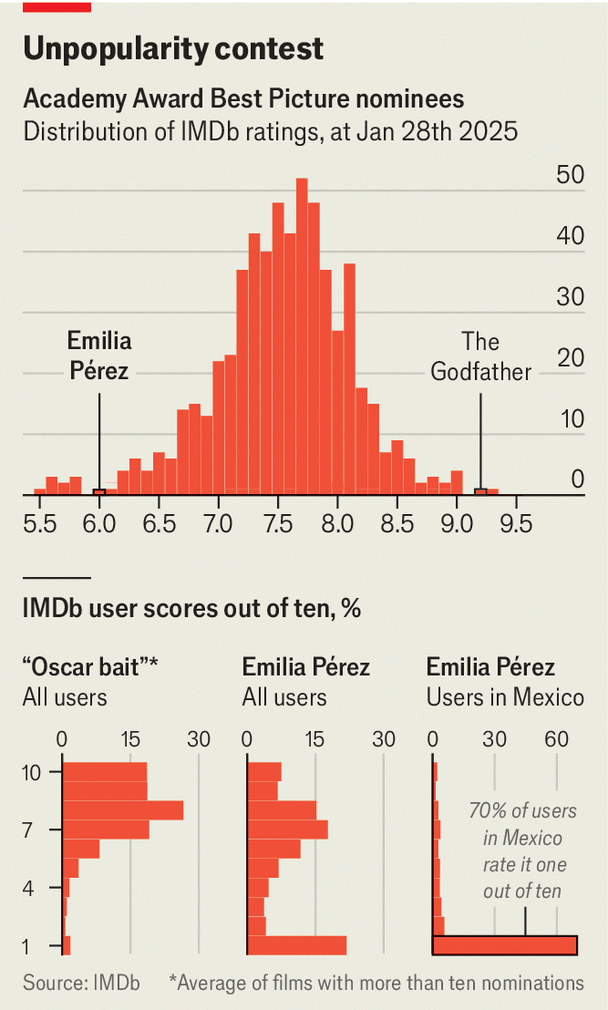
Chart: The Economist
Botched pronunciations have angered Mexicans. Karla Sofía Gascón, who plays Emilia, was born in Madrid and cannot always hide her Spanish accent. Emilia’s wife with the sore vulva (played by pop star Selena Gomez) sounds robotic in Spanish and slips into English halfway through a line. Adriana Paz, Emilia’s love interest, is the only Mexican in the main cast. She has less than 12 minutes of screen time.
Some also feel the film trivialises the drug war. They accuse it of focusing on one person’s story while ignoring how devastating the cartels continue to be; some 100,000 Mexicans have disappeared or are missing since record-keeping began. Even some trans people are critical. GLAAD, an LGBT+ advocacy group, has called the film a “profoundly retrograde portrayal of a trans woman”, relying on tired tropes.
Why, given the film’s flaws, does Hollywood celebrate it? Two factors are at work. One is money. Netflix, which bought the film for $12m, has reportedly invested tens of millions of dollars in its awards campaign. This is its tenth attempt at a Best Picture win since “Roma” became the first film on a streamer to be nominated in 2019. (Apple TV+ was the first streaming service to win the top prize with “CODA” in 2022.)
The other explanation is Hollywood’s liberal self-image. Members of the Academy of Motion Picture Arts and Sciences, who vote on Oscar winners, put a high premium on diversity. Both “Crash” (2004) and “Green Book” (2018) won Best Picture, despite what critics saw as mawkish takes on America’s race problems. The ostensibly inclusive credentials of “Emilia Pérez”, including a trans lead, probably contributed to its nomination haul. Hollywood’s top brass may want to send a message to Donald Trump and his socially conservative administration. But even Oscar wins are not going to be enough to persuade audiences to sing the film’s praises. ■
Culture | Word of mouth
The Michelin Guide is no longer the only tastemaker in town
How is it adapting to changing eating habits?

Illustration: Giacomo Gambineri
Jan 30th 2025|NEW YORK
It began, implausibly, with a guide to French roads. In 1900 two brothers, André and Édouard Michelin, wanted to promote travel by car as a route to rev up sales of their tyres. Their first book gathered practical information such as maps and the locations of mechanics; later, recognising that travellers want fuel for themselves as well as their vehicles, it expanded its restaurant recommendations. The company first introduced its star-ranking system in 1926.
In the century since, over 30m copies of the Michelin Guide have been sold—making it about as widely read as “Gone with the Wind”, “The Great Gatsby” or “Pride and Prejudice”. Michelin’s taxonomy has become the restaurant industry’s standard. Only the most exalted eateries earn a star: of the roughly 11.8m places that serve food in the world, only 3,647 (or 0.03%) currently hold at least one.
Of those, 82% have one star—denoting an establishment “where dishes with distinct flavours are prepared to a consistently high standard”; 13.6% have two stars, in acknowledgment of their “refined and inspired” offerings that show “the personality and talent of the chef”. Only 149 restaurants have three stars, the highest honour (see chart). According to Michelin, they are institutions where “cooking is elevated to an art form” and chefs are “at the peak of their profession”.
Gordon Ramsay, a British chef with eight stars currently to his name, has said that Michelin prizegivings are to chefs what Academy Awards are to film-makers. And just as an Oscar encourages people to go to see a film, recognition from Michelin can boost reservations. Joël Robuchon, who held 31 stars at the time of his death in 2018, observed that “With one Michelin star, you get about 20% more business. Two stars, you do about 40% more business, and with three stars, you’ll do about 100% more business.”
In recent years, however, the star system has lost some of its lustre. Michelin’s status as the ultimate arbiter of taste seems to be under threat. One problem is its longtime emphasis on fine dining. Many associate Michelin with hefty prices, minuscule portions and pretension. In a discussion about rated restaurants on Reddit, a social-media site, users complained of “gimmick-driven shit”. “You won’t appreciate it unless you have so much money to waste that your time is completely worthless,” one person wrote, “because you have nothing better to do than spend three hours eating two morsels of food.”
Michelin has said that neither presentation nor silver service is an eligibility requirement: “Any restaurant of any style” can earn a star. Gwendal Poullennec, international director of Michelin Guides, insists the company looks for quality, not luxury. A taco stand in Mexico City won a star in May, for instance.
Even so, diners are not the only ones turned off. A handful of establishments are refusing the prize. (Marco Pierre White, a British chef, started the trend in 1999; he said he felt that the judging process was meaningless.) Giglio in Tuscany won a star in 2019 but voluntarily gave it up in 2024. Benedetto Rullo, a co-owner, said the star brought “incredible” stress and implied a snooty vibe: “We’re not the kind of place you come to worship star chefs.” Top accolades increase the pressure on chefs and drive up costs (suppliers and staffers use it as an excuse to demand bigger fees).
Of cravings and critics
Yet the internet poses the greatest challenge to Michelin, as it has democratised food criticism. Diners can share reviews on websites such as TripAdvisor and Yelp; bloggers collate lists of the best local spots; influencers dish up assessments on social media. Videos about food on TikTok have more than a trillion views combined.
Posts by Toby Inskip (@eatingwithtod), an influencer, have amassed more than 25m likes on the app. They show him avidly tucking into chicken wings as well as £400 ($500) tasting menus. At a time when almost 80% of Americans and Britons say going out to eat is too expensive, such sites and accounts can point to trendy new spots and affordable treats for foodies. Mr Inskip often focuses on cheap dishes—some as low as £1—in London. Queues soon gather at the joints he highlights.
Despite all this, Michelin is determined not to join meat in aspic and seafood mousse in culinary oblivion. People across the globe are becoming more adventurous and curious about the world of food; Michelin, too, is opting for a more varied diet. In 2004 only Europe shimmered with stars. France still has the highest number of starred restaurants. However, today Michelin sends reviewers (of 30 different nationalities) to four continents. The company produces guides to 43 countries; the number of guides has increased by almost 50% since 2020.
Inaugural guides to Lithuania and Mexico were launched in 2024. Restaurants in Slovenia and Thailand recently earned three stars for the first time. Mr Poullennec has said that 20 new locations are being scouted, including India. Michelin already covers several Chinese cities and is expanding to provinces.
In America only New York was deemed worthy of review 20 years ago. Now foodies can get recommendations for Atlanta, Chicago and Orlando, among other places. Michelin recently expanded into Texas, which has a growing, hungry population. Restaurants in the Lone Star State savoured more than $100bn in sales in 2023—some $20bn more than those in New York.
The expansion is guided by market growth and other financial incentives; places eager to lure gastro-tourists are willing to pay for the prestige of a Michelin Guide. Travel Texas, part of the governor’s office, had a hand in bringing Michelin to the state. In 2017 Thailand’s tourism board reportedly paid Michelin $4.4m in exchange for a series of guides, starting with Bangkok. (Michelin has insisted that commissioned guides are still subject to the same rigour and that countries and states cannot buy stars.)
Michelin’s judges have been paying attention to hawker stalls as well as haute cuisine. Since 1997 the Bib Gourmand award has spotlighted restaurants that offer “a complete quality menu” for “a reasonable price”. The company seems cognisant of the importance of the category: there are almost as many Bib Gourmands as there are starred restaurants.
Of the 3,274 Bib Gourmands, 134 of them are street-food vendors. Many dish up Chinese, Mexican, Thai or Vietnamese food: cuisines with a history of cheap, informal dining. The Bib Gourmand rewards local, authentic cooking, a trend Mr Poullennec identifies as important to eaters. The category appeals to those put off by the frippery a star implies.
The company is also catering to a growing cohort of climate-conscious eaters. In 2020 Michelin launched the Green Star, given to restaurants that demonstrate a commitment to sustainability. (So far only 608 have qualified.) Mr Poullennec notes that restaurants “are making a great deal of effort” to balance their menus with plant-based offerings to satisfy the 1.5bn vegetarians and 88m vegans worldwide. A top chef told him that, after winning a Green Star, his restaurant attracted a younger crowd who ordered vegetarian dishes.
Will these efforts be enough to keep Michelin on the road for another century? The firm says traffic to its website has doubled in the past year, suggesting Michelin is accruing trust. Time and constancy work in its favour. Whereas food influencers may visit a restaurant once—and be paid by the owners to film a glowing video—Michelin’s expert reviewers have a standardised approach. (They must visit several times and tell no one who they are or that they are going.) Clare Smyth, the British chef who catered the wedding of Prince Harry and Meghan Markle, says her restaurant, Core, received eight secret visits before it was awarded three stars in 2021.
Today anyone can have an opinion on food, but not everyone can be an authority. Michelin will always have its critics. But discerning diners will continue to seek it out—for, as George Bernard Shaw, a playwright and critic, once wrote, “There is no love sincerer than the love of food.” ■
Obituary | One man on his island
Mauro Morandi needed to abandon consumer society
The hermit-guardian of Italy’s loveliest beach died on January 3rd, aged 85

Photograph: BILD/Stefano Laura
Jan 30th 2025
To Polynesia! That was where Mauro Morandi wanted to go. By 1989 he had the means to get there, a 16-metre seven-cabin catamaran, “a Ferrari of the seas”. Flat, dull Modena would be left behind; in the footsteps of Paul Gauguin he would discover tropical forests, coral reefs, turquoise lagoons and dark, brooding women. He would break with the Western world, and find himself.
Sadly, though, the Ferrari ran into a storm before it had cleared Sardinia. It was laid up for repairs in La Maddalena, where he and the crew had to hang around for a while. And there began an intriguing chain of events. By sheer synchronicity (not fate, an absurd imposition, but close vibration with the universe) he happened to talk to an Argentine. The man mentioned an island, the smallest in the archipelago, called Budelli, and knew the warden. The gruff warden, when visited, happened to be leaving his job in two days; and Mauro, who had instantly fallen for Budelli, became his successor, making the island his for more than 30 years. Stranger still, this scrap of a place, less than two kilometres square, had the turquoise waters, pink coralline beaches and rampant vegetation he had meant to find in Polynesia.
He had longed for years to escape. At nine, he had run away from home for the first time. As a young man he would take the family’s punt through the maze of canals and ditches round Modena, ever exploring, while longing for the riskier open sea. He became a PE teacher in a rural school, where he got into trouble for introducing music and asking the children to imagine they could fly. He managed a seven-year marriage and had three daughters, but chafed at doing what hidebound, consumerist society expected of him. One reading of Richard Bach’s “Jonathan Livingstone Seagull” convinced him that he could perfect himself, like the seagull, only in flight and in exile.
His job on Budelli was simple enough: to look after the island, especially the Spiaggia Rosa, a beach of rare, beautiful salmon-pink sand made of fine-crushed coral, fossils and shells. It was also to work on himself. Living there alone, in a tiny granite-block cottage hidden in juniper trees, was less easy. He had no running water, just a cistern to collect the rain. Power came from one solar panel on the roof, not enough to run a fridge during the baking summers. In winter storms ravaged the island; he was once stuck in his house for 25 days. Vegetables refused to grow there, and all his food had to be shipped from La Maddalena, the nearest town. His sole form of transport was a dinghy, which liked a calm sea.
Yet none of this outweighed the compensations. The first was the sunrise over the sea, which it was a sin to miss. He would get up when he heard his two hens stirring, go down to his armchair above the beach, and watch. He did not know, or care, what the day or the hour was; time moved more serenely here. Breakfast, of barley coffee and half an apple, was followed by his first cigarette of the day. As the sky grew bluer, he liked to see the white smoke curl against it. Only gulls disturbed the all-pervading silence. Even during storms he was content, cosy by his fire with his library of books, reading of other adventures while in the middle of his own.
He also learned self-reliance. Working slowly, since he was no mechanic, he rigged up more solar panels and brought his dead dinghy motor back to life. His grand armchair, a sort of throne from which he supervised the Spiaggia Rosa or simply gazed at the horizon, he had made himself out of hard, knotty juniper wood. Cleverly he avoided cuts, hard knocks and doctors; most wounds, he found, needed only disinfectant and a plaster. Otherwise, he never caught as much as a cold. Something about Budelli, with its salt-and-juniper air, kept them away.
As for his work on himself, it became submerged in his passion for the place. His mission in life was now to preserve that beauty and that peace, which had taken him over. He disliked the word solitudine, which suggested he shunned people or was missing something, when his mind was full of new birdsong, the characters of winds, the pattern of the tides, and everything else Budelli could teach him. What he had entered was isolamento, isolation, a positive state of being alone on an island, and wanting its undamaged survival as keenly as his own.
In truth, too, he was not so solitary. He knew the grocer, baker and butcher in La Maddalena, and had a few friends there to share a glass of red and a smoke. He took odd weeks off to visit his family in Modena. For the first few years his girlfriend, Silvana, stayed for parts of the summer. Budelli in the season was crowded with visitors who came to swim and sunbathe on the Spiaggia Rosa. Although in 1994 the park authorities had closed off the beach, day-trippers still came to marvel at it. From his cottage Mauro could hear the guides talking about it, and about him.
At first he kept well away from them. But then his attitude changed. Dostoevsky had written that only beauty could save the world; now only humans could save beauty. He had to get them on his side. He encouraged tourists to come to his veranda, under the shady awning, and talk about anything—free will, religion, love problems—but especially the destruction of Nature and the urgent need to save it. They heard his plea to be viaggiatori consapevoli, conscious travellers, to see beauty deeply and respect it. The same message went out to the 100,000 followers he acquired on Facebook and Instagram, once Budelli had WiFi.
Eventually, though, he had to leave. The park authorities had tried to dislodge him since 2016, wanting their own way with Budelli. He had fought them hard, but in his 80s his health was fading anyway. He was given a one-bed apartment in La Maddalena where cars and motorbikes roared past all night, but at least he had a balcony and the sea. There he went on gazing at the horizon, and sometimes wondering, too, whether his own tiny Polynesia had been real, or just a dream. ■