The Economist Articles for Apr. 1st week : Apr. 6th(Interpretation)
작성자Statesman작성시간25.03.28조회수188 목록 댓글 0The Economist Articles for Apr. 1st week : Apr. 6th(Interpretation)
Economist Reading-Discussion Cafe :
다음카페 : http://cafe.daum.net/econimist
네이버카페 : http://cafe.naver.com/econimist
Leaders | Efficiency drive
Is Elon Musk remaking government or breaking it?
So far, there is more destruction than creation

Mar 27th 2025
Listen to this story
NEXT TO SPACE travel, remaking the government sounds easy. Elon Musk conceives of himself as the saviour of humanity, who will put people on Mars as a prelude to making humankind a multiplanetary species. But of all the things President Donald Trump has done at home since his inauguration in January, putting DOGE (the Department of Government Efficiency) under Mr Musk has turned out to be the most polarising. The world’s richest man is exalted by some as an altruistic genius and hated by others as a self-dealing villain. Is he remaking the government, or breaking it?
This newspaper looked forward to what Mr Musk might do with some hope. He has transformed at least two industries. If he could reform the federal government—an organisation whose annual expenditure of $7trn is roughly equivalent to the revenues of America’s 20 biggest companies—that would be a boon for humanity. Across the West voters are frustrated because their governments are more adept at slowing things down than at making them go. Yet large democracies have for decades struggled to come up with a convincing fix.
So far, however, DOGE has stirred up animosity, as it has barged into one agency after another. It has broken laws with glee and callously destroyed careers. It has made false claims about waste and seized personal data protected by law. This week’s big scandal—the unintended inclusion of a journalist in a Signal group of senior officials discussing an imminent attack on Yemen—has nothing to do with DOGE. But it does not inspire confidence that Mr Trump’s inner circle can handle big tasks responsibly.
Some transgressions along the way might be worth it if DOGE brought about a true transformation. Proceeding with all due caution can be a recipe for stasis, after all. Who now remembers the recommendations of the Grace commission, which was tasked by President Ronald Reagan to find ways to cut waste in government?
Ordinarily, chances to start government afresh crop up only in times of war, plague or natural disaster. A sympathetic reading of DOGE is that Mr Musk is trying to bring creative destruction to bureaucracies by other means. His preferred method at Twitter (now X) was to break things and see what happened. Perhaps what America has seen so far is the destruction and the creation will come afterwards. Optimists note that Argentina’s President Javier Milei has achieved real progress with Musk-like tactics, and that the painful reforms carried out by Reagan and Margaret Thatcher in the 1980s were hated by many at the time but proved beneficial.
Others retort that the government is not like the companies Mr Musk has transformed. If a firm goes bust, another will spring up to take its place; by contrast, government, in theory at least, provides critical services that the private sector does not or will not lay on in sufficient quantities. There may be some places where DOGE is doing good, like hiring Joe Gebbia, who is a co-founder of Airbnb, to streamline the retirement process for federal workers. Unfortunately, examples of DOGE making government less effective are much more numerous.
The inspectors general, whose job is to look for waste and fraud, have been fired. DOGE has sacked people at the FDA, the agency that approves drugs for medical use, which will slow innovation. It has driven lots of principled people to resign, including Louis DeJoy, who was appointed by Mr Trump to run the postal service. Employees of some agencies singled out by DOGE still have to send a weekly email listing five things they did last week. But the inbox is full and they bounce back.
DOGE’s scope to save money is smaller than advertised. It is targeting discretionary spending (the part of the budget not on autopilot) and defence is excluded, for now. That means Mr Musk’s attack surface is just 15% of the budget. Because much of the rest of government spending is redistribution, there are no huge efficiencies to be had there. If he were cutting administrative costs wisely, that would be welcome. But too many of DOGE’s planned cuts have turned out to be misprints, like the $8bn contract it cancelled that was actually worth only $8m. Nor has it identified lots of burdensome regulation to cut, as was the hope of Vivek Ramaswamy, briefly DOGE’s co-head.
Worst is that DOGE’s actions so far look as if they are designed not to make government work better, but to expand the president’s power and root out wrongthink. USAID and the Department of Education were created by Congress, and legally only Congress can get rid of them. Republicans have legislative majorities, but have not tried to pass the necessary laws. Instead, DOGE is trying to close these institutions by fiat, expanding executive power for its own sake. Facing lawsuits and some adverse rulings, Mr Musk and others have attacked judges, accusing them of staging a coup. Some of Mr Trump’s backers believe that in the 2010s America was gripped by a soft authoritarianism, whose instruments of power were universities, the media and partisan bureaucrats, and that a little authoritarian behaviour is now required to break it. Efficiency doesn’t have much to do with it.
DOGE goes rogue
Even this does not mean DOGE has failed—yet. There are three possible outcomes. First, that just as rivals laughed at Tesla and SpaceX in their early days, DOGE will come good in time. Second, that Mr Musk will break the government. The third, likeliest scenario is that DOGE becomes snarled up in court; many good civil servants are fired or quit; fewer talented people see government as an appealing career; and America is left with a stronger president and a weaker Congress.
This would be a huge missed opportunity. Imagine the Musk of the early 2010s, the genius-builder, in charge of procurement at the Pentagon or federal infrastructure projects. Instead, America has got late-era Musk, radicalised by his own social-media platform, flirting with authoritarian movements and stuck in the same mind-numbing partisan thinking as millions of less talented folk. ■
Leaders | Humanity 2.0
How to enhance humans
Finding ways to live much longer—and better—shouldn’t be left to the cranks

Mar 20th 2025
Listen to this story
BRYAN JOHNSON wants to live for ever. The American businessman pops a hundred pills a day, never eats after 11am, and obsessively monitors dozens of his body’s “biomarkers”. The goal, as he will tell anyone who asks, is not merely to live a few years longer. It is to vanquish death entirely.
Eccentric? Undoubtedly. But as we report this week, Mr Johnson is not alone. He is part of a growing movement that sees the human body as just another piece of hardware to be hacked, optimised and upgraded. In the name of “human enhancement” Mr Johnson and his fellows, who include Peter Thiel and Elon Musk, are exploring life extension, brain implants and drugs that enhance mind and body.
It would be easy to recoil from a project that is filled with cranks and has uncomfortable echoes of the eugenics movement of the early 20th century. But it would be a mistake to dismiss all forms of human enhancement. The idea that medicine should seek to augment the body, not just restore it to health when it goes wrong, has plenty of merit. The key to maximising the benefits and minimising the risks will be to drive out the quacks and bring this rapidly growing project into the scientific mainstream.
A wannabe superhuman has a large menu of techniques to choose from. Some of the options are already to be found in medicine cabinets. The drug metformin, for instance, has been prescribed to diabetics for decades. In mice, at least, it seems to extend lifespans. Those results have not been confirmed in humans, but aspiring Methuselahs (including Mr Johnson) are taking it anyway.
Ritalin, prescribed to treat attention-deficit hyperactivity disorder, and testosterone, the chief male sex hormone and a powerful anabolic steroid, are claimed to be nootropics, drugs that boost cognitive performance. Other chemicals are less familiar. Nicotinamide adenine dinucleotide, better known as NAD+, is vital for cellular metabolism. Not only is it supposedly a nootropic; it allegedly has anti-ageing properties, too.
Adventurous biohackers can do more than pop pills. They might travel to Próspera, a lightly regulated place in Honduras founded with help from Mr Thiel. There they can have genes inserted into their cells to try to get their body to make more of a protein called follistatin. The clinic says that this will promote muscle growth and lengthen telomeres, chemical caps on the ends of chromosomes that shorten with age.
A still more drastic choice is the brain-computer interface (BCI), a device designed to pass signals directly between biological brains and silicon chips. Some can be worn externally. But others are implanted directly into the brain. Several disabled human patients have used such devices—including those made by Neuralink, a firm founded by Mr Musk—to control computers with impressive precision. But that is merely a proof of concept: Neuralink was founded because, in Mr Musk’s view, only a human brain that can achieve “symbiosis with artificial intelligence” can hope to remain relevant in a world of intelligent machines.
Plenty of people seem to want to try out these ideas. Humans have always looked for ways to boost their powers, from mass education to the wristwatch. If taking a brain-boosting chemical sounds exotic or implausible, consider that the world produces around 11m tonnes of coffee annually, and not just because people like the taste. The market for supplements already shifts $485bn-worth of pills every year, despite little evidence that many of them do much good.
The human-enhancement project suffers from two related problems. The first is that it is a baffling mix of cutting-edge science and old-fashioned snake oil. Some of its ideas look genuinely promising, some are honest long shots and many are designed to fleece gullible customers of their money. The second problem is that the poor reputation this quackery produces scares off the sort of large-scale investment that could help move enhancement forward more quickly and safely. The industry is at once dangerous and short of cash.
To fix that, governments should create an environment in which rigorous trials can more easily take place. That will mean rethinking the purpose of medical regulation. For decades, regulators have concentrated on treatments that are designed to restore ill people to a baseline of health. Attempts to improve those who are already healthy, or to fight natural processes, are therefore neglected. Ageing, for instance, is not usually classified as a disease, which makes it harder to run trials designed to “treat” it. That is starting to change: American regulators recently approved a trial of metformin as an anti-ageing medicine. Reform needs to go further and faster.
Better rules would help patients sort the brass from the muck. They would be in the interest of honest researchers, too, since an official stamp of approval would be worth a lot of money. And the benefits could be huge. Most people enjoy being alive and dislike the effects of growing old. A drug that slowed the ageing of everyone in America enough to raise life expectancy by a year would bring benefits that one study values at $38trn.
We can rebuild him
Thinking about human enhancement now will also help governments prepare to deal with the downsides. Technologies like BCIs may be voluntary in theory. But if they work half as well as some hope, they will leave those who refuse them at a big disadvantage. As with most technologies, from cars to antibiotics, the wealthy will gain access first. What would it be like to live in a society where the rich are not only better off, but much stronger, cleverer and longer-lived, to boot?
Serious human enhancement sounds like science fiction. But there is no reason to think it is impossible. If and when real advances turn up, the world could change very quickly. Think of GLP-1 weight-loss drugs, which were in development for years before demand exploded overnight. Better for governments to set some rules now than be caught on the hop if and when Mr Johnson and his fellow biohackers strike it big. ■
Business | Schumpeter
Should BHP, Rio Tinto and Vale learn from Chinese rivals?
The mining industry is drifting apart into two distinct models
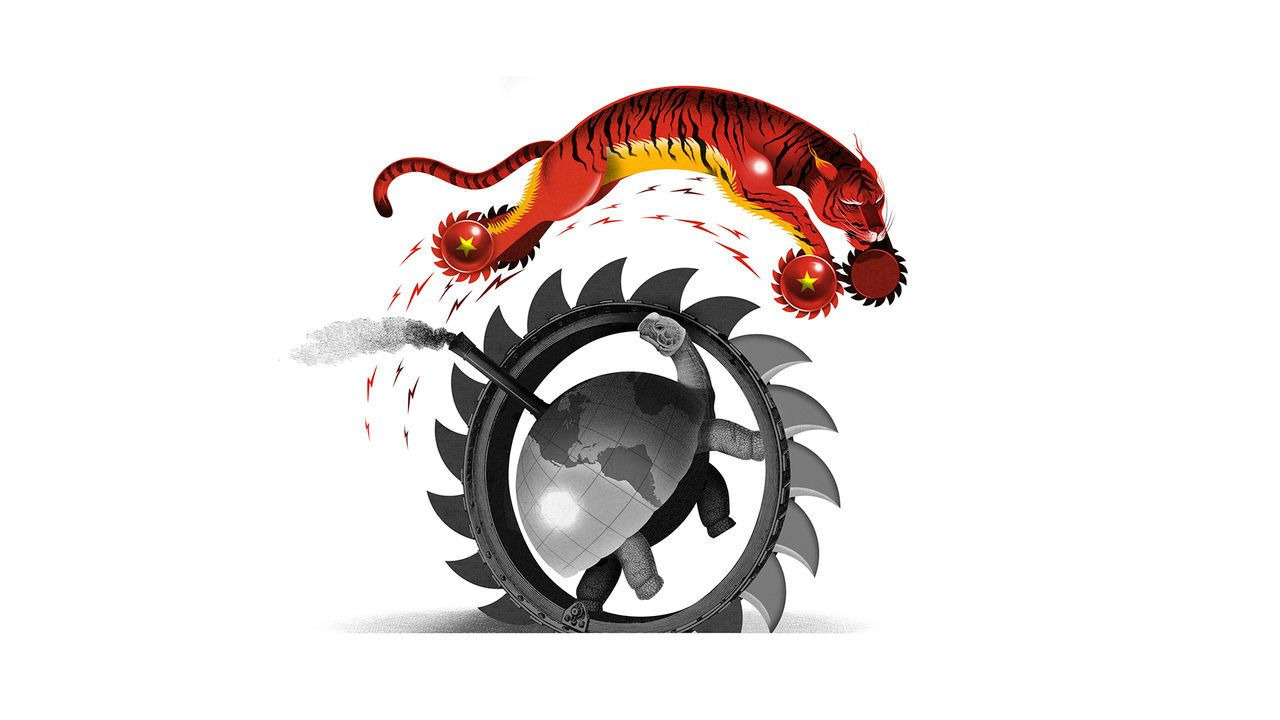
Illustration: Brett Ryder
Mar 20th 2025
Listen to this story
MANY OF THE world’s richest deposits of iron ore and copper predate the breakup of the last supercontinent, Pangaea, around 200m years ago. Tectonic shifts subsequently scattered the global economy’s two favourite metals around Earth’s surface. An abundance of the iron ended up in what are now Australia and Brazil. Prodigious seams of pre-Pangaeatic copper settled in places like central Africa.
In more recent times—extremely recent, geologically speaking—the mining industry formed to dig up this ancient bounty has been undergoing its own version of continental drift. Its business model is splitting asunder, say Western bosses. On one side are multinational giants such as BHP, Rio Tinto and Vale. They aim to maximise returns on the capital they put to work while taking a cautious approach to risks. On the other are much more gung-ho Chinese rivals. As iron ore and copper become scarcer, this could spell trouble for the Western firms.
The critical minerals which get the most attention tend to be things like lithium, used in batteries, and rare-earth metals with exotic names such as vanadium, which go into electronics. They are the reason Donald Trump covets Greenland and access to Ukraine’s subterranean bounty, which he has demanded in exchange for American help brokering peace with Russia. Iron ore and copper, which account for perhaps half the value of all metals mined worldwide, provoke no such conniptions.
Yet rare earths and lithium are in fact commonplace, just fiddly and dirty to extract. With a few domestic plants America could “solve its rare-earth problem”, reckons one mining executive, at a cost of perhaps $20bn-40bn—a mote of dust in the pile that is the $7trn-a-year federal budget. The two big base metals, in contrast, have always been hard to come by, and are becoming increasingly so as known deposits are shovelled up.
For most of the past four decades giant Western miners did the bulk of the shovelling. They were spurred on by globalisation, which was emerging as the most powerful force shaping the era that some geologists have christened the anthropocene. The rise of Japan in the 1980s and of China starting in the 2000s boosted demand for steel and copper cables. Between 2010 and 2014, as China became obsessed with building and metals prices soared, BHP, Rio Tinto and Vale ploughed a combined $200bn into capital investments.
That left the base-metals behemoths exposed when prices plunged. From 2015 to 2019, the trio’s collective annual pre-tax profits averaged $30bn, compared with nearly $60bn in the preceding five years. At one point in early 2016 all three were worth less than the book value of their assets. Returns on those assets had just turned negative, down from 15-25% in mid-2011. The combined market value of the three collapsed from more than half a trillion dollars in 2011 to barely over $100bn five years later.
Investors’ displeasure at the capital indiscipline forced the miners to think carefully about where they put their money. Each prospective project is now scrutinised for its profit-maximising potential. Capital spending has been reined in. Profits have rebounded. Market capitalisations have not returned to the lofty heights of the early 2010s but are no longer on the floor.
As the Western companies have grown less adventurous, state-controlled Chinese rivals have turned more so. Some of this has to do with greater Chinese tolerance for dodgy jurisdictions. Listed but state-controlled firms such as Zijin Mining and CMOC piled into the conflict-torn Democratic Republic of Congo (DRC), keen to get their hands on that central African copper, as well as the world’s biggest known reserves of cobalt (which is also important in battery-making). A Chinese-led consortium did the same with a big chunk of the gargantuan Simandou iron-ore project in Guinea once held by Vale (Rio Tinto retains an interest).
It is true that Chinese companies tend to be less constrained than Western businesses by concerns over human rights, environmental vandalism and graft. To level the playing field, and “further American economic and national security”, Mr Trump has ordered his Justice Department to stop enforcing the Foreign Corrupt Practices Act. Yet the Chinese have two even bigger advantages. The first, shared with the rest of Chinese industry, is a carefree attitude to profits. Zijin’s operating margin of 11% is less than half that of Rio Tinto and Vale, and a third of BHP’s. Jiangxi Copper ekes out 2%. Despite this they enjoy a lower cost of capital, thanks to their state sponsor.
Digger, thy neighbour
Disregard for the bottom line allows the Chinese to move faster—their second advantage. It took CNMC, a fully state-owned Chinese miner, less than four years to develop the Deziwa copper-and-cobalt mine in the DRC, from the signing of a joint-venture agreement with a Congolese partner to first ore shipments. By comparison, the paperwork for BHP’s planned Resolution copper mine in Arizona was first filed in 2013, with no end in sight.
Even in places less bureaucratic than America, Western firms can take three times as long to get mines going than their Chinese rivals, bosses admit. That is because BHP and its peers must keep their shareholders happy, which means painstaking due diligence to justify each project on its own merits. The Chinese favour a copy-paste approach that may result in operations that are less optimal. However, they start yielding results much sooner.
Speed mattered less when rock-bottom interest rates made cash far in the future worth nearly as much as cash tomorrow. As interest rates have risen, so has the value of alacrity. Mining bosses mustn’t sacrifice prudence. But they may need to speed up their sedimentary decision-making. ■
Leaders | A perilous path
Israel’s expansionism is a danger to others—and itself
It risks turning hubris into disaster

Mar 27th 2025
Listen to this story
IT IS HARD to believe today, but 18 months ago Israel was in grave peril. Surrounded by enemies, bickering with its main ally in Washington and reeling after Hamas’s attack caused the most murderous day in the country’s history, the Jewish state seemed vulnerable and confused. Now, by contrast, Israel is rampant. It is still fighting—occasionally in Lebanon and Syria, more permanently against Palestinian militants in the West Bank and once more, on an even larger scale, in Gaza, where an American-sponsored ceasefire has broken down. But this time Israel is fighting on its own terms and with full American backing. You might think that makes it safe again. Yet its renewed military supremacy comes with a danger of overextension and bitter strife at home. As its government charges ahead, it risks turning hubris into disaster.
The improvement in Israel’s security has been remarkable, and welcome. Since the atrocities of October 7th 2023 Israel has attacked and greatly weakened Hamas. Military action in Lebanon has decapitated Hizbullah. Iran’s baleful influence across the Middle East has been shattered, as its proxies in Gaza, Lebanon and Syria have foundered. Israel fended off two big Iranian missile barrages with America’s help, and struck back against Iran’s air defences.
However, the Israeli government has drawn two worrying conclusions from this success. One is that cruel tactics work. Having killed tens of thousands of civilians in Gaza, it has again withheld aid and shut off basic services, in what looks like a violation of international law. In Gaza it is preparing for a new occupation as part of what may become a huge ground operation. Shameful plans for ethnic cleansing are gaining currency. Encouraged by President Donald Trump’s vision of an American “takeover” and the resettlement of Gaza’s population, the Israeli government has approved the establishment of an agency for the “voluntary” departure of Palestinians. Since last year it has engaged in a rapid de facto annexation of the West Bank, expanding Israeli settlements, forcing tens of thousands of Palestinians from their homes and allowing violent settlers to rampage unchecked. A push for formal annexation is gathering pace.
The government’s second conclusion is that, after deterrence collapsed on October 7th, it must protect itself by creating buffer zones and striking perceived threats as early as possible. The army is attacking Lebanon, even if that discredits Lebanese groups who are working to shut Hizbullah out of power. Rather than wait to see if the new government in Damascus can put Syria together again, Israel is bombing it. That same logic could well lead to a pre-emptive strike against Iran, to prevent it acquiring a nuclear weapon. Having been softened up by Israeli bombing, the Islamic Republic’s defences are weaker than they have been in decades.
This is a dangerous path for Israel: in the region, with the Palestinians and at home. In the region Israel will struggle to maintain military dominance if it demands too much of its own forces. It has a citizen army of reservists, who serve at moments of national peril. Soldiers who have families to care for and businesses to run cannot live their lives if they are permanently being called up. In addition, Israel still depends on America to project force. But Mr Trump is not a dependable ally—especially if a war against Iran becomes drawn out. Even if his support endures, the Democrats could be back in power in 2029 and they would be less tolerant of annexation. And last, as repeated Israeli strikes around the region lead to a popular backlash, Arab leaders will gradually come to reflect their people’s hostility. In time that could threaten Israel’s regional alliances, with Egypt and Jordan and with several other Arab countries through the Abraham accords.
As for the Palestinians, Israel cannot simply cancel their yearning for a homeland. After the horrors of October 7th most Israelis oppose the creation of a Palestinian state or the incorporation of Palestinians as full citizens inside Israel. But other options are dire. Formal annexation of Palestinian land would lead either to ethnic cleansing, or the creation of non-citizens without full rights, or to further cooping up Palestinians in tiny non-viable statelets. If those policies are enacted, it will be an affront to the values on which Israel was founded.
Overextension may be most corrosive within Israel. The trauma of October 7th ought to have united Israeli society. However, the country is once again divided. A clear majority of Israelis support negotiations with Hamas and a withdrawal from Gaza in order to bring the remaining hostages there home. They believe that the prime minister, Binyamin Netanyahu, is prosecuting the war to appease the hard right, whose support he needs to prevent his government from collapsing. Increasingly, army reservists wonder if they are fighting a war in the national interest or in the interest of a minority that happens to wield influence.
This comes as the government is showing a distressing eagerness for democratic backsliding. It is using aggressive tactics to curb the independence of Israel’s institutions. In recent days the cabinet has endorsed the firing of the head of the Shin Bet, the domestic security agency, and of the attorney-general—both decisions are fiercely contested. The two officials happen to be involved in investigations of Mr Netanyahu’s aides over allegations of graft and other sins. At the heart of Israel’s crisis is a campaign by religious Zionists who see their vision of Israel as a country embracing the biblical lands of Azza, Judea and Samaria, as they call Palestinian territory, being thwarted by the country’s secular institutions.
Israel looks strong. But its army is tired and its politics is split. Meanwhile, the most dynamic part of the Israeli economy, its tech sector, is highly mobile. Before October 7th tech workers dismayed at political divisions and erosion of the rule of law threatened to move abroad. They may one day make good on those threats. For many years Israel depended on its American ally to tell it when to stop fighting. With Mr Trump in the White House, those days are over. Israel now needs the wisdom to practise self-restraint. ■
Leaders | Dark times
President Recep Tayyip Erdogan is throttling Turkey’s democracy
But no one outside Turkey seems to care
Photograph: Getty Images
Mar 25th 2025
Listen to this story
Recep Tayyip Erdogan has been running Turkey for 22 years, and has spent much of that time eroding its democracy. His government controls the courts, the security apparatus and almost all the media. Yet until last week Turkey remained a place where the opposition could, in theory, win elections, and occasionally did, at least at the local level. Since the arrest on March 19th of Ekrem Imamoglu, the mayor of Istanbul and Mr Erdogan’s strongest rival, along with many of his associates, that may no longer apply.
Some have thought Mr Erdogan an aspiring dictator ever since the 1990s, when as an Islamist he campaigned against Turkey’s secularism. He once called democracy a tram you get off when you reach your stop. However, his first years in power were reassuring. It was only later that he cracked down on ngos and used trumped-up prosecutions to attack opponents. Mr Erdogan crushed Kurdish militias in a military campaign in 2015 and jailed peaceful Kurdish dissidents. The next year, after foiling a coup attempt, he imprisoned tens of thousands of people, only some of whom had played a part in the putsch, and muzzled the media. Still, the Turkish president consistently beat the opposition in elections that were largely free, if far from fair.
Mr Imamoglu’s arrest marks a turning-point. For months the charismatic mayor has led Mr Erdogan in opinion polls for the next presidential election, due in 2028 or before. Last year his Republican People’s Party (CHP) shocked Mr Erdogan’s Justice and Development (AK) party by beating it in local elections. Years of economic mismanagement and corruption scandals have sapped Mr Erdogan’s popularity. Mr Imamoglu’s emergence as the CHP’s leader promised a chance of a democratic transfer of power. But his imprisonment, on charges of corruption that experts consider baseless, suggests that Turkey’s president would rather end democracy than risk losing.
Mr Erdogan seems to have picked this moment shrewdly. Donald Trump has shown little interest in other countries’ democratic standards. Europe is preoccupied by the war in Ukraine and its difficulties with Mr Trump. Indeed, the Europeans need Turkey’s help and are courting Mr Erdogan to supply troops for a potential peacekeeping force in Ukraine. As America steps back from Europe, Turkey’s army, the second-largest in NATO, is more vital than ever. And since the migrant crisis of 2015-16, the European Union has relied on Turkey to keep waves of refugees away from its borders.
For all these reasons, the international reaction to Mr Imamoglu’s arrest has been meek. The European Commission merely urged Turkey to “uphold democratic values”, though France and Germany made tougher statements. Europe could do more. Greece and Bulgaria have toughened their borders, meaning that Turkey can no longer so easily threaten to flood the EU with migrants. Mr Erdogan still appears to value Turkey’s long-dormant candidacy for EU membership. He has also wanted to broaden his country’s customs union with the EU; the bloc should make it clear that is out of the question while Mr Imamoglu remains behind bars.
Yet outside powers cannot stop Mr Erdogan from turning Turkey into an autocracy. Only its citizens can do that. Some of them may be alarmed by his growing authoritarianism, others by the worsening prospects for the economy as investors lose confidence that reformers will be able to make their voices heard. The hundreds of thousands braving police batons to protest against Mr Imamoglu’s arrest have the democratic world’s sympathy. Alas, they will not get much else. ■
Leaders | The cost of uncertainty
The unpredictability of Trump’s tariffs will increase the pain
Businesses are struggling to adjust
Illustration: Rose Wong
Mar 27th 2025
Listen to this story
DONALD TRUMP has already raised the average tariff on America’s imports by about twice as much as he did in his entire first presidency. Just as damaging, though, has been the uncertainty about what comes next.
After April 2nd—“Liberation Day”, Mr Trump calls it—there will be another round of levies. The president promises 25% tariffs on all imported cars and country-by-country “reciprocal” tariffs based on how much his administration objects to a counterparty’s trade and tax policies. Will these plans change? Who knows? Mr Trump’s use of emergency powers means that he can do as he pleases.
This freedom may suit him. It does not, however, suit America’s businesses, which have no idea how bad the trade war will get; nor its consumers, who fear future inflation. The liberation America needs is from the paralysing uncertainty brought about by Mr Trump’s chaotic approach.
Since the president came to office, hefty tariffs on Canada and Mexico have twice been announced only to be mostly postponed. A long-threatened 10% levy on China has doubled in size. Industry-specific measures have proliferated. Mr Trump has already struck aluminium and steel imports, and has pledged new levies on chips, lumber and medicines. The price of copper has soared as reports swirl that it is to be targeted next. His justifications are dizzying: tariffs have been linked to border control, drug smuggling, vat, trade deficits, TikTok and Mr Trump’s territorial ambitions. The president recently threatened to put levies on any country buying Venezuela’s oil. Such “secondary” tariffs, placed on the trading partners of target countries, would be devastating.
What’s a business to do? When currying favour with Mr Trump, firms play up their investment plans. But when speaking to shareholders, they warn about the unpredictable environment. Surveys show an alarming fall in planned capital expenditure. The White House claims that, by prompting firms to invest in America, its tariffs on cars will boost GDP, jobs and real incomes.
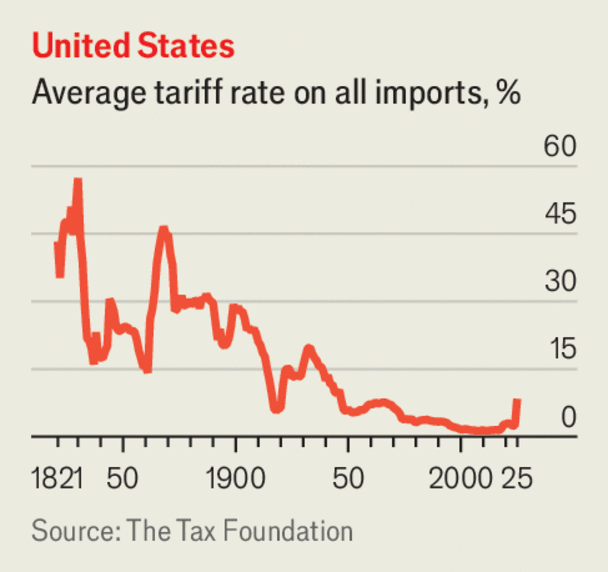
Chart: The Economist
Ironically, however, the uncertainty makes it harder for tariffs to change investment patterns. Factories last for a long time. Building one in response to a tariff that could disappear at any moment is a gamble. The tariffs Mr Trump implemented during his first term failed to stem the secular decline in American manufacturing jobs. They did, however, push up costs for downstream producers, such as the firms that made goods using imported steel.
It would be naive to think that the tariff regime will be settled on April 2nd. The president exults in his power to dole out punishment and grant exemptions at will. It makes companies and countries beat a path to his door to beg for mercy. In contrast to his first term, Mr Trump seems little concerned by the falls his policies cause in financial markets. And this time his staff are proving to be pliant. Scott Bessent, a hedge-fund titan turned treasury secretary, used to be a source of comfort to investors. He now says that market corrections are “healthy” and the economy could benefit from a “detox”.
Although Mr Trump is committed to tariffs, he is hardly a details man: his unpredictability partly reflects his malleability. This creates an opportunity. His advisers are debating how to implement his agenda. Some reportedly favour using emergency powers only as a stopgap during which the more studious approach of his first term—in which tariffs followed investigations—can be resurrected. Establishing even a bare-bones process would represent a big improvement.
The most beautiful word in the dictionary
America’s trade partners must also consider how they can stabilise the situation. It will be tempting to retaliate on April 2nd, as many countries have against existing levies. But retaliation carries a cost, because it brings economic pain, and because it might stoke further escalation from America. For most countries retaliation is simply self-defeating. Even those who have the clout to push back should be careful how they use it.
Better, then, to offset the damage America is inflicting. Given Mr Trump’s reciprocal approach, some countries may be able to win concessions by lowering their own tariffs. And countries could bring down the barriers that exist among themselves, integrating with each other as Mr Trump pulls America back. The president is intent on wreaking trade havoc. It need not span the globe. ■
Asia | A new era for salarymen
Japanese people are starting to quit their jobs
After decades of inertia, workers are now on the move. Why?

Photograph: AP
Mar 27th 2025|Tokyo
Listen to this story
Kawata Yasutoshi was never cut out for traditional Japanese corporate life. As a former guitarist in a heavy-metal band, he found working at a large electronics firm frustrating: particularly the rigid hierarchy, where youngsters did whatever their seniors said. A lot of the work was inefficient, and many hours slipped away either at his desk or at obligatory drinking sessions with his colleagues. Leaving proved tricky, too. When he decided to move to a global IT company a decade ago his superiors berated him, even calling him a “traitor”. Now in his late 40s, Mr Kawata has changed jobs again. “I was hungry for a challenge,” he says.
These days Mr Kawata is less of an outlier. In Japan the ideal worker was once employed fresh from graduation and expected to stick with one company for life—reaping the benefits of a seniority-based promotion system as he (usually not she) aged. But this rigid “salaryman” model is eroding. While job-hoppers remain less common in Japan compared with Western countries, they are on the rise.
The number of regular workers shifting to another full-time job reached 990,000 in 2024, an increase of more than 60% from a decade ago. In a 2024 survey by the Tokyo Chamber of Commerce and Industry, 21% of young Japanese employees said they plan to stay with their current employer “until retirement”, down from 35% in 2014. The trend reflects Japan’s demographic reality too; workers have more bargaining power when they choose jobs as the working-age population shrinks. According to one survey, over half of Japanese companies face a shortage of regular workers. Japan’s once-mighty civil service has also faced an exodus of smart young employees looking for something more exciting.
Japan’s archetypical salaryman worker emerged in the post-war boom period (coinciding with Showa, the era of Emperor Hirohito’s reign). Their loyalty was demonstrated through long hours at the office and after-hours bonding. A famous advertisement for an energy drink in the 1980s asked, celebrating the dedication of corporate warriors, “Can you fight 24 hours?”
But younger generations have started to question this way of working. The share of men taking paternity leave has jumped from 2% of those eligible a decade ago to 30% in 2023. “The Showa-era workstyle is collapsing,” says Ono Hiroshi of Hitotsubashi University Business School. Matsunami Tatsuya, a millennial in Tokyo, thinks that “so many Japanese people don’t find joy in their work.” The salarymen he saw on trains when growing up looked more like lifeless zombies. Determined not to follow the same path, he launched his own recruitment agency, matching workers with startups that are tackling social issues.
At the office, tensions are brewing across generations. Young workers complain about hatarakanai ojisan, “older men who don’t work”, referring to veterans who contribute little but remain protected by Japan’s strict labour laws. In a survey in 2022 nearly half of employees in their 20s and 30s reported having such colleagues, citing them as a major cause of falling workplace morale. They also tend to clog upper-management positions, leaving younger workers little room to advance. “Windows 2000” is another phrase to mock such senior slackers—a play on their hefty ¥20m ($132,000) salaries. During the pandemic, Japan’s unemployment rate remained around 3% (by comparison, America’s rose from 4% to nearly 15%). Mr Ono likens Japan’s rigid labour market to a “stagnant bathtub”, where water cannot be drained or refreshed.
Calls for regulatory reform have grown. In 2019 the then head of Keidanren, Japan’s largest business federation, declared that the country’s lifetime-employment system was “no longer sustainable”. More recently, during the Liberal Democratic Party’s leadership race last year, Koizumi Shinjiro, one of the leading candidates, pledged to loosen dismissal rules to promote labour fluidity—though his proposal sparked fierce debate, with conservative candidates warning against hasty changes.
But though policy is slow to adapt, attitudes are shifting among older workers too. A famous saying in Japan known as the 35-year-old limit theory warns that changing careers after that age is almost impossible. That theory is starting to crumble. According to Recruit, an employment agency, the number of job-hoppers in their 40s to 50s increased sixfold over the past decade. Wakatsuki Mitsuru, 44, recently left his job at a big Japanese firm after having spent more than two decades there. “I probably could have coasted along for another 20 years until retirement,” he says. “But I couldn’t help thinking: is that what I want?” Labour shortages also mean that companies that used to focus on hiring fresh graduates now increasingly welcome mid-level talent.
This shift has big economic implications. In Japan, a lack of labour fluidity has meant that wage rises depend on shunto, the annual spring wage negotiations. Another Recruit study finds that nearly two-fifths of job-hoppers now see their wages rise by more than 10%. That was true for less than one-third of them in 2021. While Japanese wages have remained low by rich-world standards, growing labour mobility “could improve the situation”, observes Koike Masato, an economist at Sompo Institute Plus, a think-tank in Tokyo. It could also inject dynamism into Japan’s ossified institutions. “When you have the same people staying in the same organisation, the mindset becomes increasingly inward,” says Mr Wakatsuki, reflecting on his previous workplace. Mr Kawata, the bandsman-turned-IT worker, agrees. “Japanese firms need wind from the outside to blow in.” ■
China | Tracking the hacking
Chinese hackers are getting bigger, better and stealthier
Experts say it is the main shift in the cyber-threat landscape in a decade
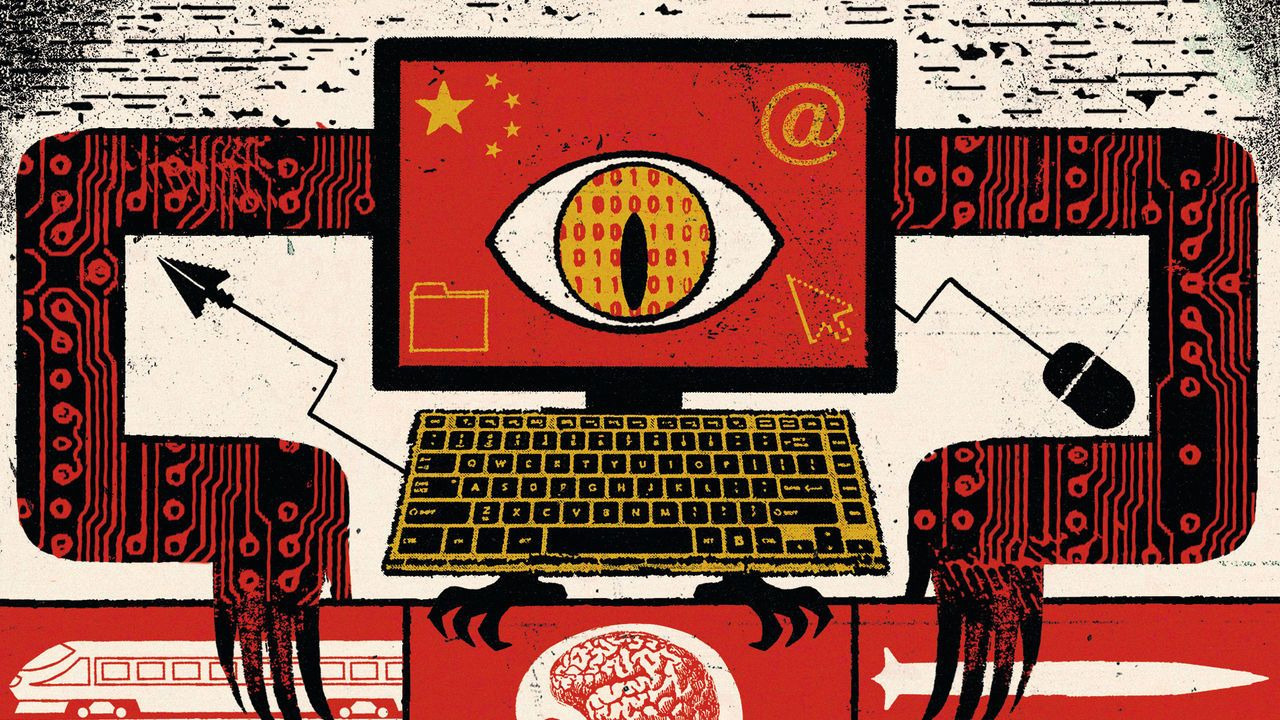
Illustration: Ben Jones
Mar 25th 2025
Listen to this story
China’s POWER is growing rapidly every year. From warships to missiles, the country is churning out hardware at an extraordinary rate. In the unseen, online world, it is making similar leaps. On March 4th America’s Justice Department charged eight Chinese nationals with large-scale hacking of government agencies, news outlets and dissidents in America and around the world, on behalf of i-Soon, a Chinese company, at the direction of the Chinese government. It also indicted two officials who it said “directed the hacks”.
These instances are the tip of a vast iceberg. Over the past decade China’s hacking programme has grown rapidly, to the point that in 2023 Christopher Wray, then the fbi director, noted it was larger than that of every other major nation combined. China’s growing heft and sophistication have yielded success in three main areas.
The first is political espionage, linked primarily to the Ministry of State Security (mss), China’s foreign-intelligence service. Last year it emerged that one group of Chinese hackers, dubbed Salt Typhoon, had breached at least nine American phone companies, giving them access to the calls and messages of important officials. Ciaran Martin, who led Britain’s cyber-defence agency from 2016 to 2020, compares it to the revelations in 2013 by Edward Snowden, a government contractor, that American spy agencies were conducting cyber-espionage on a huge scale. China was “gaining vast access to the nation’s communications via a strategic spying operation of breathtaking audacity,” he says.
A second is in domains of little espionage value: hacking that lays the groundwork for sabotage in moments of crisis or war. These efforts are led by the People’s Liberation Army (pla), China’s armed forces. In 2023 it became apparent that a pla-linked hacking group known as Volt Typhoon had, over several years, burrowed into an extraordinary range of American critical infrastructure, from ports to factories to water-treatment plants, across the continental United States and in strategic American territories such as Guam.
All of that builds on a third type of hacking: the industrial-scale theft of intellectual property. In 2013 Mandiant, a cyber-threat intelligence firm, which is now part of Google, made waves when it exposed “apt1”, the label for a group of hackers linked to the pla. apt1 was not focused on stealing political secrets or turning off power grids but on stealing blueprints, manufacturing processes and business plans from American firms. A year later America’s government took the then unprecedented step of indicting five pla hackers for this activity. Keith Alexander, a former head of the National Security Agency (nsa), America’s signals-intelligence service, described this as “the greatest transfer of wealth in history”.
That period ended with a partial truce. In 2015 Barack Obama, then America’s president, and Xi Jinping, his Chinese counterpart, announced a “common understanding”. Neither country would conduct cyber-espionage to steal intellectual property. The agreement worked. Shortly afterwards commercial espionage of this sort fell dramatically, if temporarily. But that was simply the start of the new era of political espionage and sabotage.
All of these areas have been affected by three big shifts within China’s hacking programmes. One is who is doing the hacking. In 2015-16, shortly after being shocked by the Snowden revelations, China reshuffled its cyber forces. The pla was forced to retrench, focusing on military intelligence and reconnaissance—like Volt Typhoon—and its activity declined. The mss took over political-intelligence gathering—like Salt Typhoon—which it conducted with gusto, and commercial espionage, which continued on a smaller scale. “Nowadays,” writes Tom Uren, author of “Risky Business”, a cyber newsletter, “the mss is the big kahuna.”
Quieten down, lads
Second, Chinese hacking got better. About 20 years ago, when cyber-security firms began tracking the threat, Chinese hackers were “very, very loud”, says John Hultquist of Mandiant, “incredibly willing to set off alarms, incredibly willing to be caught”. A European official concurs. Even five years ago, she says, “Chinese cyber operators were not considered very sophisticated.” That has now changed. “The speed at which they improve always seems to come as a surprise to Westerners, even though it really shouldn’t,” says the official. “If China wants to accelerate in an area, then they will, and they have very smart people.”
That points to a third shift. Chinese cyber operations now draw increasingly on a large and flourishing private-sector ecosystem which has become a talent pipeline, enabler and force multiplier for Chinese cyber operations around the world. Consider the mss-linked Tianfu Cup in the south-western city of Chengdu (which has emerged as a hub for this kind of activity). It is one of many “capture the flag” (ctf) competitions in which tech-savvy youngsters compete to show off their hacking prowess by finding and exploiting vulnerabilities in software. China has hosted about 130 of these sorts of events since 2004, most of them after 2014, and many backed by government ministries, according to data collected by Dakota Cary, a consultant at SentinelOne, a cyber-security company, and Eugenio Benincasa of the Centre for Security Studies at eth Zurich.
These events can draw huge crowds. The Wangding Cup is organised by the Ministry of Public Security (mps), which runs the country’s police force and gathers domestic intelligence. The cup is known as the “cyber-security Olympics” and can attract 30,000 people, note Mr Cary and Mr Benincasa. The tournaments are scouting grounds for Chinese spooks. As with elite sports, a handful of star hackers tend to drive a team’s success. A decade ago Chinese hackers were allowed to travel to contests abroad; that is now restricted. The vulnerabilities they discover—weaknesses in code that can be used to gain access—“are siphoned straight into the state apparatus”, says a person familiar with the process. In 2021 the government punished Alibaba Cloud, a tech firm, for divulging a vulnerability without first telling the state.
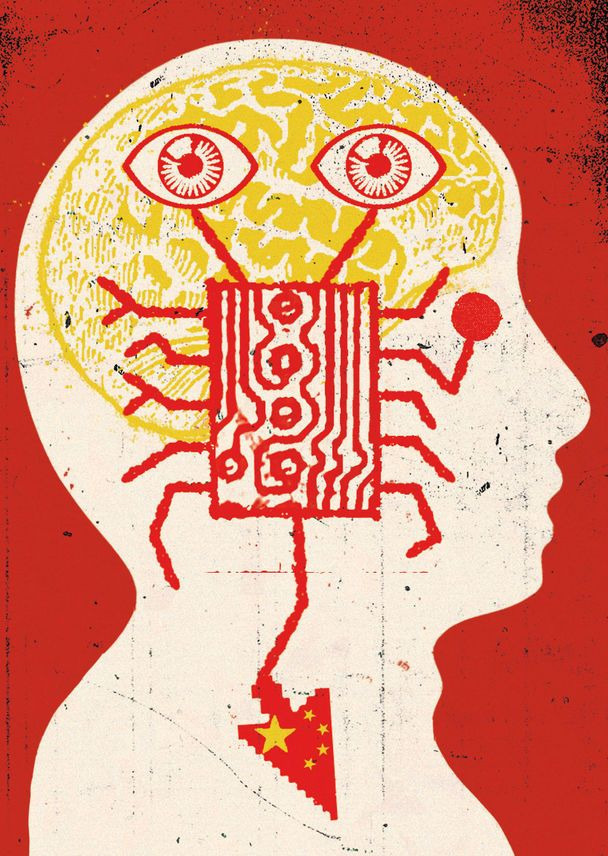
Illustration: Ben Jones
Talent contests are just the start. Last year, documents belonging to i-Soon were leaked on the internet. They showed that the firm was functioning as a private signals-intelligence agency whose targets spanned 23 countries: Nepal’s presidential palace, road-mapping data from Taiwan, South Korean telephone logs, Indian immigration systems and Thailand’s intelligence service. i-Soon is one of many such firms in Chengdu.
The firms are not unstoppable ninjas—the leaked files show evidence of internal arguments, disorganisation and failure—but they add to China’s cyber heft. Even where mss hackers do the hacking themselves, they often rely on this corporate hinterland for the tools and infrastructure to enable their attacks. When Chinese hackers first started, they used to come, undisguised, “right out of Shanghai networks”, says Mr Hultquist. Today they make use of operational-relay-box (orb) networks, built and maintained by private firms, which use compromised devices around the world, such as home internet routers, to disguise the origin of attacks.
The increasing scale, sophistication and aggression of Chinese hacking are “by far the most significant shift in the cyber-threat landscape in well over a decade”, notes Mr Martin. Volt and Salt Typhoon, on their own, “are strategic compromises of the West on a scale hitherto unseen by any other cyber power”, he warns.
It is not yet an all-out cyberwar. “What separates China from their peers like Russia, North Korea and Iran”, says Mr Hultquist, is that those states routinely cross the line from espionage to disruption, from spying and reconnaissance to outright sabotage. China has “never pulled the trigger”, he says. Even in American infrastructure networks, China has stopped short of inserting destructive code. “We can see them doing the reconnaissance. We can see them getting into place. They’re not showing us the weapon.” ■
United States | Cyber muck
Elon Musk is powersliding through the federal government
But to what end?

Illustration: Patrick Leger
Mar 27th 2025|CHICAGO
Listen to this story
The United States Institute of Peace (usip) was established by Congress in 1984 to promote an end to conflict all over the world. Forty years later it came to an end with an armed stand-off at its headquarters, a glass and acid-etched concrete building just off the National Mall.
usip is not part of the executive branch. It is an “independent nonprofit corporation”, according to its founding law, and owns its own building. Yet on February 19th Donald Trump issued an executive order to shut it down. Its president, George Moose, resisted but could not hold out. On the afternoon of March 17th Elon Musk’s “Department of Government Efficiency” (DOGE) came to visit.
The incursion was just one of dozens of raids conducted by DOGE on various parts of government. The tension it sparked, and the nature of DOGE’s tactics, illustrate the extent to which Mr Musk has become Mr Trump’s enforcer.
According to an affidavit by Colin O’Brien, the Institute’s head of security, at around 2.30pm, three cars packed with men turned up at the headquarters. They were let into the lobby by Kevin Simpson, an employee of Inter-Con, a contractor which had managed the building’s security until Mr O’Brien cancelled the contract. Mr Simpson had nonetheless retained a physical key. According to Mr O’Brien, Derrick Hanna, a vice-president at Inter-Con, said the firm had been threatened with losing all of its government contracts if it did not co-operate and let doge in.
usip’s lawyer then called the DC police department to report a break-in. Mr O’Brien meanwhile electronically locked all of the building’s internal doors. The stand-off was resolved when the police, apparently on the advice of Ed Martin, Mr Trump’s interim US attorney for the District of Columbia, forced Mr O’Brien and his colleagues to open up, before escorting them off the premises. By the following day the institute’s website was offline and its signage had been removed from its headquarters. The organisation’s 400-or-so staff, many of them working in conflict zones, are now in limbo.
In the past two months doge has ripped through the federal government. It has already obliterated one whole department, USAID, America’s aid agency. Within others it has unleashed chaos with sudden firings and equally sudden reversals under court orders. Almost across the board, with its threatening emails, mass firings and its hoovering-up of sensitive government data, DOGE has provoked something close to panic among civil servants. “They have created confusion, fear and loathing across the entire federal workforce,” says Max Stier of the Partnership for Public Service, a charity that works to improve government. Is this a necessary part of a transition to more efficient government, or is something else going on?
There is little doubt that the government needs to change. “Reform is absolutely needed on both a micro level and a macro level,” says Steve Goodrich, a consultant with decades of government experience. Reports from the Government Accountability Office list failure after failure. And Mr Musk’s record in the private sector is replete with success in cutting costs and getting seemingly impossible things done quickly. Part of his mantra is that the only unbreakable rules are the laws of physics.
When DOGE was first mooted, few predicted it would so quickly shape Mr Trump’s second term. After all, this would not be the first time a Republican president brought in a businessman to fix the government. In 1982, Ronald Reagan also pledged to “drain the swamp”. He launched the Grace Commission, led by Joseph Peter Grace, a chemicals industrialist. Grace’s group promised to save $424bn of spending in three years, not much less relative to the economy than Mr Musk’s promise to cut $1trn in one year. Most of its recommendations came to little.
Ludicrous speed
The planning for something far more dramatic under Mr Trump seems to have begun even before the election. On a recent podcast, Senator Ted Cruz recalled a meeting with Mr Musk in September or October where the tech billionaire said he wanted “the login for every computer” at the government. By the time Mr Trump took office on January 20th, there was a clear blueprint. With an executive order, Mr Trump inserted DOGE into an existing organisation, the United States Digital Service (usds), and gave it a mandate to access any government IT system.
With this, Mr Musk’s new employees—almost all young, male software engineers—set to work. They wear hoodies, carry multiple phones and suck on Zyn nicotine pouches. Some have been sleeping at the offices of the General Services Administration. To career civil servants they are known as the “Muskrats” or “the Bobs” (after consultant characters in “Office Space”, a cult film). The youngest, Edward Coristine, nicknamed “Big Balls”, is just 19 years old and, according to Reuters, previously ran a firm that provided tech support to a cybercrime ring.
Mr Musk says that he doesn’t think “anything has been this transparent ever”, but DOGE has been secretive from the beginning. Its workers hid their names at the agencies they arrived in. For several weeks, government lawyers told judges that they did not know who the administrator formally in charge of DOGE was. At the end of February they relented and named Amy Gleason, a former USDS employee, as acting administrator. But in a sworn statement on March 19th, Ms Gleason admitted that nobody reports to her, and that DOGE still has no organisational chart.
DOGE appears to be run by Mr Musk directly and by his trusted lieutenants from business, such as Steve Davis, a longtime collaborator. Mr Trump told Congress on March 4th that DOGE is “headed by Elon Musk”. Mr Musk seems to have almost completely ditched his other jobs, and has been sleeping at the Eisenhower Executive Office Building, next door to the White House. He has an office there where he has apparently installed a gaming computer with a large curved monitor.
The extent of Mr Musk’s ambition became clear a week after the inauguration, when almost all federal workers received an email offering “deferred resignation”. It was entitled a “fork in the road”, the phrase Mr Musk used when he took over Twitter in 2022. Since then tens of thousands of “probationary” government workers have been fired, only to be reinstated after judges ruled that the Office of Personnel Management (opm), the federal government’s HR department, had exceeded its authority. Many of them are now back.
DOGE’s work has gone far beyond trimming headcounts, though. Its workers have also grabbed government data. In February, when USAID was, in Mr Musk’s words, fed “into the woodchipper”, DOGE recruits were trying to take control of the Treasury’s central payment system to stop its payments out to contractors. In the weeks since, they have tried, with varying degrees of success, to get access to data from the Internal Revenue Service, from the Social Security Administration and from the Department of Labour, among other places. On March 20th Mr Trump signed an executive order strengthening their ability to do this, though court fights continue.
Some of the efficiency drive has been beyond parody. After one early mass firing of probationary workers at the National Nuclear Security Administration, which manages America’s nuclear weapons, the agency was forced to issue an agency-wide memo to get contact details with which to beg them to come back. The DOGE workers who did the firing had apparently not thought to ask for personal email addresses before cutting off government ones. In another mess, the names of recently recruited CIA agents were sent in an unclassified email to the opm after DOGE’s request for the details of all probationary employees. Their names may now be known not just to DOGE, but to China’s government too.
What does this add up to? Mr Musk is not yet cutting the budget deficit much. Civil servants’ wages make up only around 5% of federal spending. Firing irs agents in particular could cost a fortune in uncollected taxes. Other cuts have hit scientific research and software licences. Some of this no doubt needed trimming, but the cuts have been indiscriminate.
Super heavy
As for efficiency, it is hard to see much of it. “I’ve done nothing but put out doge fires for six weeks,” says one government lawyer. Veterans Affairs psychiatrists now deliver therapy in busy open-plan offices because they can no longer work from home. Park rangers have to beg to be allowed to buy petrol. An inbox to which workers have been ordered to send weekly bulletin-point diaries is full. Workers are furious. One employee at the Treasury who voted for Mr Trump three times describes Mr Musk as “the literal antiChrist”.

Illustration: Patrick Leger
There are enormous conflicts of interest here, notes Don Moynihan of the Ford School of Public Policy in Michigan. After all, Mr Musk’s companies have faced probes from almost every federal regulator the billionaire is now gutting. Yet Professor Moynihan goes on to say that grift does not explain DOGE. Even with Mr Trump filming a free Tesla advert on the White House lawn; the commerce secretary tipping its stock on live TV; and people who vandalise Teslas threatened with deportation to El Salvador, Tesla’s market value has slumped.
In his interview with Mr Cruz, the Tesla boss described his work as “reprogramming the Matrix”. He laid out a conspiracy theory in which vast sums of government money are sent by “magic money machines” to left-wing charities whose leaders “buy jets and homes and… live like kings and queens”. What remains is used to bribe foreigners to move to the United States. “By using entitlement fraud, the Democrats have been able to attract and retain vast numbers of illegal immigrants and buy voters,” he said. Some 20m people have supposedly been spread across swing states to rig elections. The obvious problem with this is that it is nonsense. To take one example, the $1.9bn Mr Musk says was sent personally to Stacey Abrams, a Democratic politician in Georgia, was spent on renewable-energy projects.
Insane mode
Grover Norquist, a conservative activist, once famously said he wanted to cut the state “to the size where I can drag it into the bathroom and drown it in the bathtub”. Half a dozen federal workers interviewed by The Economist have cited that same quote to explain what they think Mr Musk is doing. He has, for example, taken an axe to the Social Security Administration—ordering dozens of its physical offices to be closed and threatening to get rid of its phone helplines. This is unlikely to stop much fraud, but it may mean that fewer people who are entitled to benefits claim them. Some think that the ultimate plan is to replace most workers with an AI and that this explains why DOGE is grabbing so much sensitive data.
One thing that is certain is that Mr Musk is centralising power to get things done that might otherwise be blocked by Congress or the courts. DOGE’s demolition of USAID achieved a longstanding goal of Mr Trump’s to reduce money sent to foreign countries, and though a court has now ruled it was probably unconstitutional, it will be hard to rebuild the agency. Courts are simply not set up to reverse these sorts of scorched-earth tactics, argues Anna Bower of Lawfare, a specialist legal-news site. Similarly, cutting off grants to universities may damage things like cancer research, but by putting that power directly in the hands of the president, Mr Musk has helped Mr Trump to impose his will on institutions like Columbia University.
The power to make sudden cuts gives Mr Trump enormous leverage. Republican congressmen, who are meant to hold the power of the purse, now have to ring up Mr Musk and ask for cuts in their districts to be reversed. In a tweet posted on March 7th Tom Cole, a representative from Oklahoma, announced that he was “thrilled to announce that common sense has prevailed” after he worked with DOGE to reverse office closures planned for his district. Two days before, Mr Musk met with Republican members of Congress and handed out his mobile phone number. The possibility of targeted cuts is something Republican congressmen must consider before expressing disloyal thoughts.
What this adds up to is an upending of America’s constitutional order of a sort unseen since Nixon’s presidency, if not before. It may yet burn out. Mr Musk has already begun to clash with cabinet members, some of whom do not like having their authority usurped. Polling suggests the billionaire is far less popular than his boss. The takeover of USIP aside, there are some signs of tactical retreat. Most cuts now at least are nominally “advised” by DOGE, rather than directly ordered. The pressure on the group will only grow in coming months, says Ms Bower, as litigation ties the government up in knots and discovery reveals more of what DOGE is up to. All of this might doom the work of lesser men. But with his businesses, Mr Musk has defied gloomsters. If his project in government succeeds, he could get a lot done. Whether that would be good for America is another thing. ■
The Americas | Disappearances in Mexico
A newly discovered killing site shocks Mexico
Can outrage over the latest case force change?
Photograph: Getty Images
Mar 25th 2025|Mexico City
Listen to this story
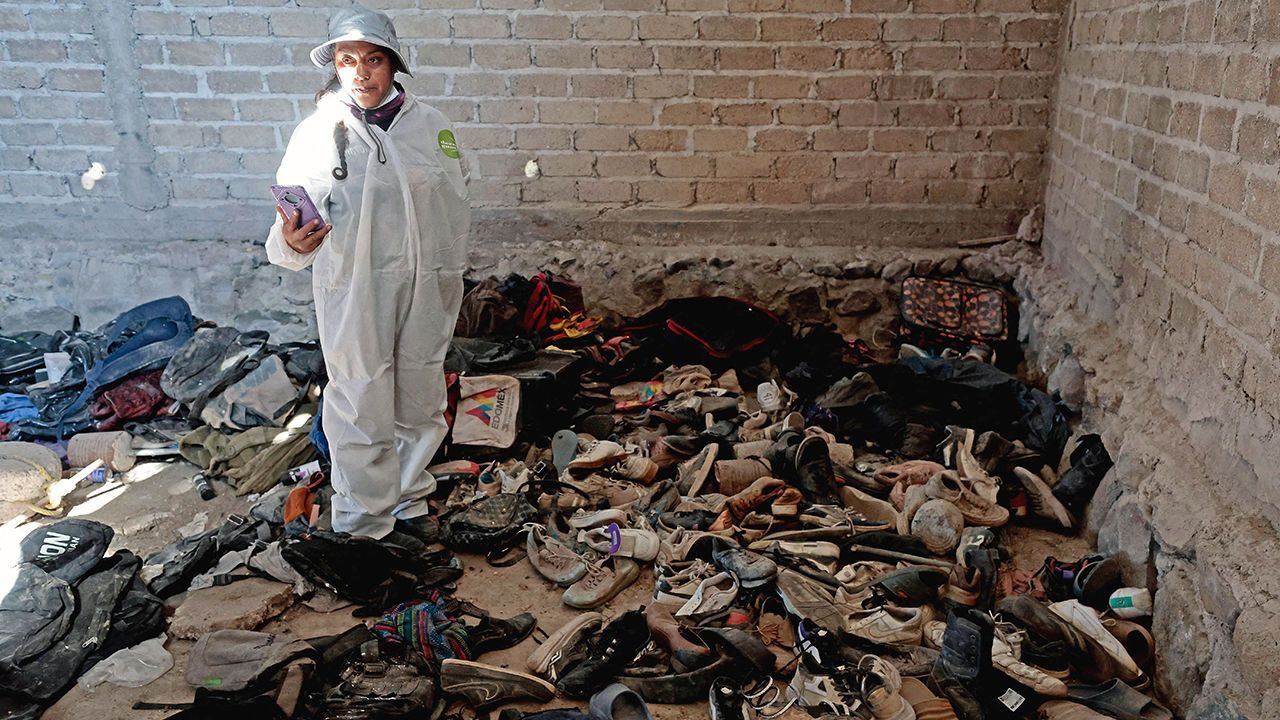
Mexicans rarely express outrage commensurate with the country’s suffering. But the discovery on March 8th of three cremation ovens, bones and hundreds of shoes at a ranch in Teuchitlán, in the state of Jalisco, has sparked real shock. The horror has reignited fury over Mexico’s epidemic of disappearances—and the government’s inaction. “Mexico is a mass grave,” read one sign at a vigil.
Disappearances became common after 2006, when the government’s “war on drugs” caused rivalries between splintering gangs. They rose sharply during the six-year presidential term of Andrés Manuel López Obrador, which ended last year. In 2024 an average of 37 people disappeared every day. The figure has risen to 40 since October. Most are young men, often entangled with gangs. Others are unrelated. The Teuchitlán ranch appears to have been used by Jalisco New Generation Cartel, Mexico’s most brutal criminal organisation. Victims probably included those who had been forcibly recruited and killed after they failed to pass training.
Most of the disappeared are presumably dead. Burning the bodies is one method of hiding the crime; others include dissolving them in acid or burying them in the desert. Nearly 6,000 clandestine graves have been found. Mexico’s forensic services hold the remains of 72,000 unidentified people, some of who may be on the missing-persons register. The full scale of the crisis is unknown. The official register of 124,000 missing is certainly far too low. Add confirmed killings to the disappearances, and the picture is clear: the risk of being murdered in Mexico is rising.
Disappearances are given little attention because that suits politicians and criminals alike. Officials point to falling murder numbers and fail to mention the rise in disappearances. Criminal groups dispose of bodies because it helps them avoid investigation. “The state doesn’t look for missing people,” says Francisco Rivas of the National Citizen Observatory, an NGO in Mexico City. The country’s many collectives—volunteer groups of relatives of the missing, mainly mothers—do the work of the authorities. One such group unearthed the evidence at the ranch (and have since received threats). Only weeks earlier government security forces had supposedly searched the site and found little.
The discovery has put pressure on Claudia Sheinbaum, Mexico’s president, who has promised to improve security since taking office in October. She would not have to do much to beat Mr López Obrador’s record. His “hugs not bullets” policy allowed gangs to flourish. More people went missing during his tenure than under the previous two presidents combined. He refused to meet mothers searching for their children, and dismissed activists as seeking to smear his government.
Ms Sheinbaum appears to want to take a more serious approach. Although her government initially blamed bots for amplifying the outrage about Teuchitlán, she has since then outlined six steps to take. They include creating a national database of unidentified bodies; scrapping the practice in some states of waiting for 72 hours before registering someone as missing; and strengthening the National Search Commission, a government body, which will get better equipment, including drones.
Yet activists and relatives say that most of these pledges are not new and fall far short of what is needed. The powers they are talking about already exist, says María Isabel Cruz, who has been looking for her son since 2017. “They need to actually apply them.” Mexico spends too little on security, let alone the disappeared. Forensic experts are lacking.
A thornier obstacle is political. In many places criminals work with local officials to cover up, or even perpetrate, disappearances. Many doubt that officials knew nothing about happenings at the ranch, which is under an hour from Guadalajara, Mexico’s second-biggest city. Mexico’s attorney-general appeared to downplay the issue by suggesting there was not enough evidence to describe the ranch as an “extermination site”. He then failed to turn up to a visit on March 20th by journalists and relatives of the missing, who were dismayed to see that evidence had been removed or improperly secured. A man alleged to be the leader of the training camp has since been arrested.
History does not inspire confidence that what happened at Teuchitlán will be properly investigated, much less resolved. Ms Sheinbaum has set up a new investigation into the Ayotzinapa case, a notorious incident in 2014 when 43 male student teachers went missing in Iguala in the south-western state of Guerrero. Their parents still do not know what happened to their sons or where their bodies are. On Paseo de la Reforma, a grand avenue in Mexico City, the teachers’ faces stare out from posters. Most passers-by barely notice. Families who believe their relatives perished in Teuchitlán can only hope to learn the truth before indifference sets in. ■
The Americas | Hispaniola
One island, two worlds
The vast difference between Haiti and the Dominican Republic
Photograph: AP
Mar 27th 2025|MEXICO CITY AND SANTO DOMINGO
Listen to this story
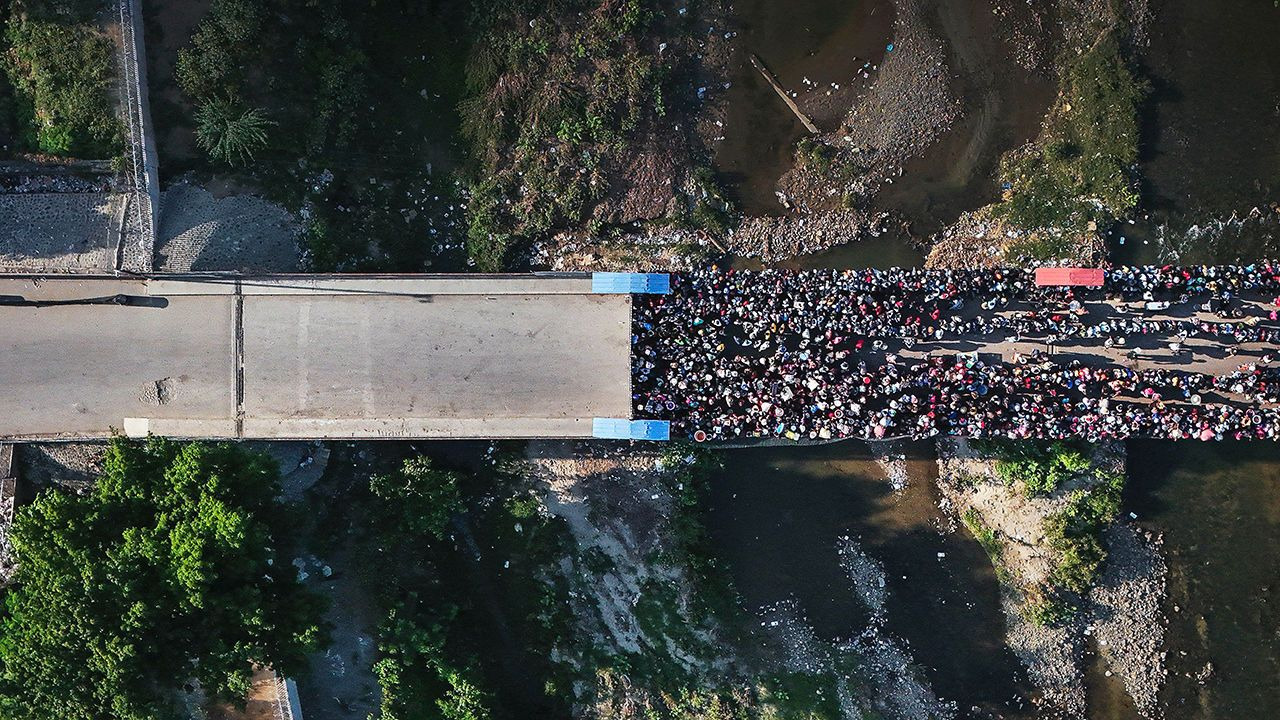
Ayear of staggering violence in Haiti ended in the most brutal fashion. Over the course of five days in December, in a slum near the capital, Port-au-Prince, 207 people were killed by gangsters. The ringleader accused his mostly elderly victims of practicing voodoo and causing the death of his child. Bodies were dismembered and burned. Gangs, who control nearly 90% of Port-au-Prince, killed some 5,600 Haitians in 2024. The new year has brought no respite; around 60,000 people fled their homes in the past month amid growing violence. The city is on the brink of complete collapse.
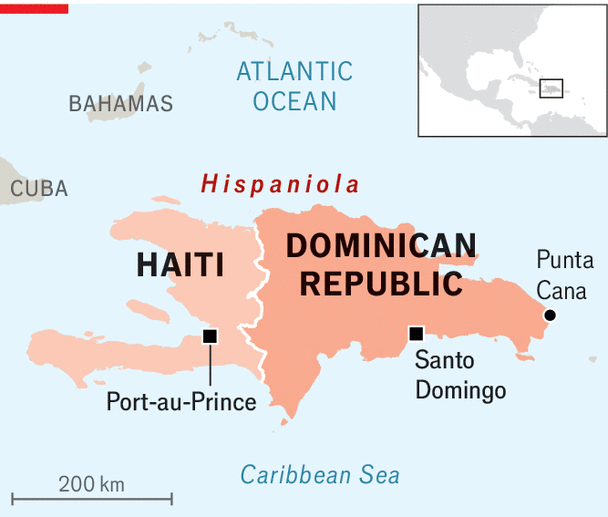
Map: The Economist
Across the border in Santo Domingo, the capital of the Dominican Republic, things could not be more different. Cafés and restaurants in the old colonial district teem with customers as jazz music fills the air. A two-hour drive away lies Punta Cana, a coastal enclave of luxurious beach resorts littered with cocktail-sipping holidaymakers. Some 11m tourists visited the Dominican Republic in 2024, more than any other Caribbean country and, within Latin America, second only to Mexico.
According to any measure Hispaniola, the Caribbean island shared by Haiti and the Dominican Republic, is two different planets in one. People in the Dominican Republic are 11 times richer than those across the border (see chart). A host of other measures—from unemployment to health care to education—illustrate the chasm between the two countries. Economists and analysts long viewed these differences as a grim natural experiment. How can two countries on the same island and under one climate diverge so starkly?
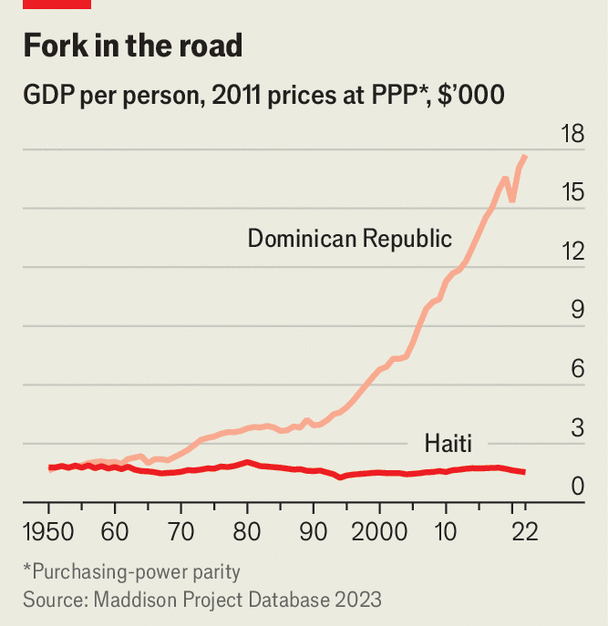
Chart: The Economist
Up until the 1960s both countries faced similar levels of poverty. But ask just about any Haitian and they will point to the turn of the 18th century as the source of their curse. The cost of pursuing the modern world’s first successful slave revolt against France crippled the country financially. France refused to accept independence until 1825, after Haiti agreed to pay a huge indemnity financed by extortionate loans from French banks. From then until 1957 an average of 19% of Haiti’s annual revenue was spent on its international debt, the New York Times found.
But a bad start cannot explain today’s gulf. Spanish rule over the island’s Dominican half similarly stymied its economic growth. Haiti went on to occupy its neighbour for 22 years until Dominican independence in 1844, sparking decades of violence between the countries. Some 20,000 Haitians were killed in the 1937 “Parsley” massacre on the Dominican border, so-called because Dominican soldiers tried to identify Haitians by how they pronounced the word for that herb. Fervent animosity persists today.
Another theory prominent among historians blames deforestation. They say the lush forests on the eastern half of the island blessed with healthy rainfall helped the Dominican Republican thrive. The west, on the other hand, was stripped bare of trees, burdened by overpopulation and less rain. This, they argue, hampered Haitian growth. But research casts doubt on that, too. One IMF paper found comparable amounts of arable land and rainfall over the years on both sides of the island.
A far more convincing explanation lies in governance. Both countries were run by vicious dictators who murdered their opponents and plundered state coffers—but the Dominican Republic was luckier with its tyrant. Rafael Trujillo encouraged investment in public infrastructure and agriculture up until his murder in a CIA-inspired coup in 1961. The sham democracy that followed, bankrolled by the United States, upped the budget-busting spending on roads, bridges and canals. That foundation helped a market-based economy emerge in the 1980s. A “marked divergence” occurs as the Dominican Republic rid itself of Trujillo, says Ernesto Sagás of Colorado State University.
A sliding doors moment?
It was at around the same time that Haiti fell under the Duvaliers’ thumb. “Papa Doc” and “Baby Doc” Duvalier were a father-son dictatorial dynasty that ruled from 1957 to 1986. They showed more interest in thievery that governing. Papa Doc strangled business, driven by his distrust of the mulatto economic elite. Baby Doc, partial to flashy cars and champagne, pilfered state assets when most Haitians lacked basic infrastructure. He ordered the dismantling of large chunks of Haiti’s only railway line and sold it for scrap.
When democracy returned in 1987, there was little left to build on. An enfeebled state and chronic economic instability fuelled repeated coups: Jean-Bertrand Aristide, the country’s first democratically elected president, was twice deposed by army thugs, in 1991 and 2004. Political turbulence aside, the country is especially prone to natural disasters. An earthquake in 2010 devastated Haiti, killing perhaps 200,000 people. Further hurricanes and storms periodically batter the island, which is ill-equipped to deal with either catastrophes or their aftermath.
Security sharply deteriorated after the murder of Jovenel Moïse, then the president, in 2021. There are no elected officials in Haiti. A Transitional Presidential Council—created to organise elections and re-establish order—is mired in corruption allegations. A UN-backed security force of around 1,000 mainly Kenyan police officers, deployed since June, is failing to make a mark. Gangs control swathes of the country. Economic activity has plummeted. Few dare go outside after dark. The World Bank reckons that the economy contracted for a sixth consecutive year in 2024. The UN estimates that half the population can barely feed themselves.
The Dominican economy, by contrast, is booming. Living standards are rising faster than anywhere else in Latin America. Tourism and remittances account for nearly a third of GDP. At Las Americas Industrial Park, a free-trade zone outside Santo Domingo, manufacturers churn out everything from lingerie to pacemakers.
Stable politics underpins this growth. Last year President Luis Abinader won re-election with 57% of the vote. Power alternates between a handful of parties: all share a commitment to market-friendly policies lubricated by grubby clientelism.
That rankles with some Dominicans. But when asked about Haiti, Dominicans are loth to complain about their lot. “It’s a civil war over there—they are killing each other,” says a young police cadet outside the national Pantheon. “We worry about the violence coming here.” Some 500,000 Haitians live in the Dominican Republic. Many provide vital labour for farms. The Dominican government has long embraced Haiti-bashing. Last year it deported 276,000 Haitians, many of Haitian descent born in the Dominican Republic.
Marco Rubio, the US secretary of state, wants to tackle the Haiti crisis as a priority. The country’s first elections since 2016 are officially slated for November. But many doubt they will even take place. And if they do, they are unlikely to usher in the change needed to narrow the gap with its prosperous island neighbour. ■
Middle East & Africa | Troubled Rivers
Nigeria’s president pushes the limits of his power
A crisis in the oil-rich Niger Delta raises questions about the rule of law
Photograph: Panos
Mar 27th 2025|Lagos
Listen to this story
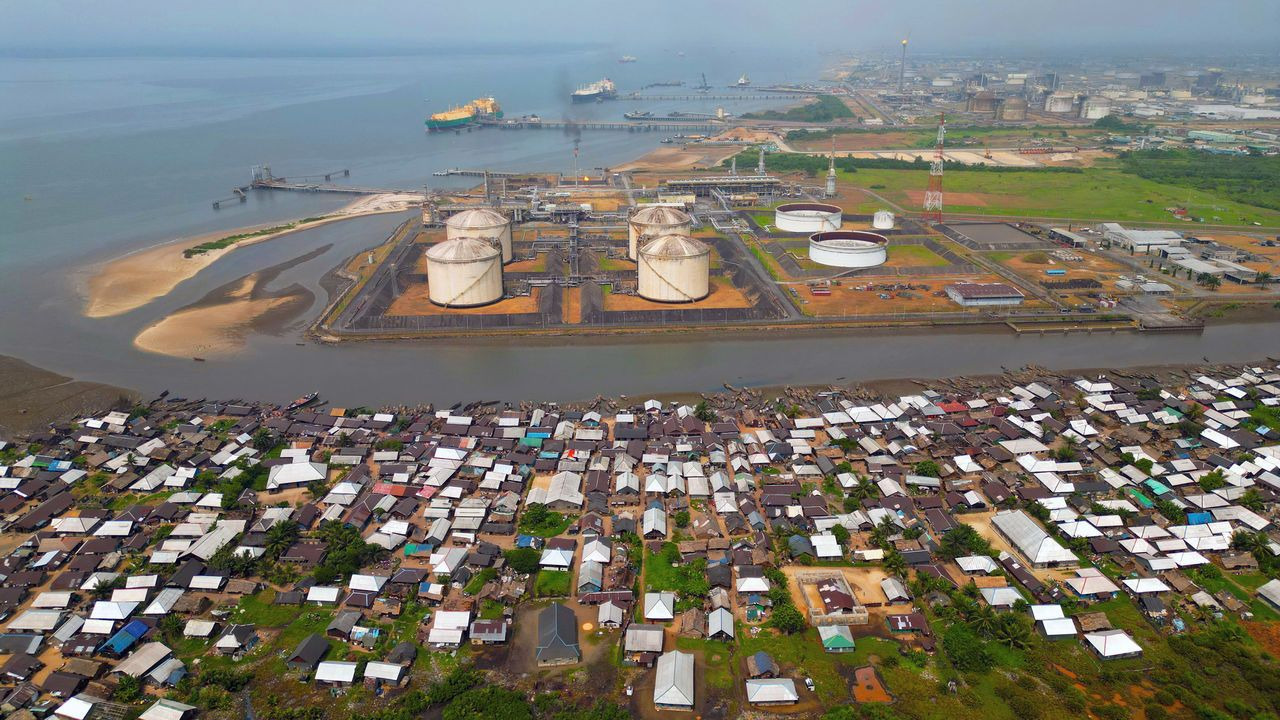
After a Nigerian firm called Heirs Energies paid $1.1bn in 2021 to acquire an oil field in the Niger Delta, its boss found the company was losing no less than 97% of the field’s daily output to theft and vandalism. “What you put in the Trans Niger pipeline and what gets to the export terminal is not the same,” says Tony Elumelu, referring to one main conduit for Nigeria’s oil exports (see map).
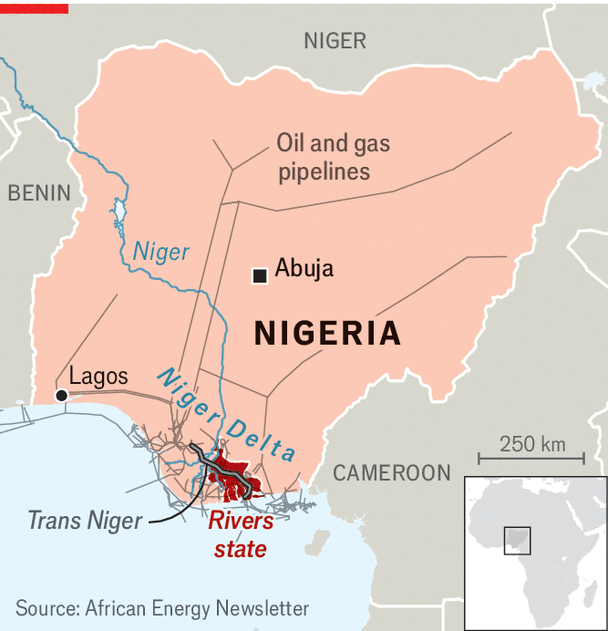
Map: The Economist
Nigerians were reminded of the pipeline’s importance and vulnerability on March 17th, when an explosion put it out of service for several days. In response Bola Tinubu, Nigeria’s president, declared a state of emergency in Rivers, the oil-rich state in the Niger Delta where the explosion happened. He also suspended its governor, who belongs to an opposition party. The pipeline, which has the capacity to transport around 450,000 barrels of crude per day, resumed operations on March 25th. But the political crisis sparked by Mr Tinubu’s controversial decision is likely to linger for longer. It raises questions not only about stability in a region that is central to the Nigerian economy, but also about the strength of Nigerian democracy.
Despite recent moves towards economic diversification, oil is still the lifeblood of Nigeria’s economy. Oil sales account for half the national budget and 80% of export revenue. Though most production has moved offshore and global oil companies have recently sold most of their onshore assets, the Niger Delta region, and especially Rivers state, remains central to the industry. Mr Tinubu, whose government is keen to attract fresh capital to the sector to increase crude output, has been at pains to show that investors’ assets in the Niger Delta are safe.
The president argues that Siminalayi Fubara, the suspended governor of Rivers, has been getting in the way of that aim. When declaring the state of emergency on March 18th, Mr Tinubu claimed that Mr Fubara had allowed violence in the state to escalate. He said that solving the problem required “extraordinary measures to restore good governance, peace, order and security”. He appointed a former vice-admiral as interim administrator for the six-month state of emergency.
Recently there have been several other attacks on oil and gas facilities in Rivers. Yet Mr Fubara reckons claims of a security crisis are overblown. The Niger Delta has long been beset by militant activity, oil theft and pipeline sabotage, but security had lately been improving. Mr Elumelu says his firm’s transit losses are now only around 10% of production. In January Nigeria produced around 1.5m barrels of crude per day, the highest level since 2020.
That suggests that the real reason for Mr Tinubu’s move is political. Before he was suspended Mr Fubara had been feuding with Nyesom Wike, who preceded him as governor of Rivers and is now a powerful minister in Mr Tinubu’s cabinet. Ousting Mr Fubara, many suspect, is a way to give a leg-up to Mr Wike, thereby ensuring that an ally of the president continues to call the shots in the oil-rich state.
Whatever Mr Tinubu’s motives, the crisis raises questions about the rule of law in Nigeria. The president does not have the constitutional power to suspend governors. Yet the country’s legislature rushed to ratify Mr Fubara’s suspension. The decisive vote in the Senate was taken by voice, leaving the judgment of whether a majority had been reached to the Senate president, another close ally of Mr Tinubu. The new interim administrator of Rivers was immediately given access to federal funds that courts had been withholding from Mr Fubara. “No businessman can bring his money to invest in a country where the judiciary is compromised,” Goodluck Jonathan, a former president, said of the events.
There was a time when Mr Tinubu, who was a leading light in the campaign against Nigeria’s military dictatorship in the 1990s, would have condemned this kind of manoeuvring. “The struggle was meant to rescue democracy…[and] ensure enduring adherence to constitutionalism,” he later said of his political activism. Those days appear to be gone. “Tinubu is preparing for [elections in] 2027 and he doesn’t want any governor that will oppose him,” says Rotimi Amaechi, another former Rivers governor. Nigerian politicians will be taking note. So will international investors. ■
Middle East & Africa | The Jewish diaspora
The war in Gaza has unsettled the Jewish diaspora
They have found uneasy alliances with their new protectors on the right

Photograph: Getty Images
Mar 27th 2025|JERUSALEM, NEW YORK AND PARIS
Listen to this story
Nailed to the entrance of the Gun For Hire shooting range in Woodland Park, New Jersey, is a large mezuzah, the prayer-scroll that Jews attach to their doors. In the gift-shop are kippot (head-coverings) embroidered with guns. The range advertises in local Jewish newspapers and trains synagogue security teams. “We get full minyanim [Jewish prayer quorums of at least ten] who come to shoot here,” says Phil Stern, one of the managers.
“There’s been growing demand for guns and training among Jews for years,” says Tzvi Waldman, founder of the New York State Jewish Gun Club. Now an increasing number of liberal Jews go to him for advice about gun ownership, says Mr Waldman, an ultra-Orthodox Hasid and a Republican party activist. He puts this down to feelings of general insecurity after the George Floyd riots and fears of white nationalism. But he also thinks that many feel that the threat levels since October 7th have gone “way up”.
Read all our coverage of the war in the Middle East
On that day more Jews were murdered than on any other since the end of the Holocaust. It shattered the confidence of Israelis in their army and intelligence services. For the diaspora, it called into question the core reason for Israel’s existence: to be a haven for a long-persecuted nation.
The shock-waves reverberated beyond Israel’s borders. There was fear for Israel, where many Jews have relatives and friends. But there was also distress at non-Jewish friends’ and neighbours’ ambivalence about, and even justification of, the atrocity they faced at home. The Jewish Agency, a quasi-governmental Israeli organisation, reports that between 2022 and 2024, the number of antisemitic incidents rose by 340% globally, largely driven by protests (violent assaults declined). The Anti-Defamation League, an advocacy group in America, says that 83% of Jewish students there have experienced antisemitism on campus since the war began.
Growing distances
Israel’s increasingly devastating war in Gaza brought an additional sense of alienation. Even some of those Jews who initially backed Israel’s response wavered as it killed tens of thousands of Gazans, many of them civilians. For some, it challenged their own Jewish identity, though for others it allowed the exploration of a new version tied less to Israel. And so with calamity in Israel, estrangement in the diaspora and divisions within and between the two, what had seemed to be a golden age for the Jews looked as if it might end.
At the turn of the 21st century, after nearly two millennia of almost relentless persecution and banishments, culminating in the industrial slaughter of the Holocaust in which over a third of the world’s Jews were killed, they had achieved two almost unimaginable successes. Israel and America were home to nearly 90% of all Jews. In the first, the Jews had a powerful and prosperous nation-state. The wars and instability of Israel’s early decades had given way to a grudging if tacit acceptance by countries in the region. Israel’s military might and tech-fuelled economy guaranteed its survival. It made a formal peace with at least some of its Arab neighbours.
In the second place, America, they had become a successful and secure minority, fully integrated into the world’s sole superpower. The largest Jewish diaspora in history defined much of American culture, from Hollywood to Wall Street. They secured not only equality, but also outsize visibility and success, given their share of the population—2%—and a political influence that let them rally support for Jews elsewhere, especially in Israel and the former Soviet Union.
After the fall of the Soviet empire and the emigration from there of around 2m Jews, most of them found themselves in liberal democracies, protected from the bigotry and discrimination they had experienced for so many centuries. Antisemitism had not disappeared, but it had become unacceptable in public and in some countries illegal.
Yet there were still some clouds on the horizon. Sergio DellaPergola, an expert on Jewish demography at the Hebrew University of Jerusalem, estimates there were 16.5m Jews in the world on the eve of the second world war. At 15.7m, the current numbers still falls short, 80 years later. In the same period the world’s global population has roughly quadrupled.
Assimilation in the West began to blur Jewish identity outside Israel, and with it intermarriage and lower birth-rates, especially among liberal Jews in the diaspora. As a result, two groups have grown as a share of the Jewish population: Israelis, who are now nearly half of all Jews; and the ultra-Orthodox Haredim, whose members largely live, educate and raise their children in isolated environments and who now number around 15% of all Jews.
These demographic shifts mean that in many places organised Jewish life is increasingly dominated by a fast-growing Orthodox minority who reject many of the liberal values that most Jews see as the bedrock of their security. Greater religiosity has also translated into greater support for Israel, which itself has been becoming more nationalistic and less liberal.
Politically, many diaspora Jews have felt increasingly homeless. The left, consumed by identity politics, often included them in the “white” majority and expected them to denounce any affiliation with Israel as proof of their ideological reliability. On the right, populist-nationalist parties, evolved from movements that were once openly hostile towards Jews, were ascendant. And so the indifference to the suffering of Jews exhibited by parts of the left, the uptick in antisemitic attacks and the despair of many Jews over Israel’s war in Gaza, all came together to create a sense that that brief golden age was over.
Not quite so clear
But nearly a year and a half since the war in Gaza began, a more nuanced reality has emerged. The wave of anti-Israel attacks has been met by a tough response from governments and police forces, which has increased the protection of Jewish communities in the diaspora. And while many Jews are appalled at Israel’s military tactics, especially in Gaza, they have held countless solidarity events for Israel. Jewish groups also say they have seen rising attendance at communal meetings, as their members have sought to reassert their identity in the face of antisemitic attacks.
There is also a renewed interest in Jewish life. “Since October 7th people are returning to the community and feel the need to be part of it. Services are full, including places outside Paris where barely anyone used to turn up,” says Mr Laurence Hauguenauer, a civil servant and president of a progressive Jewish organisation in Paris. Some progressive Jewish communities that used to criticise Israel now say prayers for Israeli soldiers “and all the civilian victims” (though others also pray for Palestinian prisoners and Gaza’s dead).
Donald Trump has ratcheted up support for Israel and Jewish-American communities. The president removed the limited restrictions placed by the previous administration on arms sales to Israel. He made it clear he would tolerate no international criticism of Israel, imposing sanctions on the International Criminal Court in The Hague for issuing a warrant to arrest Binyamin Netanyahu, Israel’s prime minister. Mr Trump signed an executive order “to marshal all federal resources to combat the explosion of antisemitism on our campuses and in our streets.” The government cut $400m of federal funding for Columbia University, which saw some of the fiercest anti-Israel protests. Students accused of leading the protests have been arrested and threatened with deportation.
Protests against Israel in America and other Western countries go on, as does international condemnation of Israel’s conduct. But the actions of Mr Trump and his administration have lessened to a large degree the siege atmosphere many Jews feel.
Some of America’s Jews had already shifted their political loyalties. For decades the overwhelming majority voted Democratic in presidential elections. Last year was no exception. But some exit polls showed Mr Trump winning more of the Jewish vote, close to a third, than any Republican since 1988. Surveys show that Mr Trump’s voters tended to be more religious and pro-Israel than those who supported Kamala Harris, the Democratic candidate.
“There’s no doubt Haredim feel at home with Trump,” says Yossi Gestetner, a Hasidic political consultant. “We’re a conservative community who don’t want liberals interfering in our schools and other religious affairs. And we have a lot of relatives in Israel. But also on a personal level, we felt Trump was much more open to us.” As few as two-thirds of American Jews may have voted for Ms Harris. Among them, feelings are mixed. Is a president whose supporters include antisemitic white supremacists a welcome protector?
Similar dilemmas exist in other countries, where parties which were once openly antisemitic are now offering themselves as allies to Israel and the Jews. In France Jews feel much less welcome on the left than they once did. They see Jean-Luc Mélenchon, who aspires to be president, as exploiting resentments among France’s Muslims against its Jews. Meanwhile, on the hard right, another potential contender for France’s presidency, Marine Le Pen, has made a great show of purging the older antisemitic members, including her own father (before he died this year) from her party. But many French Jews still mistrust her.
Never be complacent
These are risky alliances. Mr Trump is fickle. Presidents change. For Jews on the right, especially those more religious and less committed to liberal values, the shifts seem appealing. After all, they argue, we are all in the same camp against Muslim fundamentalism and the anti-Zionist left.
But as voting patterns in America still show, most Jews have yet to be persuaded of these new alliances. So have many elsewhere. The decision of an Israeli minister to invite members of Europe’s hard right, including a close ally of Ms Le Pen, Jordan Bardella, to a conference on combating antisemitism, prompted other guests, including Britain’s chief rabbi, to boycott it. Their invitation was “stabbing Jews in the back”, said Ariel Muzicant, president of the European Jewish Congress.

Where does my help come from?Photograph: Getty Images
Open criticism of Israeli policies is increasingly common among many diaspora Jews. That is particularly true for the younger generation. According to a poll by the Pew Research Centre, 33% of American Jews thought Israel’s response to the Hamas attack was “unacceptable”, but among the 18-34-year-olds it was 42%. At pro-Palestinian protests in America and Britain, groups of young Jewish students proclaimed that the carnage in Gaza was not in their name.
Yet the number of young diaspora Jews volunteering to join and fight in the Israel Defence Forces (idf) has swollen. The number of new recruits meant the idf’s Hebrew course had to open a fourth company of soldiers last year. Most also intend to emigrate to Israel, but the number of Jewish volunteers who simply arrived to serve, without formally becoming Israeli citizens, jumped from 268 in 2023 to 362 last year. “I felt like a fish out of water in college, surrounded by people hating Israel,” says one Seattle-born recruit, taking a brief break from training. “I don’t think I’ll live in Israel in the future. I have a lot of criticism of Israel. But I didn’t want the convenient relationship of a diaspora Jew commenting from the sidelines. I wanted some skin in the game.”
Even for Jews who reject the notion of an ethno-national Jewish state, their Jewish identity is largely apophatic. “It’s hard to find an alternative for Jewish activity which is not around Israel,” says Daniel May, publisher of Jewish Currents, a New York-based magazine that is a platform for Jews on the left who seek to distance themselves from Israel.
Jews in Israel and the diaspora share a conundrum. Restoring Israeli deterrence and ensuring safety for the diaspora involves awkward trade-offs between democratic principles and security priorities, especially when the politicians making them, such as Mr Netanyahu, seem to be in the process of undermining the democratic institutions on which Israelis and Jews have relied. If Jews everywhere fail to articulate shared liberal values and if Israel further erodes its fragile democracy, that truly will spell the end of the golden age. Despite the persistence of antisemitism and threats to Israel, the real challenges to a Jewish future come from hardliners within. Yet perhaps the best development for the Jews is that for once in their long history, their fate is largely in their own hands. ■
Europe | Dictatorship’s edge
Protests are the last thing keeping Turkey’s democracy alive
America and Europe have offered President Erdogan little resistance
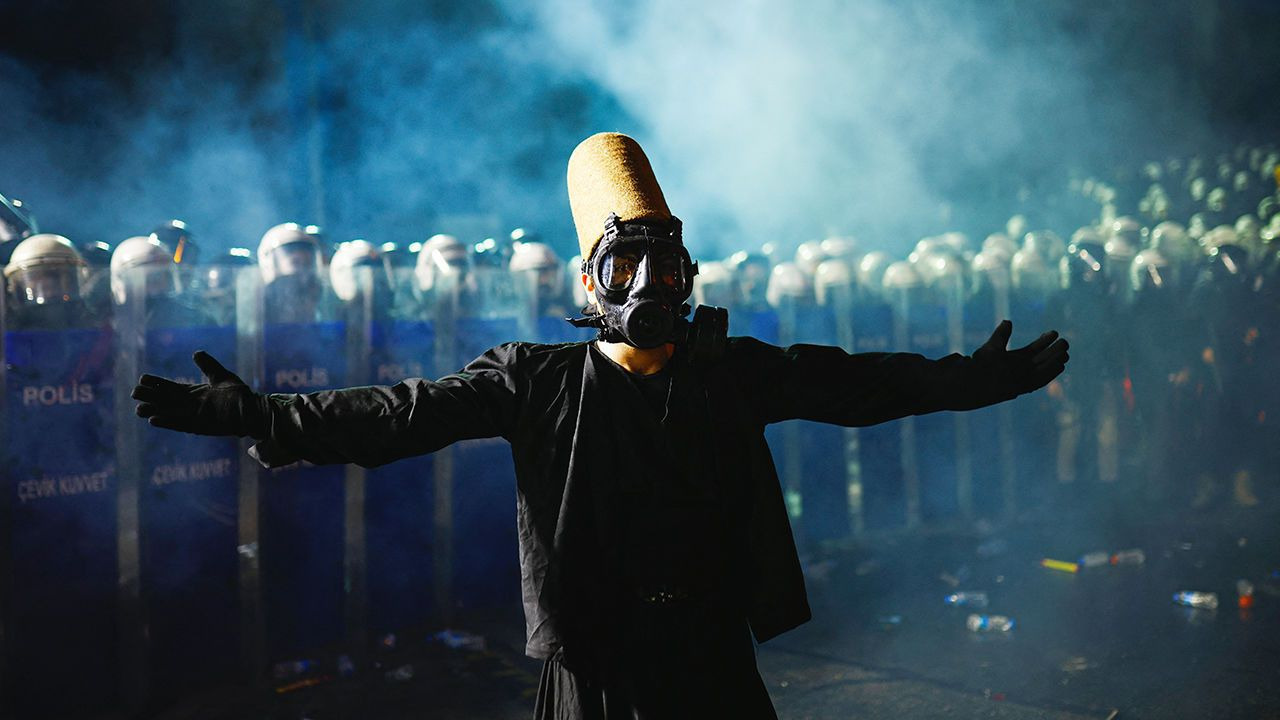
Photograph: AFP
Mar 24th 2025|ISTANBUL
Listen to this story
“THE PRESIDENT had a great conversation with Erdogan a couple of days ago,” Donald Trump’s special envoy, Steve Witkoff, told an interviewer on March 21st. “There’s just a lot of good, positive news coming out of Turkey.” As he spoke, the biggest protests in over a decade were spreading across the country. Perhaps Mr Witkoff was referring to America’s prospective sale of F-35 jets to Turkey, or to the country’s offer to mediate in Ukraine. But that he said nothing about the arrest on March 19th of Turkey’s top opposition politician, Ekrem Imamoglu, or the ensuing demonstrations, was probably not lost on President Recep Tayyip Erdogan. Turkey’s leader is reading the mood in Western capitals and exploiting his position abroad to orchestrate a crackdown at home.
For more than a week, despite bans on public gatherings, student protesters have faced off against police. More than 1,800 people, including at least ten journalists, have been detained. Scores have been injured. Every evening tens of thousands of mostly young people pack the square outside Istanbul’s city hall. Almost every night, they brave tear gas, water cannons and rubber bullets. Mr Imamoglu, the city’s mayor and the Turkish opposition’s de facto leader, was arrested on corruption charges widely considered bogus. The outrage shows no signs of subsiding.
On March 23rd, as Mr Imamoglu was being moved to a maximum-security prison on the city’s outskirts, the opposition Republican People’s Party (CHP) staged a primary election to confirm him as its candidate in the next presidential elections, scheduled for 2028. It was open to all voters, not just CHP members. The party said 15m Turks took part.
Faced with the biggest challenge to his rule in years, Mr Erdogan has seized on reports of policemen injured in clashes with protesters to accuse the opposition of fomenting violence. “Beware,” he said on March 25th. “Our country will not give in to street terror.” It is a familiar line. Over a decade ago Turkey’s strongman compared a wave of protests, which began with calls to save a popular Istanbul park from developers, to a coup. Scores of demonstrators were prosecuted. Osman Kavala, a businessman and arts patron the government framed as their leader, was sentenced to life in prison in 2022.
Mr Erdogan need not fear pressure from his NATO allies. Turkey is a “good place” and its president a “good leader”, Mr Trump said on March 25th. European leaders, who hope Turkey will join a “coalition of the willing” to supply peacekeeping troops in Ukraine, have been mealy-mouthed. Britain has been silent. European countries’ fear of uncontrolled migration via Turkey dictated policy towards Mr Erdogan in the past, says Senem Aydin-Duzgit of Sabanci University in Istanbul; fear of Russia now plays the same role.
Turkey’s economy took a hit after the arrests, though the government tempered the blow. After three days of chaos, during which the stockmarket index plunged by 16% and the Turkish lira hit a record low against the dollar, the authorities restored a measure of calm. It has come at a big cost. Stockmarket regulators have banned short selling. To avoid a currency crash, the central bank has sold at least $26bn (of $97bn) in foreign-currency reserves and raised its overnight lending rate. Having replenished its coffers over the past couple of years, the bank can defend the lira in the short term even if foreign portfolio investors head for the door, says Ibrahim Turhan, its former deputy head.
But the damage has been done. Since 2023 Turkey’s economic team has cleaned up some of the mess caused by Mr Erdogan’s previous policies, which pursued growth at any cost. Dramatic interest-rate increases restored faith in the lira. Annual inflation, which had approached triple digits, dipped to 39%, letting the central bank begin to cut rates cautiously. The crackdown has wrong-footed the technocrats. “Many foreign investors bought into the shift towards orthodox policies,” says Piotr Matys at InTouch Capital Markets, a consultancy in London and New York. “Their confidence has been seriously shaken.”
Mr Erdogan hopes the CHP can be placated by a court ruling that allows the party to retain control of Turkey’s biggest city. (Had Mr Imamoglu been arrested on terrorist charges, the government would have replaced him with its own surrogate.) On March 26th Istanbul’s city assembly, where the CHP has a majority, elected one of Mr Imamoglu’s associates as acting mayor. The previous day the party’s leader, Ozgur Ozel, announced an end to the protests at the city hall, but not before calling a mass rally over the weekend.
On Istanbul’s streets there is a sense that the genie is out of the bottle. “The more we keep quiet, the more they attack us. Enough is enough,” says Silan, a young woman wearing a surgical mask to protect herself from tear gas and CCTV cameras. Meral, a housewife, joined the protests with her daughter, a university student. “This is not about Imamoglu or the CHP,” she says. “This is because our right to vote and to be elected is being taken away.”
Mr Erdogan’s rule, now in its 23rd year, is in little danger. Turkey’s battered democracy is. On the eve of Mr Imamoglu’s arrest, you could still claim that the government could be held accountable by voters, if not by the subservient courts or media. With Mr Erdogan’s main opponent packed off to prison, that government has taken a possibly irreversible step towards becoming a regime. ■
International | The Telegram
Europe will have to zip its lip over China’s abuses
In a fracturing world, trade and co-operation will come first
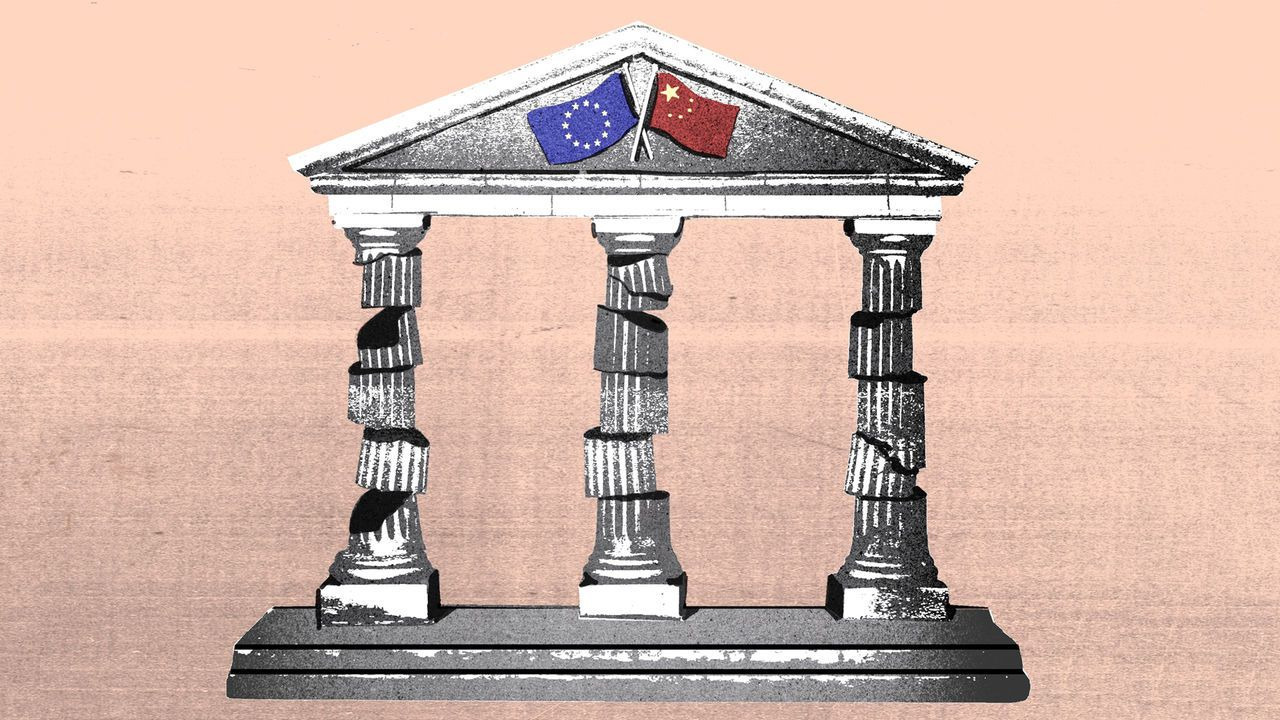
Illustration: Ellie Foreman-Peck
Mar 25th 2025
Listen to this story
IN THESE VERTIGINOUS times, America’s allies are taking a new look at their relations with China. In recent years, politicians in Europe and elsewhere in the West have talked boldly and clearly about the economic, geopolitical and ethical risks posed by China, an autocratic giant with plans to reshape the world. Now, though, their willingness to speak out may become more selective.
Only months ago, agreeing on the China challenge was supposed to bind America to its friends. Western powers stood ready to please President Donald Trump by blocking sales of the most advanced technologies to China, or by excluding Chinese firms from sensitive industries. Alas, Mr Trump appears uninterested in agreeing with allies on anything much at all. He has treated partners more harshly than supposed foes, and hinted at ambitions to explore a trade deal with the Chinese leader, Xi Jinping.
Allies are duly hedging. The president of the European Commission, Ursula von der Leyen, has for years led calls to “de-risk” relations with China. The aim is to engage and trade with China where it is safe, but to make the European Union depend less on China for hard-to-substitute technologies and commodities. The strategy also pushes European governments to scrutinise potentially dangerous Chinese investments, for instance in critical infrastructure. This approach is guided by a three-pillared model of relations, in which the EU calls China “a partner for co-operation, an economic competitor and a systemic rival”.
Since Mr Trump’s re-election, Ms von der Leyen has softened her tone. She now talks of an “era of hyper-competitive and hyper-transactional geopolitics”, in which Europe should “engage constructively with China—and find solutions in our mutual interest”.
When EU leaders adopted the three-pillared model in 2019, Chinese officials grumbled that the term “systemic rival” was an insult, casting doubt on the legitimacy of their political system. In truth, the EU was making a simple observation: that it is hard dealing with China, a rising power in global governance that is also an indispensable trade partner and an autocracy with alarming ambitions. That diplomatic puzzle became a crisis when Russia invaded Ukraine. Despite claims of neutrality, China blames the war on Ukraine and the West, and has sold Russia vast numbers of components to make drones, missiles and tanks.
Now, the EU is rebalancing. China can still expect to hear lots about that first, co-operative pillar, as Europe offers to work with it on slowing climate change, preserving biodiversity and other global public goods. Some of those invitations will have a note of rebuke to them. China has invested vast sums in renewable energy but it also burns lots of coal in the name of energy security and to provide cheap power to industry.
Some aspects of relations involve both partnership and competition. Climate change cannot be abated without China, a dominant producer of solar panels, wind turbines, advanced batteries and other green technologies. Yet that same dominance alarms other countries, which fear that their carmakers and other industries cannot compete. China’s overall manufacturing exports continue to grow. As a result, the second pillar, involving economic competition, is set to bear ever more weight.
These words are being written in Beijing. In China’s capital, foreign diplomats describe a “charm offensive” by Chinese officials, urging EU and other Western governments to deepen ties with their orderly, predictable country, as a hedge against Trumpian chaos. Some European officials and politicians want to revive talks with China about a long-frozen deal, the Comprehensive Agreement on Investment, not least to show America that Europe has options. The word among European diplomats in Beijing is that China wants warmer relations. “The problem is they want them for free,” says one. Chinese officials reportedly brush aside European complaints about a trade balance skewed hugely in their favour, saying their products are simply more competitive.
Then comes the third pillar, which identifies China as an ideological adversary. This pillar is losing importance, notably over Ukraine. That marks a big shift. In March 2022, weeks after Russia’s invasion of Ukraine, your columnist met Western envoys in Beijing who called it an “outrageous lie” that China was claiming to be neutral, when it clearly wanted a Russian victory. The same diplomats predicted that China would try to pose as a peacemaker at the war’s end. As one put it then, the dream of Chinese officials is to be asked to help rebuild a shattered Ukraine. They think that the end of the Ukraine war “will be a glorious moment for China, and we will forget what is happening now”, he growled.
That dream is coming true. Chinese firms are contacting Ukraine’s government, scouting for contracts. Western diplomats can see no reason to exclude China from peace talks, glumly noting that Mr Trump’s stance is far harsher on Ukraine than China’s.
If you don’t like our values, we have others
Behind closed doors, they admit that many Western governments now have little or no appetite for confronting China over repression in Tibet, Xinjiang or Hong Kong, claiming this is a time for pragmatism. Their governments will make strong statements about the rules-based order if China takes control of the democratic island of Taiwan, by war or blockade. But if America fails to use force, no other Western power will fight for Taiwan.
Playing down values and international law is not cost-free. Not so long ago European leaders talked of the need to challenge China when it bullied its neighbours, for instance in the South China Sea, in order to credibly condemn aggression by Russia in Europe.
Arguments about consistency remain valid. Alas, America’s allies have a lot to worry about just now. As a result, many will feel that confronting China’s ruthless side is a luxury, not a necessity. ■
International | Wing women
Trump is a problem for Europe’s most important hard-right leaders
His antics are causing headaches for Giorgia Meloni and Marine Le Pen

Illustration: Klawe Rzeczy
Mar 23rd 2025|PARIS AND ROME
Listen to this story
WHEN UKRAINE’S allies’ military top brass met in London on March 20th to discuss a possible peacekeeping force, one of their number was missing. The chief of Italy’s defence staff, General Luciano Portolano, apparently had more important things to do and was represented by more junior officers. His absence was suggestive. The meeting was part of Europe’s response to the growing disengagement of America under President Donald Trump. But Italy’s hard-right prime minister, Giorgia Meloni, is a friend of Mr Trump, and that has put her in an awkward position.
Mr Trump’s re-election initially invigorated the European hard right. The American president’s anti-woke national conservatism chimes with the politics of leaders such as Ms Meloni. Boosted by Elon Musk, a social-media mogul who is the president’s ally, it also looked set to help the electoral chances of hard-right candidates. The most important of these is France’s Marine Le Pen, who leads polls for the country’s presidential election in 2027. (Judges will decide on March 31st whether to block her from running over alleged misuse of European Parliament funds.)
Yet the speed with which Mr Trump has upended transatlantic relations, undermined NATO and distanced himself from Ukraine has discomfited hard-right leaders. It has put Ms Meloni at odds with Italy’s partners in the European Union and with other allies. And it has exposed the ambiguous relationship of Ms Le Pen and her party, the National Rally (RN), with their American analogues: French and American nationalism do not always mix.
Unfashionably late
Ms Meloni has made plain her discomfort with Europe’s assertive response to Mr Trump. She turned up 50 minutes late for the first Trump-era crisis meeting, organised in Paris by France’s president, Emmanuel Macron, on February 17th. Italian officials said she disapproved of the format, which did not include all 27 EU states. When Sir Keir Starmer, Britain’s prime minister, held a broader virtual summit a month later, she waited until the night before to decide to take part.
Last month, when Volodymyr Zelensky was rebuked in the White House by Mr Trump and Vice-President J.D. Vance, Ms Meloni was, conspicuously, the only major European leader not to declare support for the Ukrainian president. On March 12th in the European Parliament the deputies of her hard-right Brothers of Italy party abstained on a motion supporting Ukraine (one voted against it). On both occasions, the reason was fear of upsetting Mr Trump. Ms Meloni has since said she will not contribute Italian troops to a peacekeeping force in Ukraine. Her MEPs did vote for the European Commission’s new ReArm Europe programme. But she opposes confiscating Russian assets, frozen under EU sanctions, to give to Ukraine.
For years Ms Meloni staunchly backed Ukraine and condemned Russia. Why the apparent volte-face? Personal resentment may play a part. Before the new American administration took office, Ms Meloni was touted as Europe’s “Trump-whisperer”. She was feted by America’s president as a “fantastic woman” and invited to his inauguration. But that was before Mr Vance bashed Europe at the Munich Security Conference, and before Mr Trump called the EU an organisation “formed in order to screw the United States”. Now Europe’s initiative has been snatched by leaders prepared to take a more robust line: Sir Keir and Mr Macron, with whom Italy’s prime minister has a thorny relationship.
A further reason is that Ms Meloni’s coalition is split over how to react to Mr Trump. Matteo Salvini, the leader of the hard-right League party and one of her two deputies, has condemned ReArm Europe and calls the French president “that madman Macron who talks of nuclear war”. Though the League has now fallen to single digits in polls, it still commands enough votes in parliament to bring down the government. And in a country with a strong pacifist streak, Mr Salvini seems to have public opinion on his side. A poll this month found barely a third of voters back higher defence spending.
Nathalie Tocci, the head of the Istituto Affari Internazionali, a think-tank in Rome, suggests a more troubling reason. Many originally saw Italy’s prime minister as a toxic far-rightist. “Backing Ukraine was a way of gaining credibility, a means to an end. But now, with a new [American] administration, it works in the opposite direction,” she says. Italy is unlikely to join Hungary and Slovakia among the EU’s pro-Russian Trojan horses, she says. “But nor do I expect Giorgia Meloni to do anything that could irritate Donald Trump.”
For Ms Le Pen the calculation is different, and not only because she is in opposition. Unlike Ms Meloni, the French nationalist leader has never portrayed herself as close to America. Indeed, she and her party have often shown an affinity with Russia. In early 2022, during France’s presidential campaign, Ms Le Pen printed flyers featuring a photo of herself and Vladimir Putin, which were hastily shelved after Russia’s full-scale invasion of Ukraine. On March 12th this year the RN abstained in a non-binding parliamentary vote in support of Ukraine. Until recently, such was Ms Le Pen’s scepticism about the transatlantic alliance that she argued for France to withdraw from NATO’s military command.
This makes it easier for Ms Le Pen to criticise Mr Trump. This month she denounced the “brutality” of his suspension of military aid for Ukraine (since reversed), something Hungary’s Viktor Orban would never do. In this, she is in tune with French public opinion: in a poll conducted in March 73% of respondents said that America is “no longer an ally” of France.
What the party admires about Mr Trump, says a senior RN figure, is not only that he has shown once again how nationalists can win elections. He is also a lesson in political agency in sceptical times: that, once in office, “you can actually do things, and fast.” This is a powerful message for Ms Le Pen’s team in a country perennially hampered by bureaucracy and now burdened with a weak minority government.
Leaving early
Yet Ms Le Pen’s party is torn. Jordan Bardella, her 29-year-old sidekick, travelled to Washington for a recent national-conservative convention, only to quit the event when Steve Bannon, Mr Trump’s former aide, made what looked very like a Nazi salute. Ms Le Pen has not spent the better part of the past decade scrubbing the image of her once-toxic party to have it tarnished again by fascist associations. “Trump is turning into a real problem for Le Pen,” says a French diplomat. In March her popularity dropped by two points to 34%, according to a Cluster17 poll. (Mr Macron gained five points, to 23%.)
Mr Trump still delights many hard-right European leaders. But for Ms Meloni and Ms Le Pen, the American president could become a serious headache. Europeans don’t like him: a tiny 6% of French and 8% of Italians told a poll in March that Mr Trump is “a friend of Europe”. The more his blustering brand of nationalism seems damaging to the continent, the more voters in Italy and France may doubt its local versions. ■
Business | Schumpeter
Big law’s capitulation to Donald Trump may be bad for business
As well as being a moral failure
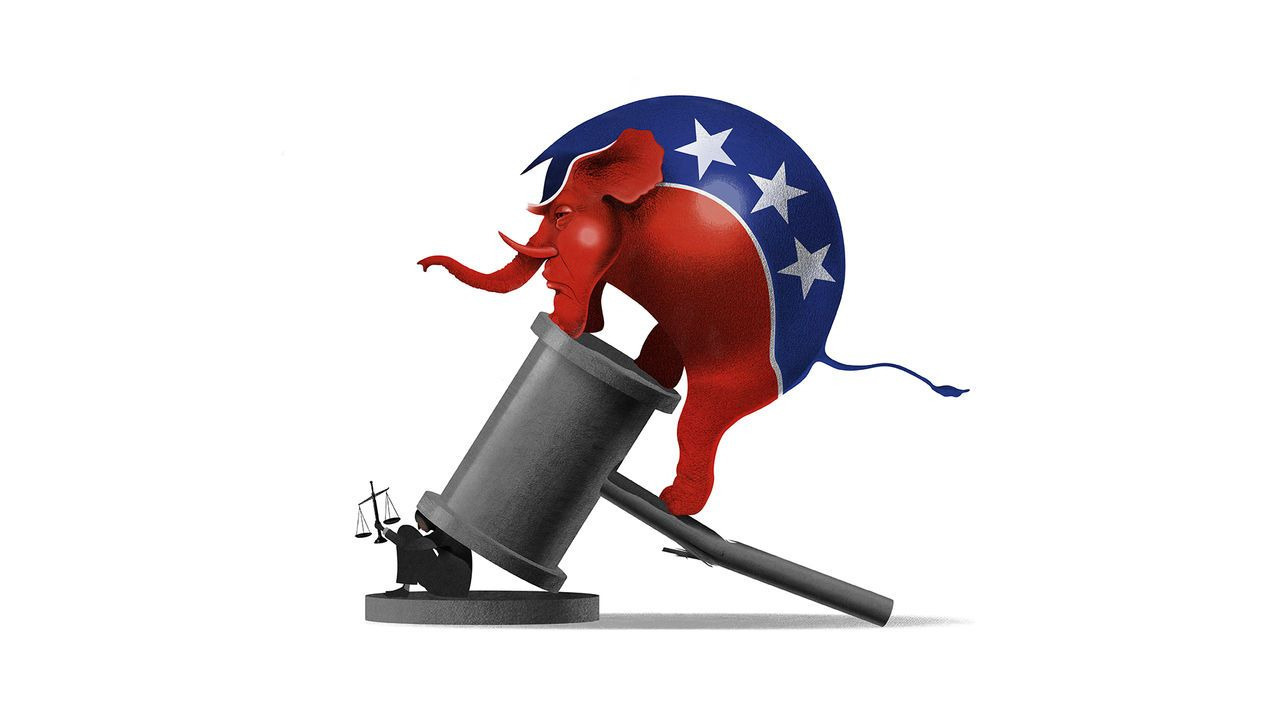
Illustration: Brett Ryder
Mar 26th 2025
Listen to this story
IT PASSES FOR a courtroom truism that whoever wins or loses, the lawyers come out on top—especially in litigious America. The same goes for political outcomes. Had Kamala Harris and the Democratic Party won the presidential and congressional elections in November, white-shoe firms would have expected less work on mergers and acquisitions (M&A) but more representing corporate clients before regulatory agencies. With Donald Trump and the notionally pro-business Republicans in charge, you might have guessed the opposite. Either way, billable hours beckoned.
As with many self-evident truths in American life, this president has other ideas. In February he suspended the security clearances of some attorneys at one law firm, Covington & Burling. Days later he did the same to all of Perkins Coie, a second, also limiting its employees’ access to federal buildings and officials, among various other sanctions. Then he lashed out at a third, Paul Weiss. On March 25th he hit one more, Jenner & Block. Along the way he issued a memo targeting anyone who impedes Making America Great Again with “frivolous, unreasonable and vexatious litigation”. Rich coming from someone who, by one count, filed 2,121 lawsuits between 1976 and 2016. Chilling nonetheless.
The four named firms committed the same apparent crime: having ties to hate figures of the MAGA right. Covington & Burling has represented Jack Smith, the special counsel who in 2023 brought criminal charges against Mr Trump. Perkins Coie worked on a dossier for Hillary Clinton about Mr Trump’s ties to Russia. Paul Weiss once employed someone later involved in an investigation of Mr Trump by the Manhattan district attorney. Jenner & Block rehired an attorney who helped with an official probe into those Trump-Russia links. Almost as obnoxiously, each firm embraced diversity, equity and inclusion (DEI) in its hiring.
Where the cases diverge is in the firms’ responses. Covington & Burling is trying to keep a low profile. Perkins Coie sued, and won a reprieve from a judge who blocked most of the order as unconstitutional. On March 19th Paul Weiss settled—or, less charitably, caved—leading Mr Trump to rescind the order. So far Jenner & Block has said it “will pursue all appropriate remedies”. It should think twice before following the path of appeasement.
To be fair to Paul Weiss and its chairman, Brad Karp, who negotiated with Mr Trump, the firm found itself in an impossible situation. It “faced an existential crisis”, Mr Karp wrote in a letter to staff, with “no right answer”. Even a successful court challenge would not remove it from Mr Trump’s bad graces. Clients were apparently ready to flee. Rivals, instead of closing ranks to protect the profession, were sizing up partners to poach.
Moreover, in Mr Karp’s telling, in practice the deal requires the firm to do little beyond what it is doing anyway. It already takes on clients and hires lawyers regardless of political leanings, and promotes people based on merit not DEI. It spends $130m a year on pro-bono work. An extra $40m it will funnel over four years to “areas of shared interest”, such as combating antisemitism, is chump change for a firm that last year made $1.5bn in net profit.
Paul Weiss, it is also true, has more to gain from accommodation than Perkins Coie, which may have reasoned that Mr Trump’s fury over the “Russia hoax” meant no deal was ever on the table. It has more to lose from retaliation, too. Over half its 300-odd partners practise corporate law. More than a third handle private equity. A quarter dabble in M&A. The respective figures at Perkins Coie are one in four, one in 12 and one in six. Such rainmakers tend to be readier than litigators to jump ship. In America they can take their clients with them. Paul Weiss should know: it has made more than 20 “lateral hires” (lawyer-speak for partner-poaching) at its M&A and private-equity practices in the past few years.
If a handful of top revenue-earners depart, others often follow. Because law firms are owned by partners, this puts strain on their balance-sheets, leading to still more departures. In 2008 two firms with two centuries of experience between them, Heller Ehrman and Thelen, each folded within a month owing to self-reinforcing partner flight. In the words of John Morley of Yale Law School: “Law firms don’t go bankrupt—they collapse.”
All this doubtless weighed heavily on Mr Karp. Yet he may have overestimated the immediate risks to Paul Weiss and discounted some longer-term costs. (Paul Weiss did not respond to requests for comment.) Large clients such as ExxonMobil, an oil giant, do not switch counsel on a dime. Paul Weiss partners are “fabulously well-paid” and hard to poach, says a big-law bigwig who has tried. Partners might have stomached a bit less profit if rallied. Taking on the White House would not risk other people’s money, since the firm has no outside shareholders.
Let’s cow all the lawyers
Mr Karp’s concessions are not costless. They may put off as many clients as they placate and make it hard to lure legal eagles. Some 1,600 associates at big firms, including 30 or so at Paul Weiss, have signed an open letter decrying efforts to “weaponise the Executive against the rule of law”. Many may avoid a firm where the government “has a call” on hiring practices, says Bob Bauer of NYU Law School (who was Barack Obama’s White House counsel).
Worse, rather than mollifying the plaintiff-in-chief, Mr Karp’s deal emboldens him. Just ask Jenner & Block. America is not China or Russia, and lawyers can make money even in such lawless places. But it is the rule of law that underwrites the profession’s prosperity. Without it lawyers are mere consultants. Ideally, big law would mount a co-ordinated resistance. In its absence, firms have every right to pursue their self-interest. They should remember that anything which erodes the rule of law won’t redound to their benefit. That includes Paul Weiss’s surrender. ■
Business | Spit take
How safe is your DNA in a bankruptcy?
23andMe’s demise raises thorny legal questions

Illustration: Ben Hickey
Mar 27th 2025
Listen to this story
Spit in a tube and, for about $100, discover secrets held by your DNA. That was the promise of 23andMe, a direct-to-consumer genetic-testing company. It proved popular—more than 15m customers coughed up to receive tailored reports. Insights ranged from the banal (there is a 48% chance you have freckles) to the potentially helpful (you have an increased risk of type-2 diabetes). Ultimately, though, the venture was unprofitable. On March 23rd the firm filed for bankruptcy.
Why 23andMe folded is no great mystery. The company’s market value had been languishing at less than 5% of the $5.8bn high it reached in 2021. Its testing services were struggling. Customers have only one genome and are therefore likely to hand over their cash only once. The service revealed family skeletons: one in four users surveyed by YouGov, a pollster, said that the test uncovered a close relative they did not know about. Attempts to roll out health-testing subscriptions, including blood assessments and analysis by a clinician, failed. The firm’s aspirations of becoming a drugmaker fell flat. To top it all, the firm suffered a data breach in 2023.
However, the fate of 23andMe’s genetic data is less clear. In May the firm plans to auction off the records of millions of customers, alongside other assets. Regulators and spitters are fretting about who the buyer might be. Rob Bonta, California’s attorney-general, waded in to remind users that they could still delete their data. The day after 23andMe announced its bankruptcy, its website struggled to cope with the surge in traffic.
Much will depend on the buyer. Such a trove of data may be put to good use rather than a nefarious one. The firm “did an incredible thing in that they got people to pay to participate in research”, says Jonathan LoTempio of the University of Pennsylvania. Hundreds of academic studies have drawn on 23andMe data.
But there is no guarantee of a positive outcome. Although 23andMe says that “any buyer will be required to comply with applicable law with respect to the treatment of customer data”, there are few, if any, such privacy laws, according to Sara Gerke of University of Illinois. Federal health-privacy laws do not cover 23andMe. State rules are patchy.
One hope is that the courts will intervene. Bankruptcy judges are able to appoint an ombudsman to recommend how best to protect users’ privacy. Yet there will be a conflict: maximising value to creditors seems likely to run up against any desire to ensure users’ privacy, says Laura Coordes of Arizona State University. And, she adds, an ombudsman would be only an adviser, without the final say over what happens to the data—much like those who once spat in a tube.■
Business | Bartleby
Teams and extremes
What space, submarines and polar research teach about teamwork
Illustration: Paul Blow
Mar 27th 2025
Listen to this story
If you are fed up with the other people on your team, remember this: it could be so much worse. Butch Wilmore and Suni Williams, two American astronauts, returned to Earth on March 18th after a planned days-long mission to the International Space Station turned into a nine-month stay. At the SANAE IV research station in Antarctica, reports have emerged of assault, death threats and intimidation among a team of South African scientists who arrived there in February; they are due to leave the base only in December. Submariners on Britain’s nuclear-armed subs can be at sea for six months or more.
Spacecraft, polar-research stations and submarines are among a set of environments classed as isolated, confined and extreme (ICE). They put that two-day off-site retreat you’re dreading into perspective. They also put very specific stresses on teams.
Most obviously, there is no real escape from each other. If you storm out of an Antarctic research station, you will storm back in again fairly quickly. Privacy will always be limited: a British nuclear sub has a crew of 130 or so in a vessel whose length a sprinter would cover in under 20 seconds. Its absence is likely to be particularly obvious to women in male-dominated teams. Family members are a very long way away; any future missions to Mars would involve crews spending years away from home.
These are plainly not typical team environments. You cannot tell a story that no one else knows about you, do a few trust falls—and then blast off. NASA, America’s space agency, simulates the conditions of space at a facility in Houston called the Human Exploration Research Analogue (HERA), a 650-square-foot structure where crews can spend weeks at a time on mock missions.
A paper by Mathias Basner of the University of Pennsylvania and his co-authors reports on a 520-day simulation of a mission to Mars that was conducted in Moscow in 2011. Of a multinational crew comprising six male volunteers, one reported symptoms of depression almost all the way through. Only two crew members reported no sleep disturbances or psychological distress, which makes them the weirdest of the lot.
Extreme though these situations are, they provide a magnified lens on more quotidian team problems. One example is tedium. Missions to ICE environments can be a curious combination of danger and monotony. Antarctic explorers report that it is preferable to follow someone on the ice than to lead, because at least there is something to look at. But there are ways to inject meaning into the mundane whatever the workplace. A paper by Madeleine Rauch of the University of Cambridge looks at the disconnect experienced by UN peacekeepers between the abstract ideals of their work and the humdrum reality of it. She finds that people cope better with boredom if they are able to reframe tedious tasks as steps towards the larger goal.
Another magnified problem is conflict. Small things can lead to great friction among colleagues in every workplace. (“Wow, you want to see crew dynamics,” reads one entry in a journal kept by an astronaut on the International Space Station, about an attempt to take a group photo. “I thought we were going to lose a member of the crew during that one.”) But defusing conflict is much more important if there is nowhere for an angry worker to cool off.
Personality obviously matters here. Some of the traits that seem to predict successful team members in ICE environments include agreeableness, emotional stability and humour. Empathy also matters. In his book “Supercommunicators”, Charles Duhigg describes research conducted at NASA to test would-be astronauts for their instinctive capacity to match the emotions, energy levels and mood of an interviewer.
Tactics can help mitigate conflict, too. Regular team debriefs are a constructive way to bring simmering issues to the surface, especially if crews have very limited contact with mission control. A paper on long-duration space exploration by Lauren Blackwell Landon of NASA and her co-authors suggests that debriefs can be effective hurtling away from Earth as well as on it.
ICE environments plainly place very unusual demands on people. But they can teach some lessons about boredom, team composition, conflict resolution and more. And knowing that they exist might just make you feel happier about the daily commute. ■
Finance & economics | Free exchange
Even priests need the free market
What clergymen can learn from economists

Illustration: Álvaro Bernis
Mar 27th 2025
Listen to this story
Henry Ward Beecher’s church was very rich. Every Sunday crowds would flock across New York’s East River on “Beecher’s boats” to see the charismatic preacher, who had arrived in Brooklyn from rural Indiana. In the 1850s and 60s Beecher sold sermons, bringing in so much cash that he could sponsor and arm with rifles a regiment in the American civil war (“Beecher’s regiment,” toting “Beecher’s bibles”). By 1875, when an adultery scandal brought him down, his Brooklyn congregation had swollen from 20 souls to thousands. Beecher was a celebrity; proof both that religion can lead to riches, and that riches can lead to religion.
Nowadays Christianity is struggling across the developed world. According to the most recent data, just 45% of Americans attend church, down from 70% in 1999. In Italy, home of Catholicism, the number of churchgoers has shrunk by almost half over the past decade. What can the clergy do to draw people back? Various options have been tried in the past. The authors of the Gospels appealed to miracles. Crusading popes preferred the use of force. In the 19th century British Quakers thought that providing for the material needs of their flock would guarantee its piety.
Fortunately, growing numbers of economists now study religion—and can offer despairing clergymen some advice. The first lesson is that experimentation may be required. Religious institutions around the world have long offered scripture classes, bankrolled religious schools and run cut-price bookshops, based on the theory that knowledge will lead to godliness. According to Jean-Paul Carvalho of the University of Oxford and co-authors, this theory may be misguided. Looking at Turkey, they find that the more years of religious education a person receives, the less likely they are to vote for a religious candidate in an election. Perhaps this is because, as Mr Carvalho suggests, people who have sat through years of religious education have already made their piety clear, and so do not need to prove it with their politics. Yet some cynics suspect a different mechanism is at play: maybe religious education, much like mainstream schooling, provides people with the tools required to question dogma.
Charity appears to be no more effective. The Cadburys, a family of Quaker faith and chocolate fame, built Bournville near Birmingham, England in the 1890s. The village provided low-cost housing and health care to the area’s factory workers. Although this probably improved their well-being, that is unlikely to have made them more pious. In 2017 Ingrid Storm, then at the University of Manchester, published a paper looking at censuses across 31 European countries. She found that people were most religious when they were poor. Indeed, in modern America, it is Evangelical megachurches, which offer few handouts but preach that religion is the route out of penury, that are growing fastest. Prayer’s potential to bring prosperity seems to be more alluring than giveaways.
Even divine intervention may not be enough to fill the pews. According to Carson Mencken of Baylor University and his co-authors, who surveyed some 14,000 Texans, people who reported having witnessed a miracle were more likely to consider themselves religious. They were, however, less likely to attend church. That may satisfy preachers who are content with inner holiness, but organised religion requires more.
Thankfully, there is something even more powerful than the Lord himself: economic incentives. In a forthcoming paper, Raphael Corbi and Fabio Sanches, both of the University of São Paulo, look at the impact of tax breaks on church membership. Such incentives are common: American churches, for instance, are exempt from levies on revenue and property. Messrs Corbi and Sanches assume that priests are constantly evaluating whether to cut back or expand based on the size of congregations and revenues from worshippers. They then use data from isolated Brazilian townships to measure the impact of tax breaks. Their results are striking. Federal tax breaks from 1992 to 2018, which amounted to 30% of total religious profits, led to 10% more churches being open than would have otherwise been the case. This ripples through to politics: Messrs Corbi and Sanches find that tax breaks are associated with 8% more votes for Evangelical politicians.
Tax breaks benefit churches, not worshippers, so cannot persuade people into the pews directly. How, then, to explain their effects? The researchers do not guess what clergymen spent their profits on but, given the findings of other researchers, it is unlikely to have been education or welfare that put more bums on seats. Larger congregations may instead reflect performance-related pay. It is not uncommon for Brazilian Evangelical preachers to become millionaires—provided they fill the pews. Lower taxes only increase the incentive for priests to preach to their fullest ability (or to tailor their sermons to what is popular among parishioners). Moreover, it may be easier for a parishioner to believe that a well-resourced and well-known man has been ordained by God.
The eye of the needle: bigger than previously thought
Religious scholars would rather not think that churches act like firms in economic theory. Surely a priest is watching over the souls of his parishioners, rather than trying to maximise revenue per square metre of consecrated floorspace? And economists do face difficulties. They usually assume that people pursue certain outcomes, such as consumption or satisfaction, over the course of their life. How to account for belief in an afterlife? But economics can still bring expertise to bear. Today most churches in America are registered as corporate organisations, albeit tax-exempt ones. Many have complex structures through which millions of dollars a year flow. The results speak for themselves. Although priests may be God’s representatives on Earth, they still respond to financial incentives. You can, it turns out, serve both God and Mammon. ■
Finance & economics | Buttonwood
Can foreign investors learn to love China again?
Wall Street still needs more to coax it back. But non-American firms may be ready to return
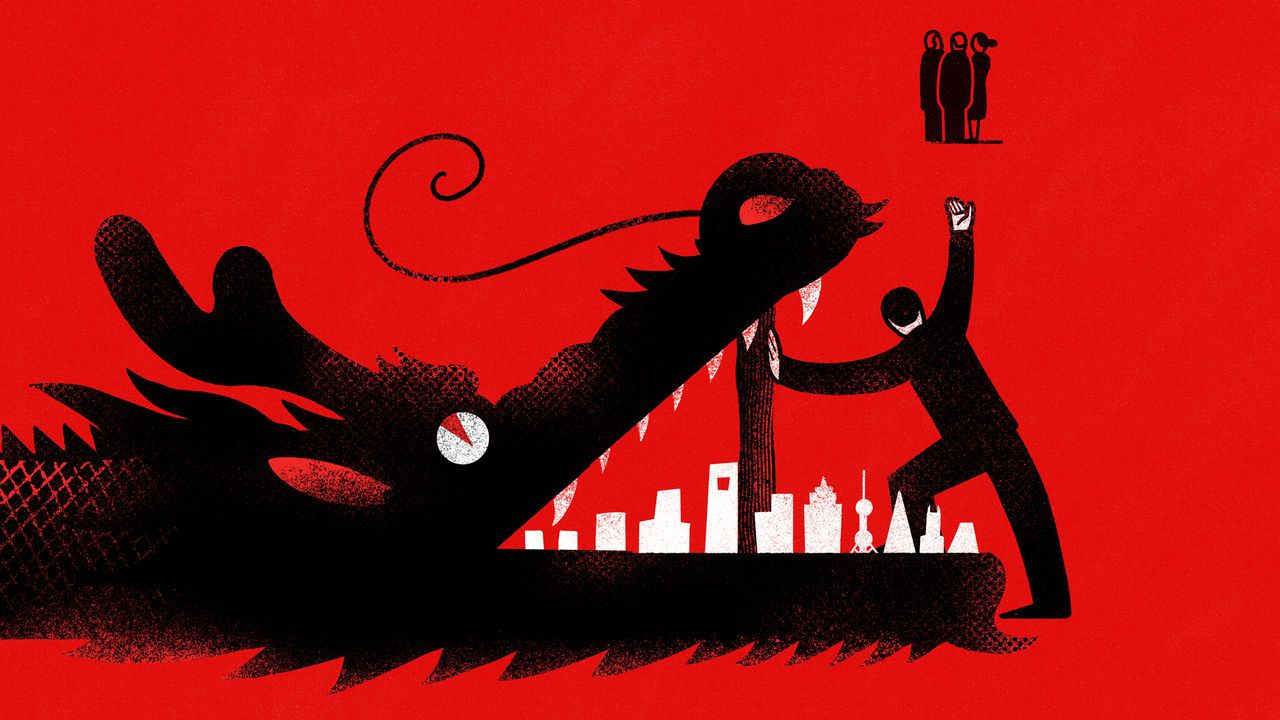
Illustration: Satoshi Kambayashi
Mar 27th 2025
Listen to this story
FOR CHINESE stocks to outperform American ones is rare enough. But this year the MSCI China index has beaten its American equivalent by an impressive 20 percentage points, on the back of excitement about cutting-edge tech firms such as DeepSeek and Manus AI. American shares, meanwhile, have been weighed down by worries about a bellicose Trump administration and the danger of a slowing economy.
Could this revival be enough to entice international investors back to China? It has been a rocky romance so far. When outsiders looked at China’s vast economy and rapid growth in the early 2010s, many saw a land of endless opportunity. More recently, however, slowing growth and a government crackdown on private firms, ranging from video-game makers to tutoring companies, has led to a reduction in the share of domestically listed stocks that are held by foreign institutions. From 6.4% at the start of 2021, it fell to just 4% at the end of 2024.
The main beneficiary of the market upswing has been Hong Kong-listed high-tech stocks, reflecting Western investors’ newfound enthusiasm for Chinese artificial intelligence. Even after the recent rally, many of the companies in question still look cheap. Hong Kong’s Hang Seng tech index has a price-to-earnings ratio (based on expectations of earnings next year) of around 19, compared with almost 70 at its peak in 2021. China’s tech firms are not just markedly cheaper than American tech stocks by the same measure; they are cheaper than American stocks overall.
When it comes to mainland stocks, though, investors are more reluctant. Cheapness may be necessary for a resumption of foreign interest, but it is not sufficient. Three issues make investors cautious. All would have to be resolved for them to return in good number.
Some progress has been made on the first issue, which was what initially sent foreign investors running for the hills. China’s tech crackdown began in 2020, when officials cancelled the initial public offering of Ant Group, the fintech arm of Alibaba, a tech giant, after the firm’s founder, Jack Ma, criticised the country’s regulators. The move sparked discussion of whether China had become “uninvestable”. Now a thaw seems to be in progress. Last month Xi Jinping, China’s president, got together with a group of private-sector leaders that included Mr Ma and Liang Wenfeng, the founder of DeepSeek. Mr Xi stressed the importance of entrepreneurship and the scale of the Chinese market.
A revival in the Chinese economy would help too. The slump of the past few years, driven by the country’s troubled property industry, has knocked consumer spending, the main engine of growth for most large Chinese companies. Here, the necessary work is half-done at best. On March 16th the state laid out a new economic-rescue plan, apparently demonstrating its commitment to boosting consumption. The plan included schemes to subsidise interest on consumer loans and a modest increase in China’s stingy government pension. Yet it was worth only 2% of GDP—not quite the bazooka required to really get consumption going.
The last challenge, and the one that looks least likely to be resolved in the foreseeable future, is politics. Miserable relations between China and America have made Uncle Sam’s investors wary. In 2023 Joe Biden, then America’s president, signed rules that required American private-equity investors to receive approval if they wished to invest in some high-tech Chinese sectors. Mr Trump is likely to expand their reach.
For Wall Street itself, that means the hurdle to investing in China has been raised. But there are plenty of investors in other countries who have trillions of dollars of their own to deploy. Capital allocators in New York may feel as if they cannot appear too bullish on China for political reasons. Their peers in Dubai, Geneva and Singapore will not feel the same compunctions. Indeed, American politics may push foreigners towards China even as it keeps Americans out. The Trump administration’s chaotic spending cuts and on-again, off-again tariff promises are a big part of why American markets are in the doldrums.
All this presents an opportunity for Chinese policymakers. A recovering economy, a truce between the government and business, and a swell of interest in China’s technological innovation have begun to revive overseas interest. It is early days, and more is to be done. But the opportunity to seal the deal is there—if they wish to take it. ■
Science & technology | Well informed
How harmful are electronic cigarettes?
The risks of vaping may be worth the benefits
Illustration: Cristina Spanò
Mar 21st 2025
Listen to this story
RESTRICTIONS on vaping are multiplying. Belgium banned sales of disposable vapes on January 1st. France adopted a similar law on February 24th. Other bans on “puffs”, as these single-use electronic cigarettes are also known, may soon come into force in England, Scotland, Wales and New Zealand. The law in the last of those, which takes effect on June 17th, even prohibits specialist retailers from speaking with existing customers about vaping products. More than 30 countries including Brazil and India have outlawed all vaping products. Are such measures justified?
Vaping clearly carries risks. Starting in 2019, America’s Centres for Disease Control and Prevention (CDC) began to track a new inflammatory respiratory disease known as EVALI (“e-cigarette or vaping product use-associated lung injury”). As of February 18th 2020, the CDC had identified 2,807 admissions to hospital for EVALI in America. At least 68 of those patients had died.
Swift action ensued. Researchers pointed fingers at vitamin E acetate, a skincare oil that was added to many illicit batches of vaping liquids as a thickening agent. When vitamin E acetate is vaporised by a vape’s heating coil, highly toxic ketene gas is produced. Many jurisdictions outlawed any addition of vitamin E acetate to vape liquids, and crackdowns on black markets followed. EVALI cases fell sharply; the CDC has not detected a resurgence.
Yet health authorities believe EVALI might also be caused by other substances in vape aerosols, including those that are manufactured legally. In a landmark analysis of four popular vaping liquids published in Chemical Research in Toxicology in 2021, a team at Johns Hopkins University labelled six ingredients—including caffeine and tributylphosphine oxide, a pesticide precursor—as potentially hazardous. Earlier studies had found vaping mixtures that used formaldehyde, as well as heavy metals such as chromium and lead.
There are other reasons to be concerned. First, as vaping surged in popularity only in the past dozen or so years, cancer cases could still crop up. Lab mice, which can develop diseases quickly owing to their fast metabolisms, have developed cancers after being subjected to vape aerosols. The second is that vape aerosols have been found to damage human tissue, including DNA, via a process called oxidative stress.
This sounds grim. Yet researchers mostly concur that vaping is less harmful than smoking. Of the more than 7,000 substances generated by burning tobacco, over 70 have been linked to cancer, and a greater number are toxic. Vape aerosols share some of those carcinogens and toxins, but generally at much lower levels. Crucially, vapes produce no carbon monoxide or tar, two of the biggest nasties in cigarette smoke. A review of 39 studies that was published in January in Tobacco Induced Diseases found “no significant incident or prevalent risk” of cancer in vapers who had never smoked.
What is more, taking up vaping, which mimics smoking gestures, seems to make the latter habit easier to kick. Consider a study of 886 British smokers published in the New England Journal of Medicine in 2019. All wanted to stop smoking. Roughly half were given nicotine via gum, mouth spray, patches and the like. The rest were given nicotine vapes. A year on, 10% of the first group had quit smoking. The figure for those given vaping kits was 18%. And among participants still smoking, the vapers had been lighting fewer cigarettes. ■
Science & technology | Don’t stop him now
Can Musk put people on Mars?
Whether successful or not, his attempt to do so will reshape America’s space programme

Photograph: Alamy
Mar 27th 2025
Listen to this story
HUMAN LAWS can be changed, waived or broken. Physical laws are less biddable. When it comes to putting humans on Mars, which he sees as the first step towards the planet’s settlement and humankind’s salvation, Elon Musk now has little to worry about from human law. Mr Musk has overseen the gutting of the FAA, America’s aviation authority and a sometime obstacle to his company SpaceX, by his so-called Department of Government Efficiency (DOGE). What is more, he stands at the side of an American president who, as well as having little regard for legal strictures, explicitly endorses Mr Musk’s Martian agenda. In his inaugural address President Donald Trump declared that it was time for Americans to “pursue our manifest destiny into the stars, launching American astronauts to plant the Stars and Stripes on the planet Mars”. This was not a one-off. He repeated the aspiration in his address to Congress six weeks later.
There are, though, physical constraints. They do not preclude reaching the orbit of Mars from that of Earth. That is, in principle, fairly simple. Put your spacecraft on an elliptical orbit around the Sun, carefully chosen so that it is tangential to Earth’s orbit upon departure, and tangential to Mars’s orbit upon arrival (see diagram). The mathematics dictate that, six to eight months later, it will arrive at a point on the orbit of Mars that lies on the opposite side of the Sun.
The only difficulty arises from the need to arrive at such a point at the same time as Mars itself does. Getting that right requires Earth to lag behind Mars by roughly 45 degrees at the time of launch, a state of affairs which comes around only every two-and-a-bit years—which is to say, only twice in any given four-year presidential term. If humans are to be launched to Mars before Mr Trump’s constitutional time is up, they will have to leave Earth’s orbit during the opportunity which opens at the end of 2028. But unless the mission is to be insanely risky, one or more uncrewed precursor landings will need to be attempted beforehand. And they would have to be launched during the opportunity which begins in late 2026.
This is what Mr Musk said he wanted to do last year. Then it seemed barely plausible. Today it looks next to impossible.
On my way to Mars
Mr Musk’s plans focus on Starship, the unprecedentedly large and, in principle, fully reusable spacecraft that SpaceX is developing at its Starbase facility on the southern tip of Texas. One of the earliest iterations of the two-stage system’s design was referred to as the Mars Colonial Transporter; its design could allow it to carry up to 100 people at a time.
Starships are supposed to weigh about 100 tonnes when empty, with crew and cargo adding as much as 150 tonnes to that. Propellant, always the biggest contributor to a launch system’s mass, would provide a further 1,500 tonnes. Even with the help of a “Super Heavy” booster to take it to 60km from the surface of Earth and a speed of around 4,400kph during the first few minutes of flight, almost all of that fuel will be needed to get a Starship to the 28,000kph which is required for a low-Earth orbit.
If all the Starship needs to do is take a pod of SpaceX’s Starlink communication satellites into orbit—the commercial-use case—then being left with only a little fuel is fine. Push out the satellites, as planned; use the last propellant to re-enter the atmosphere and land. If the intention is to send the Starship farther, though, the almost empty tanks need refilling.
This means other Starships will have to carry extra propellant to any sibling bound for Mars. How many such missions would be required depends on the tonnage each such tanker mission can lift to orbit. If Starship’s payload capacity is less than planned, the number of missions needed to fill the tanks could be 15 or 20. What the actual requirement would be, no one knows: 23 months and eight flights into the testing programme, no Starships of any sort have yet reached orbit.
Burnin’ through the sky
It is a measure of SpaceX’s reputation that when, last September, Mr Musk talked about having a number of uncrewed Starships in orbit, fuelled up and ready to head off to Mars by 2026 it seemed, if not likely, at least possible. The three or more launches a week that the company now gets from its fleet of Falcon 9s would once have seemed just as outlandish.
In October the company astonished the world by catching a returning Super Heavy booster in mid-air. The following month it brought down a Starship from its suborbital passage through space, and the fires of atmospheric re-entry, to a precisely controlled splashdown in the Indian Ocean. Estimations of the firm’s all-round wizardry increased yet further.
This year the version of Starship used in all previous tests has been replaced by a new, larger and notionally upgraded version. It has not gone well. On January 16th the first of these “Block 2” Starships was blown up by a safety system when fires broke out in its aft section a few minutes after separating from the Super Heavy, sending a shower of debris through the skies over the Turks and Caicos Islands. Thinking it had identified the cause of the problem, SpaceX tried again on March 6th; again the engines malfunctioned; again the Starship had to be blown up; again fiery debris rained down over the Caribbean.
It looks as if a Starship that can do what is being asked of it is, at best, still some way off. The setbacks have thus sharpened the need for extra testing. But they have also slowed its pace. SpaceX always knew that, after it produced Starships capable of getting to orbit and back, it would then have to work out how to transfer ultra-cold propellants from one ship to another—something never before attempted.
It also knew that developing the capacity to launch multiple “tanker” flights in quick succession would require a lot of practice. The need to speed things up is why the company applied for a licence for 25 launches to be conducted at its Texas site over the course of this year. As it has turned out, the pace has slackened. The company may manage just four test flights in total before 2025 is half done, at which point the launch window for Mars will be only 16 months away. Mr Musk’s claim that uncrewed launches for Mars in 2026 are still on the table is very hard to believe.
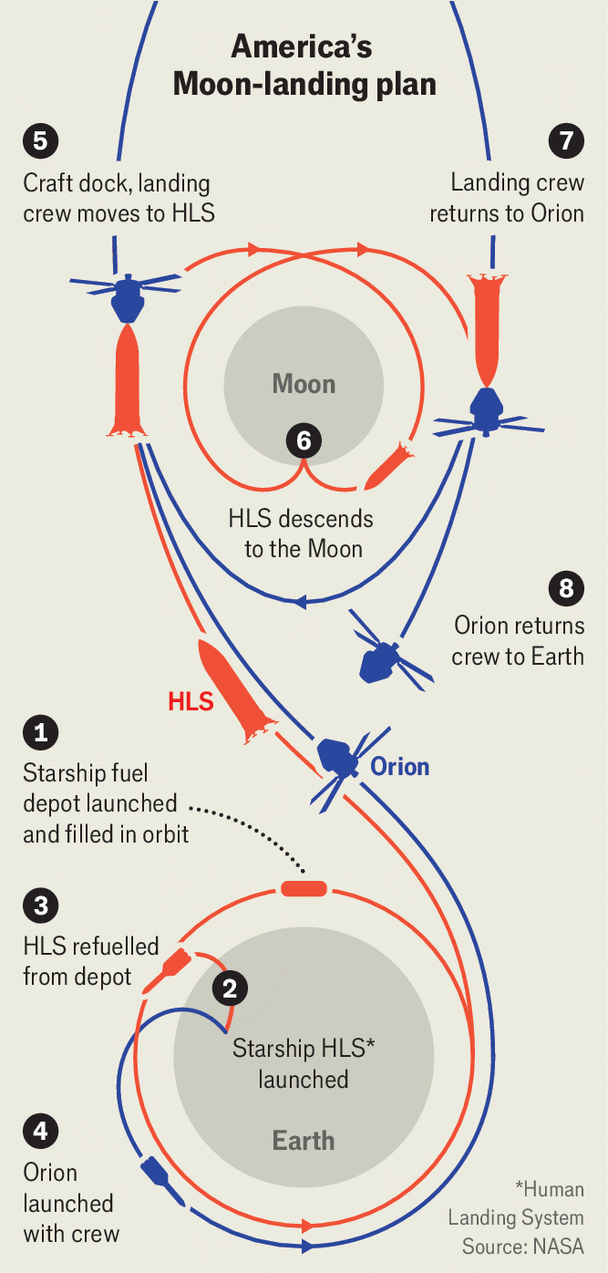
Chart: The Economist
Delays to Starship are not just a blow to Mr Musk’s Martian timetable. They are bad for NASA’s lunar one, too. In 2021 NASA chose a version of Starship to fulfil a crucial role in the agency’s Artemis Moon-landing programme—that of getting astronauts from the Orion capsule in which they are due to leave Earth down on to the surface of the Moon (see diagram). This Human Landing System (HLS) version of Starship, like those planned for the Drang nach Mars, would have landing legs and a life-support system as well as some space for cargo. And it, too, would need to be more or less fully refuelled in orbit.
NASA says it plans to launch the Artemis III mission, which is the one intended to return American astronauts to the surface of the Moon, and which therefore requires the services of the HLS Starship, in the middle of 2027. This would mean pulling off an uncrewed HLS dress rehearsal in 2026. If uncrewed Mars missions are not possible on that timescale, neither are uncrewed Moon missions. Artemis III, which has already been postponed a number of times, will get pushed back yet further.
Flights to the Moon are not constrained by orbital dynamics in the same way as flights to Mars. In principle, NASA could head off more or less as soon as it is ready. But it does face a political deadline. China has said that it plans to land people on the Moon in 2030. Its plans for doing so are much simpler than those on which Artemis relies, featuring no in-orbit refuelling or similar malarkey. It will be building on a record of successful recent robotic missions that America has yet to match. Daniel Dumbacher, an engineer who used to have a senior role in NASA’s human-exploration effort, recently testified to Congress that: “Any objective assessment, including my own view, concludes that [NASA’s] approach today has a very low probability to match the ‘before 2030’ milestone for landing humans on the Moon.”
On a collision course
Getting to the Moon is not, in itself, a high priority for people in Mr Trump’s orbit, despite the fact that the Artemis programme began on his watch. Mr Musk’s interest is purely instrumental; the $4bn in NASA contracts SpaceX has won for HLS will develop technologies the company needs for Mars, too. The member of the first Trump administration most closely associated with Artemis, vice-president Mike Pence, is now an unperson. The programme’s once proudly stated goal of putting the first American woman on to the Moon—and the first person of colour, too—is an initiative tainted with the sort of focus on diversity, equity and inclusion that the current administration deplores. In March that commitment was quietly removed from the administration’s website.
Being beaten to the Moon by China, though, is probably another matter. Many in Washington think that a scenario in which China reaches a Moon to which America has not yet returned is unacceptable, which argues for revamping or replacing Artemis. Blue Origin, a rocket company owned by Jeff Bezos, who founded Amazon, is developing a smaller, niftier Moon lander for later Artemis missions; perhaps it could be brought forward. Plans developed by Lockheed Martin, a defence firm, for a reusable tug to take things from Earth orbit to an orbit around the Moon might also be accelerated.
And maybe SpaceX could contribute something other than the Starships it would have been working on anyway. Robert Zubrin, an aerospace engineer whose ideas about reaching and settling Mars were a great influence on Mr Musk, argues that SpaceX should develop a new expendable second stage for the Super Heavy, allowing it to launch things other than Starship. Doing so could provide a way to transport large payloads to places beyond low-Earth orbit, including the Moon.
Mr Musk has shown no interest at all in such deviations from his defining goal; at its heart the Starship is still the Mars Colonial Transporter. Neither he nor the administration will be keen on spending a lot on new hardware from his competitors. But if no action is taken, Mr Trump will not only be denied the glory of sending American astronauts off to Mars before his second term comes to an end; he runs a real risk of seeing Chinese astronauts in pole position in the race for the Moon, too.
Having a good time
The end of Mr Trump’s term, though, will in no way represent the end of Mr Musk’s ambitions. This gives him an interest in future-proofing SpaceX, which can expect no favours under a Democratic administration. He will want to see Starlink built into the government’s operations to the greatest extent possible and to make SpaceX’s launch services and satellites ever more central to the operations of America’s Space Force, at the expense of its various rivals. But the best way to extend his political launch window, from his point of view, will be to use his energy, his money and any technological leverage over government systems he might achieve through DOGE to ensure that Mr Trump’s successors are pro-Musk, if possible, and, if not, at least Mars-curious.
Such a follow-on administration does not have to be committed to paying for Martian high jinks; just to stay out of their way. Indeed, though government money would doubtless be welcome, extramural Mars missions would have their own advantages, allowing for a degree of flexibility that government-funded missions could scarcely contemplate.
No mere boosterismPhotograph: AP
One big question concerns any return journey. Starships refuelled in orbit could definitely get to Mars if they perform as specified. But they will not be able to get there with enough fuel to come back. The way SpaceX intends to deal with this problem is by borrowing an idea of Dr Zubrin’s: make the methane needed to refill the tanks out of Mars’s carbon-dioxide atmosphere and subsurface ice.
Dr Zubrin imagined landing a propellant-production facility on Mars before the astronauts arrived, so they would know when they got there that there would be a means of returning. But to do this for a spacecraft as big as Starship would mean a plant with either a great many solar panels or a small nuclear facility of as yet unspecified and untested design. Having to transport such payloads one or two orbital opportunities before the first crewed missions would push back those missions well into the 2030s. Even Mr Musk might not be able to keep his political launch window open that long, try as he might.
The alternative would be to send the first pioneers to a place with no existing fuel cache. That would increase the risks of an already perilous mission. Mars-bound astronauts will face the possibility of radiation exposure and muscle-wasting during the prolonged weightlessness of their transit; the Martian environment is far less hospitable than anywhere on Earth. An attempt to remain on a foreign planet for as long as six years, even with resupplies every two-and-a-bit years, would be utterly gruelling. No worse, perhaps, than what was endured during some 18th- and 19th-century voyages of exploration. Yet no more assured of success, either.
This is not the way a government would do things. When President John F. Kennedy set America the goal of landing a man on the Moon before the end of the 1960s, he specified it should also bring him safely home. Mr Musk is not interested in doing things the government way, however, nor in overseeing something like the Apollo programme. Kennedy wanted Moon missions not because he was interested in the Moon (he wasn’t) but because he wanted to demonstrate that America’s will, innovative capacity and industrial might could be harnessed to achieve an extraordinary feat—one beyond the Soviet Union.
Mr Musk wants Mars missions because he wants to see Mars settled. His rhetorical commitment to the idea is tightly aligned with the preferences revealed by his actions and investments. There is little doubt that he would be able to find kindred spirits, quite possibly well fitted to the task, who would spearhead that destiny without a guaranteed route home. And if they would take the risks, so would he.
Don’t want to stop at all
Indeed, all indications suggest that he would go further. There is no doubt that part of Mr Musk’s alliance with Mr Trump comes down to opportunism: the president’s authority hugely assists the goal of making travel to Mars first possible and then routine. In his megalomania, Mr Musk is using the American polity as a booster stage from which to launch the multiplanetary human destiny in which he believes himself to play a crucial role.
His incentives to catch and refurbish that first stage when he believes its job to be done are much less clear. ■
Culture | Unhappily ever after
What the controversial new “Snow White” can teach Hollywood
Remakes are a riskier business than studios realise
“I can’t believe they called you dopey!”Photograph: Walt Disney Pictures/Alamy
Mar 21st 2025
Listen to this story
“Snow White”, Disney’s live-action remake of a beloved animated film, had an icy reception before its release in cinemas on March 21st. A trailer posted three months ago has earned just 60,000 likes and over 1m dislikes. “If I saw this movie on a plane I would still walk out,” grumbled one YouTube user. “We thankfully have the technology nowadays to make the animation look worse than the original from 1937,” groaned another.
Among the remake’s many sins are seven in particular: the dwarves, who have been cheesily rendered with computer-generated imagery (CGI), after a row over whether it was politically correct to have actors with dwarfism in the roles. (In the face of criticism, Disney recast the film’s dwarves as “magical creatures”—whatever that means.) There is also the issue of Rachel Zegler, the actress chosen to play Snow White, who panned the original film as “extremely dated” and said that the prince “literally stalks” the princess. It turns out fans do not like it when a remake’s heroine villainises the classic film that inspired it.
By respinning familiar tales, remakes can offer studios a surer path towards commercial riches. In the amount of pushback and controversy it has faced, “Snow White” is unusual. But in another way the film reflects a current trend, which is for studios to reach further back in history for source material. From 2020 to 2024 the average age of the source films that new remakes were based on was 35. That is about 13 years older than from 2011 to 2015, according to our analysis of data from The Numbers, a film website.
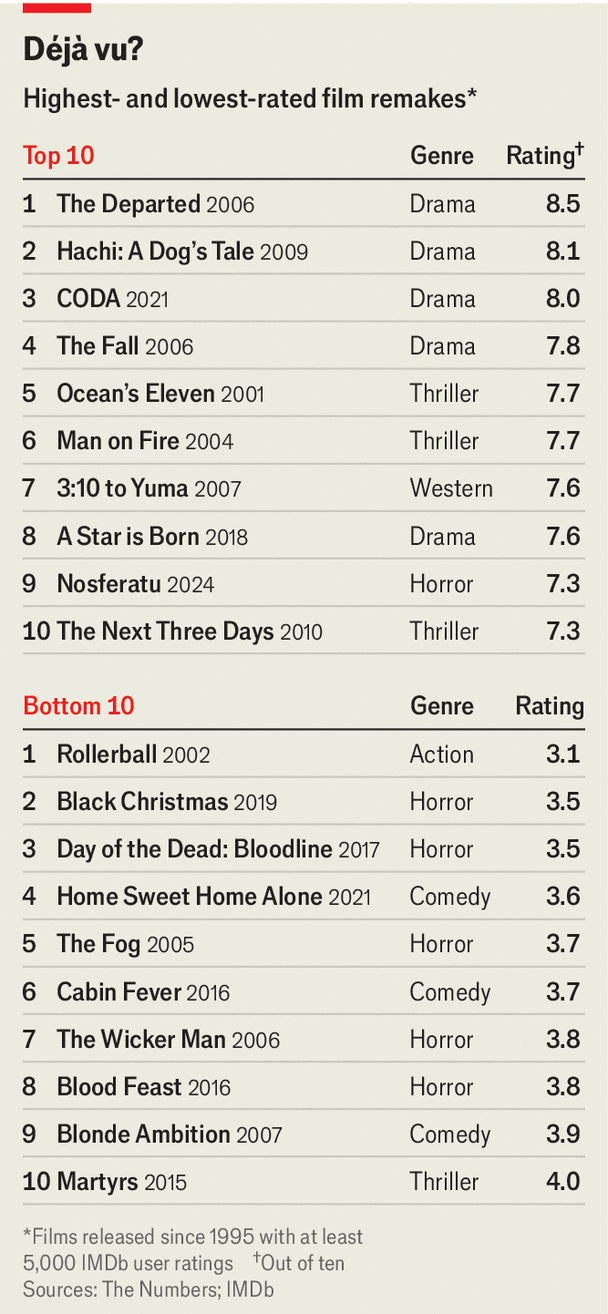
Chart: The Economist
What makes for a successful remake? It is a question on the minds of many Hollywood executives, as well as cinephiles. To answer it, The Economist analysed 200 remakes released since 1995; each had a minimum of 5,000 ratings on IMDb, an online movie database. (Our analysis only includes remakes of films, not adaptations of books.) Three lessons stand out.
First, it is not enough to use state-of-the-art special effects; computer-generated imagery needs to be handled carefully. Of the 20 worst remakes (as measured by IMDb audience ratings), half are horror films, in part because of their use of unconvincing special effects. In the fifth-worst-rated, a remake in 2005 of John Carpenter’s cult classic “The Fog” from 1980, a supernatural, vengeful fog descends on an island town off the coast of Oregon. Cheap shocks substitute for tension: viewers have complained that the fog moves too quickly and that ghosts in the fog (never clearly visible in the original) are hokey, a complaint also made by viewers about the dwarves in the new “Snow White”.
Second, comedies come with grave risks. This is the worst-performing genre for remakes, earning an average IMDb rating 1.5 points (out of ten) lower than the originals. Comedy remakes also tend to make the least at the box office. Not a single one significantly outshines the original film it was based on, according to audience ratings. It may be that viewers of comedies and horrors crave an element of surprise, which is hard to offer in a faithful remake, because audiences already know which gags and gasps to expect.
Photograph: Rex/Shutterstock
The best remakes get their inspiration from abroad. Since 1995 about a third of the top remakes have been based on foreign source material, including six of the top ten. So are the only two remakes to have won Academy Awards for Best Picture: “The Departed” (2006), based on a Hong Kong film, and “CODA” (2021), based on a French-Belgian one.
Unfamiliarity with the originals may mean that audiences come in with lower expectations and without any attachment to the original. Take “Bugonia”, starring Emma Stone, set to be released in November. It is an English-language remake of a South Korean film; instead of a male chief executive, the new story centres on a female one. However, audiences, lacking knowledge of the original, are unlikely to kick up a fuss about the change. The same cannot be said of the new “Snow White”, which seems destined for an unhappily-ever-after ending. ■
Culture | Television’s most valuable player
How Shonda Rhimes became a billion-dollar asset for streamers
Her career offers lessons for any writer who wants to make it big on the small screen

Illustration: Timo Lenzen
Mar 27th 2025
Listen to this story
FOR SHONDA RHIMES, deciding whether an idea is screen-worthy is easy. “We make shows that we want to watch,” she says of Shondaland, her production company. “If we don’t want to watch it, we don’t want to make it.” Since its founding in 2005, Shondaland has been behind some of television’s most popular shows, including “Grey’s Anatomy”, “Scandal”, “How to Get Away with Murder”, “Inventing Anna” and “Bridgerton”. “The Residence”, a new mystery drama on Netflix inspired by a book about the White House, may also reside among Ms Rhimes’s successes.
Few in the TV business can claim so many hits across different genres. Twenty years ago, on March 27th, “Grey’s Anatomy”, which follows clueless and competitive surgical interns, made its debut on ABC, a broadcast network. It has since become the longest-running primetime medical drama in America. Last year it was the second-most-watched programme on streaming services there, racking up 48bn minutes of viewing. Meanwhile “Bridgerton”, a Regency-era romp, reigned as Netflix’s most popular original series in America. In 2020-24 Shondaland shows brought in $2.4bn in subscription and advertising revenue for streamers globally, according to Parrot Analytics, a data firm. Ms Rhimes is probably the most valuable person in tv that you have never seen on screen.
Her 20-year career in TV embodies the upheavals of the industry. She has adapted to the displacement of linear weekly dramas by bingeable, high-budget streaming shows. In 2017 Netflix paid an estimated $100m-150m to lure her from ABC in an exclusive deal (reportedly renewed in 2021 for $300m-400m).
Peter Nowalk, the creator of “How to Get Away with Murder”, reckons she is “the Michael Jordan of TV”, a once-in-a-generation star. The comparison is apt: screenwriting and sport share a lot. Raw talent is a key determinant of success in both fields, but not the only one. For anyone who dreams of making big hits on the small screen, her career is instructive.
The first lesson is to shoot for the spectacular. When Ms Rhimes was writing for network TV, stories were circumscribed by advertising breaks; she had to make the viewer “want to come back”, she says. As a result each act would close with a hook of some kind: a surprising revelation or moment of emotional turmoil.
Even though streaming shows mostly do not contain adverts, Ms Rhimes says her rule for scripts still involves having an exciting development “every ten pages”. Twisting plots are Shondaland’s hallmark; Ms Rhimes’s fondness for bombshells has been described, not always flatteringly, as “OMG TV”. Viewers are unlikely to forget the episode of “Grey’s Anatomy” in which a patient arrived at hospital with a bomb in his chest, for example, or when Olivia Pope was kidnapped in “Scandal”.
The second lesson is to learn quickly from failure. Not all risks pay off, on screen or on court; Ms Rhimes had several projects at ABC that were rejected or quickly cancelled. In the early 2000s a pilot about female war correspondents was not picked up; nor was “Gilded Lilys”, a period drama, in 2012. “Still Star-Crossed” (2017) unsuccessfully imagined a sequel to Shakespeare’s “Romeo and Juliet”; one reviewer wrote that its cancellation would not “evoke much sorrow, sweet or otherwise”.
But Ms Rhimes learned from these setbacks. The show about war correspondents was pitched soon after the Iraq war had begun, at a time when the industry was lukewarm about dramas set in conflict zones; Ms Rhimes says this prompted her to think more carefully about what tastemakers wanted. She had heard that Bob Iger, then the president of Disney (which owns ABC), was seeking a medical show, so she devised “Grey’s Anatomy” instead.

Photograph: AP
The third lesson is to time your moves well. In the early 2000s Ms Rhimes worked in film, but felt that tv was becoming the home of character-driven storytelling, with shows such as “The Wire” and “Lost”. She pitched “Grey’s Anatomy” just as TV was becoming more ambitious. A decade later Ms Rhimes says she realised that streaming “was where the future of television was going to be” and that an arms race for content was beginning. Netflix, determined to stock its arsenal, doubled its annual content budget to around $12bn from 2017-18.
Like some of her shows’ heroines, Ms Rhimes was in the right place at the perfect time. The first show Shondaland made for Netflix, “Bridgerton”, arrived in December 2020. After lockdowns, audiences were eager for a fanciful escape—a world with fewer face masks and more dapper dukes. Some 80m households watched the romance in its first month. Its multiracial cast was ideally timed for the political moment, in the wake of Black Lives Matter protests and calls for greater diversity.
Ms Rhimes’s programmes often feel fresh and norm-breaking, but in many ways her firm is not. Its structure “harks back to the very traditional, old-fashioned studio model”, says Alice Thorpe of Ampere Analysis, a research firm, whereby a single person oversees a roster of trusted directors, producers and writers. Ms Rhimes does so from a distance: she lives and works in Connecticut, on America’s east coast, and the firm is based in Los Angeles. She delegates responsibilities, she says, in order to focus on “the one thing I know that Netflix needs from me and me alone, which is the creative part”.
She is also expanding in directions other media firms have ventured before. Disney, for example, has used its popular films and TV series to sell toys and trinkets for children; Shondaland is mimicking that model, just for adults. (She pushed the idea after fans of “Scandal” wanted to buy the wine glass Olivia Pope drank from, and they went to Crate & Barrel, a retailer, to do so. Shondaland did not get one sip of the profits from glass sales.) Fans of “Bridgerton” have been able to buy themed crockery, make-up, rugs, tea and wedding dresses; no other hit drama has such a visible presence in American and British shops.
“We stopped just storytelling and started world-building,” Ms Rhimes explains. Whenever a script comes in, executives think up ancillary offerings, from tie-in podcasts to products. They are also investing in live experiences, including “Bridgerton” balls, where fans come to dances in fancy dress. This is a broader trend in TV: Netflix is launching immersive experiences, including a restaurant in Las Vegas where patrons can eat food from their favourite shows. In the streaming age, when there is so much choice—and a long lag between lavishly produced seasons—such offerings keep shows relevant.
Broadcasters and streamers are no doubt eager to find the next Shonda. But that will prove more challenging than, say, getting away with murder. With network TV declining, broadcasters are unwilling to gamble on rookies. “It’s hard to be the first-time writer selling a show now because so much revenue goes into established outfits” such as Shondaland, says Michael Szalay of the University of California, Irvine. In the wake of the pandemic and the Hollywood strikes, streamers are also becoming more parsimonious, even with well-known writers and creators. There has been “a notable drop-off” in the number of production deals that Netflix has signed, according to Ms Thorpe. But for now, Netflix and its viewers do not seem ready to see Ms Rhimes pass the ball. ■
Obituary | To Finland in a car boot
Oleg Gordievsky worked for both sides in the cold war
The KGB officer who spied for Britain died on March 4th, aged 86

Photograph: Alamy
Mar 26th 2025
Listen to this story
The first thing Oleg Gordievsky did, having decided in July 1985 to defect, was to barricade the door of his Moscow flat. When the KGB men came for him, that would slow them down.
He had once been a star among them. An ideal young recruit from the Moscow State Institute of International Relations, expert at languages, highly intelligent and with a retentive memory. Good at cross-country running, too. He had risen swiftly, working for Line S, which ran “illegals”, agents living abroad under false identities. First he was posted to East Berlin, then to Copenhagen, and in 1982 to London, where he rose to the top job, rezident. But when he was called back to Moscow Centre to be “formally confirmed”, he knew it was a trap. After five hours of interrogation, drugged with doctored brandy, he had still not given anything away. But now, granted short leave, he urgently needed his exfiltration plan. To stay in Russia was a death sentence.
From a bookshelf he took down Shakespeare’s Sonnets, dumped the book in the kitchen sink, and ran the tap. Gradually the binding fell off to reveal, wrapped in cellophane, his escape instructions from Britain’s Secret Intelligence Service. For MI6 was his informal employer, too.
Ingenuity like the secret Sonnets was one reason why he had become a spy. Finding clever deadletter spots; practising brush-pasts, to invisibly pass microfilm to a colleague; leaving bent nails and chalk marks in certain places to convey messages; and “dry-cleaning”, or shaking off surveillance without turning round. But there were several draws. His father, a devoted communist, had been a low-level member of the NKVD, ancestor of the KGB. His brother Vasilko had already joined the agency. For a young Russian in the Soviet era who wanted to use languages and travel abroad, the KGB was the obvious place to go. Spying was exciting.
Sometimes too much so. Now, in a panic—too much Cuban rum, too many sedatives—he read his instructions. He was to wait on a certain street corner, near a bakery, on Tuesday at 7pm, carrying a Safeway plastic bag. Twenty-four minutes later a man would come past with a Harrods bag, munching a Mars bar. He must look him in the eye and silently plead: It’s me. Get me out.
His destination was Finland. Or, to be honest, anywhere in the West. Slowly but inexorably, he had been drawn towards it. As a boy he had sometimes caught Voice of America through the jamming on his radio. More indelibly he had heard his mother, with her commonsense peasant attitude, express contempt for the Soviet regime. On his trainee posting in East Germany in 1961 he witnessed people’s despair as the Berlin Wall went up. In Copenhagen he was astonished by the beauty, abundance and openness of the West. He compared it with the queues in Moscow, the misery, the shortages and rude officials. But the final straw was the invasion of Czechoslovakia in 1968. He called his wife Leila to pour out his anger then, into a phone he knew was tapped by MI6, in the hope they would want to cultivate him. He had resolved to fight for freedom and democracy, on the side of good rather than evil. That was so strong a duty that he would do it for nothing.
The next stage of the exfiltration plan was delivered in a brush-past in St Basil’s cathedral. It told him to catch two trains, then a bus, to a forest near the Finnish border. There he waited by a particular rock, plagued by mosquitoes, for his MI6 handlers to arrive in cars. They were 15 minutes late. Had he been wrong to trust them? His mother often said he was too trusting, a risky quality in an officer. He had almost given up hope when they appeared.
The British had been late to cultivate him, too. It took a year. They clearly thought he might be a provocation. Instead, he was an extraordinary find. From 1974, using the KGB’s own archives in Moscow, he helped MI6 identify communists in Britain, including trade unionists, and follow the track of Soviet funding. He also fingered 25 Soviet spies, who were expelled. The KGB knew it had a mole on board, and began to suspect it was him, but he was still sending titbits back home, too. In 1984 he provided briefings to Mikhail Gorbachev about Margaret Thatcher, and vice versa, leading to an amicable meeting. The ground for that had also been prepared by him the year before, when he warned MI6 that the Russians, paranoid about a NATO exercise and Ronald Reagan’s tough talk, were preparing a first nuclear strike. In response the exercise was swiftly curtailed and the tough talk softened. He had probably prevented a third world war.
That saviour was now in the boot of a diplomatic car, wrapped in a foil space blanket to throw off heat-detectors at the several checkpoints. He was sweating with terror that he might be found. At long last, instead of loud pop music, a burst of Sibelius’s “Finlandia” came on the car radio. The boot opened on blue sky, clouds and pine trees. He was out, and he was free.
Free in a way. But his death sentence in Russia, for treason, was never rescinded. He could not return. He needed to live incognito, in a safehouse, for the rest of his days. His marriage was shot, because he had never been able to tell Leila about the activity that took up half his existence. He therefore barely saw his daughters, either. Allied governments still asked him for advice, and he co-wrote four books about the KGB; but there was no more spycraft. Instead in deepest Surrey he wrote reviews, read the Spectator and went, with caution, to the pub. Queen Elizabeth gave him the CMG, the same honour granted fictitiously to James Bond. That made a sort of sense.
He missed nothing about Russia, especially under Vladimir Putin. Putin was an abomination, and to think that Russia could ever be democratic was just naive. On “Desert Island Discs” in 2008 his second record was Feodor Chaliapin singing “The Song of the Volga Boatmen”, as faint and crackling and far away as he had once heard the voice of the West. ■