The Economist Articles for June. 4th week : June. 22nd(Interpretation)
작성자Statesman작성시간25.06.14조회수66 목록 댓글 0The Economist Articles for June. 4th week : June. 22nd(Interpretation)
Economist Reading-Discussion Cafe :
다음카페 : http://cafe.daum.net/econimist
네이버카페 : http://cafe.naver.com/econimist
Leaders | Factory fever
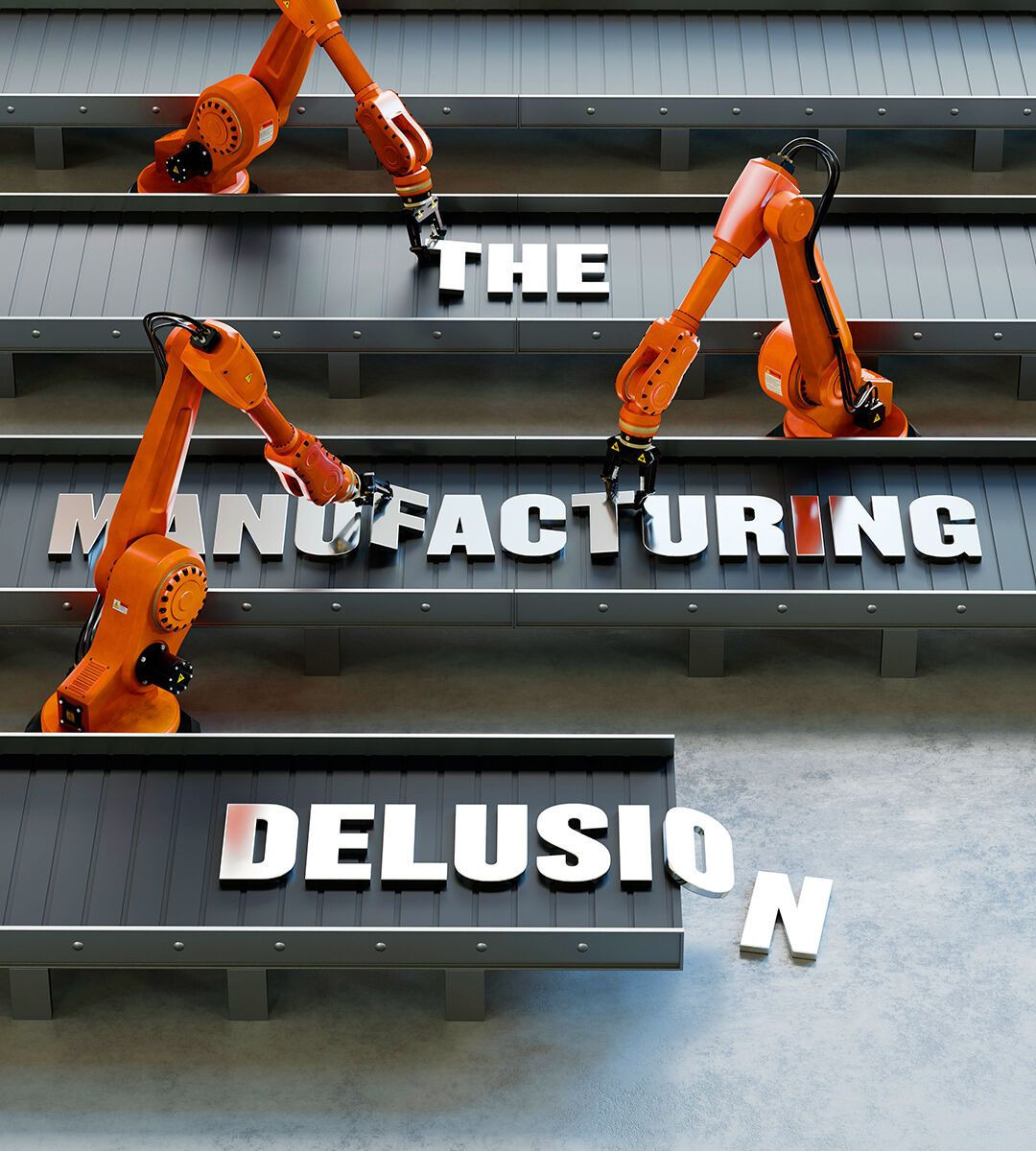
The world must escape the manufacturing delusion
Governments’ obsession with factories is built on myths—and will be self-defeating
Jun 12th 2025
Listen to this story
Around the world, politicians are fixated on factories. President Donald Trump wants to bring home everything from steelmaking to drug production, and is putting up tariff barriers to do so. Britain is considering subsidising manufacturers’ energy bills; Narendra Modi, India’s prime minister, is offering incentives for electric-vehicle-makers, adding to a long-running industrial-subsidy scheme. Governments from Germany to Indonesia have flirted with inducements for chip- and battery-makers. However, the global manufacturing push will not succeed. In fact, it is likely to do more harm than good.
Today’s zeal for homegrown manufacturing has many aims. In the West politicians want to revive well-paying factory work and restore the lost glory of their industrial heartlands; poorer countries want to foster development as well as jobs. The war in Ukraine, meanwhile, shows the importance of resilient supply chains, especially for arms and ammunition. Politicians hope that industrial prowess will somehow translate more broadly into national strength. Looming over all this is China’s tremendous manufacturing dominance, which inspires fear and envy in equal measure.
Jobs, growth and resilience are all worthy aims.
Unfortunately, however, the idea that promoting manufacturing is the way to achieve them is misguided. The reason is that it rests on a series of misconceptions about the nature of the modern economy.
One concerns factory jobs. Politicians hope that boosting manufacturing means decent employment for workers without university degrees or, in developing countries, who have migrated from the countryside. But factory work has become highly automated. Globally, it provides 20m, or 6%, fewer jobs than in 2013, even as output has increased 5% by value. For all countries to take more of a shrinking pie is impossible.
Many of the good jobs created by today’s production lines are for technicians and engineers, not lunch-pail Joes. Less than a third of American manufacturing jobs today are production roles carried out by workers without a degree. By one estimate, bringing home enough manufacturing to close America’s trade deficit would create only enough new production jobs to account for an extra 1% of the workforce. Manufacturing no longer pays those without a degree more than other comparable jobs in industries such as construction. As productivity growth is lower in manufacturing than it is in service work, wage growth is likely to be disappointing, too.
Another misconception is that manufacturing is essential for economic growth. India’s manufacturing output, as a share of gdp, languishes about ten percentage points below Mr Modi’s target of 25%. But that has not stopped India’s economy growing at an impressive rate. In the past few years China has struggled to meet its growth targets, even as its manufacturers have come to dominate entire sectors, such as renewable energy and electric vehicles.
What about the argument that, given the war in Ukraine and tensions with China, the rich world must reindustrialise for the sake of national security? It seems dangerous to rely on factories abroad. And covid-19 caused a supply-chain panic. Some dependencies are indeed chokeholds. China’s near-monopoly in refining rare earths has recently allowed it to put the brakes on global carmaking, giving it leverage over America. It is also prudent for the West to build up stocks of weapons and ammunition, to ensure that crucial infrastructure is sourced from allies and to build things with long lead times, like ships, before conflict breaks out.
But in today’s ultra-specialised world, across-the-board subsidies for reindustrialisation will not do much to boost war-readiness. Making Tomahawks is entirely different from making Teslas. Far from suggesting that countries at peace must develop the capacity to make lots of drones, the war in Ukraine shows that a wartime economy can innovate and multiply production volumes remarkably fast.
The final part of the manufacturing delusion is the idea that China’s industrial might is a product of its state-led economy—and so must be countered with a similarly extensive industrial policy everywhere else. China does indeed distort its markets in all kinds of ways, and early in this century it manufactured an unusual amount given its level of development. But those days are past.
China has not escaped the global shrinkage of factory jobs since 2013. The share of its workforce in factories corresponds to America’s at a similar level of prosperity; and it is lower than it was in most other rich economies. China’s 29% share of global manufacturing value-added is a function of its size rather than its strategy. After years of fast growth, it now has an enormous domestic market to support its manufacturers. Innovation is begetting innovation; a “low-altitude economy” of drones and flying taxis promises to take flight soon. Yet, even though China’s goods exports have grown by 70% relative to global GDP since 2006, they have fallen by half as a share of the Chinese economy.
Factory settings
The way to rival the manufacturing heft of China is not through painful decoupling from its economy, but by ensuring that a sufficiently large bloc rivals it in size. This is best achieved if allies are able to work together and trade in an open and lightly regulated economy; factories in America, Germany, Japan and South Korea together add more value than those in China. As the pandemic showed, diverse supply chains are a lot more resilient than national ones.
Alas, governments today are heading in precisely the opposite direction. The manufacturing delusion is drawing countries into protecting domestic industry and competing for jobs that no longer exist. That will only lower wages, worsen productivity and blunt the incentive to innovate, while leaving China unrivalled in its industrial might. The mania for manufacturing is not just misguided. It is self-defeating. ■
Leaders | Strike it lucky
Israel has taken an audacious but terrifying gamble
The world would be safer if Iran abandoned its nuclear dreams, but that outcome may prove unattainable
Jun 13th 2025
FOR THREE decades, Israel’s prime minister, Binyamin Netanyahu, has warned that Israel’s gravest external threat is Iran. And no Iranian threat is graver than its programme to acquire a nuclear bomb. Israel is a small, densely populated country within missile range of the Islamic Republic. A nuclear-armed Iran would put its very existence at risk.
Early on Friday June 13th, Mr Netanyahu at last acted on this conviction, dispatching wave after wave of Israeli aircraft to strike Iran. They attacked nuclear installations in Natanz, 300km south of the capital Tehran, as well as officials associated with the weapons programme. And they also killed the top echelons of the Iranian armed forces, including Mohamad Bagheri, the chief of staff.
Mr Netanyahu once had a reputation as a risk-averse leader, but this strike was audacious, even reckless. Israel is entitled to take action to stop Iran from getting a bomb. The prime minister is justified in fearing that a nuclear-armed Iran would hold dire consequences for his country. He appears to have the support of President Donald Trump, an essential ally. Friday’s assault could turn out to be a devastating blow against the regime in Tehran. But it also threatens a bewildering range of outcomes, including some that are bad for Israel and America.
Nobody familiar with the recent history of the Middle East could doubt that Israel is right to see Iran as a threat. The Islamic Republic has been a malign presence in the region, sponsoring terrorists, violent militias and despotic regimes, including that of Bashar al-Assad in Syria. The supreme leader, Ayatollah Ali Khamenei, has repeatedly threatened to obliterate Israel. Iran backed Hamas, which launched a murderous attack on the country from Gaza on October 7th 2023.
An Iranian bomb would make all of this worse. It could lead countries in the Middle East, such as Saudi Arabia, to seek weapons of their own. Even without any proliferation, a nuclear-armed Iran would be perceived in the region as a constraint on the Israel Defence Forces’ freedom of manoeuvre. In Israel’s eyes, that would undermine the deterrence that keeps it safe in a dangerous neighbourhood.
Israeli officials argue that they would eventually have no choice but to attack Iran’s nuclear programme and that they had a brief window to carry one out. Iran is weaker than it has been for decades. Israel wrecked its air defences last year, in strikes undertaken as part of a tit-for-tat exchange. Not only is the regime unpopular, but its influence in Lebanon and Syria is much diminished. Hizbullah, the Lebanese militia that was once seen as the spearhead of any Iranian retaliation, no longer has the missiles or organisation to mount a serious reprisal.
More importantly, Israel insists, Iran has never been closer to going nuclear. It says that, having accelerated its production of enriched uranium, Iran now has enough for 15 bombs. In a recorded address, Mr Netanyahu claimed to have evidence that Iran is weaponising its technology, saying that it may be close to a device. His officials believe that, in talks with America about a deal that would halt the nuclear programme, Iran has been creating a smokescreen behind which its scientists were in reality pressing rapidly ahead. In a post, Mr Trump endorsed that view, accusing Iran of being unwilling to make a deal. If the talks were doomed, Israel believes, then it had to act now, before it was too late.
Perhaps with American help over the coming days, Israel may inflict fatal damage on Iran’s nuclear programme. Having killed many Iranian officials, it may have caused so much chaos in Tehran that the regime cannot mount a powerful response. After being on the receiving end of such a show of strength, the mullahs may be deterred from mounting another attempt to build a nuclear arsenal. That is the outcome which would best serve the Middle East and the world.
However, Friday’s offensive is also a huge gamble. For one thing, the urgency may not be as great as Israel suggests. In March America’s intelligence chief, Tulsi Gabbard, said that Mr Khamenei had not reauthorised the weapons programme he suspended in 2003. Even after the attacks, Mr Trump continued to believe that there was scope for talks, calling on Iran to return to the negotiating table and strike a deal. Should Iran agree, a remote possibility, this could yet become a source of friction between America and Israel. Mr Netanyahu has never trusted Iran to abide by agreements to limit its nuclear programme.
The strike is also a gamble because of its potential regional and global consequences. Although Iran is less able to retaliate than it once was, it can still cause a lot of harm. Already, on June 13th Iran loosed over 100 drones against Israel. Iran could launch attacks on the Gulf states that are American allies or host American bases. It can still call on the Houthis, its proxies in Yemen. And it could also wage a campaign of terror against Israeli or Jewish interests around the world. If this descended into a regional war, there could be consequences for stability and—via oil prices—for the rest of the world.
Odd as it may sound, a collapse of the rotten Iranian regime, much as it is hated within the country and in the region, could also be highly destabilising. Iran is a big and complex country without a history of democracy. Nobody can say what might emerge from the chaos.
But the main reason the strike is a gamble is that it may not work. Twice before, in Iraq in 1981 and Syria in 2007, Israel attacked nuclear-weapons programmes and successfully halted them. Iran’s effort is much more advanced and dispersed than those ever were. Its facility at Fordow, in Qom province, is safely hidden beneath a mountain. If, as some officials believe, that puts it beyond reach of Israeli munitions, Israel would require ground troops or American help to put it out of action. Even if physical infrastructure is destroyed, Iran has its own deposits of uranium. In the past few decades it has mastered the process of enrichment. Geology and knowhow lie beyond the reach of even American bombs. If the Iranian programme is restarted, it may return more virulent and threatening than ever.
The prospect is therefore that, within a few years, Israel and possibly America will be obliged to repeat the operation all over again. Each time will be harder than the last. Even in a world where the old rules are breaking down, an endless pattern of regular bombing raids on a sovereign nation would carry a heavy diplomatic and political cost. Eventually, repeated strikes could stretch America’s patience and inflame public opinion there, doing long-term harm to the alliance with America upon which Israel depends.
Mr Netanyahu will argue that none of these arguments weighs more heavily than his country’s survival and that he simply cannot afford to let talks with Iran play out. It is an all-or-nothing worldview that has led Israel into wars in Gaza, Lebanon and now Iran.
The hope is that Iran’s nuclear programme will be destroyed never to return. That would be vindication for Israel’s prime minister. But if not, Israel will have to live with the paradox that Mr Netanyahu engenders. At a time when the Gulf states are offering a new vision of the Arab world built on the coexistence with Israel that comes from economic development, his eagerness to resort to conflict risks making their plans impossible. In attempting to spare the Middle East from Iranian aggression, he risks trapping it in a cycle of violent destruction and instability. In its own way, that poses an existential threat to Israel, too. ■
Leaders | Phew, it’s a girl!
The stunning decline of the preference for having boys
Millions of girls were aborted for being girls. Now parents often lean towards them

Jun 5th 2025
Listen to this story
Without fanfare, something remarkable has happened. The noxious practice of aborting girls simply for being girls has become dramatically less common. It first became widespread in the late 1980s, as cheap ultrasound machines made it easy to determine the sex of a fetus. Parents who were desperate for a boy but did not want a large family—or, in China, were not allowed one—started routinely terminating females. Globally, among babies born in 2000, a staggering 1.6m girls were missing from the number you would expect, given the natural sex ratio at birth. This year that number is likely to be 200,000—and it is still falling.
The fading of boy preference in regions where it was strongest has been astonishingly rapid. The natural ratio is about 105 boy babies for every 100 girls; because boys are slightly more likely to die young, this leads to rough parity at reproductive age. The sex ratio at birth, once wildly skewed across Asia, has become more even. In China it fell from a peak of 117.8 boys per 100 girls in 2006 to 109.8 last year, and in India from 109.6 in 2010 to 106.8. In South Korea it is now completely back to normal, having been a shocking 115.7 in 1990.
In 2010 an Economist cover called the mass abortion of girls “gendercide”. The global decline of this scourge is a blessing. First, it implies an ebbing of the traditions that underpinned it: the stark belief that men matter more and the expectation in some cultures that a daughter will grow up to serve her husband’s family, so parents need a son to look after them in old age. Such sexist ideas have not vanished, but evidence that they are fading is welcome.
Second, it heralds an easing of the harms caused by surplus men. Sex-selective abortion doomed millions of males to lifelong bachelorhood. Many of these “bare branches”, as they are known in China, resented it intensely. And their fury was socially destabilising, since young, frustrated bachelors are more prone to violence. One study of six Asian countries found that warped sex ratios led to an increase of rape in all of them. Others linked the imbalance to a rise in violent crime in China, along with authoritarian policing to quell it, and to a heightened risk of civil strife or even war in other countries. The fading of boy preference will make much of the world safer.
In some regions, meanwhile, a new preference is emerging: for girls. It is far milder. Parents are not aborting boys for being boys. No big country yet has a noticeable surplus of girls. Rather, girl preference can be seen in other measures, such as polls and fertility patterns. Among Japanese couples who want only one child, girls are strongly preferred. Across the world, parents typically want a mix. But in America and Scandinavia couples are likelier to have more children if their early ones are male, suggesting that more keep trying for a girl than do so for a boy. When seeking to adopt, couples pay extra for a girl. When undergoing in vitro fertilisation (IVF) and other sex-selection methods in countries where it is legal to choose the sex of the embryo, women increasingly opt for daughters.
People prefer girls for all sorts of reasons. Some think they will be easier to bring up, or cherish what they see as feminine traits. In some countries they may assume that looking after elderly parents is a daughter’s job.
However, the new girl preference also reflects increasing worries about boys’ prospects. Boys have always been more likely to get into trouble: globally, 93% of jailbirds are male. In much of the world they have also fallen behind girls academically. In rich countries 54% of young women have a tertiary degree, compared with 41% of young men. Men are still over-represented at the top, in boardrooms, but also at the bottom, angrily shutting themselves in their bedrooms.
Governments are rightly concerned about boys’ problems. Because boys mature later than girls, there is a case for holding them back a year at school. More male teachers, especially at primary school, where there are hardly any, might give them role models. Better vocational training might nudge them into jobs that men have long avoided, such as nursing. Tailoring policies to help struggling boys need not mean disadvantaging girls, any more than prescribing glasses for someone with bad eyesight hurts those with 20/20 vision.
In the future, technology will offer parents more options. Some will be relatively uncontroversial: when it is possible to tweak genes to avoid horrific hereditary diseases, those who can will not hesitate to do so. But what if new technologies for sex selection become widespread? Couples undergoing fertility treatment can already choose sperm with X chromosomes or determine an embryo’s sex via genetic testing. Such techniques are expensive and rare, but will surely get cheaper.
Also, and more important, more parents who conceive children the old-fashioned way are likely to use cheap, blood-based screening in the first weeks of pregnancy to find out about genetic traits. These tests can already reveal the sex of the embryo. Some people trying for a girl may then use pill-based abortifacients to avoid having a boy. As a liberal newspaper, The Economist would prefer not to tell people what kind of family they should have. Nonetheless, it is worth pondering what the consequences might be if a new imbalance were to arise: a future generation with substantially more women than men.
The power of numbers
It would not be as bad as too many men. A surplus of single women is unlikely to become physically abusive. Indeed, you might speculate that a mostly female world would be more peaceful and better run. But if women were ever to make up a large majority, some men might exploit their stronger bargaining position in the mating market by becoming more promiscuous or reluctant to commit themselves to a relationship. For many heterosexual women, this would make dating harder. Some wanting to couple up would be unable to do so.
Celebrate the cooling of the war on baby girls, therefore, and urge on the day when it ends entirely. But do not assume that what comes next will be simple or trouble-free. ■
Business | Schumpeter
AI agents are turning Salesforce and SAP into rivals
Artificial intelligence is blurring the distinction between front office and back office
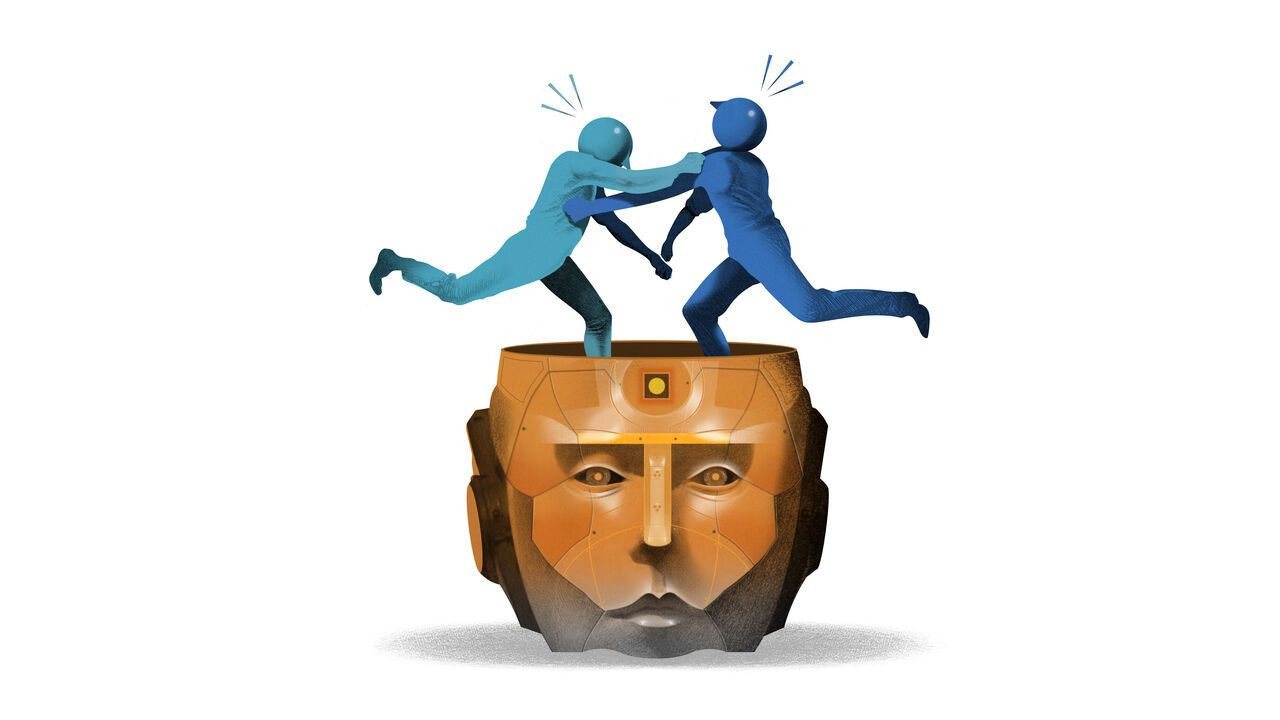
Illustration: Brett Ryder
Jun 5th 2025
Listen to this story
ENTERPRISE SOFTWARE is an unlikely source of hubbub. Bringing up CRM or ERP in conversation has usually been a reliable way to be left alone. But not these days, especially if you are chatting to a tech investor. Mention the acronyms—for customer-relationship management, which automates front-office tasks like dealing with clients, and enterprise resource planning, which does the same for back-office processes such as managing a firm’s finances or supply chains—and you will set pulses racing.
Between June and early December 2024 Salesforce, the 26-year-old global CRM giant, created more than $120bn in shareholder value, lifting its market capitalisation to a record $352bn. In the past 12 months SAP, a German tech titan which more or less invented ERP in the 1970s, has generated more. It is Europe’s most valuable company, worth $380bn, likewise an all-time high. Both enterprise champions rank among the world’s top ten software companies by value. Maybe not so dull, after all?
The source of the excitement is another, much sexier acronym: AI. Builders of clever artificial-intelligence models may get all the attention; this week Elon Musk’s xAI hogged the headlines when it was reported that the startup was launching a $300m share sale that would value it at $113bn. But if the technology is to be as revolutionary as boosters claim, it will in the first instance be because businesses use it to radically improve productivity. And as anyone who has tried—and probably failed—to replace corporate computer systems will tell you, they are likely to do so with the assistance of their current IT vendors.
Salesforce and SAP each believes it will be the one ushering its clients into the AI age. The trouble is that many of those clients use both firms’ products. Perhaps nine in ten Fortune 500 firms run Salesforce software. The same share relies on SAP.
This did not matter when the duo focused on their respective bread and butter. A client would run Salesforce’s second-to-none CRM in the front office and SAP’s first-rate ERP in the back. Amazon and Walmart, Coca-Cola and PepsiCo, BMW and Toyota: pick a household name and the odds are it does just that.
A big reason for SAP and Salesforce to slather a thick layer of AI on top of their existing offering, though, is to give customers a way to uncurdle their data, analyse it and, with the help of semi-autonomous AI agents interacting with one another on behalf of their human managers, act on it. In this newly blended world, the lines between front and back office are fudged. “It’s one user experience,” sums up Irfan Khan, SAP’s data-and-analytics chief.
Controlling the user interface for this “agentic” AI experience promises fat profits. It also creates a head-to-head rivalry between the two enterprise masterchefs. For their AI recipes look alike.
Step one: expand your range of products. SAP has improved its front-office chops by buying CRM firms (like CallidusCloud) and marketing platforms (such as Emarsys). Though Salesforce has not gone full-ERP, it has a 16-year-old partnership with Certinia, whose financial-management system sits exclusively atop its platform. It has bought firms like ClickSoftware, which helps businesses manage their service workforce. On June 2nd it hired the team behind MoonHub, a recruitment-and-HR startup. Clients, spared from switching between providers for every specialist function, love it. So do SAP and Salesforce, since it amasses more client data, AI’s great leavener, in their own systems.
Step two: piggyback on the “hyperscalers”. This allows clients to choose between the cloud giants, including, in China, Alibaba and Tencent (and, in Salesforce’s case, excluding Microsoft, with which its co-founder and boss, Marc Benioff, has a long-running feud). It saves SAP and Salesforce from splurging on what each sees as infrastructure destined for “commoditisation”. Oracle, the giant of corporate-database management which has taken the opposite approach, has seen its quarterly capital budget explode from $400m in 2020 to nearly $6bn in its latest quarter; SAP and Salesforce spend $300m-400m a quarter between them.
Step three: whip up the AI layer. In February SAP teamed up with Databricks, a $60bn AI startup, to help clients make sense of their information, including that stored outside SAP systems, and deploy SAP’s Joule AI agents across their operations. On May 27th Salesforce said it would pay $8bn for Informatica, which designs tools to integrate and crunch corporate data. This will make its own Agentforce easier for clients to use beyond the front office.
Right now investors prefer what SAP is serving up. Its systems cover a wider range of functions and thus contain more data. This data is also notoriously hard for non-SAP systems to extract. As annoying as this may be for clients, it gives them an incentive to look from inside the SAP platform out rather than the other way round. SAP’s share price has risen by 12% in the past six months.
Meanwhile, Salesforce’s has collapsed like a bad soufflé. It is down by nearly 30% since its peak in early December. Although its sales passed those of SAP in 2023, growth is slowing while SAP’s accelerates. Analysts wonder if Agentforce, the launch of which fuelled last year’s rally, can make real money. They also fear a return to profligate dealmaking that culminated with the $28bn purchase in 2021 of Slack, a corporate-messaging platform.
Too many cooks
Investors could yet sour on SAP just as they have on Salesforce. Gartner, a research firm, reckons that between 2020 and 2024 rivals like Workday cut its share of the ERP business from 21% to 14%. For all its front-office efforts, its CRM sales declined around that time, even as Salesforce preserved its 20% slice of a growing market. Microsoft, which has its own cloud, its own cutting-edge AI and plenty of business clients, is elbowing its way into ERP, as well as CRM. The enterprise-AI food fight is just beginning. ■
Asia | Horns of a dilemma
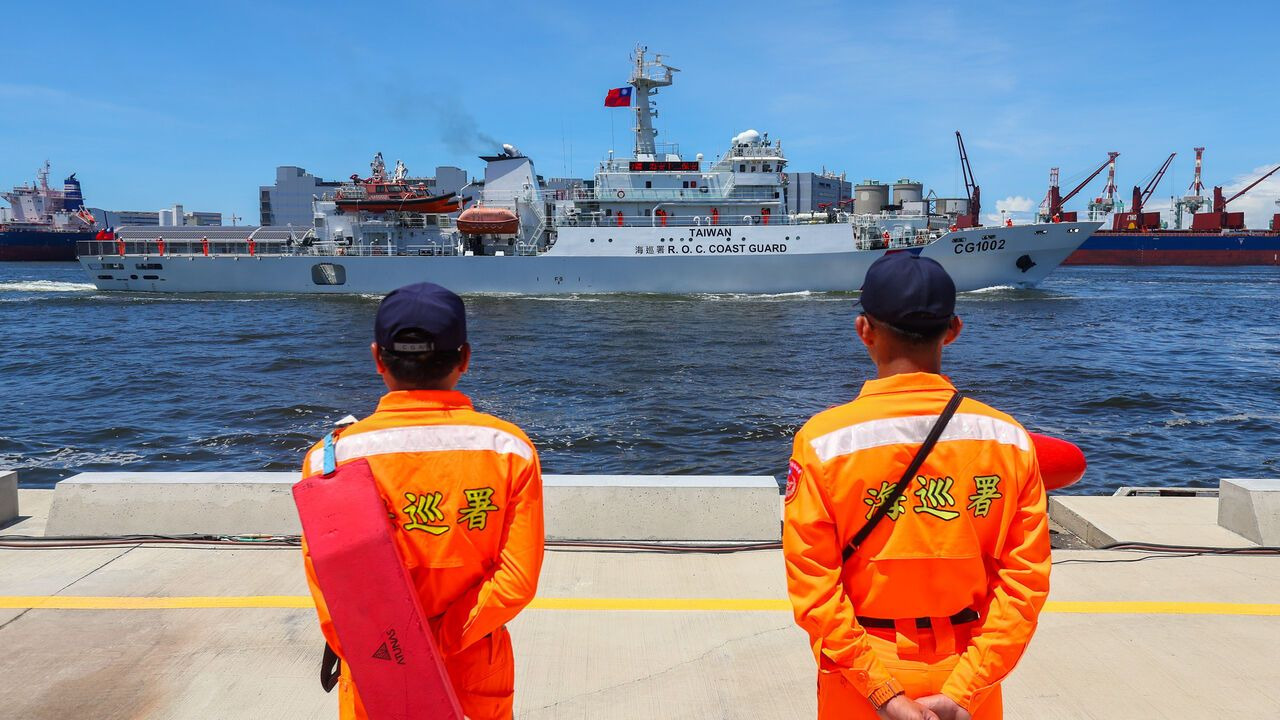
If China invaded Taiwan, who would enter the war?
Japan and the Philippines would struggle to stay out. But what about the rest?
Photograph: Getty Images
Jun 12th 2025|Singapore
Listen to this story
“THE ELEPHANT in the room”, acknowledged Emmanuel Macron, France’s president, speaking to an audience of defence bigwigs at the Shangri-La Dialogue in Singapore on May 30th, “is the day China decides a big [military] operation.” Would France intervene on day one of such a war, he mused? “I would be very cautious today.”
Mr Macron’s ambivalence is widely shared. If China were to invade Taiwan, no one is certain how different countries would line up. A new paper by the Centre for a New American Security (CNAS), a think-tank in Washington, examines that question. If America stayed out of the war, it suggests, everyone else would, too. Speaking in Singapore, Pete Hegseth, America’s defence secretary, sought to dispel that thought. “Any attempt by Communist China to conquer Taiwan by force would result in devastating consequences,” he said. “Our goal is to prevent war, to make the costs too high.”
In practice, many Asian allies fear that America is getting wobblier on the issue. Last year Donald Trump said that he would “have to negotiate things” before coming to the island’s aid; some in the Pentagon see the Taiwanese as perhaps even a lost cause.
If America does step in, the two allies most severely affected would be Japan and the Philippines. Neither country would be enthusiastic about direct involvement, though. Japan’s participation would be unlikely to go much further than submarine patrols or missile strikes, argues CNAS. The Philippines, which has 175,000 citizens in Taiwan, would be more cautious still. But if China’s armed forces were bogged down, it could be tempted to grab territory in the South China Sea, where it has multiple disputes with China, suggest the authors. All this would depend on whether China had first attacked American bases in those two countries to pre-empt American involvement or whether it held back, hoping to secure American neutrality.
A second group of countries—South Korea, Australia and India—would be more insulated. But America would put pressure on each one to help. South Korea’s immediate concern would be deterring North Korea from exploiting any diversion of American forces. The country might offer “rear-area support”, such as logistical assistance, reckons CNAS.
Australia has become an increasingly important base for American forces, too. It has not formally pledged to join a war over Taiwan, even in private. But Australian officials acknowledge that their relationship with America, including the AUKUS nuclear submarine pact, could be in jeopardy if they stayed out. India would almost certainly focus on defending its land border with China, but America could probably count on co-operation on intelligence and anti-submarine warfare.
Then there is South-East Asia. Around 900,000 passport-holders from the region live and work in Taiwan, notes CNAS, accounting for 90% of foreign citizens there. Many countries would probably attempt to remain neutral, not least because China is by far the most important trading partner for most of the region. But America would probably push for access to Thai and Singaporean air and naval bases.
What about Europe? France and Italy have recently sent aircraft-carriers to the region; Britain has one en route. In private, European policymakers are increasingly concerned about a Chinese invasion of Taiwan. A handful could offer cyber and space capabilities. More consequential would be a decision by the EU to impose sanctions on China. In particular, writes Agathe Demarais of the European Council on Foreign Relations, another think-tank, a ban on Chinese imports to Europe “could be game-changing”. For now that is an exceedingly tall order. ■
China | Great rejuvenation, grim departure
Would you want to know if you were terminally ill?
In China, catastrophic diagnoses are often kept from patients

Things need not be so darkPhotograph: Getty Images
Jun 12th 2025|Beijing
Listen to this story
QUALITY OF LIFE in China has soared in recent decades. The quality of death, however, remains grim. As the population ages, the number succumbing to diseases that can be protracted and painful, such as cancer and Alzheimer’s, is soaring. The government wants to make dying a bit less execrable, so it is experimenting with state-subsidised end-of-life care. But deep taboos and bureaucratic hurdles are making progress agonisingly slow.
International rankings confirm that China is one of the worst places to die. A study in 2015 by the Economist Intelligence Unit (EIU), a sister organisation of this newspaper, placed China 71st out of 80 countries for the quality of palliative care. Another international study, published by the Journal of Pain and Symptom Management, ranked China 53rd in its comparison of end-of-life care in 81 countries (Britain was top; America came in 43rd).
Chinese hospitals often do not allow patients to occupy beds simply to receive palliative care. Even at one of Beijing’s top hospitals (which does), only one-third of the patients who need such help can get it, a doctor told state media last year. Separate institutions for the dying are scant, too. For a terminally ill patient, there are often only two options: persist with hospital treatment that is expensive and ineffective, or die at home without ready access to powerful painkillers or help from well-trained nurses.
Taboos that limit discussion of death make all this harder to fix. It is common for doctors not to tell patients when they are terminally ill. Family members get told first—and they themselves sometimes decline to pass on the bad news. This can make it difficult to move someone to a hospice bed, even when one is available. Chinese tradition emphasises the importance of filial duty. People feel they are failing their parents if they give up on attempts to stop them dying. “We knew that treatment was pointless, but I covered it up and took her to Shanghai for surgery,” writes one woman on social media, about her mother’s cancer. “In the end, it was nothing but pain and disappointment.”
Efforts to set up dedicated hospices have sometimes faced opposition from neighbours fearful of living near a place linked with death. Li Wei, the founder of Songtang Hospice—a rare private institution in Beijing—recalls ordeals he faced after setting it up in 1987. The facility used rented property and had to move several times because landlords wanted to redevelop it. On one occasion occupants of an apartment complex gathered to stop the hospice moving in. Dozens of patients were left stranded outdoors in the summer heat with equipment piled around them.
Going gently
The good news is that attitudes towards hospice care have changed considerably in the past decade. Instead of lashing out as they usually do when China is criticised abroad, state media accepted the findings of the EIU’s big study. In 2016 hospice care was mentioned for the first time in a major health-related policy document issued by the central government. In its outline of goals for 2030, it said the building of hospice facilities should be “stepped up”. The following year China launched experiments in several cities. They include requiring health authorities to provide hospice beds in hospitals and offer palliative care at home.
Shanghai took the lead: by 2020 community health centres in every district were providing inpatient or home-based hospice care. Last year Beijing achieved the same. Between 2018 and the end of 2022, the number of hospice units in Chinese hospitals increased 15-fold to more than 4,200.
Yet the number of beds for palliative care remains “a drop in the bucket when considering the annual tens of millions of deaths in China”, noted Yicai, a news service, last year. Although some of the pilot schemes help patients by allowing some hospice treatment to be claimed on insurance, the biggest cost in palliative care—nursing—is not usually covered. And there is little real incentive, beyond government pressure, for underfunded hospitals to provide these services: peddling more expensive treatments is better for their bottom lines. In other rich countries hospice networks rely heavily on charitable donations. But these are far less available in China, not least because the party is wary of letting civil society flourish.
Another problem with the pilot schemes is that they do not tackle a glaring unfairness in China’s health-care system. When using urban medical services, many migrants from the countryside (there are about 300m such people) have to pay a far higher proportion of their expenses out of pocket than they would if they received the same treatment in their hometowns. And hospice wards are mostly in big cities.
It will not get easier. As China’s property market falters, one of the main sources of revenue for local governments—land sales—is drying up. It is no coincidence that the biggest progress towards rolling out hospice care is being made in the richest parts of the country. Poorer ones have little incentive to launch new public services that are not self-sustaining financially. In addition to providing beds, hospitals would have to devote considerable resources to training staff in what for most would be an unfamiliar area of expertise. In most of China a dignified, comfortable death will remain a luxury that only the rich can afford. ■
China | Can’t buy me love
Bride prices are surging in China
Why is the government struggling to curb them?

Photograph: Getty Images
Jun 12th 2025
Listen to this story
MARRIAGE IN CHINA can be mercenary. “Is 380,000 yuan a lot for a bride price?” a woman in Guangdong asks on a social-media site. She is thinking of getting married, and wants to know how much her fiancé’s family should pay for her hand. The sum she is suggesting, equivalent to nearly $53,000, is more than seven times her annual wage. Thousands reply; many say she should demand more. “Sis, life is your own, don’t wrong yourself, at least ask for 888,800,” says one.
In many countries the custom of paying a “bride price” has faded as people have become richer. Not in China, where the practice remains deeply entrenched. In some parts of the country bride prices are an endowment passed by the groom’s parents to the newlyweds. In others, it is a compensation paid entirely to the bride’s family. In both cases, the amounts involved are going up.
The median bride price for marriages in the countryside doubled in real terms between 2005 and 2020, according to a recent paper by Yifeng Wan of Johns Hopkins University. Prices in urban areas are rising, too. A bride price of 380,000 yuan would indeed be steep in Guangdong province, where the median was about 42,000 yuan when last estimated. But it would look a bit less outrageous in neighbouring Fujian, where 115,000 yuan is the norm.
The government disapproves. It wants more marriages, in part to boost China’s low birth rate. Lofty bride prices do not help with that. Officials desire in particular to curb them in the countryside, where they are very high, relative to incomes. Sometimes acquiring the necessary money can plunge a groom’s family into poverty.
Since 2019 the Communist Party has routinely called for efforts to tackle the problem. Yet little progress has been made—even though Chinese law bans “the exaction of money or gifts in connection with marriage”. Village officials often avoid interfering, out of respect for local custom and for fear of getting caught between bickering families. Various places have introduced caps, but these are sometimes high: 50,000-80,000 yuan in parts of Gansu province, for example.
In May state media said Gansu’s government had circulated a plan to “effectively control” high bride-prices by the end of this year and “gradually reduce” them in 2026. But the measures in its plan look fairly meagre: there seem to be no penalties.
The desperation of some men for a bride is a big obstacle to change. There is a huge imbalance of the sexes: by 2027 China will have 119 men for every 100 women in peak marrying-age groups. Women, too, resist reform. Many see bride prices as a hedge against divorce (marriages in China fail more often than in America). Should the marriage end, part of the bride price might be returned. But a big share can remain with the female divorcee.
Some Chinese argue that bride prices commodify women. In recent weeks men and women have been fighting online over a case involving a man convicted of raping his fiancée after his family made a betrothal gift of 100,000 yuan: some dinosaurs say that accepting such sums implies consent to sex. But many Chinese are coolly pragmatic about demands for cash. “Money is the foundation of everything,” writes one woman on Weibo, a social-media site: “You might not care about it in your heart, but if the other side doesn’t even want to give it, that’s a problem.” ■
United States | Lexington
The true meaning of Trump Derangement Syndrome
His partnership with Elon Musk is the Rosetta Stone
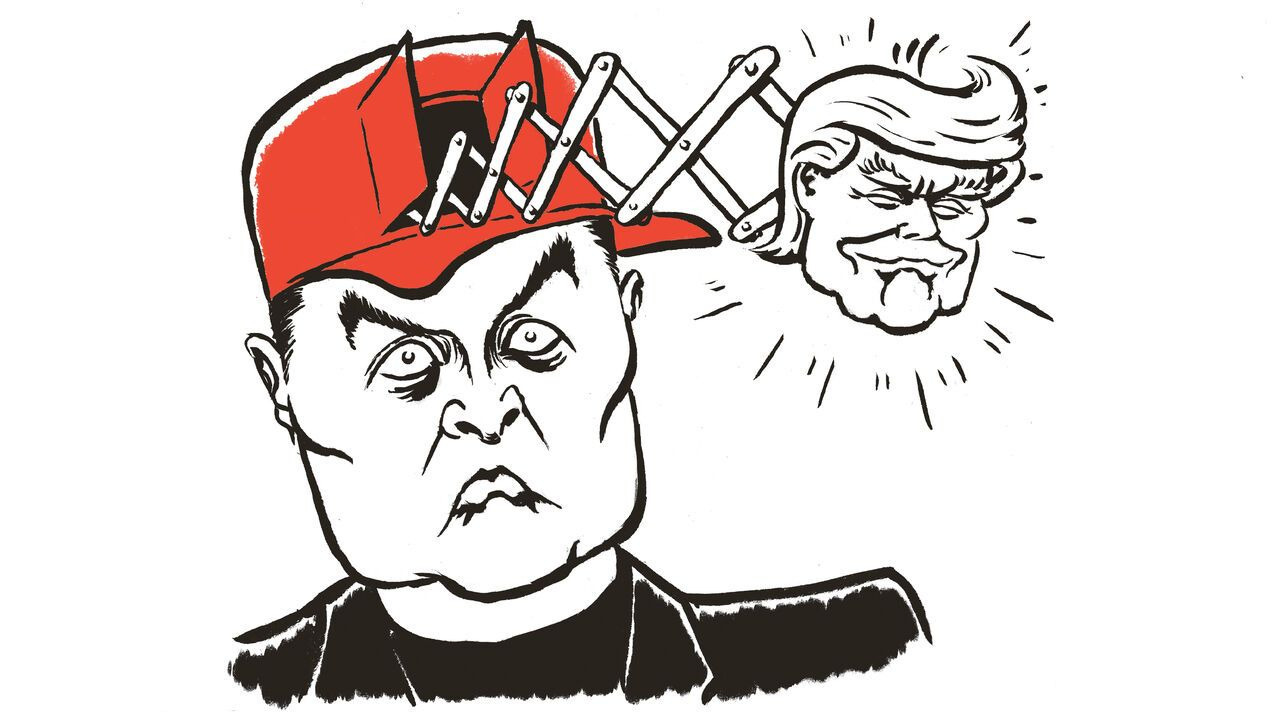
Illustration: David Simonds
Jun 12th 2025
Listen to this story
Elon Musk said Donald Trump should be impeached and that he was covering up his ties to an accused sex trafficker. Mr Trump said Mr Musk, whom he had put in charge of eliminating waste and fraud in the government, had ignored the easiest way to do the job, cutting his own government contracts. He also said Mr Musk had lost his mind. Do any of these accusations matter? Probably not, at least not nearly as much as they seemed to at the time, lo these few days ago, when they were riveting national and even global attention.
Already, in a concession to the leverage each man holds, the two are making nice with each other. Illegal immigration, the problem that has always made Mr Trump beloved by his base and at least acceptable to enough other Americans, helped the president change the subject and the businessman reingratiate himself. Mr Musk tweeted approvingly about Mr Trump’s militarised response to demonstrations in Los Angeles that turned violent, and Mr Trump told reporters he wished Mr Musk “very well”. By June 11th Mr Musk was publicly regretting “some” of his posts.
Since Mr Trump began taking control of the Republican Party more than a decade ago, it has often been noted that he was succeeding in “normalising” behaviour that would have once scandalised members of both parties, from freely using expletives in speeches to scoffing at the sacrifices of American war heroes to making outrageous insinuations about adversaries—whether that Barack Obama was a foreign-born Muslim, that Ted Cruz’s father had a link to the killing of John F. Kennedy or that Kamala Harris was cognitively impaired. But “normalisation” has always been the wrong way to think about Mr Trump’s peculiar achievement. If his antics were becoming normal, they would not continue to command the spotlight. An outrage is not outrageous if it is normal.
What Mr Trump succeeds in doing is trivialising obnoxious and even corrosive conduct. Where normalisation still invites accountability—that’s normal, after all—trivialisation defies it. The alliance with Mr Musk has been the most extreme instance of Mr Trump’s politics of trivialisation, in which outrageous abnormality after outrageous abnormality has whetted more interest in speculating about the next abnormality than in weighing the consequences of what has happened. Rather than just move on, let us reckon with a few features of their partnership—so far—that have had little if any precedent in American history.
Mr Musk spent more than a quarter of a billion dollars in a matter of months to help elect Mr Trump last year, including through a “lottery” awarding $1m each day to a registered voter in Pennsylvania. During Mr Trump’s transition, Mr Musk advised him about staff, sat in on his meetings with foreign leaders and accepted responsibility for overhauling the entire federal government. His companies not only had billions in federal contracts; they were subject to more than two dozen federal investigations and enmeshed with governments around the world. The White House waved away concerns about conflicts of interest with assurances that Mr Musk would voluntarily avoid any.
The very name of Mr Musk’s operation, the Department of Government Efficiency, or DOGE, was a joke, a smirking reference to a meme coin Mr Musk had made fun of for years. Mr Musk blitzed minions into targeted agencies to commandeer their information-technology systems and use them to cancel contracts and fire people, apparently without considering what they did. Agencies wound up frantically rehiring specialists who safeguarded nuclear weapons, protected against bird flu or calculated interest-rate tables to rationalise the mortgage market. Thousands of other federal workers have lost their jobs, but the precise number is uncertain because DOGE cuts are still working their way through the courts, and because DOGE’s statistics have proved far less trustworthy than those of the bureaucracy Mr Musk scorned.
The principal agency for foreign development, USAID, was authorised and funded by Congress. But Mr Musk did not ask Congress to reconsider, let alone to grant him permission, before chortling on X that he had sent the agency “into the woodchipper”. No doubt the spending was not all wise. And maybe hundreds of thousands of people have not died already, as one academic has estimated. Still, that number is surely not zero, as the secretary of state, Marco Rubio, testified it was to Congress last month.
“The picture of the world’s richest man killing the world’s poorest children is not a pretty one,” Bill Gates told the Financial Times. That judgment may haunt those in Washington—Mr Rubio used to be one—who valued foreign aid. Still others may remain offended by DOGE’s overpromising, sloppiness and glibness. But all that seems somehow beside the point now, fading as memories of “Liberation Day” should not be but are, as Mr Trump sends the Marines into Los Angeles and works to ram his overstuffed, deficit-amping, DOGE-deriding budget bill through the Senate.
A small beautiful bill
That bill was ostensibly the reason Mr Musk erupted, because it undermined DOGE’s work. He called it “a disgusting abomination”. (Though who would bet he will focus on persuading Republicans to oppose it?) For his part, Mr Trump said during the spat that Mr Musk suffered from “Trump Derangement Syndrome”, brought on by how much he missed working for the president.
As it happens, two House Republicans introduced a bill last month to get to the bottom of this phenomenon. The bill instructs the National Institutes of Health to spend precious federal dollars to “conduct or support research to advance the understanding of Trump Derangement Syndrome, including its origins, manifestations, and long-term effects”. What more perfect demonstration could there be of the syndrome itself? ■
United States | California screamin’
The meaning of the protests in Los Angeles
Donald Trump’s provocation could change LA, California and perhaps the entire country
Photograph: Reuters
Jun 12th 2025|Los Angeles
Listen to this story
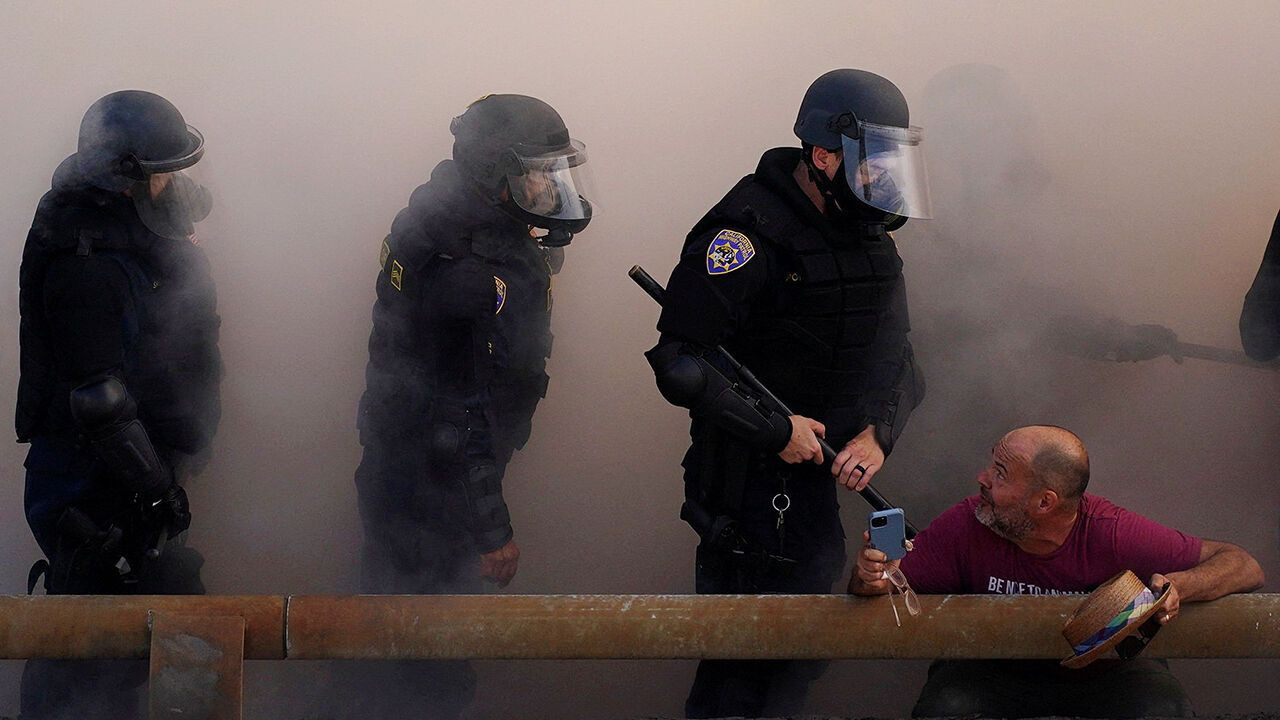
THE MOOD changed by the moment. On June 8th a woman hugged her two young daughters on a bridge overlooking the 101 freeway in downtown Los Angeles. Vendors sold Mexican flags and protesters adjusted the rhythms of their chants. “Move ICE get out the way” morphed into “Donald Trump, let’s be clear, immigrants are welcome here”. It felt like a neighbourhood block party—if block parties encouraged graffiti. But chants turned to screams as police exploded flash-bang grenades to clear the road. The two young girls grimaced and hustled away. California Highway Patrol officers paced in riot gear, their less-lethal weapons aimed at the crowd. Some protesters lobbed bottles at police, who dodged the projectiles.
Nearby, several Waymo driverless cars were set aflame.
Immigration and Customs Enforcement (ICE) had conducted several raids across Los Angeles County, which sparked protests. Mr Trump likened them to a “rebellion” and invoked a rarely used statute to deploy at least 2,000 members of the California National Guard to LA to protect federal agents and property, against the wishes of California’s state and local officials. This overreaction galvanised Angelenos and turned what were isolated clashes between protesters and federal agents into general unrest that swallowed parts of downtown. Since then, Mr Trump has doubled the number of guardsmen and added 700 active-duty marines to the mix.
Mr Trump’s political success since 2016 can be partially explained by his talent for rallying his supporters against a common enemy, whether that be illegal immigrants, Democrat-run cities, or, in this case, both. That his first reaction was to reach for the military suggests that the move was meant as a provocation, as if he were daring Angelenos to resist, thereby justifying his decision to call in troops and proving to his followers that Democrats will raise hell to shield immigrants from deportation. Local leaders urged protesters to stay peaceful lest they offer Mr Trump a reason to invoke the Insurrection Act, a law from 1807 that gives the president the power to deploy the military to help quell domestic uprisings. He has not ruled that out. The troops’ deployment has already traumatised Los Angeles and turned a tense relationship between California and the Trump administration into a hostile one. What happens next will determine whether the unrest in LA fades, or sparks a national movement.
LA was already having a bad year. Raging wildfires in January killed 30 people, incinerated two neighbourhoods and left locals angry at their leaders. A survey from the University of California, Los Angeles, in April found that just 37% of Angelenos viewed Karen Bass, the city’s mayor, favourably, down from 42% a year ago. Now the president is piling on. During a speech at Fort Bragg on June 10th Mr Trump expressed disdain for his country’s second-largest city, calling it “a trash heap” in need of liberation. Ms Bass is trying to strike a balance by promising to punish protesters who got violent, while defending LA’s massive immigrant community (roughly one-third of the county’s 10m people are foreign-born).
The unrest could unite the city against the administration, but right now it seems more likely to sow division. Several protest leaders stood on a truck bed in front of City Hall and decried Mr Trump, ICE—and their local leaders. “If Karen Bass can’t protect us, if the city council can’t protect us, if the Democratic Party can’t protect us, who’s going to protect us?”, asked one young man. The answer, he argued, isn’t just rebellion but “revolution”.
Still, LA has seen worse. More than 220 people have been arrested so far and Gavin Newsom, California’s Democratic governor, promises that number will grow. In 1992 thousands of people were arrested and 63 were killed when Angelenos rioted after police officers were acquitted of beating Rodney King, a black motorist. Across most of the city there was no sign that anything unusual was happening, except perhaps the circling helicopters. Even downtown, protesters ambled past “Fuck ICE” graffiti to admire the violet buds of the blooming Jacaranda trees. That duality is part of the city’s character: LA promises a sun-drenched dreamscape but sometimes delivers something closer to the darkness and moral ambiguity of film noir.
The unrest pits California squarely against the Trump administration. It was not an easy relationship to begin with. The liberal politics of America’s most-populous state make it a favourite target of the Republican Party. Mr Trump attacked Kamala Harris last year as a “San Francisco radical” who would turn America into California. When Mr Trump was inaugurated in January, Mr Newsom played nice: he needed the feds to help pay for LA’s recovery from the fires.
Things began to devolve even before the recent immigration raids. Last month the Republican-led Senate voted to revoke a waiver California uses to set stricter emissions standards than the federal government, and the administration said it would claw back federal dollars for the state’s boondoggle of a bullet train. California, meanwhile, is involved in at least 22 lawsuits against the administration, including a new one questioning the legality of Mr Trump’s deployment of troops to Los Angeles.
Though Mr Newsom and Mr Trump are on opposite ends of the political spectrum, they share a love of the limelight. When Tom Homan, the president’s border czar, threatened to arrest the governor for allegedly interfering with immigration enforcement, Mr Newsom told him to “come after me, arrest me, let’s just get it over with”. Mr Homan backed down, even if his boss didn’t. “I would do it,” Mr Trump told the press outside of the White House. “I like Gavin Newsom, he’s a nice guy, but he’s grossly incompetent.” Their catty spats can be mutually beneficial. The president titillates his base by attacking the governor, and Mr Newsom raises his national profile, perhaps with 2028 in mind, by presenting himself as the anti-Trump.
Map: The Economist
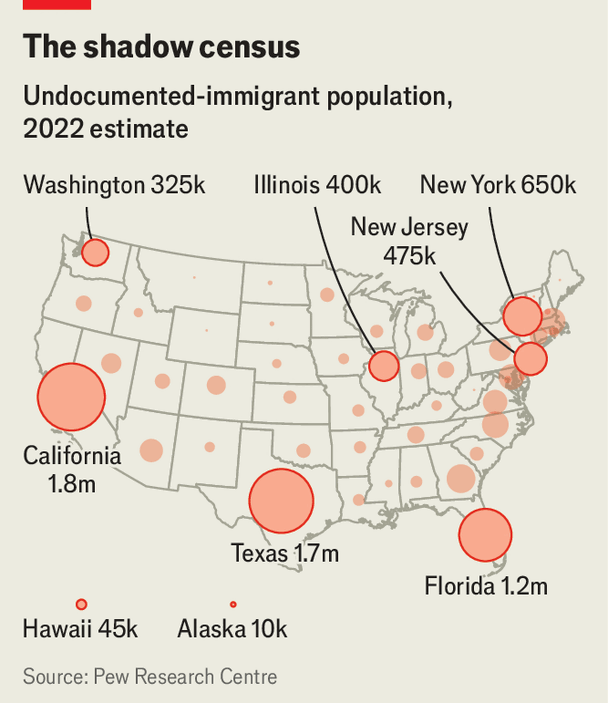
Now more is at stake than their approval numbers. In a speech on June 10th Mr Newsom warned other states that “California may be first but it clearly will not end here.” Legal scholars point out that the proclamation federalising National Guard troops did not mention LA, leaving open the possibility of sending them to other cities. After California, New York, New Jersey and Illinois are the Democratic-run states where the most unauthorised immigrants live (see map). Anti-ICE protests have already started to spread beyond Los Angeles, to Chicago, New York City and elsewhere. Some Democratic mayors may see the trouble LA is in and try to avoid attracting Mr Trump’s ire. Daniel Lurie, San Francisco’s moderate mayor, seems to be trying this route, though protesters there have taken to the streets anyway.
What the federal government does next will depend on whether Mr Trump’s end goal is to scare cities into not protesting against deportations, or to provoke unrest so he has an excuse to declare an insurrection and use the military to crack down on places that disagree with him. LA’s experience suggests the latter is not hyperbole. During his speech Mr Newsom coined a clunky phrase: “the rule of Don” (rather than the rule of law). He meant it as an insult, but Mr Trump may not mind. When asked what the standard would be for sending troops elsewhere, the president replied: “The bar is what I think it is.”■
The Americas | Crime and justice
A Harvard man turned narco-gang-buster
Daniel Noboa assures The Economist he can save Ecuador without hurting democracy

Illustration: Fede Yankelevich
Jun 12th 2025|GUAYAQUIL
Listen to this story
The president loves jogging. Yet so determined are gangsters to kill Daniel Noboa that his runs require a military operation. As his motorcade of black SUVs and outriders sweeps back to his apartment after a morning run in Guayaquil, Ecuador’s biggest city, a swarm of heavily armed soldiers surrounds him. Mr Noboa and his wife, incongruous in colourful lycra, slip swiftly inside. “We’ve had death threats on a daily basis for two years,” he tells The Economist, matter-of-factly.
Ecuador is deep in the bloody grip of transnational criminal gangs with links to Mexico, Colombia and Albania. They ship thousands of tons of cocaine, mostly made in Colombia, out of the country to Europe and the United States. Illegal mining and extortion bring in stacks more cash. Other Latin American countries have balked at taking on the gangs. Mr Noboa was recently re-elected on the promise to do just that. His efforts to make Ecuador safe again pose a crucial test that is about more than just one country: is it possible to beat back the rampant transnational gangs while respecting the rule of law and democracy?
Ecuador’s descent into chaos has been shocking. In 2019 the murder rate was below seven per 100,000, similar to that of the United States. By 2023 it had surged to 45, making it the most violent country in mainland Latin America. The violence followed cocaine-export routes, which shifted to Ecuador to escape increased security at Colombian ports. Ecuador’s vast banana exports offered an ideal smuggling route, its dollarised economy a perfect conduit for laundering cash. Mr Noboa says gangs are moving about $30bn-worth of drugs through Ecuador every year, equivalent to a quarter of the country’s GDP. (Other estimates are smaller.)
Posting through it
The man Ecuadorians have chosen to fight this storm is a curious mixture. Born in Miami, Mr Noboa is the son of a billionaire banana magnate who unsuccessfully ran for president of Ecuador five times. His social-media posts alternate between pictures posed with seized loot and cowed bad guys, and clips of him working out with his influencer wife: a crime-fighting Camelot for the TikTok age.
In light of this, you might expect Mr Noboa to combine charm with the thinly veiled arrogance of privilege and chest-thumping alt-right machismo. Instead, the graduate of the Harvard Kennedy School of Government appears introverted, nervous and wonkish. He is keen to discuss Ecuador’s debt-to-GDP ratio and country-risk premium. He admits to doubts. “There are moments that you start questioning it,” he says when asked if the job is worth the risk. “Most of the time it feels right.”
Mr Noboa was first elected president in October 2023 after the government of a conservative president, Guillermo Lasso, fell apart, prompting a snap election. Mr Noboa’s political experience was a short stint in the National Assembly. At just 35 years old, he was the youngest president ever elected in Latin America. Since then he has pushed legal limits to combat crime, governing through a series of states of exception and using his expanded powers to send the army onto the streets and into prisons. After gangs rioted in prisons and attacked journalists live on television in January 2024, he declared a state of “internal armed conflict”. He is building mega-prisons and has designated 22 gangs as “terrorist organisations”.
After winning re-election in April, Mr Noboa is stepping up the crackdown. He is taking advice from Erik Prince, founder of Blackwater, a controversial mercenary group. Mr Noboa wants to bring in foreign troops, mentioning Israel and the United Arab Emirates. Mr Lasso says all this is “a bit of the pageantry of populism—like, ‘Look, I’m bringing in Iron Man, I’ve got Spider-Man’”. More serious is a new law that allows for drop-of-a-hat raids and asset seizures, increases sentences for organised-crime offences and gives the president greater discretion to declare an internal armed conflict. It reduces the powers of the Constitutional Court, which has blocked some state-of-emergency moves.
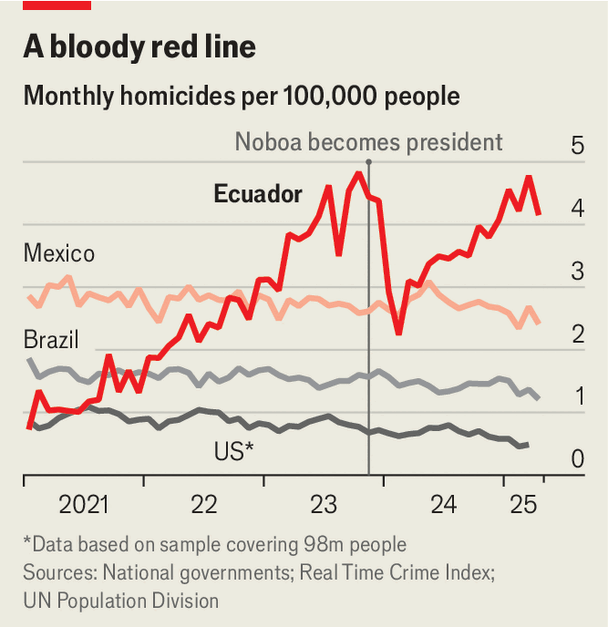
Chart: The Economist
So far, results have been underwhelming. Homicides fell by about 15% from 2023 to 2024, but have since surged, especially on the coast. The first months of 2025 were among the bloodiest on record (see chart). Beatriz García Nice, a policy analyst in Guayaquil, suggests Mr Noboa has weakened the gangs, prompting them to lash out in a last-ditch show of force. It is also possible his policy has broken up larger groups, spurring increased violence in the process. “The groups adapt, wars are not linear,” says Mr Noboa.
The militarisation of law enforcement often comes with human-rights violations, for instance when four boys from Guayaquil were found dead near a military base in December after being seized by soldiers. Mr Noboa concedes there are risks to militarisation, but vows to prosecute soldiers who commit abuses. His new law, however, gives him more power to pardon them.
Youthful and social-media-savvy, he is often compared to El Salvador’s president, Nayib Bukele, who has smashed local gangs with mass incarceration. Mr Noboa says he respects Mr Bukele, but laughs off the comparison as absurd. “We’re looking to promote public health and strengthen public education, so ideologically it’s a bit different, I would say, from Bukele.” Instead he compares himself to the presidents of France and Brazil, Emmanuel Macron and Luiz Inácio Lula da Silva. He expounds on the need to invest in education and create jobs for young men who are vulnerable to gang recruitment.
Mr Noboa recognises that crushing transnational gangs requires cross-border collaboration. He is right, but his execution has so far been woeful. Last year he broke international law by ordering a raid on Mexico’s embassy to arrest a leftist former vice-president, Jorge Glas, who was sheltering there after a conviction for corruption. Any dialogue with Mexico now runs through Switzerland, admits Gabriela Sommerfeld, Ecuador’s foreign minister. That is a huge problem. Mr Noboa concedes as much, but claims collaboration is anyway difficult, seeing that Mexico is “not going to confront narcos”. He also struggles to work with President Gustavo Petro of Colombia who is pursuing “total peace” with his country’s gangs and armed groups, and has a resurgence of political violence to show for it.
No Trump card
Instead he is cleaving to President Donald Trump for help. That is sensible enough, but Mr Trump’s America-first agenda means he is unlikely to send troops or reopen a military base in Ecuador. Mr Noboa is eager to change the constitution to permit such a course. Asked about security help from China, he does not rule it out.
Another problem is that many institutions are either weak or compromised, from the justice system to the electoral authority, anti-money-laundering bodies and political parties. Judges and prosecutors, especially those in remote areas who inevitably handle cases relating to organised crime, lack adequate physical protection. At least 15 have been killed since 2022. Between 2020 and 2022 there were just three convictions for money-laundering.
A strong, independent attorney-general will be crucial. Diana Salazar finished her six-year term in May, having led courageous prosecutions against gangsters and corrupt politicians. Worryingly, both groups will probably try to influence the selection of her successor, as well as that of judges. That could grant criminals dangerous impunity. It helps at least that Mr Noboa wants to speed up justice and vows to “follow the money”.
He is in a strong position to carry out his plans. The leftist opposition is in disarray, his allies dominate the National Assembly and the courts will probably be wary of ruling against him, says Aparicio Caicedo, a former adviser to Mr Lasso. Some, however, fear that his security crackdowns and his eagerness to reform the constitution could see him turn authoritarian.
Mr Noboa is quick to reject this idea. “I won’t stay one second more than what the constitution allows me. I will never ignore the importance of a parliament or the judicial branch, and I cannot go against the Constitutional Court,” he says. “That is what keeps this country civilised.” ■
The Americas | Controlling coca
Bolivia wants the world to stop treating coca leaves like drugs
The WHO is reviewing whether the crop should be removed from international drug-control schedules

Seizing a Schedule I substancePhotograph: Getty Images
Jun 12th 2025|Cochabamba, Bolivia
Listen to this story
If New York runs on coffee, Cochabamba runs on coca. The leaves—which can be chewed as a mild stimulant, but also processed into cocaine—are everywhere: spread out by the road to dry; sold in bags alongside sweets and SIM cards; stuffed in cheeks as golf-ball-sized bolos. “With a bolo I can drive all night,” boasts one trucker, with a flash of leaf-flecked teeth.
Bolivia is one of very few countries with a legal market for coca. In the rest of the world it is controlled with the same stringency as cocaine and heroin. The Single Convention on Narcotic Drugs, an international treaty adopted by the United Nations in 1961, lists coca leaf as a “Schedule I” substance, one considered to come with a high risk of abuse and to pose a serious public health threat. Some consider that to be a historic mistake. It might soon change. A review by the World Health Organisation (WHO), which will conclude in October, may recommend that coca be bumped down to Schedule II, or removed from the schedules altogether. The latter would be a first. The prospect is causing hope and anxiety in equal measure.
Andeans have chewed coca for millennia. The Spanish noticed that it kept workers going in the silver mines of Potosí, but saw it as an indigenous vice. Such attitudes persisted well into the 20th century, when the WHO described coca chewing as a “social evil”. When the cocaine business took off, coca’s status as an internationally controlled substance was cemented.
Bolivia never seriously tried to abolish traditional uses of the coca leaf. Like Peru and Colombia, the other main coca-growing countries, it created broad exemptions under national law. Then, in 2013, it negotiated a partial opt-out from the convention. Now it wants coca taken off the drug schedules altogether; it was Bolivia that requested the WHO review. Other treaty articles mean coca would still be controlled to prevent it being used for making cocaine. But de-scheduling would make it easier to develop coca-based products and sell them abroad. Proponents hope it would be a boon for rural development.
Bolivia already has a lively coca economy. The law allows 22,000 hectares of coca fields to feed the legal market. And Bolivians have cooked up new ways to consume coca. In one garage factory, a woman sprinkles leaves with caffeine and fruity flavourings and puts it under a power hammer. The result: coca machucada, an amped-up version of the sacred leaf. Such products have helped win over new consumers, bringing a rural habit to the urban middle class. There is even an “executive bolo”: sachets of ground coca for those anxious about leaves in their teeth.
If coca were de-scheduled, the hope is that the legal international market would boom. Bolivia could start exporting existing products such as coca tea, flour and sweets. But de-scheduling could also boost investment in the leaf. Bolivia’s state-led efforts to industrialise coca for the domestic market failed. But the prospect of a global market could entice investment from companies to create new products, from energy drinks for health nuts to new versions of tipples like Vin Mariani, which mixed Peruvian coca with Bordeaux wine for 19th-century consumers such as Queen Victoria and Pope Leo XIII.
Bolivian coca growers worry that the profits would be gobbled up by international companies. Proponents say the idea would be to legally limit coca cultivation to Bolivia, Peru and Colombia, and to ensure locals benefit from any use of their genetic resources. One template could be the agreement that sees the rooibos tea industry pay a percentage of revenues to indigenous people in South Africa who used the plant before it was industrialised. But Bolivians still worry that industrial-scale coca farming might squeeze them out.
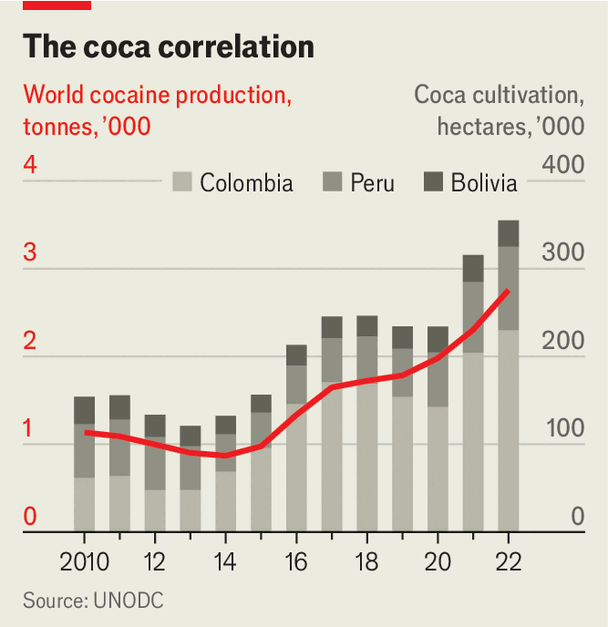
Chart: The Economist
Another fear is that de-scheduling coca would lead to a surge in cultivation that was bound in theory for legal markets, but in practice used to make cocaine. Such diversion already happens with part of Bolivia’s legal production. But while demand for cocaine exists, there will always be an incentive to grow coca for that purpose. And there is evidently no shortage of coca for cocaine under existing laws (see chart). Much would depend on the emergence of new regulatory systems.
If the WHO recommends changing coca’s treaty status, the 53-member UN Commission on Narcotic Drugs will then vote on the question. The diplomatic environment is challenging. The cocaine market is growing, fuelling destructive gangs. Peru opposes de-scheduling. A winning majority would probably need the bloc vote of the European Union, two-thirds of Latin America and the Caribbean, and some unexpected alliances. “It will be tough,” said Andrés López Velasco, a drug-policy expert. “But it’s not impossible.” ■
Middle East & Africa | The kernel of an idea
Globalisation is nuts
A brave and high-tech attempt to export nuts
Photograph: Getty Images
Jun 12th 2025|BOUAKÉ
Listen to this story
The lowly cashew is globalisation in a nutshell. The route from cashew tree to tasty snack follows a peripatetic journey. More than half of the world’s cashew nuts are grown in African countries. Most are exported raw, mainly to Vietnam, for shelling and sorting, before being exported again as processed kernels. Often the nuts munched by Americans or Europeans have travelled more than 20,000km.
African countries lament being the bottom link in global supply chains for cashews and other commodities. A rule of thumb in agro-processing is that just 10-15% of the cost of the final product, say a bag of roasted cashews, goes to the farmer in the country of origin. If more processing is done in Africa, goes the logic, the continent will create jobs and capture more of the $8bn cashew market.
This is why African countries—most of which export predominantly unprocessed commodities—are studying the parable of the Ivorian cashew. Fifteen years ago Ivory Coast, the world’s largest grower of cashews, exported nearly all of its crop as raw nuts. But last year about 30% of its harvest was processed at home; the government aims to increase that to 50% by 2030. Its efforts hold lessons for those who feel Africa gets a raw deal from its raw materials.
After Ivory Coast’s civil war ended in 2011 the government made it a priority to do more processing. The timing was fortuitous. In the 2000s Vietnam supplanted India as the global hub for turning raw nuts into kernels. It did this by mechanising tasks once done by nimble hands—cutting, shelling and peeling. This reduced the cost of processing from about $600 per tonne to $200. Factories that employed 3,000 people in India had 400 in Vietnam. This made businesses consider using the same technology, but closer to where the nuts are grown and eaten.
The Ivorian government, seeing an opening, introduced incentives for domestic and foreign-owned processors. Firms pay no import duties on machinery. They receive a subsidy of about $700 per tonne of processed kernels exported, or 10% of the price paid by the buyer. A regulator was given clout and staffed by competent technocrats. There was consistent high-level support, including from Alassane Ouattara, the president, and his late prime minister, Amadou Gon Coulibaly.
Foreign expertise has been critical. “Agro-processing in theory sounds simple, but it is very technical. It’s food science and business mixed together,” notes Jonathan Said of AGRA, an NGO headquartered in Nairobi. Ivory Coast convinced Olam, a Singaporean firm, to build the first big factories. Several foreign firms have followed.
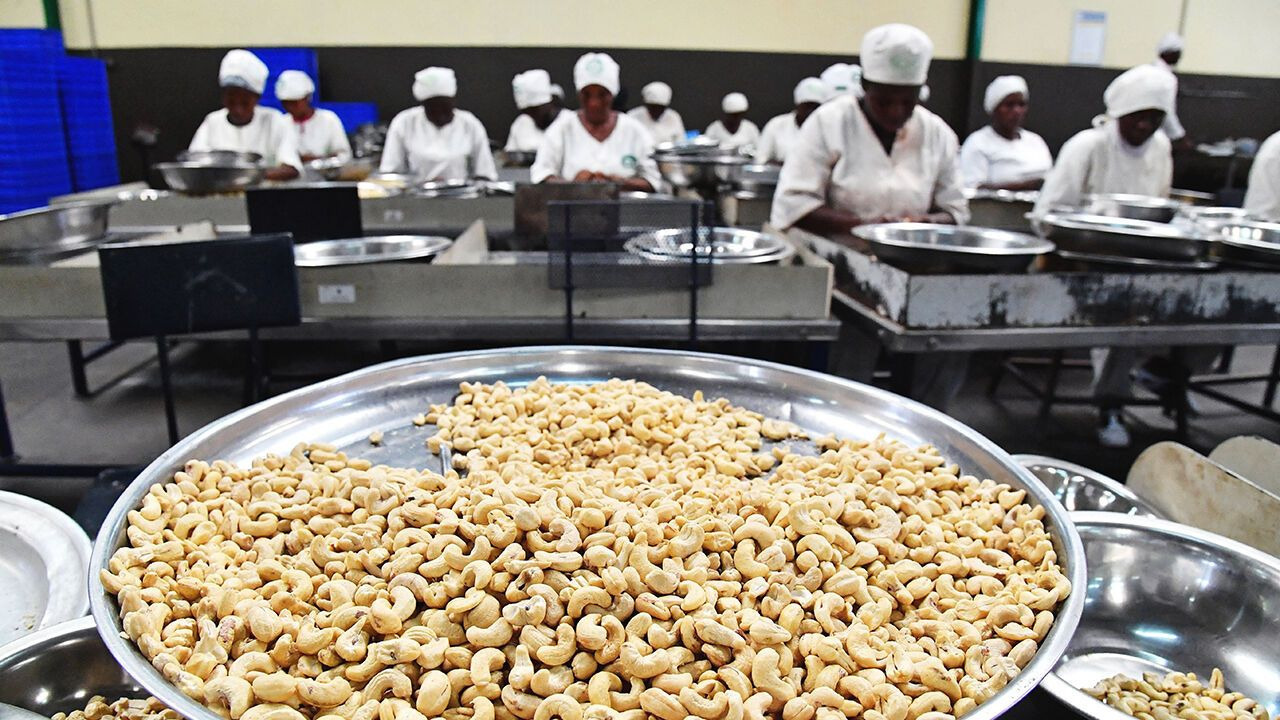
One is Cashew Coast, which was set up by Mauritians but has investors from all over. Visitors to its factory in Bouaké, a city in central Ivory Coast, are given headphones to block the deafening noise from the machines that cook, shell, dry, peel and sort the nuts. Many are high-tech: one scanner uses optical laser technology to spot defects. Software from SAP, a German tech firm, allows the firm to trace the origin of every shipment. Ivorian women deftly peel the last 15% of shells left by the machines, just as efficiently as their Vietnamese peers, reckons the head of operations.
Salma Seetaroo, the CEO of Cashew Coast, says that “Africa is increasingly delivering a greater value equation.” Processing a tonne of cashews at Vietnamese factories remains cheaper than in Ivory Coast, but brands such as hers are competitive. The cashews taste better, she points out, because they are processed at source and not sitting on a ship for months. Freight costs and carbon emissions are lower. European demand for traceable and “sustainable” produce mean buyers are willing to pay a premium. Concerns that Ivorian factories produce too many broken nuts are less relevant these days, as fragments can be turned into lots of products, including vegan “cheese”.
Donald Trump’s trade war will raise the price of cashews for American snackers. But some in Ivory Coast see a potential upside if it ends up with a lower tariff than Vietnam. “The whole tariff thing could give firms reason to relocate some of their operations from Asia to Africa,” hopes an adviser to Mr Ouattara.
Yet Ivory Coast still has work to do before it can say it has cracked the cashew-nut industry. Foreign-owned firms, which account for about 70% of exports, do not need the government’s subsidy to turn a profit. But for Ivorian outfits it can be the difference between survival and bankruptcy. As ever in industrial policy, there is a fine line between supporting a nascent export industry and indulging firms with no hope. In a worrying sign of protectionism, last year the government briefly suspended the export of raw nuts to ensure supply to locally owned factories.
That step also reflected a deeper problem: the need to guarantee a long-term supply of raw nuts. Farmers’ yields are low compared with those in countries like Cambodia, which has large plantations. In Ivory Coast, as in most of Africa, cashew farmers are smallholders. “There is no such thing as a cashew farmer,” notes Jim Fitzpatrick, a cashew-nut expert: “There are farmers with some cashew trees.” Shoddy storage leads to too much waste. Only a few firms, including Cashew Coast, try to improve farmers’ productivity.
At a village an hour’s drive from Bouaké one farmer says he earned the equivalent of $700 from cashews last year. Will he invest the money in his plot? “I want a motorbike,” he replies. “That way I can take my daughter to look for work at a factory.” These days that is not a nutty idea. ■
Europe | Sunshine in the Valley
Picasso’s home town is thriving
But will Málaga fall victim to its own success?

The sixth cityPhotograph: Getty Images
Jun 12th 2025|MÁLAGA
Listen to this story
ON A RAINY weekday in early spring Málaga is thronged with tourists, clambering over the Moorish castle that overlooks the port, carousing at the pavement bars or queuing for one of half-a-dozen art museums. It wasn’t always thus. Until the turn of the century tourists heading for the resorts of the Costa del Sol shunned what was then a drab former industrial town. Today Málaga, Spain’s sixth city, is booming, powered not just by tourism but also by a burgeoning tech industry. Its economy has outpaced the rest of the Andalucía region for most of the past decade. It is held up by some as a model for other Spanish cities, but some locals fear it may fall victim to its own success.
Its revival began with the pedestrianisation of the centre and the opening in 2003 of a museum dedicated to Pablo Picasso, who was born in the city. Three others followed, including an outpost of Paris’s Pompidou Centre. Though cultural tourism accounts for only a minority of the 14.4m visitors last year to Málaga province (which includes Marbella and other resorts), the museums have helped turn the city into a magnet for tech workers and others. Antonio Banderas, an actor, has returned to his native city to open a theatre.
In a nearby valley sprawl the anonymous buildings of the Technological Park of Andalucía. Founded in 1992 as a joint venture between the city and regional governments and a local bank, it now employs 28,000 workers and houses companies ranging from Accenture and Ericsson to startups. Google and Vodafone have operations in the city. The park is still expanding: it now focuses on cybersecurity, games and microelectronics.
Málaga has natural advantages, says Francisco de la Torre, its mayor. They start with a benign climate and its site on the Mediterranean. It has Spain’s fourth-biggest airport. But it also has good vocational-training centres and a steady, consensual leadership: Mr de la Torre, who is 82, has been mayor since 2000.
Two clouds have darkened the horizon. Like many other Spanish cities, Málaga is short of housing. Some 9,000 new homes are under way, with the city providing the land for private builders. The other worry is the excesses of mass tourism. The historic centre has around 6,000 tourist flats, the highest density in Spain. Carlos Carrera of the local residents’ association complains of “strangers entering buildings, fights, drunks and hooligans in the lift” and of bars that stay open till 2am. “The balance has been upset,” he says. Mr de la Torre replies that the city has banned new tourist flats and is closing those without permits. The overall number is falling, he says.
These are the problems of success. “It was a city in black and white and now it’s in colour,” argues José María Luna, the city’s culture boss from 2011 to 2024. “Málaga has found a place in the world.” ■
Britain | Bagehot
Welcome to Bonnie Blue’s Britain
A place of sin, spin and soft power

Illustration: Nate Kitch
Jun 11th 2025
Listen to this story
Bonnie Blue is the most famous British woman not everyone knows. Ms Blue, a 26-year-old from Nottinghamshire, has become a mainstay of social media, her blonde hair and blue eyes beaming out from TikTok feeds, Instagram reels and YouTube shorts. Her Wikipedia page gets more traffic than Beyoncé’s, and a little less than Taylor Swift’s, even if some still say “Bonnie who?” when her name is mentioned. She has become a frequent guest on podcasts that enjoy immense listenership, yet create barely a ripple in older media.
Why the disparity? Her fame is not family-friendly. Ms Blue is a porn star, famous for stunts such as claiming to have had sex with 1,057 men in 12 hours. Footage of the event is not erotic. It is by turns surreal and disturbing, like staring at a Hieronymus Bosch painting. Nearly all the men awkwardly queuing wear balaclavas; one man brought his mother. At the end, the final gentleman begins thanking the cameraman and crew before launching into a rendition of “You’ve Got A Friend In Me”, from “Toy Story”.
Luckily, attention rather than arousal was the aim. The video was to plug OnlyFans, a British website where customers can pay porn stars directly. Ms Blue said she earned £600,000 a month posting more orthodox videos than the marathon sessions that made her name. In terms of attracting notice, it worked. When some people picture Britain, they picture Ms Blue.
And why not? Ms Blue’s strengths are Britain’s strengths. Smut, scuzz and sin are fixtures of the British economy. Tobacco companies are among the largest in the ftse 100, along with booze companies. British gambling companies, though considerably smaller, are among the country’s best-run.
OnlyFans is simply another name on the list. In 2023 people spent a little under $7bn in total on OnlyFans—or roughly how much broadcasters paid in total to show the Premier League outside Britain from 2022 to 2025. OnlyFans, which takes a 20% cut, achieves pre-tax profits of nearly $700m, sending a wodge of corporation tax to hm Revenue & Customs. Now OnlyFans’ owner is looking to sell it, wanting $8bn for the company.
If it is sometimes confusing to work out how Britain makes a living, Ms Blue and her ilk provide an answer. In one gimmick, Ms Blue turned up at Nottingham Trent University offering to bed any student. The gambit was sponsored by Stake.com, an Australian gambling company, whose logo also adorns the shirt of Everton Football Club. An OnlyFans star, a low-tariff university reliant on foreign students, and a gambling company? Behold Britain’s thriving services sector.
After all, London is stuffed with advisory agencies staffed by smooth men with pinky rings who will tell any story for a fat monthly fee. Ms Blue simply did it for herself. If Britain has a world-class sin sector, its bullshit industry is second to none. Attention is a powerful thing and Ms Blue knows how to get it.
Without media Leviathans able to control who sees what, the battle for attention becomes a fight of all-against-all. This provides a gap for people such as Ms Blue who are willing to do anything to gain it. That is how Ms Blue wound up with the queue of men in balaclavas. After Lily Phillips, another British OnlyFans star, had sex with 101 men in one session, Ms Blue promised to breach the 1,000 mark. Extreme content generated extreme reaction. Hordes of social-media users declared themselves disgusted, but subscribers to Ms Blue’s OnlyFans account trickled in.
The system can be gamed, of course. Any self-respecting OnlyFans star relies on a network of accounts to spray content across people’s feeds. Synthetic attention can evolve into organic popularity. Every piece of content on a TikTok feed bears the scars of this constant, hidden struggle over the memes of production. It is a fight that Ms Blue and her team were able to win.
Such modern strategies were matched with a more traditional one. Ms Blue speaks in headlines. She fed journalists talking points, whether about sleeping with young men (“barely legal”) or old men (“barely breathing”). Ms Blue was welcomed onto “This Morning”, a wholesome daytime television show, because producers know that controversy and clicks will follow.
The result is that porn has merged back into people’s everyday media consumption, just as it did in the days when British tabloids used to run news from Westminster opposite pictures of naked women. Discourse has returned to the 1980s, when the Sun would happily splash outrageous headlines, such as “Freddie Starr ate my hamster”, without bothering to question precisely how true it was. Did Ms Blue really sleep with 1,057 men? Did Freddie Starr eat a hamster? Does it matter?
The medium is the message
A respectability of sorts beckons for Ms Blue. Channel 4, a highbrow-ish channel, is working on a documentary about her. There are limits, however. Even the most cynical of investors are wary of too much smut. OnlyFans kicked Ms Blue off the platform on June 9th. Promoting an OnlyFans account via extreme content, such as sleeping with hundreds of men in one go, violated the platform’s terms of service. When an $8bn sale is at stake, having Ms Blue as one of its most prominent figures would not do.
OnlyFans can cut Ms Blue loose, but Britain has no such option. Successive governments are obsessed with soft power, carefully husbanding the country’s reputation as its actual power wanes. “Britain is Great” adverts featuring Paddington Bear and Harry Potter gaze down on travellers in foreign airports. It is a vision free from the smut that also helps the country pay its way. Ms Blue is unlikely to join Paddington and Potter any time soon. There is no need. In 2025, if someone lies back and thinks of England, they may well think of Ms Blue.■
International | Secular stagnation
The West has stopped losing its religion
After decades of rising secularism, Christianity is holding its ground—and gaining among the young

Photograph: Getty Images
Jun 12th 2025|CAMBRIDGE, Massachusetts
Listen to this story
FOR DECADES America’s fastest-growing religious affiliation was no religion at all. In 1990 just 5% of Americans said they were atheists, agnostics or believed in “nothing in particular”. By 2019 some 30% ticked those boxes. Those who left the pews became more socially liberal, married later and had fewer children. Churches, where once half of Americans mingled every Sunday, faded in civic life. Yet for the first time in half a century, the march of secularism has stopped (see chart 1).
Chart: The Economist
The same is true elsewhere. In Canada, Britain and France, the share of people telling pollsters they are irreligious has stopped growing. Across another seven western European countries it has slowed markedly, rising by just three percentage points since 2020, compared with a 14-point surge in the previous five years. The stall coincides with a pause in the long-term decline of the Christian share of the population in the same places. This suggests that slowing secularisation is caused by fewer people leaving Christianity—rather than the growth of other faiths, such as Islam—alongside a surprising increase in Christian faith among younger people, particularly those from Generation Z (born between 1997 and 2012).
“I’ve tried alcohol, I’ve tried parties, I’ve tried sex...none of these work,” says Eric Curry at Pace University, recounting what his peers say about trying to overcome depression, ennui and loneliness. “Young people are looking and searching deeply for the truth.” Mr Curry says his recent baptism was the best decision of his life.
The long rise of secularism, which Ryan Burge of Eastern Illinois University calls “a dominant trend in demography of recent decades” has shaped many aspects of Western society. These range from more liberal attitudes towards gay marriage and abortion to prospects for economic growth. Its sudden stall—and possible reversal in some places—is unexpected.

Photograph: Carrie Schreck/Redux/eyevine
The most plausible explanation for the changing trend is the covid-19 pandemic. Lockdowns, social isolation and economic shocks affected almost all countries and age cohorts at about the time that the data on religious belief hit an inflection point. This is especially the case for Gen Z, whose years of early adulthood were disrupted, leaving many young people lonely or depressed and looking for meaning.
“The pandemic really was a catalyst” for becoming religious, says Sarah, a 20-year-old student at Liberty University, who grew up outside the Church but converted after joining a Bible-study group on Zoom during the lockdowns. “Probably over 75% of my friends who are Christians became Christian since the pandemic.”
This trend seems to have persisted beyond the tumult of covid-19. Across three surveys in 2023-24, the share of young Americans identifying as Christian rose from 45% to 51%. The “nones” fell by four points, to 41%. At Harvard, a progressive bastion that started as a Puritan seminary, half of undergraduates attended a chaplain-run event or religious service this academic year. Tammy McLeod, a chaplain at the university for 25 years, also sees covid-19 as a turning-point: “People were sick of being alone.” Since then, “our numbers are higher and they don’t drop off after the beginning of the semester.” Chaplains on other campuses are seeing the same.
Chart: The Economist
In all 14 Western countries surveyed by Pew, a pollster, more people (often twice as many) said their faith was strengthened by the pandemic rather than weakened. More than a quarter of Americans had their faith fortified, says Gregory Smith, an expert in religion at Pew. Research by Jeanet Sinding Bentzen, an economist at the University of Copenhagen, shows internet searches for prayer and other religious practices shot up in almost every country in 2020 (see chart 2).
Pippa Norris of Harvard and the late Ronald Inglehart argued that in times of existential insecurity, people tend to turn to religion for comfort. Religion can explain suffering, offer hope and provide a sense of moral order and communal solidarity, they wrote. Religious attendance (often online) increased in Italy in 2020, particularly in places hardest hit by the virus. Ms Bentzen’s previous research on devotion following earthquakes—a different sort of shock—shows that religiosity tends to remain elevated for up to 12 years after a catastrophic event.
That’s me in the corner
Young men are becoming particularly keen on God, overturning a norm that spans cultures and time: that women are the more devout sex. In America Gen Z women are now more likely to have no religious affiliation than their male peers, according to a study by the American Enterprise Institute, a think-tank. In Britain a YouGov poll of some 13,000 people found 21% of young men who identify as Christian now attend church—up from just 4% in 2018, compared with 12% of young women. One reason for the divergence is that women have increasingly found the Church out of step with their more liberal views.
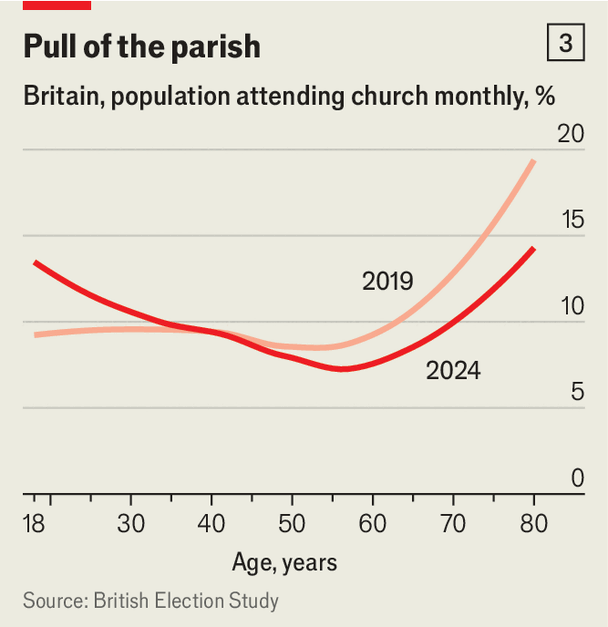
Chart: The Economist
At the same time as younger Americans are finding religion, fewer older Americans are giving it up. Between 2020 and 2024 the share of Christians in the population as a whole fell by just one percentage point. Before then, it had been dropping by that much every year. Look more closely at each generation and the Christian share either held steady or increased over the four years across all age groups except millennials. Baby boomers, for example, were seven points more Christian (at 79%) than they were in 2020. Taken together, the slowdown in religious exits across several generations and the unexpected rise among the young have caused the Christian share of America’s population to stabilise at around 62% since 2020.
Similar forces are at work elsewhere (see chart 3). Spain, Portugal, Italy and Finland, among others, are no less Christian today than they were in 2019, according to our analysis of large European surveys (see chart 4). Some countries, such as Austria and Ireland, are still becoming less Christian, but at a slower rate than before. The share of people in the West who told Gallup, a pollster, that religion was important in their daily lives steadily declined between 2006 and 2019. But over the past five years this figure has stabilised. In Ireland, for instance, 58% said religion mattered in daily life two decades ago; by 2018, that figure was 48%, and has remained there since.
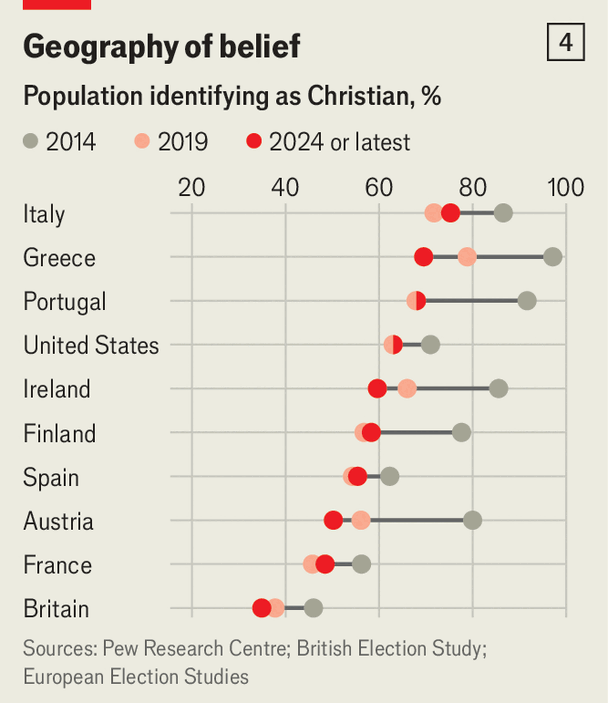
Chart: The Economist
As in America, a slowdown in religious exits and resurgence among the young are responsible. Active withdrawals from the Church of Sweden have fallen for the past five years, and baptisms among young adults have more than doubled since 2019, notes Andreas Sandberg, its record-keeper. Our analysis of the British Election Survey shows both the secular and Christian share of the population have been flat since 2020. More interesting is that the irreligious share of Gen Zs has fallen every year over the same period.
Because there are fewer cradle-Christians these days, many Gen Zs who now identify with a religion are doing so for the first time in their lives. Some are diving right in, literally. Adult baptisms in France at Easter this year jumped by 45% to more than 10,000, the most in 20 years. Two in every five of these were Gen Zs, double the share in 2019. Baptisms in Austria and Belgium also rose. In 2023, the last year for which data are available, converts to the Church of Norway doubled to 4,000.

Photograph: Getty Images
The data pointing to a levelling off of secularism are clear. These findings are consistent across several large annual surveys, including samples of almost 25,000 adults in a study from Harvard, 37,000 in a survey by Pew and 12,000 in one by Gallup. But what is less clear is whether they mark a plateau or a sustained inflection. Part of the answer may depend on what other causes are contributing to the shift besides the pandemic. “We don’t know if this is a temporary lull or if we are seeing the end of the long secular surge,” says David Campbell of the University of Notre Dame, Indiana. And no one knows for sure why people have stopped leaving the Church or how to account for youthful piety.
Can immigration explain why secularism has stood still in many Western countries? Probably not. In America newcomers tend to be less Christian than the native-born, making them a drag, not a boost, for the Christian share, notes Mr Smith. Migrants to Europe also tend to be non-Christian, and younger than the local population. Their presence does not explain the plateau in the Christian share of the population, or secularism’s pause across a broad range of age groups.
That was just a dream
Instead, wider cultural changes appear to be playing a role. For most of the past two decades, God was on the receiving end of bad publicity, while atheism found pop-culture swagger. Books such as “The God Delusion” by Richard Dawkins, an Oxford don who in 1996 compared religion to the smallpox virus, or “God is Not Great” by the late Christopher Hitchens, a journalist, became bestsellers. Now, however, it is sales of the Bible that are booming (up by 22% in America last year).
The most important driver of secularisation in the West in recent decades has been people abandoning their religion, says Stephanie Kramer, also of Pew. Loss of faith has had a far bigger effect on the numbers than ageing, migration or fertility. So if the net outflow of the devout were to end, as now appears to be happening, then Christians would retain their majority in America for at least the next 50 years, Ms Kramer predicts, rather than falling below 45% as previously expected. Hardly anyone saw this coming, just as hardly anyone predicted the pandemic. God moves in mysterious ways—and so do people. ■
International | The Telegram
Taiwan thinks the unthinkable: resisting China without America
Its plan was to hold off a Chinese attack until America turned up. What now?
Illustration: Chloe Cushman
Jun 10th 2025
Listen to this story
IF TAIWAN CAN resist Chinese invasion forces for a month, then Communist Party leaders in Beijing can be deterred. That calculation has long guided war planners and politicians in Taiwan. The democratically ruled island would need to survive weeks of bombardment, blockade or even amphibious landings by the People’s Liberation Army, to give America time to turn up and save the day.
Alas, Taiwanese confidence that America will arrive at all is growing weaker by the day. That is reshaping the plans that the island’s sitting government, which is determined to resist Chinese aggression, must make for its defence.
For years, the island has had to live with a degree of doubt. When President Donald Trump declines to say whether he would risk war with China to save Taiwan, he is following the precedent set by most modern presidents, who used “strategic ambiguity” to deter rash moves by either side to change the status quo. Under the terms of that uneasy stand-off, China calls Taiwan a province that must one day return to the motherland. The island’s leaders deny being part of the People’s Republic of China, but stop short of declaring Taiwan a separate country. American ambiguity leaves China’s supreme leader, Xi Jinping, wrestling with uncertainties. If Mr Xi wants to avoid conflict with America, he needs to be sure of a quick victory, or must stay his hand. As for leading Taiwanese opposition politicians, they have long seized on that same ambiguity to portray America as an unreliable friend, and counselled accommodation of China to buy peace.
What is new is the alarm engendered in Taiwan by Mr Trump’s treatment of Ukraine. When Mr Trump scorns Ukraine as a small country that foolishly imagines it can defy a larger neighbour, Taiwanese hear echoes of their own plight. It does not help that Mr Trump has long scoffed at Taiwan’s prospects in a fight with China. And if America stays aloof, no other power will take up arms in Taiwan’s defence (see Asia section).
True, Chinese hopes of a quick victory were shaken by the failure of Russia’s own attempt at a lightning conquest of Ukraine in February 2022: a debacle that China has studied minutely. But now Ukraine’s long war is forcing Taiwan and friendly governments, including in Europe, to make unprecedented public efforts to prepare the island’s 23m people for a crisis lasting far longer than a month, such as a naval blockade.
In June The Telegram travelled to Berlin for the Taiwan Trilateral Forum, a meeting of diplomats and analysts from America, Europe and Taiwan. Asked for lessons from Ukraine, a Taiwanese participant replied that his island needs “to prove to the rest of the world that Taiwan is able to fight for an extended period”. This is as much a political as a military imperative. Taiwan’s plan is “to hold on as long as possible, while China’s legitimacy is challenged and the international community has time to help”, he added.
Speakers described a flurry of studies and war-games in Western capitals, weighing Taiwan’s vulnerabilities. Taiwanese firms, notably TSMC, make more than 90% of the world’s cutting-edge semiconductors. Even if TSMC foundries are not blown up, the forum heard, a blockade could stop just-in-time imports of specialist gases and chemicals needed to make chips. The meeting, organised by the German Marshall Fund, a Washington-based think-tank, heard of growing seriousness in Taiwan, too. Green groups that clamoured for ageing nuclear power plants to be shut down are more open to arguments about national security and the risks of Taiwan’s heavy reliance on imported fossil fuels.
Trump administration views were parsed like scripture. There were accounts of reassuring meetings with the defence secretary, Pete Hegseth, and the secretary of state, Marco Rubio. Against that, there were dismaying reports of Britain and Germany being chided by other American officials for sending warships through the Taiwan Strait to uphold the freedom of navigation. Europeans should be focusing on Europe’s security, was the message.
The new German government risked China’s wrath by allowing Jaushieh Joseph Wu, the head of Taiwan’s national security council and a former foreign minister, to address the forum in Berlin. Praising Germany’s “courage”, Mr Wu pledged that Taiwan will spend more on defence but will “not be a provocateur”, in remarks that German officials allowed to be made public. Speaking a stone’s throw from Friedrichstrasse station, a cold-war crossing point between East and West Germany, Mr Wu hailed West Berlin’s survival as an island of freedom. He described Taiwan’s improving civilian resilience, including the stockpiling of food, water, medicines and energy, and “whole of society” training drills.
Taiwan contemplates a harsher, lonelier world
Under Tsai Ing-wen, Taiwan’s president from 2016-24, such planning was kept secret to avoid alarming the public and foreign investors. The current president, Lai Ching-te, has chaired meetings about resilience and live-streamed them. His hope is to educate a society riven by partisan divisions. Promoting civilian resilience is a diplomatic play, too, allowing friendly powers to help Taiwan without arms sales that would enrage China. Israel and Finland, two countries with advanced civil-defence systems, have both welcomed Taiwanese fact-finding missions. Other Western countries want to learn from Taiwan’s expertise in fighting off Chinese cyber-attacks and disinformation campaigns.
One step is almost unsayable aloud. Should Taiwan rehearse how to resist occupation by China, striving to be ungovernable after a defeat? Several Taiwanese experts are sceptical. They call such planning defeatist, divisive and panic-inducing. Besides, fears of post-war unrest and resistance on Taiwan will not deter Mr Xi, sceptics argue. Other Taiwanese see no choice. They point to Ukraine’s starkest lesson: survival is a long game. ■
Business | Falling from the sky
Can Tim Cook stop Apple going the same way as Nokia?
It’s time to tear up the rule book
Photograph: Reuters
Jun 8th 2025|SAN FRANCISCO
Listen to this story
Editor’s note (June 9th 2025): This article has been updated.
AYEAR AGO, when Apple used a jamboree at its home in Silicon Valley to unveil its artificial-intelligence (AI) strategy, grandly known as Apple Intelligence, it was a banner occasion. The following day the firm’s value soared by more than $200bn—one of the biggest single-day leaps of any company in history. The excitement was fuelled by hopes that generative AI would enable Apple to transform the iPhone into a digital assistant—in effect, Siri with a brain—helping to resuscitate flagging phone sales. Twelve months later, that excitement has turned into almost existential dread.
It is not just that many of last year’s promises have turned out to be vapourware. Siri’s overhaul has been indefinitely postponed, and Apple Intelligence is no match for other voice-activated AI assistants, such as Google’s Gemini. Meanwhile Apple’s vulnerabilities in China have been exposed by President Donald Trump’s trade war. Moreover, the company faces new legal and regulatory challenges to the two biggest parts of its high-margin services business.
Chart: The Economist
Apple’s shares, down by almost a fifth this year, have lagged behind its big-tech peers, Alphabet, Amazon, Meta and Microsoft (see chart 1). But those are not the most alarming comparisons. In a new book, “Apple in China”, Patrick McGee draws an ominous parallel between Tim Cook, Apple’s chief executive, and Jack Welch, boss of General Electric from 1981 to 2001. Like Welch, Mr Cook has made a fortune for investors. When Apple’s market value first exceeded $3trn, in 2022, it had risen by an average of more than $700m per day since he took over from Steve Jobs in 2011. But Mr McGee raises the possibility that, as at GE, Apple’s success may obscure serious vulnerabilities. If that is the case, what can Mr Cook do to avoid the sort of fate that befell GE and other once-great companies that suddenly lost their way, such as Nokia, a Finnish phone-maker that was disrupted by Apple in the late 2000s?
The answer did not emerge during the keynote address on June 9th at Apple’s annual Worldwide Developers Conference. Unlike last year, Apple made few promises about AI, besides opening up the Apple Intelligence models on its devices to app developers. The biggest announcement was a refreshed look for its operating systems, which it called Liquid Glass.
Many would prefer to see Mr Cook work on a new hardware strategy instead. Craig Moffett of MoffettNathanson, an equity-research firm, notes that the greatest moments in Apple’s history have come from the reinvention of what techies call “form factors”: the Mac reimagined desktop computing, the iPod transformed music-listening habits and the iPhone popularised touchscreen smartphones. AI looks like it will be another such pivot point. (Eddy Cue, Apple’s head of services, recently admitted that AI could make the iPhone irrelevant in ten years.)
For now, Apple’s rivals have been faster to explore new opportunities. Meta and Google are pinning hopes on AI-infused smart glasses, as are Chinese tech firms such as Xiaomi and Baidu. OpenAI, maker of ChatGPT, recently announced a $6.4bn deal to buy a firm created by Jony Ive, Apple’s former chief designer, to build an AI device. As yet there is only hype to go on, but it has put Apple’s lack of AI innovation in the spotlight.
Apple’s response may seem like dogged incrementalism. Next year it is expected to unveil a foldable phone, following a path blazed previously by the likes of Samsung and Motorola. But Richard Windsor of Radio Free Mobile, a tech-research firm, thinks Apple may still have an ace up its sleeve. If smart glasses take off, its investment in the Vision Pro virtual-reality headset, though so far an expensive flop, may be a useful insurance policy. It could provide Apple with enough expertise in headgear and eyewear to shift quickly to glasses. If so, the company will avoid “doing a Nokia”, he says.
Questioning the Cookbook
Likewise, Apple might make use of this moment of soul-searching to rethink other shibboleths of Mr Cook’s tenure, such as the obsession with privacy and the high walls it puts around its family of products. As Ben Thompson of Stratechery, a newsletter, points out, sanctifying the privacy of its users’ data has been an easy virtue for Apple to uphold because until recently it did not have much of an advertising business. Yet in the AI era, prioritising privacy has drawbacks.
First, Apple’s reluctance to scrape customers’ individual information makes it harder to train personalised AI models. Apple uses what it calls “differential privacy” based on aggregate insights, rather than the rich, granular data hoovered up by firms such as Google. Second, privacy has encouraged it to prioritise AI that runs on its own devices, rather than investing in cloud infrastructure. Chatbots have advanced more rapidly in the cloud because the models can be bigger (awkwardly, this led Apple to offer some users of Apple Intelligence an opt-in to ChatGPT).
In order to overcome its AI deficiencies, it could splash out on buying a builder of cloud-based large language models (LLMs). But it has left that quite late. OpenAI’s deal with Mr Ive makes it less likely to ally with Apple. Anthropic is close to Amazon, which has a big stake in the maker of the Claude family of LLMs. Other options are either Chinese or too small for a company of Apple’s heft.
Alternatively, it could relax its “walled garden” ethos of seamless integration, and partner with a variety of third-party LLMs, as Motorola, owned by the Chinese firm Lenovo, has done. Third-party voice-activated chatbots could quickly solve its Siri problem, giving renewed reason for people to upgrade their phones.
The likelihood is that Mr Cook will do nothing radical. As Mr Moffett puts it, his tenure has been marked by the steady ascendancy of “process over product”. Instead of flashy innovations, his hallmark has been metronomic reliability, especially with regards to financial performance. Nor has he any hope of swiftly extricating Apple from China. As Mr McGee points out, even if Apple’s final assembly moves to India and other countries, the supply chain’s roots remain deeply embedded in the Middle Kingdom.
Chart: The Economist
Yet this is no time for complacency. Whatever the ups and downs of AI—as Google has recently shown, yesterday’s losers can quickly become today’s winners—nothing turns investors off quicker than a profits shock. That is what makes the threats to Apple’s services business so serious (see chart 2).
The most striking risk is that the judge who declared Google a monopolist may order it to suspend payments to Apple that make Google’s search engine the default on the iPhone. The payments, which are partly for exclusivity and partly a revenue-sharing arrangement, generate about $20bn a year for Apple (last year its services revenue was $96bn). David Vogt of UBS Investment Bank says that, if the judge imposes a ban on the exclusivity part of the payments, it could cut Apple’s revenue by about $10bn. “I’m getting calls every day of, ‘What will the market do to Apple stock if that happens?’” he says. Google has vowed to appeal.
Another looming threat is to app-store revenues, which are under scrutiny as a result of the EU’s Digital Markets Act, as well as from an antitrust lawsuit brought by Epic, a gaming firm, against Apple in America. Bank of America estimates that app-store commissions generate $31bn a year of high-margin services revenue for Apple. If app developers steer customers away from Apple’s app store as a result of the rulings, it could clobber the lucrative cash cow.
Services have been the brightest spot of Mr Cook’s tenure in recent years, helping to mitigate stagnation in iPhone sales. It will be a blow if the line of business suffers. But if it prompts Mr Cook to tear up his own rule book on AI and everything else, it may be worth it in the end. ■
Business | Schumpeter
Make America French Again
Gallic lessons for the American private sector
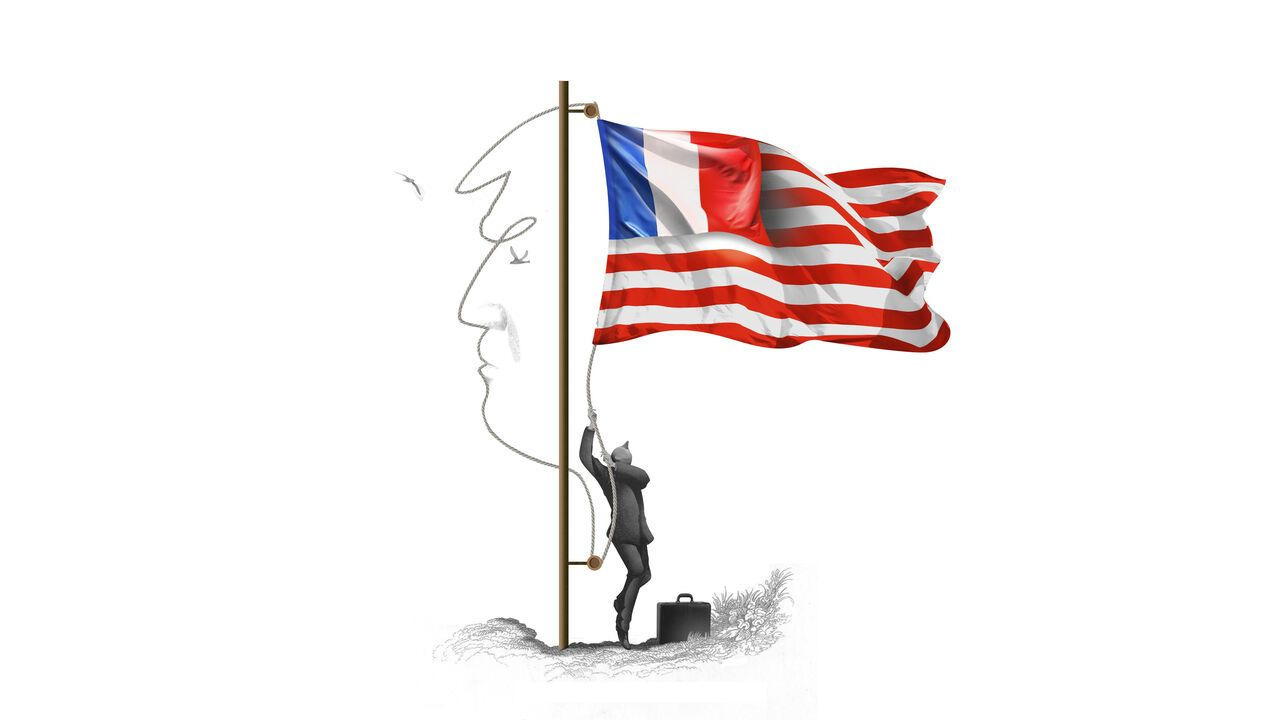
Illustration: Brett Ryder
Jun 12th 2025
Listen to this story
ON JUNE 14TH Constitution Avenue will turn into the Champs Elysées for a day. Some 150 military vehicles, 50 aircraft and 6,600 troops will roll, fly and march past the White House to celebrate the US Army’s 250th birthday (and, coincidentally, its current occupant’s 79th). The scene will be reminiscent of the annual Bastille Day parade in Paris, which so inspired Donald Trump when he attended one during his first presidential term that he has since insisted on emulating it at home.
The Pentagon pantomime is not Mr Trump’s only recent French import. The Oval Office got a Versailles-style gilded makeover. And even as they turn their noses up at goods from France and the rest of the European Union, which may soon face a 50% tariff, the president and people around him are turning into avid consumers of French ideas. These include what by America’s free-market standards counts as a heavy dose of dirigisme.
In recent months the Trump administration has touted not just tariffs (to protect domestic industry) but also national champions (such as the $500bn Stargate artificial-intelligence project), price controls (for pharmaceuticals) and state ownership (demanding a golden share in return for blessing a Japanese takeover of US Steel). On June 5th Steve Bannon, a prominent MAGA-whisperer, went so far as to call for the full nationalisation of SpaceX, a rocketry-and-satellite firm belonging to Elon Musk, a former “First Buddy” who had just had an epic falling-out with the president.
Mr Trump himself has yet to channel his inner François Mitterrand in so far as seizing private assets is concerned. But it is becoming clear that for large sections of his right-wing movement, Making America Great Again involves the sort of protectionism and state meddling that would be more familiar to Mitterrand than to his American contemporary, Ronald Reagan.
Chief executives in industries that could benefit from protection have cheered parts of this agenda. Mary Barra of General Motors has defended Mr Trump’s tariffs on cars as helping “level the playing-field” warped by other countries’ unfair rules. Leon Topalian of Nucor said those on steel, of which his firm is America’s biggest producer, were “long overdue”. Marc Bitzer of Whirlpool has described the washing-machine maker as a “net winner” from Trumpian trade policies. However, for most American CEOs it all seems about as appealing as a corked Pétrus.
To understand their sniffiness, consider American business before Reagan’s free-market revolution. The 1960s seem to be the time when, in populist MAGA eyes, America was great: men were men, most women had yet to discover feminism and businesses built stuff. Manufacturing accounted for more than a fifth of total output. Effective tariffs averaged 5-10%. Unions enjoyed plenty of clout. By 1970 more than half of the net value generated by non-financial companies was paid out to workers as wages, twice the share that flowed to their employers’ bottom lines. In all these respects, America Inc and France SA were hard to tell apart.
American capitalists look back at the period of Franco-American similitude with less nostalgia. Between 1960 and 1980 their companies turned profits (as measured by the gross operating surplus of non-financial firms) amounting to a ho-hum 14% of GDP. Uncle Sam pocketed around a third of that in corporation tax. Rising inflation,exacerbated by Richard Nixon’s 90-day freeze on prices and wages in 1971, pushed up short-term interest rates. The cost of capital for a typical firm soared from 7.5% or thereabouts in the 1960s to nearly 15% in the early 1980s. In the two decades to the start of 1980 the S&P 500 index of large companies rose by 80%, for a paltry compound annual return of 3%.
Both in terms of profitability and stockmarket returns, the pre-Reagan era in America also happens to mirror the past 20 disappointing years in corporate France. Since 2005 French companies’ gross operating surplus has hovered around 15-16% of GDP and the CAC 40 index of the largest ones has returned a piddling 3.5% a year. The ten blue-chip businesses part-owned by the state have done even worse. They include makers of aeroplanes (Airbus, Safran), arms (Thales), cars (Renault, Stellantis) and materials (Saint-Gobain), utilities (Engie, Veolia), plus a bank (Société Générale) and a telecoms operator (Orange). As a group, they represent 21% of the index’s market capitalisation—and generated no shareholder value in the 20 years to January 2025.
Meanwhile, American business has zoomed ahead. Its profits rose from less than 15% of GDP in 2003 to around 18.5% in the early 2020s. Since the start of 2005 the S&P 500 has ballooned five-fold, yielding a compound return of 8.2% a year. Three American technology giants, Microsoft, Nvidia and Apple, are worth more apiece than the entire CAC 40. France’s most valuable firm, Hermès, a $280bn manufacturer of pricey bags and scarves, wouldn’t make America’s top 25.
France is not as étatiste as it was. But the state remains meddlesome. In 2023 it strong-armed grocers to freeze prices of hundreds of everyday food items. Dealing with its representatives on corporate boards is impossible, says an executive with experience of the ordeal. Even when it does not own a stake, it can interfere—as it did in 2005 by blocking PepsiCo’s takeover of Danone, a French yogurt-maker that the government could not bear to see swallowed by an American rival.
Au revoir, laissez-faire?
Mr Trump’s views on the strategic importance of dairy products are unknown. He has ignored Mr Bannon’s SpaceX suggestion. He is a tax-cutter at heart (even if it means exploding debt). And his administration appears too undisciplined to enact French-style five-year economic plans. Still, American bosses are right to be on alert for more soupçons of Mr Trump’s unlikely Francophilia. ■
Business | Bartleby
A checklist for decision-making
Companies run on decisions. Asking three questions makes choices better
Illustration: Paul Blow
Jun 9th 2025
Listen to this story
The ways in which humans can be triggered into making irrational decisions are many and varied. Investors make higher bids for stocks when the sun is shining. If you add paper packaging to a product wrapped in plastic, people will perceive it as being more environmentally friendly than the same product without paper. The act of sharing an article makes people feel more knowledgeable: people who read a story on investing and share it are likely to take more risk in investment decisions than those who read the same article but do not pass it on. It’s a wonder the species has done as well as it has.
In an ideal world, individuals would correct for their own biases when they make decisions. Good luck with that, says Olivier Sibony, who studies decision-making at HEC Paris, a business school. A distinguishing feature of biases is that people are unaware of them. “If I show you a visual illusion and you fall for it, you would never say ‘I will watch out and I will never fall for any visual illusion again.’” Instead, it’s up to organisations to encourage better decision-making, the subject of the latest episode of our Boss Class podcast. That means asking three questions in particular.
The first is what kind of decision is being taken. When he was leading Amazon, Jeff Bezos used the idea of one-way and two-way doors to separate decisions into two categories. A one-way door is a big decision which is hard to reverse and should absorb more thought. A two-way door is a decision where changing course is not that difficult and it’s better to move fast even if mistakes are made. (A revolving door is presumably for people who never come to a decision at all.)
Whatever vocabulary you choose, it’s useful to think about the costs of botching a decision and to calibrate things accordingly. Michelle Gass, now the chief executive of Levi Strauss & Co, was one of the team at Starbucks that gave the world the pumpkin spice latte. In focus groups, consumers balked at the idea of a beverage full of pumpkin. Inside the coffee company, confidence was much higher that the firm was onto a winner, and they decided to press ahead. “Very few things have irreparable consequences if you’re wrong,” says Ms Gass.
Having a sorting mechanism like this works only if bosses have a reasonably high tolerance for reversing course if mistakes are made. But it does mean the pace of decision-making can increase.
The second question is who is taking the decision. Disagreements can quickly lead to an impasse unless someone has the authority to make the choice. There are lots of formal frameworks designed to specify decision-making roles. RAPID stands for Recommend, Agree, Perform, Input and Decide (this is not actually the order in which things happen but in management, acronyms always trump logic). The RACI framework makes tremendously confusing distinctions between people who are responsible, accountable, consulted and informed.
Even then, decisions can end up being countermanded by someone higher up the ladder (a framework informally known as BIG CHEESE). So an awful lot depends on whether bosses are willing to live with decisions if they disagree with them. Supercell, a Finnish mobile-games company responsible for titles such as “Clash of Clans”, preaches the gospel of autonomy. Games teams are able to kill off new titles unilaterally before they get into users’ hands, even if games have been years in the making. That degree of decentralisation will not appeal to everyone, but the clarity over where decision rights really lie is something to replicate.
The final question is how to reach your decision. Should it follow a codified process? Should there be structured ways to gather opposing views? Should it involve a pre-mortem, which asks people to imagine the things that are likely to cause a decision to turn out badly? For strategic choices, the answer to all these questions and more is probably “yes”. However a decision is made, some rules are better than none. “When you wash your hands, you don’t know specifically which virus or bacterium you are washing away, but you know it’s a good idea,” says Mr Sibony. A process makes big decisions more hygienic, too. ■
Business | Very demure, very mindful
Muslim “modest-wear” is a hit with fashionistas of all faiths
Long hemlines and loose styles please the fashion gods

Photograph: Courtesy of Alexander McQueen
Jun 5th 2025
Listen to this story
Eid al-Adha, which began this year on June 6th, is nicknamed the “Muslim Met Gala” for good reason. The three-day Islamic holiday is an opportunity not only for religious observance but for worship of the fashion gods, as revellers dress up to the nines. As Muslim spending on fashion grows, designers are bringing out collections aimed at the observant. What’s more, even non-Muslims are adopting the trend for “modest-wear”.
Modest fashion’s primary market is the world’s billion or so Muslim women, many of whom dress conservatively. Muslim consumer spending on fashion will reach $428bn by 2027, up by more than a third since 2022, forecasts DinarStandard, a research firm. Online searches for modest-wear are highest in the run-up to summer wedding season and religious occasions like Eid. In the past month, modest apparel has been one of the five most popular fashion categories on the British version of TikTok Shop, a social commerce platform.
Spotting the growing demand, Western brands are targeting modest dressers. ASOS, a British fast-fashion retailer, has a modest-wear section on its site with items offering fuller coverage. Nike, which introduced a “pro hijab” in 2017, has since unveiled a modest-swimwear line (the hijab costs $38 and the swimsuits $130—not so modest on the wallet). Designer houses, including Alexander McQueen, LVMH and Versace, have dropped Ramadan and Eid collections in recent years.

Photograph: Courtesy Louis Vuitton
Muslims are not the only ones spending on conservative fashion. Modest-wear’s crossover with current trends has pushed it further into the spotlight. Social media are saturated with looks such as “Scandi minimalism”, “old money” and “quiet luxury”, which feature relaxed fits, long sleeves, high necklines and long hemlines. Pinterest, a social platform, has seen searches for “modest dresses fashion” and “baggy outfit ideas” more than quadruple in the past year. On TikTok the hashtag #modestfashion has over 12bn views.
Trends come and go: skinny jeans and bum-grazing shorts will no doubt return in due course. But spending on apparel by Muslims is set to rise. DinarStandard predicts continued increases of 6% a year. As Muslim markets grow, the modest-wear business will not be going out of style any time soon. ■
Finance & economics | Buttonwood
European stocks are buoyant. Firms still refuse to list there
Another star prepares to move from London to New York
Illustration: Satoshi Kambayashi
Jun 11th 2025
Listen to this story
It must be tempting to give up. Those tasked with reviving Britain’s stockmarket have long faced a difficult task and a steady drip of bad news, as one firm after another departs for private ownership or America. It will still have hit like a bucket of cold water to learn, on June 5th, that Wise intends to move its main listing to New York.
One of Europe’s hottest fintech outfits, Wise’s flotation in London in 2021 spurred hopes that other stars would follow. If they included Klarna and Revolut, two even hotter peers, the London Stock Exchange would add a new, buzzy cluster to its old-timers in banking, energy and mining. That would attract attention from stock analysts, capital from international investors and yet more listings. Four years on, it has not worked out. Like Wise, Klarna intends to float in America; Revolut’s boss has hinted that it may do so, too.
The failure to attract and retain fast-growing firms is most often laid at the doors of the London Stock Exchange, but it is a pan-European malaise. Klarna, after all, is Swedish. So is Spotify, the only European firm founded this century worth more than $100bn. It listed in New York in 2018. New Financial, a think-tank, reckons that in the decade to 2024 some 130 companies moved their listing from Europe to America, while over 1,000 were taken private. In today’s money, their total value at the point of de-listing adds up to $1.7trn—more than 10% of what Europe’s stockmarkets are worth. Proportional to market capitalisation, Ireland is the biggest loser, followed by Sweden, Britain and Germany.
Unnerved, Europe’s financial elite has responded in time-honoured fashion: it has convened task-forces, launched consultations and commissioned reviews from grandees that, if printed, would fell forests. There have been extravagant promises of streamlined reporting, harmonised regulations and centralised supervision. In what may eventually be a radical step, Britain’s government is mulling plans to force some retirement savings to be invested at home.
It is, in fact, unfair to make fun of these efforts. Speak to bosses of private firms in Europe, or to their investors, and they will commend these incremental reforms to make the continent’s stockmarkets work better. A European listing, they will say, might make sense for plenty of companies. Then, without missing a beat, they will explain why theirs is not one of them and America is a better fit.
Frequently, most of the company’s shareholders will be American already. “They would find it weird if I didn’t list there,” says the boss of a European startup planning its initial public offering. Listing in America means using bankers and a wider milieu with which the investors are already familiar. More importantly, if the company has global ambitions, which pretty much all those backed by venture capital do, America’s consumer market is among the most lucrative. An IPO in New York might build the brand. It does not hurt that the median boss of a firm in America’s S&P 500 share index is paid two and a half times their equivalent in Britain’s FTSE 100. The biggest and most consistent bugbear among tech founders is that nervous European investors are perennially reluctant to approve the high-risk, high-growth strategies that they want to pursue.
Just as important are the factors that startup bosses do not mention. The main one is the supposed “valuation gap”, meaning the higher average multiple by which earnings are scaled up to generate share prices for firms listed in America as opposed to Europe. Perhaps sensing that harmonised regulation does not set pulses racing, proponents of Europe’s exchanges have recently switched tack, reasonably arguing that the valuation gap is a myth. Control for expected profit growth and the different markets’ sectoral mixes, and it disappears.
Before Arm, a British chip designer, listed in New York in 2023, the City of London was rife with rumours that the perceived valuation gap was why the local stock exchange missed out. But the gap does not seem to be behind recent moves. Wise’s chief financial officer has said that valuation was “not really the driver” of his firm’s decision. This makes sense: at 29 times its expected earnings for the coming year, it is already more richly valued than the S&P 500 average. Meanwhile, European shares have recently been outperforming American ones. The most disheartening thing for those trying to patch up Europe’s capital markets is that the companies they must woo are simply not interested.■
Finance & economics | Free exchange
The economic lessons from Ukraine’s spectacular drone success
National security is a weak argument for battery subsidies

Illustration: Álvaro Bernis
Jun 12th 2025
Listen to this story
On June 1st Ukraine took military raiding into the 21st century. It did so with little more than ingenuity and 117 drones, which emerged from trucks across Russia—everywhere from Siberia to the Chinese border—and destroyed a dozen or so planes in Vladimir Putin’s long-range air fleet. The raid came amid the Russian president’s relentless bombardment of Ukraine. On June 9th he launched his biggest drone strike of the war, sending 479 machines to hit Ukrainian airfields, cities and factories.
As many as half of casualties on the front line are inflicted by drones, according to a Ukrainian doctor. The “Spider’s Web” operation was a demonstration of the machines’ supreme importance. For the West, it was also a reminder that an important military technology is dominated by an adversary, namely China, which supplies batteries and motors used by both sides. That raises a question. If, say, a conflict over Taiwan were to escalate, could America and its allies step up production fast enough?
Many people believe that a country with a vibrant electric-vehicle industry has a decisive advantage in the manufacture of drones. Lots of the batteries for EVs use lithium-ion technology; so, too, do most shorter-range drones. And in the race for battery supremacy there is only one winner: China, which accounts for 85% of global EV capacity. The European Union is studying whether this dominance would put China ahead in the event of a conflict; American officials are under pressure from companies and think-tanks to dole out subsidies to ensure that the country wins any “battery war”. If subsidising battery production is such a good idea, then President Donald Trump’s budget bill, which promises to end all EV subsidies, is a hugely damaging policy.
America has sought an EV industry to rival China’s since 2009, when the Obama administration first subsidised consumer purchases. Joseph Shapiro of the University of California, Berkeley, and Hunt Allcott of Stanford University estimate that, in 2023, each additional EV sold owing to subsidies cost the government $32,000. Supporters of such an approach see this as sensible not just on environmental grounds, but on national-security ones. The batteries produced by a healthy EV industry could, in the event of a conflict, be repurposed to fuel drones.
Consider the mechanics of warfare in Ukraine, however, and the argument becomes less compelling. Ukraine’s drones range from small, autonomous boats patrolling the Black Sea to aircraft that travel hundreds of kilometres into Russia. Most are designed to be made from parts that are cheap, easy to find and simple to put together, according to a firm a few miles outside Kyiv, which builds them in an airy suburban home. Another firm, established two years ago and now making some of Ukraine’s most sophisticated drones, locates its production line in a series of garages, so as to minimise disruption from Russian airstrikes.
Most Ukrainian drones are single-use, short-range “kamikaze” ones that travel just a few kilometres before blowing themselves up—more akin to munitions than aircraft. The batteries of some store a mere 77 watt-hours of energy, compared with the 20,000-100,000Wh common in EVs. Meanwhile, production lines have become less flexible owing to the high-tech nature of modern EV-making. “It is unimaginable...that a Tesla factory would be anywhere near as useful for production as a Detroit factory was in the second world war,” says the boss of a defence firm.
China has grown closer to Russia, so Ukrainian drone producers have found their old Chinese suppliers less keen to do business. Several, including Wild Hornets, now import battery cells from South Korea and assemble their own packs. Pawell, another firm, is working on its own battery chemistry. Already, building batteries in Ukraine is only a little more expensive than buying them from abroad. Wild Hornets sells its ones for simple drones at $90 a piece. Drone batteries, it turns out, are simpler to make in wartime than an EV industry is to nurture in peacetime.
Indeed, American battery-makers could adjust quickly if required—without the need for assistance from EV-makers. For proof, look at their response to the supercharged subsidies that the Biden administration introduced in 2023. Although America’s capacity still lags far behind China’s, the country’s production has surged from 0.11 terawatt-hours in 2022 to 0.44tWh this year. Include production in Europe and among East Asian allies, and that is already sufficient to furnish Ukraine with kamikaze drones for 3,750 years at the current rate of use.
Drop a bombshell
Were American drone production to be hamstrung in a conflict with China, it would not be by industrial capacity. Ukrainian firms are now discovering that the most pressing shortage is motors, rather than batteries. They need magnetic components containing rare-earth metals that are produced and refined by China. More mineral refining, not manufacturing, is the solution.
Another question is whether America’s armed forces would be able to adapt to drone warfare. So far, the Pentagon has been slow to adjust to the pace of drone experimentation and manufacturing demonstrated by Ukraine. The US Army seeks to put 1,000 drones in each of its dozen divisions. The Pentagon’s Replicator Initiative, launched by the Biden administration, aims to field “tens of thousands” of AI-enabled drones. Ukraine claims to have produced 1.5m drones last year, and does so at far lower cost, in part because it is less squeamish about using parts from China.
Industrial-policy advocates might like to rescue EVs from Mr Trump’s chainsaw. Unfortunately for them, arguments involving national security offer little protection. America does not need a bigger battery industry to master drone warfare. It needs more mining, more refining and more imagination. ■
Finance & economics | Heiry questions
How to invest your enormous inheritance
Do not make the mistakes of the first Gilded Age
Illustration: Álvaro Bernis
Jun 12th 2025
Listen to this story
What do you stand to inherit? It still feels like a question from a different age, despite its growing importance today. In 2025 people across the rich world will inherit some $6trn, or around 10% of GDP—a figure that has climbed sharply in recent decades. French bequests have doubled as a share of national output since the 1960s; those in Germany have tripled since the 1970s; Italian inheritances are now worth around 20% of GDP (see chart 1).
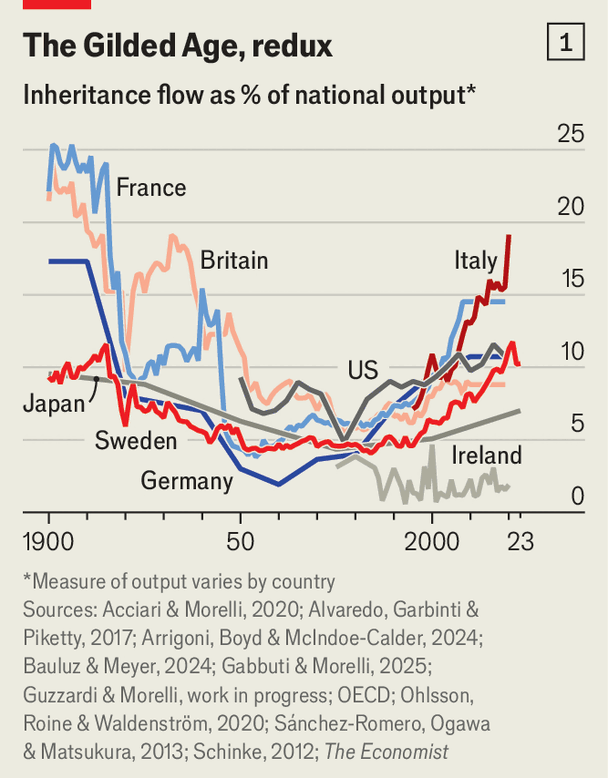
Chart: The Economist
There are two entirely reasonable responses to this. One is to worry about the new inheritocracy harming society: how it could corrode incentives to work, say, or widen inequality and distort the marriage market. The other, if a windfall is coming your way, is to rub your hands in glee and ponder what you ought to do with it.
The typical inheritance is closer to the value of a typical home than to a Vanderbilt-style fortune. Even so, a rising number of people are in line for a bonanza. UBS, a bank, reckons that 53 people became billionaires in 2023 by inheriting money; many more will have received amounts in the hundreds of millions. Asset prices have climbed so high in recent decades, and inheritance taxes have fallen so low, that the number of very wealthy scions is growing all the time. Descend from the stratosphere, and a sizeable cohort is set to receive far lower sums that will nevertheless be life-changing. In Britain, for instance, a quarter of 35- to 45-year-olds are expected to inherit more than £280,000 ($380,000).
For these lucky people, the experience of the Vanderbilts and their contemporaries offers a cautionary tale. At the turn of the 20th century, America’s census recorded about 4,000 millionaires, note Victor Haghani and James White, two wealth managers, in their book, “The Missing Billionaires”. Suppose a quarter of them had at least $5m (the richest had hundreds) and had invested it in America’s stockmarket. Had they then procreated at the average rate, paid their taxes and spent 2% of their capital each year, their descendants today would include nearly 16,000 old-money billionaires. In reality, it is a struggle to find a single one who traces their fortune back to the first Gilded Age.
That is not down to inflation or the 20th century’s wars, but to poor investment and spending decisions. After all, spending 2% of $5m in 1900—that is, $3.8m in today’s money—would not exactly have consigned anyone to penury. The big question for a 21st-century heir is how to avoid the mistakes of those of the past. In other words, how can you enjoy a nice life while ensuring your inheritance lasts for ever?
Silver spoons for all
Some cheery news is that the question of how to invest, which sounds like the hardest part, need not be solved perfectly. In theory, this would mean finding the blend of risky assets with the best volatility-adjusted return, and comparing it with the “safe” return on inflation-protected government bonds. You would then solve for an optimal split between the two, which would vary with market conditions.
Thankfully, far simpler procedures can produce spectacular results. Our putative 20th-century millionaires just plonked everything in America’s stockmarket, and did very well. Today, we know they could have done even better without much more effort. A simple rule-of-thumb known as the “Merton share” can approximate the optimal split between stocks and inflation-protected government bonds, by comparing their expected returns and volatility.
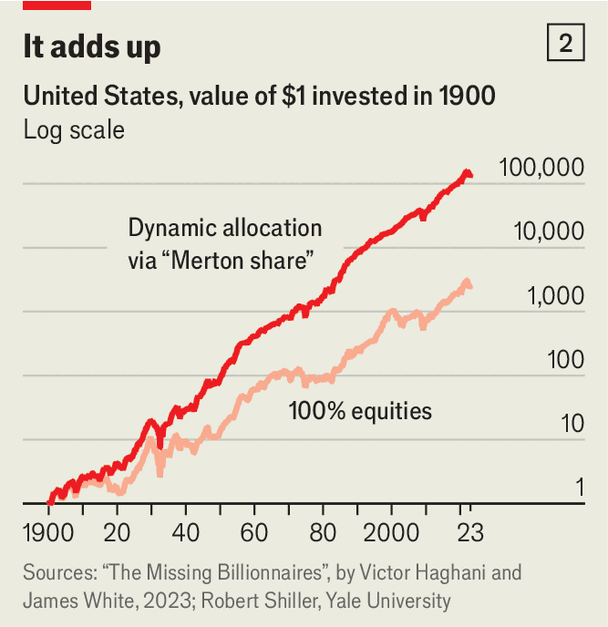
Chart: The Economist
Messrs Haghani and White have calculated the annualised returns on such a strategy since 1900 (using a proxy for inflation-linked bonds for before 1997, when they were first issued). The results are shown in chart 2. Had the Gilded Age crowd and their descendants invested in this manner, they would have scored an annualised real return of 10%, compared with 6.6% from the all-stock strategy. Remarkably, it would also have been 40% less volatile. That would have produced vastly more old-money billionaires today.
The worse news is that deciding how much to spend is trickier than it sounds. Popular rules for drawing down retirement savings, such as spending a largish fixed percentage of the initial value each year, are definitely out. In truth, these are not wise even for pensioners. Suppose you had kept a classic 60/40 split between American stocks and government bonds, starting in 2000, and drawn down 5% of the value of your initial savings a year. You would have run out of money in 2019, despite earning an annualised return of 5.25%, since you would have depleted too much capital in the market’s “down” years.
Even if you spent only 4% of the initial value each year—well below the portfolio’s return—you would run a high risk of going bust. Simulate many different market outcomes, based on the 60/40 portfolio’s expected return and volatility, and the 4% spending rule leads to ruin within three decades about a third of the time.
To avoid this trap, the optimal amount to spend each year must be a percentage of the portfolio’s value at that point (the “spending ratio”), not of its initial value. In other words, if you want to take the risk required to generate outsize returns, you must vary your (maximum) spending from year to year. That way, after a bad spell for the markets, you will not deplete too much of the remaining pot, allowing it to recover. Each year you could, for example, spend a proportion of the portfolio’s value equal to its annualised expected return. This is similar to the spending rule adopted by university endowments, which aim to solve the same problem. The median outcome is that the fund’s value, and hence annual spending, stays roughly constant with time (provided you have not been overly optimistic about your returns).
Nice—but hardly enough to start a dynasty. Ideally, you want to increase your portfolio’s value, which means spending less to let the returns rack up. The trade-offs here are difficult to parse. You will get pleasure (or, in economists’ jargon, “utility”) from spending more today, albeit with diminishing marginal returns as you get more and more profligate. Doing so will also trim your descendants’ purchasing power, especially if the portfolio has a large expected return, which you in part forgo by spending now. Yet such returns are inherently uncertain. In any case, it is only human to prefer an immediate pay-off to a delayed one (“time preference”).
The solution is to plug these dynamics into a mathematical model, simulate possible paths for financial markets and calculate the utility derived from each for a given level of spending. You can then calculate the expected utility for each rule and pick the one that maximises this.
Unsurprisingly, the procedure is hard, and generates results that are sensitive to the inputs. Maybe spend some of your money on an excellent financial adviser.
Yet there are straightforward lessons that everyone can absorb. Although greater expected returns allow you to spend more, they do not do so by as much as you might think. With higher returns, the gap between these and the optimal spending ratio widens (since there is more value in sacrificing spending to let the portfolio grow). Higher volatility means lower spending, since it drags on your annualised return. The more reluctant you are to vary year-to-year outlays, the less you can tolerate investing in stocks, since their value fluctuates. The smaller your minimum spending requirement, the more risk you can take, meaning your expected returns, and hence your overall spending, can rise.
A more important lesson is that making your inheritance last for ever means spending far less than its expected return. Exactly how much less depends on market conditions and your risk and time preference. But under reasonable assumptions, a near-optimal portfolio might have an expected annualised return of 4.1% and an optimal pre-tax spending ratio of 2.4% per year. Even that is before allowing for how much your family tree might grow, cutting whatever you pass on into smaller chunks. “People often want to know how much they need to have to give each member of their family’s next few generations a modest income,” says Mr Haghani. “The answer is: a lot more than most anyone thinks.” ■
Finance & economics | Out and about
The rise of the loner consumer
Solo spenders are a new economic force

Photograph: Karsten Moran/Redux/eyevine
Jun 9th 2025|San Francisco
Listen to this story
In the pandemic years, people became used to staying inside. Outlays on services—everything from restaurant meals and foreign travel to elective medical care—collapsed. Demand for goods jumped, with a rush for computers and exercise bikes. Such patterns proved resilient even as life got back to normal. In 2023 we called people spending in this manner “hermit consumers”.
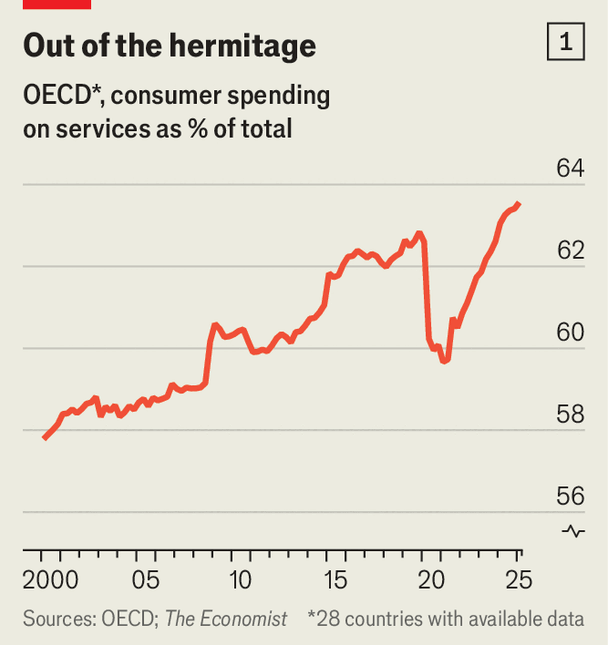
Chart: The Economist
The hermit economy is now a thing of the past. Across the rich world, the out-and-about economy is roaring back. Indeed, the share of consumer spending that is devoted to services has at last caught up with its trend from before the pandemic (see chart 1). However, there is a twist. The hermit economy has been replaced with a consumer market that still deviates from the pre-pandemic norm in an important way.
America exemplifies the resurgence of the out-and-about economy. Since 2023 spending on health care has grown by 10% in real terms, while outlays on public transport are up by 21%. By contrast, consumers are no longer splurging on power tools and garden implements.
Americans are also determined to have a good time. We estimate that, at the country’s largest airlines, revenues from premium products, such as business-class travel, are growing by 7% a year, compared with a rise of 1% across the board. Similarly, even as revenues decline at budget hotels, sales at luxury alternatives are up by 8% year on year.
These trends are clear on the other side of the Atlantic, too. Goldman Sachs, a bank, tracks the share prices of European companies that benefit when people stay at home (such as those in e-commerce and gaming) and firms that thrive when people bother to get dressed (such as gyms and restaurants). During the pandemic the share prices of stay-at-home companies soared (see chart 2). But recently investors have looked more favourably upon companies involved in the out-and-about economy. According to OpenTable, a booking website, in Germany the number of seated restaurant diners in early June was over 10% higher than a year ago.
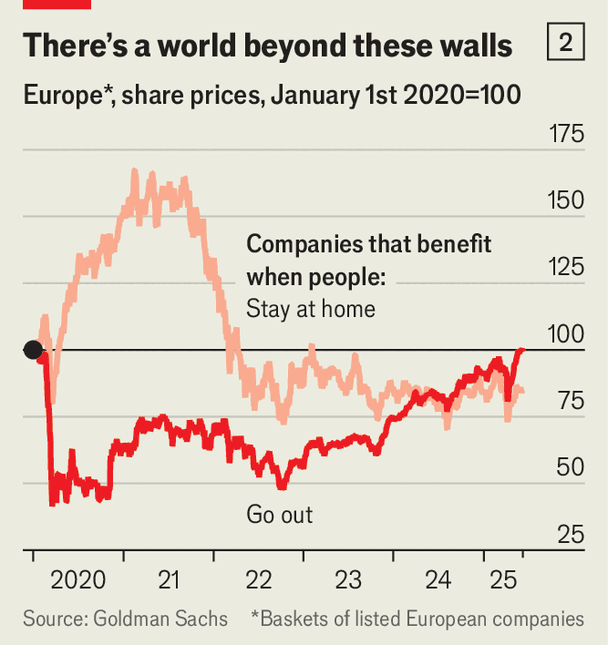
Chart: The Economist
In a sense, then, covid-19 is truly in the rear-view mirror. The risk of infection influences almost nobody’s day-to-day decisions. Yet even today, the pandemic continues to cast a long shadow over the economy. For although people are getting out of the house, they are increasingly doing so alone.
In the past couple of years global online searches for “solo travel” have exploded. Airbnb, an online booking platform, reports that searches for solo trips have grown by 80% this spring compared with last year. According to official British data, travellers are more often using cars or taxis, which offer privacy, than public transport, which does not. People are also less likely to share meals than before. More than a quarter of Americans report eating all their meals alone the previous day, a sharp rise from just before the pandemic. The hermit economy is gone. In its place stands the loner economy. ■
Science & technology | Well informed
How much protein do you really need?
Unless you are older or want bigger muscles, you’re probably getting enough
Illustration: Cristina Spanò
Jun 6th 2025
Listen to this story
Fats and carbohydrates, eat your hearts out—protein is the macronutrient of the moment. Rich people love the stuff. They treat it like ambrosia. Are they onto something?
Having protein on your plate is important. It is made up of amino acids, of which the body needs 20 types in order to grow, produce hormones and stay healthy. Nine of these amino acids must come from food. The World Health Organisation recommends 0.83 grams of protein a day per kilogram of body weight (g/kg) for healthy adults to maintain muscle and tissue health.
Elderly folk may be better off eating more, since muscles wither with age and older bodies are less efficient at absorbing protein. A review published in Nutrients in 2021 suggested that a ratio closer to 1.2g/kg, together with resistance training, could help limit muscle shrinkage in older people. Children and teenagers, who are still growing, may also want more than the minimum, depending on how active they are. A paper from 2020 suggested that pregnant and breastfeeding women need double the recommended amount to maintain muscle mass and feed their child.
More protein can also help you lose weight. Protein takes more energy to digest than carbohydrates and fats and makes you feel fuller for longer. To build muscle mass, the International Society of Sports Nutrition has recommended a daily protein intake of between 1.4g/kg and 2g/kg, combined with resistance training. A meta-analysis published in Sports Medicine in 2022, though, found that eating more than 1.6g/kg does not lead to further muscle growth.
Where should the protein come from? Powders (dried extracts of milk, pea or soya) are popular and convenient—chugging protein as a drink is easier than gnawing on steak. A randomised controlled trial in 2013 found that whey protein, made from milk, was especially good at building lean body mass for exercising adults. But the supplement won’t offer bulk on its own: a review published in 2014 in Sports Medicine found that the best results came in those who also lifted heavy in the gym.
Yet advocates of a traditional balanced diet argue that because alternative sources of protein such as powders and bars often contain too many sugars, flavourings, emulsifiers and other additives, they are less healthy than food-based protein. Eating whole foods may also be a better route to building muscles after a workout, according to a review published in Nutrients in 2018, because of the added benefits of naturally occurring micronutrients such as calcium, vitamin D and iron.
Followers of a Western diet, typically rich in meat, dairy and pre-packaged foods, tend to exceed the minimum protein requirements without trying. This includes vegetarians and vegans, according to a review published in Nutrients in 2019. Most Americans get more than the recommended amount of protein because of their fondness for meat.
The risks of overdoing it on protein are debated. Some nutritionists warn of the potential for kidney damage, but a 2018 meta-analysis concluded that this is only a concern for people with existing kidney trouble. The greater risk may come from protein-rich diets which rely heavily on red meat and ultra-processed foods that can also contain the saturated fats associated with ill health.
In places where food is plentiful, measuring your protein by the gram may not be worth it. Unless you’re looking to bulk up, a regular diet is ample.■
Culture | Back Story
As “Jaws” turns 50, who is the blockbuster’s real hero?
Steven Spielberg’s saga of man v shark is not the film you remember
Photograph: Landmark/Universal Pictures
Jun 9th 2025
Listen to this story
That relentless, rumbling music—DUM-dum DUM-dum DUM-dum—like a heartbeat gone awry. The mayor who wants to keep the beaches open (and his equally obnoxious tailoring). “You’re gonna need a bigger boat.” These may be your recollections of “Jaws”, released 50 years ago in June 1975. But as so often with classic movies, your memory may be as faulty as an animatronic shark. Watch it again and, in particular, you may conclude that the real hero is not who it first seemed.
“Jaws” is a story of two halves. A killer great white shark terrorises Amity Island, a pretty New England resort. Then the local police chief pursues it on the waves, in company with a bumptious marine biologist and an unhinged shark-hunter. The tale of how the film was made likewise involves a man—Steven Spielberg, then 27—triumphing over nature. “Jaws” made his career, but only after his choice to shoot at sea almost wrecked it. He ran way over budget and schedule. Boats sank when they weren’t meant to. Actors feuded and drank.
Yet “Jaws” became the prototype summer blockbuster and a model for big-splash action extravaganzas. For generations of fans, this saga of American grit and ingenuity has had an all-American hero: Brody, the police chief, played by Roy Scheider (pictured below). Brody is an everyman, who loves his kids and likes a drink and a cuddle with his wife. He has flaws but also a conscience, plus the guts to vanquish the monster.
Brody was an apt champion in the wake of the Watergate scandal of the early 1970s. Rather than covering up his part in letting a child paddle to his doom, he accepts it. “In Amity,” he declares, “one man can make a difference!” That was a stirring credo for a public servant in a disenchanted age. Still, just as you can’t lower a shark cage into the same ocean twice, today “Jaws” makes a new impression—and Brody has a rival.

Photograph: Shutterstock
Famously, the shoot’s biggest hiccup was the replica sharks. “What would Alfred Hitchcock do?” Mr Spielberg asked as they malfunctioned. He fell back on portents and mystique, flashes of fin that were menacing enough to scare viewers away from seas, swimming pools and bath tubs. The upshot is that you dread the shark and long to see him.
For well over an hour, you barely do. But you see what he sees from the start. The film’s signature technique is the underwater shark’s-eye view, the camera looking up at frolicking holidaymakers or poised at the sloshing waterline. Admit it: as you track the shark’s gaze, you want him to chomp some of those delicate legs. After all, no mastication, no movie. Each grisly meal supplies a shiver of relief that he got someone else, not you.
The script omits the adultery and mafia subplots in the novel it is based on. Even so, the shark is an agent of retribution. The mayor isn’t Amity’s only wrong ’un. The medical examiner and newspaperman are corrupt; the townsfolk are greedy, petty and blithe, whingeing about parking while the shark swims amok. “Bad fish,” says Quint, the shark-hunter (Robert Shaw). Bad people, too.
“Jaws” is the “Macbeth” of horror flicks: a bait-and-glitch drama known for lurid violence that is intimate and pensive at heart. Its moral anchor is a boozy, below-decks chat in which Quint delivers a haunting monologue. He recalls going down with the USS Indianapolis—a torpedoed cruiser that had ferried bits of the atom bomb dropped on Hiroshima—and seeing sharks devour his shipmates. This explains his Ahab-like fixation on the great white. At the same time, the link to the bomb suggests the shark is part of a wider reckoning.
And the shark, it must be said, is very good at what he does—ie, eating people—and as worthy a harpooned foe as Moby Dick. “He’s incredible,” says Quint during the three-men-against-one-fish duel, shortly before he is munched. The shark’s efficiency contrasts with the myopic officials and slapstick bounty-hunters. (“Jaws” is also a funnier film than is remembered: the funny and the frightening overlap, both springing from human vanity and frailty, the conceit of would-be demigods made of clay.)
After the movie’s release, moreover, came half a century of environmental despoliation. That has been especially hard on sharks, whose global population is thought to have fallen by 70%. Now the film’s elemental source of fear—that the ocean is the shark’s domain, or was—tugs your sympathies towards him; he seems simply to be getting his revenge in early. The shark is the hero of “Jaws”, the head, the tail, the whole damn thing. ■
Obituary | Burning bright
Valmik Thapar was in love with all the tigers of India
The conservationist and ardent campaigner died on May 31st, aged 73
Photograph: Valmik Thapar
Jun 12th 2025
Listen to this story
Once seen, he was not easily forgotten. In his kingdom, the national tiger reserve of Ranthambore in Rajasthan, he patrolled night and day, solitary, guarding what was his. His shoulders were broad, his girth impressive; he exuded power and purpose. A thick ruff of hair grew on his cheeks, and his eyes bored and blazed. No one registered more intently the trail of pug-marks or the flocking of vultures; the deer sucking up water-plants from the shallows of Rajbagh Lake, their antlers flat among the lotus flowers, and the crocodiles that pulled them under; each piglet-rustle in the tall grass. His speed, when he charged, was terrifying. Many of his kind were lazy, but not he; day and night he paced his territory, fearless and often roaring.
His name was Genghis. But anyone who mistook him for Valmik Thapar would not have been wrong. Mr Thapar admitted that he was obsessed with him; from their first mutual glance, he moved in his skin. The Ranthambore reserve was indeed his domain, all 392 square kilometres of it, and his life was completely entangled with the tigers who, for five decades, he fought to protect. Throughout India (for his love encompassed all its tigers) he was known as “Tiger Man”. In almost 30 books and TV documentaries he spoke in the tiger’s booming voice. And many were the government ministers, the forest wardens and the state jobsworths who, at some encounter or another, had felt the furious glare of those eyes and dreaded the inevitable charge.
The urgency of his campaign was obvious. In 1900 around 100,000 tigers had roamed India. By 1973, through a combination of plunder, agriculture and maharajas’ shooting sprees, their numbers had fallen to 1,800. That year Indira Gandhi, then prime minister, set up Project Tiger, establishing nine national reserves manned with guards. As a result the population had stabilised, but still at a desperately low level. Poachers continued to raid the reserves for lucrative tiger pelts, bones and bits to send as medicine to China. Local villagers and tribal people, deprived now of access to ancestral grazing land, wood and water, saw tigers as their enemy. India took great pride in tigers; they were the national animal. But relations between them and humans were often dire.
Mr Thapar had no idea he would take on such a role. His family were part of the Punjabi elite in New Delhi, intellectuals, army officers and friends of the Gandhis; he saw his first tiger, at ten, when majestically astride an elephant. His next sighting, though, was under very different circumstances. His first marriage had gone wrong, attempts at a career were stalling, and he went to Ranthambore to try to find healing. It came in the sprightly form of Fateh Singh Rathore, the wildlife warden, with his Stetson hat and elegant moustache, who introduced him to the delights of a life spent largely in a jeep, keeping as quiet as possible, waiting for the sheer joy of a glimpse of stripe, a tip of an ear above the grass, or a flicker of a tail: tiger-watching.
This was love from the beginning. The rarity of sightings—perhaps one every two weeks—added to the allure. For most of the day the tigers slept, perfectly camouflaged by tall grass and tree-shadows. At sundown they were on the move. In time he could sense them before he saw them, partly from the highly accurate panic-cries of peacocks but also from his own instinct, grown keen as an animal’s. He observed and recorded the activities of 125 tigers, but some were family. Calm, elegant Padmini, the Queen Mother of the jungle; Akbar, a confident risk-taker; Noon, who spread her favours between two males; Nasty, who threatened to attack each jeep as it passed her. And Ghengis, whose imperiousness included refusing to be watched while he ate.
Some of Mr Thapar’s findings surprised him. He saw male tigers bringing up motherless cubs, rather than devouring them, and making successful deer-kills in water. He also saw them (Ghengis again) sparring over carcasses with crocodiles, and usually winning. As the years passed he could draw closer and closer to tigresses with young, watching the little ones roll stones or chase after butterflies. The beauty of these creatures never failed to move and amaze him.
His task, then, was to spread the word in his writings and documentaries (”Land of the Tiger”, for the BBC in 1997, was the best known) and to keep their plight in India’s eye. Whenever he was not in the forest he tended to be prowling the corridors and anterooms of government, looking for prey. He reckoned he had sat on 150 committees, almost all rife with sloth and indifference. His action plan was small and sharp: inviolate space for tigers, far from noise and humans; properly armed local wardens who would enforce the law; and forest services run at state, not national, level.
In the villages around the reserve, however, he faced fury from the people who felt they had lost out to tigers. Here his tactics were gentler. He set up a foundation to encourage conservation in 100 perimeter villages, as well as a co-operative craft society and a school of art. Eventually, admitting that “inviolate space” was too optimistic, he spoke up for properly managed tourism, and hoped to see scientists, villagers and state officials serving tigers together. The bottom line, he reminded villagers, was that without its apex predator the forest itself would not survive.
The unique feature of Ranthambore was an ancient fort from which, in the past, successive rulers had controlled central India. It was in ruins now, but many of his sightings of tigers took place among its crumbling walls. His friends made dens there, and dragged their kill there to eat. He meanwhile made his den on the terrace of an adjacent temple, now a rest house, drinking whisky as the sun went down. The landscape was filled with evening calls, each one of which he knew. Soon he would begin to patrol in the deepest possible silence; but the reverberation of his roaring still echoed, both in his head and in the forest. ■