The Economist Articles for Jun. 3rd week : Jun. 21th(Interpretation)
작성자Statesman작성시간26.06.12조회수35 목록 댓글 0The Economist Articles for Jun. 3rd week : Jun. 21th(Interpretation)
Economist Reading-Discussion Cafe :
다음카페 : http://cafe.daum.net/econimist
네이버카페 : http://cafe.naver.com/econimist
Leaders | Our cover
The World Cup paradox
How the rules of both entertainment and soft power are being rewritten

Jun 10th 2026|5 min read
Listen to this storyAI Narrated
WITH LYRICS in English, French, Spanish, Italian and Japanese, the theme tune of the men’s World Cup, performed at its opening ceremony on June 11th, exemplifies the contest’s claim to foster global unity. Nearly half the world is expected to tune in over the coming weeks as the tournament moves towards its final on the outskirts of New York. A viewer might come away with two conclusions. First, that entertainment culture is more globalised than ever. Second, that America remains the soft-power superpower at the centre of it all.
Both assumptions would be wrong. Mega-events like the World Cup still seize global attention. But the bigger picture is that entertainment is fragmenting. From music to television to social media and gaming, audiences are tuning out of American content and embracing alternatives from closer to home. There is an emerging paradox: even as the world becomes more connected, people are choosing more local forms of fun. Even as billions tune in to a single show in North America, the American-led monoculture is fading.
Read the rest of our cover package
This local turn is the opposite of what many predicted. Global entertainment platforms such as Spotify, Netflix, YouTube, and the Apple and Google mobile-app stores give people everywhere access to the same music, video and games. The biggest winners have been a lopsidedly American elite of megastars and brands—think Taylor Swift, MrBeast or Roblox—which have gone global as never before. The biggest sports leagues have soared in value along with them.
But below the top tier, entertainment is fragmenting. Sport has always been a reluctant globaliser, because people prefer to watch their local team. America’s National Football League, the world’s highest-earning sports property, earns 98% of its media-rights revenue at home. The English Premier League is the only football league in Europe that makes more in media rights abroad than it does at home. Every four years the world comes together for the World Cup and the Olympics. Otherwise, fans are mainly engrossed in domestic contests. New Yorkers are far less excited about the football than they are about the Knicks.
Other kinds of culture have long been more globalised, often thanks to America; think of music from Motown or TV from Tinseltown. But now this seems to be reversing. Music charts are becoming more local: in Brazil, an extreme case, 96 of the 100 most-streamed artists last week were Brazilian. Video-streaming services like Netflix and Amazon are producing more shows abroad, to woo subscribers in fresh markets. North America’s share of new streaming commissions has halved in the past six years, from 70% to 36%.
New media are no more global. YouTube offers content from every country, but its users gravitate towards clips from close to home: three-quarters of its “trending” videos manage to trend in only one country. Gaming on PCs and consoles remains dominated by a few worldwide franchises (including a football series formerly known as “FIFA”). But on mobile, which has a bigger and more diverse audience, regional variations are sharper. Across the five biggest gaming markets, no app features in every country’s top ten. While Americans play “Fortnite”, Asians have shifted to titles such as “Free Fire”.
Cheaper production and distribution have caused a boom in the supply of local entertainment. In the age of CDs, cinemas and game cartridges, there were huge economies of scale in pushing popular acts or products to go global. Today, producing and distributing new entertainment—whether songs, videos or games—is cheap enough for it to be profitable to target much smaller niches. In some places there is even evidence of a sub-national cultural boom: more than half the content posted on YouTube in India is in languages other than Hindi (mostly local ones). AI will enable ever more niche production.
The audience has also changed. A growing global middle class has made it worthwhile for Netflix to make big-budget shows tailored to Mexican subscribers, or for the developers of “Free Fire” to devise Bollywood themes for Indian gamers. And audiences’ discovery of new content is increasingly being led by algorithms rather than human tastemakers. Sometimes those algorithms send everyone to the same global hits—prepare for a blizzard of World Cup highlights on your social feeds—but they also divide them into niches. In one recent year, German songs made up only four of the 100 most-played tracks on national radio, but 44 of the country’s streaming top 100. People’s preferences have turned out to be more local than elite tastemakers thought.
Something will be lost if people’s cultural habits turn too far inward. A Britain that served only British food and “Carry On” films would be bleaker than purgatory. Yet it is cause for celebration that audiences now have so much more choice. Rather than a diet of entertainment from a country that had a historical advantage in its production and distribution, consumers can choose from a global menu of Danish hip-hop, Polish comedy or Chinese video games. Regulators should note that the turn towards local options has been brought about by technology, and not by rules of the sort imposed by Canada, where radio stations have to play unhealthy amounts of Justin Bieber to meet local quotas.
Moving the goalposts
Governments will need to adapt to the changing dynamics of soft power. America’s century of dominance over global popular culture is over. It still controls much of entertainment’s distribution, via platforms such as YouTube and the app stores, and thus much of the industry’s profit. But it has lost its grip on content, and with it the cultural tractor-beam that has recruited millions of listeners, viewers and players to American values and ideas over the years. Other countries are rushing to fill the gap that America has left, from Brazil in music to South Korea in TV and China in gaming.
All eyes will be on America for the World Cup final next month. But it is a fading force in a new game of soft power that has only just kicked off.■
Europe | Charlemagne
Ukraine’s war is now longer than the first world war
The ghost of Versailles haunts Ukraine’s peace
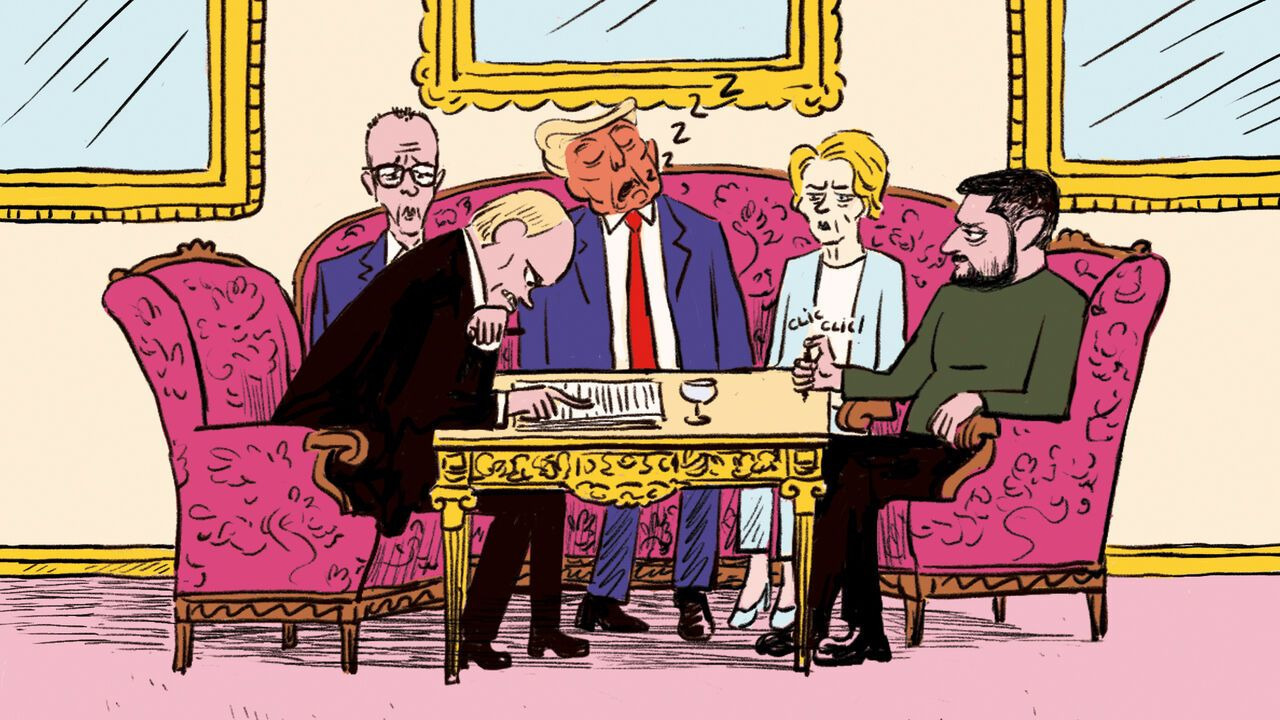
Illustration: Javi Aznarez
Jun 11th 2026|5 min read
Listen to this storyAI Narrated
On June 11th Europe passed a sombre milestone. As of that date, the fighting in Ukraine had ground on for longer than the first world war. In a grim irony, a conflict that looked like it might last just a few days, as Russian troops confidently stormed towards Kyiv in February 2022, has outlasted one some assumed would be “over by Christmas” in 1914. Whether in this century or last, war has defied the best-laid plans of military high commands. Soldiers were promised triumphant parades in conquered capitals, but soon found themselves bogged down, often literally. Conscripts defending their homelands huddled in foxholes, their trenches turned to quagmire. Novel weapons—tanks, machineguns and mustard gas back then, drones today—reshaped warfare. Men died, families grieved. Maps were updated as towns and villages, or rather what was left of them, changed hands.
Alas, a long war is no guarantee of a just peace—as the Treaty of Versailles, signed in 1919, went on to show. But the echoes of that failed armistice might usefully inform efforts to bring hostilities in Ukraine to a close. The “war to end all wars” is remembered these days as a prequel to the even grislier conflict it helped midwife a generation later. The ghost of Versailles should thus haunt those valiantly trying to end the current conflict. Ukraine’s allies have helped it not lose the war. Soon they will have to gear up to help it win the peace.
For now, serious talks remain elusive. Surely, after 1,568 days of near-uninterrupted fighting, the end of this war should be nearer than its beginning. The recent tentative turning of the tide in Ukraine’s favour may nudge Russia towards the negotiating table. Territorial gains the aggressor made at enormous cost—around 1,000 Russian men dead or seriously wounded every day, say the Ukrainians—are now being partly reversed. Ukrainian drones are reaching deep inside Russia, each plume of putrid smoke a humbling message to President Vladimir Putin. Europe is about to start disbursing a €90bn ($104bn) loan to Ukraine, helping its ally even as help from America has dried up. Ukrainian troop morale is at a recent high. President Volodymyr Zelensky, once a haggard, hollow shell of a man, can occasionally be seen smiling these days. But his challenges to Mr Putin to engage in peace talks—backed on June 7th by the leaders of Britain, France and Germany—have come to nothing thus far. Mr Putin says nyet.
When an armistice in this conflict comes, it will differ in flavour from that signed in the Hall of Mirrors in 1919. Russia will not be a broken, defeated country with no choice but to accept intemperate diktats from its adversaries. Notwithstanding the demands of Ukraine’s most strident allies—not least those in the Baltics or Poland, who worry unchecked Russian revanchism might target them next—there will be no war reparations paid, nor rulers rendered to international courts. Peace will be a messy, unsatisfying affair full of compromises that neither side will want to live with. And yet they will have to, if the drones are to be silenced.
But there will be parallels with Versailles, too. Both the peace in 1919 and the forthcoming one in Ukraine will be sealed as part of a new security architecture in Europe. Back then it was a hobbling of Germany, financially and militarily, as well as a new-fangled League of Nations to defuse wars before they could get started. This time a new European order will include security guarantees to Ukraine that will have to be backed by a “coalition of the willing” in Europe, one tacitly willing to fight Russia. There is talk of a European Security Council, though few details. Ukraine’s bid to join the European Union will reshape both its fortunes and those of the bloc. And what of America’s role? Woodrow Wilson spent six months in Europe trying to seal the peace, only the second sitting president to leave America. His successor, Donald Trump, once promised to end the fighting in Ukraine “within 24 hours”, but has since started a new war instead.
What are the lessons of Versailles? One is that promises made to secure peace need enforcement mechanisms. In the wake of the peace in 1919, America ultimately balked at joining the League, its Senate fretting about foreign entanglements. One mechanism to constrain Russia’s future designs on Ukraine will be credible security guarantees—underpinned in fine by Ukraine joining the EU. On June 15th the bloc’s 27 member states will unanimously agree to open the first negotiating cluster, another step towards Ukraine’s accession. But the odds of that happening soon—or perhaps at all—are longer than Kyiv’s friends care to admit. If Ukraine feels it has been promised a brighter future as an EU member and that somehow fails to materialise, its people may end up embittered, like the Germans of 1933. If the EU is not, in fact, ready to welcome Ukraine, it should come clean now.
The guns of August, the drones of June
The contours of a peace agreement are still too distant to divine. Ukraine seems ready to accept losses of territory—an inevitable outcome at this stage. Europe, which is stuck between being a mediator for talks or a party to them, will be among those with impossible choices to make. To secure peace it may end up lifting sanctions on Russia, and perhaps even sending back hundreds of billions of euros it froze and once hoped to send to Ukraine instead. There will be talk of normalising diplomatic relations. That will be denounced in some quarters as little short of treason.
A crude interpretation of Versailles is that humiliating the aggressor leads to resentment and thus sows the seeds of further war. A better lesson is that the longing for retribution cannot be an end in itself. The desire to see Mr Putin humbled or worse will be justifiably strong in Europe. His abhorrent regime is guilty of the worst crimes; the war is his responsibility. And yet one day, hopefully soon, he may be a partner in making peace. ■
United States | Catholics and confession
Should priests have to report child abuse disclosed in confession?
American states take different approaches
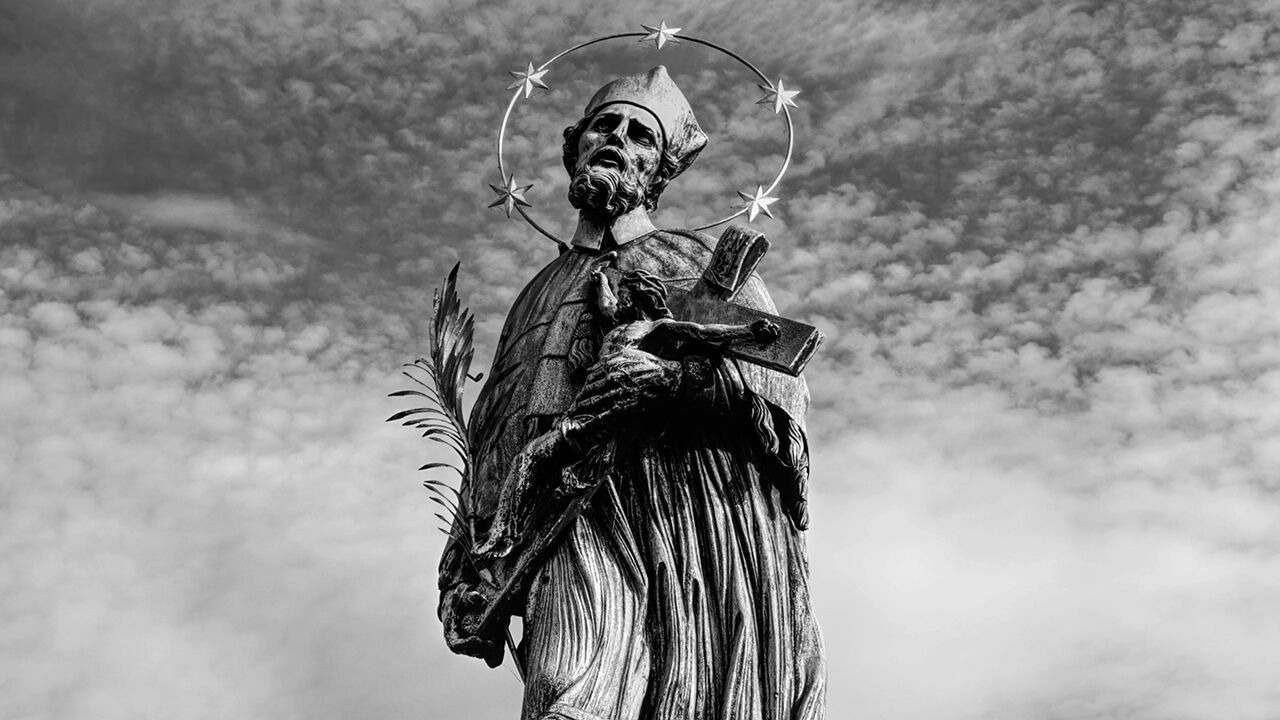
Mr Nepomuk kept quietPhotograph: Getty Images
Jun 5th 2026|ATLANTA|4 min read
Listen to this storyAI Narrated
TRAVEL THROUGH central Europe and you will eventually come across one of thousands of statues of a man on a bridge with his finger pointing to his tongue. According to lore, John of Nepomuk, a 14th-century clergyman, heard the queen of Bohemia’s confession, only for the jealous king to ask him to divulge his wife’s secrets. When he refused, the king had him drowned. Poor John was martyred for one of Catholicism’s most sacred tenets: the absolute seal of confession.
Six centuries later, tight-lipped priests are once again being tested—this time by state legislatures. State laws govern which adults are required to report child abuse that they learn about on the job. In most places teachers, doctors, therapists and camp counsellors have to tell the police and can face fines or even jail time if they don’t. As part of a reckoning with the church’s recent history, more states have added clergy to the list. But this spring twin bills in Missouri and Vermont took it further. They aimed to scrap an exemption that allows priests to withhold information disclosed during confession.
Policy on the matter is already a patchwork. Clergy everywhere in America enjoy some form of “penitent privilege”, which broadly shields conversations that take place in a spiritual context from the courts. But states differ on whether the protection applies when it comes to child abuse. At least six states—New Hampshire, North Carolina, Oklahoma, Rhode Island, Texas and West Virginia—don’t recognise it in these cases or override it, as the new bills aim to. Others, such as California and South Carolina, preserve it narrowly by exempting a priest who learns about a crime during confession but not while teaching a class, for example, or when a perpetrator confesses rather than a victim. That inconsistency of rules has ignited a battle between child-safety advocates and religious-liberty lawyers.
Under Catholic doctrine, “breaking the seal” of confession is one of the worst offences a priest can commit. Because a spiller of secrets is automatically excommunicated and referred to Rome for discipline, mandated reporting puts American clergy in a bind. “Practically, you have all these priests who will have to make a choice between violating canon law and violating civil law,” says Kurt Martens of the Catholic University of America.
A band of right-wing lawyers saw a constitutional problem in that. When Washington state passed a similar bill last year, they argued that it violated the First Amendment’s protection of exercising religion. Their case hinged on a contradiction: if uncovering child abuse was important enough to justify burdening religious practice, how could the state exempt lawyers from the same reporting mandate? (What clients confess to their lawyers can remain secret.) “If you provide any exceptions to your rule, then by definition under Supreme Court precedent you don’t have a compelling interest,” says Hiram Sasser, who argued for the First Liberty Institute. The Department of Justice joined the lawsuit last June and a judge temporarily ruled against Washington state. Its lawyers chose not to appeal.
Marci Hamilton, who founded the CHILD USA think-tank, finds their argument legally indefensible. She believes that the state has an overriding interest in protecting children—and that the church’s defence of the confessional privilege is hypocritical, given that it has received thousands of abuse reports over the past 25 years and mishandled them. (To make matters worse, many cases of priests abusing children happened in the confession box.) “If they are permitted to continue to keep the secrets, then we’re conceding that a certain amount of child sex abuse simply will not be prevented,” she says.
Victims of clerical abuse say the confessional can be a place for uncovering crimes that would otherwise go undetected. A seven-year-old boy entering the box may well have internalised sexual abuse as his own sin and confess it as such, says Peter Isely, who was raped by his “spiritual director” while at boarding school. “I felt—and he told me this—that I was making him do these things.”
As the weather warmed and state legislative sessions ended, both the Missouri and Vermont bills died in committee, never reaching the chamber floor. Esme Cole, the Vermont lawmaker behind the bill, is not giving up. Child-safety advocates argue the defeats could mark a moment of peak influence for the religious right on the issue, and that the pendulum will swing back. Others are not so sure. “The church always wins,” says Mr Martens. ■
By Invitation | America at 250
How the war on terror primed America for autocracy
The road from 9/11 leads directly to January 6th, writes Rosa Brooks
Illustration: Dan Williams
Jun 2nd 2026|5 min read
Listen to this story
LIKE VIRTUALLY every American over 40, I remember where I was when I learned of the 9/11 attacks. I was driving to work, listening to National Public Radio. When I got to the office people were wandering about, shocked. Some were crying. Others were huddled around computer monitors. Every screen showed the same things, over and over: the planes flying into the towers, the tiny shapes that were human beings leaping into nothingness, the towers collapsing, the clouds of smoke and debris rising.
No one knew much. Al-Qaeda was not yet well known. It took several days for officials to confirm Osama bin Laden’s group as the perpetrators. But even in those first stunned hours, one thing was apparent: this would change our world, and not for the better.
A quarter-century later, it’s easier to assess the damage. The attacks marked the beginning of the end of American global leadership, launching us into a state of permanent fear and emergency that, in turn, enabled the precipitous decline of our democracy.
The events of 9/11 themselves, and al-Qaeda more generally, did not pose an existential threat to the United States. The richest country on Earth could, and did, shrug off the economic impact, and from a cold actuarial perspective, in a nation so large—one that routinely loses 15,000-20,000 people a year to homicide—the 3,000 deaths on 9/11, however tragic, weren’t likely to cripple the country. It was our predictable overreaction that did us in.
Less than a month after 9/11 President George W. Bush invaded Afghanistan, starting a war that would last for 20 years and kill more than 6,000 American military personnel and contractors before its ignominious end. Six weeks after the attacks Congress passed the USA PATRIOT Act, permitting a previously undreamt-of expansion of government surveillance and detention authorities. Within six months Mr Bush signed a directive declaring the Geneva Conventions inapplicable to the conflict with al-Qaeda. A year after that we went to war in Iraq as well, relying on false claims that its dictator, Saddam Hussein, possessed weapons of mass destruction and was aiding al-Qaeda. That war would leave more than 8,000 American troops and contractors dead.
By the end of 2004 the surge of global goodwill America had enjoyed in the immediate aftermath of 9/11 had evaporated. Too many dead bodies had piled up, for one thing: in addition to the thousands of American and allied military personnel killed in Iraq, Afghanistan and other far-flung outposts of the global war on terror, hundreds of thousands of Afghans and Iraqis were dead. By overseeing the indefinite detention of terrorist suspects and the use of torture, the Bush administration had also squandered any claims to moral leadership: once viewed, images of naked Iraqi prisoners piled into human pyramids couldn’t easily be unseen.
But the self-inflicted damage continued after Mr Bush left office. Although President Barack Obama rolled back many of the Bush administration’s most egregious policies, such as the use of torture, the “forever war” proved difficult to end. Mr Obama acknowledged that playing whack-a-mole with terrorists wasn’t a sustainable strategy, but he could not seem to stop; he expanded the use of drone strikes and other targeted killings of terrorist suspects around the world. Like the Bush administration’s use of torture, the targeted-killings programme, which continued under Donald Trump and Joe Biden, was notably lacking in meaningful due process. The executive branch insisted it had the right to kill anyone, anywhere, at any time based on classified evidence it declined to disclose—declaring itself judge, jury and executioner.
The 9/11 attacks reverberated domestically as well. The 2001 PATRIOT Act was just the beginning: surveillance and detention authorities continued to expand, and surveillance technologies developed on the battlefield were later adopted by police at the federal, state and local levels. Legal doctrines developed in the context of national-security-related issues increasingly found their way into ordinary civil and criminal cases. As a quiescent Congress ceded ever more power to the executive branch, “emergency” authorities granted in the wake of 9/11 became permanent.
Just as perniciously, America became a nation defined by fear and mutual suspicion. Jolted out of their pre-9/11 sense of invulnerability, citizens turned on one another. Islamophobia and xenophobia rose. Conspiracy theories spread: the attacks were an inside job, or an Israeli plot, or planned by Wall Street elites who profited from insider trading. Political polarisation increased, too. By 2014 more than a quarter of Democrats and a third of Republicans saw the other political party as a “threat to the nation’s well-being”. Far-right and white-nationalist groups gained traction.
Of course, 9/11 was not the sole cause of America’s democratic decline, but it helped create legal, political and psychological conditions which accelerated that decline. By 2015, when a certain New York reality-TV star began his rise to power, we were a nation ripe for authoritarian takeover from within. Weakened by internal division, with a populace habituated to executive overreach and violations of due-process norms, what chance did American democracy have against an authoritarian in the White House?
By the time a violent right-wing mob stormed the Capitol on January 6th 2021, it had become clear that the gravest threat to American democracy was not a vicious and homicidal band of Islamist extremists. It was our own citizens, goaded by an autocratic president to whom we had handed vast powers.
In 1776 the American colonists rebelled against what they saw as the arbitrary and tyrannical British monarchy. As we approach America’s 250th birthday, it’s hard not to imagine Mad King George gazing out at Donald Trump’s America—and laughing. ■
Middle East & Africa | Rolling the dice
Iran has lost its fear of war
A once-cautious regime is making a risky bet on low-level conflict
Photograph: EPA
Jun 11th 2026|DUBAI|5 min read
Listen to this storyAI Narrated
WHAT was once unthinkable has now become routine. In the past week America and Israel have both bombed Iran, and Iran has downed an American helicopter, fired missiles at Israel and attacked several Arab states. This is fast becoming the region’s new normal. Though a ceasefire of sorts has largely held for more than two months, talks between America and Iran remain at a stalemate and violations are becoming more frequent.
Diplomatic deadlock is not the only cause of the volatility. It also reflects an emboldened Islamic Republic. Donald Trump has insisted for months that the regime is desperate for a deal. Instead he has been vexed by an Iran willing to tolerate low-level conflict and risk a return to all-out war. Yet a newfound fondness for risk is a risk in itself. Iran is wagering that it can deter Israel and coerce Mr Trump into a deal. Both may prove difficult.
Read all our coverage of the war in the Middle East
For decades, Iran’s rulers were cautious about the use of force. A generation forged by the ruinous war against Iraq in the 1980s was determined to keep conflicts away from the country’s borders. Instead the regime cultivated Arab militias such as Hizbullah, a Shia group in Lebanon, as a way to project power across the Middle East without risking direct consequences.
Such caution had its critics. When Mr Trump ordered the assassination of a top Iranian general in 2020, for instance, the regime retaliated with a pre-announced barrage of missiles on two American bases in Iraq. Some younger officers in Tehran argued that this was an insufficient response, one that might signal weakness and encourage future American attacks. They were overruled—but many of the leaders who overruled them are now dead.
Having endured six weeks of war against two superior foes, Iran’s current rulers are more confident. They believe that Mr Trump has no desire to resume an unpopular war. Periodic attacks on American forces in the Gulf now seem to Iran like a useful source of leverage rather than an unacceptable risk.
The change in Iran’s strategic doctrine is most striking in Lebanon. Hizbullah was meant to protect the regime: in the event of an Israeli attack on Iran, the group would unleash its missiles and commandos against Israel. Instead Iran now seeks to protect Hizbullah.
In the short term, this will make life more complicated for America and Israel. It underscores how their interests have diverged: Mr Trump’s desire for a deal with Iran is at odds with that of Binyamin Netanyahu, the Israeli prime minister, to continue the war in Lebanon.
The Iranian regime’s boosters argue that it is a more profound shift: a new balance of power in the region, in which Iran can deter Israeli attacks against third parties. That seems like wishful thinking. Few words are more misused in foreign policy than “deterrence”. To deter an adversary is to dissuade them from taking an action by convincing them that the costs will outweigh the benefits. That is not what has happened over the past week.
Iran warned Israel that any attack on Beirut would trigger a response. Israel was not deterred: it bombed the Lebanese capital anyway. Iran then made good on its threats, but the barrages of ballistic missiles it fired at Israel failed to cause serious damage. That may have been a deliberate choice, since a destructive attack could have ended the ceasefire entirely. Regardless, Israel’s riposte caused real harm—not just to military targets but also to a petrochemical plant, a vital part of Iran’s energy sector and its industrial base.
This was a lousy scorecard for Iran. Not only did it fail to deter Israel, it ended up suffering more damage than the country it sought to deter. For a time, Mr Trump may restrain (though not halt) Israel’s war in Lebanon. But if the current limbo drags on, Iran may face an uncomfortable choice between escalating its attacks on Israel, thus risking the truce, or allowing Israel to continue chipping away at Hizbullah.
The regime has had more luck with changing the behaviour of America. Closing the Strait of Hormuz and firing thousands of missiles and drones at Gulf states helped persuade Mr Trump to accept a ceasefire in April. Since it took hold, Iran has been walking a tightrope. It wants to show enough resolve that Mr Trump makes further concessions towards a deal, but not so much that he drops diplomacy entirely.
On June 9th it downed an American Apache helicopter over the strait. Mr Trump decided to retaliate by bombing Iran’s air defences (though those defences were “100% annihilated” earlier in the war). Iran subsequently attacked—again—American bases in Bahrain and Kuwait.
Mr Trump sounded furious in a social-media post the next day: Iran had “taken too long to negotiate a deal” and would “have to pay the price”. That night he ordered another round of strikes on military targets. This is a dangerous cycle. Iran may want to show that the impasse will have costs for America, but the loss of a single helicopter was not enough to sway Mr Trump’s negotiating position. Conversely, if the pilots had been killed, he might have felt compelled to resume all-out war.
Iran is newly confident in its capabilities, but they are limited. Hormuz is already closed, and Mr Trump seems not to care so long as oil prices do not go much above $100 a barrel. Iran cannot resume widespread attacks on its Gulf neighbours without ending the ceasefire. Lobbing missiles at Israel is a poor deterrent. What looks like confidence can also seem like desperation: a regime more willing to take risks not because it is stronger, but because it has less to lose. ■
Middle East & Africa | A growing dilemma
How Israel is frustrating Donald Trump’s Iran plans
Binyamin Netanyahu has defied America twice in recent days
Don’t stop me nowPhotograph: Flash90
Jun 8th 2026|JERUSALEM|5 min read
Listen to this storyAI Narrated
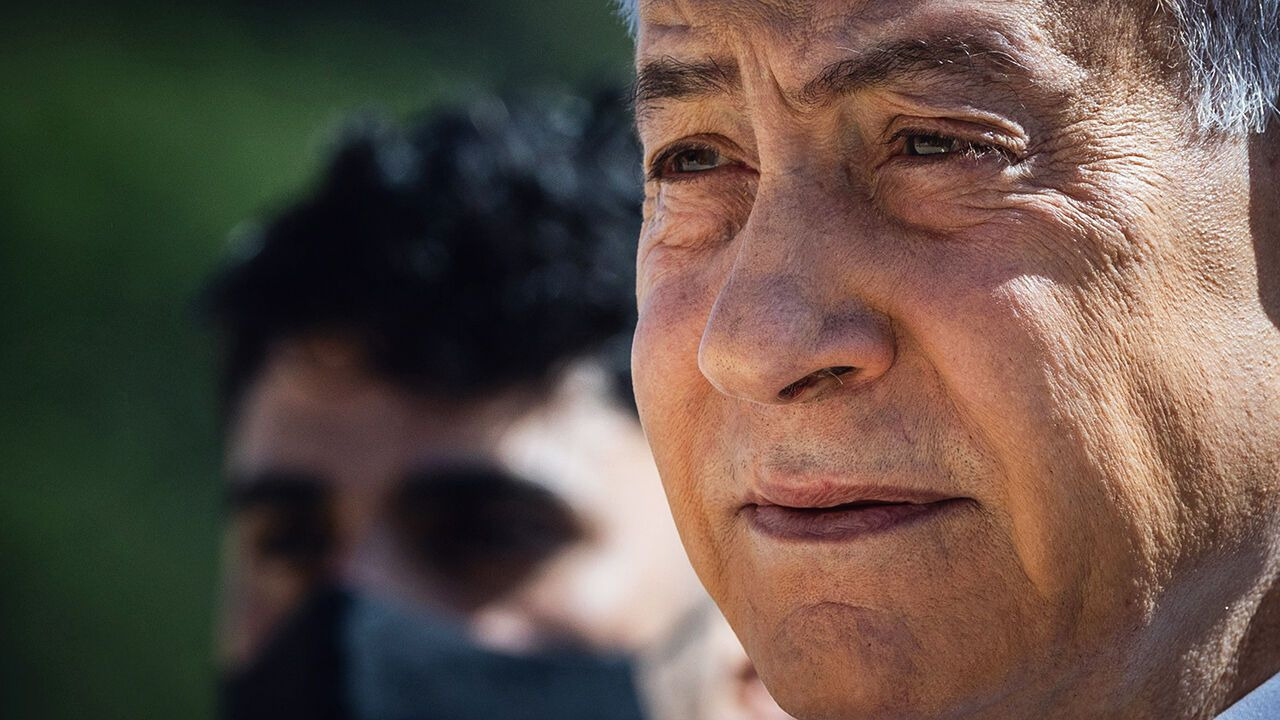
FOR SOME 12 hours on June 7th fighting between Israel and Iran flared up as the two yet again traded missiles and air strikes. Then a tenuous calm was restored as Donald Trump insisted, rather unconvincingly, that “both sides, Israel and Iran, are looking to do an immediate ceasefire!” The American president does not want to see a renewal of the war that America and Israel fought together against Iran for 40 days, which led to an unresolved blockade of the Strait of Hormuz and a spike in global energy prices.
The temporary resumption of hostilities highlighted Mr Trump’s twin failures to control his ally and cajole Iran to accept a lasting truce. Binyamin Netanyahu, Israel’s prime minister, has now defied the president twice in rapid succession. First, on June 7th Israel attacked Beirut, Lebanon’s capital, bombing what it claimed were offices of Hizbullah, the Shia militia that is Iran’s most powerful regional proxy. Less than a week earlier Mr Trump had imposed a limited ceasefire on Israel and Hizbullah that prohibited Israel from striking Beirut. Israel claimed its bombs were responding to Hizbullah attacks.
Read all our coverage of the war in the Middle East
Iran then sprang to Hizbullah’s defence, firing a salvo of 11 missiles towards northern Israel, but failing to cause any damage. Mr Trump thought this was enough, telling a reporter at Axios he was “going to call Netanyahu right now and tell him not to strike back”. Instead, Israel’s prime minister ignored the president’s instructions for a second time. Israeli fighter jets launched ballistic missiles at Iran, hitting targets including missile-launchers, an air-defence installation and a petrochemical plant that Israel claims is part of Iran’s missile industry. Iran struck back, firing 20 missiles at Israel, one of which hit the desert near the Dead Sea. The rest were either intercepted or fell short.
Both countries made their point. Iran is unwilling to abandon Hizbullah, which it helped found in 1982 and in which it has invested billions of dollars. The militia remains one of the most important ways it can project power in the region. Israel, which now occupies a swathe of southern Lebanon, is determined to keep battering Hizbullah. For decades the two countries fought a shadow war in which direct attacks were taboo. Today both are prepared to resume firing in order to prove a point.
This leaves Mr Trump with a dilemma. He has already tried and failed to impose ceasefires on Israel, in both Lebanon and Iran. He has frozen it out of the negotiations with Iran that are being brokered by Pakistan and other intermediaries. But leaving his partner-in-war out in the cold has not worked. After Iran’s latest barrage, the president claimed that Mr Netanyahu would have no choice but to accept any deal he reaches with Iran: “I call all the shots. He doesn’t call the shots,” he told the Financial Times. And yet Mr Netanyahu kept shooting until a second call from Mr Trump forced him to abort further strikes.
It is hard to gauge the state of their relationship from Mr Trump’s rebukes of Mr Netanyahu, whose defiance has not led to any obvious repercussions. The president recently told the prime minister on the phone: “You’re fucking crazy. You’d be in prison if it weren’t for me.” And yet Mr Netanyahu’s aides insist the two leaders are still close. “No other world leader has a closer relationship with Trump,” says one Israeli official. “But that doesn’t mean we know what he’s going to decide.”
Although Mr Trump may be willing to tear a strip off Mr Netanyahu, he still is reluctant to break with his ally. Co-operation between the two armed forces is such that America could have blocked Israel’s strikes on Iran, had the president chosen to do so.
Political constraints are not holding Mr Trump back. In the past, American leaders feared paying a heavy domestic price for confronting Israel. Now public support for Israel is waning. The collapse spans partisan, generational and religious boundaries. A Gallup survey released in February showed that, for the first time in two decades of polling, more Americans sympathised with Palestinians (41%) than with Israelis (36%), a reversal from 55% to 26% in Israel’s favour before the attacks of October 7th. Democrats—the party backed by most Jewish-American voters—are especially disillusioned, but other polling shows 57% of Republicans aged 18 to 49 also hold an unfavourable view of Israel.
Some officials are keen to blame Israel for America’s failures to achieve its war aims in Iran and to secure a lasting peace. They are briefing accordingly. A recent leak about suspicions in the Pentagon that Israel is spying on members of Mr Trump’s inner circle, including his personal envoy, Steve Witkoff, may be part of such efforts.
Mr Netanyahu has more pressing concerns than the long-term erosion of American support for Israel. He will face an election by late October and is coming under intense criticism, both from his allies and opponents, for failing to achieve decisive results in the wars Israel has been fighting for nearly three years. The Iranian regime retains its nuclear and missile programmes. Hamas, the Islamic movement that carried out the October 7th massacres, still controls the parts of Gaza that Israel does not. Likewise Hizbullah, despite being pummelled by Israel, remains capable of launching rockets and drones, while enjoying Iranian missile cover.
Since Mr Trump first announced a ceasefire with Iran on April 8th, Israel has tried to decouple the Lebanese front from the Iranian one and continue its campaign against Hizbullah. The president’s priority is reaching a deal with Iran. Increasingly, he seems to have concluded that doing so will require him to impose limits on Israel.
As for Israel, it has once again proved it can strike targets throughout the Middle East, but cannot translate this into strategic gains. And just as dangerous: it risks losing its American ally in the process. ■
The Americas | Dead heat
What happens when a presidential vote is a dead heat?
Peru, looking for its ninth president in a decade, is in a tight spot
Photograph: AP
Jun 9th 2026 (updated 5h ago)|Lima|4 min read
Listen to this storyAI Narrated
Peru often marches to a different beat from the rest of South America. When its neighbours were run by right-wing military dictatorships in the 1960s and 1970s, a leftist general was in charge in Lima. In the 1990s, Peru veered into electoral authoritarianism while others were consolidating democracy. It first elected a left-wing leader long after the “Pink Tide” of the early 2000s—which saw leftists win power across Latin America—had crested.
This year, Peru might at last fall into sync with the rest of the region. After Argentina, Ecuador, Chile and Bolivia turned right, political analysts asked if Peru would be added to the list of countries with Trump-aligned leaders. Conditions seemed ideal. The left had been discredited by the hapless presidency of Pedro Castillo, while an explosion of gang violence had made law and order the most pressing issue for voters. Peruvians voted in a run-off between right-wing Keiko Fujimori and the left-wing Roberto Sánchez on June 7th.
Ms Fujimori, on her fourth straight run for the presidency, led opinion polls for most of the campaign. In the final stretch, though, Mr Sánchez tacked to the centre and closed the gap. The votes are split nearly evenly between the two. At first Mr Sánchez held a slim lead. But on June 11th, as The Economist went to press, with 98% of the vote counted, Ms Fujimori had slipped ahead by just 651 votes out of 18m. She pulled ahead as ballots came in from abroad, which broke for her disproportionately. The betting platform Polymarket gave her a 97% chance of victory.
Neither candidate is popular. Ms Fujimori is best known as the eldest daughter and political heir of Alberto Fujimori, an autocrat who oversaw human-rights abuses while in government between 1990 and 2000. Mr Sánchez, meanwhile, centred his campaign on pardoning Mr Castillo, who was convicted last year for attempting to close down Congress and rule by decree in 2022. While their core supporters propelled them to the run-off, more Peruvians cast blank or spoiled ballots in the first-round than voted for either candidate.
Ahead of the run-off, voters struggled to assess who would do the least damage. One podcast dedicated an episode to the question “Who is more of a coup-monger?” Some voters bought dollars ahead of the vote. Despite frequent bouts of political upheaval, Peru’s mining-powered economy has remained stable largely thanks to high copper and gold prices and investor-friendly policies enshrined in the constitution, which Mr Sánchez wants to replace.
If she does win, Ms Fujimori will lack the mandate enjoyed by her father and the region’s more populist leaders, who beat their rivals with the support of millions. Peru’s next president will take office with a margin of victory so small that all of its voters could fit in a football stadium. Her party is also expected to wield less power in the next Congress—sufficient to shield her from impeachment but not to pass ambitious reforms.
Recounts and legal wrangling could easily drag on into July. Fortunately, Peruvians have learned to shrug off political uncertainty. Three of the four tightest presidential elections in Peru’s history took place in the past decade, according to an electoral expert, Fernando Tuesta. Ms Fujimori lost the last two by a quarter of a percentage point. After her 2016 defeat, she embraced the role of opposition leader with zeal, using her party’s congressional power to chuck out four out of the next eight presidents. “I don’t even remember our current president’s name. Velasco? Balazar?” says Hernán Santos, a taxi driver in Lima. (The answer: Balcázar.)
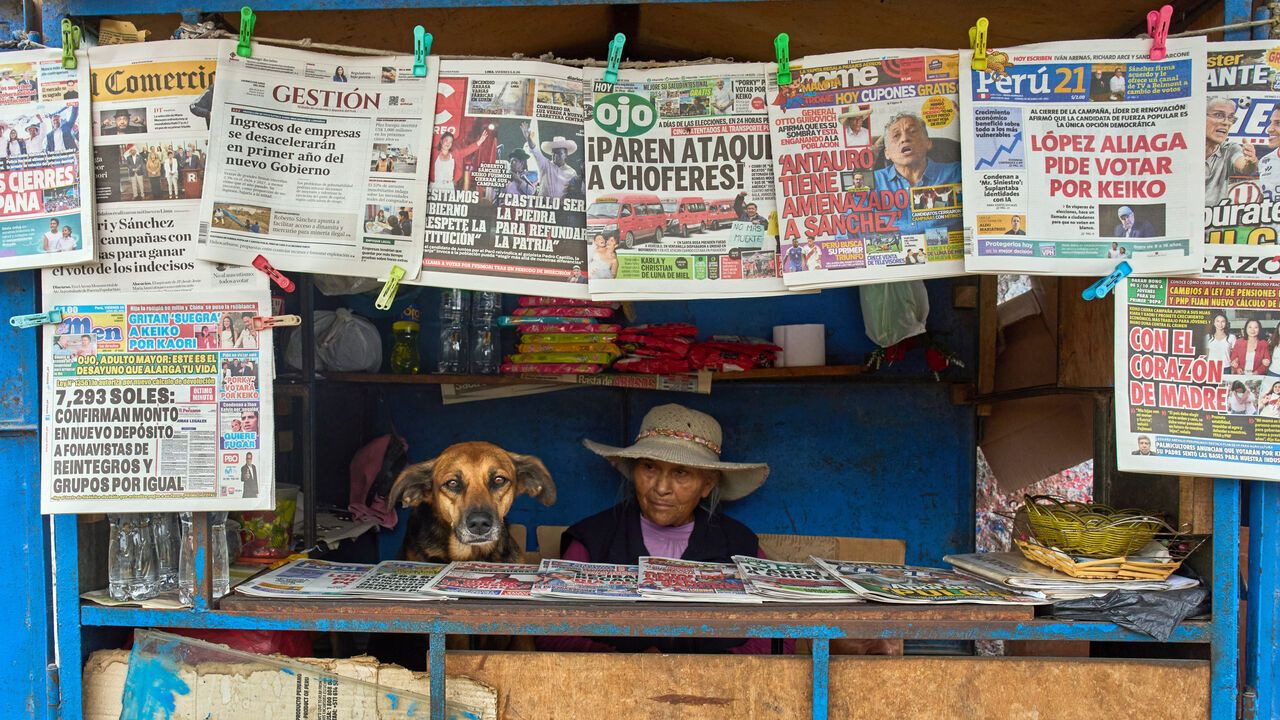
Ms Fujimori’s persistence has forced Peruvians to rehash debates about her political dynasty. Many headed to the polls with the enthusiasm of the protagonist in “Groundhog Day”. “I hope I live long enough to see an election without Keiko,” says Victoria Ramos, a 55-year-old newspaper vendor who nonetheless voted for her hoping she would rein in crime. “I want her to be like her father and bring order.”
While Ms Fujimori promised military-run mega-prisons and deportation of immigrant criminals, Mr Sánchez cast a “corrupt-mafia pact” as the ultimate source of chaos, claiming that laws which Ms Fujimori’s party helped to pass had weakened the fight against organised crime. Speaking to The Economist, he suggested that Donald Trump did not endorse Ms Fujimori because the Americans “did their homework. They know very well that this level of instability is unforgivable and who’s responsible.”
While he accused Ms Fujimori of seeking impunity for her friends, Mr Sánchez excused Mr Castillo’s 2022 power grab as a “politically understandable” act of desperation. He claims that he would not follow the same path if elected and obstructed by Congress. Instead, he would insist on dialogue, encouraging protests if needed.
Ms Fujimori is already a magnet for protests across southern Peru, where voters blame her for propping up an interim president whose crackdown killed 49 civilians. If elected, she could struggle to contain her detractors while making good on a “reservoir of promises from four campaigns”, says Mr Tuesta, the analyst. “If she can’t deliver quickly, the streets will mobilise.” ■
Asia | Back in the Blue House
An interview with South Korea’s president
Lee Jae Myung has put his country on track again, but challenges loom
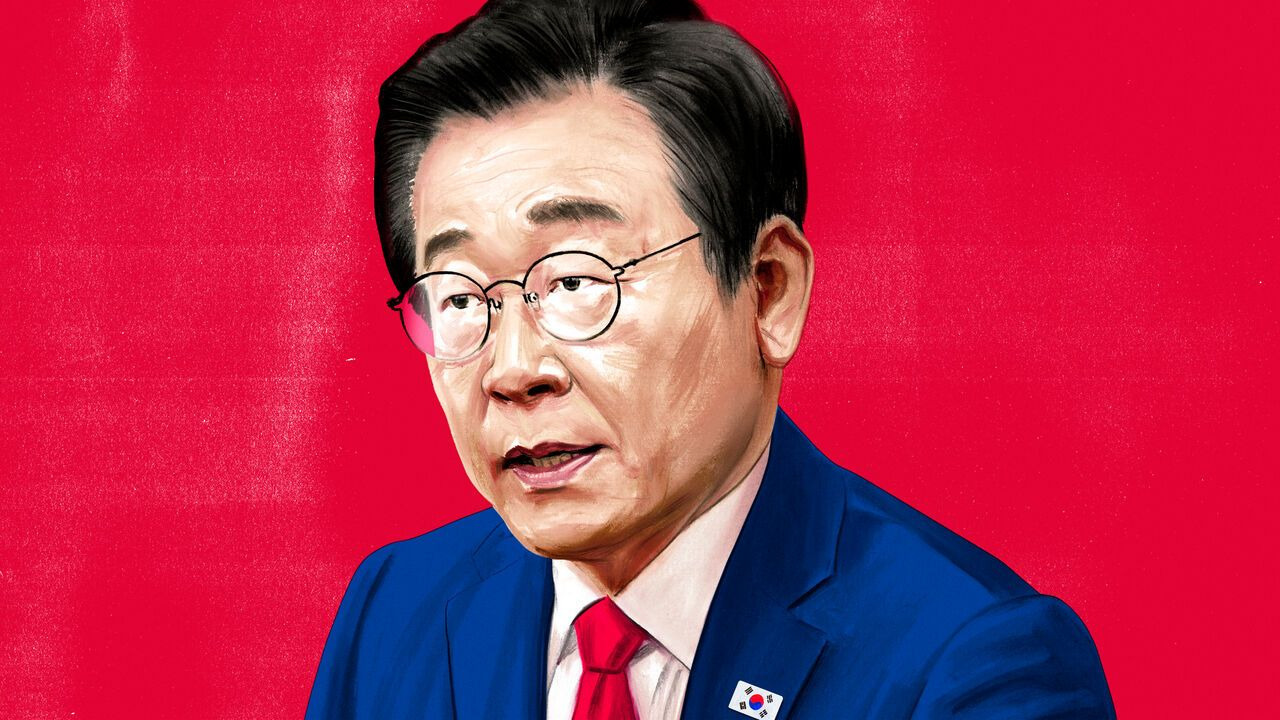
Illustration: Diego Mallo
Jun 10th 2026|SEOUL|6 min read
Listen to this storyAI Narrated
THE TILED roof of the Cheong Wa Dae complex in central Seoul gives the building its colloquial name: the Blue House. Generations of political leaders in South Korea called it home until Yoon Suk Yeol, then the president, decided to move out in 2022, giving a hint of the turbulence to come under his rule. Following Mr Yoon’s declaration of martial law in 2024 and his subsequent impeachment last year, South Korea’s new president, Lee Jae Myung, moved back in, signalling a restoration of normality. In an interview with The Economist in one of the Blue House’s opulent reception halls, Mr Lee projects calm. His country can “move beyond this normalisation of the abnormal” he declares, plausibly. He is less convincing in suggesting it could “develop into a nation that leads the world”.
Mr Lee has reason to be confident. A year after taking office, his approval rating remains around 60%, among the highest for a South Korean president at this stage. Voters give him credit for the political stability. He is fortunate for being in office during a scorching stock market rally. Mr Lee has also managed to deftly steer South Korea’s relations with notable powers, including America, China and Japan. Yet, as Mr Lee looks ahead to the rest of his five-year term, challenges loom.
After Mr Yoon’s declaration of martial law in late 2024, the country cycled through three acting presidents. Mr Lee, as opposition leader, galvanised resistance to the move. In office his lively social-media presence and habit of live-streaming cabinet meetings appeal to voters. It has not hurt that the conservative opposition People Power Party (PPP) remains in thrall to the disgraced ex-president. In local elections on June 3rd, candidates from Mr Lee’s Democratic Party (DP) took 12 of 16 big mayoral and gubernatorial jobs (though the conservative incumbent in Seoul held on).
Somewhat unexpectedly for a left-winger with a background as a labour lawyer, Mr Lee campaigned on a promise to boost capital markets. He called for reforms to corporate governance to help raise the country’s main equity index, the KOSPI, from under 3,000 to 5,000 within his five-year term. Mr Lee was lucky to take office amid an AI gold rush in which South Korean tech giants, such as Samsung and SK Hynix, profit by making memory chips. The KOSPI has nearly tripled over the past year, reaching record highs of over 8,000.
Mr Lee has lived up to his promise of pragmatism in foreign policy as well. Leaders from the DP generally favour engagement with North Korea and warm to China to make that easier to do; they also typically have tetchy relations with Japan, the former colonial overlord. Mr Lee has stabilised relations with China without seeming obsequious. Most consequentially, he has forged a bond with Japan’s right-wing prime minister, Takaichi Sanae, born of a shared understanding that the neighbours must get along in the face of a more assertive China and a less reliable America.
Dealing with the Donald
Relations with Donald Trump could have been awful. Mr Trump has often railed against South Korea as an ungrateful ally. But Mr Lee’s government has pledged to raise defence spending to 3.5% of GDP (from 2.7% last year); it also wants to take greater responsibility within the alliance’s command structure. “When it comes to the defence of our nation, we must take matters into our own hands,” Mr Lee says. Pete Hegseth, America’s secretary of war, now calls South Korea a “model ally”.
Mr Lee entered office amid negotiations over Mr Trump’s “liberation day” tariffs. South Korea struck a deal for tariff relief in exchange for a $350bn investment pledge, with caps on annual outflows to limit the damage to the local economy. Mr Lee also slid several long-standing security goals into the package, gaining the American president’s blessing for South Korea to possess nuclear-powered submarines and to develop the capacity to enrich and reprocess nuclear fuel. He insists it will be used only to enrich to the low levels needed to power atomic reactors, and that it is “not desirable nor realistic” for South Korea to get its own nuclear weapons. Nonetheless, having enrichment facilities will bring it a big step closer to being able to build the bomb, if it ever decides to.
Implementing the deals reached with the mercurial American president is the first big challenge looming over the rest of Mr Lee’s term. Last week American officials visited South Korea to continue talks over nuclear issues. Big gaps still need to be bridged, not least over the question of where the subs will be built. (Mr Trump wants them made in America.) Congress would have to agree to giving South Korea nuclear-enrichment rights.
South Korea’s position would be a good deal less precarious were it not for the nuclear-armed neighbour to its north. Mr Lee, in keeping with DP tradition, has made every effort to reach out. But North Korea, which in recent years has taken to calling South Korea a “hostile state” and is now enjoying the fruits of a new alliance with Russia, has shown no interest in talking to the South. Mr Trump’s “unique personality” can be “very helpful” in the current situation, he says. Kim Jong Un, North Korea’s dictator, says he will meet Mr Trump only if the long-held goal of “denuclearisation” is off the table (see China section). Following the war in Iran, North Korea will be even less inclined to give up its arsenal, Mr Lee notes.
More problems lie ahead at home. While AI-related investment has thus far lifted South Korean equities and Mr Lee’s political fortunes, his standing would suffer if the market dips. Even if the boom continues, it will raise hard questions about how to share newfound wealth equitably. Mr Lee says that the rise of industries generating extraordinary profits may require a rethink of tax and distribution systems, and that using a portion of those excess profits to support consumers’ purchasing power through a basic income could be a useful option. He has also called for more balanced growth among different regions, pushing chipmakers to build supply chains in less developed corners of the country. As part of that agenda, he wants to move part of the presidential administration out of the Blue House and to an administrative centre south of Seoul.
Mr Lee’s own future is also uncertain. He entered office with five trials hanging over his head, related to his earlier spells as a mayor and governor. Mr Lee calls these prosecutions politically motivated. They have been put on hold while he is in office, but seem sure to re-emerge once he leaves. Since the country’s democratisation in the late 1980s, more than half of South Korea’s presidents have been impeached, jailed or both. Mr Lee acknowledges that the possibility of something similar happening to him is “pretty high”. His legacy will thus in part depend on whether he can break the curse of the Blue House. ■
China | A Kim-Xi summit
Nukes were off the agenda as Xi Jinping visited North Korea
China is wary of Russian influence and another Trump-Kim summit
Photograph: Getty Images
Jun 7th 2026|Taipei|6 min read
Listen to this storyAI Narrated
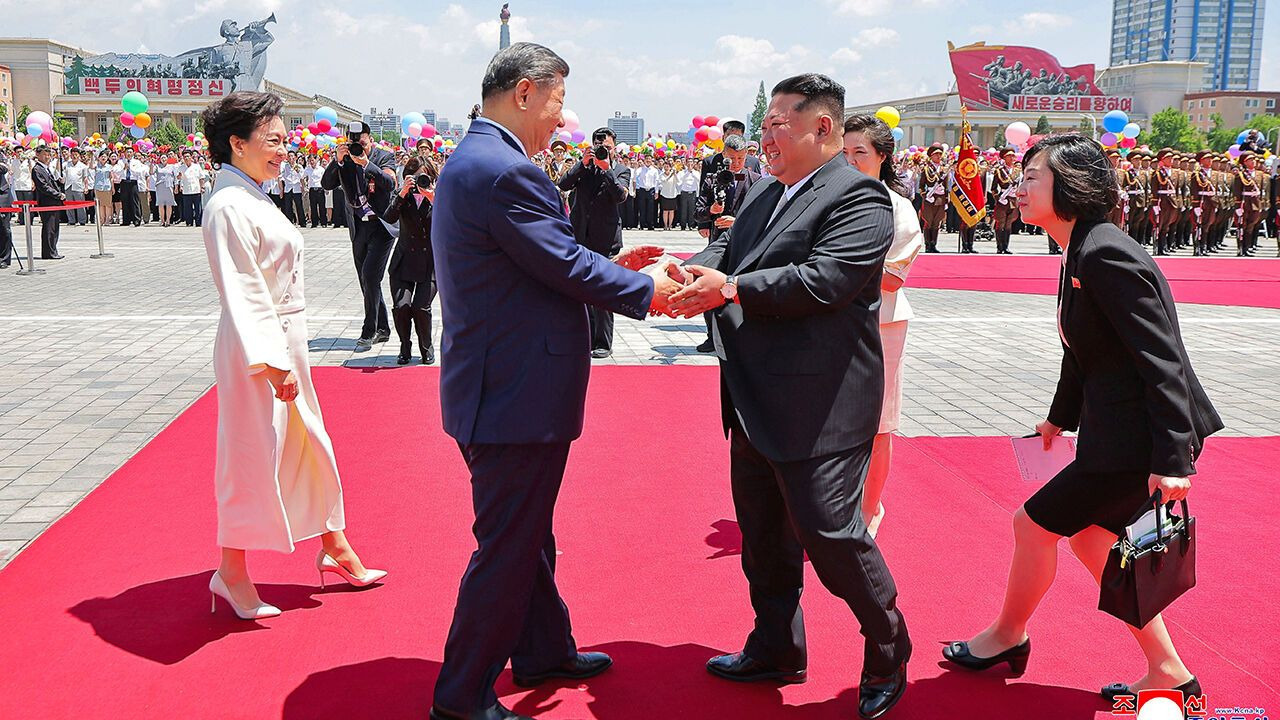
WHEN XI JINPING last visited North Korea, in 2019, international efforts to halt its nuclear-weapons programme were still under way. China and Russia, North Korea’s longtime patrons, had backed stiffer UN sanctions on the country as part of an American-led campaign of “maximum pressure” on its leader, Kim Jong Un. Mr Kim had just held two summits with Donald Trump, then in his first term in the White House. And though the second of those summits ended in failure, Mr Xi expressed hope on his North Korean visit that the process would continue, commending Mr Kim on his supposed efforts to denuclearise the Korean peninsula.
China’s leader harboured no such hopes on his second visit to North Korea, which ended on June 9th. One of his priorities was to counterbalance Russian influence there, which has grown much stronger since Mr Kim sent troops to fight against Ukraine in 2024. Mr Xi also aimed to reassert China’s clout as North Korea’s primary economic partner in case Mr Trump renews his diplomatic outreach to Mr Kim, as many observers expect. Some even speculate that Mr Xi may have been conveying overtures from Mr Trump. But stopping North Korea’s nuclear-weapons programme—which is far more advanced than Iran’s—appears to have fallen off China’s agenda. That could hinder any new American bid to disarm Mr Kim.
Neither China nor North Korea mentioned denuclearisation in their official accounts of the visit. Instead they emphasised the historical ties between the two countries: the pair fought together in the Korean war and then signed a mutual-defence treaty in 1961. Mr Kim said strengthening the relationship was “the most important top-priority strategic work” and pledged to support China’s claim to Taiwan. Mr Xi said they reached an “important consensus”. He called for closer economic and military ties and stronger strategic co-ordination.
Russia’s president, Vladimir Putin, is partly to blame for China’s shifting priorities. In exchange for help tormenting Ukraine, Russia has provided financial and other assistance that has bolstered North Korea’s economy and military build-up. The two countries have signed a new mutual-defence treaty. In addition, Russia has in effect accepted North Korea’s nuclear status. Sergei Lavrov, Russia’s foreign minister, has called it a “closed issue”.
All this unsettles Mr Xi, despite his own support for Russia’s war. Like Mr Putin he has long worried that regime collapse in North Korea could lead to a unified, pro-Western Korea with American troops (of which there are 28,500 in the South) on his eastern borders. Yet Mr Putin does not appear to share Mr Xi’s concern about North Korean aggression against the South, one of China’s big foreign investors and trade partners. Nor, it seems, does Russia worry, as China does, that North Korea’s nuclear threats could help convince Japan and South Korea (both American allies) to acquire their own atomic weapons.
Mr Xi still worries about those risks, according to Chinese experts. But they say he has concluded that China cannot use its leverage to convince Mr Kim to renounce his nuclear programme without risking economic collapse there. And America cannot risk a military strike on North Korea. Since 2019 Mr Kim has not publicly committed to denuclearisation; he has tested more than a dozen intercontinental ballistic missiles; and America’s war against Iran has probably intensified his determination to retain his nuclear arsenal.
On the eve of Mr Xi’s visit, Mr Kim’s powerful sister, Kim Yo Jong, declared that North Korea’s nuclear-armed status is “irreversible”. Experts believe North Korea has 50-60 warheads and South Korean officials reckon it creates enough fissile material for an additional 10-20 annually.
China has not completely abandoned its denuclearisation hopes but faces “extremely severe practical challenges” to achieving that goal, said Niu Xiaoping of the Shanghai Institutes for International Studies, a think-tank affiliated with China’s government, in an interview with the government-linked China Review News Agency. Those challenges include Mr Kim’s rejection of such efforts and South Korea’s continuing debate about developing nuclear weapons or hosting American ones, she said.
China’s tacit acceptance of North Korea’s nuclear status started to become clear last September, when official Chinese readouts of Mr Kim’s meeting with Mr Xi in Beijing did not mention denuclearisation, as they had after previous encounters. When Mr Trump visited China in May, the White House said he and Mr Xi “confirmed their shared goal to denuclearise North Korea”. But China said only that they discussed the Korean peninsula. And when Mr Putin visited Beijing a few days later, a joint statement made no reference to denuclearisation and expressed opposition to sanctions or military pressure on North Korea.
As well as counterbalancing Russia, China hopes to complicate American military planning, says Tong Zhao of the Carnegie Endowment for International Peace in Washington. Mr Xi aims to exploit tensions between South Korea and America, which wants its own forces there to focus more on China, while South Korean forces shoulder more responsibility for the threat from the North. China is also keen to gain access via North Korea to the Sea of Japan, says Mr Zhao. Although China has recently tried to revive its economic links by improving cross-border infrastructure, Mr Kim appears to have been slow-rolling those efforts. Direct flights and train journeys between Beijing and Pyongyang, which were suspended during the pandemic, resumed in March. But North Korea has yet to let Chinese tourists return.
Mr Xi also seems to think he can handle the regional fallout from North Korea’s de facto nuclear status. Chinese experts say that, by tacitly acknowledging it, China is unlikely to upset relations with South Korea. The left-wing government in Seoul supports engaging with Mr Kim (who exhibits no interest in reciprocating), and taking a staged approach to denuclearisation. Some Chinese scholars suggest China could tolerate a nuclear-armed South Korea. That is because China hopes that, if South Korea develops the weapons, they would not be directed at Chinese targets and that South Korea’s alliance with America might weaken. China would be far less tolerant of Japan acquiring atomic arms, but thinks it is less likely because of domestic opposition there.
The big question now is what Mr Trump could offer to bring Mr Kim back to the negotiating table. Since returning to office, America’s president has referred casually to North Korea as a “nuclear power” and said he is willing to meet Mr Kim. His administration’s first National Security Strategy did not mention North Korea and, though its National Defence Strategy did, it made no mention of denuclearisation. But Mr Kim insisted in a speech in September that for talks to resume America must explicitly drop its demand for North Korea to denuclearise.
In his first term, Mr Trump hinted that North Korea’s failure to commit to that goal could prompt American military strikes. Today America is bogged down in the Middle East; North Korea has more than enough nuclear firepower to deter an attack; and with Russia and China back on his side, Mr Kim’s bargaining position has never looked stronger. ■
International | The Telegram
Why strongmen are wrong to loathe Europe
The leaders of America, China and Russia scorn consensual politics. That is a mistake
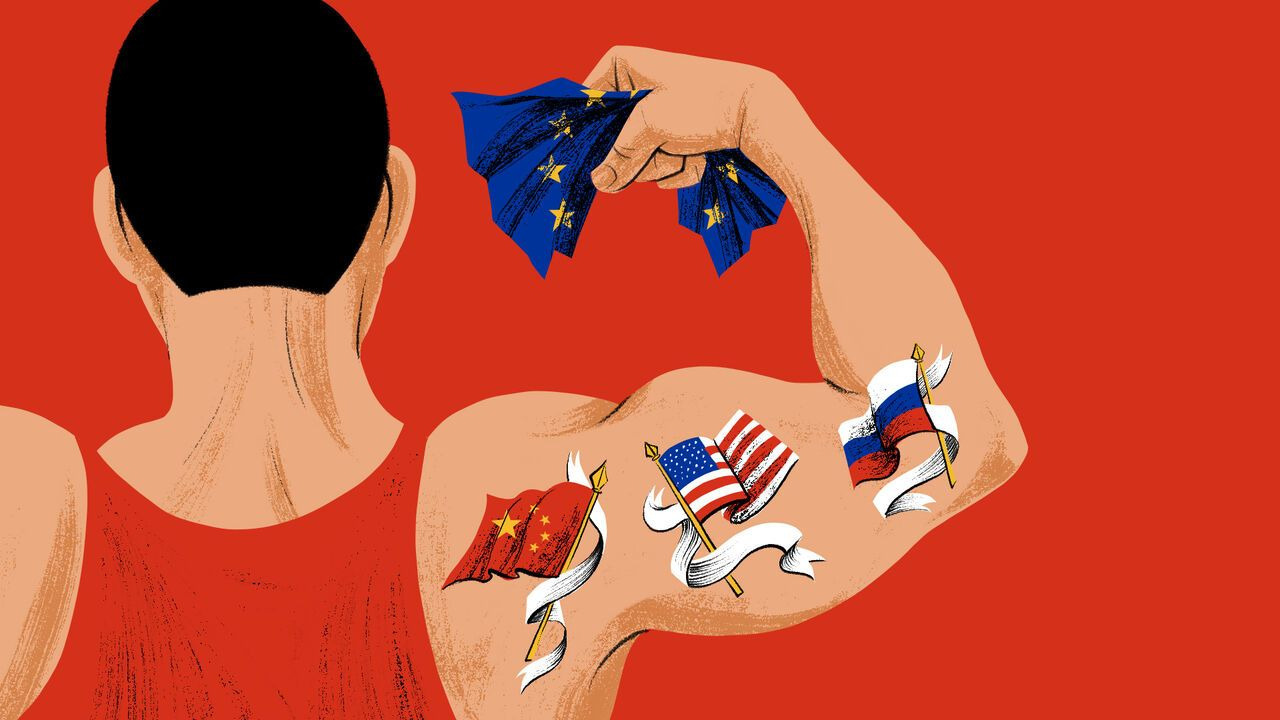
Illustration: Chloe Cushman
Jun 9th 2026|5 min read
Listen to this storyAI Narrated
TO THE HARD men who run America, China and Russia, Europe is soft and thus doomed. The contempt of Presidents Donald Trump, Xi Jinping and Vladimir Putin is broad and deep.
Denouncing people for their ancestry, Trump lieutenants portray the presence of even second-generation migrants as evidence of Europe committing civilisational suicide. The European Union’s need to seek a consensus among 27 countries is used by America, China and Russia to play divide and rule. An EU-China trade conflict looms, as Europeans panic about Chinese exports putting locals out of work. In response, The Telegram hears, Chinese envoys have been urging Europe to learn from America. In the envoys’ telling, Mr Trump hit China with tariffs last year but was punched back, harder. As a result, America now respects China. That refers to China’s threats, in 2025, to curb shipments of vital rare-earth minerals. The implicit message is blunt. China beat Mr Trump. Just who do Europeans think they are?
China is losing patience with European demands to stop its companies supplying Russia’s war machine. Ukrainian drones are also full of Chinese components and China turns a blind eye to that, Chinese officials have told European governments. They prod: How far do you want to push export controls?
Europe’s vulnerabilities were on display at the Stockholm China Forum on June 4th and 5th. A closed-door gathering of political and business leaders, officials and scholars from America, China and Europe (meaning the EU, Britain and a few other Western countries), the forum is co-hosted by Sweden’s foreign ministry and the German Marshall Fund, a think-tank. This columnist has attended the forums since 2008. This was one of the bleakest.
After China successfully intimidated Mr Trump with rare-earth controls, America secured a fragile truce backed by threats of tariffs and chip-export controls. EU markets provide some leverage, but it cannot easily be used, because of economic dependencies on China, and economic and security ties to America.
As the US-China tech contest speeds up, Europe is falling further behind. In Stockholm, Chinese participants called Europeans too “comfortable” to compete. One gave a real-world example: a European executive at a Chinese tech company told his boss that a crushing workload was endangering his marriage. “Oh dear,” said the Chinese boss. “You clearly have the wrong wife.”
Yet amid the gloom, a contrary thought struck this columnist. Just maybe, in this age of radical uncertainty, Europe’s softer, more consensual approach to work and politics may prove useful.
Mr Trump, Mr Xi and Mr Putin see a world shaped by power—and the will to use it. The American and Russian presidents endorse a global order in which “peace” is secured when weaker countries submit to the strong. Both condemn Ukraine for defending itself against Russia’s unprovoked invasion. China is more mealy-mouthed, but when its diplomats accuse the West of provoking and prolonging the war by ignoring Russia’s legitimate security interests, they are using the same logic.
Might-makes-right views of international relations have their equivalent in domestic politics. Countries worldwide are succumbing to the winner-takes-all doctrine of majoritarianism. At first glance, that looks like democracy, as power is wielded in the name of a legitimate, law-abiding majority. But in such systems, minorities and dissenters enjoy few or no rights. The offer to citizens is one of conditional safety, if they stay on the right side of a majority-minority dividing line.
To be sure, America, a fractious but functioning democracy, is vastly freer than China and Russia, both of them tyrannies of the majority. But like Mr Putin and Mr Xi, Mr Trump treats politics as winner-takes-all. To different degrees, each behaves as if the state serves the interests of a single ruling party, demonising opponents as enemies within.
Strongmen boast of earning legitimacy by being efficient and effective. The sheer unpredictability of the future will test that claim. When rulers put their trust in power, rather than in laws and treaties, they are betting on staying strong. Mr Trump, Mr Putin and Mr Xi are all risk-takers, seemingly tempted by dangerous adventures from the Middle East to Europe’s eastern frontiers, or the Taiwan Strait. Nobody can confidently predict the relative strength of America, China and Russia in five or ten years.
Thanks to AI and other disruptive technologies, dividing lines between economic winners and losers are about to move wildly. Nobody knows which industries will vanish or flourish, or what sort of education will make people employable. In such an age, who can be confident of belonging to a “good” majority that plays by the rules, and so deserves to be safe?
Coalition-building, as the world is turned upside down
It is easy to mock Europe, with its unsustainable welfare systems and long holidays. But there was nothing silly about its embrace, after 1945, of consensual, rules-based politics. The continent’s many castles were not recently built by tourism ministries. They testify to centuries in which Europeans settled disputes by fire and sword. History taught Europeans to fear tyrannical majorities. Time and again over the ages, lines moved. Without inalienable legal rights for individuals, belonging to the wrong religion, social class or group spelled sudden ruin, exile or worse.
Europe has problems. But there are scenarios in which its bet on rules pays off. America may elect a president who tries to serve the whole country, and not one political tribe. An America that is open to diverse cultures and views could ally with Europe to counter China’s and Russia’s predatory ways. Hard men may not own the future. Perhaps consensual politics will help keep citizens from panicking. Softness may not spell Europe’s doom just yet.■
Business | Schumpeter
American capitalism is run by millionaires, not billionaires
They hide in plain sight—and wield enormous power
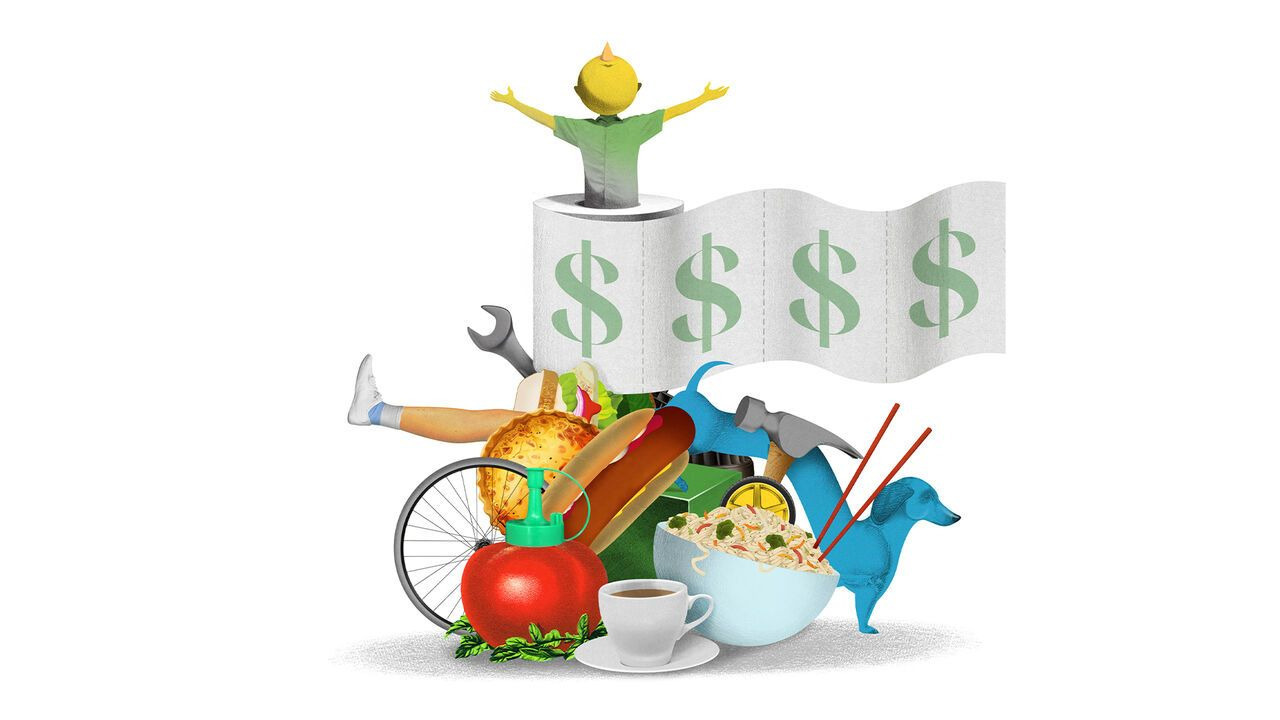
Illustration: Brett Ryder
Jun 10th 2026|5 min read
Listen to this storyAI Narrated
Entrepreneurs in Silicon Valley want to change the world. The ones profiled in “The Everywhere Millionaire”, a forthcoming book by Owen Zidar and Eric Zwick, are different. They find something boring, often catatonically so, then pursue it with star-spangled doggedness until they become rich. A typical character sells gutters in Texas. Another distributes toilet paper in New Jersey. One woman in California began baking quiches for her own parties and simply did not stop. Two decades later she was making more than a million quiches a day and owned a yacht.
The authors are economists in the vein of their subjects. Messrs Zidar and Zwick, of Princeton and Chicago universities respectively, spend their days toiling in the thicket of America’s tax data. Much of their work involves untangling the effect of a 1986 law that cut the top rate of individual tax to below the corporate one. As changes to the tax code are wont to do, this brought about a vast reorganisation of American business. Private corporations were reconstituted as partnerships, sole-proprietorships and other structures which “pass through” profits directly to their owners, who then pay income tax.
These firms receive far less attention than they ought to. Journalists, academics and investors spend most of their time thinking about public companies. Populists direct their anger at a handful of tech executives, because they are the richest and the strangest. Yet for each member of the Forbes 400 list of America’s wealthiest people, the authors find there are more than 4,000 owners of private businesses who are worth at least $10m apiece. The top private business owners are better off than public-company chief executives. A number of the characters in the book are millionaires in the same way Warren Buffett, the paragon of Main Street capitalism, is a millionaire—which is to say they are actually billionaires.
An unavoidable conclusion is that the very rich in some ways have it better than the very, very rich. Happier is the local hero with a bowling alley in his house than the national villain with a rocket on his ranch. Often they travel in the same luxurious style. The authors used private-jet and yacht-ownership records to find the poultry and paper magnates who appear in the book. And plenty own sports teams.
These entrepreneurs benefit from many of the political privileges that titans of tech or finance enjoy, yet manage to avoid public opprobrium. Barrels of newspaper ink have, for instance, been spilled over the political influence of Elon Musk, who may soon become the world’s first trillionaire. Far fewer have been dedicated to explaining why most American states ban or severely limit carmakers, including Tesla, from selling vehicles directly to customers. Almost 10,000 coddled car dealerships, which are represented mightily in Congress, have at least one owner in the top 0.1% of national income. Beer distributors are another protected species of wealthy and anonymous Mr Bigs.
This book will therefore be of great interest to those who think the rich have it rigged. These bosses certainly benefit from some of America’s more egregious tax rules, such as the “stepped-up basis”, which ignores historical capital gains when shares are passed on to heirs. (That said, an earlier paper by the authors and their collaborators found that the widely cited decline in the share of income going to workers rather than capital was less pronounced once pass-through firms were properly accounted for.)
The book will appeal even more to those who hope to join their ranks. The desire to get moderately rich slowly is less remarked upon than the impulse to get rich quick. But for every prediction-market gambler there is a “FIRE” fanatic (financial independence, retire early) salivating over the accumulation of moderate riches. This is especially true at America’s top business schools, where employment through acquisition, which involves buying a small firm of the blue-collar kind rather than getting a job at a white-collar one, has grown in popularity in recent years.
A slightly awkward finding for capitalists hoping to rely on their wits alone is that lawyers—the apex predators of credentialism—earn the largest share of top pass-through incomes. Better news is that much of the private economy is in a state of permanent revolution. Death does the hard work. Messrs Zidar and Zwick found that in the four years after the unexpected death of a millionaire owner, profits at their firm typically fell by four-fifths compared with similar businesses, because it either shrank or went out of business. Disappointing children are a gift to capitalist reinvention. Being exposed to business while young increases the likelihood of being good at making money in adulthood, but many firms learn the hard way that grit is not heritable.
The easiest way to cheat nature is to sell up, and the easiest way to sell up is to a private-equity fund. The private-equity investor is the risk-adjusted cousin of the entrepreneur. He, too, is primarily an American creature, though he bears a diversified portfolio and little of his own money. His role is vital: one man’s extractive villain is another’s exit liquidity. And if things go wrong, as they often do, another entrepreneur can step in.
A billion dollars isn’t cool. You know what’s cool?
Wannabe millionaires leafing through “The Everywhere Millionaire” may sometimes feel like they are preparing for drone warfare by studying the Battle of Waterloo. One tale of industrial espionage involves a hot-dog tycoon checking a rival’s relish before being booted out of the kitchen. A row of pale cheerleaders’ legs inspires a strategic pivot from selling sun beds to waxes. All this might look parochial compared with the civilisational struggles under way in Silicon Valley. Yet that is exactly the point. Much of the spoils of capitalism are still won by those who roll their sleeves up. That is a great thing. ■
Business | Bartleby
Too many people are shockingly bad at prioritisation
Choosing where to focus is among the most important skills
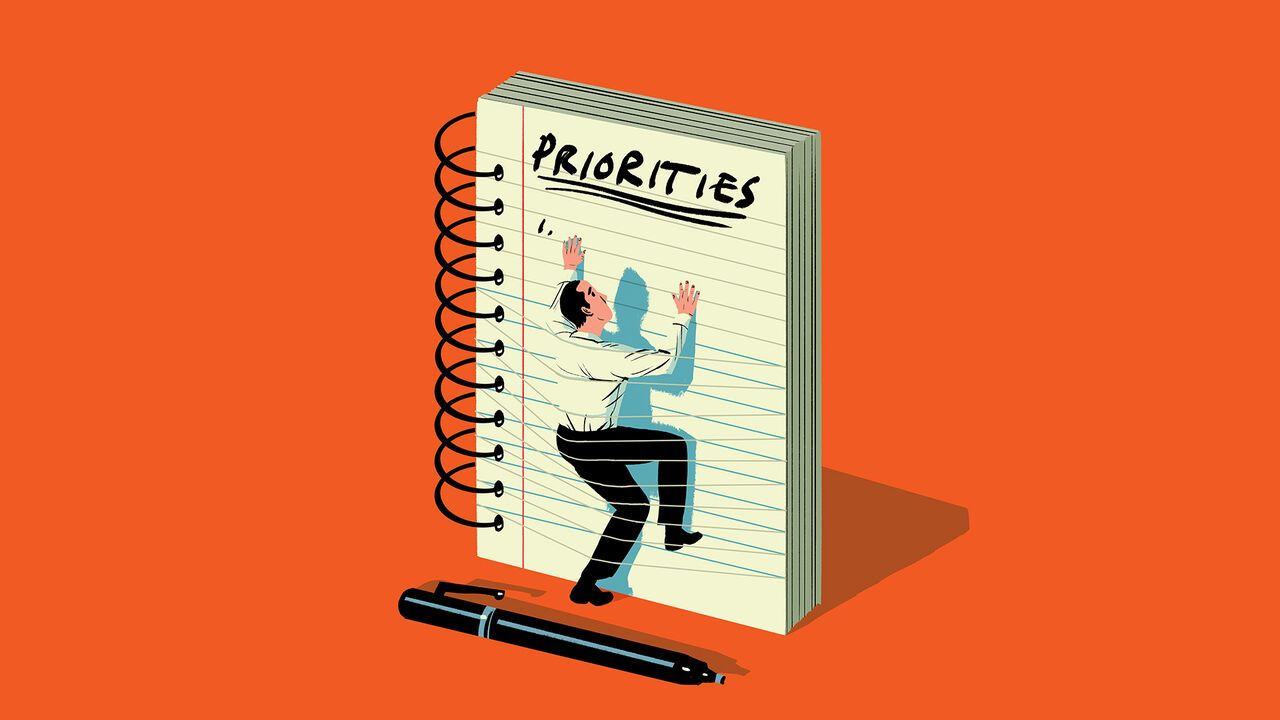
Illustration: Paul Blow
Jun 11th 2026|4 min read
Listen to this storyAI Narrated
Work is a series of decisions about what to prioritise. Occasionally, events set the agenda: when the covid-19 pandemic shut down the world in 2020, for example, it was pretty obvious which problems firms had to focus on. But normally managers must weigh up for themselves how to allocate capital, decide which initiatives to concentrate on and work out which numbers matter most. Product teams have to choose which features to work on first. Sales teams must decide which customers to focus on. And day by day, hour by hour, individuals have to work out how to spend their next chunk of time.
It’s a shame, then, that people are often very bad at setting priorities. Individuals seem to be so motivated by achieving goals of any kind that they find it hard to abandon them. In one lab experiment, Timothy Ballard of the University of Queensland and his co-authors asked participants to pursue two competing goals, and varied the monetary rewards on offer. Even in cases where the reward for achieving one goal was the same as achieving both (and pursuing both made it more likely that neither would be attained), participants tried to get both done.
When people have to make a choice about what to do next, they often pick the thing that seems achievable, even if that is not in their interests. A paper by Moty Amar of the Ono Academic College and his co-authors found that indebted consumers prioritised paying off small debts ahead of larger debts with higher interest rates. A tangible sense of progress was more important to them than the rational choice.
This kind of behaviour is observable in offices, too. Being the 400th person to review a document adds nothing of value, but at least you can go home with some sort of achievement to your name.
Organisations, or rather the people who run them, are not necessarily much better. Some bosses regard everything they ask for as a priority; even if they don’t, their employees may behave as though nothing matters more. Many firms accumulate so many priorities that they suffer the “peanut-butter problem” of attention and resources being spread too thinly across all of them. When Niels Christiansen, chief executive of Lego, took charge of the toymaker, he found lots of examples of this. “We had 100 key enterprise risks. How can you look after 100 different risks without being risk-averse on everything you do?”
All sorts of frameworks exist to enable better prioritisation. The Eisenhower matrix is a classic time-management technique for individuals, which involves categorising tasks into quadrants. An urgent and important task belongs at the top of the queue. An important and non-urgent task is the sort that you need to make time for. If you are doing non-urgent and unimportant tasks, you need to take a long hard look in the mirror.
The action-priority matrix is another way of dividing tasks into quadrants, this time based on impact and effort. Product teams often use a scoring model called RICE (reach, impact, confidence and effort). MoSCoW is a framework for teams to distinguish between must-have, should-have, could-have and won’t-have features. Google pioneered the 70:20:10 rule for how to allocate resources to innovation: 70% on the core business, 20% on adjacent activities and 10% on totally new ideas. (If the thought of choosing which prioritisation framework to prioritise paralyses you, just choose one at random.)
Establishing what matters is not enough, however. If you are setting priorities for a team, you then need to communicate them properly. In 2017 Donald Sull of the Massachusetts Institute of Technology and his co-authors asked senior executives at 124 organisations to recite their company’s strategic priorities. They found that in the typical company, only about half of its leaders agreed on what these were.
When you prioritise a new thing, you also need to deprioritise an existing one. In their book “The Octopus Organisation”, Phil Le-Brun and Jana Werner, two Amazon executives, recommend having explicit rules for cancelling initiatives. They give the example of projects that have explicit “go/kill” decision points, and of software projects with “kill criteria” like team attrition rates or time commitments that exceed a certain threshold. The language is excessively martial, but the sentiment is absolutely right. Effective prioritisation means choosing, communicating and stopping. Henceforth to be known as CaraCaS. ■
Business | Rich pickings
The world’s wealthy are migrating like never before
A booming industry of advisers is easing their passage
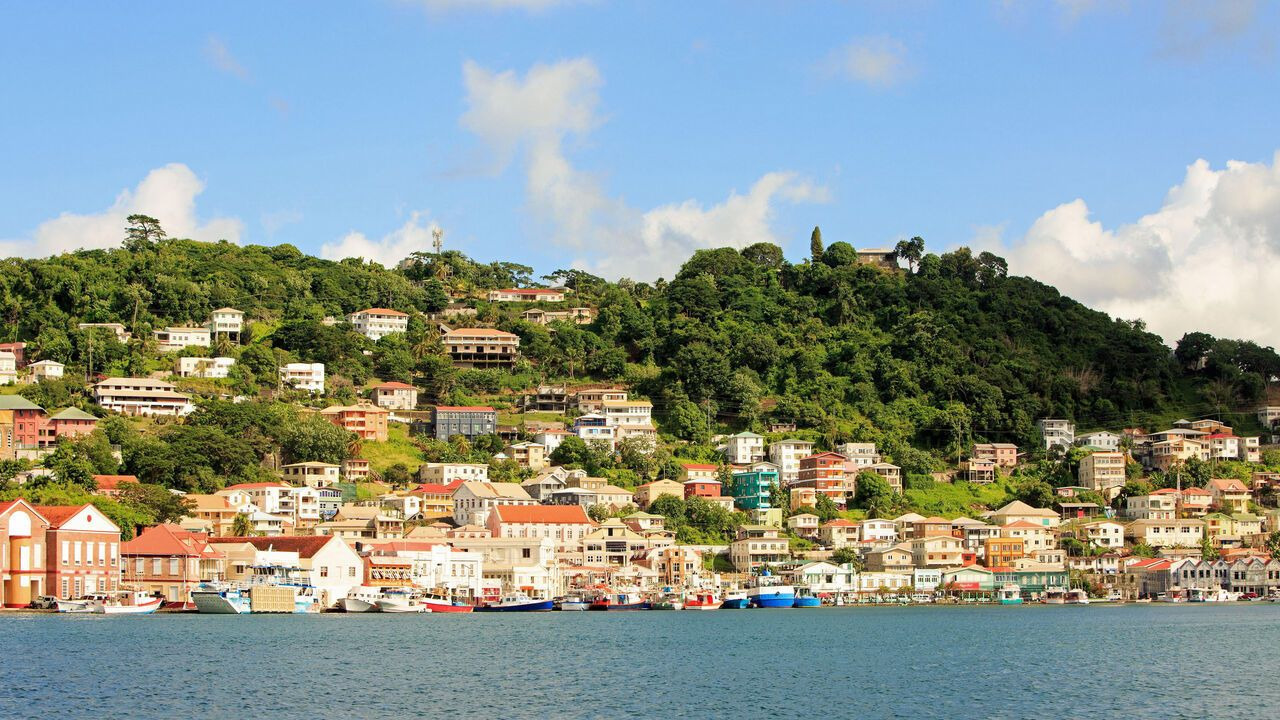
Photograph: Alamy
Jun 11th 2026|Dubai|4 min read
Listen to this storyAI Narrated
THESE ARE unsettling times, even for the rich. Many of those wealthy enough to move abroad for low taxes or their physical or political security are less sure these days about settling in Dubai or Hong Kong, even America or Britain. Dry your eyes, however, for plenty of governments remain eager to take in foreigners with money and skills. And a growing industry of trusted advisers stands ready to help the rich relocate.
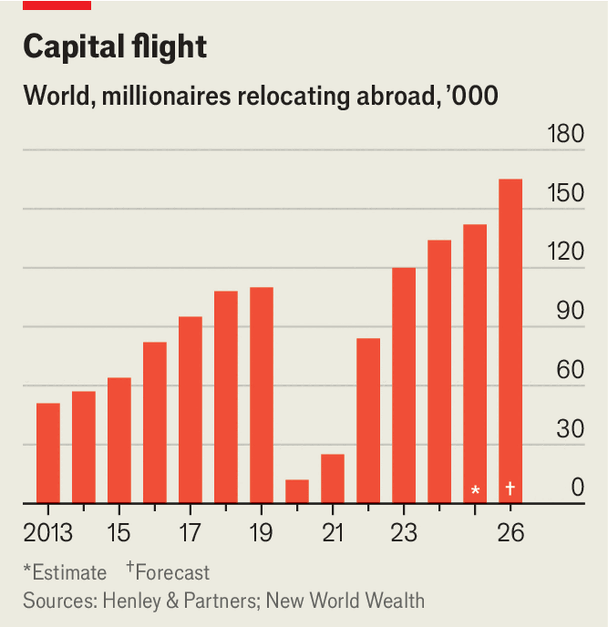
Chart: The Economist
For these consiglieri, business is booming. Last year more than 140,000 millionaires migrated, the most on record, reckons New World Wealth, a research firm; this year it expects the figure to rise to 165,000 (see chart). IMI, another research outfit, estimates that the investment-migration industry—which advises both rich would-be expatriates and governments seeking investment and talent—turned over $40bn in 2025, twice as much as in 2019. IMI counts more than 1,200 companies providing investment-migration services. They include law firms, providers of property or investment funds linked to citizenship or residency, accountants and so on.
Until Iran struck the Gulf states, a favoured destination was Dubai, home to a fast-growing number of millionaires. One immigration lawyer describes the emirate as the Walmart of the industry, with countless providers and fiercely competitive rates. It has chiefly attracted rich people from the global south: south Asia, but also Nigeria and war-torn Syria and Lebanon.
Industry folk now report growing interest in migration among well-off Westerners. Many rich Britons started looking for options after the pandemic. In 2025 they applied to 23 investment-migration programmes run by foreign governments, including America’s EB-5 scheme and programmes in Grenada and Thailand. Elsewhere in Europe, concern about wealth taxes is a prompt. Henley & Partners, a consultancy, publishes an annual list of the top countries millionaires are fleeing from and heading to. Last year France, Germany and Spain appeared for the first time among the countries that repelled more wealthy inhabitants than they attracted.
But the biggest shift is in America—home to more than a third of the world’s people worth $30m or more, according to Knight Frank, a property firm. “The US has gone from a blip to the primary market,” says Ronald Klasko, a lawyer in Philadelphia. In 2024, having spotted that more Americans were seeking advice about foreign citizenship and residency, he set up Exodus Migration, an investment-migration consultancy. He says that most clients are interested in moving to Europe, because they are concerned about America’s political direction, want an alternative residency or want to be able to travel without an American passport.
Despite such misgivings, and the fact that America bans some countries’ citizens, it still attracts many rich foreigners. Demand for the EB-5 programme, which requires investment of at least $800,000 in the country, is high—though that may be because the threshold is due to rise to around $900,000 at the start of next year. (Lawyers report “very little demand” for Donald Trump’s “Gold Card” visa, which is priced at $1m per family member and has an uncertain legal foundation.)
Many other places are eager to get in on the act. St Vincent and the Grenadines, in the Caribbean, announced in December that it was opening a citizenship-by-investment programme it called a “critical economic pillar”. Uzbekistan, the Maldives and Nauru have all asked Henley to design and develop schemes.
Yet the wealthy can find that a warm welcome sometimes goes cold. In January 2025 Spain, once a popular destination, cancelled its €500,000 ($577,000) residency programme in an effort to curb property speculation. In April the European Union’s Court of Justice ruled that Malta’s scheme broke EU law because it “commercialised” citizenship (though the island’s “citizenship-by-merit” programme, which admits entrepreneurs, has since gained traction). In April this year Argentina cancelled a tender to set up an investment-migration programme, issued only in December, which had drawn interest from 11 firms. Last month Portugal extended most migrants’ waiting time for passports from five years to ten.
Many governments are facing pressure to increase the diligence of their citizenship and residency programmes, notes Mr Klasko. The big issue is: “Do you as a country know the background of people who you are giving passports to?” In other words, geopolitical uncertainty does not only trouble the rich. But plenty of countries will take them—and plenty of advisers are eager to help them choose. ■
Finance & economics | Buttonwood
Wall Street’s undignified SpaceX mania
Is that a rocket in your lobby, or are you just happy to see me?
Illustration: Satoshi Kambayashi
Jun 9th 2026|4 min read
Listen to this storyAI Narrated
“THE ICK”, a term popularised by Gen-Z daters, refers to the loss of romantic interest after a trifling but embarrassing behaviour by a crush. Admirers of American high finance may be feeling it. Ahead of the initial public offering (IPO) of SpaceX, scheduled for June 12th, Wall Street looks desperate trying to woo Elon Musk, the rocketry firm’s boss and the world’s first soon-to-be trillionaire. Fidelity, an asset manager, has lowered its minimum account balance for small investors to participate in the listing from $100,000-500,000 to $2,000. Nasdaq and FTSE Russell will fast-track SpaceX into their popular stock-market indices.
Few people are abasing themselves more than America’s investment bankers. Decorative spacecraft and banners fill the lobbies of Goldman Sachs and Morgan Stanley. The spire of Bank of America’s midtown headquarters has been lit up in the image of a rocket in lift-off. The boss of JPMorgan Chase, who once feuded with SpaceX’s hot-headed CEO, has hosted him for a chummy interview in front of wealthy clients.
If that feels icky, what the bankers are telling investors about SpaceX’s business is cringe. Goldman Sachs is said to expect revenue from SpaceX’s xAI division, today an also-ran in the artificial-intelligence race, to surge from $3bn in 2025 to $322bn in 2030. Morgan Stanley apparently thinks that by 2040 SpaceX could be raking in $3.4trn in sales and $2.7trn in operating profit (before depreciation and amortisation), respectively up from $19bn and $7bn last year.
Sycophancy seems a small price to pay for fat fees. SpaceX reportedly aims to offer advisers perhaps 0.75% of the deal’s proceeds. If it sells $75bn in stock at a valuation of $1.8trn, this will net its bookrunners over $500m. That is equal to more than 20% of all such proceeds American banks earned last year. Anthropic and OpenAI, the two leading AI labs which have just filed paperwork for similarly sized listings, can expect similar flattery.
The bankers’ fees are a pittance, though, compared with the size of the deals. Giant listings generally command lower fees than the long-term average of 7% for all IPOs. Still, anything less than 1% is puny. When Goldman Sachs agreed to a 0.75% fee for relisting General Motors in 2010, this was seen as a favour to the American government, which was ridding itself of the carmaker after a bail-out.
Worse, SpaceX has neutered its bankers by reserving up to 30% of the offering for retail investors and setting its own take-it-or-leave-it price of $135 per share. This reduces the advisers’ discretion in handing out shares and turns them from power-brokers to utility providers. Who wants to date one of those?
This is quite a change from past IPO waves, when bankers were the masters of the universe. This let them flagrantly underprice IPOs, allowing their handpicked buyers to benefit from the first-day pop in the value of the shares. The average pop since 1980 has been 19%. In 1999, at the height of the last tech boom comparable to today’s AI-fuelled one, it reached a record 71%. Issuers had no choice but to lump it. Despite the Chinese walls between the banks’ rainmakers and analysts, on Wall Street a cheap IPO was often seen as a way to buy bullish coverage (and for issuers’ executives to secure early access to other underpriced listings).
The investment banks maintain their tight grip on IPOs. Alternatives such as selling shares directly to buyers without an underwriter have proved messy. After Coinbase, a cryptocurrency exchange, went public that way in 2021, its shares traded choppily and no similar large “direct listings” have occurred since then. But, as their treatment of SpaceX shows, today it is increasingly Wall Street that has to lump it. Companies stay private far longer than they once did, denying banks advisory fees and gatekeeping power. Whizzy trading firms chew away at their marketmaking revenues. Private-credit behemoths eat into business lending.
If SpaceX’s debut flops—one research firm’s analysis of SpaceX’s discounted future cashflows arrives at half its target valuation—the investment banks will face scrutiny, despite their limited control of the process. Yet even a success will leave them something to think about—and not just because of the icky monuments to Anthropic and OpenAI that will soon loom in lobbies like the Colossus of Rhodes. They will have surrendered control and shown themselves to be less important than they thought. “The ick” is putting it mildly.■
Finance & economics | Free Exchange
A guide to redistributing AI wealth
From Trump to Sam Altman, the idea is catching on. Does it make sense?
Illustration: Álvaro Bernis
Jun 11th 2026|5 min read
Listen to this storyAI Narrated
THE artificial-intelligence boom has minted vast fortunes. Jensen Huang’s stake of nearly 4% in Nvidia, the chipmaker he co-founded in 1993, is worth $175bn, up 50-fold in seven years. Anthropic’s latest funding round, which valued the AI lab at nearly $1trn, more than doubled the estimated wealth of its boss, Dario Amodei. Yet as new plutocrats gain riches, most Americans doubt the gains from AI will be widely shared. Less than one in three think the technology will make ordinary people richer.
Populists on left and right are scrambling for an answer. On June 5th Donald Trump appeared to endorse a proposal, championed by Sam Altman of OpenAI, under which AI firms would voluntarily contribute equity to a public wealth fund, with the returns eventually flowing to households. “It almost becomes a partnership with the American public,” Mr Trump declared. “It would make ’em rich.” Bernie Sanders, a leftie senator, wants a one-off 50% tax on AI firms’ value, paid in stock, to give Americans a “direct ownership stake”. Mr Amodei has floated the idea of “universal capital accounts”. These proposals reflect a growing belief that if AI generates extraordinary wealth, the public should share in it.
Beneath the populist packaging lies a serious idea. Wealth in America is already concentrated: the top 1% own nearly a third of it and the bottom half just 2.5%. If AI substantially raises the returns to capital relative to labour, that divide could widen; superintelligence, if it materialises, could make much human labour obsolete, leaving the gains to whoever owns the machines. In such a future, giving the public a stake starts to look prudent.
In one sense, citizens already have a claim on AI success. Governments tax corporate profits, which is an efficient way of sharing in firms’ upside without picking winners or exposing taxpayers to losses. The case for AI wealth funds is therefore in part political. Direct ownership stakes make the gains from AI more visible, while providing insurance against a future in which a handful of firms capture an ever-larger share of economic activity.
Still, pursuing that goal raises practical questions. The first is how the assets get into public hands. Mr Altman has proposed voluntary donations, but the mechanics are tricky. Newly issued shares would dilute existing investors—including, in OpenAI’s case, Microsoft—who may object; Mr Altman himself owns no equity in his firm, so he has no founder stake to donate. As the AI labs prepare to go public, such dilution would soon hit pension funds and retail investors, too. Voluntary schemes can be meaningful or painless, not both. If governments buy stakes directly, that would put taxpayers on the hook for loss-making firms at frothy valuations. Mr Sanders’s approach—forcing firms to transfer equity—would raise more money but would be hard to distinguish from expropriation, inviting legal battles and chilling investment by reducing the expected rewards of future success.
The next question is how much the schemes would raise. Suppose OpenAI and Anthropic each gave 3% of their equity, the midpoint of the 1-5% range discussed by industry advocates. At current valuations, that would seed a fund of $55bn or so. If the stake earned a healthy 10% a year, the fund would grow to $140bn or so after a decade. Paying out 4% annually, a rule of thumb for preserving a fund in perpetuity, would amount to $20 a year per American annually. To be sure, the point of such schemes is that AI may prove anything but ordinary. Yet even if it does change everything, the firms’ combined value rises ten- or 20-fold and the state picks the right winners, Americans would get a yearly payout of a few hundred dollars. This is not enough to make anyone rich.
Since it is anyway unclear where AI’s rents will ultimately accrue, this argues for looking across the industry. An annual levy of 0.2% of market value, along the lines proposed by some advocates of a broad wealth tax, could raise roughly $40bn a year at the current valuations of AI labs, chipmakers and cloud providers. But deciding what counts as an AI firm—and how much of Amazon, Google or SpaceX does—would be contentious. And the resulting dividend would still be at best a few hundred dollars per American annually. A nice bung—but well short of a universal basic income or meaningful insurance against widespread job displacement.
Disbursing the proceeds involves more choices. One model is Norway’s oil fund, whose returns help fund public services. Another is Alaska’s Permanent Fund, which invests the state’s resource revenues on behalf of residents and pays them annual dividends (similar to what OpenAI and Anthropic have proposed and we assumed in our calculations above). A third is something akin to the “Trump accounts” the president has proposed for American tots. These would be seeded by the state, compound over time and be used to fund college or a pension, say. The left may prefer the Norwegian way. Mr Trump would favour one of the other two.
Command-Shift-Control
Public ownership carries risks. It blurs the line between regulator and shareholder. Politicians may be unwilling to pursue antitrust action or impose costly safety rules on publicly owned firms, and happy to prop up stumbling ones (and their valuations). This may entrench incumbents and weaken competition. AI rents may also flow somewhere unexpected: electricity transformed society, but a wealth fund built around electric utilities would be a dud.
The best way to minimise such downsides may be a public wealth fund invested in a broad equity index. The capital could come from taxes on AI profits or mandatory equity contributions from across the AI economy—which, if the optimists are right, may one day mean most business. Even extraordinary returns would still probably translate into a modest dividend, arriving years from now. The harder questions—how to tax AI, how to regulate it and how to support displaced workers—would remain.■
Science & technology | Well Informed
The chemicals that reduce wrinkles
Vitamins, applied properly, can partially reverse the effects of ageing
Illustration: Cristina Spanò
Jun 5th 2026|3 min read
Listen to this storyAI Narrated
ABIOCHEMISTRY textbook sometimes feels like essential reading when shopping for wrinkle-reducing products. Their labels list molecules like retinoids, antioxidants, peptides and exfoliating acids. The names might be familiar, but does anyone know what they do? Many of the claims that they will make skin appear more youthful rely on company-funded studies or consumer surveys rather than rigorous clinical evidence. Yet a handful of ingredients do have a solid scientific backing.
Older-looking skin comes about via two distinct processes: the passage of time and environmental damage caused by ultraviolet (UV) light, pollution and smoking. All of these harm the collagen and elastin fibres in the extracellular matrix, the skin’s structural scaffolding, causing wrinkles and sagging. Around 80% of ageing in white skin is caused by UV exposure, according to Abigail Langton, a dermatology researcher at the University of Manchester—the melanin in darker skin provides some degree of protection.
If your wrinkles worry you, then the ingredient with the strongest scientific backing that might help is tretinoin, also known as all-trans retinoic acid. A derivative of vitamin A, it was originally developed as a treatment for acne, but in the mid-1980s dermatologists noticed that patients who used it had fewer wrinkles as well as fewer spots. Studies of skin biopsies, as well as non-invasive skin imaging, revealed that tretinoin thickens the epidermis, the skin’s outer layer, making it look smoother and improving fine lines. It also stimulates collagen production in the dermis, the layer that sits just under the epidermis. This seems to partly restore the extracellular matrix and reduce wrinkles.
Tretinoin is generally only available on prescription and it can irritate the skin. Milder retinoids—molecules derived from vitamin A—such as retinol and retinal, are used in over-the-counter creams and serums. Once they are absorbed by the skin, these chemicals are converted into tretinoin. Pricier formulations often contain those derivatives that convert more easily or are more stable. Although over-the-counter retinoids are less aggressive, it is still sensible to start with a lower concentration (those as low as 0.04% can be effective) and work up to avoid irritation.
There is also support for the anti-ageing effects of certain antioxidants, chiefly vitamin C (ascorbic acid). This plays an important role in collagen production, and there is evidence it can reduce wrinkles and hyperpigmentation. The downside is that it is unstable and can break down quickly if products are not formulated or stored correctly. An expensive cream can become ineffective if it is left lying around for too long.
Peptides, another common ingredient, are short chains of amino acids. Some encourage the production of extracellular matrix proteins, others prevent their breakdown and some relax the face muscles, in a manner similar to botox. The scientific studies used by cosmetics companies to claim anti-wrinkle benefits are, however, typically conducted or funded by those same companies.
All these ingredients can be, and are, combined in different ways. And they need time to work: dermatologists recommend sticking with the same regimen for several months before judging the results and making any tweaks. But though these ingredients may partly reverse the signs of ageing, prevention is more effective. Nothing beats protecting yourself against the sun.■
Culture | To high heaven?
Saint or sinner: Antoni Gaudí’s polarising style
A hundred years after his death, the Spanish architect is both loved and reviled
Photograph: Getty Images
Jun 9th 2026|Barcelona|4 min read
Listen to this storyAI Narrated
With its cluster of 18 honeycombed, tapering towers, the basilica of the Sagrada Família (Holy Family) dominates Barcelona’s skyline. For some, it is a work of genius, a modern reincarnation of the great medieval cathedrals of Europe. For others it is a gigantic folly. But no one can doubt that it has become a global icon. Last year it attracted almost 5m people, making it one of the most visited churches in the world, alongside St Peter’s Basilica in the Vatican and Notre Dame in Paris.
After almost 150 years of construction, in February builders finished installing a white 17-metre-high ceramic cross on top of the central tower. With that, it became the tallest church in the world, overtaking Ulm Minster in Germany. Finishing a remaining façade may take another ten years. But on June 10th Pope Leo XIV celebrated a mass at the basilica to bless its near-completion and to mark the centenary of the death of Antoni Gaudí, the architect who created it.
Photograph: Getty Images
To the outside world, Gaudí has become almost synonymous with Barcelona. As well as the Sagrada Família, his output included six mansions and Parc Güell, which overlooks the city. Most were built for the Catalan bourgeoisie as they grew rich from industrialisation in the late 19th century. His clients liked, or at least tolerated, the architect’s boundless decorative imagination and eclecticism.
Gaudí was both reactionary and revolutionary. He was born to a family of coppersmiths in the lowlands of Catalonia. His rural childhood and the family vocation gave him both an organic decorative template and a liking for manual work. Gaudí observed that there were “neither 90-degree angles nor straight lines in nature”, writes Peter Stanford, a journalist, in a new biography, “God’s Architect”. He preferred curves in his buildings, as well as representations of plants and animals. His tomb, in the crypt of the Sagrada Família, describes him as “an extraordinary craftsman”. He was also a self-taught engineer. The director of Barcelona’s architecture school mused that he would “either be a madman or a genius”. He was both.
His buildings were highly original and technically innovative. The exterior of the Batlló mansion on Paseig de Gràcia, Barcelona’s grandest thoroughfare, features windows like eye sockets, framed by bones carved in stone. A roof for Gaudí was a creative field, with chimneys like helmeted sentinels. His favourite forms included hyperbolic paraboloids (a saddle shape) and helicoids (spirals).

Photograph: eyevine
At the Sagrada Família, he rejected external buttresses and supporting columns in the nave. To spread the weight of the roof, he designed walls to resemble trees and used hanging chains of stone, notes Mauricio Cortés, one of the team of architects still working on the building today. He persuaded local people to pose as models for the biblical figures on the façade.
Gaudí’s deepest influences were Catholicism and Catalan nationalism. He looked back to Catalan Gothic, a particularly elegant variant of the medieval style, though he also incorporated Baroque, Orientalist and Moorish flourishes. He saw his work as an expression of his faith. In the 1890s, as the church waged a culture war against anticlerical anarchism, Gaudí joined an artistic group whose mentor was an arch-reactionary bishop. He gave up commercial work to dedicate the last 12 years of his life to the Sagrada Família.

Photograph: Panos Pictures
In 1926, on his regular evening stroll to see his confessor, he was hit by a tram. Taken for a tramp, he was moved to a hospital for the poor, where he died three days later. Some 10,000 people attended his funeral. But for decades the Sagrada Família was little loved. In 1936, at the start of the Spanish civil war, an anarchist militia smashed the elaborate models that Gaudí had left and looted his archive of drawings. George Orwell, who was in Barcelona during the civil war, called the Sagrada Família “one of the most hideous buildings in the world”, adding that “the anarchists showed bad taste in not blowing it up when they had the chance.”
Several things would save it. The Surrealists championed Gaudí’s legacy—though he had rejected the idea that his work was based on dreams. The drug-soaked counterculture of the 1960s saw in him the architect of an acid trip. Japanese tourists saw pantheism. In the 1980s the money at last started pouring in, and construction speeded up (it is financed almost entirely from entrance fees paid by tourists).
Because of his technical prowess, Gaudí is also an architect’s architect. He was admired by Le Corbusier for his mastery of structure and stone. Unlike the works of some recent starchitects, his buildings have not suffered structural weakness, notes Mr Stanford. His influence can be seen in Frank Gehry and Zaha Hadid.
Yet Gaudí’s aesthetic remains divisive. Many who study his church and homes think his style is pure kitsch—though it is hardly his fault if Disneyland copied him. For others he remains refreshingly iconoclastic. He had a sublime sense of colour. Walk into the Sagrada Família, and you will be soothed by the gentle light reflected through the coloured glass windows, just as in a medieval cathedral. Last year Pope Francis declared Gaudí “venerable” and put him on the path to sainthood. Listen carefully in the nave, and you can almost hear Orwell’s groan. ■
Obituary | Veil and beard and nuclear weapon
Marjane Satrapi set out to correct the West’s views of Iran
The author of “Persepolis”, an international sensation, died on June 4th, aged 56

Photograph: 2.4.7. Films/Kobal/Shutterstock
Jun 11th 2026|5 min read
Listen to this storyAI Narrated
When it happened, she was ten. Her face stared out separately from a line of grim little girls, all wearing black veils. She didn’t see why she had to; no one had explained. In the playground the veils came off (too hot anyway) to make strangler scarves and skipping ropes. On that first page of “Persepolis”, Marjane Satrapi’s graphic novel of 2000, it was already clear that Marji, her child-self, would not be told what to wear or how to behave. She knew who she was: the last Prophet, born to bring celestial light. She had already written her own book of Rules (Rule 6: Everybody should have a car). Iran’s Islamic Revolution in 1979 forced her to look demure, and she was outraged.
It was so hard to fit in. Her bright, bourgeois parents were Marxists; her head was filled early with dialectic materialism, which she read about in bed. Teachers and preachers held no terror for her, nor any heavy-bearded official who would not look a woman in the eye. Speaking her mind got her expelled from school and into trouble with the regime’s morality police. But why shouldn’t she walk out in the tight jeans and denim jacket her parents had bought for her, or in lipstick, with a bit of hair showing? Why shouldn’t she politicise the maid by taking her along to protests? And what was wrong with going out at night to buy Iron Maiden tapes from the men with suitcases on Gandhi Avenue?
In mullah-ruled Iran she lived two lives, but so did many people. In public, men grew beards and removed their ties. Women went black-robed all over. Everyone recited the same politico-religious nonsense, especially during the war with Iraq, when the martyrs (their bodies dissolving into ghosts, with the golden keys to paradise swinging round their necks) were honoured with twice-daily breast-beatings. In private, certainly in the houses of her parents and their neighbours, there could be riotous drinking and dancing; her father once had to distract the police while she and her grandmother, in panic and quickly back in their chadors, emptied all the alcohol down the loo.
Her double life continued after she left Iran for Austria, at 14, to continue her education. But there the hypocrisy was reversed. As she grew she lived a free, wild European life, doing drugs, being punk and sleeping around, but inside she was ashamed. Assimilation meant betrayal; by 19, she needed to go back to Iran. Putting on her veil again, she thought: “So much for my individual and social liberties,” with a face as sad as when she had tied it first.
Words were hardly necessary. Her expression said it all. Throughout the two parts of “Persepolis” her face dominated the pages, sulky or scared, angry or exploding with laughter, rippling like a puddle as she tripped on drugs. In the simplest drawings, with the tiniest nicks of her pen, the most complex emotions could come through. Drawing nailed them, when writing was too hard; it was, after all, the first language of humans. She preferred her books to be called “comic”, not “graphic”, and she had fun, but the modern history of Iran kept tipping towards the dark. At the most harrowing moment of the first volume, when she found her Jewish friend Neda’s bracelet (“still attached to...I don’t know what...”) in a house just destroyed by an Iraqi missile, the final panel was plain black. No scream; no drawing either. Nothing.
Photograph: Getty Images
From time to time her interest shifted. After the success of “Persepolis”, including an animated film in 2007 that won her an Oscar nomination, she tried directing films for a time. She went back to drawing, though, in 2024, when she collaborated with 17 artists to produce “Woman, Life, Freedom”, the story of Mahsa Amini, an Iranian girl who died in custody after wearing her veil “improperly”. This revived her sempiternal theme, the repression of women. At art school in Iran, after her return, she mocked the absurdity of “life classes” in which the female-only model was draped from head to toe. Her real feminist heroine, however, was her grandmother, who had endured several varieties of 20th-century patriarchy, from Mossadegh to the Shah to the ayatollahs, and had emerged smiling (once her morning opium had kicked in), shockingly frank, and wise. In “Embroideries” (2003), she and a group of other women spent an enjoyable teatime discussing men, their precious penises, their ridiculous hang-ups, and how to fake virginity on your wedding night. Her sly remarks were the most eyebrow-raising.
It was with her grandmother that Marjane walked by the Caspian sea before, in 1994, she left Iran for good. After five years, her return had not worked out. She had married and then divorced, realising that she couldn’t possibly seal her position in society so firmly. At the margin was where she felt comfortable: commenting, rebelling, chain-smoking. She was bound for France, where she stayed, married happily and, in 2006, became a citizen. France loudly claimed her, but Iran was still home. Despite the beauty of Paris, Tehran with all its ugliness was where she would rather be.
Yet in Iran now she was a Westerner, while in the West she was Iranian. Her identity risked falling between them. She wrote “Persepolis” not only to preserve her own memories of her country, pinning down who she was, but also, explicitly, to explain Iran to the West. To most Americans, it could be summed up as “veil and beard and nuclear weapon”. Its 4,000-year history, its glorious poets and philosophers, were ignored. Worse, there was no understanding of ordinary Iranians. They were not dead-eyed terrorists or donkey-riding peasants from the Dark Ages. Most lived in cities, modern people resisting every day the rulers who did not represent them. Freedom she was sure, must arrive in the end.
Her first book began with herself as a silent, angry child in a veil. The cover of “Woman, Life, Freedom”, her last, showed a crowd of women with one supportive, half-hidden man. No woman wore a veil. They were shouting, and their splendid, cascading hair was on fire. The fiercest voice is now missing. ■