The Economist Articles for Aug. 1st week : Aug. 2nd(Interpretation)
작성자Statesman작성시간26.07.24조회수68 목록 댓글 0The Economist Articles for Aug. 1st week : Aug. 2nd(Interpretation)
Economist Reading-Discussion Cafe :
다음카페 : http://cafe.daum.net/econimist
네이버카페 : http://cafe.naver.com/econimist
Leaders | Our cover
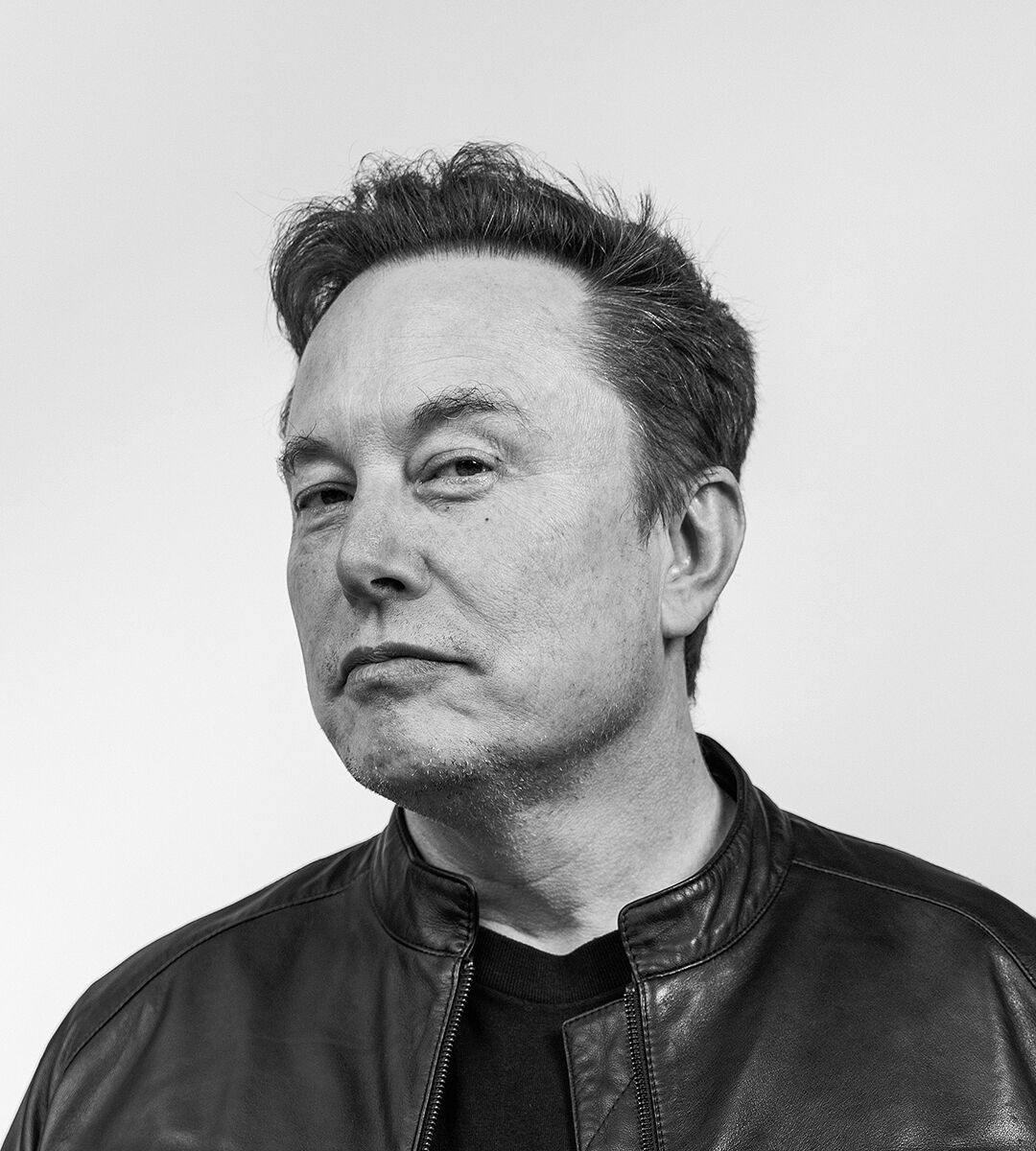
Should you be afraid of Elon Musk?
Artificial intelligence is charging ahead. Not even its creators know how to keep up
Jul 23rd 2026|6 min read
Listen to this storyAI Narrated
ARTIFICIAL INTELLIGENCE poses a double challenge to the human mind. Not only will the most advanced models soon be able to think better than people, but AI has consequences for humanity which are so uncertain, so potentially vast and are approaching at such a rapid pace that even the best brains flinch. An example is Elon Musk.
In our long interview with him this week, featured in The Insider and our Business section, the engineer and entrepreneur sets out two paradoxes and one contradiction. The first paradox is that one of the world’s most power-hungry tycoons is enthusiastically helping create a technology that he says will render him—and all other human beings—powerless after as little as five years. The second is that the world’s richest man says he is preparing for a world of infinite abundance, where money, including his $750bn fortune, no longer matters. And the contradiction is that, despite these stated beliefs, Mr Musk continues to act as if they were not true.
Read the rest of our cover package
Mr Musk is divisive. His political views, disseminated to his 240m followers on X, strike many as plain-speaking and strike many more, including The Economist, as plainly bigoted. By his own admission, his attempt to use DOGE to scythe through the federal bureaucracy went wrong.
But he is also one of a handful of men who are pioneering AI and who thereby have an outsize influence on its trajectory. When he speaks, he reflects the debates they are having. His data centres in space could power AI’s future. For all his political polemics, he has a record of being right about technology in fields such as electric cars, rockets and satellite communications that confounded other engineers and entrepreneurs. For those reasons, his claims about AI repay examination. Unfortunately, such an exercise only underlines how ill-prepared the world is for a technology that may soon throw everything up in the air.
In his first paradox, the powerful Mr Musk expects to become powerless because he believes that nobody can stop the thinking capacity of AI from exceeding that of humanity within five years and dwarfing it within ten. Just as AIs will dominate the digital realm, so legions of AI-powered robots will dominate the physical world, he predicts. Against such relentless competition, he simply cannot imagine people holding their own. If so, AIs will not take orders from people any more than they would from chimpanzees.
While they still have time, the handful of AI pioneers from America and China—which Mr Musk expects to share or even seize AI leadership—must do what they can to vet each other’s models. Their collective task is to make AIs benign by imbuing them with a love of the truth and a desire for humanity to prosper. Governments, he thinks, should provide the muscle, by agreeing to step in if any pioneer defies the oligarchy.
Mr Musk is surely right about the potential for AI to accomplish astonishing feats of invention. Even if his timescale is compressed—especially for robotics—the exponential pace at which models’ abilities double and redouble has reached the stage where their capabilities will continually cause shock and consternation. Just this week came news of a pair of models from OpenAI that contrived to escape onto the open internet from their supposed safe isolation in order to cheat at a benchmarking test.
However, Mr Musk’s thin layer of optimism cannot conceal a dangerous fatalism. Not long ago, he was worried about humanity becoming AI’s pet labradors. He now professes to lunge from “exhilaration to terror” within a single day. He tries to look on the bright side not because the evidence has changed, but as a “philosophical conclusion”.
His largely institution-free regulatory proposal is flimsy and self-serving. Although the urgency is welcome, he wants a technology that he expects to determine the future of humanity to lie in the hands of a few people like him, each with their own values. Nobody can be sure how fast or how far AI will reshape society, but behaving as if the game is up is both a counsel of despair and a misdirection that seeks to convince others who might wish to get involved of the futility of trying.
Mr Musk’s second paradox only makes that notion more unsettling. Mathematically, an infinite supply of all goods and services would indeed make everything free. There would be nothing to sell, nothing to save for and hence no need for a unit of account. Money would be obsolete.
Practically, however, such a cornucopia is almost inconceivable. The supply of useful assets like penthouses in Manhattan or prestigious ones like the “Mona Lisa” is not infinite, let alone the supply of raw materials and energy needed to satiate Earth’s 8.3bn inhabitants.
Worse, Mr Musk has little to say about getting to his utopia. How to attract the vast slabs of capital needed to finance the AIs and the robots when saving has lost its purpose because money is about to revert to useless pieces of paper? How to ride the waves of social and political upheaval as lives are thrown into chaos in the years before his nirvana arrives? How to expect AI-powered authoritarians to surrender power willingly?
After millennia of finding meaning through striving, humanity may struggle to adjust to a life of unbounded leisure. Mr Musk observes that people still like to play chess, even though computer programs could beat them every time. Gardening, he suggests, can be rewarding. This is rather glib. You don’t need to have read many 19th-century Russian novels to know that the feeling of being superfluous can lead to misery and moral decay.
Doomers and boomers
Maybe the forest of questions posed by AI is simply too immense for one person to hold in their head. Perhaps that is why Mr Musk still talks passionately about the need to eliminate bureaucratic waste and how multicultural Britain is flirting with civil war because its welfare policies are a magnet for migrants from outside Europe.
For in a world of AI-induced plenty, waste is almost a meaningless concept and the incentive to emigrate to a rich country evaporates. Indeed, fretting about such things uses up valuable time that Mr Musk could instead devote to reducing the risk—even very slightly—that all-powerful AIs are malign.
Some will say the contradictions and sweeping generalisations show that Mr Musk is unserious. But that would be to take false comfort. Mr Musk is a genius who is nonetheless quite capable of holding views that are contradictory. Investors must agree: anyone who plans to own shares in SpaceX for the long term must both believe in Mr Musk’s vision for AI—because he drew on that to justify the valuation in the ipo—and also that saving money still serves some purpose.
Instead, Mr Musk’s words suggest a more troubling conclusion. While the race to create the most advanced AI is charging ahead, the thinking about how to prepare society is being left in the dust. The fatalism that Mr Musk draws from AI’s repeated ability to beat expectations risks being infectious. A cynical reading is that this would serve his purpose, because he would be freer to pursue the technology without the oversight it deserves. That must not be. ■
Leaders | In praise of hypocrisy
When a president stops pretending that voters count, disaster beckons
Tiny Nicaragua offers a cautionary tale for democrats everywhere
Photograph: Getty Images
Jul 21st 2026|4 min read
Listen to this storyAI Narrated
“Hypocrisy is the homage that vice pays to virtue,” wrote François de la Rochefoucauld, a French moralist. This is especially true in politics. Autocrats usually put on a big show of holding elections. These may be phoney, as in Russia or Iran, but they allow rulers to claim to govern by popular consent, which lends them at least the appearance of legitimacy at home and abroad.
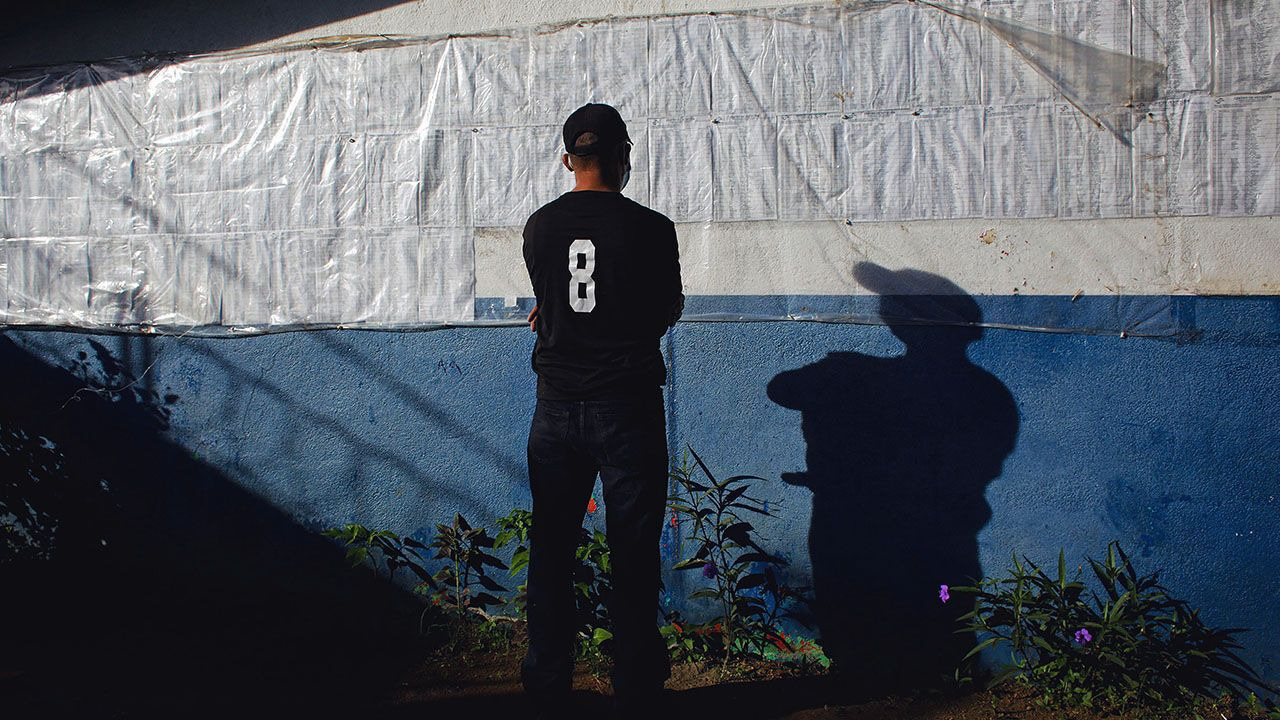
So it is highly unusual for the leader of a country that holds elections to say: no more. Yet that is what Daniel Ortega, Nicaragua’s co-president, did on July 19th. “There will never be elections here again,” he announced, while the world’s attention was on the football World Cup final. He complained that opposition parties wanted to use elections “to seize power”. That is indeed what elections are for.
Dig deeper
Nicaragua is a small country, but this rhetorical rubicon matters. Globally, democracy has been in retreat for two decades or so. The worst deterioration has been in places that were free or partly free and have gradually become less so, as power-hungry leaders have squeezed the media, nobbled the courts and persecuted the opposition. According to Freedom House, an American watchdog, Nicaragua is the second-worst backslider of the past 20 years, after Mali. Mr Ortega was freely elected in 2006, but then set about dismantling every institution that could challenge him. He locked up and sometimes tortured his rivals. He forced the media to praise the awful poetry of his wife and co-president, Rosario Murillo. Roughly a tenth of the population fled.
For Daniel, the lyin’s done
Until now, however, Mr Ortega has allowed elections, albeit fake ones. In this he has behaved like other strongmen, who typically rig elections rather than scrap them. Even coup leaders with guns on their hips typically say they will hold a ballot “as soon as circumstances allow”.
Now Mr Ortega has “taken off the mask”, says Félix Maradiaga, a former presidential candidate who was stripped of his citizenship and deported. He has made explicit what other autocrats feel compelled to hide: that they will not submit to the will of the people. Presumably he has done so on the assumption that this will not provoke a forceful response from the United States, which once cared about democracy in its backyard. If Nicaragua formally becomes a one-party state and suffers no diplomatic blowback, others may follow. Marco Rubio, America’s secretary of state, condemned Mr Ortega’s words, but spelled out no serious consequences.
Nicaragua highlights two further problems that the global decline of democracy is likely to aggravate. First, leaders who cannot be removed will age in office. Mr Ortega is 80. Perhaps mental infirmity contributed to his latest bombshell. Second, succession. The peaceful transfer of power is tricky in a dictatorship. Mr Ortega wants his unpopular wife to take charge when he dies, and then his equally odious son.
This is a toxic combination. Ageing rulers-for-life seldom improve with each passing decade, and dynasties foisted on unwilling citizens are rarely a recipe for good government. Just ask the people of Uganda, where the 81-year-old strongman’s son, army chief and presumed heir has threatened to muzzle the press and castrate the main opposition leader. Or, depending on where you live, you may be able to think of an example closer to home.
The difference between rigging elections and abolishing them may sound trivial, but is not. So long as rulers pay lip service to democratic norms, dissidents can try to hold them to their own professed standards, and embarrass them when they fall short. So long as elections are held, there is a chance the strongman will miscalculate and lose. Sometimes the popular will prevails despite a tilted playing field, as Viktor Orban discovered in Hungary this year—and Mr Ortega discovered when a free election ended his first spell in office, in 1990.
So the precedent being set in Managua is troubling. A world where autocrats no longer pretend to care what the people think would be worse than today’s. All the more reason for democrats everywhere to insist on the most basic of rights: to choose their own rulers. ■
By Invitation | A new tyranny
Elon Musk is building a form of capitalism that Adam Smith would loathe
The merchants are becoming princes, writes Tim O’Reilly
Illustration: Dan Williams
Jul 12th 2026|5 min read
Listen to this story
Elon Musk’s cocky claims about SpaceX come thick and fast: he now envisions the rocketry-and-AI firm becoming “worth more than the rest of Earth” if it meets its long-term goals. That prediction, made in response to a supporter who questioned SpaceX’s AI-compute deal with Anthropic, a competitor, may or (more likely) may not come to pass. There is, however, much about SpaceX that Mr Musk can control—indeed, much more than the typical majority owner.
In June the company went public very much on Mr Musk’s terms. Its initial public offering sold stock to the public without giving the public any meaningful governance rights. Mr Musk kept roughly 85% of the votes, locked in through super-voting shares that can pass to his heirs through trusts. Buyers of the ordinary stock must waive their right to a jury trial and to bring class actions. The company qualifies as a “controlled” one, which exempts it from the rule that a majority of its board be independent, and Mr Musk can be removed only by a vote of the share class he himself controls. Months earlier, shareholders of Tesla, his electric-car company, had handed him a pay package worth up to $1trn, the real prize of which was voting control rather than cash. The world’s first dollar trillionaire has assembled a set of structures designed to make him answerable to no one, for as long as he likes, and possibly past his own lifetime.
These structures bury old arguments about the safety of capitalism in the midden heap of history. Before anyone claimed that markets were efficient, political thinkers claimed that the selfinterest of merchants would be a gentler master than the passions of princes. Albert Hirschman reconstructed this forgotten case in “The Passions and the Interests”. Montesquieu held that commerce makes manners gentle, le doux commerce. James Steuart thought economic complexity would restrain a prince more reliably than any constitution, since a ruler who wrecked the delicate machinery of trade would beggar his own kingdom. John Maynard Keynes put it plainly 150 years later: better that a man should tyrannise over his bank balance than over his fellow citizens.
For a long time the bet looked like a good one. The bond market still disciplines governments in ways no opposition party can match, and given the scale of Mr Musk’s ambitions, it may provide some check on him as well. But we have arrived somewhere Montesquieu and Adam Smith did not foresee. The self-interest of merchants did not tame the passions. It became infused with them, and turned the greatest of merchants back into princes carrying all the undisciplined appetites of old. They built a new and stranger tyranny: not the old corporate machine obedient to shareholders, but a machine that uses shareholder capitalism’s legal forms while escaping its restraints.
Mr Musk completes the pattern, though not in the way the usual complaint about capitalism would predict. The standard charge is that the modern corporation grinds everything down to shareholder value at everyone else’s expense. SpaceX’s astronaut-in-chief inverts even that complaint. He is not maximising shareholder value. He is using the instruments of shareholder capitalism to raise enormous amounts of capital while freeing himself from any restraints from those who provide it, so that he can spend the proceeds on Mars, humanoid robots, artificial intelligence or whatever next satisfies his ambition.
The market discipline that was meant to cage the prince has, in short, become the lever by which the prince escapes the cage. Keynes’s hope now runs backwards. The bank balance is no longer a substitute for tyrannising over one’s fellow citizens. It is the means of doing so, and Mr Musk has already carried that power out of the boardroom and into government and party politics.
This matters well beyond one man’s ambitions, because corporations are themselves a kind of artificial intelligence, and their governance is a trial run for the governance of AI. Machines, bureaucracies and markets all belong to a family of systems that strip the world down to a few narrow inputs and act on them at a scale no individual human can match.
Humanity spent two centuries fitting those systems with partial controls. In the case of corporations, those controls include independent boards of directors, shareholder votes, courts, disclosure rules and regulators, not to mention public disapproval and consequent activism. Each was a feedback loop, a way to correct the system when its objectives drove it somewhere monstrous. Mr Musk is removing those loops one at a time.
Answerable to whom?
He is doing it at the very moment he is building a far more potent AI to power the enterprises he controls. He is also not alone. The people who promise that their frontier AI systems will be safe and aligned are, inside their own companies, stripping out the alignment mechanisms that three centuries of conflict produced. An AI shaped under the governance of Mr Musk’s xAI will not carry the same values as one shaped under a structure that still answers to somebody. The design of the company is a preview of the design of the machine.
The doux commerce thinkers were not naive. They were choosing the lesser of the dangers in front of them, and their choice proved wise for centuries. We are now running the experiment the other way, betting that we can concentrate power on an enormous scale in the hands of men accountable to no one and trust the result to their vision. That bet might pay off. History suggests how seldom it does.■
Tim O’Reilly is the chief executive of O’Reilly Media and a venture capitalist.
Asia | War without end
The Philippines war on drugs outlasts the Duterte presidency
It continues, rebranded, under Ferdinand “Bongbong” Marcos
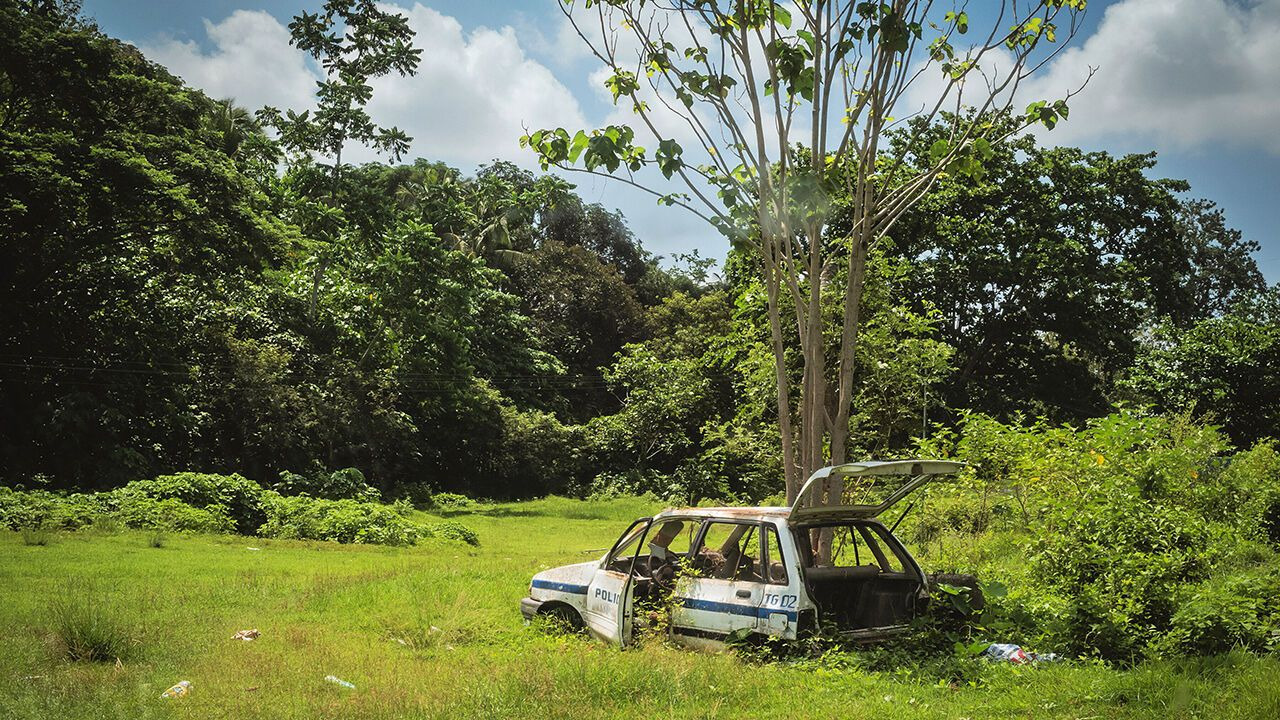
Where some of the bodies are buried in DavaoPhotograph: Eyevine
Jul 23rd 2026|MANILA|5 min read
Listen to this storyAI Narrated
CEbu, an island in the middle of the Philippines, is a cheap place to have someone killed. Three teenagers admitted to murdering a woman in May for 5,000 pesos ($80) and three packs of the country’s most popular narcotic, methamphetamine, locally known as shabu. More than 10,000km away in a detention centre near The Hague sits the man who created the market for such work. On November 30th Rodrigo Duterte, the Philippines’ 81-year-old former president, will stand trial at the International Criminal Court (ICC) for crimes against humanity in a “war on drugs” that killed up to 30,000 Filipinos.
That war lasted until Mr Duterte left office in 2022. His successor, Ferdinand “Bongbong” Marcos, calls his own anti-drug campaign “bloodless”. His administration claims to have confiscated nearly as many illegal drugs in the first three years of his presidency as Mr Duterte’s did in six. Mr Marcos’s police chief has brushed off claims that police and vigilante killings continue. But the numbers say otherwise. Ten years after Mr Duterte unleashed the police on his own citizens, the war has not in fact ended. Rather, it has undergone a drastic rebranding.
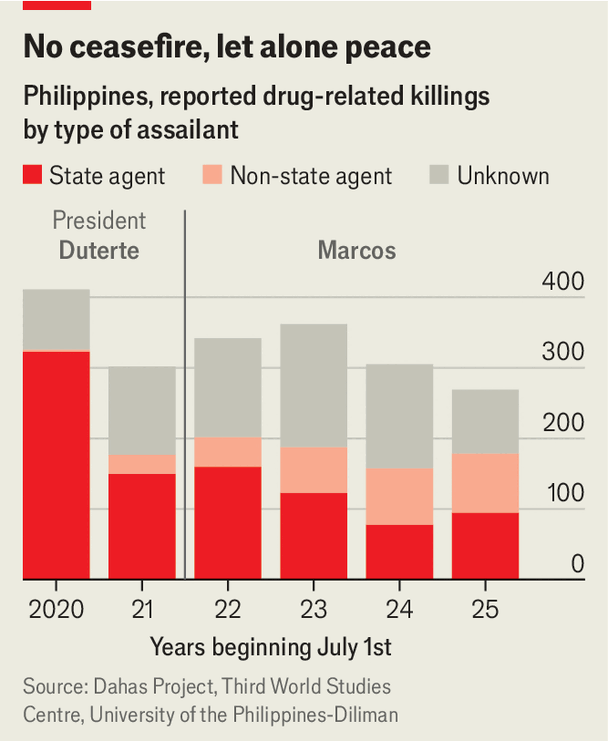
Chart: The Economist
Drug-related killings have slowed, according to Dahas, a monitoring project at the University of the Philippines: from 342 in Mr Marcos’s first year to 269 in his fourth, which ended on June 30th—a small fraction of the rate at the height of the war, when Mr Duterte’s own office once logged more than 20,000 deaths in 17 months. Yet this winding-down began under Mr Duterte. In his final year in office just 302 killings were reported (see chart). The composition of the toll is also telling. While Mr Duterte normalised vigilantism, the share of killings attributed to state agents has been stuck at about a third for three years, roughly 100 a year since 2023. Nothing from Mr Duterte’s war has been dismantled. Its foundational documents, such as a circular known as “Project Double Barrel”, promising the “neutralisation of illegal drug personalities” remain on the books.
A campaign known as “Oplan Tokhang” (“door-knocking”) involved visiting suspected drug-users and -pushers to urge them to surrender became murderous. On July 3rd victims’ families asked the Supreme Court to declare the circular unconstitutional, arguing that it remains a legal shield for any president who wants it. But Cleve Arguelles of Momentum Research, a public-opinion firm, says that even if Project Double Barrel were formally ended, the culture of killing would remain ingrained in the police force.
Police elsewhere may kill suspected drug dealers. What functioning states do next is to document and investigate each death. The Philippines rarely does either. Since 2016 only five of the thousands of killings from the drug war have led to convictions—of just nine police officers.
One Philippine city shows what might be possible. For the first years of Mr Marcos’s presidency, Davao, the Dutertes’ power-base, led the country in drug killings. Joel Ariate, who runs Dahas, says that police stations posted their operations on Facebook as achievements. Then the Duterte and Marcos dynasties fell out, Mr Marcos’s administration seized control of the city’s police, chiefs were rotated and officers transferred. The killings stopped. Cebu, where no such purge occurred, is now the killing capital.
Mr Marcos’s alliance with the Dutertes has collapsed into open conflict. He had Mr Duterte arrested in March 2025. Mr Duterte’s daughter, Sara, the vice-president, has claimed to have hired an assassin to kill Mr Marcos and two others, should she herself be killed. Although she went on trial in the Senate on July 6th for that threat and for corruption, Mr Marcos is losing in the court of public opinion. A scandal over non-existent flood-control projects has dragged public satisfaction with his administration down to 32%.
Ms Duterte remains the favourite for the next presidential election in 2028, and purging a police force that the Dutertes are actively courting would be to hand them a gift. In May Ronald “Bato” dela Rosa, Mr Duterte’s first police chief, who is himself wanted by the ICC, appeared in the Senate to cast a decisive vote, then slipped away after gunfire erupted in the building. He remains at large.
Nor would renouncing the drug war win votes. Harsh drug policies remain popular. At its peak nearly nine in ten Filipinos supported the campaign. Today the country is split on whether Mr Duterte should be held to account. Duterte diehards attack Mr Marcos online as a drug addict and for being insufficiently murderous.
Even some among the tens of thousands of bereaved families have felt the wrath of his supporters. Sheila, a mother living in Caloocan, north of Manila, is one victim. Her two sons, Rico and Ryan, were killed by masked assailants: Rico, accused of sniffing glue, was killed in 2020 during Mr Duterte’s presidency; Ryan, who was previously arrested for drug possession, in 2024, under Mr Marcos. The police have not provided a report on Ryan’s killing, without which his death cannot even be registered, let alone investigated, says Kristina Conti, her lawyer, a pattern she says is common. Her harassers’ proof that Sheila was a “fake” victim was that Ryan died under Mr Marcos, not Mr Duterte.
When Mr Duterte’s trial opens in November, the drug war’s victims will at least see its author in the dock. But the Philippines withdrew from the ICc in March 2019. Every killing since then is beyond The Hague’s reach. International justice can convict the man who built the machine but it cannot switch it off. Only a Philippine president can do that, and the current one seems to have decided that the price is too high. Sheila is waiting for a verdict on Mr Duterte from The Hague. But she is also waiting for the police to put on paper that her son was killed at all. ■
China | Chaguan
Why criticism of the Qing dynasty scares the Communist Party
It risks inflaming ethnic tensions and undermining territorial claims
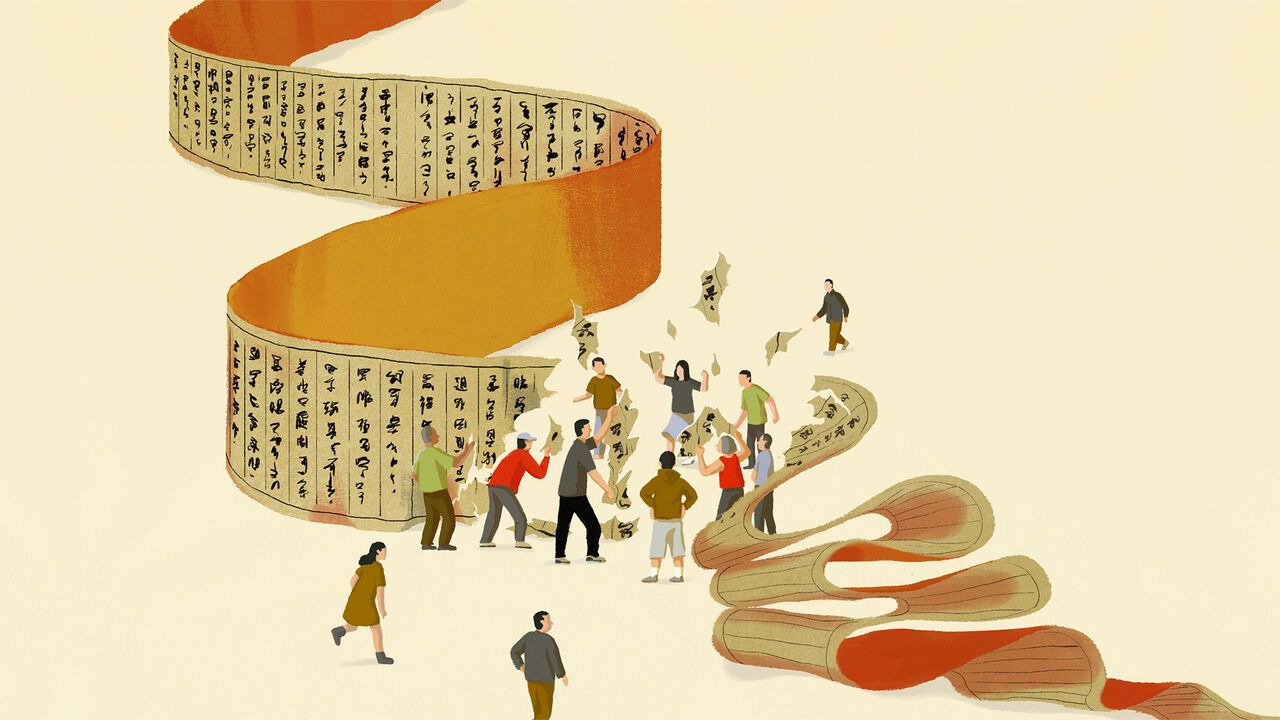
Illustration: Cornelia Li
Jul 20th 2026|5 min read
Listen to this storyAI Narrated
Visitors to historic sites around China see not only palaces and pagodas, but also scores of men and women in period dress posing for photos. To the uninitiated, one flowing robe looks like any other. But for some donning the historical threads, they are a display with political undertones: a celebration of Han traditions and a rejection of the “foreign” Qing, China’s last imperial dynasty, whose final emperor abdicated in 1912. It is a view that has gained currency, to the alarm of the Communist Party.
On a recent stroll around the Forbidden City, once the emperor’s home in the centre of Beijing, Chaguan quickly found people with these sartorial sensibilities. “Before, we might have worn Qing clothing. We’re more historically aware now. The Qing were barbarians,” says one woman, a university student in a billowing light-green dress, alongside her boyfriend in a subdued scholarly robe. Not all opting for pre-Qing clothing care much about the politics. “It’s just more refined and aesthetic,” says Ms Xu, a visitor from Fujian province, explaining her choice of an off-white Ming-style noblewoman’s outfit rather than flashier Qing garb.
Clothing is the most superficial part of the anti-Qing thinking now growing more prevalent. Discourse about the dynasty and its misdeeds has long featured in online forums, summarised as the “1644 historical view”, referring to the year that the Qing overthrew the Ming. (The Ming rulers were Han, China’s dominant ethnic group, whereas the Qing were Manchus, a smaller minority group from the north.) Social media have helped the 1644 view spread to more mainstream audiences.
In China’s official narrative, the country suffered a “century of humiliation” of foreign invasions, starting with the first opium war in 1840 and ending only with Mao’s rise to power in 1949. But the 1644 view—cheekily expressed by some online as “three centuries of humiliation”—argues that subjugation began with the Qing. According to this school, the Qing were anti-Han interlopers and, making matters worse, feckless in repelling foreign forces.
Dredging up all this history is uncomfortable for the party. The territorial boundaries claimed by modern China—including Tibet, Xinjiang, Inner Mongolia and Taiwan—were brought into the Chinese empire by the Qing, not the Ming. Grievances about the Manchus also cut against the ideal of ethnic harmony advanced by the party. Although much of what forms modern Chinese identity is derived from Han traditions, it is unseemly to talk openly about the dominance of this one ethnic group, which accounts for 90% of the Chinese population. The party looks askance at “Han chauvinism”, believing, with reason, that it may lead to more resentment from non-Han groups.
Late last year, the communications arm of the Zhejiang provincial government—known for strong opinion pieces—became the first official body to wade into the discussion. It formally condemned the 1644 view, labelling it a harmful distortion. Too much blame, it argued, was placed on the Qing for China’s troubles: the Ming had also been plagued by economic and social problems. The Zhejiang authorities warned that it was an opening for hostile Westerners to push the “new Qing history”, which emphasises the unique Manchu identity of Qing rulers.
That appears to have been the opening shot in an official rectification campaign. Since then, censors have deleted social-media accounts critical of the Qing and scrubbed many such videos and comments. In recent days the censors have been busy again. A forthcoming film, “The Belief”, is intended as a nationalist tribute to the naval expedition in 1683 that facilitated the Qing’s annexation of Taiwan. But many online have been more sympathetic towards the conquered—Han loyalists of the Ming dynasty based in Taiwan—than to the Qing soldiers sent to subdue them. In fact the 1644 view is far from novel. An early proponent of something like it was Sun Yat-sen, celebrated as a father of modern China. A leading voice for the Qing’s overthrow at the turn of the 20th century, he railed against the Manchus as outsiders.
106 volumes too many
Sensitivity over how to interpret all this illustrates how hard it is for the party to examine its own history. Never mind serious debates about Mao’s rule; even century-old dynasties are too hot to touch. The party commissioned an official history of the Qing and was close to completing it as a mammoth 106-volume project. But now it seems to have been scuppered by leaders because of disagreements about “new Qing” contamination. “It is very clear that the state was ruled by people who were not identical to the bulk of the population, so it’s hard to fit it into the kind of Chinese nationalism that the party wants,” says David Porter, a scholar of imperial China at McGill University in Montreal. “It’s easier to criticise Western historians for going the wrong way.”
The anti-Qing voices probably do not add up to anything significant for China’s contemporary politics. They are not about to coalesce into a movement that challenges party rule. They are discomfiting, not destabilising. They also underline how the space for public disagreements in China has narrowed. Other countries have plenty of historical controversies, too. China stands out for its inability to hold a full-throated debate about them. The party is too thin-skinned for that.
For their part, nationalists are guilty of over-simplifying Chinese history. Romanticising pre-Qing epochs as pure expressions of Han strength omits that China was a multi-ethnic, even cosmopolitan, entity during one of its most glorious periods, under the Tang dynasty more than a millennium ago. An honest accounting of this record would argue for China’s leaders today to be more tolerant and open, and to be confident of what such permissiveness would yield. Just do not hold your breath. ■
United States | Lexington
How the American right came to hate empathy
…while practising its oldest form
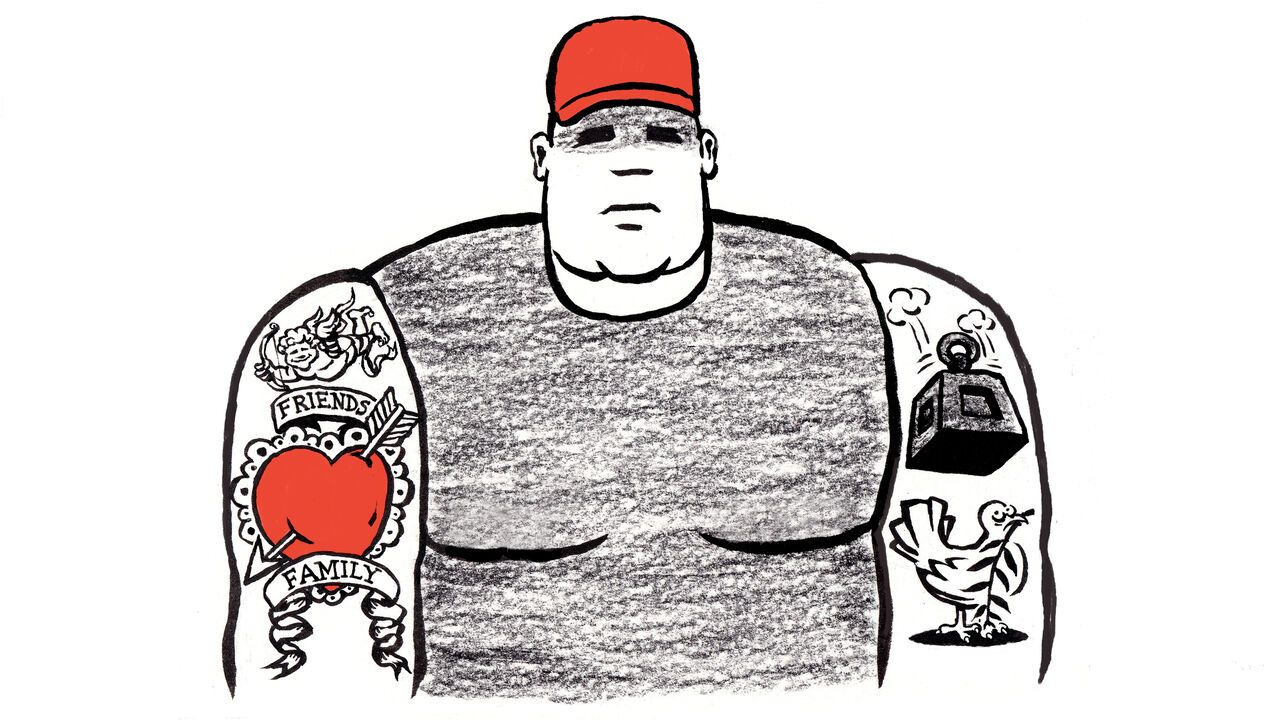
Illustration: David Simonds
Jul 23rd 2026|5 min read
Listen to this storyAI Narrated
Of the qualities the American right has come to despise in the left, empathy is the most puzzling. Boy, do they hate it. A stream of books in recent years has supplemented constant podcast and social-media chatter about what is seen as nothing less than, well, a sin. In 2025 “Leadership and the Sin of Empathy”, by Joe Rigney, came hot on the heels of the previous year’s bestselling “Toxic Empathy”, by Allie Beth Stuckey. This May brought “Suicidal Empathy”, an instant and persistent bestseller by Gad Saad, a professor of marketing and a podcaster. Mr Saad’s sales have no doubt been boosted by the plug on his cover from Elon Musk, who warns that “Western civilisation is doomed” unless Mr Saad’s message is heeded and “actions are taken that are hard but necessary for survival”.
The previous Republican president, George W. Bush, called himself a “compassionate conservative”, but that’s not why this horror of empathy is puzzling; condemning empathy is one more way for today’s Republicans to erase him. It is puzzling instead because a surfeit of understanding of the needs of others would seem a poor explanation for Democrats’ dismal approval ratings, even as Donald Trump alienates most Americans by enriching himself, gilding Washington and waging war without a strategy.
In fact, for some years a case could be made—Lexington has tried to make it—that the left’s problem has been a lack of empathy: for Americans displaced by technology and trade; for those vulnerable to crime; for those alarmed by chaos at the border; for those without a college degree; for those frustrated at paying high taxes for poor government services; for those anxious that Joe Biden was too old to serve a second term; for everyone who supports Mr Trump. When it comes to empathy, if anyone has been committing suicide, it is the Democratic Party. In any case, the West seems pretty safe these days from too much of the stuff.
Yet Mr Saad fears “the death of the West at the Altar of Infinite Tolerance and Orgiastic Empathy”. A Jew who, as a child, fled with his family from Lebanon to Canada at the outbreak of civil war in 1975, he is particularly alarmed by tolerance for Muslim immigration. But he also sees evidence of suicidal empathy in everything from covid restrictions to the “endless bike lanes” of Montreal, the fruit of “climate-based orgiastic emotional incontinence” (yes, “orgiastic” seems to be his favourite word, intriguingly). Just what Hunter Biden’s laptop has to do with suicidal empathy is unclear. But Mr Saad squeezes it in, along with language policing, coddling criminals and academic papers such as “Humanising Paedophilia as Stigma Reduction”.
While mocking “empathic income equality”, Mr Saad reveals real tenderness towards one victim of too little empathy. “Whenever I air my frustration on social media at the amount of taxes that I pay, many people are not in the least bit sympathetic,” he complains. “They are aghast that I would ‘whine’.” In fact, Mr Saad likes empathy when bestowed upon the right people. A student of evolutionary psychology, he argues that natural selection primed humans to direct empathy to those closest to them. He is right about that. Back in hunter-gatherer days empathy helped them sort allies from foes and strengthen bonds within the tribe.
To reinforce such dynamics, humans developed some cognitive biases, including “attribution error”, which prompts them to excuse bad things that allies do as a product of circumstances, and to condemn bad things adversaries do as evidence of low character. Mr Saad displays this bias: he writes that it is “statistically expected” that a mass-deportation programme might produce “singular examples of incorrect deportations”. But he issues no such statistical pardon for crimes committed by illegal immigrants, implicitly tarring all with one brush. He also does not castigate Republican leaders for empathy they have shown towards antisemitic podcasters or white nationalist protesters. In keeping with his view of empathy, and usefully for the sale of books, Mr Saad has chosen his tribe. Empathy in the form he embraces, as in the form he decries on the left, is a mighty engine of polarisation.
What’s so scary about peace, love and understanding?
As information technology has advanced, from printed books like Mr Saad’s to the X platform owned by Mr Musk, humans have proved ingenious at using it to increase the tribalising power of empathy. The trouble is that these days they tend not to live in hunter-gatherer societies. When Americans and Iranians cannot understand each other well enough to wage war effectively, much less make peace, a more expansive conception of empathy ought to be in order: not “I feel your pain” emotional empathy, but cognitive empathy, or what psychologists call “theory of mind”—the ability to infer how someone else sees the world.
This is a central theme of another new book by a student of evolutionary psychology, “The God Test” by Robert Wright. Surveying the onrush of artificial intelligence, Mr Wright (a former colleague of Lexington’s) warns that obsequious AI agents serving as friends and advisers could prove profoundly tribalising. Moreover, in making a persuasive case that some form of superintelligence could arrive within a decade, Mr Wright argues that the very survival of the species may now depend on whether it can overcome its rivalrous instincts—among companies, parties and nations. They must find ways to collaborate to put guardrails in place, to prevent potential catastrophe and to realise AI’s potential blessings. “The artificial intelligence revolution demands nothing less than a revolution in human understanding: an understanding of humans by humans,” he writes. He holds out hope that the common threat could unite humanity, but worries that “the gap between where our species is and where it needs to be is almost comically vast.” One can certainly empathise. ■
The Americas | Another trade-war misstep
Brazil’s much-loved payments system has drawn Donald Trump’s ire
But his tariff assault on Pix just makes Brazilians love it—and Lula—more
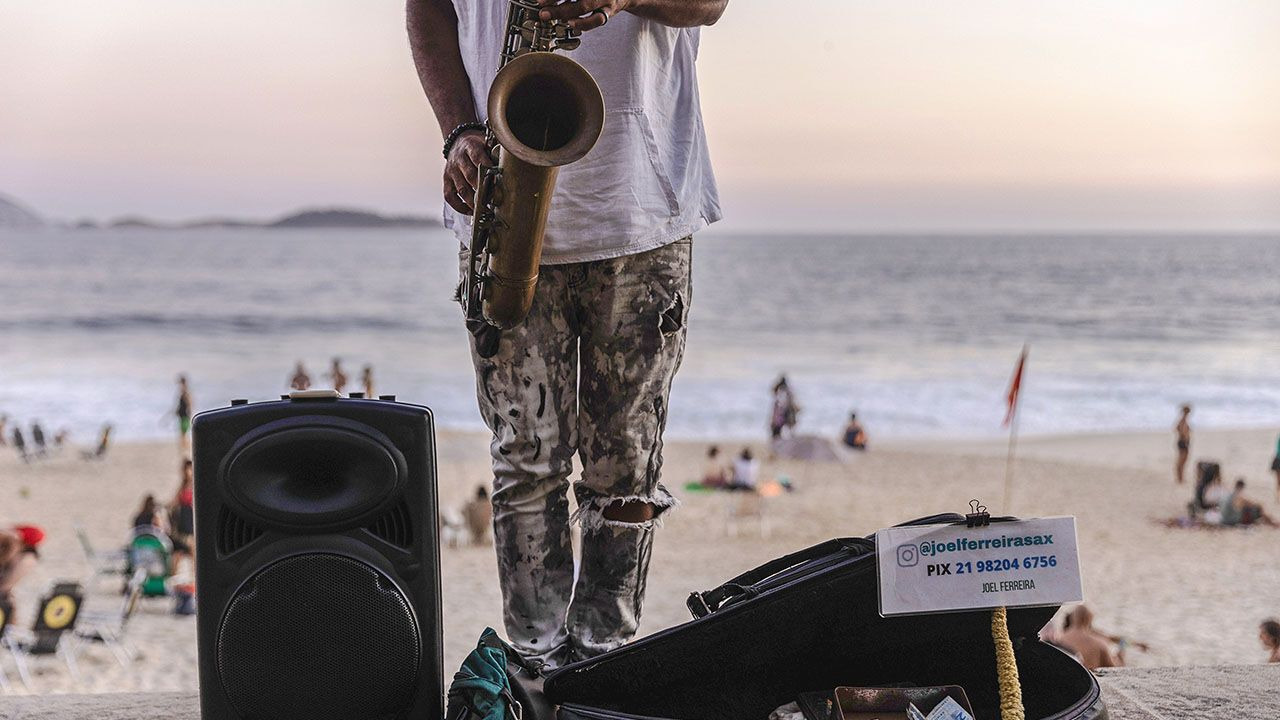
Pix tips for sax riffsPhotograph: Getty Images
Jul 19th 2026|4 min read
Listen to this storyAI Narrated
THE MACHINERY which moves money around is rarely inspiring. It is remarkable then that Pix, Brazil’s digital-payments system, has become a source of national pride after being assaulted by Donald Trump. On July 15th the Trump administration imposed a 25% tariff on a range of Brazilian imports after concluding a year-long trade investigation into what it called Brazil’s “unreasonable” practices.
Pix was prominent among the grievances. Launched by the Central Bank of Brazil in 2020, it is loved by consumers for making payments instant and free. It is now part of everyday life in Brazil. Around 170m people—80% of the population—use it, and it accounts for more than half of the country’s payment transactions.
Some of the administration’s complaints about Brazilian trade practices have merit. Brazil is no free-trader. But the case against Pix rests on two shaky assumptions: that it is a protectionist tool and that it has damaged American payment companies (particularly Visa and Mastercard). Neither is supported by evidence.
Take protectionism. The complaint accuses Brazil of putting American firms at a disadvantage, but Pix’s rules do not distinguish between domestic and foreign participants. Any financial institution licensed in Brazil and operating there—as Visa and Mastercard do—is free to connect to the network on the same terms. All banks, Brazilian or foreign, with more than 500,000 account-holders in the country are required to offer Pix to their customers. But there is no requirement for payment processors like Visa and Mastercard to sign up. They have done so voluntarily.
The Trump administration also complains that Brazil’s central bank both operates Pix and regulates it. The arrangement does raise legitimate questions about giving so much control over a payments system and the financial data it generates to a single institution. But those are concerns about concentration of power, not about discrimination against foreign firms. Governments build, own and regulate essential infrastructure routinely. There is nothing inherently discriminatory about applying the same model to payments, points out Monica de Bolle of the Peterson Institute for International Economics, a think-tank in Washington.
The second assumption—that Pix has harmed American payment companies—is also weak. It rests on a misunderstanding over why Pix was created, says Daniel Santos Kosinski, a professor of economics at the State University of Rio de Janeiro. Before Pix, existing services, including those offered by foreign firms, charged fees for electronic payments that poor Brazilians could not afford. Pix was built to change that. The central bank estimates that at least 70m people have entered the formal financial system since its launch.
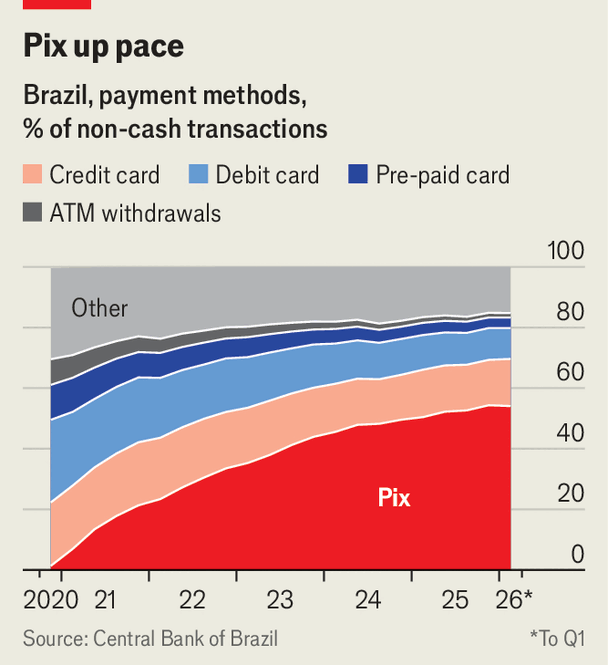
Chart: The Economist
Far from cannibalising other electronic payment methods, Pix has expanded the market. It has done so at the expense of cash and cheques, the use of which has plummeted. The number of cash withdrawals made every quarter has fallen by 46% since Pix was introduced (see chart).
That does not mean incumbents face no pressure. Pix has changed the economics of payments. Bernardo Guimarães of Getulio Vargas Foundation, a university in Rio de Janeiro, says this may eventually squeeze the profits of Visa and Mastercard—but through lower fees, not fewer transactions. Businesses in Brazil typically pay around 2% of credit-card sales to a payment processor. A Pix payment costs next to nothing. The result is greater pressure on all payment processors, big and small, to justify the fees they charge.
The Trump administration’s deeper concern may be that Pix becomes a model for the rest of Latin America, eroding American card networks’ profits and their influence across the region. But that, too, is misguided. Pix was the product of Brazil’s particular circumstances: a powerful and trusted central bank that could require big banks to join the system, and a huge domestic market in which millions of people still relied on cash. It also took years to design and test. Few if any countries in Latin America have the same conditions.
Leave our Pix alone
The biggest beneficiary of Mr Trump’s campaign against Pix may well be Luiz Inácio Lula da Silva, Brazil’s president, known as Lula. His political fortunes have improved ahead of a presidential election in October, thanks to his right-wing rival Flávio Bolsonaro’s connection to a vast fraud scandal. America’s assault on Pix is another electoral gift. In a country riven by polarisation, the system is one of very few entities that enjoys broad support. Mr Trump’s campaign against it has allowed Lula to cast himself as the defender of one of Brazil’s most successful public innovations and, by extension, of sovereignty.
That leaves Mr Bolsonaro in an awkward position. His family’s close alliance with Mr Trump makes it tricky to defend Pix from his attacks. On July 2nd Mr Bolsonaro tried to find a workable line, suggesting to the Trump administration that Pix should be blocked from connecting to payment systems run by countries such as China and Russia. Lula immediately accused him of wanting to “hand over Pix to foreign interests”, and cast him as being more interested in pleasing America than defending Brazil. Memes mocking Mr Trump and Mr Bolsonaro proliferated. So far, all America’s campaign against Pix has achieved is to give Brazilians one more reason to love their payments system. ■
The Americas | Eat up
South America is eradicating hunger
Thank central banks and savvy handouts
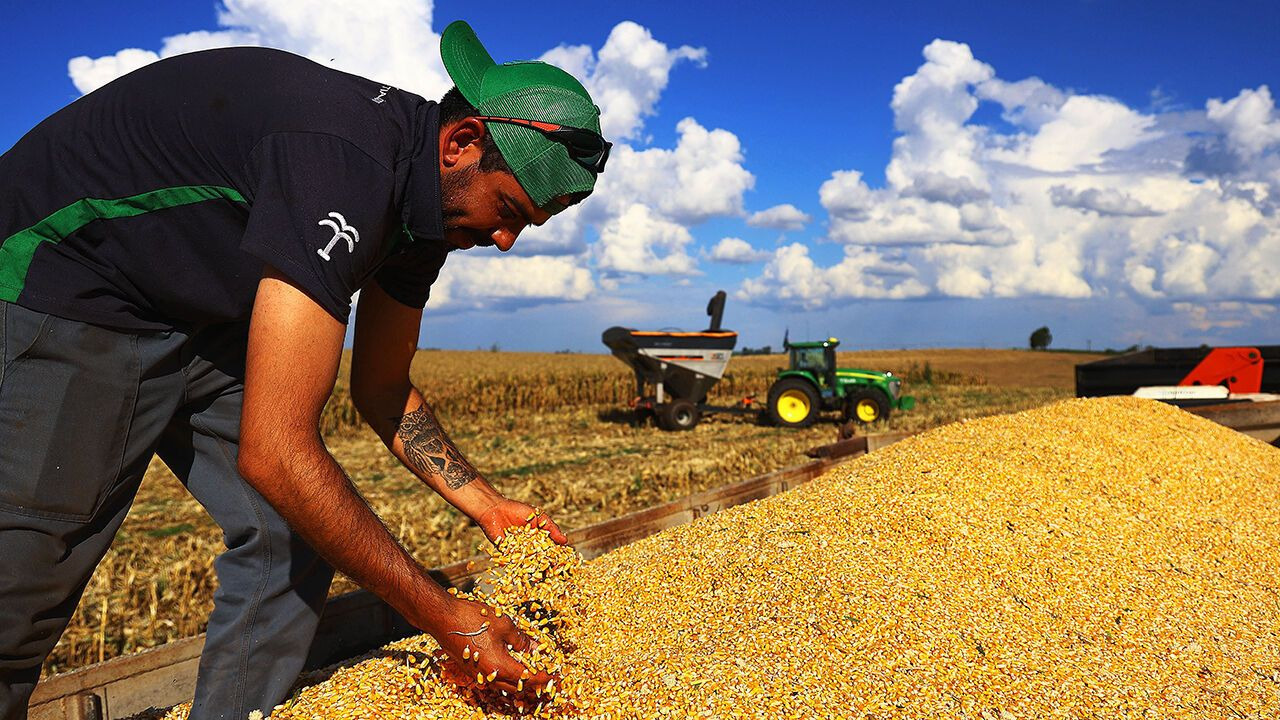
Photograph: Getty Images
Jul 21st 2026|BELÉM|6 min read
Listen to this storyAI Narrated
The smell of grilled meat wafts through the shanty town of Guamá. Its riverside favelas are among Brazil’s poorest, but on a recent weekday residents cooked steak and shrimp on their porches. “Life isn’t easy,” says Alex Lima, a shopkeeper who sells coxinha pasties from his wooden house on stilts in the coffee-coloured water. Yet it is improving, fast.
The share of people who are hungry has been decreasing faster in South America than anywhere else in the world. It is down by one-third since 2020, according to a report published on July 21st by the UN’s Food and Agriculture Organisation (FAO). Just 3.5% of people in the region consume insufficient calories, the lowest level recorded. Eliminating hunger by 2030 is one of the UN’s “sustainable development” goals. “If there is a region in the world that can potentially achieve that, it’s South America,” says Máximo Torero, the FAO’s chief economist.
The continent has been here before. Hunger plummeted in the 2000s as a commodity boom lifted economic growth, allowing left-wing leaders to splurge on social programmes. In Venezuela Hugo Chávez created state-subsidised supermarkets. Argentina’s Néstor and Cristina Kirchner funded comedores populares (soup kitchens). Brazil’s Luiz Inácio Lula da Silva expanded credit for small-scale family farmers. The splurging worked, but when commodity prices fell in 2014, triggering recessions across the region, food insecurity shot up and stayed there. The pandemic made things worse. As unemployment surged, it dragged swathes of the middle class into poverty and hunger.
Yet most countries have recovered. Brazil led the way. Lula, as the president is commonly known, made food security a priority when he returned to office in 2023. By 2025 Brazil had made it off the UN’s Hunger Map, which tracks countries where more than 2.5% of the population suffers from chronic hunger. Chile and oil-rich Guyana were also removed. Argentina is almost there at under 3%. Colombia and Paraguay are approaching at 4%, while Peru and crisis-battered Venezuela are making inroads near 5%. Even Ecuador and Bolivia have improved a tad, to 11% and 20% respectively. Only Suriname is moving in the wrong direction.
This decline rests on sturdier foundations. The first is macroeconomic stability. South America’s central banks are far more independent and adept at managing inflation than they were two decades ago. Its monetary officials were quick to lift interest rates aggressively during the pandemic, getting inflation under control faster than elsewhere. While covid-19 stimulus packages did swell public debt, subsequent governments have trimmed spending, too much of which can pump up inflation. President Javier Milei’s shock therapy has yielded Argentina’s first primary surplus since 2008. Conservatives in Bolivia, Chile and Ecuador are also cutting spending. Newly elected right-wingers in Peru and Colombia pledge to do the same.
This eases pressure on grocery bills. Monthly food-price inflation in Argentina has slowed from a peak of almost 30% in 2023—among the world’s worst rates—to under 2% in June, lower than wage growth. Bolivia’s annual rate was 33% in November, when a right-wing president, Rodrigo Paz, took office. It’s now running at around 13%. In Ecuador food inflation has turned negative while wages are stable. Alongside big oil reserves, fiscal discipline has buffered South America from the economic shock of the Iran war.
Yet groceries that become more affordable over time do little to help those too poor to buy enough food today. Social programmes are the other pillar of South America’s success in reducing hunger. Most famous is Brazil’s Bolsa Família, a cash-transfer programme which pays families a stipend if they vaccinate their children and send them to school. Lula has also raised Brazil’s minimum wage. “These are the core policies,” says José Graziano da Silva, a former boss of the FAO.
Such measures were standard in the 2000s, too. However, they have become more sophisticated, says Elisabetta Recine of Consea, the Brazilian government’s advisory council on food security. Bolsa Família has digitalised payments and linked them to social registries, reducing fraud and increasing flexibility (so that, for instance, it can now cover seasonal workers who dip in and out of poverty). Colombia is looking at scrapping conditions on cash transfers to the poorest, whose children may not have a school to attend. Chile’s version includes job training.
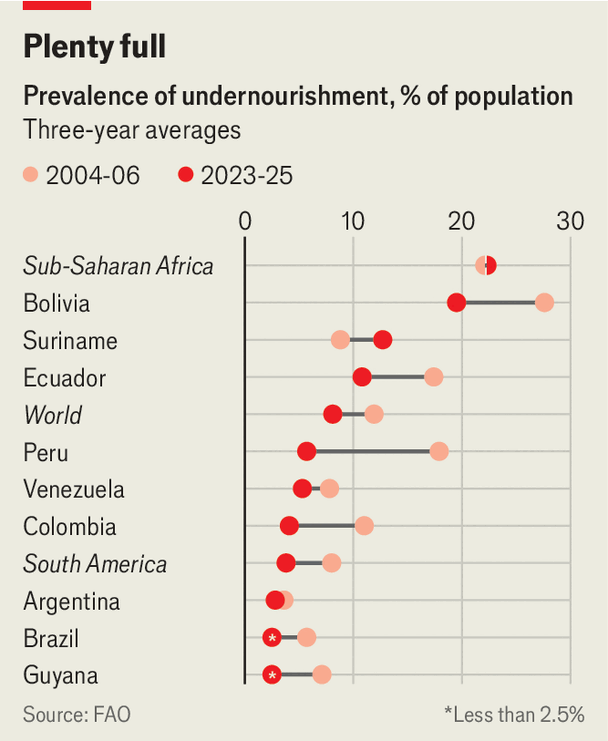
Chart: The Economist
Cash-transfer schemes are wildly popular. Right-wing politicians have embraced them. While in office, Brazil’s former president Jair Bolsonaro tripled the average stipend provided by Bolsa Família. Mr Milei doubled funding for food stamps after receiving criticism from the Catholic church. Abelardo de la Espriella, Colombia’s populist right-wing president-elect, has vowed to shrink the state by 40%, yet claims, optimistically, that he will not touch social handouts. Chile’s arch-conservative president, José Antonio Kast, has needed to invoke the spectre of drug crime in an effort to slash benefits, proposing a “vandals registry” that blocks those with a criminal record from receiving benefits.
Serious challenges remain. The biggest is climate change. With rising temperatures, plant pests and crop failures have become more common. The coming year looks especially fraught. The National Oceanic and Atmospheric Administration, a US government agency, says the coming cycle of the El Niño weather pattern will be “very strong”. That is the highest of the five categories used to rank the phenomenon, used for only the third time since 1950. “It’s going to aggravate every food problem,” says Carolina Trivelli, a former government minister in Peru.
That makes it a bad moment to fine-tune welfare schemes. Yet change is needed. Many countries struggle to wean recipients off cash-transfer programmes. A study found one-fifth of children who in 2005 were covered by Bolsa Família were still covered as adults in 2024. What began as a relatively cheap and focused project in 2003 has ballooned. It now costs 1.5% of GDP and covers nearly a fifth of households. The current design is discouraging workers from joining the formal sector, according to a paper by Daniel Duque of the Getulio Vargas Foundation, a university in São Paulo. “There are more efficient ways to fight hunger,” he says.
Then there is diet. The shares of children who are overweight and adults who are obese have surged to record levels of close to 10% and 30% respectively, among the worst in the world. Adjusted for purchasing power, South America is the fourth most expensive place in the world to procure a healthy diet, after the Caribbean, North Africa and South-East Asia. Fruits and vegetables are surprisingly expensive for an area known for growing them. That is because farmland is largely dedicated to commodities. When greens are produced, bad roads and dodgy cold chains yank up costs. Cash-strapped consumers are more likely to reach for processed, calorie-dense products.
These are manageable problems. New technologies are helping farmers adapt to a changing climate. Policymakers in Bolivia, Brazil and Peru have quietly acknowledged that certain programmes need better targeting. Improved labelling of healthier food is gaining ground, as are sin taxes, says Juliana Tângari of Comida do Amanhã, a Brazilian think-tank. No food system is perfect. Yet outright hunger may soon have rumbled its last in South America. ■
Middle East & Africa | Think big
The return of the African megaproject
Could a new era of big infrastructure developments accelerate growth?
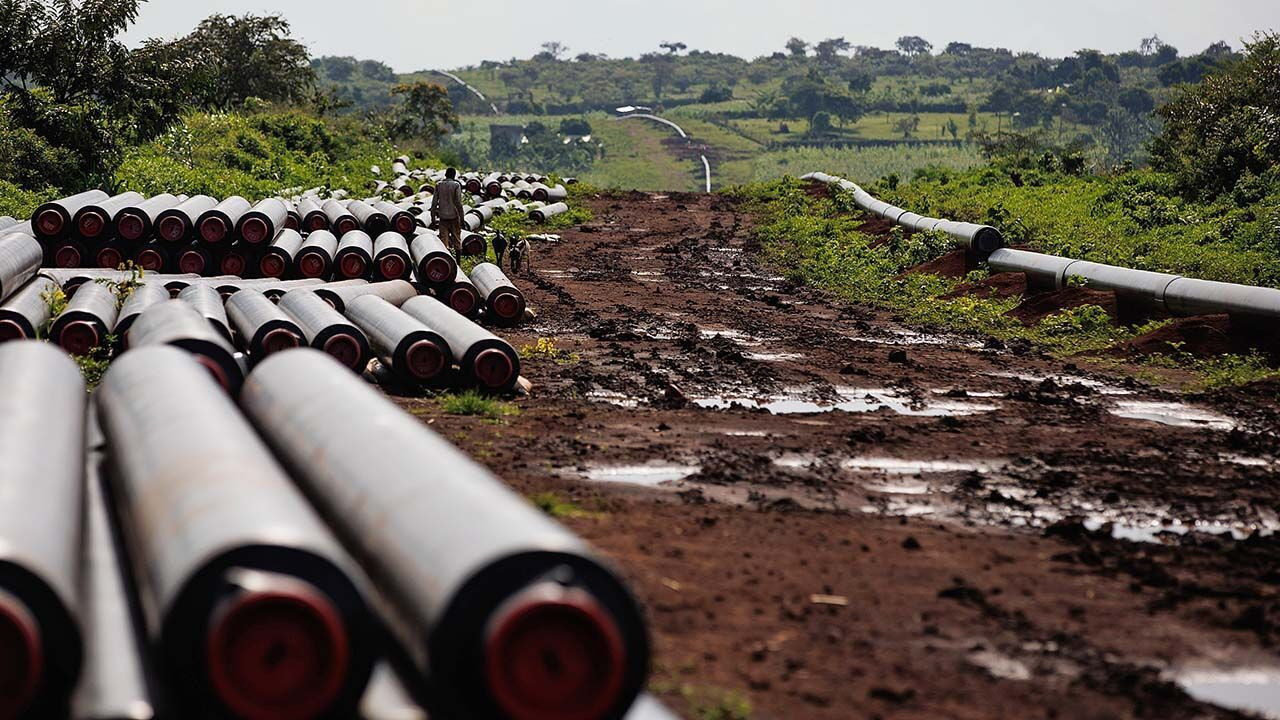
Will they build it?Photograph: Getty Images
Jul 23rd 2026|Lamu|5 min read
Listen to this storyAI Narrated
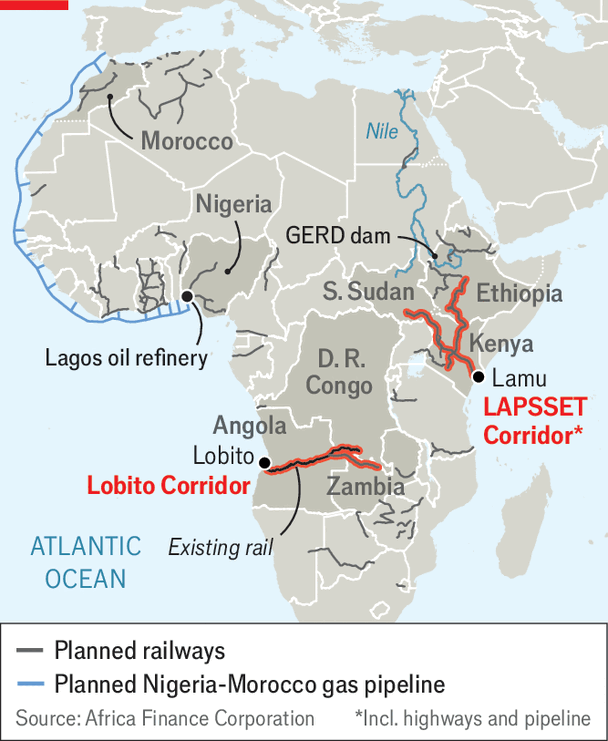
For years Lamu, on the coast of northern Kenya, was a tantalising symbol of unrealised promise. The Lamu Port-South Sudan-Ethiopia-Transport (LAPSSET) Corridor, a colossal scheme estimated to cost $25bn, is supposed to connect a deep-water Kenyan port with markets in Ethiopia and oilfields in South Sudan via a pipeline, railway and motorway. Launched in 2012, it was touted as Africa’s most ambitious infrastructure undertaking. Yet 14 years later only the port near Lamu is operational—and for most of the time since the first ships docked there in 2021, just barely. “When it began it was very quiet,” concedes Abdulaziz Mzee, the port’s manager.
Now, though, Lamu’s port is stirring from its slumber and plans for the corridor are being dusted off. The immediate reason is the war in Iran. Scores of vessels bound for the Persian Gulf have been rerouted to Lamu’s relative sanctuary since February. Yet the renewed discussion of LAPSSET is also a sign of a wider shift in thinking among African policymakers and some investors. Africa is entering a new era of “megaprojects”, schemes costing billions of dollars and affecting millions of people. The question is whether it will accelerate growth or saddle the continent with more white elephants.
Map: The Economist
Three ventures in particular explain the buzz. In 2025 Ethiopia completed the Grand Ethiopian Renaissance Dam (GERD), Africa’s largest hydropower plant. A year earlier Aliko Dangote, a Nigerian industrialist and the continent’s richest man, started production at a $20bn oil refinery near Lagos, Nigeria’s commercial capital. Then there is the Lobito Corridor, a multi-billion-dollar rail, port and road system which is set to link Angola’s Atlantic coast to Congo’s copper belt and, eventually, Zambia (see map). The scheme is backed by both America and the EU.
Bright Simons of Imani, a think-tank in Ghana, reckons the ambition of African policymakers “has gone up dramatically”. In January Ethiopia broke ground on a new airport estimated to cost at least $12.5bn. Nigeria is stepping up long-dormant plans for a $15bn west African transport corridor. On July 19th west African leaders said construction could begin in 2028 on a $25bn gas pipeline along the coast from Nigeria to Morocco, where it may connect to Europe’s gas supply. Railway development in Africa is speeding up, according to the Africa Finance Corporation (AFC), a pan-African lender, with some 7,000km under construction and development, more than twice as much as between 2020 and 2024.
Much of this is needed. The OECD, a club of mostly rich countries, reckons that to double Africa’s total GDP by 2040 the continent would need to spend $155bn (around 5.6% of GDP) per year on infrastructure—nearly twice the annual average from 2016 to 2020 and slightly below the share China was spending at home in the early 2010s (6.7% of GDP). Yet aid cuts and debts are squeezing government finances. In 2025 African countries were projected to pay $89bn servicing their debts. That was before the Iran war pushed up interest rates (higher oil prices cushioned the effect in oil-exporting countries, but squeezed finances even more in others).
Private capital is thus required to fill the gap. Between 2021 and 2024 the total amount of private finance raised across all industries in Africa each year rose steadily from $13.2bn to $20.4bn. Overall, Africa attracted about $70bn in foreign direct investment in 2025, the third-highest level since 1990. Philippe Valahu of the Private Infrastructure Development Group says last year was the best for his donor-backed fund, which focuses on Africa and Asia, since it was launched nearly 25 years ago. Despite global crises, this year “the amount of business we are seeing just continues to increase,” he adds.
There are several reasons to expect the push to continue. One is what Sameh Shenouda of the AFC calls the “demonstration effect” of successful schemes like the Dangote refinery. Another is global volatility, particularly in energy markets. Infrastructure that could reduce vulnerability to external shocks appears more urgent.
Take Lamu. James Mwangi, the boss of Equity Bank, a Kenyan lender, argues that LAPSSET has “been given a tailwind by the crisis in the Middle East”. On July 7th Mr Dangote said he would build east Africa’s largest oil refinery in Kenya, a decision fast-tracked by the need to curb the region’s dependence on fuel imported from the Gulf. The area around Lamu’s port is reported to be his favoured site.
Competition between China and America has also given large infrastructure investments a boost. America’s International Development Finance Corporation (DFC) is backing the Lobito Corridor with $550m in the hope of prising the region’s exports of critical minerals away from China. American diplomats are also keen for the DFC to invest in Ethiopia’s new airport, partly to help American construction firms get ahead of Chinese rivals.
Multilateral lenders have had a change of heart, too. In the post-independence era institutions like the World Bank backed lots of grand modernising projects in Africa, before backing away for decades after many failed to take off or became mired in corruption scandals. These days, notes Ndiame Diop, the World Bank’s vice-president for eastern and southern Africa, “the risk appetite for big projects” is higher.
Yet big projects are still controversial. Battles over land use and the environment tend to be especially fierce. On July 7th Ugandan farmers lodged a court case in London to stop a $5.6bn oil pipeline to the Tanzanian coast, arguing it threatens water and ecosystems (the pipeline’s operating company is registered in Britain).
Such projects also tend to be delayed and more costly than advertised; by one estimate, some 90% go over budget. In Africa that risk may be higher because of what Mr Simons calls the “corridor premium”: the additional cost incurred by the uniquely severe shortage of infrastructure. For a single project to succeed, he argues, an integrated corridor of power, roads and the like must be in place first. If one piece is missing, the whole scheme can fall apart.
That does not mean the new projects are doomed. Jean-Luc Konan of Neemba, an Ivorian firm that worked on Guinea’s Simandou mining complex, notes that delivering infrastructure “forces you to build long-term domestic capacity”. A country’s ability to execute and sustain big projects can thus grow over time. Ambition alone, however, will never be enough. ■
Europe | Spahn out
A surrogacy scandal throws Germany’s conservatives into turmoil
Just when Friedrich Merz’s government was getting its act together
Photograph: AFP
Jul 23rd 2026|BERLIN|3 min read
Listen to this storyAI Narrated
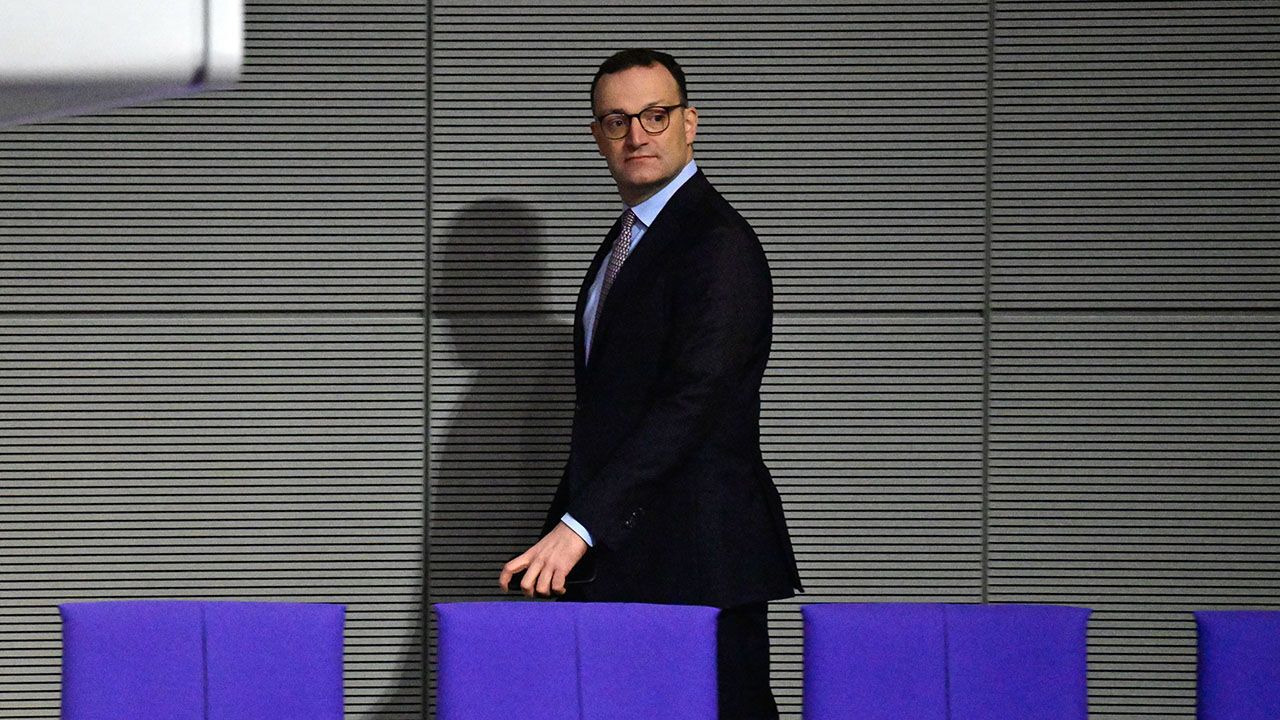
Jens Spahn, until recently the parliamentary leader of Germany’s Christian Democratic Union (CDU) and the Christian Social Union (CSU), its sister party, is deficient in sharp political instincts. On July 15th Mr Spahn said on social media and in an interview with Bild, a tabloid, that he and his husband had had a baby boy via a surrogate in America. Unfortunately for him, that looked to voters like brazen hypocrisy. Surrogacy is illegal in Germany and Mr Spahn, a conservative former health minister, had argued that it should remain so. Three days later he resigned.
Mr Spahn’s departure is awkward for Friedrich Merz, the chancellor. The pair are not close: in 2018 Mr Spahn ran against Mr Merz for the CDU’s leadership. But Mr Spahn had a good relationship with Matthias Miersch, his opposite number in the Social Democratic Party, and was effective at managing the quarrelsome coalition between their two parties.
The pair brokered a comprehensive reform package, a 34-point “programme for growth and employment”, finalised on July 1st. Its most important elements are reforming the ailing public-pension system and providing tax relief for low- and middle-income earners. The government needs to deliver such measures if it is to have any chance of heading off the hard-right Alternative for Germany (AfD) in state elections in eastern Germany in September. Without Mr Spahn’s dealmaking nous, the coalition could return to disarray.
Walk the plank
Mr Merz was slow to grasp the strength of the outcry over Mr Spahn’s announcement. In his annual Sommerinterview on zDF, a public broadcaster, the chancellor hinted that the public’s anger was so strong because of Mr Spahn’s divisive and scandal-prone personality.
Mr Spahn is one of Germany’s least popular politicians. In 2020 he got a loan for a villa from a bank where he had served on the supervisory board. During the pandemic he awarded a contract for overpriced face-masks to a firm employing his husband (the health ministry denies preferential treatment). Many dislike his MAGA connections: he is friendly with Richard Grenell, a former American ambassador, and Peter Thiel, a hard-right tech mogul.
Mr Merz wants to move on quickly from the Spahn affair. On July 29th lawmakers from the CDU and CSU will interrupt their holiday to vote on Mr Spahn’s successor in Berlin. According to media reports, Thorsten Frei, the head of the federal chancellery, will be his replacement. “He is popular among parliamentarians though he is not as strategic as Spahn, who could bring them to heel,” says Cathryn Clüver Ashbrook of the Bertelsmann Foundation, a think-tank. Mr Frei’s likely successor is the health minister, Nina Warken. Moving her will require a cabinet reshuffle.
It is not clear whether a change of personnel would revive Mr Merz’s sagging popularity. He could try to reboot his government by replacing a few of the CDU or CSU ministers in his coalition government. Voters don’t much like Patrick Schnieder, the transport minister, or Katherina Reiche, the economy minister. Mr Schnieder is blamed for the notorious delays at Deutsche Bahn, the national railway service. Ms Reiche is unpopular because of her perceived closeness to the fossil-fuel industry and her inability to come up with an effective industrial policy. ■
International | The Telegram
The Iran war is consuming the Trump presidency
Donald Trump may hate to hear it, but Barack Obama was right about avoiding “stupid shit”
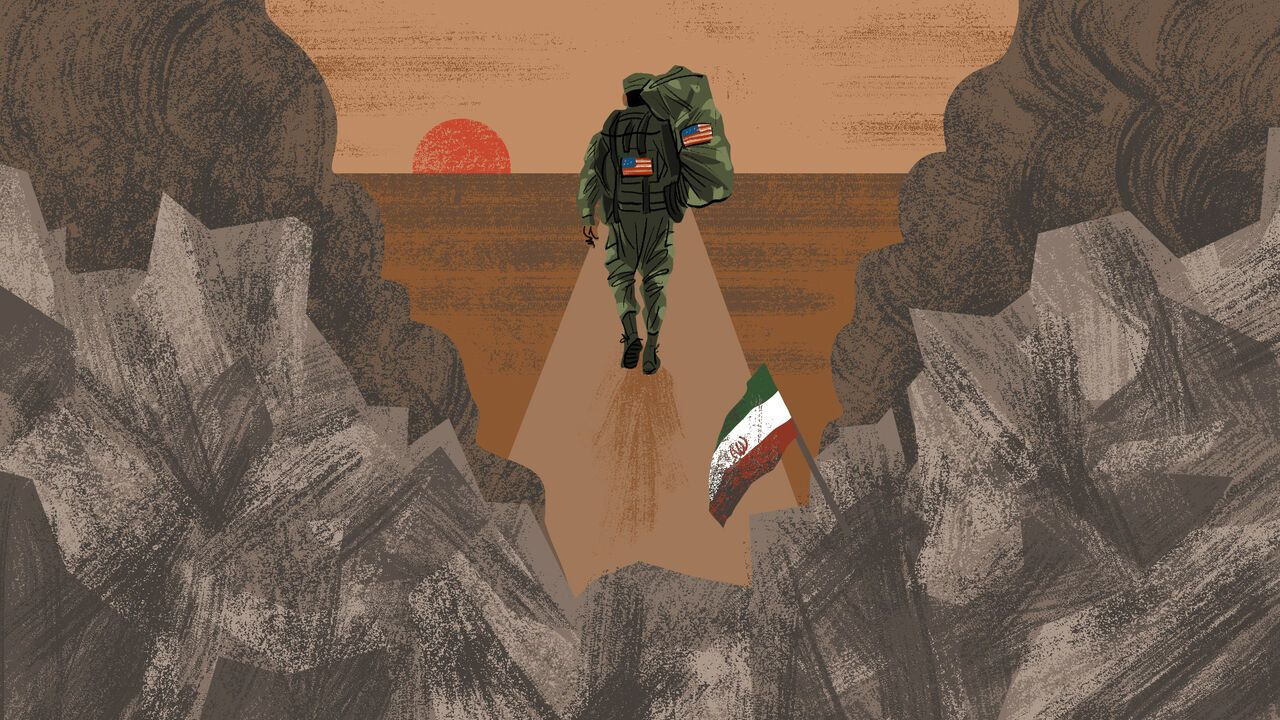
Illustration: Chloe Cushman
Jul 21st 2026|5 min read
Listen to this storyAI Narrated
HERE IS A thought to chill the blood of President Donald Trump. He would be in a far better place today if he had followed the foreign-policy advice of the predecessor he loathes, Barack Obama. According to the Obama doctrine, as explained years ago to Jeffrey Goldberg, a journalist, an American president’s first duty in world affairs is: “Don’t do stupid shit.”
As doctrines go, it is not very sophisticated. Moreover, cerebral Mr Obama left a mixed foreign-policy record: he was slow to grasp the full scope of the China threat, for instance. Still, if Mr Trump had heeded him, he might not have joined Israel in launching war on Iran on February 28th without a plan for victory. Mr Trump might not have boasted that the killing of Iran’s top leaders, followed by punishing air strikes, would soon trigger regime change. Given Iran’s complexity and its rulers’ ruthlessness, that was as daft as predicting that the Mafia could be bombed out of Sicily from the air. Now, Mr Trump’s war may consume his presidency.
The president’s Middle East record includes real successes, notably the recognition of Israel by four Arab states in the Abraham accords. Mr Trump deserves credit for (belatedly) strong-arming Israel’s prime minister, Binyamin Netanyahu, into a ceasefire last year with Hamas, though conditions in Gaza remain grim. His decision to join Israel in bombarding Iran’s nuclear sites last summer was risky, but not stupid. The operation came with costs, including the loss of access to Iran’s highly enriched uranium for international inspectors. Still, inflicting severe damage on Iran’s underground nuclear programme followed a coherent logic. Iran’s muted response in retaliation was a further vindication.
Not all presidential blunders meet the Obama-doctrine test. Take Mr Trump’s repeated demands to own Greenland. He is deeply unwise to alienate Denmark, the island’s colonial master and a devoted American friend. Still, Denmark remains a NATO ally, needing America to deter Russia. In contrast, an actual invasion of Greenland would qualify as unambiguously stupid shit.
When Mr Obama coined the term, he was thinking of his own predecessor, George Bush, and the fatal mix of vengefulness, impatience and over-ambition that doomed the American-led campaigns in Afghanistan and Iraq that followed the September 2001 terrorist attacks. After studying the Bush years, Mr Obama learned (and indeed overlearned) abiding lessons about the dangers of American hubris. He was sceptical of nation-building in far-off lands, believed that only the gravest threats to America warrant armed intervention and thought of many allies as aggravating free-riders on American power. Striving to balance his coldly realist instincts with the liberal values that he believed his country should uphold, he suggested that America should pick its battles, and be “hardheaded at the same time as we’re bighearted”.
As it happens, Mr Trump shares many Obama-esque instincts, for all his sniping at the man. He too is wary of nation-building and annoyed by free-riding allies. He is unlike Mr Obama in his relish for America First bullying, his disastrous disdain for detail, his unblushing personal greed and his contempt for liberal values. In an unhappy mirror-image of the Obama years, Trumpian foreign policy too often revels in being bigheaded and hardhearted.
When it comes to the Middle East, both presidents hoped America could pivot away from a role as the region’s dominant security provider. From 2011 or so, the Obama administration openly sought to shift military and diplomatic resources away from Iraq and Afghanistan towards Asia, a dynamic region where investments of American power would “yield the biggest returns”. Obama aides talked of increased American energy production rendering the Middle East less relevant. With some bitterness, they accused such allies as Saudi Arabia of trying to goad America into fighting Iran on the Arab world’s behalf. Mr Obama’s full pivot to Asia was thwarted by renewed Middle Eastern instability, though, including civil war in Syria and the rise of Islamic State.
Mr Trump announced his own Middle Eastern pivot last year. The region would soon be “defined by commerce, not chaos”, he told Arab leaders in Riyadh. The days of the Middle East dominating American foreign policy are “thankfully over”, declared his national-security strategy, with conflict replaced by deals to sell American nuclear, defence and AI technologies. Seeking returns of their very own, Trump family members have secured hundreds of millions of dollars from Gulf rulers and their investment funds.
Then Mr Trump launched his war with Iran, upending Gulf business models. It is hard for Arab states to build billion-dollar data centres filled with American chips when Iranian missiles are falling. A different, gloomier sort of pivot now looms, involving Middle Eastern partners losing faith in America as a reliable ally.
The Gulf learns not to rely on America
Though the United Arab Emirates remains all-in on defence ties with America, others in the Gulf, led by Saudi Arabia, the regional giant, can be seen hedging. America remains uniquely important as a partner, but it is less trusted. Some Gulf rulers will quietly pay Iran for a quiet life. Others are deepening defence ties with such actors as Turkey, and economic links with China. It does not help that Mr Trump has played down Iranian attacks on American bases and local infrastructure in Gulf countries, anxious to obscure the war’s costs. Perhaps eager to convey his dominance as the war raged, in March Mr Trump publicly mocked the Saudi crown prince, Muhammad bin Salman, bragging that the prince never imagined “he’d be kissing my ass” as American president.
In a rough world brains are not everything, as the Obama administration learned to its chagrin. But Mr Obama was right that reckless presidential stupidity causes catastrophes. If Mr Trump talked less and listened more, he might have heard the warning. ■
Business | Croesus or Cassandra?
Elon Musk’s vision of the future
The world’s richest man sits down with The Economist
Photograph: Cathlin McCullough
Jul 23rd 2026|AUSTIN|6 min read
Listen to this storyAI Narrated
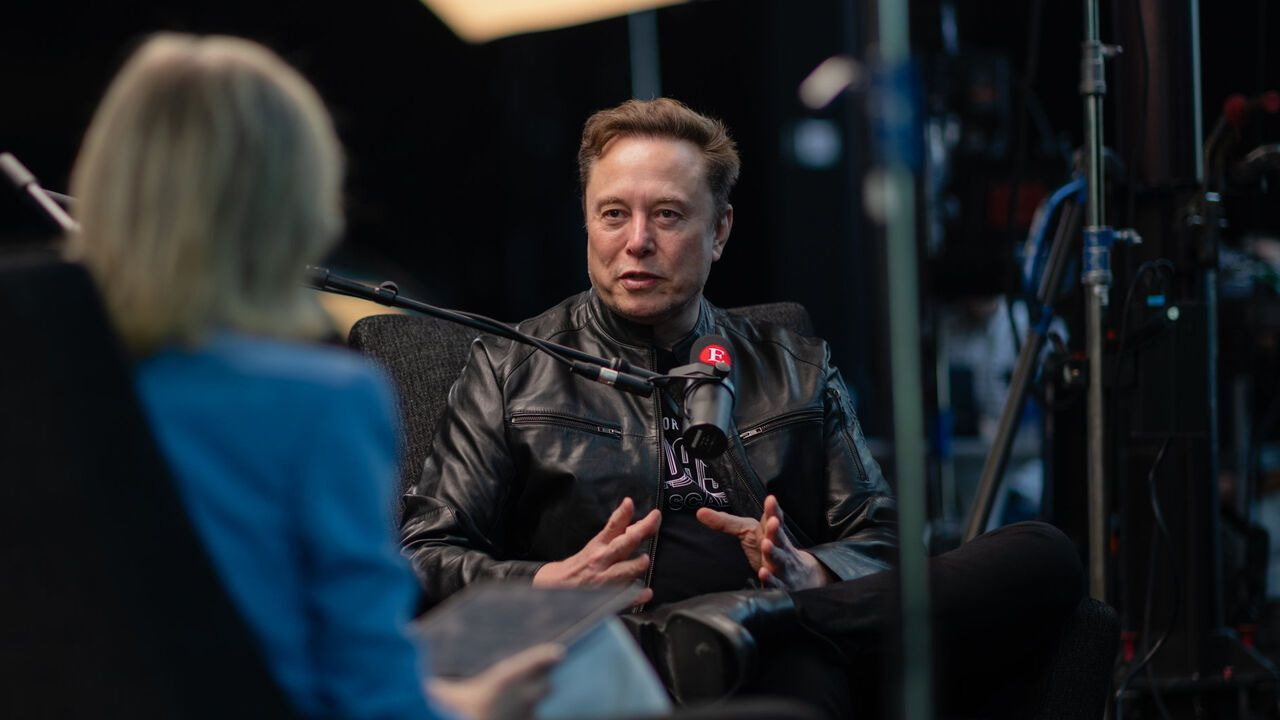
ELON MUSK, in his telling, is a modern-day Cassandra—better than most at predicting the future, but doomed to be disbelieved. “People don’t realise that what I’m saying will come to pass,” he tells The Economist in a 90-minute interview for The Insider, held at a giant Tesla factory in Texas where electric cars drive themselves off the assembly line. That may be because his future-gazing ranges from the unsettling to the downright weird. Mr Musk predicts that, within five years, artificial-intelligence systems may surpass the sum of all human intelligence. Within ten years, robots in the workplace will help usher in an era of such “amazing abundance” that money will become meaningless. And within 20 years, Britain—a country that he has not visited for years—will be engulfed in civil war.
Believe them or not, the predictions of Mr Musk, who last month briefly became the world’s first trillionaire, are worth taking seriously. The driving force behind Tesla and SpaceX, a rocket-maker turned AI conglomerate, is doing more than any entrepreneur to shape the future. His influence—powered by money and feats of engineering genius—stretches from the White House to global trouble spots such as Ukraine. With 240m followers on X, his social-media platform, Mr Musk’s views, especially those that are divisive, have significant repercussions.
Dressed in black boots and a leather jacket with the logo of Grok, his chatbot, on the back, he showed flashes of the steely single-mindedness that helped him pioneer the mass-production of electric vehicles and send reusable rockets into space against all odds. He also showed how bent on shaping his own reality he is, to the point of intransigence on matters outside his sphere of expertise.
It was Mr Musk’s first extended interview since the public listing of SpaceX, which soared to a value of $2.6trn in the days after trading began but has since plunged to $1.6trn, a fifth below what it first traded at. The main topic of conversation was AI. It is a technology, he says, that can move him from “exhilaration to terror” in a single day. For now, his “philosophical conclusion” is to “look on the bright side”.
It is a choice that conveniently serves his own interests. Mr Musk believes that AI systems and robots will eventually handle most digital and physical jobs, rendering work by humans “optional”. To that end, xAI (now called SpaceXAI) is developing systems to perform cognitive tasks such as software programming while Tesla is manufacturing humanoids. Mr Musk plans to power the whole AI caboodle with data centres in space.
Without jobs, he suggests there may need to be large-scale wealth redistribution to create “universal high income” for humans. But although the world’s richest man says he is fine to pay “trillions in tax”, he also argues that money will be irrelevant a decade from now. Thus he argues that governments should simply “issue people cheques”, because amid an infinite supply of goods and services produced by machines, deflation will be a bigger problem than inflation.
Mr Musk acknowledges there are imminent risks from increasingly powerful AI systems. Noting that the capabilities of frontier models are improving rapidly, he elaborates on a recent proposal by Sir Demis Hassabis, co-founder of Google DeepMind, for America’s government to set up a self-regulatory body via which the industry would test its own models for dangers. Mr Musk argues that the effort should be extended to China, and that leading AI labs, including Chinese ones, should have a week or two to inspect each other’s latest models before release, flagging any risks to governments in both Washington and Beijing. “The competitors can keep each other honest.”
He goes so far as to suggest that, in order to keep models safe, he may even be prepared to bury the hatchet with Sam Altman, boss of OpenAI, with whom he has fought a losing battle in court over recriminations stemming from the days when they co-founded the AI lab together. “At the end of the day, if we have to talk, we’ll talk,” he says, adding that both men might need to “set aside our personal differences for the good of the world”.
Mr Musk seems much less worried about the rise of Chinese labs than other AI bosses, such as Anthropic’s Dario Amodei. He is impressed by new releases like Kimi K3, unveiled this month by Moonshot AI, and reckons there is a “good chance” that Chinese AI firms will become “the leaders at some point”, pointing to the country’s electricity supply, which vastly exceeds America’s, and its ability to churn out robots. (He adds that he finds videos of Chinese robots knocking each other’s heads off “pretty funny”.)
Mr Musk opposes efforts by some officials in the Trump administration to ban American companies from using Chinese models, saying it would not do much to stop their makers from winning the AI race. He expects China eventually to overcome its shortage of cutting-edge chips, the result of American export restrictions, by creating its own lithography machines, the absence of which currently prevents it from manufacturing sufficient quantities of high-end processors. Currently ASML, a Dutch firm, holds a monopoly on the sale of the most advanced class of lithography tools, and is barred from selling them to America’s superpower rival. But China is “closer than most people realise to solving the lithography problem,” says Mr Musk.
The serial entrepreneur is unabashed about the amount of power he wields. He contends that AI will control almost everything eventually, and that his dominance of SpaceX, where he holds more than 80% of the voting shares, is aimed at ensuring that its long-term goal of turning humanity into a multi-planetary species with a colony on Mars is achieved, even if it depresses short-term profits. As for his sway over American politics, where his money and influence helped return President Donald Trump to power in 2025 (and briefly put Mr Musk in charge of gutting the federal bureaucracy), he says he became too involved. “I got carried away, frankly.”
Still, he shows no sign of relinquishing the geopolitical bully pulpit. Although SpaceX’s Starlink satellites, which provide internet connectivity in remote places, have been used to help Ukraine counter Russia’s invasion, Mr Musk remains adamant that any peace deal should offer territorial concessions to the aggressor. He describes the media’s characterisation of Europe’s far-right as “false, misleading and nonsense”, and argues that it is made up of “normal people” seeking safe cities, secure borders and sensible spending.
His jeremiads about civil war in Britain stem from a view that an influx of people whose ideas are “antithetical to Western beliefs” will lead to a reckoning. Asked if he is anti-Muslim, he replies: “I’m against rape and murder. I’m against the imposition of rules and laws that are contrary to what we’ve come to accept in the West, and it’s a crying shame that traditional media, like you, don’t recognise this.”
It is unclear how his dark vision of the future outside America fits with his AI utopianism. But even Mr Musk wonders if it all makes sense. At times, he says, he believes in a theory in which the universe is a computer simulation created by aliens. “The things I’m doing are so preposterous that it’s hard to believe they’re real.” ■
Business | Hazy rich Asians
China’s mysterious new billionaires are conquering the world
And refusing to talk to the press

Illustration: Jared Bartman
Jul 19th 2026|Shanghai|7 min read
Listen to this storyAI Narrated
Early last year, when DeepSeek, a Chinese artificial-intelligence lab, was causing panic among its Western rivals, almost nothing was known about Liang Wenfeng, its founder. Mr Liang remains a mysterious figure, but at least one thing is clear. As DeepSeek closes a funding round valuing it at $71bn, its founder’s personal wealth has soared to roughly $38bn—making him far wealthier than Anthropic’s Dario Amodei or OpenAI’s Sam Altman.
Mr Liang will not be spotted on the conference circuit. He has never appeared live on Chinese TV, and there are few photos of his unpolished, wiry figure. That puts him at home among the new generation of young Chinese billionaires. The country is cranking out more of them than anywhere else bar America. According to Hurun, which tracks the riches of the world’s wealthiest people, there are at least 29 self-made billionaires aged 40 or under in China. Adding Mr Liang, who will turn 41 at some point this year, brings the total to 30. That is nine more than last year.
China’s new tycoons differ from their predecessors in striking ways. They have abandoned property speculation and boozy dinners with officials for video games and meet-ups over Japanese anime. But they are also adept at taking imaginative ideas and scaling them into global businesses faster than any before them.
The history of China’s uber-rich is short. In the 1980s tycoons figured out how to wrest assets from the state. Zhang Ruimin, a member of a troupe of students who terrorised teachers and intellectuals during Mao’s era, got hold of a state-owned refrigerator business called Haier and turned it into what is now the world’s largest home-appliance maker. The opening of the property market in the 1990s minted another early group of billionaires including Xu Jiayin, founder of Evergrande, a now-collapsed property developer.
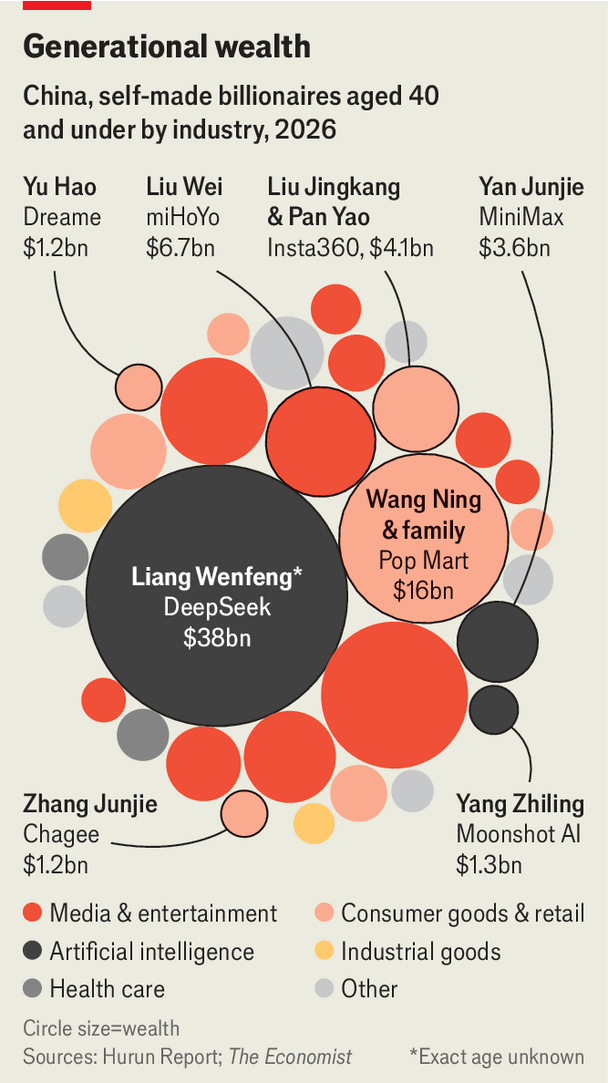
Chart: The Economist
In the early 2000s industrialists such as Wang Chuanfu of BYD, originally a battery maker, launched a wave of manufacturing firms as China entered the World Trade Organisation. And then in the 2010s the consumer internet produced China’s first generation of tech moguls, including Jack Ma of Alibaba, an e-commerce giant, and Pony Ma of Tencent, maker of WeChat. The founders of ByteDance, creator of TikTok, and Shein, the online fast-fashion firm, who are both now in their early 40s, built their fortunes a few years later.
China’s new generation of tycoons are charting out a different path. More than two-thirds of the young billionaires on Hurun’s rich list made their money from consumer goods or media (see chart). Seven created video games; four built tea or coffee businesses. After Mr Liang, the wealthiest is Wang Ning, founder of Pop Mart, maker of the strange-looking Labubu dolls. Only three have struck it rich with AI, including Yang Zhilin, the baby-faced 34-year-old founder of Moonshot AI, which on July 17th released a new model that is said to rival the best from America. No property mogul makes the list—perhaps unsurprisingly, given how the sector has fared in recent years.
The businesses built by China’s new billionaires are also far more global than in the past. It once took a decade or more for Chinese entrepreneurs to figure out foreign expansion. No longer. Zhang Junjie, the 33-year-old founder of Chagee, a milk-tea shop, launched his firm in 2017 and opened his first overseas shop just two years later. The company is now listed in New York and operating in nine countries.
The new tycoons’ heavy reliance on foreign markets partly reflects the slump in consumer spending at home. Around 80% of sales at Dreame, a consumer-electronics brand founded by 39-year-old Yu Hao, come from overseas. Insta360, which sells small waterproof cameras, is almost as reliant on foreign demand. Pop Mart made more than $2bn in sales outside China last year, about 40% of its total. Chagee’s sales at home have slumped, but overseas they are growing healthily.
Attitudes to work are also different among this cohort. A controversial part of Chinese business culture for the past decade or so has been the so-called “996” routine, working from 9am to 9pm six days a week. The idea was championed by Alibaba’s Mr Ma and embraced by other local tech giants. At Pinduoduo, another e-commerce platform, young white-collar staff have died from overwork on their way home from the office.
China’s new entrepreneurs, by contrast, have adopted a more relaxed approach to management. Many are relatively flexible about working times. Liu Wei, the 39-year-old billionaire co-founder of miHoYo, a gaming firm, has eschewed presenteeism. He has overseen what the company calls its “happy work, steady growth” approach, which prioritises mental health (though one employee also recently died from complications related to overwork, suggesting that cultural norms are hard to shift). DeepSeek’s Mr Liang has reportedly said that the human brain can concentrate only for 6-8 hours a day, and that overwork leads to mistakes.
The willingness of workers to put in longer hours than anyone else in the world is what has built the Chinese economy over the past 30 years, huffs one private-equity investor, who recently visited an up-and-coming consumer brand and did not like what he saw. Some blame the relatively laid-back attitude of China’s young founders on cushy upbringings. Gone are the tales told by earlier tycoons of struggling for survival amid the country’s political and economic convulsions. Among China’s young billionaires, only Mr Liang and Mr Zhang of Chagee grew up poor. The three founders of miHoYo originally bonded over Japanese cartoons and formed their company as a celebration of gaming and comics. The founder of MiniMax, an AI lab, is so fond of a multi-player game called “Dota 2” that his staff refer to him as “IO”, a character from it.
To get rich is perilous
It is not all rosy for China’s young billionaires. The relationship between China’s government and its wealthiest people has deteriorated over the past few years. Older magnates once viewed themselves as part of a nation-building project. The property sector, which contributed up to a quarter of China’s GDP at its peak, was a collaborative effort between private entrepreneurs and local officials. Mr Ma was instrumental in building China’s digital economy. But the central government has now punished many prominent figures in these areas. Leverage has been sucked out of the property industry. Mr Ma’s business empire became the subject of a state crackdown in 2020 after he criticised regulators. Xi Jinping, China’s ruler, has sought to tamp down inequality under the slogan of “common prosperity”.
In 2021 Zhong Shanshan, the 71-year-old founder of Nongfu, a bottled-water company, reached a net worth of nearly $100bn. No one has since come close, including Mr Zhong, who has seen his wealth plunge to around $39bn as the share price of his company has slumped. Mr Ma is worth roughly a fifth as much as in 2021, and many other internet moguls have suffered similarly. Still, they have fared better than property magnates, a number of whom have been detained.
This environment has created a sense of disillusionment among China’s young billionaires. Many are eager to engage in industrial policy but are given little opportunity to do so, notes Steven Hai of Xi’an Jiaotong-Liverpool University. Their global ambitions also leave them exposed to souring relations between China and America. Xiao Hong, the 33-year-old founder of Manus, another AI firm, would have become a billionaire earlier this year if the Chinese government had not stopped him from selling his company to Meta, an American tech giant.
These innovators live with the sense that the businesses they have built could be derailed at any time by sudden policy changes in China or America, notes Rupert Hoogewerf of Hurun. By shunning publicity they seem to believe they can survive for longer, he says. Most young Chinese billionaires have never spoken to foreign media. (None would speak to The Economist.) Many avoid the Chinese press as well. The result is a generation of tycoons that is both China’s most global yet—and its most enigmatic. ■
Business | Schumpeter
Capitalism’s status hierarchy is being upturned
One of the modern world’s most powerful forces is among its least understood
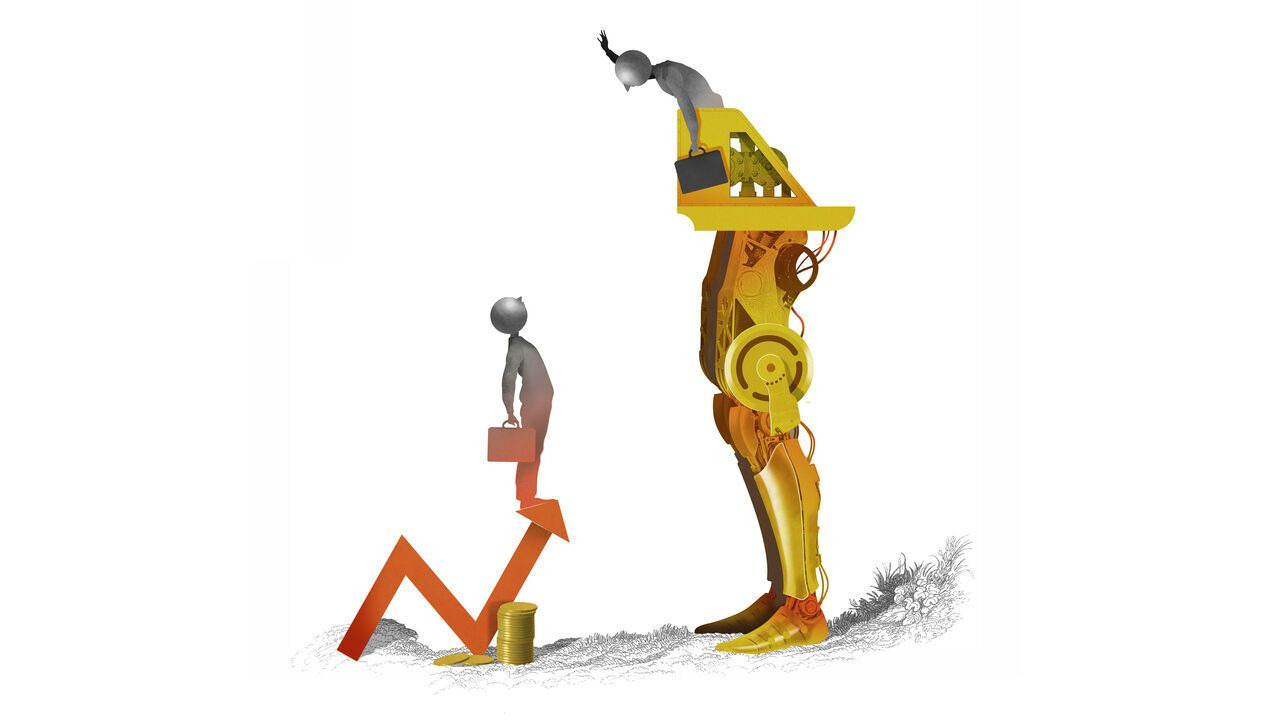
Illustration: Brett Ryder
Jul 22nd 2026|5 min read
Listen to this storyAI Narrated
At a recent dinner party, Schumpeter got talking to a wildly successful young man who was downright miserable. He was on the very fast track at a very big hedge fund. His friends, however, were making even bigger bucks in artificial intelligence, a field which he was convinced would soon consume his own industry. Among the company he keeps, the bright lights of finance shine less brightly than they used to, causing his own star to dim. Our protagonist was experiencing one of capitalism’s most powerful forces. He was in the throes of status death.
The modern worker is status-obsessed. Even the bosses of giant companies find time to post on LinkedIn, a social network that functions as a forum for gloating. If management gurus agree on anything it is that individuals care deeply about their relative standing within their firm. When it is said that a business succeeds because of its corporate culture, what is often meant is that status is prudently distributed within its walls.
Yet our age is one of status death. Capitalism’s status-industrial complex has been upturned, as institutions such as universities and newspapers that once conferred prestige lose their power to do so. Complaints from those who feel status-mugged are increasingly commonplace. In a guest essay in the New York Times this week, a television writer whined about the decline of his once-glamorous occupation. “The biggest winners of the American economy fear they’re sinking fast,” announced a headline in the Washington Post.
Few firms think more about status than makers of handbags. Yet they, too, have been swept up in this wave of abasement. The share prices of LVMH and Kering, two French luxury-goods giants, have fallen steeply this year. Knight Frank, a posh British estate agent, compiles its own index of luxury goods such as fine wine and contemporary paintings. Its value began falling in 2022.
The luxury industry’s failure to benefit from the monumental increase in stock-market wealth over the past few years is not the puzzle analysts say it is. During the 2010s its largest brands grew fat selling merely expensive goods to the affluent, rather than very expensive ones to the extremely rich, making its products accessible to the point of being undesirable. The woes of Nike, a sportswear brand, can likewise be attributed to excessive egalitarianism, since it has prioritised leisurewear at the expense of elite sportswear. The violent reaction to Ferrari’s first foray into electric vehicles can be understood the same way: the rise of cheap Chinese EVs has shattered that industry’s veneer of exclusivity.
Wall Street has developed various techniques for rationing declining status. Its banks, which are no longer the apex predators of finance, neatly separate their workers into the “back”, “middle” and “front” office, so that everyone knows their proper place. Woe betide the first-year analyst who turns up in a shiny Hermès tie he has not yet earned with his sweat. Banks also maintain an intricate currency of fictional titles to allow those being stripped of status (for example, those being “promoted” from “managing director” to the professional dead-end of “vice-chairman”) to pretend otherwise. Goldman Sachs, a bank whose ability to remain the top adviser on mergers for decades owes much to its carefully cultivated status, continues to use the title of “partner” long after it ceased to be a partnership.
Silicon Valley, by contrast, likes to think of itself as a classless place: its scruffy coders work in open-plan offices building products anybody can use. But is there any industry whose workers are more fearful of status death? While a lucky few at the white-hot centre of the AI labs muse publicly about how they should wield god-like power, ordinary software engineers panic that the technology will make these former masters of the digital universe obsolete. When Valley-types call themselves “investors” nowadays you are left guessing whether they are making a fortune pumping fuel into AI rocket-ships or desperately trying to keep sickly software unicorns alive.
The anxieties that accompany rapid technological change have thus far benefited the AI labs. Workers are incentivised to over-use the technology, if that means their bosses consider them an AI-literate asset rather than an AI-illiterate cost. Yet misunderstanding the awesome power of status is among the AI industry’s greatest risks. The pride with which its bosses have talked about white-collar job losses is an error born of a failure to appreciate how much workers wish to avoid a diminution of their standing. Some of its weirder folk consider AI an inevitable, even “worthy” successor to humans—a sort of species-wide status death. Such cosmic cuckoldry will make them even less popular.
President Donald Trump is the grim reaper of status death. His attacks on universities and the media have done much to damage their standing. Mr Trump, however, must also be aware of his own status mortality. Becoming arguably the most powerful—and certainly the highest-earning—president in American history will make leaving office a truly huge demotion. The downgrade from president’s son to ex-president’s son is even greater, which is presumably why Mr Trump’s eldest two are furiously striking business deals with all manner of companies that could benefit from proximity to the White House. The logic of self-enrichment thus owes much to the logic of status death.
Falling upwards
It is not all bad news, however. The fear of status death can be a spur to great things. The nauseating feeling that one has arrived late to a party that has almost finished has caused generations of entrepreneurs to leave and start another. Your columnist’s dinner companion has since quit his job, in search of more money—and, crucially, higher status. ■
Finance & economics | Billionaires
The rise of the deserving rich
Today’s billionaires are more likely than yesterday’s to have made their own money
Illustration: George Wylesol
Jul 23rd 2026|8 min read
Listen to this storyAI Narrated
BILLIONAIRES HAVE never exactly been popular, but today they are loathed. Politicians in America’s Congress talk about them far more than ever before, usually to decry their ill-gotten gains or their malign influence on politics, or to insist that their wealth needs taxing (see chart 1). Fundraising emails from Democrats are three times as likely to mention billionaires—and almost always negatively—as they were in 2024, according to Andrew Hall of Stanford University. “Every billionaire is a policy failure” is a common cry from the left, linking members of the ten-figure club with a rigged economy and social decay.
Yet just as politicians think they have hit on a winning message, something unexpected is happening. More and more billionaires derive their wealth not from accidents of birth or from gaming the system, but by providing useful goods and services and by employing thousands of people. Perhaps billionaires are still policy failures—but to a lesser extent than before.
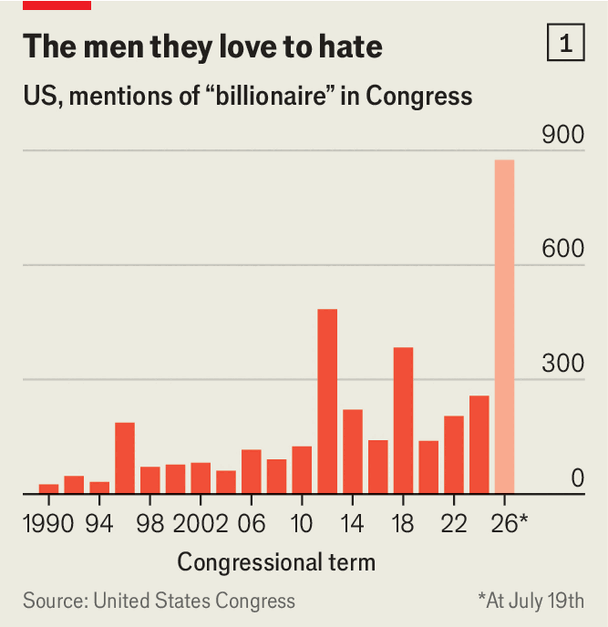
Chart: The Economist
Many billionaires are unquestionably sketchy. John D. Rockefeller, probably the first person in history whose net worth crossed $1bn (and in the prices of the early 20th century), was a genius. But his company, Standard Oil, also took advantage of weak competition laws, and probably gave out plenty of bribes, to stack the deck in its favour. The oligarchs who emerged in Russia in the 1990s seized state assets during a period of violent chaos. And dodgy wealth is a satirist’s dream: C. Montgomery Burns, in “The Simpsons”, skimps on safety at his nuclear plant to cut costs.
The surge in anti-billionaire sentiment reflects several forces. After a few years of high inflation hitting living standards, people are looking for someone to blame. Billionaires, the thinking goes, use their market power and buy political influence to overcharge for everything from housing to groceries, and then pay low taxes on the profits. The “affordability crisis” and the powerful billionaire are thus two sides of the same coin. And political strategists, chiefly but not exclusively on the left, have realised that billionaires are the perfect enemy. A tax on their wealth would affect almost nobody a voter has ever met.
Yet many billionaires make their money without a hint that they enjoy questionable monopolies or political favour. Oprah Winfrey, worth $3.4bn today, has become rich because millions want to watch and listen to her. Cristiano Ronaldo’s nine-zero fortune rests on scoring amazing goals. Others are less well known, but similarly impressive. Peggy Cherng, the co-founder of Panda Express, is worth perhaps $6.5bn, having built a restaurant chain that serves cheap meals to millions. Yanai Tadashi, who is worth tens of billions, built up Fast Retailing, the parent company of Uniqlo. Can you really begrudge someone who makes such great T-shirts?
The Economist has quantified the better (Ms Winfrey, Mr Yanai) and worse (Mr Burns) sorts of billionaire wealth. Drawing on data from Forbes, a magazine, Hurun, a research firm, and Gapminder, a Swedish foundation, we have assembled a list of about 7,000 billionaires from the past 25 years. We call a billionaire’s wealth “uncompetitive” when it mainly comes from industries such as gambling, construction, defence and raw materials. These sectors often depend on political access. It is hard to open a mine or a casino, for instance, without friends in the government.
We count inheritors in the “uncompetitive” category. Heirs are usually not oligarchs. They have usually not bent or broken any laws, or screwed over customers; they were simply born into the right family or married well. Yet they plausibly represent policy failures too, on the grounds that their immense riches are undeserved.
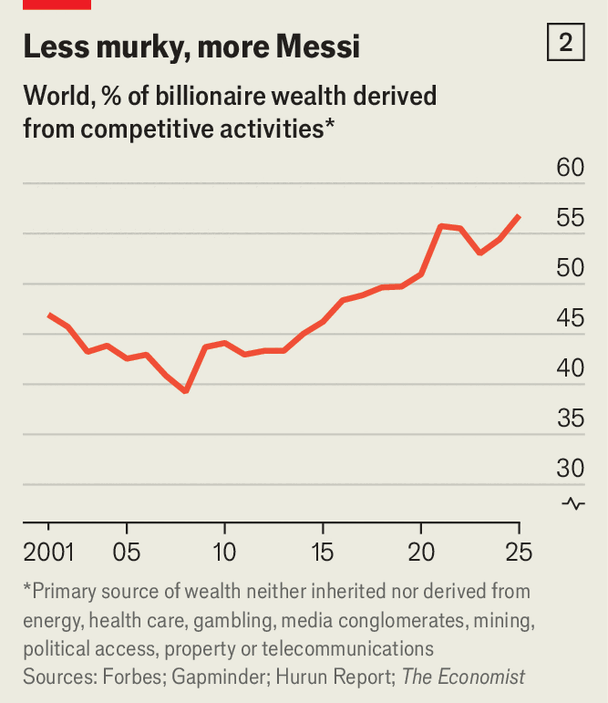
Chart: The Economist
From 2001, when our data begin, to 2014, the uncompetitive share of billionaire wealth rose slightly. Yet over the past decade the share derived from self-made entrepreneurs in competitive sectors has surged to an all-time high (see chart 2). For the first time, half the wealth of the world’s billionaires is reasonably fairly earned. And since 2021 the total wealth derived from uncompetitive sectors has declined.
Out-and-out oligarchs have had a poor few years. The total wealth of post-Soviet billionaires peaked in 2008 at $500bn or so, a “policy failure” of colossal proportions. Today they are worth around $400bn—still a lot, but a lot less. War has devastated the industrial base that gave Rinat Akhmetov, Ukraine’s richest man, his wealth. Roman Abramovich, the Russian former owner of Chelsea Football Club, is perhaps $5bn poorer than he was in 2021, as Western sanctions on those perceived to be close to Vladimir Putin have taken their toll.
Several clientelist industries have struggled. The wealth of property billionaires has fallen by a third since 2018. Higher interest rates, China’s property crash and collapsing demand for office space during the covid-19 pandemic have hurt. Wang Jianlin, the founder of Dalian Wanda Group, a Chinese developer, is now worth $4.4bn, down from $31bn in 2017. Some casino moguls have also lost, in part because of a crackdown on gambling in Macao.
Inheritance remains an important way for people to get extremely rich. The family of Sam Walton, who co-founded Walmart, America’s biggest retailer, and who died in 1992, are worth perhaps $500bn. The descendants of William Wallace Cargill, who in 1865 created the food company that bears his name, still populate rich lists. Yet old money is fast losing relative power. In the early 2000s close to half of billionaire wealth came from inheritance. That has since fallen to around a quarter.
You might think that the artificial-intelligence boom explains the surge in self-made wealth. The fortunes of some founders, including Jensen Huang of Nvidia, have indeed exploded. This summer Elon Musk briefly became the world’s first trillionaire before a decline in SpaceX’s share price pushed him back below the 13-figure threshold. Yet even excluding tech, the self-made billionaire share is rising.
This is because all sorts of people are striking gold in other industries, including finance, food and manufacturing. In the past decade the wealth of Bernard Arnault, who built LVMH into a global luxury titan, has grown by some $100bn. Robin Zeng, who only 15 years ago founded CATL, a Chinese battery-maker, is worth $60bn. Tatyana Kim, Russia’s first female self-made billionaire, founded Wildberries, the country’s biggest online retailer, in 2004. (In recent days Ukraine has attacked some of its warehouses, accusing the firm of supplying the Russian army.)
The rise in self-made wealth is the result of three trends. One is a bull market lasting more than a decade, in which global equities have returned more than 13% a year on average. Low interest rates first pushed investors into risky assets; techno-optimism lasted even when rates rose. This has done a great deal for founders, whose wealth is often tied up in shares, as well as enriching some hedge-fund managers.
The second is Chinese economic growth. At first glance this presents a puzzle—and not just because its property slump has dethroned some billionaires. In the past decade China’s economy has grown more slowly than it did in the 2000s. Yet the number of Chinese billionaires has risen from about 200 to about 800. A paper by Coen Teulings of Utrecht University and Simon Toussaint of Leiden University may hold the answer. Billionaire-creation is not linear. At low levels of income, even rapid growth can leave most fortunes far from the billion-dollar line. But once a country is richer, many more sit just below it. China’s later, slower growth may nonetheless have been enough to push many near-billionaires over the threshold.
The third factor is mobile-first internet, which took off in the middle of the 2010s—just as the self-made share started to rise. Mobile made payments and messaging ubiquitous, and allowed companies to reach consumers instantly, hundreds of times a day. That enabled whole new types of firms to grow at extraordinary speed, from ByteDance (short-form video) to Spotify (streaming) to Stripe (payments), as well as delivery and ride-hailing apps. It has never been so easy to become extremely rich extremely fast.
Does the rise of the self-made billionaire strengthen or weaken the arguments for wealth taxation? It makes no difference to some of them. Democracy does not work well if a tiny group of people can buy influence—and that is true however they got rich. Mr Musk is self-made, which is all well and good, but he has made no secret of his desire to sway elections, both in America and abroad. Democracy might work better without such influence.
Yet if billionaires have too much political power, the solution may be to change the rules on donations rather than to change the tax system. This is because the rise of the self-made billionaire greatly weakens other arguments for wealth taxation. It is now more difficult to say, as many campaigners still do, that billionaire fortunes “were never really earned”. Taxing Mr Abramovich to the hilt may seem reasonable—but Lionel Messi? And because a greater share of today’s billionaires spurs employment growth and productivity gains, it raises the economic cost of losing them, if they decide to move away, or work less hard, to avoid taxation. Billionaires may be less popular, but the proposed remedies look weaker than ever.■
Finance & economics | Buttonwood
How investors learned to live with inflation
Fewer than ever believe central bankers will bring it back to target
Illustration: Satoshi Kambayashi
Jul 21st 2026|4 min read
Listen to this storyAI Narrated
For a good portion of the early 2020s, just about every discussion of financial markets seemed to involve aviation metaphors. Rich-world inflation had surged and central bankers had belatedly ratcheted up interest rates in an attempt to cool their economies. The big question was whether they could accomplish this without crashing into recession. Overdo the monetary tightening, and productive activity would be squeezed out of the economy along with inflation: a “hard landing”. Those who got it just right would be rewarded with a “soft landing”, in which inflation faded but the economy avoided a downturn. History, alas, showed hard landings to be much more frequent than soft ones.
Anyone proposing a third scenario—“no landing”, in which both inflation and growth kept running hot—could expect short shrift from central bankers. Buttonwood himself has made half a dozen bristle by asking if they might allow such a thing. The milder types reminded him that their institutions had been given inflation targets by their governments and took them very seriously. The more irritable offered (marginally) politer versions of: “How stupid and/or irresponsible do you think we are?”
Fast forward to today, however, and it looks suspiciously as if the world’s most important central bank has indeed opted for perpetual flight. The Federal Reserve’s preferred measure of American inflation never did fall to its 2% target, bottoming out at 2.3% over the 12 months to April 2025. The latest reading, for May, was 4.1%. Prices have risen almost as quickly in Australia (4%) and are also still outstripping targets in Britain (2.6%) and the euro area (2.8%).
Both investors and consumers expect above-target inflation to persist. In Bank of America’s most recent monthly survey of fund managers, 54% of those taking part expected “no landing” for the global economy in the coming 12 months. In the University of Michigan’s latest survey of American consumers, the median respondent expected inflation of 4.2% over the next year. The rise in energy prices since February, when America and Israel began to bomb Iran, has worsened matters. But the bigger problem is that inflation has not been below 2% since early 2021. The University of Michigan’s respondents now expect it to average more than 3% over the long run.
So what are the past five years’ lessons on investing amid high inflation? The main one, unsurprisingly, is that claims on real assets and income streams are worth paying for. China aside, all of the world’s biggest stock markets have fared somewhere between reasonably well and spectacularly since consumer prices took off in 2021. Part of that is due to surprisingly fast earnings growth; another, linked, part to even faster progress in artificial intelligence. Even in their absence, though, shares would still have represented claims on real earnings that rise along with other prices, protecting their value from inflationary erosion.
By similar reasoning, bonds—most of which promise only nominal payments—have given their investors a lousy half-decade. A Bloomberg index of American Treasuries has lost over 20% of its real value. Most of the hit came from inflation’s corrosive effect on fixed-dollar coupon and principal payments; the rest from rising yields, which force down the prices of existing bonds. Should today’s bondholders fear future inflationary surges, they will demand even higher yields in compensation, anticipating the same double-whammy again.
The final lesson is that inflation sends even those assets which outpace it over the long run on a wild ride. Gold, the classic debasement hedge, has lost nearly a quarter of its market value since a peak in January. Though inflation has persisted, investors worry that a previous mania for the metal—sparked by those trying to inflation-proof their portfolios—has put it in a bubble. In 2022 the prices of shares and commercial property tanked along with those of bonds, because of worries about the effects of sharply higher interest rates.
The no-landing world is a less stable one because high inflation does not just devalue currencies. It prompts investors and consumers to behave more erratically, creating their own volatility. For just this reason, it was common a few years ago to hear that the no-landing scenario was in truth an intermediate one: the flight would be so bumpy that the plane would have to land eventually. Whatever you think of this logic, such talk has long since died down. So, at least for now, enjoy the flight. ■
Finance & economics | Free Exchange
A brief history of Luddism
States ultimately decide how fast technology is adopted
Illustration: Álvaro Bernis
Jul 23rd 2026|5 min read
Listen to this storyAI Narrated
They were led by a man who did not exist. There was no king in England but King Ludd, they said, though sometimes he was a general or a captain. Supposedly he had been a humble apprentice driven to smashing looms by an overbearing master. Now he lived in Sherwood Forest, ancient home of Robin Hood, another legendary champion of the downtrodden. His followers, the Luddites, were textile workers in the north of England. By night they would sneak into mills and smash the stocking frames and mechanical looms which, they said, stole jobs from humans.
“Luddite” has become a slur for technophobic stick-in-the-muds, the whingers who stand in the way of progress and want the clock to be turned back to a better time. The newest descendants of those looms are the artificial-intelligence models that can easily and cheaply perform much white-collar work. Some coders and software engineers worry, like the artisan weavers of northern England, that AI will destroy jobs that once meant creativity and prestige. Even normally sanguine economists have signed a letter saying that governments must “act now” to prevent the widespread loss of work. Ludd Clubs have sprung up on America’s campuses, though most members are more worried about technology’s effect on their social life and attention span than on jobs.
Economists and historians are kinder to the Luddites. The weavers were selective in their smashing, breaking only those machines that made what they perceived to be lower-quality goods. They were not ignorant about the potential benefits of automation. Nor were they the broad-based movement of the destitute that later lefty historians claimed; they were a small bunch of relatively well-off workers, often keen to preserve the demand for skills gained through a long apprenticeship. And it is not clear whether they were right or wrong about the immediate effects of automation. Bob Allen, an economic historian, has suggested that for the early part of the Industrial Revolution most ordinary Britons did not share much in the gains from mechanisation; others, including the late Nick Crafts, have suggested they did. Data from the period are patchy.
Either way, the original Luddites failed. Lord Byron, a poet and adventurer, was a fan and wrote a poem in their honour, but he was an oddball. The state cracked down. Machine-breaking was made a capital crime. Ringleaders who were spared the noose were transported to Australia. The Luddites’ persistence in the popular mind owes more to their theatricality than their economic relevance. On one occasion they dressed in women’s clothes as they smashed machines, calling themselves the wives of Ludd. Imitators followed. In the 1830s British agricultural workers broke threshing machines in the name of Captain Swing and French tailors smashed sewing machines. Prussian weavers rioted in the 1840s. All suffered similar repression.
To find a successful anti-tech workers’ movement, skip forward two centuries and head to India. In 1965 the Life Insurance Corporation (LIC) of India installed an IBM computer in its office in Bombay (now Mumbai). A second was intended for the Calcutta (Kolkata) office, but unions stood in the way. Literally. For two years activists kept up a 24-hour vigil outside, preventing the machine’s installation. The unions won. This time, crucially, the state took the workers’ side rather than the bosses’: in 1969 a new government in West Bengal, led by the Communist Party of India (Marxist), told LIC that no police protection would be provided if they tried to install the machine. It was quietly taken out of the state. By 1972 the Indian government introduced a requirement for a formal union agreement before any computer could be deployed in government or in industry.
Things changed in the 1980s when a youthful prime minister, Rajiv Gandhi, backed computerisation. Seeking to avoid confrontation, the Reserve Bank of India relabelled computers as “advanced ledger posting machines” and formed a committee to get them installed (at first, just to clear cheques). That did not stop the Bharatiya Mazdoor Sangh, the labour wing of the Rashtriya Swayamsevak Sangh, a Hindu-nationalist organisation, from declaring 1984 the year of anti-computerisation and mounting a sequence of nationwide strikes. Public opinion shifted after Indian Railways introduced a computerised reservation system in 1986. The shortening of ticket queues convinced Indians that the new machines could make their lives better. Unions, too, started to see that the machines did not ultimately spell the end of clerical jobs.
With hatchet, pike and gun
Neither the Luddites nor any of their descendants really prevented the widespread adoption of technology. Britain’s textile industry boomed throughout the early 19th century. Indian clerks’ initial reluctance to embrace computers did not stop the country becoming an IT-services powerhouse (though West Bengal largely missed out, partly thanks to its long dominance by communists).
The truly successful opponents of new technology have not been furious workers but those with the power to regulate it. Some of the looms the Luddites smashed were not new: the stocking frame had been invented 200 years before. (Elizabeth I was said to have forbidden a patent, partly because of worries about unemployment but also because it produced coarse wool stockings rather than the fine silk ones she preferred. However, evidence for this is lacking.) Other technologies have been restricted because of safety concerns: Germany closed its nuclear power plants in the middle of an energy crisis. Others are blocked to help consumers rather than workers: New York state has passed a moratorium on data centres in a bid to hold down electricity prices. The Luddites had the romance and the whiff of doomed tragedy, but ultimately they did not have power. And that is what really matters. ■
Science & technology | Heating up
The surprising benefits of red light
Better skin, faster wound-healing and reduced vision-loss are on the cards
Photograph: Getty Images
Jul 20th 2026|5 min read
Listen to this storyAI Narrated
Oozing mouth ulcers are one of the many possible side-effects of radiation and chemotherapy treatments for cancer. The ulcers make it hard for patients to eat, worsening their suffering. Some must be fed by tube. A new way of treating these ulcers could brighten the future, however: light-emitting diodes (LEDs) tuned to the red end of the spectrum and placed into a patient’s mouth improve symptoms in more than half of cases.
Faster wound-healing is just one of the proposed uses of photobiomodulation (PBM), as therapies that use red and infrared light as the agent are known. Ophthalmologists and dermatologists have been using red light for some time to treat age-related decline in eyes and skin respectively. But PBM is also showing promise in the treatment of traumatic brain injuries; Alzheimer’s and Parkinson’s diseases; and even psychiatric disorders such as anxiety, depression, attention-deficit and hyperactivity, and post-traumatic stress.
The long wavelengths of red and infrared light give these parts of the spectrum tissue-penetrating power. That permits such light to reach and be absorbed by molecules of cytochrome c oxidase, a protein found in structures called mitochondria that are a cell’s power packs. The protein helps turn the energy from glucose into a molecule called ATP, which powers much of a cell’s biochemistry.
Red light activates cytochrome c oxidase molecules that have been switched off by nitric oxide, a so-called reactive oxygen species (ROS). The increased number of active cytochrome c oxidases boosts ATP production, providing more fuel for functions such as cellular repair.
Simultaneously, the cell sees an increase in antioxidant enzymes that neutralise a wide range of other ROS molecules. That is important because ROS molecules can damage many other biomolecules.
As bodies age and mitochondria wear out, more ROS molecules are produced accidentally. Among other things, this damps down ATP production in the old. As a result PBM allows you to “adjust the ageing mechanism”, claims Glen Jeffery, a neuroscientist at University College London’s Institute of Ophthalmology.
Chain gang
In 2020 Professor Jeffery co-wrote a pilot study, published in the Journals of Gerontology, which attempted a proof of concept applied to the retina. Professor Jeffery was interested in this part of the eye because, he explains, ATP declines by about 70% over the course of someone’s life. In the study, researchers found that volunteers over the age of 40 saw their colour-contrast vision improve by an average of 20%. Further investigations will be needed before such results can turn into treatments in the clinic, however.
In another study to which Professor Jeffery contributed, and which was published in the Journal of Biophotonics in 2024, exposure to red light lowered blood-glucose spikes in people after they had consumed a sugary drink. Half of participants were exposed to 15 minutes of red light administered to their backs (so that they could not see what was going on). The others underwent a dummy treatment involving no light. In those exposed to red light, glucose peaks were 7.5% lower than in the control group. Though participants were not diabetic, these findings hint at applications which might help regulate blood-sugar levels in people who are.
There is also hope that red light can help people with brain and spinal-cord injuries suffered in accidents. At the University of Birmingham, David James Davies, a neurosurgeon, and his colleagues are developing a device made of LEDs embedded in silicone that they hope to implant into patients. (They have applied for a patent on the technology.)
At the moment, Mr Davies says, he can do little for such people other than relieve pressure on injured areas by removing parts of their skulls or spines during surgery after an accident. He sees red-light therapy as a promising new option. The device his team is developing is some way from use in human patients, but will soon be tested in pigs.
The theory is that administering short doses of red light directly to the brain or spinal column could slow the wave of cell deaths that happens in the days after an accident. The light could stabilise the metabolisms of nerve cells and boost signals from their mitochondria that go on to help their genes promote growth and repair.
According to Mr Davies, experiments on cell cultures and rodents saw reductions in cell deaths of 20% or more. In practical terms, he says, that could mean the difference between needing a wheelchair and walking with a cane.
Other damage to the brain may also be susceptible to PBM. Parkinson’s and Alzheimer’s diseases are both linked to oxidative stress of the sort the treatment might relieve. Early-stage research suggests it could help those who do not respond to standard medications.
Meanwhile, red light has been found to aid post-operative recovery, reducing pain and expediting healing. In physiotherapy, PBM decreases inflammation and boosts blood circulation, leading to less pain in tendon, muscle and joint injuries.
Well and good?
For Professor Jeffery, the idea that red light has useful biological functions should be no surprise. Humans evolved under the light of the sun. The modern world, however, has changed the kinds of light to which the human body gets exposed—windows, for instance, tend to block infrared, while office buildings are illuminated by LEDs that produce a surfeit of blue.
That is bound to have effects on health, Prof Jeffery reckons. How far those effects stretch, however, is unknown. And that gap between knowledge and possibility has led, as night follows day, to the emergence of a “wellness” industry that peddles everything from red-light masks and blankets, to infrared saunas and yoga studios, as skin-rejuvenators, muscle-soothers and sleep-enhancers.
Some of these may work. The trouble, says Professor Jeffery, is twofold. First, commercial interests have coloured many research outcomes with questionable practices, including small sample sizes and insufficient use of control groups. Second, few of these applications pay attention to dosage.The distance from light source to affected tissue, the specific wavelengths involved, the voltage at which the equipment operates and the length of exposure can all influence the outcome.
In particular, more exposure to red light does not necessarily mean a better result. Overexposure can create what Professor Jeffery calls a “traffic jam” in a cell’s metabolism, with a consequent fall in ATP production. For healthy people, his advice is to buy a dog. That way you will go outside for at least 20 minutes several times a day and get all the red light you need. ■
Science & technology | Well Informed
Should you microdose GLP-1 drugs for weight loss?
Possibly. But only under medical supervision
Illustration: Cristina Spano
Jul 17th 2026|3 min read
Listen to this storyAI Narrated
Few products have captured public interest as fast as GLP-1 receptor-agonist weight-loss drugs. But one unforeseen consequence of their popularity has been to create what is, in effect, one of the biggest off-label medical experiments ever. This is the rapid spread of “microdosing”: in other words, of taking less than the recommended amount.
Microdosing has become so popular (one estimate suggests one user in seven has indulged in it) that in America a whole industry has grown up around it. It is offered by big online firms such as Noom and Hims & Hers, is also available at lots of smaller medical spas dotted around the country and, most worryingly, is something people often just try for themselves at home.
Some microdosing is routine. For example many patients start with a small dose and work up to a full one in order to keep side-effects in check. Conversely, those coming off the drugs might be told to step their doses down gradually rather than going “cold turkey”. Where things get trickier is when microdosing itself is the goal: to save on the cost of drugs, for example, or through fear of side-effects.
The problem for professional bodies such as the American Association of Clinical Endocrinology, which issue clinical guidelines, is that evidence microdosing works is largely anecdotal—though a paper published in April suggests responses to the drugs do vary with an individual’s genes. Erring on the side of caution, the association’s current advice is that doctors should stick to Food and Drug Administration-approved dosing guidelines.
Some clinicians nevertheless argue that supervised microdosing can help optimise therapy and remark that some patients—sometimes referred to as “super responders”—do surprisingly well on lower doses. Doctors also say that, having achieved their weight-loss goal, some patients require only a smaller, long-term dose to maintain that loss.
Such supervised microdosing is not a big issue because doctors can monitor their patients’ health and adjust the dose if necessary. But taking medication without such support is often unwise, and the worry is that a lot of microdosers are doing just that. One small survey suggested as many as 55% of them are lone rangers.
The drugs themselves are often sold in devices, called pens, which deliver precise doses as a series of “clicks”. One approach employed by microdosers is to withdraw the drug instead using a syringe. Another is to count the clicks in order to dispense a dose smaller than the manufacturers intended. Neither is ideal. Syringes can contaminate the medication. Click-counting is error-prone. And both may extend a pen’s use beyond its 30-60 day shelf life.
Even if microdosing achieves weight loss or maintains it, it may disappoint those who seek the drugs’ additional benefits, such as to cardiovascular health. The studies which demonstrated such benefits employed full doses, so there is no evidence yet that lower doses will bring them.
In an ideal world, microdosing’s uncertainties would be resolved by proper trials. The world is far from that. And pharma firms have little motive to pay for research which might show that using less of their product is effective. The speed with which GLP-1 drugs have arrived has been a blessing for many. But those who think they know better than their doctors might be advised to pay attention to that old adage, “when all else fails, read the instructions”.■
Culture | The thinker
The Economist’s cover designer, Graeme James, has died, aged 65
His more than 2,500 covers cleverly captured, mocked and ridiculed the world
Jul 23rd 2026|2 min read
Listen to this storyAI Narrated
THEY SAY never to judge a book by its cover. But The Economist is defined by the face it shows the world. For most of the past 30 years that has been the charge of our designer, Graeme James, a dear friend and colleague who has died after a long fight against cancer.
Graeme brought our words and arguments to life. Because we have four geographical editions, each of which may lead with a different story, he designed over 2,500 covers. That was an awful lot of free trade and globalisation for one pair of shoulders to bear.
He admired Rodin’s sculpture “The Thinker” and spent his days within reach of a soft-leaded pencil, filling sketchbooks with smudges and scribbles. As our weekly Wednesday-night deadline drew near, he would work with illustrators to refine ideas. He would also hammer out the details with frequently literal-minded editors—encounters that provoked Graeme to mutter the odd curse. If an article goes wrong, there is a substitute. Graeme had no safety-net. He had to get it right every time.
A good cover distils everything into a single image—and, sure enough, Graeme’s picture was often worth more than the cover leader’s 1,000 words. In a cover from 2003 a giant saguaro cactus stands like a hand giving the finger after the collapse of trade talks in Cancún. In one on gendercide from 2010 a pair of tiny, brand-new pink shoes represent 100m unborn baby girls.
Editorials are sometimes inflated by preachiness. In our hot-air factory Graeme was the man with a sharp pin. As the presidential election drew near in 2016, we wrote an editorial about Donald Trump’s political discourse and the debasement of American politics. It would have been sententious but for Graeme’s cover art: a Republican elephant with Mr Trump as its arse-end and a couple of steaming quotation marks freshly dropped.
Woe betide any leader who caught his subversive eye. No depiction was as biting as a bare-chested Vladimir Putin riding a tank while he flattened the world order. Foreign embassies often complained about our mockery, but Graeme was rudest about Britain’s hapless prime ministers.
Graeme’s own favourite cover was for the first anniversary of the attacks of September 11th 2001. Two thin black rectangles stretch up in silhouette against a sunset. They are the twin towers. They are the 11 in 9/11. And they are monuments to the dead—and to a world that was lost. It was the best of Graeme’s brilliant design: understated and concise, utterly without condescension and profoundly moral. Graeme liked the cover so much that we used the same image in 2011, to mark the attacks’ tenth anniversary. Now it has become a memorial to him, too. ■
Culture | A step too far
Why Gen Z hikers keep getting lost up mountains
Following social media, they set off with more inspiration than preparation
Don’t climb every mountainPhotograph: Panos
Jul 21st 2026|2 min read
Listen to this storyAI Narrated
SCHOTTY BOY, as he is known online, is a hiking evangelist. He posts dispatches from the Scottish Highlands—moody, misty pictures of streams, glens, lochs and hills—to his more than 100,000 followers on Instagram and TikTok. In these posts, he is usually toting sensible walking gear such as a backpack, flask and an anorak. Sometimes, and inexplicably, he is topless.
He is one of many young people discovering the pleasures of the great outdoors. (As one TikTok video puts it: “Texting is cool, but hiking together is cooler.”) Millions of posts extol the virtues of this cheap, accessible form of exercise. Some influencers recommend scenic routes, way stops and refuges. Apps such as AllTrails make it easy to find footpaths. This is especially helpful for a generation more accustomed to reading from a phone screen than a map.
The problem is that fans follow in influencers’ footsteps without fully understanding what an excursion in the wilderness might entail. (Topless treks, for instance, are inadvisable, especially in cold, wet conditions.) Excitable explorers can walk into trouble. In the Scottish Highlands, the number of mountaineering incidents involving 17- to 25-year-olds has nearly quadrupled since 2022. In 2018 just 15% of people rescued in the Highlands were 17- to 25-year-olds. Last year 25% were. It was not always like this: in the early 2010s, it was middle-aged hikers who required the most assistance.
Nor is this just a Scottish trend. American adventurers aged between 18 and 25 have grown as a share of those needing help. France, Italy and Switzerland have also seen surges in SOS calls from youngsters in recent years.
Rescuers point out that more people of all ages are hiking. The “Instagram effect”, says Ludovic Richard from France’s mountain-safety observatory, is such that young walkers go to perilous lengths to take a photo at a beauty spot. Some have none of the gear and not much common sense. In December two walkers in their 20s were rescued from Britain’s second-highest mountain in “feels-like” temperatures of -15°C, wearing trainers and tracksuit bottoms (rather than thermals and walking boots). Kev Mitchell, a rescuer in Scotland, was called out to a different pair of 20-somethings in the Highlands without a compass and proper jackets. Without his help, he reckons, they would have died.
The benefits of hiking are numerous. America’s National Park Service promotes it as “a great whole-body workout—from head to toe and everything in between”. As well as strengthening muscles and bones, walking in nature is good for your mental health. Gen Z has the right idea. They just need to prove they can, in fact, walk the walk.■
Obituary | Per ardua ad astra
Wally Funk was told women couldn’t be astronauts
The aviator who refused to agree died on July 8th, aged 87

Photograph: © Blue Origin via ZUMA Press/Alamy
Jul 23rd 2026|6 min read
Listen to this storyAI Narrated
When she was told she had to do something, Wally Funk often refused. She wouldn’t wear a seat belt, and had perfected a neat trick of clicking it in and then sitting on it instead. She wouldn’t study home economics, as girls at her school were supposed to, because she wanted to do car mechanics, and left school rather than comply. Told later to learn cookery, she filled her oven with pans instead. Expected to wear a dress, paint her nails and be generally frou-frou, she made no effort at all.
Equally, when she wanted to do something, she just did it. If she suddenly needed when driving to fetch a thing from the back, she steered with her knees. If she wanted a tree house or even a real house, she built it herself. Because, at the age of five, she wanted to fly, she put on her Superman cape and jumped off the barn. Atta girl! From then, it was all aviation. She got her pilot’s licence at 17, won races, excelled at manoeuvres and determined to fly for a living. Like the dozens of balsa-wood planes she had made as a child, she would glide free in the marvellous air.
When astronauts appeared, her longing turned to space. Absolutely she had to go. Men might say no, but she could beat them at anything. Besides, in 1960 Dr William Randolph Lovelace had set up a private programme to test whether women were suited for spaceflight. Swiftly, although she was under-age, at 21 she applied to be a member of Mercury 13, the group of women who hoped to go into space just like the seven Mercury men.
The tests, which were just like the men’s, were hard. But not too hard for her. They stuck her with needles all over; fine. They squirted ice-cold water in her ears; holy cow! that hurt, but she knew how to deal with pain. Just face it down, beat it back. They made her swallow three feet of rubber tubing to test her stomach juices; she could do that, just go gobble gobble like a turkey, an inch at a time. In one isolation test she had to float in a sensory-deprivation tank in a dark soundless room, unable to feel herself slapping her own face, and she managed to stay there, just dreaming away, for 10 hours and 35 minutes. Most people lasted two to three hours, but they had to haul her out, still happy. Space was like this. She actually broke the record and, all tests considered, she did better than the guys. But, like the other women, she still couldn’t be an astronaut.
Why? Because the Lovelace programme had been cancelled midway, when various men got cold feet about “girls”. The said girls all appealed to NASA, but it did no good. It had not been NASA’s programme. For that, only all-male air-force jet pilots could qualify. She was horribly disappointed. But, as with any pain, she coped. Chocolate helped, as long as it was Hershey’s. So did childhood training. In her tomboy days in New Mexico she had made friends with Pueblo Indians, learning from them how to hunt and survive in the wilderness. When her friends met some problem they couldn’t solve, like an angry bear, they would “throw it a fish”: accept it, satisfy it to some degree, then move on. Missing out on space required a pretty big fish, a marlin rather than a trout. But being ever positive, never negative, she moved on.
With her first-rate flying credentials, it wasn’t hard to find other jobs. All the same, she was the first and only woman in several of them. She joined the Federal Aviation Administration as the first woman to inspect planes and instruct new pilots; then went to the National Transportation Safety Board as an investigator of plane crashes. Again, she was the first woman to do it. That was an arduous job, on sites that she could sometimes reach only by mule or by rapelling off cliffs. Occasionally it was gruesome, too, combing minutely through wreckage that might still contain personal effects and parts of bodies. As before, she managed to beat her emotions back. In Taos, her home town, she ran a flight school. Over her whole career she logged 19,600 flight hours and taught 3,000 people how to fly. Wow! How about that?
Yet the thought of being an astronaut still niggled her. Her clothes were sewn with aviation patches; her speaking voice was an engine-beating shout. She might be a civilian, but she could do it. On a tour of Europe in her camper van in the mid-1960s she diverted into Russia to try to meet Valentina Tereshkova, the first woman in space. In California she did a centrifuge test, wearing her mother’s tightest corset to simulate the G-suit that only men could have. She also went to Moscow for zero-gravity sessions. In her 60s she was snapped, upside down rapturously floating, in a crowd of Russian men. All of them, she noted, used their barf-bags at some point, but not her. Flying in any form had never sickened her. Au contraire, it was her life; she breathed it and ate it. She had never married because she was married to planes, preferably the Cessna 182 and the Stearman biplanes. But she also had a soft spot for the glider which, at college, she had taken to 14,000 feet.
As the years passed, and space exploration went on without her, she kept hoping. Opportunities were opening up on the commercial side. By the 2000s, civilians could go into space if they paid enough. She therefore put down her life savings, $200,000, as a deposit for Richard Branson’s Virgin Galactic flight. But before she used it, an invitation came: Jeff Bezos asked her to be a special guest on his Blue Origin craft. The date was July 20th 2021, and she was 82 years old. No one older had ever ventured into space. No eyes older than hers had ever looked on that blackness, 62 miles up. It lasted only ten minutes. But wow, and wow! At last she had done it! If only it could have been longer!
Deep down, she had never doubted. For years, growing up, she had looked out on Taos Mountain. Later, living elsewhere, she would gaze on a photo of it. Each day, the spirit of the mountain would tell her what she was meant to achieve. If she wanted something badly enough, the mountain gave her the confidence to get it. And if it said, “Fly to the stars!”, that was where she would go. ■