The Economist Articles for Apr. 4th : Apr. 24th(Interpretation)
작성자Statesman작성시간21.04.19조회수500 목록 댓글 0The Economist Articles for Apr. 4th : Apr. 24th(Interpretation), Apr. 25th (Discussion)
Economist Reading-Discussion Cafe : http://cafe.daum.net/econimist
https://www.economist.com/leaders/2021/04/15/myanmar-could-be-asias-next-failed-state
The new Afghanistan
Myanmar could be Asia’s next failed state
Only its neighbours can help put the country on a better path
Apr 15th 2021
Give this article
When the generals who run Myanmar drew up a constitution to pave the way for an elected government, albeit one that would have no authority over the army, they termed the arrangement “discipline-flourishing democracy”. Untrammelled political competition, they suggested, would lead to disorder and impede development; only the army could ensure order and prosperity. So it is ironic that, since the army took complete control of the country again in a coup on February 1st, the only thing that has flourished is chaos.
Listen to this story
Enjoy more audio and podcasts on iOS or Android.
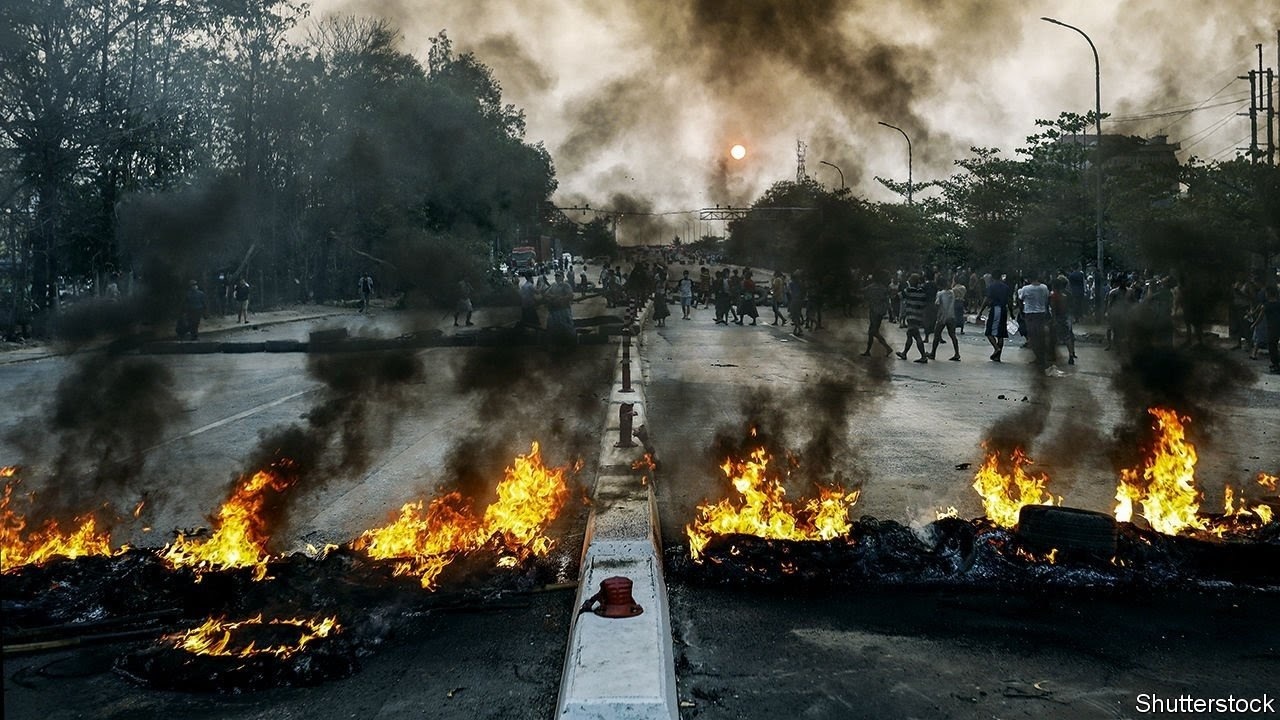
Daily protests are a rejection of the putsch, although these have shrunk since the army began shooting unarmed demonstrators. Soldiers are rampaging through rebellious districts, beating and killing at random, and reportedly charging grieving relatives 120,000 kyat ($85) to release the bodies. Citizens have burned down shops tied to the army. A general strike has paralysed businesses. Public services have largely ceased. In the borderlands some of the 20 or so armed groups that have battled the government on-and-off for decades are taking advantage of the crisis to seize military outposts or caches of weapons. The army has bombed them, sending refugees into neighbouring countries.
In short, Myanmar is becoming a failed state. A vacuum is being created in a territory bigger than France that abuts Asia’s biggest powers, China and India. It will be filled by violence and suffering. Although Myanmar is not yet as lawless as Afghanistan, it is rapidly heading in that direction—a sobering warning of how hard it is to put a country back together. The ruin of Myanmar is not only a calamity for the 54m Burmese; it also creates risks that could ripple through the region.
Myanmar’s guerrilla-controlled enclaves produce heroin and are the world’s biggest suppliers of methamphetamine. The country also exports misery. Nine refugee camps over the border in Thailand are filled with victims of the fighting between the army and ethnically based insurgents such as the Karen National Liberation Army (knla). Over 700,000 Rohingyas, a Muslim minority, fled to Bangladesh from a pogrom led by the army in 2017. A newer export is disease. China last month sealed off Riuli, a border town, after three Burmese visitors tested positive for covid-19.
These problems will get worse before they get better. The army looks as if it means to hack and blast the protesters into submission. It has warned them that they risk being shot in the head and the back—as many have been. The known death toll exceeds 700. On April 9th the army gunned down more than 80 people in the provincial city of Bago. The protesters are using makeshift weapons to fight back. Some are seeking military training from the rebel militias on the borders. In a country awash with arms, that is a recipe for shedding a lot more blood.
A group of elected lawmakers who have managed to escape arrest are talking about forming a “federal army”, presumably encompassing some of the many ethnic militias. The biggest of these can muster 20,000 soldiers equipped with anti-aircraft missiles, artillery and armoured personnel-carriers. The rebels, even were they to act in concert, do not have the firepower to overthrow the army and reverse the coup. But neither has the army been able to defeat them, despite decades of trying. The knla has been battling the army since 1949, making its campaign the world’s longest-running civil war.
The army may eventually manage to assert its authority over the centre of the country, inhabited by the Bamar, the majority ethnic group. But the apparatus of the state will be broken. Tax collectors, teachers and doctors have walked off the job in droves. When banks reopen, they are bound to suffer runs. Foreign donors have frozen aid and foreign firms have suspended investments. Before the coup the World Bank had predicted that the economy would grow by almost 6% this year; now it expects it to shrink by 10%. Others warn of a contraction of 20%.
Neighbouring countries are alarmed. China wants to keep out covid-19 and protect strategic investments such as the pipelines that carry oil and gas from the Bay of Bengal to its interior. India has been bridling at the flow of refugees from the fighting, trying to turn them away and then reluctantly agreeing to admit them. Some members of the normally hands-off asean, a club of South-East Asian countries that includes Myanmar, want to convene a summit to discuss the turmoil. Then there is meddling from afar. Russia, doubtless sensing an opportunity to needle the West, has backed the generals, sending its deputy defence minister to gladhand them.
America and Britain have imposed targeted sanctions on senior generals and the firms they control. Such measures, though welcome, will not be decisive. During earlier periods of military rule, Western pressure had little effect on previous juntas. The only outsiders able to influence the generals are Myanmar’s close neighbours: China, India and the other asean countries, to whom they will turn if shunned by the West. The problem is that all these countries have stood back. Beyond airing concerns about refugees or the coronavirus, they tend to play down the havoc as an internal political affair.
Everyone’s business
That is short-sighted. Letting Myanmar slide into mayhem will cause misery to ordinary Burmese and threaten neighbours with drugs, refugees and instability. To avoid that, those neighbours should adopt a braver, more constructive approach. No country should recognise the coup; more should impose sanctions on the top brass and their rent-seeking businesses. asean should suspend Myanmar’s membership. An arms embargo should be imposed (China, India and Russia are currently the biggest suppliers). Outsiders should press the army to release political prisoners, including Aung San Suu Kyi, the leader they overthrew, and start talking to her shadow government operating near the Thai border; the Thai government should turn a blind eye to the informal channels by which it gets money and supplies.
Only concerted pressure can get the generals to talk to the civilians and thereby put Myanmar onto a less ruinous path. The alternative is a failed state at the heart of Asia.

Beyond the frame
A change in how people consume contemporary art is under way
The vogue for immersive exhibitions has implications for the market, too
Apr 17th 2021
SAN FRANCISCO
Give this article
Across all four walls of a vast hall, Vincent van Gogh’s blue irises begin to sway. They bloom gently at first, then more violently, as the music builds to a crashing crescendo. Visitors to “Immersive Van Gogh” (pictured), now showing at a former music venue in San Francisco, sit or stand in socially distant circles on the floor, their bodies bathed in the glow of these animated laser projections.
Listen to this story
Enjoy more audio and podcasts on iOS or Android.
On America’s other coast, visitors will do more than marvel when a new exhibition space covering 50,000 square feet (4,645 square metres) opens on April 22nd. At Superblue Miami they will be able to touch the blossoms snaking across a huge wall, and in doing so make the artwork move and change. “Proliferating Immense Life—A Whole Year per Year”, a digitally projected installation by teamLab, a Japanese art collective, is a shimmering cycle of the seasons in which visitors’ hands cause plants to bloom and decay, petals scattering in a balletic display. No two visits are ever the same.
“Immersive art” experiences are on the rise, not just in America but across the world. Tens of thousands of people have walked completely dry through a “Rain Room” of streaming water in Shanghai, Melbourne and Sharjah. Others have entered a gallery filled with disorientating yellow fog in Berlin, slid down a giant slide in London or visited a mirrored “infinity room” in New York. More and more, the experience of contemporary art is just that: an experience.
These installations share a common trait: an urge by artists to create—and audiences to enjoy—a space in which visitors participate and play. “It’s a bit like going into the museum and being in the picture,” says Florian Ortkrass, co-founder of Random International, an art collective which has followed its blockbuster “Rain Room” with other hands-on exhibits that probe the tension between human bodies and technology. “If this kind of work is done well, it engages people emotionally, it lifts them out of their everyday rut,” adds Hannes Koch, Random International’s other co-founder. “It heightens your awareness and perception of people and the space around you—and people like that.”
Immersion in a sensory experience—a Gesamtkunstwerk or total work of art—has a long pedigree in human history, with the cave paintings at Lascaux and the overwhelming aesthetic experience of the Gothic cathedral. Yet through the 19th and 20th centuries artmaking became more individual and focused on the autonomous painted or sculpted object. Only in the 1960s did artists return to “reinventing art as the environment”, in the words of Marc Glimcher, head of Pace Gallery and co-founder of Superblue, a new offshoot dedicated to interactive art.
This “experiential turn” grew out of artworks based on light and space by such practitioners as James Turrell and Robert Irwin in California. In New York another strand included more performance-based, multimedia explorations by Robert Rauschenberg and Yayoi Kusama. The big immersive bang came in 2003, when Olafur Eliasson, a Danish-Icelandic artist, hung a giant “sun” in the Turbine Hall of Tate Modern, under which hordes of visitors happily basked. Artists have been experimenting with ambitious installations ever since, enabled by ever more sophisticated technological tools.
These shows are proving hugely popular. Visitors wait hours for a 60-second slot at the various versions of Ms Kusama’s “Infinity Mirror Room” around the world. There are now around half a dozen competing Van Gogh shows circulating in America, most of them sold out. L’Atelier des Lumières in Paris from Culturespaces, which popularised laser projections of dead masters, attracted 1.4m visitors in 2018. “The House of Eternal Return”, a psychedelic building with tactile rooms in Santa Fe, New Mexico, by an outfit called Meow Wolf, has wowed more than 2m people since it opened in March 2016.
Whizzy new technology is part of the reason for immersive art’s appeal. In a screen-saturated world, there is also an undeniable “relief that comes with being in a physical environment that sparks the imagination,” says Ali Rubinstein, co-chief executive of Meow Wolf. “People want to connect to artmaking,” agrees Mr Glimcher of Superblue. More profoundly, as humans become more urban and isolated, “we need our artists to help us connect to a sense of awe—to the transcendent and to each other,” he adds.
Art is always a reflection of the spirit of its time, notes Dorothea von Hantelmann, professor of art and society at Bard College Berlin. What she calls “the shift from object to experience” is a phenomenon of the rich world that reflects many things: a surfeit of stuff, a young, more interactive generation with a sophisticated aesthetic, and, perhaps, “a new kind of thinking which one might call ecological thinking, which is to think in connections, in relations.”
Working wonders
A transformation in how people consume contemporary art is under way. These huge and costly installations, in turn, put pressure on institutions designed for a different age. In an art market built on tradable objects, how can museums and galleries remain relevant and artists who make ephemeral experiences get paid?
“We’re going back full circle to the Renaissance, where you need patrons” for these kinds of huge projects, says Mr Koch of Random International, whose forthcoming work involves visitors painting with light. Both Meow Wolf and Superblue represent ambitious new business models, based on ticket sales, that are poised to spread across the globe. Meow Wolf is a “social-impact art project” whose primary goal is to value the role of artists by paying them a competitive wage, Ms Rubinstein says. The company weathered the pandemic and has just opened a surreal grocery store called “Omega Mart” in Las Vegas, with another venue opening in Denver this year and plans to expand in Asia.
Superblue, for its part, aims to create a new market infrastructure for its modern art. The firm, partly funded by Silicon Valley entrepreneurs, finances large-scale works upfront, then splits the proceeds of ticket sales with the participating artists. It will act as a lender to museums and galleries and broker big public art pieces. Watch for more mesmeric movement and light as it rolls out other “experiential art centres” around the world.

Simplify, simplifyWhy people forget that less is often more
When solving problems, people prefer adding things to getting rid of them
Apr 14th 2021
Give this article
Colin chapman, the founder of Lotus Cars, was one of motor racing’s most influential engineers. He summed up his philosophy as “simplify, then add lightness”. A stripped-down, featherweight car might be slower on the straights than a beefy muscle-machine, he reasoned. But it would be faster everywhere else. Between 1962 and 1978 Lotus won seven Formula One constructors championships.
Listen to this story
Enjoy more audio and podcasts on iOS or Android.
It appears to be an uncommon insight. A paper published in Nature suggests that humans struggle with subtractive thinking. When asked to improve something—a Lego-brick structure, an essay, a golf course or a university—they tend to suggest adding new things rather than stripping back what is already there, even when additions lead to sub-par results.
The research was motivated by everyday observation rather than psychological theory, says Gabrielle Adams, the paper’s first author, who cites folk wisdom such as “less is more” and “keep it simple”. Perhaps the need for such reminders was evidence of a blind spot in people’s thinking?
Along with colleagues at the University of Virginia, Dr Adams conducted a series of observational studies. In one, participants were asked to alter a pattern on a grid of coloured squares to make it symmetrical. Although that could be done equally well by adding new squares or by deleting existing ones, 78% chose the additive option. Other tasks gave similar results. In three different studies involving modifying structures built from blocks, just 2-12% of respondents chose to remove blocks. Asked to alter an essay they had written, 16% cut words while 80% added them.
Nor was this tendency confined to the lab. Of 827 suggestions received by the new boss of an American university for how the institution could be improved, 581 involved adding new things, such as more grants for studying abroad. Just 70 suggested removing something, such as preferential admissions for children of alumni.
Having established that addition does indeed seem to be more popular than subtraction, the next step was to work out why. One possibility was that people were considering subtractive options, but deliberately choosing not to pursue them. Another was that they were not even thinking of them in the first place. Enter a new set of experiments, each with a twist.
Attempts to tilt the pitch in favour of subtraction made people more willing to try it, but only to a point. One experiment asked participants to redesign a lopsided Lego structure so that it could support a house-brick (see picture). Participants could earn a dollar for fixing the problem, but each piece of Lego they added cut that reward by ten cents. Even then, only 41% worked out that simplifying the structure by removing a single block, rather than fortifying it by adding more, was the way to maximise the payout.
Asking people to make a golf course worse rather than better did not change their preference for additions, scuppering the idea that extra features might be seen as desirable in their own right. Practice improved people’s chances of spotting subtractive solutions, suggesting that many were simply not thinking of the possibility, at least at first. That conclusion was buttressed by results showing that people were less likely to try subtraction when they were under “cognitive load”—in other words, having to perform a second, unrelated task at the same time.
What all this amounts to, says Benjamin Converse, another of the study’s authors, is evidence for a new entry in the list of “cognitive biases” that skew how humans think. The 2002 Nobel Memorial Prize in Economic Sciences was awarded for demonstrating that humans are not “rational” in the way economists had used the word. Instead of thinking a problem through and coming up with an ideal solution, they tend to use cognitive shortcuts that are fast and—mostly—“good enough”.
Forewarned is forearmed, and such research has inspired an entire field dedicated to working out when such shortcuts lead people astray. Dr Adams and her colleagues, meanwhile, are keen to probe their result in more detail. One question is whether the preference for addition is innate or learned. Preliminary results from Japan and Germany suggest, at least, that it is not limited to America.

Free exchange
John Williamson, who defined the “Washington consensus”, died on April 11th
His brainchild became caricatured. But it had never been a manifesto
Apr 15th 2021
Give this article
It was in January 1947, with a song thrush, that John Williamson began the list he kept of the birds he had seen, which would go on to number some 4,000 species. His father, a rose-grower in Hereford, England, was an avid birder too, but Mr Williamson brought to the pastime the focused effort and aptitude for the collection of information that also characterised his work as a macroeconomist and expert on exchange rates. Birding was an understated hobby for an understated man. Yet Mr Williamson gained a measure of fame that eludes most economists when he outlined the “Washington consensus”: a description of policy orthodoxy in the late 1980s that became a flashpoint for intense global debate. Mr Williamson, who died on April 11th at the age of 83, sought merely to gather a list of macroeconomic best practices, the better to boost the welfare of people in developing economies. In that he succeeded, the furore that followed notwithstanding.
Listen to this story
Enjoy more audio and podcasts on iOS or Android.
Though Mr Williamson had notions of becoming an engineer, a schoolteacher suggested that his maths was too poor, and that he should pursue economics instead. As an undergraduate at the London School of Economics he was inspired by William Phillips, who showed him a draft of a paper describing a relationship between unemployment and inflation—or the Phillips curve, as it would become known. At Princeton University as a graduate student he rubbed shoulders with giants of the profession like William Baumol and Oskar Morgenstern.
Mr Williamson’s academic work focused on exchange rates. He began his professional career as the post-war monetary system (in which many currencies were pegged to the dollar, which in turn was pegged to gold) began to creak under the pressure of an overvalued greenback. Mr Williamson believed that persistently over- or undervalued currencies were a source of economic damage. But he was also sceptical of radical reform proposals: to allow exchange rates to float freely, for example, or to save the system by turning the imf into a global central bank. Instead, he advocated what he saw as a pragmatic idea: a crawling peg, in which countries with persistent current-account imbalances realigned their exchange rates in a slow, methodical way. He gained a reputation as an exchange-rate guru, with work taking him to Britain’s Treasury, the imf, and universities in America, Britain and Brazil.
It was the Washington consensus, though, for which he was best known. Its original context is often forgotten. In the 1960s and 1970s, booming Latin American countries borrowed heavily to fund infrastructure projects and industrialisation. When interest rates soared in the early 1980s, those debts became unpayable and a wave of defaults threatened. American politicians, fearing for their country’s heavily exposed banks, introduced a series of plans to coax as much repayment as possible from the region. They grew frustrated, however, at what they took to be Latin American governments’ lack of interest in structural reform. Mr Williamson—who by then had moved to what is now the Peterson Institute for International Economics, a think-tank—knew better, and proposed convening a conference to correct such misapprehensions. He wrote a document to help frame the proceedings; the Washington consensus was described within.
The paper sought to capture what Washington’s intelligentsia agreed were broadly sensible policies. There were ten planks, which Mr Williamson later summarised as encompassing “macroeconomic discipline, a market economy, and openness to the world”. Wild-eyed radicalism it was not; the list was intended after all to reflect only the policies that almost everyone in Washington thought wise. Mr Williamson did not endorse knee-jerk austerity; he emphasised redirecting industrial subsidies towards education and health. Exchange rates should be competitive, but not necessarily freely floating. Openness meant acceptance of imports and direct investment, but not full capital mobility. Deregulation meant liberating sheltered sectors, not gutting environmental and labour standards. It was more a practical guide to avoiding disaster than a manifesto.
The consensus soon came to mean something else entirely, though. Critics associated it with the ideological revolutions of Ronald Reagan and Margaret Thatcher, which they interpreted as fierce hostility to any state intervention. When financial crises racked the developing world in the 1990s, its woes were blamed on the consensus, which was caricatured as a foolhardy attempt to impose orthodoxy on vulnerable places regardless of local conditions. The term became a catchall for neoliberalism, its excesses and failures, real and imagined. Economists found themselves asking whether and how the consensus had gone wrong; Mr Williamson himself acknowledged in 2002 that the term had become a “damaged brand name”. Yet he was also philosophical about his brainchild’s tumultuous public life, and continued, quietly, to explain what his creation was and was not meant to include.
Flight of the concord
There is not much consensus to be found today in Washington, and many old orthodoxies are being questioned. Still, countries that hewed more closely to Washington consensus policies in recent decades—like Chile or Colombia—have kept clear of big crises while others, like Argentina and Venezuela, have not. Discipline and openness alone may not unlock a growth miracle; yet if they help countries avoid costly setbacks that is no small thing.
Indeed, purposeful pragmatism is not a bad way to approach daunting challenges of all sorts. The developing world will have more than macroeconomics to worry about in years to come, as Mr Williamson, who long advocated for action against climate change, well understood. He was a committed environmentalist, a sentiment deepened by treks through woods and fields in search of his birds. That sensible sacrifices should be made to protect such things: on this, surely, reasonable people can agree.
Buttonwood
The appeal of emerging-market dollar bonds
For a start, the alternatives are hardly compelling
Apr 15th 2021
Give this article
The hunt for bonds that pay more interest to retirees and others requiring a fixed income has taken institutional investors to some exotic places in recent years. Last month they alighted on Ghana, which issued $3bn-worth of Eurobonds, as dollar bonds issued outside America are known. Ghana may be exotic but it is also risky. Its government debt-to-gdp ratio was a hefty 78% in 2020. With such risks come rewards: the yields on Ghana’s new Eurobonds were roughly 8-9%.
Listen to this story
Enjoy more audio and podcasts on iOS or Android.
The alternatives are hardly compelling. The spread, or additional yield, over Treasury bonds offered by American corporate bonds is close to its pre-pandemic low and not far from its all-time low. For a given credit rating, an investor can usually get a wider spread over Treasuries (and thus a higher expected return) by buying the dollar bonds issued by an emerging-market sovereign, says Yacov Arnopolin of pimco, a big bond-fund manager.
There are reasons for the discrepancy. Investors feel more comfortable owning corporate bonds, because the Federal Reserve has, in effect, provided a liquidity backstop for the market since last March. American companies stand to benefit from President Joe Biden’s $1.9trn fiscal-stimulus package. A rapid vaccine roll-out means America’s economy will get back to normal far sooner than most emerging markets. On top of this lies another factor. The risk of corporate default is something that can be calculated in a spreadsheet model. But working out the chances of a sovereign default is a more complex business.
Start with the things you can put in a spreadsheet, such as debt loads. The imf divides poorer countries into two categories, middle- and low-income. The first group saw public-debt burdens rise by around ten percentage points, to 64% of gdp in 2020. Those for the second, which includes Ghana, rose by around five percentage points, to 49.5%. Ghana’s debt burden is thus well above that of its peer group. Like some other poor countries, it had a lot of lumpy dollar debts coming due in 2022-24. That is why it used some of the proceeds of its recent sale to retire a Eurobond maturing in 2023.
The debt burden and maturity profile only get you so far. There are three other influences that investors might usefully bear in mind. The first is commodity prices. The collapse in crude prices last year left a few oil-producing countries short of hard-currency earnings. It played a part in the troubles of Ecuador, one of six countries to default on its bonds last year. For a while it seemed likely that Angola, a highly indebted oil exporter, would follow suit. Support from China and the imf saved it, along with a marked pickup in the oil price late last year. Rising metals prices are also helpful to many indebted countries. The copper price is important for Chile, Peru and Zambia; the price of gold to Ghana and South Africa.
The second factor is exposure to tourism. The hit to the industry from the pandemic played a part in the default of Belize and in stresses elsewhere, says Stuart Culverhouse of Tellimer, an emerging-market research firm. It might take years for tourism to recover fully. The imf recently sharply downgraded its forecasts for the Caribbean economies. Sri Lanka has been dogged by fears of default, in part because it has heavy debts, but also because of lost income from tourists. For Kenya, an energy-importer with a hefty debt burden, a hit to tourism and a higher oil price is an unfortunate combination.
A third influence is the imf. Understanding its ways is an essential part of investing in emerging-market bonds. The fund has lent a total of $110bn, supporting 86 countries, since the pandemic struck. Some of this has been in the form of debt relief; some in rapid-fire lending and credit lines; some of it is programme lending with strings attached. The imf is readying a $650bn issue of special drawing rights (sdrs)—essentially an overdraft facility at a negligible interest rate—for its members. The sdr gift will make a big difference to smaller countries, in some cases doubling their foreign-exchange reserves, says Yvette Babb of William Blair, an asset manager.
A frosty relationship with the fund is probably unwise. The kinder, gentler imf has kept sovereign defaults in check much as central-bank action and fiscal stimulus have kept corporate defaults in check in the rich world. There may well be further setbacks to some sovereign Eurobond issuers. But a lot more yield-starved investors may soon be dusting off their atlases.
https://www.economist.com/business/2021/04/17/can-south-east-asian-techs-hot-streak-last
Schumpeter
Can South-East Asian tech’s hot streak last?
Foreign investors cannot get enough of Sea, Grab, Gojek and other regional unicorns
Apr 17th 2021
Give this article
When uber came to South-East Asia, the Silicon Valley ride-hailing giant coaxed customers into cabs with free ice cream, a tactic it had deployed in Western markets. Grab, a local rival based in Singapore, plied riders with durian, a pungent tropical fruit that repels many Westerners but is beloved of people in places like Indonesia, Malaysia and Thailand. GrabDurian, as it called the effort, delivered several varieties of the fruit (as well as desserts made from the stuff). After years of brutal rivalry Grab acquired Uber’s South-East Asian operations in 2018. The tale lives on as a lesson for doing business in the region, which is home to nearly 700m people. Digital services such as ride-hailing and food delivery can thrive—so long as they adapt to local conditions.
Listen to this story
Enjoy more audio and podcasts on iOS or Android.
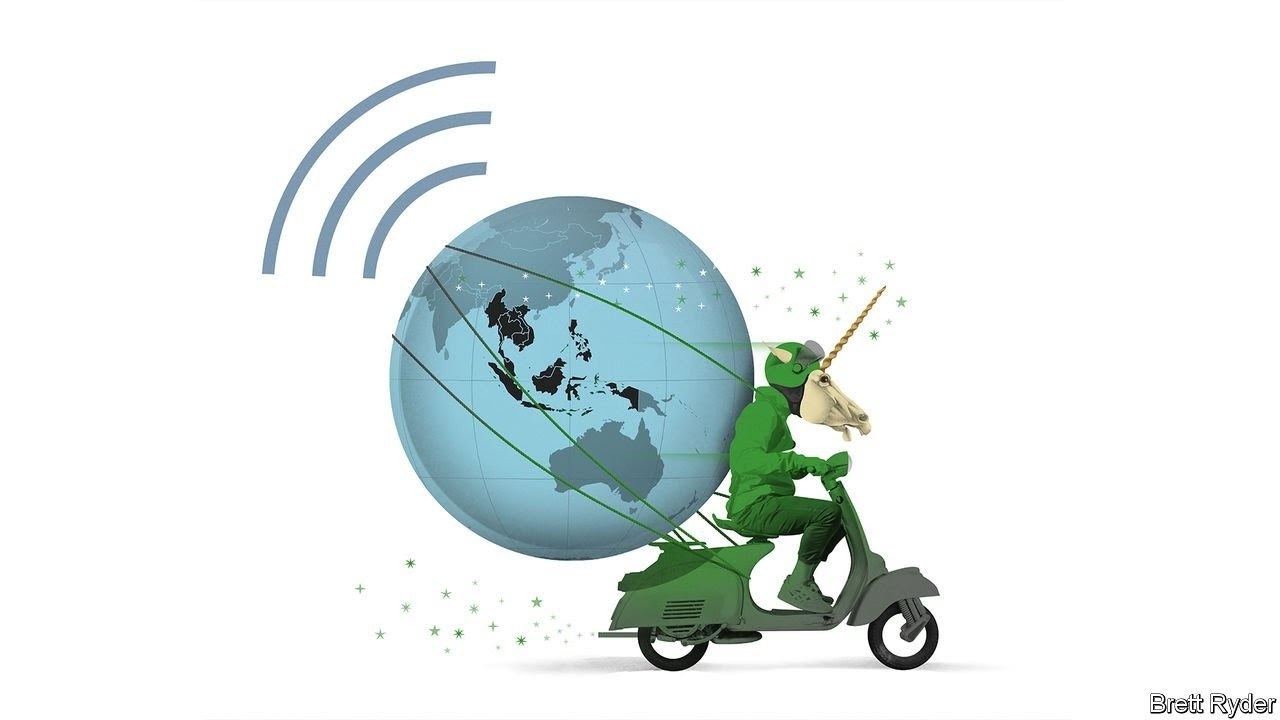
Now it is Western investors who are salivating. In the past year South-East Asia’s internet-startup scene has got hotter than Thai chilli peppers. The market capitalisation of Sea, another Singaporean group that listed in New York in 2017 (and whose name alludes to the shorthand for South-East Asia widely used in the region), has quintupled in the past year, to a mighty $125bn. On April 13th Grab said it would go public on New York’s Nasdaq stock exchange by merging with a special-purpose acquisition company (spac). The deal values the company at nearly $40bn. Gojek, an Indonesian ride-hailing group valued at more than $10bn, could merge with an e-commerce firm called Tokopedia, before also considering listing via a spac in New York. Traveloka, another local unicorn (as unlisted startups worth $1bn or more are known), is reportedly in talks to list in New York via a spac. All told, the region’s half-dozen biggest internet darlings are worth nearly $200bn.
Wall Street, in other words, has finally woken up to South-East Asia’s great promise. The region is more populous than the European Union or North America. Its economies are growing fast. Wealthy, English-speaking Singapore at its heart is a global financial centre, with all the bankers, lawyers, consultants, admen and creative types that a modern firm needs. Critically, American and Chinese tech giants have a patchy record of coping with the region’s archipelagic geography, potholed roads and unbanked masses. Besides Uber’s abortive foray, China’s Alibaba has struggled to turn around Lazada, a regional e-commerce firm it bought in 2016. Meanwhile, local internet firms have thrived. As they grow they will face another challenge: bumping into each other.
The South-East Asian tech firms began in their own separate niches. Sea started out in gaming. When Grab launched in 2012 it was a taxi-hailing service in Malaysia. Gojek gave out smartphones to Jakarta’s moped drivers (known as ojek), who could then cut through the Indonesian capital’s epic traffic jams to bring mangoes, a manicurist or any other product or personal service offered by merchants on its platform to consumers. Traveloka specialised in airline bookings; Tokopedia was a digital marketplace.
All have since expanded, evolving towards becoming “super-apps” with parallels to those run by Alibaba and Tencent, China’s biggest internet firms. Grab is present in eight countries and in addition to rides offers food delivery, mobile payments, insurance, investments and health advice. Last year it launched corporate services such as fraud detection, digital maps and advertising. This year it plans to start setting up a digital bank in Singapore. Tan Hooi Ling, its co-founder, says that the firm is “like Uber, DoorDash [an American food-delivery app] and Ant [Alibaba’s financial-technology affiliate] all wrapped into one”. Gojek, which now offers a similar suite of services, last year bought a large stake in an Indonesian bank. The co-ceo, Kevin Aluwi, also sees similarities between his firm and the Chinese super-apps. “We are a little bit of all those companies in some ways,” he observes.
As Grab, Gojek and the others continue to grow they will still have to grapple with some of the problems that have dampened the spirits of the foreign titans. Until roads, transport links and communications networks improve, many of the region’s consumers will be too expensive for the tech firms to reach profitably. Nirgunan Tiruchelvam of Tellimer, a broker specialising in emerging markets, notes that the logistical nightmare of delivering online-shopping baskets to Indonesia’s 6,000 inhabited islands is vastly different to e-commerce in China, which has world-class infrastructure, let alone the West. What is more, much of the population will remain poor for years to come, with little discretionary cash to spend on online shopping and investment products.
Even if the upstart digital champions surmount these obstacles they will increasingly face one another. As their offerings broaden they will inevitably begin to overlap. Grab and Gojek already compete for the same customers in areas from ride-hailing to finance. In Indonesia, by far the biggest market, they are burning through cash as they fight over customers in markets where switching costs are low. Neither has turned a profit. Grab’s gross operating loss narrowed in 2020 but still amounted to $800m.
Sink or swim?
High growth means investors are tolerant: Sea’s revenue expanded by 101% last year and it makes money on its preferred measure of profit, thanks to its gaming business. Grab has told investors that it expects to break even by 2023. Mr Aluwi of Gojek sees enough room for several successful firms. “I don’t think this is a winner-take-all market,” he says.
Yet to justify the unicorns’ sky-high valuations, foreign backers may be assuming otherwise. Since 2015 venture capitalists, tech groups (including Alibaba and Tencent, as well as Google and SoftBank) and Wall Street veterans (such as kkr, a private-equity behemoth) have ploughed $26bn into the region, according to Dealogic. Grab’s spac is backed by, among others, BlackRock, the world’s biggest asset manager. Some of these investments may leave a bitter aftertaste. But given the region’s potential, others are bound to end up tasting as sweet as a ripe durian.
https://www.economist.com/business/2021/04/17/life-after-the-c-suite

Bartle
byLife after the C-suite
The adjustment process can be painful
Apr 17th 2021
Give this article
There comes a time when even the most glittering career must come to an end. Choosing the right moment to retire is difficult enough, but many people also struggle to imagine what they could possibly do next. In their new book, “Changing Gear”, Jan Hall, a former headhunter, and Jon Stokes, a psychologist, discuss the strategies that people can follow when approaching the “third stage” of life, after their childhood and their careers.
Listen to this story
Enjoy more audio and podcasts on iOS or Android.
As the authors note, the third stage involves individuals redefining their role in the community. This process may be particularly difficult for those who have been in high-powered jobs. They must come to terms with a loss of their status and the realisation that they are both replaceable and mortal. Employment provides people with a lot more than just an income: it gives a structure to the day, opens up new friendships and provides a purpose that comes from taking part in a shared endeavour.
Those who have reached the top of the tree often neglect the other areas of their life—indeed, they may not have got so high if they didn’t. For such people, retiring may be a lot like the five stages of grief: denial, anger, bargaining, depression and acceptance. Denial is particularly significant. As Ms Hall and Mr Stokes observe, “those in power gradually become insulated from reality” and “develop an inflated sense of their own importance”. Executives may not realise they have grown out of touch with new market developments or so overweening in their behaviour that they are alienating their staff. When others suggest that it is time for them to step down, they may feel angry at the apparent betrayal.
It can also be hard for high-powered people to map out a future after they quit their posts. While they are working, they may have no time to consider alternative activities. Leaving their jobs may be a little like a drug addict going “cold turkey”. The word “retirement” conjures up ideas of passivity and retreat that many find unattractive, Ms Hall and Mr Stokes point out. Individuals may have chosen leadership roles because they like having power over others or sway over events. Shifting into a role as a non-executive, or volunteering for a charity, will not seem like an adequate substitute. They still want to be in charge of something.
Nor will home life necessarily be easy. Spouses and children have often become used to coping without a parent who has worked long hours. They have built their own networks of friends and activities. They may find it hard to adjust to the presence of a bored pensioner knocking about the house. On top of that, it may have been tricky for those in positions of authority to develop close friendships themselves, particularly at work.
The book presents a series of case studies of people who have been through this kind of upheaval, some a lot more successfully than others. There is, inevitably perhaps, a bit of psychobabble. But readers who tolerate talk of “transition mindsets” and “potential desired competences” will discover that the individual stories are instructive and the questions posed by the authors are important. Those near retirement must work out who they have been, who they are now and who they would like to become.
The answers will vary from person to person; there is “no one size fits all” solution. Bartleby’s father was never happier than when, after retiring from his job as a headmaster, he was able to spend his time reading, gardening and listening to Mozart. Other people would be bored to tears by such a life. The authors suggest that people be willing to experiment, to try new activities, develop new skills and talk to others who have been through the same process. Another approach is to keep a journal and make a list of things that you like to do, or have also wished to do.
In addition, those approaching retirement should consider the type of role they like to play. Do they enjoy working with others or working alone? Do they draw satisfaction mainly from developing ideas or from co-ordinating teams? Since self-awareness is a difficult skill, people should talk to a few trusted contacts to discover how they are perceived by the wider world. They may find the answers are surprising.
This is a critical issue. Think of all the time people spend deciding which university they would like to attend, which course they would like to study and which career they would wish to follow. Deciding on their post-career lifestyle is just as important. They may have decades left to enjoy.
https://www.economist.com/europe/2021/04/17/the-eus-calhounian-moment

Charlemagne
The EU’s Calhounian moment
Forget Hamilton. The spectre of another American politician looms over the European Union
Apr 17th 2021
Give this article
Last summer it was impossible to discuss the eu without someone mentioning Alexander Hamilton. The decision to issue €750bn ($895bn) in collective debt sent wonks scurrying to history books (or the musical). A lively debate followed over whether this indeed amounted to a Hamiltonian moment, as in 1790 when the young American founding father persuaded the new country to assume the debts of its states. Time might have been better spent boning up on another figure from the republic’s early history, John C. Calhoun. At first glance, an antebellum vice-president and supporter of slavery has few lessons for the eu. But he was also the main advocate of nullification: the right for states to strike down federal laws they deemed unconstitutional. This fight over legal supremacy began with a refusal to enforce tariffs in South Carolina in the 1830s and ended three decades later in civil war.
Listen to this story
Enjoy more audio and podcasts on iOS or Android.
Two centuries on, a similar debate is throwing the eu’s legal order into question. Last month, Germany’s constitutional court paused ratification of the debt plan until the court had examined it. The decision could just be legal housekeeping, but some fear it may be more. Last year, the German court declared that the European Court of Justice in Luxembourg had overstepped its mandate in the way it allowed a quantitative easing programme by the European Central Bank. Poland’s top court has taken to ignoring the ecj’s rulings. In France, officials discuss ways of circumventing an ecj decision that struck down a data-retention law, claiming that it clashes with the country’s constitution. However much Europeans may resist the idea, they face a “Calhounian moment”.
Disagreements over who has the final say in any legal order are manageable, if handled carefully by judges. In any quasi-federal system, conflict between the centre (ecj judges) and periphery (their German counterparts) is inevitable, argues Holger Hestermeyer of King’s College London. The key is for judges to be able to disagree without wrecking the whole system. In British politics, “Good Chap theory” still holds sway: there may not be many checks in the British system, but it does not matter so long as the actors do not overstep the invisible mark. In the eu, this becomes Good Judge theory. Despite their caricature as frothing federalists, ecj judges are not lunatics bent on bulldozing the constitutional arrangements of eu countries willy-nilly.
Likewise, it does not matter if German judges play chicken with their counterparts in Luxembourg, so long as they swerve out of the way at the last moment. Another option is to slow down to the point where any collision is a gentle bump. Last year, when the German court accused the ecj of going too far, it carefully offered an easy way for the disagreement to be solved: central bankers had to explain their decision more clearly. In principle, it was a big deal; in practice, it was easily fixed.
Yet problems lurk in this approach. A flaw of Good Judge theory is that not all judges within the eu are good. Poland’s constitutional court has been stacked, with regime-curbing members removed and replaced by cronies. The outgoing president of the German court dismissed the top Polish court as a “puppet”. Yet Polish jurists are keen to cite German legal thinking on constitutional pluralism, in which the authority of courts overlaps. “Constitutional pluralism is a bit like nuclear power. It has beneficial peacetime uses, but it is inherently dangerous and can easily be weaponised in times of war,” write Laurent Pech of Middlesex University and R. Daniel Kelemen of Rutgers University. If Poland elects to ignore judgments of the eu’s top court then it amounts to de facto “Polexit”. The country would be in the bloc but unbound by its rules.
Such a situation would leave the eu in a tough spot. It has no military power to enforce its will, nor enough spare cash to bribe naysayers into compliance. All it has is its legal order. If that is undermined, then so is the project. That the ecj’s rulings are final and binding on all national courts is what makes the eu unique, explains Mr Kelemen. Strip this out and the eu becomes like any other weak international organisation—an oecd with a flag and an affection for the “Ode To Joy”. There is a good reason why the “caveats” sections of analysts’ reports often mention the possibility that a German judge might upend the euro zone.
Antebellum Europe
As the eu tiptoes in a Hamiltonian direction, it will have to deal with the Calhounian tendency. There are two main theories as to how to do this. Some think the problem will solve itself over time. Though the eu has been around in some form since the 1950s, the thorniest topics, such as monetary union, were only placed on the European level in the 1990s. In this view, these are teething issues that can be settled via judicial dialogue rather than conflict. For others, only overhauling the eu’s treaties, and spelling out directly who has the final say, can fix the problem.
Both approaches are right. Treaty change would clarify the boundaries of eu law, making life easier for judges. Big breakthroughs such as issuing hundreds of billions in collective debt fly in the face of rules that, at first glance, forbid the eu from borrowing to finance its spending. That such measures can be justified with complicated legal gymnastics does little to solve the impression that the rules are being bent. At the same time, a legal system can only prosper with good-faith actors. Theeu must rein in countries that stack their courts, such as Poland, while relying on independent courts, such as Germany’s, not to overstep the new mark.
Rather than bury fundamental disagreements, treaty change would dig them up. But politics is supposed to be difficult. In recent years, Europe’s politicians have developed an unhealthy habit of ducking problems and hoping that the unelected parts of the system, such as central bankers and judges, will work out how to fix them. That is not sustainable. But at least this problem, unlike America’s at the time of Calhoun, can be solved without a war. Europe has had enough of those.
https://www.economist.com/the-americas/2021/04/17/jair-bolsonaro-wants-every-brazilian-to-have-a-gun
Playing with firearms
Jair Bolsonaro wants every Brazilian to have a gun
Especially, it seems, his supporters
Apr 17th 2021
RIO DE JANEIRO
Give this article
“Ialways had the American dream,” says Bernardo Mattos, sitting outside his shooting club in Rio de Janeiro. “Thank God, I fulfilled that dream.” Since he launched his club in 2018 membership has risen steadily—particularly so during the past year of pandemic. Now around 350 people come through his doors to rattle off rounds. Mr Mattos, who says he was trained by the United States armed forces, broadcasts his views to even more. He has nearly 90,000 followers on social media. He encourages whole families to shoot together; 14-year-olds are allowed to do so if accompanied by an instructor. “I succeeded in bringing the gun ideology I saw in the United States to Brazil,” he beams.
Listen to this story
Enjoy more audio and podcasts on iOS or Android.
Brazil’s relationship with guns goes back a long way. In the 1970s gun ownership was commonplace in the countryside, where most people lived, recalls Ivan Marques, a lawyer and the chairman of Control Arms, an ngo. By the 1980s guns were ubiquitous and rules for buying them were lax. Even supermarkets sold them. But a rise in shootings triggered stricter laws. In 2003 Luiz Inácio Lula da Silva, a left-wing president, signed one that prevented ordinary citizens from buying guns—only those in the armed forces, police and prison guards could do so. It also raised the minimum age and required a background check. Although this helped temper the rise in gun deaths for a while, Brazil remained a violent place, with many illegal firearms. With 22 killings per 100,000 people each year, it has one of the world’s highest rates of gun deaths.
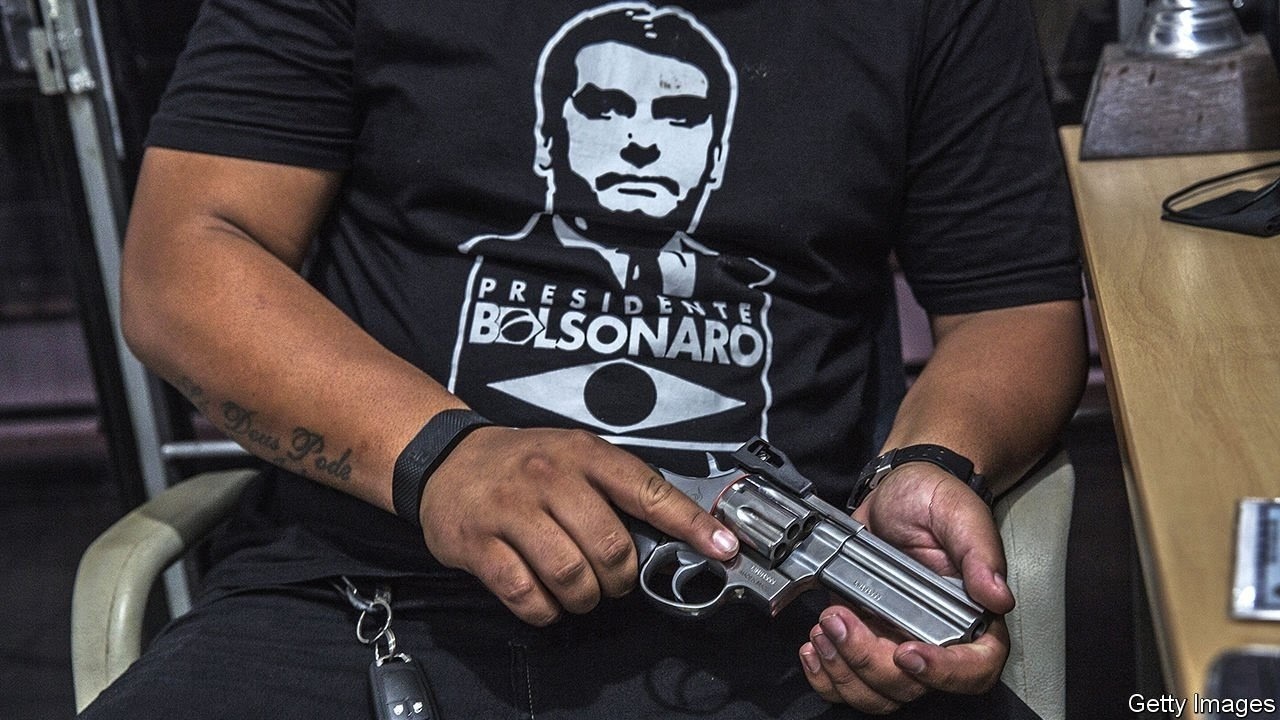
In contrast to his predecessors Jair Bolsonaro, a former army captain elected as president in 2018, wants more people to own firearms. In his election campaign he frequently posed with weapons; when he couldn’t, he made shooting gestures with his hands. Three of his sons, who are also in politics, have posed at shooting ranges. “Allegedly they have shrines to the nra in their homes,” quips Ilona Szabó de Carvalho of the Igarapé Institute, a think-tank.
As president, Mr Bolsonaro has tried to approve 31 legal changes that would make guns easier to get hold of. On April 12th the Supreme Court suspended two such changes—including decrees that would have increased the number of guns the armed forces, police and members of the judiciary could legally own for self-defence from four to six, and expanded even further the number of guns that could be owned by specialist hunters and collectors (who already can amass sizeable arsenals).
Despite this setback, however, Mr Bolsonaro’s gun-loving base has been emboldened. The number of registered firearms in circulation has surged by 66% since 2017, to just over a million, or one for every 200 Brazilians. This is far short of the standard set by the United States, which has more guns than people. But still, between 2017 and 2019 the number held by Brazilian hunters, sporting shooters and collectors increased by a whopping 120% (this group registered 271,000 new firearms in 2020). And unlike the United States, Brazil is a country where few animals can be shot legally, points out Mr Marques. At the moment only wild boars are fair game, as they are not an indigenous species. Brazilians can also now own different kinds of guns, and the amount of ammunition they can own has gone up (though the Supreme Court is querying these changes, too).
Shooting clubs have also multiplied. Last year more than 1,300 welcomed firearm fans, compared with just over 150 in 2019. More everyday folk are giving it a try. And that includes women, many of whom can be found at the Clube de Tiro Ponta Negra, a new place in Manaus. With 34 shooting stalls, it is the country’s largest club. “It’s incredible, the number of women who have been looking to train, join clubs, and buy guns,” gushes Monique Benetton, a 39-year-old manager who hones her aim there. Gunmakers are eager to woo female custom, some more subtly than others. On March 8th—International Womens’ Day—Taurus, Brazil’s largest gun manufacturer, launched “Strong Women”, a pink limited-edition revolver decorated with white flowers. It sold out in just three days.
Mr Bolsonaro’s pro-gun stance is mostly political. Loosening gun laws is cheap and simple. Perhaps that is why, unlike the promises he made during his campaign to improve schools and health care, Mr Bolsonaro has been able to keep his word on guns. Also, talking about pistols touches on the “identity of his core supporters”, says Rodrigo Soares, an academic. Many may have started to question Mr Bolsonaro’s handling of the coronavirus, which has killed more than 350,000 Brazilians and caused the economy to contract by 4%. His approval ratings have fallen to below 30%.
Others fear darker motives. When the heads of the army, navy and air force resigned on March 30th in protest at a cabinet reshuffle, it seemed to be a signal that they would not go along with some of Mr Bolsonaro’s anti-democratic urges. The president has spoken of “my army” and threatened to use it to prevent state governments from enforcing lockdowns. But if the armed forces can be relied on to respect the constitution, that is less clear of the police force, which is badly paid and full of bolsonaristas. Some pundits speculate that Mr Bolsonaro, who cheered on the storming of the United States Capitol on January 6th, is arming his base in preparation for 2022, when he will probably face Lula at the ballot box.
The next year or so will show whether this is hyperbole. Police officers benefit from job stability and handouts for themselves and their families, says José Vincente da Silva Filho, a retired colonel of the São Paulo state police. “They wouldn’t jeopardise these benefits to join a political adventure in distant Brasília,” he thinks.
For Mr da Silva Filho, the most worrying effect of Mr Bolsonaro’s rush to arm Brazil will be on crime. Already the statistics are bleak. Although homicide rates vary widely from one part of the country to another, they are rising overall. Last year saw 43,892 gun deaths nationwide, up from 41,730 the previous year. According to Daniel Cerqueira, an expert on guns at the Institute of Applied Economic Research, the inevitable outcome from a rise in gun culture will be “a tragedy” for Brazil—a country that, at the moment, is not short of them.

Free speech and social media
Will Facebook’s “Supreme Court” reinstate Donald Trump’s account?
A landmark test for the social-media giant’s experiment in content moderation
Apr 15th 2021
DALLAS
Give this article
Since january, Donald Trump has been missing from Facebook, Twitter and YouTube, after his online posts about the Capitol riot in Washington, dc, caused the firms to suspend his accounts for inciting violence. For many Americans, the sound of silence is welcome. Without the megaphone of social media, Mr Trump is muted. Facebook has not just blocked his account but is scrubbing other users’ content that features his voice.
Listen to this story
Enjoy more audio and podcasts on iOS or Android.
The ban raises questions about free speech and online platforms’ power. Even Senator Bernie Sanders, no Trump fan, confesses to feeling uncomfortable that the ex-president has been silenced by a “handful of high-tech people”. YouTube’s boss, Susan Wojcicki, has said the video firm will lift its suspension only “when we determine that the risk of violence has decreased”. Twitter will not relent, full-stop.
Facebook is taking a different approach. Mark Zuckerberg, its boss, made the call to suspend Mr Trump’s account. But whether to reverse that will be decided this month by 19 experts on the firm’s Oversight Board (ob), in effect its “Supreme Court”. The board’s decision will be a high-profile test of whether a middle ground between unfettered corporate autonomy and government regulation can be an effective tool in tackling thorny decisions on content.
Mr Zuckerberg floated the idea of the board in 2018, and its first slate of members was announced last year. It is meant to be an independent body that can render binding decisions on the social-media giant and suggest policy tweaks. Facebook has put $130m into a trust to fund it for at least six years. Board members are a global bevy of brainiacs: ten are academics, five work in non-profits and think-tanks, two hail from journalism, one from politics and one is a Nobel peace laureate. “All the members have free speech as part of their core values,” says Ronaldo Lemos, a Brazilian lawyer who is an ob member.
After posts are removed, users of Facebook and its sister social network Instagram can appeal to the ob; this has happened some 300,000 times. The board sifts through appeals to choose cases, which it has 90 days to adjudicate. Facebook itself can also refer cases directly to the ob, as it did with Mr Trump. A computer randomly assigns each case to a five-member panel. Board members are part-time, but the ob employs 40 staff, who help with case selection and research, rather like Supreme Court clerks. Just as interested parties in Supreme Court cases can submit briefs, people can submit comments to the board.
So far it has taken up 12 cases and received 10,000 comments, 9,800 of them related to the Trump ban. When the panel reaches a conclusion, the majority of the board has to approve the decision, which is then written up and made public.
The dozen cases are a varied bunch. Was Facebook right to take down images of blackface? Or a photo of a bare nipple raising awareness of breast cancer? Or a video arguing for access to an unproven treatment for covid-19? Of the seven cases it has ruled on, the board overturned Facebook’s decision five times. It does not take into account the laws of any specific country but weighs Facebook’s “community standards” and “values” with international human-rights law. It can also coax Facebook to make changes to its policies. Some of Facebook’s tweaks to handling anti-vax content were a response to the board’s criticisms.
Which way will it go on Mr Trump? From its first decisions “it was clear how highly the board prizes freedom of expression,” says Evelyn Douek, a law lecturer at Harvard. “That made me think Trump’s odds just got better.” Not everyone agrees. A lot will depend on how the board interprets human-rights law, as opposed to Facebook’s standards, which Mr Trump violated routinely. “Trump’s account involves not just his free speech but has an impact on other people’s rights,” says David Kaye, a former un rapporteur for freedom of expression, who will be “really surprised” if the ob contradicts Facebook’s decision.
Either way, controversy will continue. “Facebook is still holding the reins far too tight,” says Ms Douek. On April 13th it announced that the board would have authority to review appeals related to content that had been kept on the platform. Until now the board has only been able to review appeals against the removal of content.
Despite criticism, the board is worth watching for several reasons. One is that it will help bring some of Facebook’s decisions into the light. “One of the challenges has been the lack of information that’s available in how exactly Facebook works and how its automated systems are trained and evaluated,” says Nicolas Suzor, an Australian law professor and ob member.
Second, in ruling on Mr Trump the board will guide Facebook on how to treat other politicians, such as Brazil’s Jair Bolsonaro and the Philippines’ Rodrigo Duterte. Facebook and Twitter have operated with a “newsworthiness exemption” for such leaders, allowing speech that violated their own policies because of the speakers’ position and the potential benefit to users from hearing them. “There’s the saying, ‘with great power comes great responsibility’. But with the newsworthiness exemption, great power comes with indemnification from responsibility,” says Renee DiResta of the Stanford Internet Observatory.
And, third, the board’s verdicts will ripple across social media. Its decision on Mr Trump will put pressure on Twitter and YouTube. It will become a de facto standard-setter. “If the Oversight Board could be the germ that gets buy-in from industry, that’s wonderful,” says Sir Nick Clegg, Britain’s former deputy prime minister, who is Facebook’s communications chief.
Still, Facebook’s experiment is just a start. The Trump decision will be contentious. But if there is one thing all can agree on, it is that a single board will not alone solve social media’s ills.
https://www.economist.com/china/2021/04/17/chinas-tomb-raiders-are-growing-more-professional
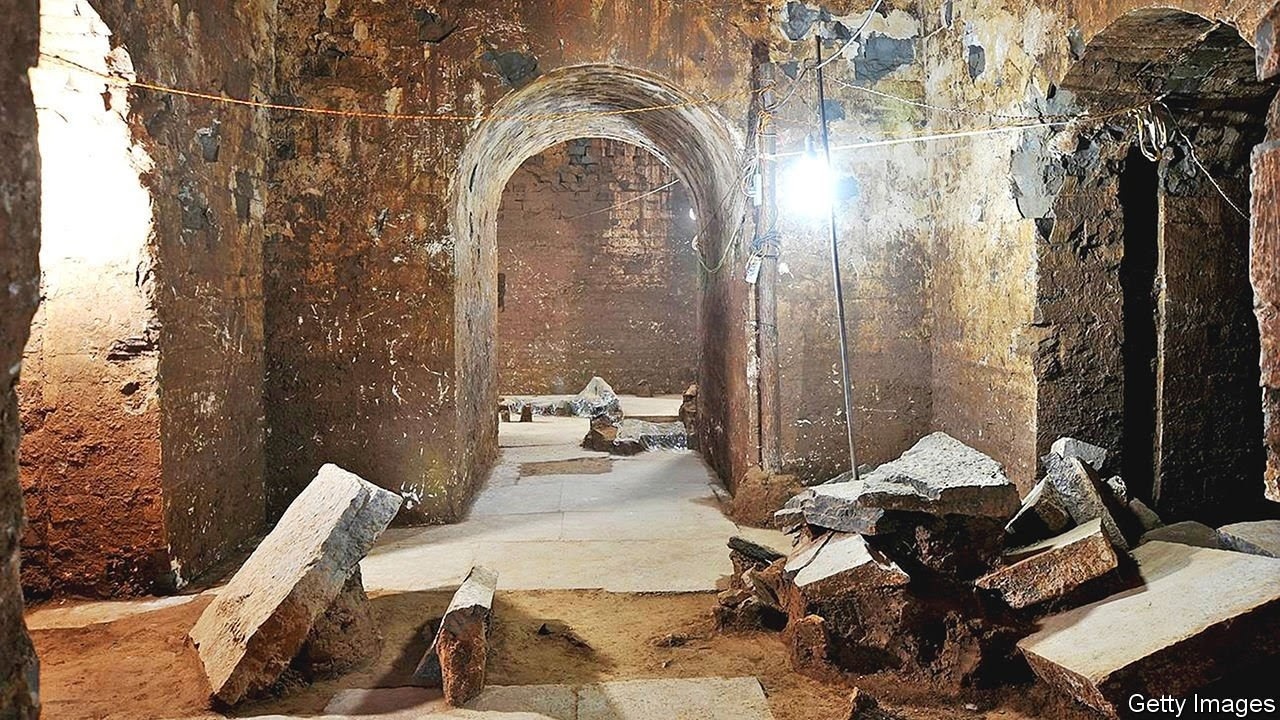
A grave offence
China’s tomb raiders are growing more professional
The government is digging deep to stop them
Apr 17th 2021
GUANGHAN
Give this article
By day mr wei sold pancakes in Shaanxi, a northern province. By night he led a gang of grave robbers who tunnelled under an ancient temple near his shop. It took 11 months for them to reach the treasures buried beneath, which included gold statues of the Buddha and the bones of illustrious monks. Mr Wei and his cronies went on to dig several more passages from restaurants that they opened in the vicinity of shrines and pagodas. Over five years the looting earned them 12m yuan ($1.8m). Last year Mr Wei was sentenced to 15 years in prison. It was the second time that tomb raiding had landed him behind bars.
Listen to this story
Enjoy more audio and podcasts on iOS or Android.
China is redoubling efforts to catch grave robbers. Last year authorities arrested 2,400 such thieves and retrieved over 31,000 lost or stolen items, almost three times the number reclaimed during the previous year. The government agency responsible for protecting relics says it is in the midst of a 12-month crackdown on tomb raiders that involves more investment in staff and equipment. Punishments are growing more severe. In 2017 a man convicted of leading a gang of 200 grave robbers was put to death.
Looting antiquities remains an alluring business, nonetheless. Some 90% of all the major tombs of which the whereabouts is known have been plundered at one time or other, says Ni Fangliu, an independent scholar. Sites in Shaanxi province—home to the world-famous terracotta army, among other ancient stuff—have been a target for centuries. But thieves are fanning out to new areas, including Xinjiang in north-western China and Inner Mongolia, in the north-east (a looted tomb in Henan province is pictured).
The robbers are increasingly professional and often well-connected. Some are backed by investors who cover travel expenses and stump up for tools. On one visit to north-eastern China, Mr Ni was approached by a thief trying to raise funds to buy an excavator. He turned out to be the brother of a senior policeman. Rummaging around for shiny stuff is not the only way they make grave robbery pay. Criminals have been known to snatch bodies or funeral urns, then ask living relatives to pay ransom.
Taboos around disturbing old graves are fading, a little. These were once so strong that even archaeologists shied from opening tombs, and some still set off firecrackers before digs to repel ghosts. But in 2006 two popular fantasy novels, “Grave Robbers’ Chronicles” and “Ghost Blows Out the Light”, made it look fun. Grave robbers’ picaresque adventures soon became the subject of films and television shows. That makes some officials queasy. In 2016 a Communist Party mouthpiece urged people not to “glamorise the grave robber” because “digging up ancestral tombs has always been a wicked practice”.
The craze has had the benefit of strengthening public interest in archaeology. In March the state broadcaster live-streamed a dig that has unearthed 3,000-year-old relics from Sanxingdui, an ancient site in Sichuan province. Millions tuned in. Yang Ying, a 25-year-old history buff milling around the Sanxingdui museum, credits “Grave Robbers’ Chronicles” for nurturing her interest in relics. But “lock up the thieves,” she says.