영어로 배우는 중학교 수학 - 직선의 방정식의 그래프 [ 한글 해설 ] / Graph of a Linear Equation
작성자CLARK작성시간09.11.20조회수1,665 목록 댓글 0
중학교 2학년 수학 - 직선의 방정식의 그래프 부분을 영어로 배워봅시다.
아래를 클릭하시면 비디오도 보실 수 있습니다.
-----------------------------------------------------------------------------------------------------------------------
E X A M P L E 1. 예제 1.
Graph the system of equations to find the solution.
다음의 연립방정식을 그래프로 그리고 풀어보세요.
x + 2y = 1
2x + y = 5
The graphs appear to intersect at the point with coordinates (3, -1).
그래프는 좌표 (3, -1) 에서 교차하는 것으로 보입니다.
Check this estimate by replacing x with 3 and y with -1 in each equation.
이것을 확인하기 위하여 각각의 방정식에 x를 3으로 바꾸고 y를 -1로 바꾸어
넣고 확인해 봅시다.
Check : x + 2y = 1 2x + y = 5
3 + 2(-1) =(?) 1 2(3) + (-1) =(?) 5
1 = 1 v 5 = 5 v
The solution is ( 3, -1 ).
정답은 (3, -1 ) 입니다.
< 관 련 단 어 해 설 >
 f,gr
f,gr

 f] <명사> 그래프, <동사> 그래프를 그리다
equation [ikw
 i
i

 n,-
n,-
 n] <명사> 방정식
solution [s
l
 n] <명사> 해, 근, 답, 해답, 정답
appear [
p

 ] <동사> (…처럼) 보이다, 생각되다; …인 듯하다[to, to be]
intersect [
 nt
s
kt] <동사> (직선이) 서로 만나다, 교차하다[at]
nt
s
kt] <동사> (직선이) 서로 만나다, 교차하다[at]
coordinate [kou
 d
d
 n
t,-n
n
t,-n
 it] 〈수학〉좌표, 좌표의
replace [ripl
is] <동사> …을 바꾸어 놓다; …을 대체하다, 교환하다[ by, with ].
A system of two linear equations has exactly one ordered pair as its solution when the graphs of the equations intersect at exactly one point.
두개의 직선의 방정식의 꼴에서 두 방정식의 그래프가 정확히 한 점에서 교차하
면 이 두 방정식은 정확히 한 개의 순서쌍을 근으로 갖습니다.
If the graphs coincide, they are the same line and have infinitely many points in common.
만일 두 방정식의 그래프가 일치할 경우, 이 두 직선은 같고 무한히 많은 점들을 공통으로 갖습니다.
In either case, the system of equations is said to be consistent. That is, it has at least one ordered pair that satisfies both equations.
이 두 방정식들의 경우는 모순이 없는 방정식 (근을 갖는 방정식) 이라고 합니다.
즉, 두 방정식을 만족시키는 적어도 하나의 순서쌍이 근으로 존재한다는 뜻입니다.
It is also possible for the two graphs to be parallel. In this case, the system of equations is inconsistent because there is no ordered pair that satisfies both equations.
또한 두 방정식의 그래프가 나란히 평행할 때도 있습니다. 이 경우 두 방정식은 불일치하는 (근이 없는) 방정식이라고 합니다. 왜냐하면 두 방정식을 만족시키는 순서쌍이 근으로 존재하지 않기 때문입니다.
관 련 단 어 해 설
linear equation <수학> 1차 방정식, 직선의 방정식
 uins
uins
 id] <동사> 동시에 동일 공간을 차지하다, 일치하다, 맞다,
infinitely [
nf
n
tli] <부사> 무한히, 무수히
consistent [k
ns
st
nt] <수학>
parallel [p
 r
l
l,-l
l] <형용사> 평행한, 나란한, 같은 방향의, 평행인
r
l
l,-l
l] <형용사> 평행한, 나란한, 같은 방향의, 평행인
inconsistent [
nk
ns
st
nt] <수학> (방정식이) 불능인, 근이 존재하지 않는
Another way to classify a system is by the number of solutions it has.
연립방정식을 분류하는 또 하나의 방법은 방정식이 가지는 근의 수에
따라 분류하는 법입니다.
* If a system has exactly one solution, it is independent.
* 만일 방정식이 오로지 하나의 근만을 갖을 경우 이 방정식은
독립방정식이 됩니다.
* If a system has an infinite number of solutions, it is dependent.
* 만일 방정식이 무한히 많은 수의 근을 갖으면 종속방정식이 됩니다.
Thus, the system in Example 1 is said to be consistent and independent.
그래서 예제 1의 방정식은 근을 갖는 (모순이 없는) 독립방정식이 되겠습니다.
The chart below summarizes the possible solutions to systems of linear equations.
아래의 표는 직선의 방정식의 가능한 근의 갯수를 요약해 놓은 것입니다.
|
Graphs of Equations 방정식의 그래프 |
Number of Solutions 근의 갯수 |
Terminology 방정식의 분류명 |
|
intersecting lines 그래프가 서로 교차할때 |
exactly one 단 하나 |
consistent and independent 근을 갖는 독립방정식 |
|
same line 그래프가 서로 완전히 일치할때 |
infinitely many 무수히 많음 |
consistent and dependent 근을 갖는 종속방정식 |
|
parallel lines 그래프가 평행할 때 |
none 없음 |
inconsistent 근을 갖지 않는다 |
관 련 단 어 해 설
i
nt
s
pt]
x-intercept 〈수학〉 x 절편
independent [indip
nd
nt] 〈수학·통계〉 (양·함수가) 독립인
dependent [dip
nd
nt] 종속되어 있는 , 종속의, 의지하는, 의존하는
classify [kl
s
f
 i] <동사>
summarize [s
 m
iz] <동사> 요약하다, 간추려 말하다; 개괄하다.
m
iz] <동사> 요약하다, 간추려 말하다; 개괄하다.
- terminology [t
 m
n
m
n
 l
d
i / -n
l-] <명사> 전문 용어, 술어.
l
d
i / -n
l-] <명사> 전문 용어, 술어.
nf
n
t] <형용사>
E X A M P L E 2 .
Graph each system of equations to determine the number of solutions.
a. x + y = 4
x + y = 1
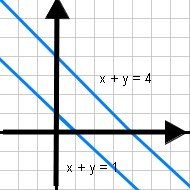
The graphs of the equations are parallel lines. Since they do not intersect,
there is no solution to this system of equations. Notice that the two lines
have the same slope but different y-intercepts.
Recall that a system of equations that has no solution is said to be inconsistent.
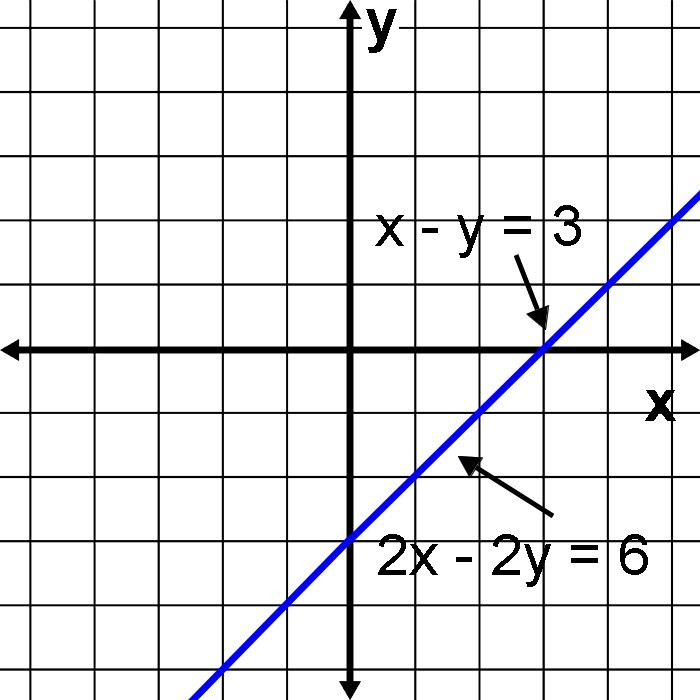
b. x - y = 3
2x - 2y = 6
Each equation has the same graph. Any ordered pair on the graph will
satisfy both equations. Therefore, there are infinitely many solutions of this
system of equations. Notice that the graphs have the same slope and
intercepts.