https://youtu.be/fclvWul_bGo?si=O8ujYqHim01sF2Mt
Split-S maneuver
스프릿S 기동은 절반의 롤과 함께 스틱에 백프레슈어backpressure를 주어 절반의 루프Loop를 수행하는 것이다.
먼저 180도 롤roll을 해서 전투기를 반전시켜라. 그때 롤을 멈추고 스틱을 당겨서 절반의 루프를 실행해라.
전투기는 다시 수평비행에 들어가게 된다. 이기동으로 전투기는 고도를 상실하고 방향을 바꿀 수 있다.
split 쪼개다, 나누다
I split the fruit in half.
과일을 반으로 잘랐다.
The road splits in two directions up ahead.
전방에서 도로가 두 갈래로 갈라진다.
For this activity, let's split the class into two groups.
이 활동을 위해, 학급을 두 그룹으로 나누자.
We should split the check for this meal.
우리는 이 식사의 계산서를 나눠야 한다.
스플릿 에스 (Split-S)
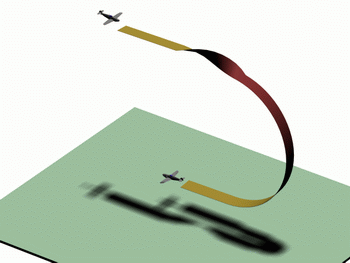
Split-S는 우선 기체를 반바퀴 롤하여 배면비행상태가 되도록 한 뒤에, 그 상태에서 바로 스틱을 곧바로 당겨 루프의 뒷부분을 실행하는 것입니다.
Split-S를 하면 진행 방향이 180도 바뀌고, 고도가 떨어지고 속도가 늘어납니다. 하강을 할 때 속도가 높아져 위험할 수 있기 때문에, 필요한 만큼 스로틀을 조절하거나 스피드 브레이크를 조절해서 지나치게 속도가 높아지지 않도록 해야합니다.
하강하는 동안 수직 자세에서 롤을 주면 최종 진행방향을 원하는 방향으로 조절할 수 있습니다.
수직으로 하강하면서 Split-S를 하지 않고 기체에 90도 이상의 뱅크가 들어가 있는 상태에서 대각선 방향으로 하강하면서 실행하는 대각선 스플릿 에스 기동은 Sliceback이라고 합니다
The split S is an Aerobatic maneuver and an air combat maneuver mostly used to disengage from combat.
To execute a split S, the pilot half-rolls his aircraft inverted and executes a descending half-loop, resulting in level flight in the opposite direction at a lower altitude.
Steps of split S
180° roll
Half loop
Exit level
루프 (Loop) maneuver
How to Fly a Loop
By Adrian Willis
In aerobatics, all maneouvres stem from just a few “prime” figures and the loop is probably the most important of these since it is most prevalent.
Even a Stall Turn (Hammer Head for our colonial cousins) incorporates a quarter loop at entry and exit.
If you are to succeed in aerobatic competitions, it is therefore essential that you master the prime figures.
The Judging Criteria for a Loop:
It is a wind corrected figure and must appear round from the judges perspective
It must be on axis
It must be vertical, i.e. not tilted to one side.
The end point should be exactly where the loop started horizontally and vertically.
If loops are flown too close they will be difficult to judge and should be downgraded both in the positioning score but also in the figure score. Similarly if the loop is positioned exactly in front of the judges on the B axis so that the shape cannot be judged, it should be downgraded.
As the loop must appear circular, entry and exit height must be the same and the radius must be constant. All figures start and finish from level flight. Typically judges will hold a pencil to your starting point and estimate the radius of each quarter of the loop. They will confirm you finish at your starting height and position.
How to Fly a Loop
There are many different types of loop, we are interested in the competition loop, i.e. on that looks perfectly circular from the judges perspective.
If you were flying a loop at an air display, it would be different to give the best spectacle. You would start and finish from a very low height, but have the ability to cope with an engine failure at any stage. It is a bad idea to be pulling lots of G near the ground so we would pull early and then let the aircraft sink towards the ground to give dramatic effect while preserving a large margin for safety but sacrificing perfect shape.
If you were taking your girl friend for a pleasant aerobatic trip and intending on a longer term relationship, it would be considerate to reduce the G somewhat and also to reduce the negative G at the top. The result would be a “granny loop” or egg shaped loop but also a happier girlfriend. (don’t be one of the many idiots that fly passengers without consideration making them feel sick and putting them off aerobatics for life )
The key consideration for a competition loop is to ensure that each quarter loop is the same radius as the first quarter. We will presume the loops to be into wind.
Step 1.
Dive for speed (45 degrees). Then come level at your chosen speed, which will vary according to aircraft type. For the Extra a good speed is 150 knots (2.5 x Vs).
Step 2.
Fly level for a second or two and note your height and a landmark or line feature straight ahead. Look at your left wing sight and see where it cuts the horizon, then ease the stick back, straight with no aileron, pulling approximately 5 G while continuing to look at the left wing sight and keeping it pegged to the horizon. You are setting the radius of the loop in this first quarter.
Step 3
As the speed reduces and you begin the second quarter you must maintain the same radius so smoothly reduce the pressure on the stick. At the top of the loop you should be floating at half of 1 G and approximately 50 knots.
Step 4
As you start the third quarter, allow the speed to increase and increase the back pressure. If you pull too hard at the beginning the extra drag will delay the speed increasing.
Step 5
As the speed increases increase the back pressure more, remembering to keep looking at the wing tip and keep the sight pegged to the horizon. When you reach level flight, look at the altimeter and confirm you are at your starting height and on your starting heading.
Of course, the ball should be perfectly in the middle throughout the loop. It is important to keep looking at the wing tip, so you are not able to use the ball as a reference. In practice you use your body as the ball but also see if the wing tip moves forward or backwards to indicate aircraft yaw. The judges cannot see if your ball is in the middle. On entry when you are fast, you will need a little left rudder (clockwise prop) to balance the power and a little left rudder when you pull to counter the gyro. As the aircraft slows down you will require a little right rudder and then as the aircraft speeds up you will again need a little left rudder. In the Extra the rudder movement required is small and is not a high priority when first starting.
Getting a perfect circle is not easy and cannot be properly judged from inside the aircraft without a reasonable amount of experience. In the early days you must fly with an instructor that has significant competition experience and trust what he tells you. Later you will get critique from the ground.
Starting at a high speed and pulling 5 G will make establishing equal radii in all 4 quadrants easier.
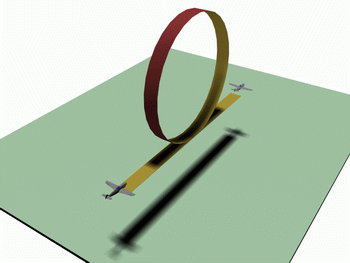
루프는 수평 비행 상태에서 단순히 조종간을 앞으로 당겨서 수직 방향으로 원을 그리는 것입니다.
루프는 초기에 많은 속도의 손실이 있기 때문에 충분한 속도가 확보된 후에 실시해야 합니다.
기동을 하는 동안 비행 방향이 어긋나는지, 그리고 기체가 롤이 들어가는지 계속 확인하면서 러더와 에일러론을 사용하여 비행 축선이 어긋나지 않도록 계속 자세를 바로잡아 주면서 루프를 해야 합니다.
루프를 하는 동안에는 지구의 중력이 비행기에 작용하여 지면쪽을 향해 1G만큼의 힘이 추가되기 때문에, 단순히 조종간을 같은 힘으로 당기고만 있으면 위의 그림에서 보듯이 동그란 원이 생기지 않고 비행 경로가 위쪽으로 길다란 타원형이 됩니다.
이 모양이 계란처럼 생겼다고 해서 이러한 현상을 Egg Turn의 원리라고 합니다.
수직으로 상승해서 루프를 그리지 않고 기체에 뱅크가 들어가 있는 상태에서부터 대각선으로 상승하면서 실행하는 대각선 루프는 Oblique라고 합니다.
https://youtu.be/7L4HMiC04ho?si=UdQKH41Vj6QTCgS6