How 50 years of climate change has changed the face of the 'Blue Marble' from space
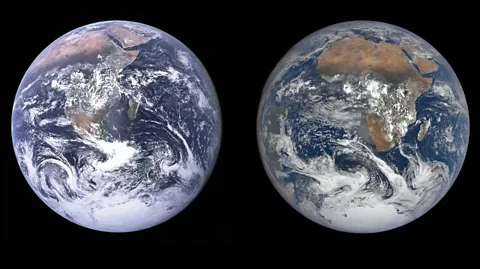
The Blue Marble: 50 Years of Earth Through Human and Satellite Eyes
On December 7, 1972, as Apollo 17 traveled toward the Moon, astronaut Harrison Schmitt looked out into the darkness of
space and saw something extraordinary: a fully illuminated Earth, fragile and blue. Moments later, the crew captured what
would become one of the most famous images in human history — the “Blue Marble.”
This was the first time a human had photographed the entire planet in full sunlight, using a specially modified Hasselblad
500 EL camera with 70mm Kodak film. Without a viewfinder, astronauts relied on training and instinct, taking turns passing
the camera and documenting their home from 29,000 km away. The result was breathtaking: swirling white clouds, blue
oceans, the curve of Africa, and the icy expanse of Antarctica. It was both a scientific achievement and a profound
emotional moment, reshaping how humanity viewed itself.
🖼️ Image Comparison: 1972 vs 2022
The image provided shows two versions of Earth:
● Left: 1972 Blue Marble – Earth appears lush and dynamic, with thick cloud cover across the Southern Hemisphere and clear visibility of Africa and Antarctica. The southern ice cap is broad and brilliant white, suggesting a cooler, more stable climate.
● Right: 2022 Blue Marble – Taken by NASA’s EPIC camera aboard the DSCOVR satellite a million miles away. The image, while equally striking, shows several notable differences:
- The Antarctic ice sheet is visibly smaller.
- The Sahara Desert has expanded north and south.
- Rainforest regions, particularly in central Africa, show reduced vegetation and fewer clouds, pointing to ongoing
deforestation and desertification.
These visual contrasts represent the real-world impacts of 50 years of climate change — changes that satellites now monitor daily, but that were once unimaginable in 1972.
🌡️ Human Footprint from Space
Climate scientist Nick Pepin highlights that many of the changes visible from space — shrinking ice, expanding deserts, and retreating forests — directly reflect human-driven climate change. Urbanization, greenhouse gas emissions, and widespread deforestation have reshaped Earth’s ecosystems in just a few decades.
What was once a vibrant, cloud-covered planet now shows signs of stress:
● Less snow and ice reflect a warming cryosphere.
● Drier land indicates reduced rainfall and vegetation loss.
● The interconnectedness of land, weather, and climate is more visible — and more vulnerable.
🛰️ EPIC Satellite Technology: Precision Without Presence
The 2022 image was captured not by a human, but by NASA’s Earth Polychromatic Imaging Camera (EPIC). Mounted on
the DSCOVR satellite at the Sun-Earth Lagrange Point, EPIC captures 13–22 images per day in 10 wavelengths (UV to
near-infrared). It provides valuable data on:
● Ozone, aerosols, cloud cover, and water vapor
● Photosynthesis, vegetation health, and ocean color
● Ice crystal formation and atmospheric reflectivity
While far more advanced than the Apollo-era camera, EPIC lacks the human touch — a fact noted by Smithsonian curator Jennifer Levasseur, who explains that no machine can replicate the emotion behind a human-captured image.
🌌 The Overview Effect: Awe from Above
Viewing Earth from space has long been described as life-changing. British astronaut Helen Sharman recalled her 1991 launch and the "gorgeous blue seas" and "ultramarine light" of the planet as it floated in space. She experienced the overview effect — a shift in perspective marked by awe, unity, and ecological responsibility.
The original Blue Marble image offered that feeling to the public for the first time. Suddenly, the Earth was no longer abstract
or vast — it was small, interconnected, and in need of care.
🌱 From Wonder to Warning
The Blue Marble came to symbolize more than just Earth’s beauty:
● It fueled the environmental movement.
● It illustrated the Gaia hypothesis, promoting a holistic view of Earth’s systems.
● It became a tool for activism — used by Friends of the Earth, Earth Day organizers, and even featured in An Inconvenient
Truth.
Today, the 2022 version serves as a visual warning. The Earth still shines, but its changes are visible and concerning.
More urban lights, more fires, less ice, fewer forests — satellites now show all of it.
[source: How 50 years of climate change has changed the face of the 'Blue Marble' from space from BBC]