------------------------------------------------------------------------ Work specialization
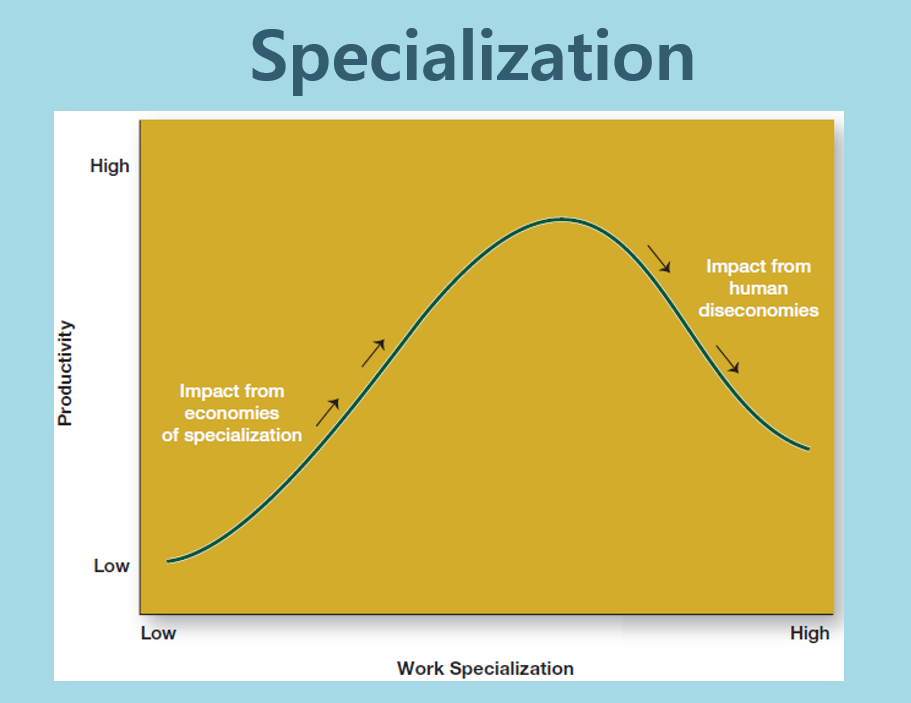
Work specialization is the division of work activities into separate job tasks. At the Wilson Sporting Goods factory in Ada, Ohio, workers making NFL footballs specialize in job tasks—such as molding, stitching and sewing, and lacing—to increase work output.
When first introduced, specialization almost always generated higher productivity. But at some point, the human diseconomies—boredom, fatigue, stress, low productivity, poor quality, increased absenteeism, and high turnover—exceed the economic advantages, as seen here in the exhibit below.
Most managers today see work specialization as an important organizing mechanism because it helps employees to be more efficient. However, managers also have to recognize its limitations.
------------------------------------------------------------------------ Types of authority relationship
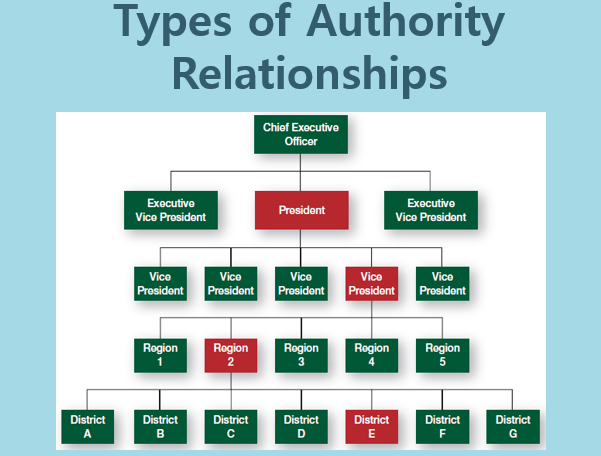
When organizing work, managers need to clarify who reports to whom, which is known as the chain of command—that is, the line of authority extending from upper to lower organizational levels.
Authority refers to the rights inherent in a managerial position to give orders and expect those orders to be obeyed. Authority is a major concept discussed by the early management writers, who viewed it as the glue that held an organization together. Each management position had specific inherent rights associated with the position’s rank or title.
When managers delegate authority, they must allocate commensurate responsibility. That is, when employees are given rights they also assume a corresponding obligation to perform and be held accountable for their performance.
Early management writers distinguished between two forms of authority: line authority and staff authority. Line authority entitles a manager to direct the work of an employee according to the chain of command, which is shown here in the exhibit below. In the chain of command, every manager is subject to the direction of his or her superior.
Sometimes the term ”line” is used to differentiate line managers from staff managers. In this context, line refers to managers whose organizational function contributes directly to the achievement of organizational objectives.
Whether a manager’s function is classified as line or staff depends on the organization’s objectives.
--------------------------------------------------------------------------------- Line and Staff Authority
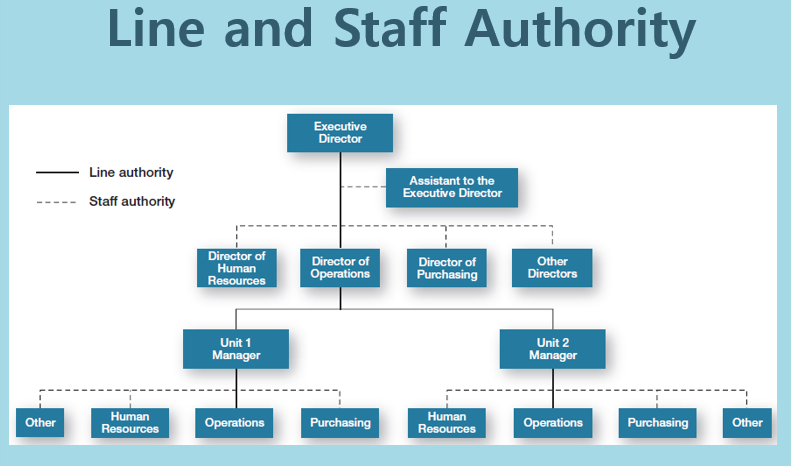
As organizations get larger and more complex, line managers find that they do not have the time, expertise, or resources to get their jobs done effectively. In response, they create staff authority functions to support, assist, advise, and generally reduce some of their informational burdens.
For example, if a hospital administrator cannot effectively purchase all the supplies the hospital needs, the administrator creates a purchasing department, which is a staff department. The exhibit below, seen here, illustrates how line and staff authority relate.
-------------------------------------------------------------------------------------- Power vs. Authority
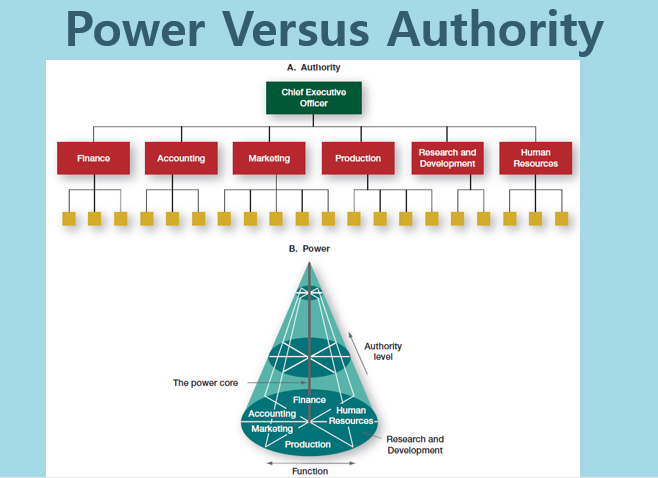
The exhibit below depicts the difference between authority and power. The boxes in Part A portray authority. Each horizontal grouping represents a functional area in which the authority applies. The influence one holds in the organization is defined by the vertical dimension in the structure. The higher one is in the organization, the greater one’s authority.
Power, on the other hand, is a three-dimensional concept (as shown by the cone in Part B of Exhibit 6-5). It includes not only the functional and hierarchical dimensions but also a third dimension called centrality.
Power is made up of both one’s vertical position and one’s distance from the organization’s power core or center. If the cone in the exhibit below were an organization, the center of the cone would be the power core. The closer one is to the power core, the more influence one has on decisions.
In fact, the existence of a power core is the only difference between A and B in the exhibit below . The top of the cone corresponds to the top of the hierarchy, the middle of the cone to the middle of the hierarchy, and so on. Similarly, the functional groups in A become wedges in the cone. Each wedge represents a functional area.
The cone analogy acknowledges two facts:
1. The higher one moves in an organization (an increase in authority), the closer one moves to the power core; and
2. It’s not necessary to have authority to wield power because one can move horizontally inward toward the power core without moving up. For instance, as gatekeepers for their bosses, assistants often are powerful in a company even though they have little authority.
-------------------------------------------------------------------------------------------- Mechanistic Org. vs. Organic Org.
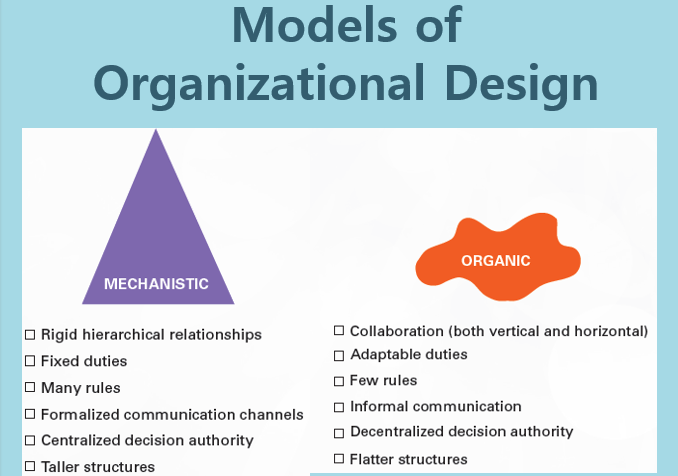
How an organization is structured depends on contingency variables such as strategy, size, technology, and environment. Let’s take a look at the two generic organization structure models shown here.
The mechanistic organization (or bureaucracy) – Rigid and tightly controlled structure that combines traditional aspects of all six elements of organization structure.
Combines traditional aspects of all six elements of organization structure: high specialization, rigid departmentalization, clear chain of command, narrow spans of control leading to taller structure, centralization, and high formalization.
In contrast, the organic organization – Highly adaptive and flexible structure, which allows it to change rapidly as required. Collaboration (both vertical and horizontal), adaptable duties, few rules, informal communication, decentralized decision authority, and wider spans of control leading to flatter structures.
------------------------------------------------------------------------------- Traditional organizational designs
In making structural decisions, managers can choose either a traditional or contemporary design.
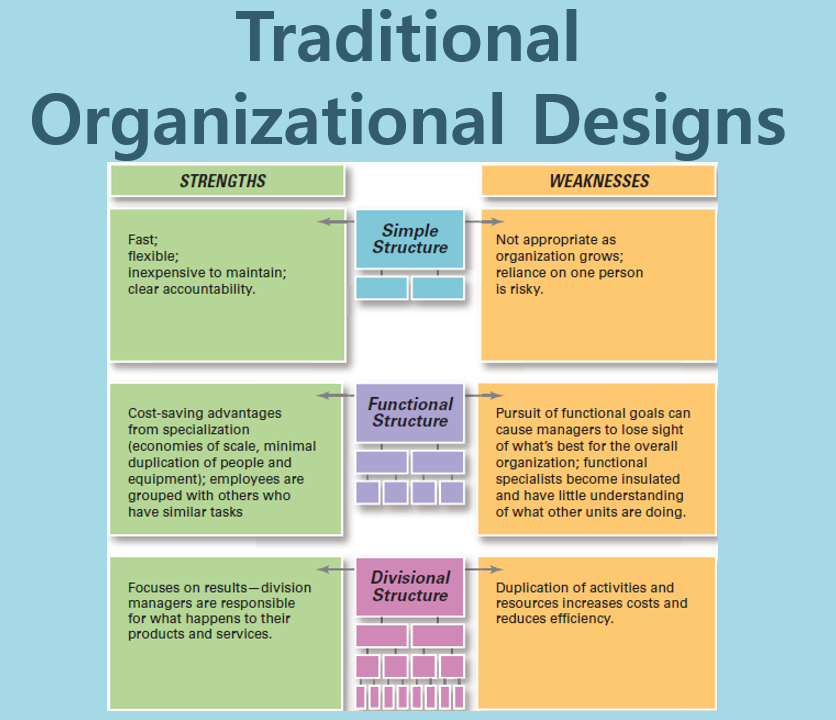
Within traditional organizational design, there are three structures: simple, functional, and divisional, all of which tend to be mechanistic in nature. Here in Exhibit below we see a summary of the strengths and weaknesses of each.
Since most companies start as entrepreneurial ventures, they use a simple structure, which is an organizational design with low departmentalization, wide spans of control, authority centralized in a single person, and little formalization.
The simple structure is most widely used in smaller businesses and it’s fast, flexible, inexpensive to maintain, and has clear accountability. However, as an organization grows, there are few policies to guide operations, which creates information overload at the top and slows decision making.
As more employees are added, most small businesses tend to become more specialized and formalized. Rules and regulations are introduced, work becomes specialized, departments are created, levels of management are added, and the organization becomes increasingly bureaucratic.
Two of the most popular bureaucratic design options grew out of functional and product departmentalization. They are called the functional and divisional structures.
-----------------------------------------------------------------------------------------------
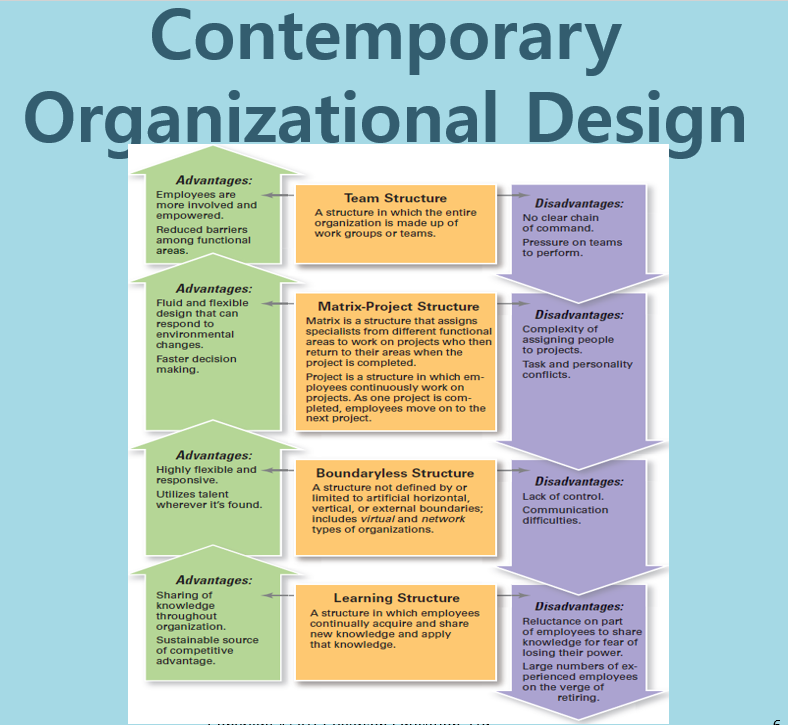
Because managers find that the traditional designs often aren’t responsive enough to today’s increasingly dynamic and complex environment, they find creative, more organic ways to structure and organize work.
As we see summarized here in the exhibit below:
•In team-based structures, the entire organization is made up of work teams that do the organization’s work.
•Matrix and project structures assign specialists from different functional departments to work on projects led by a project manager.
•Boundaryless structures are organizations with designs that are not defined by, or limited to, the horizontal, vertical, or external boundaries imposed by a predefined structure.
------------------------------------------------------------------------- Matrix and Project Structure
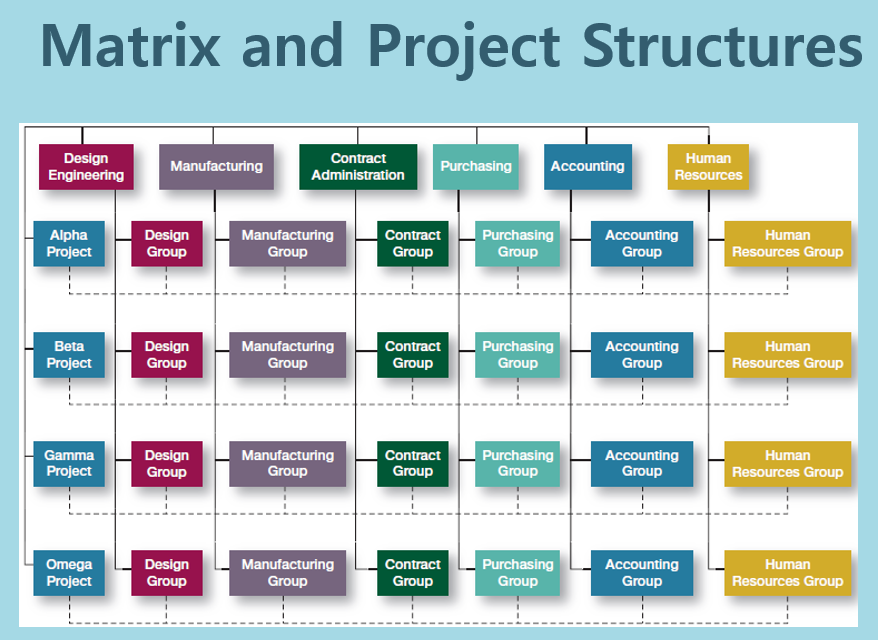
Other popular contemporary designs are the matrix and project structures. In the matrix structure, specialists from different functional departments work together to complete an assigned project. When it is accomplished, they return to their functional departments.
Another unique aspect of the matrix structure is that it creates a dual chain of command since employees have two managers who share authority: their functional area manager and their product or project manager.
As shown here in the exhibit below, the project manager has authority over the functional members who are part of his or her project team in areas related to the project’s goals. However, any decisions about promotions, salary recommendations, and annual reviews typically remain the functional manager’s responsibility. To work effectively, both managers have to communicate regularly, coordinate work demands, and resolve conflicts together.
The primary strength of the matrix is that it can facilitate coordination of multiple complex and interdependent projects while still retaining the economies that result from keeping functional specialists grouped together.
The major disadvantages of the matrix are the confusion it creates and its propensity to foster power struggles. Dispensing with the chain of command and unity of command principles significantly increases confusion over who reports to whom, which triggers power struggles.
---------------------------------------------------------------------------- Learning organization
Another challenge facing managers is how to build a learning organization, which is an organizational mindset or philosophy that has significant design implications.
In a learning organization, employees continually acquire and share new knowledge and apply that knowledge when making decisions or performing their work. Some theorists say this may be the only sustainable source of competitive advantage.
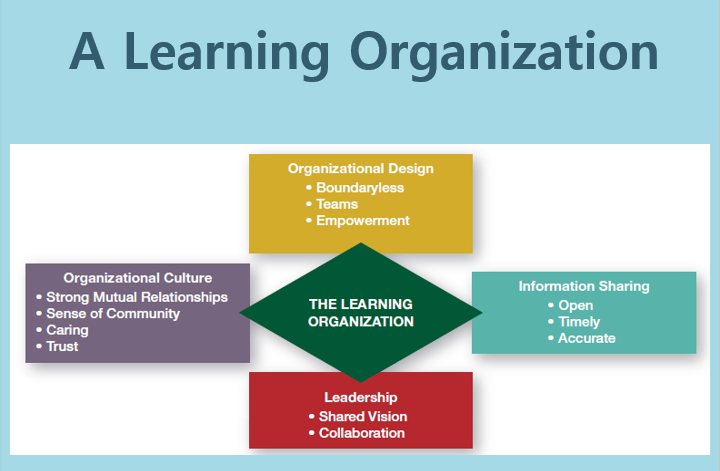
As we see in the exhibit below, the important characteristics of a learning organization revolve around organizational design, information sharing, leadership, and culture.
Leadership plays an important role as an organization moves toward becoming a learning organization. Leaders should facilitate the creation of a shared vision for the organization’s future and keep organizational members working toward that vision. They should also support and encourage the collaborative environment that’s critical to learning.
Finally, the organizational culture is an important aspect of a learning organization, where everyone agrees on a shared vision and recognizes the inherent relationships among the organization’s processes, activities, functions, and external environment. Organizational culture also fosters a strong sense of community, caring, and trust.
------------------------------------------------------------------------------------- Flxible Work Arrangements
Thanks to technology, work can now be done anywhere and anytime. As organizations adapt their structural designs to these new realities, we see more of them adopting flexible working arrangements that exploit the power of technology and give them the flexibility to deploy employees when and where needed.
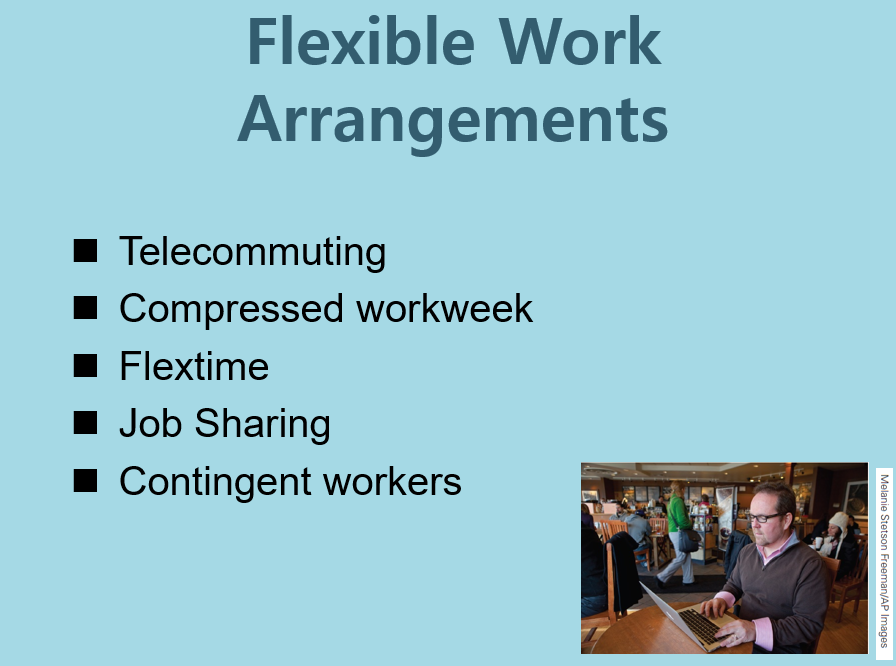
Some different types of flexible work arrangements including telecommuting; compressed workweeks, flextime, and job sharing; and contingent workforce.
Telecommuting is a work arrangement in which employees work at home and are linked to the workplace by computer. This arrangement saves the organization overhead and allows employees to save on commuting expenses and time. In this arrangement, managers might be concerned about supervising the productivity of remote employees, keeping employees connected socially, and the security of business information.
Organizations sometimes find that they need to restructure work using other flexible work arrangements, such as a compressed workweek in which employees work more hours per day but fewer days per week. The most common arrangement is four 10-hour days.
Another alternative is flextime (also known as flexible work hours), which is a scheduling system in which employees are required to work a specific number of hours a week but are free to vary those hours within certain limits.
Another type of job scheduling is called job sharing, which is the practice of having two or more people split a full-time job. Organizations might offer job sharing to professionals who want to work but don’t want the demands of a full-time position. Many companies use job sharing during economic downturns to avoid employee layoffs.
The labor force has already begun shifting away from traditional full-time jobs towards contingent workers—temporary, freelance, or contract workers whose employment is contingent upon demand for their services. In today’s economy, many organizations have responded by converting full-time permanent jobs into contingent jobs. It’s predicted that by the end of the next decade the number of contingent employees will grow from 30 percent to about 40 percent of the workforce.
No matter what structural design managers choose for their organizations, the design should help employees do their work in the best, most efficient, and most effective way they can.