일기가 불안정해 비가 오면 놓치겠지만 앞으로 당분간 목성관측이 힘들어지게 된다고 하니 이 장면은 꼭 볼 수 있기를 바래봅니다. 작년 내내 금성과 목성이 만나기를 기다리며 보낸 시간이 기억납니다.
모두 즐거운 별 생활되세요.
Two Planet Pairs Perform at Dusk
두 행성이 황혼녘에 쌍을 이루다. By: Alan MacRobert | August 17, 2016
As twilight fades during the rest of August, follow two planetary dances going on in different parts of the sky.
8월의 나머지 시간동안 별빛이 시들어가면서 두 행성이 하늘의 다른 장소에서 춤을 추다.
2016Aug23ev
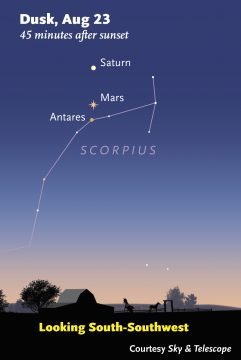
Saturn, Mars, and Antares line up almost vertically on the evening of August 23 and 24, 2016. Have a look! Sky & Telescope diagram. Click image for high-res version. (Free to reprint with the credit line "Courtesy SkyandTelescope.com").
별을 보려고 밖으로 나가 남서쪽을 바라보면, 눈을 사로잡는 형태를 보게 될 것이다. 며칠간(August 17–22) 밝은 오렌지의 화성이 토성과 붉은 안타레스의 오른쪽에서 빛나면서 거대한 삼각형을 이루는데 모양은 점차 변해간다.
화성은 점차 둘 사이로 들어와 23~24일경에 삼각형이 마침내 세 개의 빛나는 점들이 거의 수직선을 이루게 된다.
그 뒤에는 화성이 계속 순행하면서 삼각형은 다시 넓어져 꼭지점이 반대방향에 있게 된다.
놀랍게도 이 세 대상들은 서로 아무 상관이 없다. 이 눈을 사로잡는 배열은 우리 시선의 방향과 일치한 때문이다. 화성은 지구에서 빛으로 7분 거리에 있고, 토성은 거의 12배인 82분 거리에 있으며, 안타레스는 가장 아래쪽에 있는데 550광년 거리에 있다. 전갈자리에 있는 더 희미한 별들은 이 부근에서 빛을 내고 있다.
세 개의 밝은 대상 중에 안타레스만 반짝인다. 이것은 별이 내는 것이 아니라, 대개 여러분 눈의 몇 마일 거리 안에서, 지구 대기를 뚫고 흘러들어오는 저온 파장에 의해 생기는 현상이다.
행성들은 비교적 우리의 시선 가까이 있어 점이라기보다 작은 원반모양처럼 커보이므로, 행성표면의 각 점에서 독립적으로 반짝이는 것들이 일반적으로 밖에서 볼 때 서로 평균이 되어 반짝이지 않고 꾸준히 빛을 낸다.
Step outside as the stars come out, look southwest, and you’ll see an eye-catching pattern. For the next few days (August 17–22), bright orange Mars shines to the right of Saturn and the reddish star Antares. The three form a tall triangle that changes every night
Mars is moving leftward on its way toward passing between the other two. On Tuesday and Wednesday August 23rd and 24th, the triangle will collapse to a nearly vertical line of three shining points.
After that, Mars will continue leftward and the triangle will widen again, pointing in the opposite direction.
Striking as they are, these three objects have nothing to do with one another. The eye-catching arrangement results from a line-of-sight alignment. Mars is the nearest, 7 light-minutes from Earth (79 million miles). Saturn is almost a dozen times farther away at 82 light-minutes (914 million miles). Antares, the lowest of the three in the sky, is about 550 light-years in the background, or 3.3 quadrillion miles into deep space.
Fainter stars of the constellation Scorpius glimmer in the area too.
Notice that, being a star, Antares is the only one of the bright three that twinkles. That’s not the star’s own doing; twinkling is caused by the slight heat waves that are always rippling through in Earth’s atmosphere, mostly within just a few miles of your eyes. Planets appear larger across from our relatively nearby viewpoint, as tiny disks rather than points, so the separate twinklings of each point on a planet’s face generally average out to a steady glow.
Venus and Jupiter Too!
Venus-Jupiter-27Aug2016
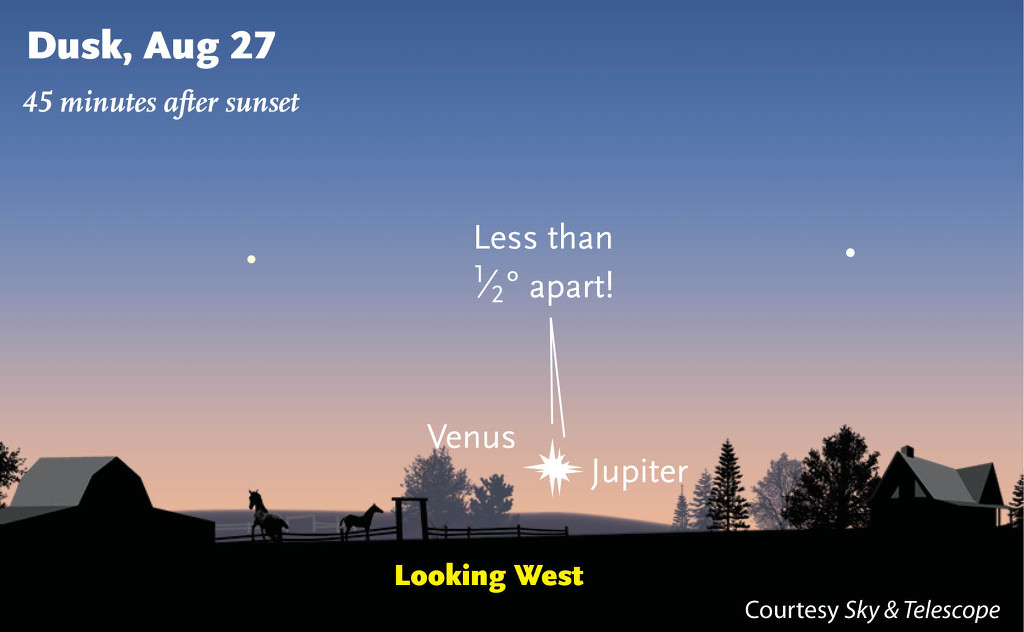
Starting 20 or 20 minutes after sunset on August 27th, look low in the west for a dramatically close pairing of Venus and Jupiter. Sky & Telescope diagram. Click image for high-res version. (Free to reprint with the credit line "Courtesy SkyandTelescope.com").
한편, 두 매우 밝은 행성-금성과 목성-은 그들의 장난을 위해 해가 진후 서쪽 아래로 움직인다. 태양이 지나간 자리의 약간 왼쪽에, 해가 진 2,30분 후에 지평선 가까이 보면 볼 수 있다. 시야가 확보가 되면 저녁마다 둘이 가까워지는 것을 볼 수 있다. 금성은 더 낮은 위치에 있다. 쌍안경이 도움이 될 것이다.
8월 24일 쯤에, 금성과 목성이 약 3각도 정도- 팔길이에서 약 손가락두개 넓이정도-분리되어 보일 것이다.
26일에는 손가락 하나정도 도 않되게 약 1각도 정도가 될 것이다. 그리고
27일에는 0.1각도 정도만 분리된 거의 합에 이르는 모습을 볼 것이다. 이 때는 쌍안경으로 보아야 두 개로 분리되어 보일 것이다.
다시 우리는 눈속임을 겪는다. 이 두 행성들은 단지 우리의 시선방향을 따라 전,후로 있을 뿐이다. 금성은 이날 지구에서 빛으로 13분 거리에 있으며, 목성은 그 4배인 53분 거리에 있다.
근래에 금성과 목성이 이렇게 매우 가까이 합쳐져 보이는 세 번중에 이번이 마지막 장면이다. 다른 두 번은 2014년 8월 18일과 2015년 10월 25일에 있었다.
Meanwhile, the two very brightest planets — Venus and Jupiter — are going through antics of their own. They’re way down low, due west, after sunset. Look for them close to the horizon, somewhat left of where the Sun went down, 20 or 30 minutes after sunset. If you have an unobstructed view and clear air, you’ll see that Venus and Jupiter are drawing closer together every evening. Venus is the lower one. If the air is hazy, binoculars will help.
By August 24th, Venus and Jupiter will appear separated by 3° — just two finger-widths at arm’s length. On the 26th, they’ll be 1° (less than one finger) apart. Then, on August 27th, they’ll have such a close conjunction — separated by only 0.1° — that you may need binoculars to see that they’re two objects, not one!
Again, looks are deceiving. The two planets merely happen to be along our same line of sight. Venus on August 27th is 13 light minutes from Earth (144 million miles), while Jupiter is four times farther: 53 light-minutes, or 592 million miles.
This is the last of a recent trio of very close conjunctions of Venus and Jupiter. The other two occurred before dawn on August 18, 2014, and on October 26, 2015.
출처
http://www.skyandtelescope.com/astronomy-news/planet-pairs-perform-in-twilight/
댓글
댓글 리스트-
작성자밤송이 작성자 본인 여부 작성자 작성시간 16.08.25 24일 밤 9시경에 본 전갈자리는 예전만 못하지만 자료사진보다 더 토성,화성,안타레스의 일직선은 예술이었습니다.
이론적으로는 알지만 막상 눈으로 보면 신기한 것은 어쩔수 없는 사실입니다. -
작성자윤경상(윤도사) 작성시간 16.08.25 이번주군요 ^^
하늘이 어떨지 모르겠지만.. 계속 주시해봐야겠습니다~ -
답댓글 작성자밤송이 작성자 본인 여부 작성자 작성시간 16.08.25 제가 너무 임박해서 알려드렸네요. 죄송합니다.
어제 사실 큰기대하지 않고 나갔다가 목성과 금성의 고도를 미리 확인할까 하고 같는데 생각보다 낮아서인지 확인을 못했습니다. 어쩐지 올해 못보고갈겄갔다는 불안감이 있네요.