Write these on the board.
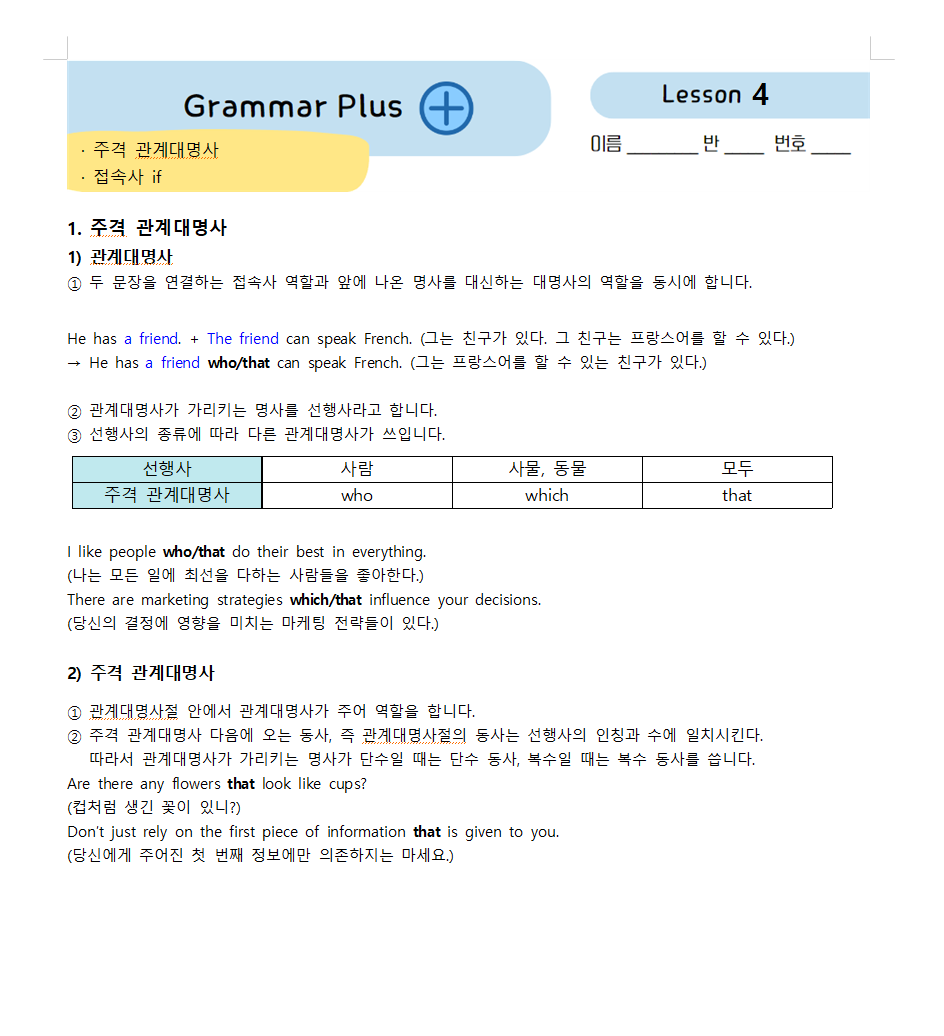
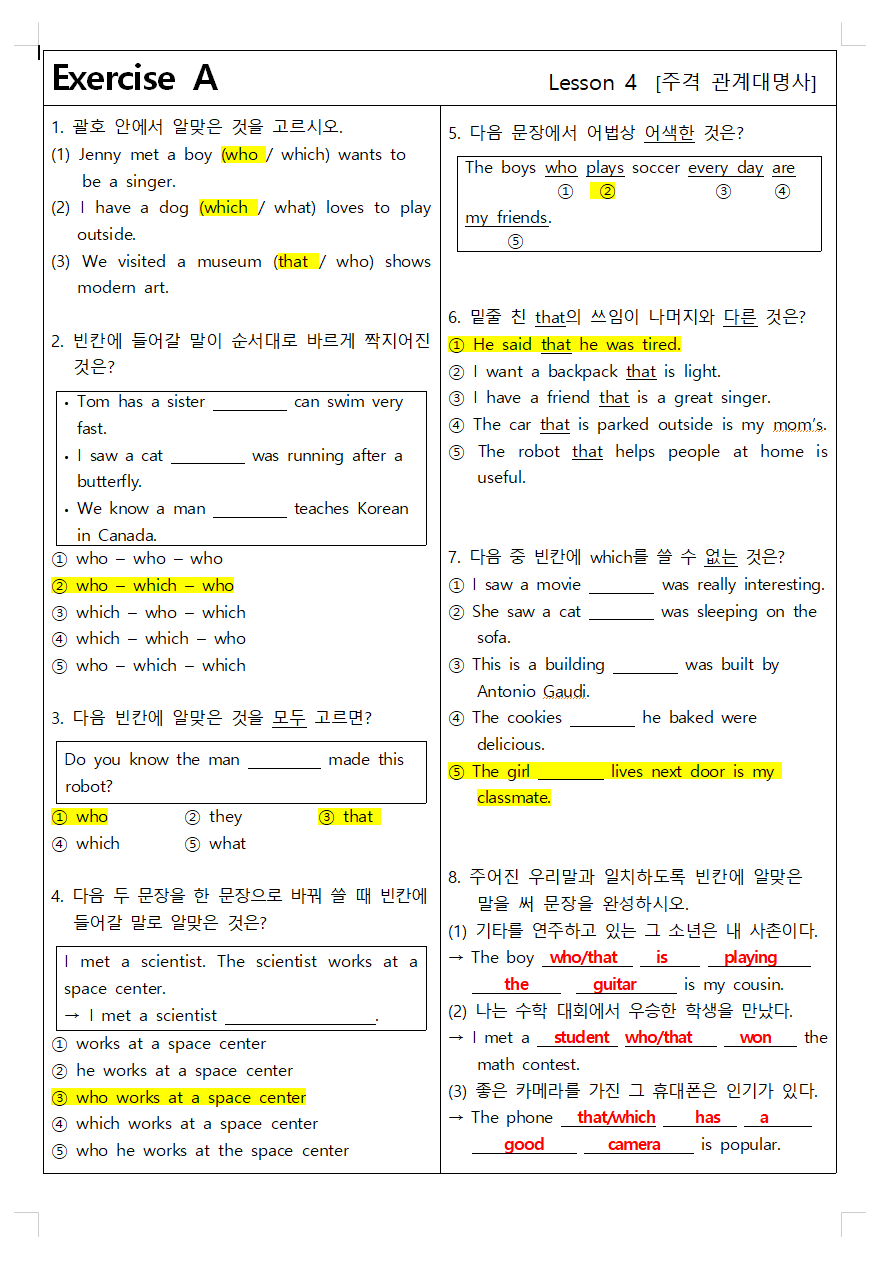
1. I have a teacher.
2. The teacher can speak three languages.
"Can we make one sentence?"
I have a teacher and the teacher can speak three languages.
I have a teacher who can speak three languages.
[학생활동 1]
Guess who?
선생님이 묘사하는 학생에 대해 듣고 교실 내 누구를 가리키는 지 맞추기
"I'm looking at a student who is wearing glasses."
"I'm thinking of a student who sits near the window."
"I'm thinking of a student who likes soccer."
"I'm looking at a student who is wearing sneakers in the classroom."
"I'm looking at a student who is very good-looking."
익숙해지면 학생들 중에 한 두명이 나와서 친구 묘사하기
1단계 묘사, 2단계, 3단계로 설명한 뒤 누구를 가리키는지 맞추면 도장
ㅇㅏ무도 못맞추면 문제 낸 학생이 도장
[학생활동 2]
Sentence Relay Race
분단별로 칠판을 나눈 뒤, 한 학생이 앞에 문장을 쓰게 하고 그 다음 학생이 다음 문장을 관계대명사를 써서 한 문장으로 완성하게 한다.
제한시간 3분 동안 제일 많은 문장을 쓴 분단이 우승, 분단별 도장 2,1개 부여
I saw a cat ____________________. (첫번째 학생)
I saw a cat that is black and white. (그 다음 학생)
https://youtu.be/b2iW7lAEwr0?si=OQcuz742v1CNPH4G
https://www.ef.com/wwen/english-resources/english-grammar/defining-relative-clauses/
Defining relative clauses
As the name suggests, defining relative clauses give essential information to define or identify the person or thing we are talking about.
Take for example the sentence: Dogs that like cats are very unusual.
In this sentence we understand that there are many dogs in the world, but we are only talking about the ones that like cats. The defining relative clause gives us that information. If the defining relative clause were removed from the sentence, the sentence would still be gramatically correct, but its meaning would have changed significantly.
Examples
- Children who hate chocolate are uncommon.
- They live in a house whose roof is full of holes.
- An elephant is an animal that lives in hot countries.
- Let's go to a country where the sun always shines.
- The reason why I came here today is not important.