 |

Samulnori basically means "four instruments" and refers to the four instruments (kwaengwari, jing,janggu, and buk) played by the musicians. With roots in Buddhist and farmers music, the style has changed through the years and evolved in different ways. One of the major influences of the style has been Kim Duk Soo SamulNori ensemble.
|

 |
| The music of Samulnori traces its roots to traditional music in several different contexts. In Nong-ak (farmers' music), professional bands of 24 or more performers perform. They usually include eight musicians playing instruments, eight dancers performing on hand-held drums (sogo), and eight actors who mimic various characters and the T'aep'yongso (conical oboe) players. The musicians in a Nong-ak band performed with Samul, the same four instruments (kwaengwari, jing, janggu, and buk) that Samulnori musicians use. |
 Kwaengwari |
 Jing |
 Buk |
 Janggu |
| Buddist tradition uses two sets of objects (not strictly for entertainment purposes) that are also called Samul. One set is part of the ritual lifestyle of the temple: the Beopgo (a drum, covered with cow leather and played in front of the Buddha), the Unpan (a type of gong, placed in the kitchen and used to summon the monks to their meals), Mokeo (a hollow wooden block, made in the shape of a carp and struck when the Sutra are read), and the Beomjong (a large bell). The instruments which accompany ritual dance (Beomp'ae) are also known as Samul. These include the Cheng, Buk, T'aepyoungso, and Mokt'ak. |

Beopgo |

Unpan |

Mokeo |

Beomjong |

 Samulnori, the music that managed to dominate the Korean music world in the 1980s, can be described as the transformation of Nong-ak (which is performed outdoors) into a form suitable for the modern stage. The repertoire which the group has made standard over the years also provides good evidence that the group's origins come from Nong-ak, while its stage performance form comes from Anjunban, rather than the nonstop drumming and dancing of Nong-ak. Samulnori, the music that managed to dominate the Korean music world in the 1980s, can be described as the transformation of Nong-ak (which is performed outdoors) into a form suitable for the modern stage. The repertoire which the group has made standard over the years also provides good evidence that the group's origins come from Nong-ak, while its stage performance form comes from Anjunban, rather than the nonstop drumming and dancing of Nong-ak.However one wishes to trace its origins, wherever its performance style takes its inspiration and no matter what terms we use to describe its inner character, the important point is that the music of Samunori has had a tremendous impaction on modern Korean music history, especially during the '80s. Kim Duk Soo's Samulnori has been responsible for an epoch with a major impact on Korean music. The impression that the group has made has been described as shocking and irresistible as the force of a sudden gust of wind. The ensemble has covered six continents in their travels. And for those whose sensibilities have become somewhat jaded, Samulnori has provided a fresh and startling impulse. Over 1,000 performances at home and abroad and the production of 16 albums have been the result of the group's global vibrations. |
 |
 Samulnori is a group of four dynamic musicians dedicated to performing and preserving traditional Korean music and dance. The Korean words sa and mul mean four objects and nori means to play. In the case of Samulnori, it refers to the four musicians playing and dancing with their four percussion instruments. Founded in 1978, SamulNori (the group) sparked a renaissance in Korea's music scene and has garnered worldwide acclaim.
SamulNori, founded by Kim Duk Soo, the group's leader and master of the janggu (hour glass drum), has become the leading institution of traditional Korean performance that maintains up to thirty students selected and trained by Mr. Kim. The group performs in many configurations but usually tours as a quartet with Mr. Kim at the helm.The original performers of SamulNori were Kim Young Bae (deceased in 1985) who played kwaengari, Choi Tae Hyun on jing, Kim Duck-soo on janggu, and Lee Jong Dae (now teaching at a university) on the buk. But soon after, Choi Jong Sil took over on kwaengari, and Lee Kwang Soo on buk. In 1993, SamulNori became SamulNori Hanullim, Inc. (Hanullim means big bang). This growth from a four-man performance ensemble into a company of thirty artists and students meant that SamulNori's dedication to traditional Korean arts, music, and dance over the last two decades has now become a viable educational and research enterprise. Over the years, SamulNori's U.S. tours have brought them to New York City, Los Angeles, Boston, Chicago, and Hawaii. In 1985 the Asia Society was awarded an Obie for Outstanding Achievement in the Off-Broadway Theater for introducing SamulNori to New Yorks stages. SamulNori has performed at the Kennedy Center in Washington, D.C., and at the Smithonian Institution as part of an effort to establish scholarly exchanges between the Smithonian and Korea. They also appeared at the Percussive Arts Society Convention in Dallas and served a residency for the Ethnomusicology Department at the University of California at Berkeley. Internationally, SamulNori has toured Germany, Austria, Great Britain, Sweden, Switzerland, Japan, China, Australia, and Greece where they accompanied the Korean Olympic representatives for the lighting of the Olympic torch in 1988. They also visited Italy where they were filmed for a Puma sneaker commercial.  Samulnori has collaborated with many highly acclaimed musicians from around the world in a variety of styles of music ranging from jazz to pop. They have also performed concerts with orchestras playing music written expressly for them. They have taken part in many festivals including 'Live Under the Sky' in Japan and Hong Kong, the Kool Jazz Festival, Peter Gabriel's WOMAD Festival, and the Han River (Korea) International Jazz Festival.
In addition to their busy touring schedule, SamulNori is dedicated to furthering the tradition of their unique performance techniques that they teach at the SamulNori Academy of Music in Seoul. They have been the subject of several books (including their own intensive instructional book) and videos for many labels, including SONY. All 15 of their musical recordings are also available. Much of Korean culture came to be Westernized in recent times, and these processes threatened the survival of folk arts. In February 1978, a number of young performers (formally members of Namsadang, the wandering artist-entertainers) performed together, giving birth to Samulnori a traditional percussive musical group. The music they played then was 'Utdari Poongmul' (the kut rhythm of Kyonggi and Ch'ungch'ong Provinces), 'Youngnam Folk Music,' and 'Honam Udo Kut.' However, they improvised the music to suit the new trends and demands of the times. This ongoing musical experiment had a great impact on the culture and arts scene of Korea in that it revived interest of the people in the traditional arts. |
 |
 The most important repertoire for the Samulnori is 'Pinari,' Samdo Seolchanggo,' 'Samdo Nong'akkarak,' and 'P'ankut.' These are the 'golden pieces,' which have made Samulnori what it is today. However, Samulnori is far from being content with only these numbers. As in its past, they are constantly seeking new ways to express themselves through countless concerts of experimental compositions and crossovers with other types of music.
Pinari  Among the four major pieces for Samulnori, the 'Pinari' is most akin to a religious ritual, containing words of calling the spirits and asking for their blessing. This is why Pinari is the first piece to be performed in a concert. The spirit of invitation and blessing of the Pinari is expected to spread good luck to the rest of the audience. In the beginning of the concert, the performers enter from a back door, playing their instruments as they proceed to the stage.
This process is a re-creation of the traditional ritual called Mun-kut which had been performed at the front gate of a household. The Mun-kut for Samulnori begins as the Puk plays the signaling patterns, followed by a clamoring response from the rest of the instruments. Then the Sangshoi (leader of the band) calls out: " Open, open the gate, ye Generals of the five directions! As we humans enter this gate, all the fortunes in the world are tumbling in as well." Marching to the 'Tongdaekung' rhythm, the band then proceeds through the aisle, past the audience's seats, and climbs on stage. The performers will then pay tribute at the altar and begin playing the Pinari. Samdo Seolchanggo Karak The story of the Pinari accounts the genesis of the universe, followed by words of exorcism and blessing. 'Samdo Seolchanggo Karak' juxtaposes the essential rhythmic patterns of past janggu virtuosi from the three main provinces of Korea. It is arranged in a way congenial to modern taste and contains some of Kim Duk Soo's own rhythmic creations. In contrast to a traditional Seolchanggo piece, the piece arranged for Samulnori resembles the 'slow to fast' procession of a Sanjo. Also, while a traditional janggu piece is more an opportunity for the leading janggu player of the band to show off his original style of dance, the Samulnori version, performed in a seated position, puts more emphasis on the dynamics and the refinement of the overall musical sound. Samdo Nong'ak Karak 'Samdo Nong'ak Karak,' perhaps the most well known of all Samulnori pieces, is an arrangement of the representative rhythms from all around Korea, performed in a seated position. The three separate pieces called 'Yangnam Nong'ak,' 'Uddari P'ungmul,' and 'Honam Udo-kut' performed in the early years of Samulnori were later compiled into this single piece. While the Samdo Seolchanggo Karak captures the essence of the janggu, the Samdo Nong'ak Karak highlights the contrasting timbre and nature between the gongs and the drums, arranged in a way that embodies the principle of winding, bending, and blending exemplified in the works of nature themselves. P'ankut If Pinari is religious, and Samdo Seolchanggo Karak and Samdo Nongak Karak are musical, then one could consider P'ankut to be the most playful. During P'ankut, the performers engage every part of their bodies in arousing the feeling of synmyong (enthusiasm) among the spectators. With Sangmo hats on their heads and instruments in their hands (or on their bodies), the performers dance with their souls and bodies. Nothing more exemplifies the harmony among heaven, earth, and man. Many call P'ankut the quintessence of Samulnori. 

Aside from the four pieces mentioned here, many other pieces have resulted from Samulnori's constant efforts to combine with other music and art genres. 'A Korean Orchestral piece for Samulnori,' 'Samulnori & the Piano,' 'Samulnori Concerto,' and 'Samulnori and Jazz' are some of the most well-known examples. |
 |
 According to ethno musicalist, Keith Howard, Ph.D., the "music of SamuINori belongs primarily to the world of farmers' bands (nong-ak), a folk tradition central to the Korean heritage. It has often been said that nong-ak captures the spirit of all that is Korea, with a documented history beginning back in the third century with Chen Suo's San Kuo Chih:
 "They 'don't play like we used to' say the islanders to the south of the Korean peninsula and 'that's not nearly what I taught them' according to Kim Pyong-sop, in reference to their version of nong-ak. Change has clearly happened. P'an Kut traditionally referred to as a type of entertainment given in a local gathering place, either by a local band during a village ritual, or by a touring group. Pinari, a type of prayer, was traditionally given by invited musicians or shamanistic practitioners to promote health and prosperity amongst a family, or to ensure spiritual support for a building project. But the folk religious world to which P'an Kut and Pinari belong is dying: today few villages maintain bands, even fewer hold annual P'an Kut, and itinerant traveling troupes have disappeared."
Dr. Howard offers some of his own comments, "The music has moved from the world of ritual to entertainment. Today in Korea, mass entertainment channels and 'airport art' provided for businessmen and tourists present large groups of pretty, young dancers who give simple, repetitive patterns from nong-ak in an ever-smiling environment. But Samulnori has chosen rather a re-interpretation of the past in a specialized, thoroughly professional present. Complexity has been added to the simplest music, which leads to a world of rich, dramatic contrast. Silence gives way to a mesmeric telling of the gong, slow thuds on a drum accelerate to shrill pitched rapid strikes. Climaxes are built and subside peacefully waves. Samulnori thus provide a blend of old and new." Lightning, Wind, Rain, Cloud SamulNori's music is based on the rhythms of traditional Korean folk percussion music. The name SamulNori literally means "To play Four Things." Those four things refer to the four percussive instruments, which it turn represent four respective elements of weather:
|
 |
Kim Duk Soo The word 'genius' should not be used to describe an individual with extraordinary talents, but rather an individual who uses those talents to inspire the best from those around him in this sense. The term is a fit appellation for the leader of SamulNori, Kim Duk soo, born in 1952. His father chose him out of eight other siblings to follow in his footsteps as a professional musician in the tradition of wandering artists, called Namsadang.
At the age of five he was awarded the President's citation for his performance, thus beginning an amazing personal career that has taken him to virtually every corner of the world. He graduated from the Korean traditional music and performing art school in Seoul and attended one year of college before the demands of his professional life took over. Aside from his talents as a performer, he has managed, directed, and created numerous productions involving not only music, but also dance and theater. 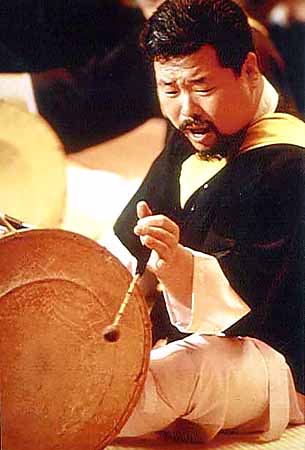 With the formation of SamulNori in 1978, his life took on new and complicated dimensions. There were five specific purposes in forming the group: to research more expensively the traditional music of Korea, to study the music and instruments (especially percussion instruments) of other traditions throughout the word, to create new music and to provide educational opportunities for students and others to learn Korean percussion. In addition, as leader he has had the responsibility to maintain the excellence that the group is known for.
SamulNori Hanullim, Inc.  SamulNori Hanullim, Inc. was founded in 1993 with the goal of better preserving and promoting the diverse Korean traditional arts through performances, research, and education. Their artistic vision of the traditional Korean arts is that it is a living entity that requires constant creative care so that it may continue to grow. To this end, there must be concrete manifestation of the spirit of traditional Korean arts not only in performances, but also efficacious educational programs. Thus it is their dream to create an accessible art that is both Korean and universal, ancient and modern.
 |
다음검색