The Law as a Foreshadowing of Christ, the Judge and Savior, and Its Limitations (Galatians 3:19–24)
제목: [기독론(41)]그리스도로서 심판주와 구원자의 예표인 율법말씀과 그 한계(갈3:19~24)
_동탄명성교회 정보배 목사
1. Introduction
Today, many Christians who attend church and live out their faith tend to view the Law and the Gospel as completely opposing concepts. This is a dichotomous way of thinking that sees the Gospel as something good and gracious that saves us, while the Law is seen as something old and evil that binds us and condemns us. However, this misunderstanding has gradually led to an extreme, blind faith characteristic of the Salvation Sect, which holds that “since Jesus Christ fulfilled the Law on the cross, we who are saved no longer need to keep the Law (the Ten Commandments) and it doesn’t matter at all.”
Yet, as a result of ignoring and discarding the Law, modern churches have become overflowing with spiritually blind people who commit sins without feeling any pangs of conscience. The pulpit has been taken over by the sweet lie that simply believing in Jesus forgives all past, present, and future sins at once, and that no matter how one lives, entry into heaven is eternally guaranteed. Has the Law truly been abolished? Is our salvation eternally secure through a single confession of faith? We hope to clearly distinguish between the two major pillars of the Law as described in the Bible—“the moral law” and “the ceremonial law”—and thereby discover the amazing foreshadowing of Jesus Christ’s roles as “Judge” and “Savior” hidden within the Law. For only then can we walk the true path of life, working out our salvation with fear and trembling.
2. Why are the modern church’s doctrine of “once saved, always saved” and the doctrine of the abolition of the law fatal spiritual errors?
The most deadly spiritual virus that has deeply afflicted the modern church is the doctrine that “once saved, always saved” and the accompanying “doctrine of the abolition of the law.” Many believers cling firmly only to the verse stating that by believing in Jesus, one has been transferred from death to life (John 5:24). Of course, receiving life through faith is the great starting point of salvation. However, they completely ignore the conditional truth warned in Revelation: “He who overcomes will not be hurt by the second death” (Rev. 2:11).
Those who firmly believe that the Law has been abolished violate the Ten Commandments in their daily lives, lying as easily as breathing, harboring lust in their hearts, and trampling on their neighbors in anger and rage—yet they delude themselves into thinking, “I have been made righteous by the blood of Jesus, so it’s all right.” Having removed the measuring stick of the law that condemns, they fail to recognize sin as sin. Yet the Lord sternly warned, “Not one stroke of a letter will by any means disappear from the Law until heaven and earth pass away” (Matt. 5:18). The “doctrine of the abolition of the Law” is Satan’s most cunning deception, leading believers to compromise with sin and abandon the path of thorough repentance, ultimately causing their names to be blotted out of the Book of Life and casting them into the place outside the city where they weep and gnash their teeth.
1. 들어가며
오늘날 많은 그리스도인이 교회에 나와 신앙생활을 하면서 율법과 복음을 철저히 대립적인 개념으로 이해하곤 한다. 복음은 우리를 살리는 선하고 은혜로운 것이며, 율법은 우리를 얽매고 정죄하는 낡고 나쁜 것이라는 식의 이분법적 사고다. 그런데 이러한 오해는 점차 "예수 그리스도께서 십자가에서 율법을 다 완성하셨으니, 이제 구원받은 우리는 더 이상 율법(십계명)을 지키지 않아도 아무런 상관이 없다"는 극단적인 구원파적 맹신으로 이어지고 말았다.
그러나 율법을 무시하고 폐기 처분해 버린 결과, 현대 교회 안에는 죄를 짓고도 양심의 가책을 느끼지 못하는 영적 소경들이 넘쳐나게 되었다. 예수님을 믿기만 하면 과거와 현재와 미래의 모든 죄가 한 번에 사해지고, 어떤 삶을 살든 천국행이 영원히 보장된다는 달콤한 거짓말이 강단을 장악했다. 진정 율법은 폐지되었는가? 우리의 구원은 한 번의 믿음 고백으로 영원히 안전한가? 우리는 성경이 말하는 율법의 두 가지 거대한 축인 ‘도덕법’과 ‘의식법’을 명확히 구분함으로써, 율법 속에 감춰진 예수 그리스도의 ‘심판주’ 되심과 ‘구원자’ 되심의 놀라운 예표를 발견하기를 바란다. 그리할 때 비로소 우리는 두렵고 떨림으로 구원을 이루어가는 참된 생명의 길을 걸어갈 수 있을 것이기 때문이다.
2. 현대 교회의 ‘한 번 구원은 영원한 구원’이라는 교리와 율법 폐지론은 왜 치명적인 영적 오류인가?
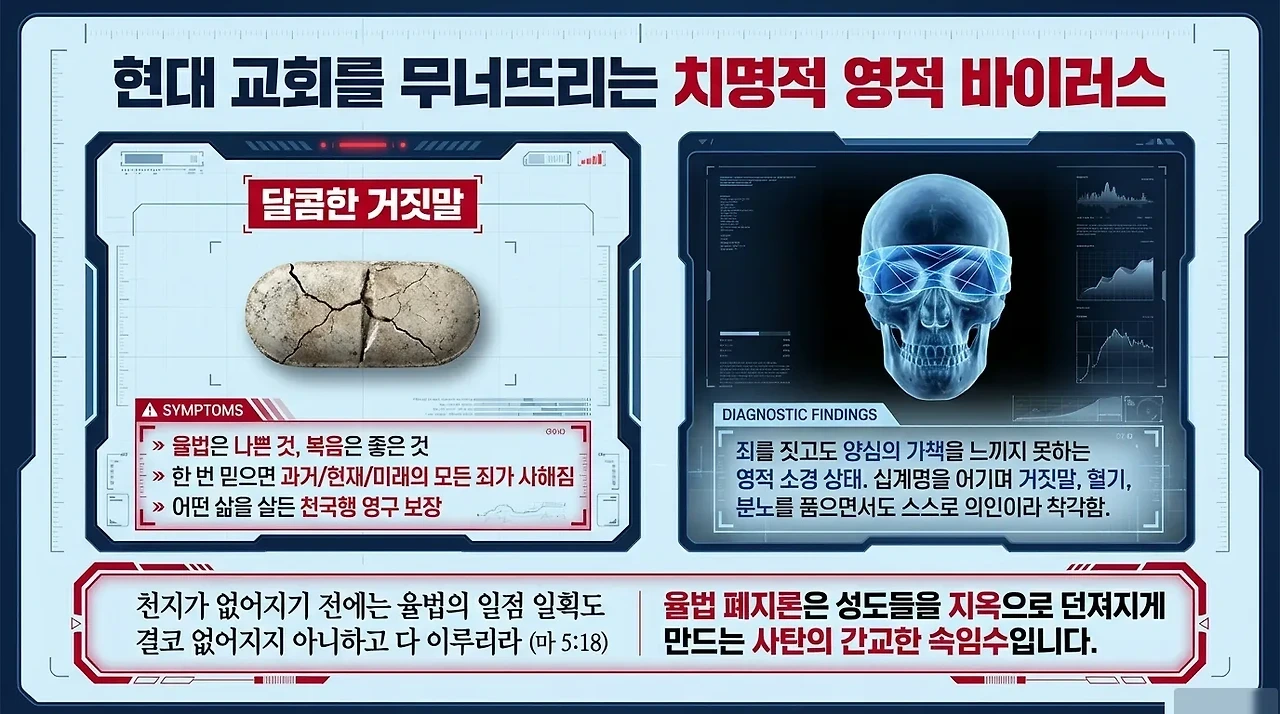
현대 교회를 깊이 병들게 한 가장 치명적인 영적 바이러스는 "한 번 구원은 영원한 구원이다"라는 교리와 그에 편승한 ‘율법 폐지론’이다. 많은 성도가 예수를 믿음으로 사망에서 생명으로 옮겨졌다는 (요 5:24) 말씀만을 굳게 붙든다. 물론 믿음으로 생명을 얻는 것은 구원의 위대한 출발점이다. 그러나 그들은 요한계시록이 경고하는 "이기[고 있]는 자는 둘째 사망의 해를 받지 아니하리라" (계 2:11)는 조건부의 진리는 철저히 외면한다.
율법이 폐지되었다고 굳게 믿는 자들은 삶 속에서 십계명을 어기며 거짓말을 밥 먹듯 하고, 마음으로 음욕을 품으며, 혈기와 분노로 이웃을 짓밟으면서도 자신은 ‘예수의 피로 의인이 되었으니 괜찮다’고 착각한다. 정죄할 율법의 잣대를 스스로 치워버렸으니 죄를 죄로 인식하지 못하는 것이다. 그러나 주님은 "천지가 없어지기 전에는 율법의 일점 일획도 결코 없어지지 아니하고 다 이루리라" (마 5:18)고 엄히 경고하셨다. '율법 폐지론'은 성도들로 하여금 죄와 타협하게 만들고 철저한 회개의 자리를 떠나게 하여, 결국 생명책에서 그 이름이 지워져 성 밖의 슬피 울며 이를 가는 곳으로 내던져지게 만드는 사탄의 가장 간교한 속임수다.
3. Even for believers whose names are written in the Book of Life because they believe in Jesus, can their salvation be revoked, as in the parable of the servant who owed ten thousand talents?
The Bible clearly warns that the salvation and justification we have received are by no means a mechanical, unchanging, eternal state. The “Parable of the Servant Who Owed Ten Thousand Talents” in Matthew 18 (Matt. 18:23–35) is a chilling spiritual reality that reveals our future. The master took pity on the servant, who owed such an enormous debt that he had no way to repay it, and “forgave” that colossal debt. Here, the original Greek word for “forgive” (aphiemi) means “to set aside for the time being” or “to postpone.” Therefore, the justification believers have received is not a complete absolution, but rather a “conditional justification”—a judgment that has been postponed in the expectation that we will live in a manner worthy of the Lord’s grace.
When the forgiven servant went out and choked his fellow servant who owed him a hundred denarii and had him thrown into prison, the enraged master had him arrested again and handed him over to the torturers to be beaten until he paid back the entire debt. The Lord Himself declared that even if one has been forgiven (saved), if the forgiven person does not live a life worthy of that forgiveness and bear the fruits of repentance and love, that salvation can be revoked at any time, and the person can be cast into eternal prison.
“For we must all appear before the judgment seat of Christ, so that each one may receive what is due for the things done while in the body, whether good or evil” (2 Corinthians 5:10)
“He who overcomes will be clothed in white garments, and I will never blot out his name from the Book of Life” (Revelation 3:5)
That is correct. Even believers must stand before the judgment seat of Christ after death. At that time, there will be a judgment based on their deeds. Therefore, even if one has believed and received salvation, becoming a believer, he must fight against sin and overcome it until the very end. However, one must realize that those who do not overcome may face the terrible judgment of having their names erased from the Book of Life, where they were once recorded. And once this is understood, one must repent of the sins committed and examine whether one is living a life worthy of repentance—that is, bearing the fruit of repentance.
4. What is the true reason the Apostle Paul declared that the Law is “holy, righteous, and good”?
When we look closely, the Law is not a set of shackles that bind us, but a tool of God’s amazing love. The Apostle Paul confessed, “So the Law is holy, and the commandment is holy, righteous, and good” (Romans 7:12).
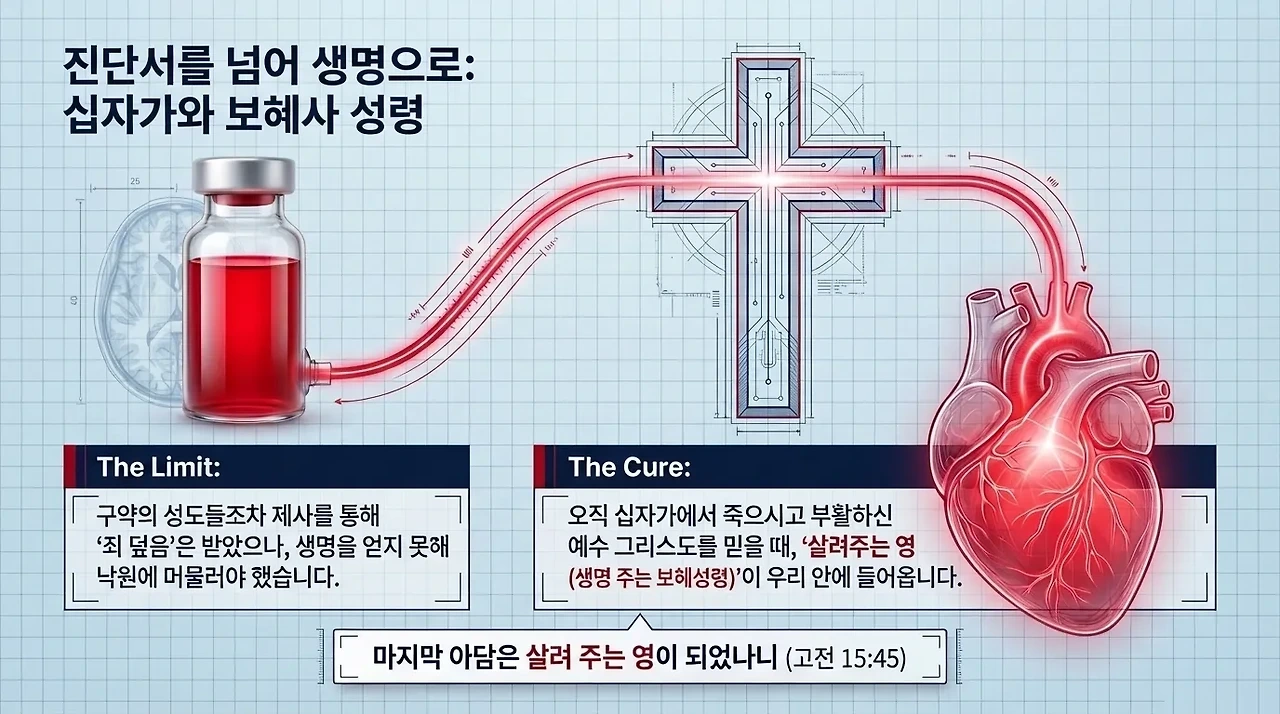
So why did Paul praise the Law so highly? It is because the Law serves as a “grateful diagnosis” that reveals our spiritual death. If I were suffering from a terminal illness like cancer but, lacking a doctor or diagnostic equipment, lived comfortably unaware of it until one day I suddenly coughed up blood and died, that would be a tragedy. However, if the mirror of the Law accurately diagnoses, “You are currently suffering from the terminal illnesses of greed, deceit, and pride, and are heading toward hell,” we will struggle desperately to find a way to survive.
“Therefore, no one will be declared righteous in his sight by observing the law; rather, through the law we become conscious of sin” (Romans 3:20).
3. 예수를 믿어 생명책에 이름이 기록된 성도라도, 일만 달란트 빚진 종의 비유처럼 그 구원이 취소될 수 있는가?
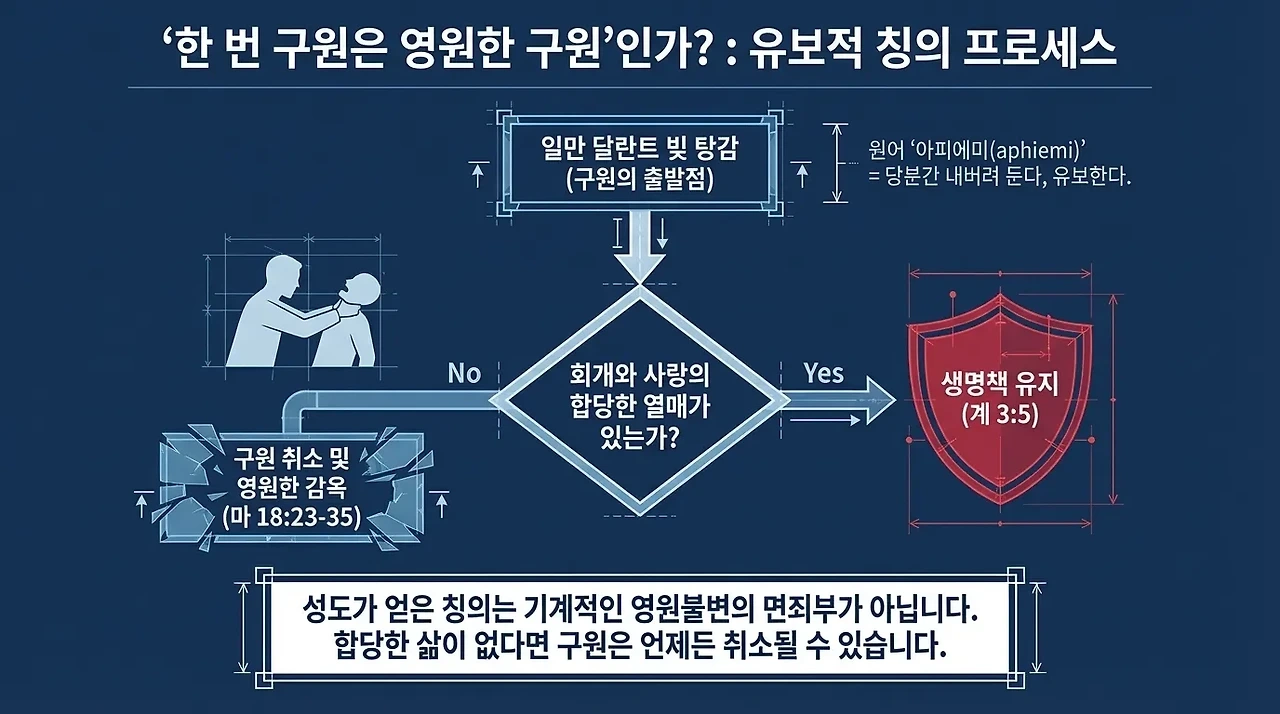
성경은 우리가 얻은 구원과 칭의가 결코 기계적인 영원불변의 상태가 아님을 분명히 경고한다. 마태복음 18장에 등장하는 ‘일만 달란트 빚진 종의 비유’(마 18:23-35)는 우리의 미래를 보여주는 소름 끼치는 영적 실상이다. 주인이 너무나 많은 빚을 져서 갚을 길 없는 종을 불쌍히 여겨, 그 어마어마한 빚을 ‘탕감’해 주었다. 여기서 탕감(용서)하다는 헬라어 원어 ‘아피에미(aphiemi)’는 ‘당분간 내버려 둔다, 유보한다’는 뜻을 지닌다. 그러므로 성도들이 받은 칭의는 완전한 면죄부가 아니라, 주님의 은혜에 합당하게 살기를 기대하시며 심판을 보류해 주신 ‘유보적 칭의’에 해당하는 것이다.
탕감받은 그 종이 나가서 자신에게 백 데나리온 빚진 동료의 목을 조르고 감옥에 가두었을 때, 분노한 주인은 그를 다시 잡아들여 빚을 다 갚도록 형리들(고문하는 자들)에게 넘겨버렸다. 한 번 탕감(구원)받았다 할지라도, 용서받은 자의 합당한 삶과 열매(회개와 사랑)가 없다면 그 구원은 언제든지 취소되고 영원한 감옥에 던져질 수 있음을 주님이 직접 선포하신 것이다.
"우리가 다 반드시 그리스도의 심판대 앞에 나타나게 되어 각각 선악간에 그 몸으로 행한 것을 따라 받으려 함이라" (고린도후서 5:10)
"이기[고 있]는 자는 이와 같이 흰 옷을 입을 것이요 내가 그 이름을 생명책에서 결코 지우지 아니하고" (요한계시록 3:5)
그렇다. 성도라 할지라도 죽은 뒤 그리스도의 심판대 앞에 서야 한다. 그때에 행위에 따른 심판이 있을 것이다. 그러므로 한 번 믿어서 구원을 받았고 성도가 되었다고 할지라도 그는 끝까지 죄와 싸워 이기야 한다. 그런데 만약 이기지 못한 자는 이미 기록되었던 생명책의 이름조차 지워지는 끔찍한 심판을 다시 받을 수 있다는 사실을 알아야 한다. 그리고 이를 깨달았다면 지은 죄를 회개하고 회개에 합당한 삶 곧 회개에 합당한 열매를 맺고 있는지를 확인해보아야 한다.
4. 사도 바울이 율법을 가리켜 ‘거룩하고 의로우며 선하다’고 선포한 진짜 이유는 무엇인가?
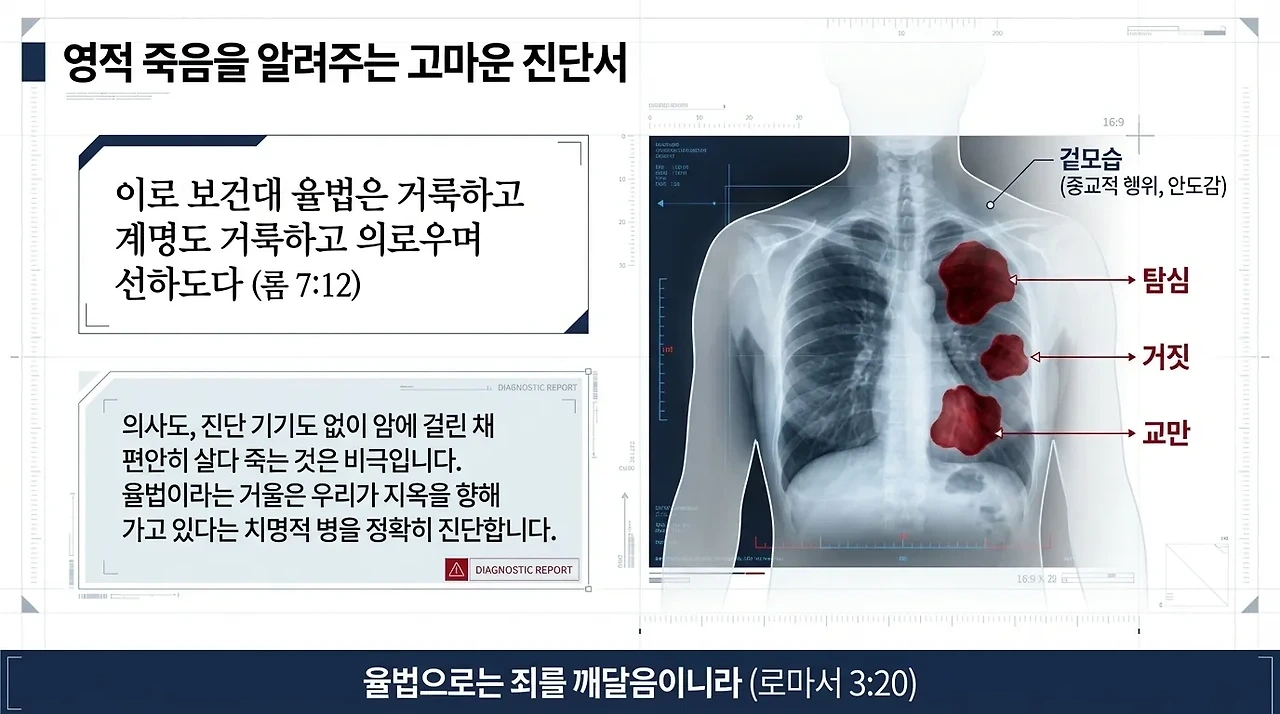
율법은 알고보면 우리를 얽어매는 족쇄가 아니라 하나님의 놀라운 사랑의 도구다. 사도 바울은 "이로 보건대 율법은 거룩하고 계명도 거룩하고 의로우며 선하도다" (롬 7:12)라고 고백하였다.
그렇다면 바울이 율법을 이토록 찬양한 이유는 무엇인가? 그것은 율법이 곧 우리의 영적 죽음을 알려주는 ‘고마운 진단서’이기 때문이다. 만약 내가 죽을병인 암에 걸렸는데, 의사도 없고 진단기기도 없어 그 사실을 모른 채 편안하게 살다가 어느 날 갑자기 피를 토하고 죽는다면 그것은 비극이다. 그러나 율법이라는 거울이 "너는 지금 탐심과 거짓과 교만이라는 죽을병에 걸려 지옥을 향해 가고 있다"고 정확히 진단해 준다면, 우리는 어떻게든 살길을 찾아 몸부림치게 된다.
"그러므로 율법의 행위로 그의 앞에 의롭다 하심을 얻을 육체가 없나니 율법으로는 죄를 깨달음이니라" (로마서 3:20)
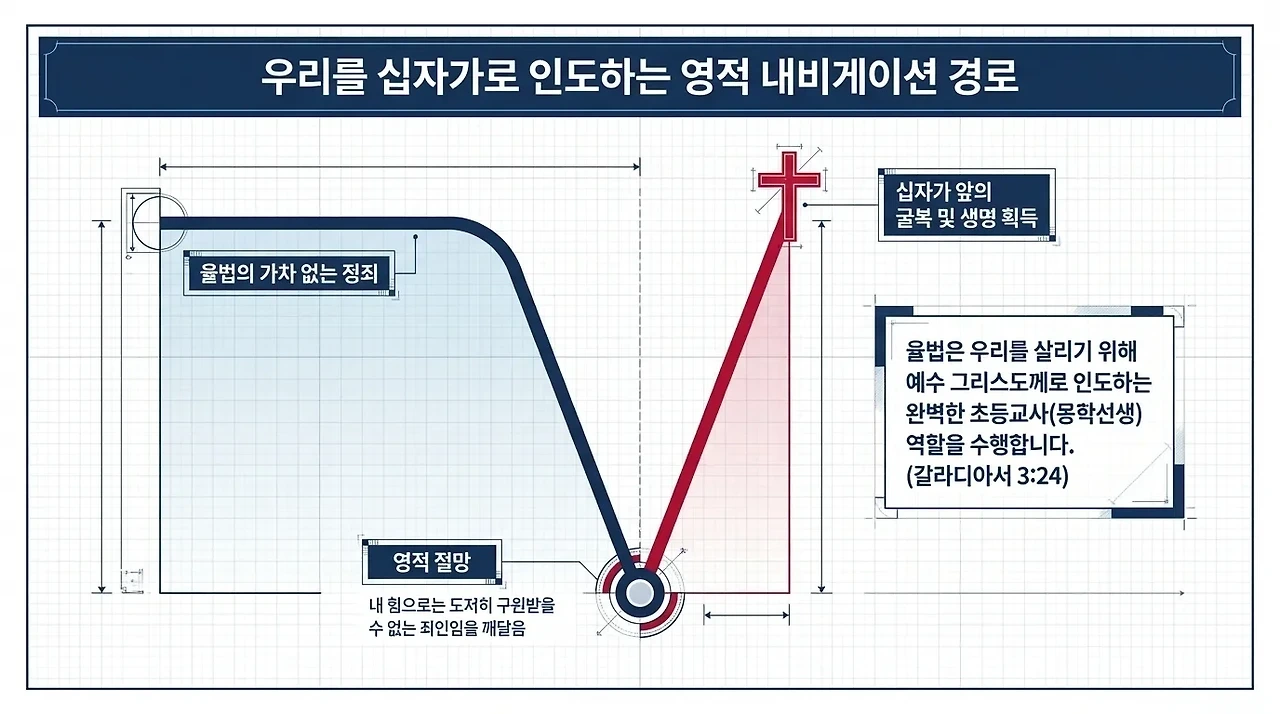
Because the Law condemns us without mercy, we realize that we are hopeless sinners who can never be saved by our own strength, and we fall to our knees before the cross of Jesus Christ, who is our life. In this way, the Law is truly good and holy because it serves as a “tutor” that leads us to Christ to save us.
“The law was our guardian until Christ came, so that we might be justified by faith” (Galatians 3:24)
5. How can we distinguish between the “laws that Jesus abolished (fulfilled) on the cross” and the “laws that He left in force forever” within the Law of Moses?
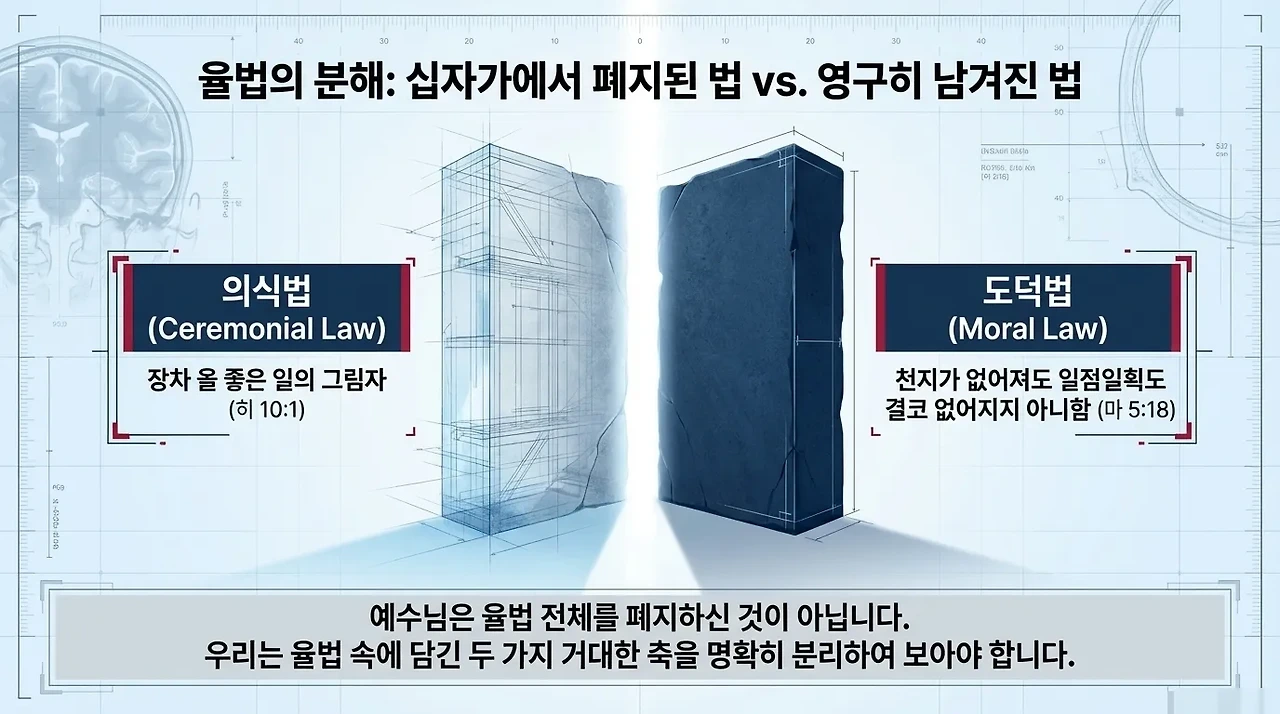
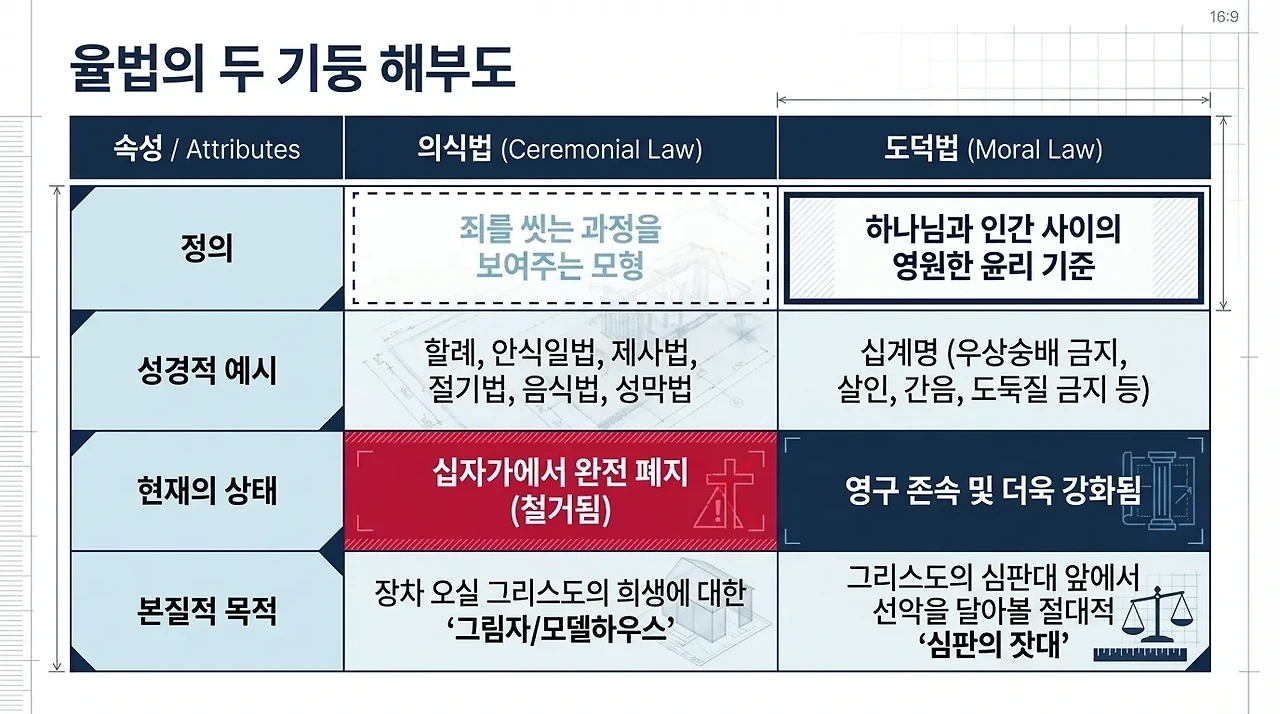
So what exactly does the Law mean that Jesus fulfilled and abolished on the cross? We must clearly distinguish between the two main branches of the Law: the “ceremonial law” and the “moral law” (in fact, if we are to classify the Law precisely, it can be divided into moral law, ceremonial law, and civil law).
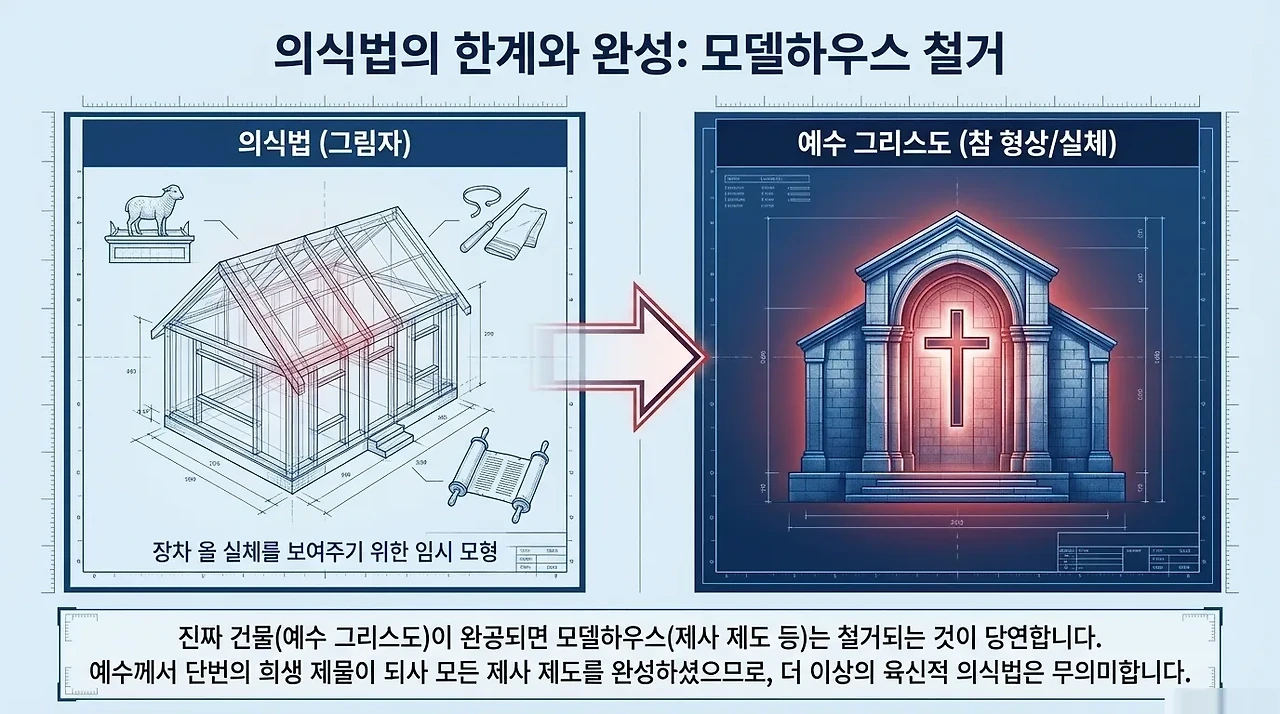
“The law is only a shadow of the good things to come, not the reality itself” (Hebrews 10:1)
That is correct. What was abolished through Jesus’ coming and fulfillment is strictly limited to the “ceremonial law.” The laws of circumcision, the Sabbath, sacrifices (priestly laws), festivals, food, purity, and the tabernacle were all “models and shadows” that foreshadowed how Jesus Christ, who was to come, would wash away the sins of humanity. Since Jesus, the true reality, came and became the once-for-all sacrifice (the Passover Lamb), thereby fulfilling this entire sacrificial system, we no longer need to offer sacrifices by slaughtering sheep or cattle, nor do we need to undergo physical circumcision. (Galatians 3:19)
“What, then, is the law? It was added because of transgressions, until the Seed to whom the promise referred had come. It was administered through angels by a mediator.” (Galatians 3:19)
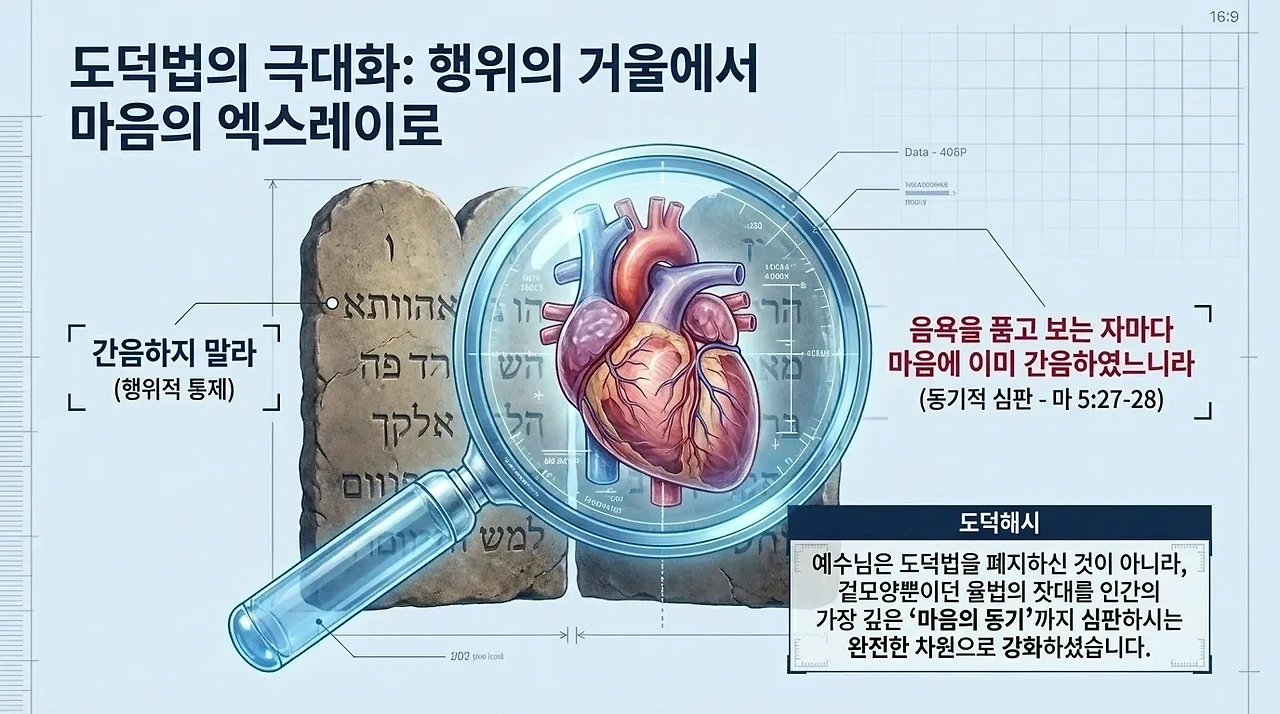
However, on the contrary, there is a law that will never be abolished, even if heaven and earth pass away, and that is the “moral law,” namely, the Ten Commandments. The Ten Commandments are the eternal ethics to be observed between God and humanity, and between human beings themselves; they are the absolute standard of judgment by which our good and evil will be weighed before the judgment seat of Christ in the future. Jesus did not abolish the moral law (Matt. 5:17–19); rather, He elevated the law—which had been merely external—to a higher, complete dimension that judges even the “motives of the heart” (Matt. 5:27–28).
“ Do not think that I have come to abolish the Law or the Prophets; I have not come to abolish them but to fulfill them. For truly I tell you, until heaven and earth disappear, not the smallest letter, not the least stroke of a pen, will by any means disappear from the Law until everything is accomplished. Therefore, anyone who breaks one of the least of these commandments and teaches others to do the same will be called least in the kingdom of heaven, but whoever practices and teaches these will be called great in the kingdom of heaven.” (Matthew 5:17–19)
“You have heard that it was said, ‘You shall not commit adultery.’ But I tell you that anyone who looks at a woman lustfully has already committed adultery with her in his heart.” (Matthew 5:27–28)
율법이 우리를 가차 없이 정죄함으로 말미암아, 우리는 내 힘으로는 도저히 구원받을 수 없는 절망적인 죄인임을 깨닫고 생명 되신 예수 그리스도의 십자가 앞에 무릎을 꿇게 된다. 이처럼 우리를 살리기 위해 그리스도께로 인도하는 ‘몽학선생’의 역할을 하기에 율법은 진정으로 선하고 거룩한 것이다.
"이같이 율법이 우리를 그리스도께로 인도하는 초등교사(몽학선생)가 되어 우리로 하여금 믿음으로 말미암아 의롭다 함을 얻게 하려 함이라" (갈라디아서 3:24)
5. 모세의 율법 중에서 예수님이 십자가로 ‘폐지(완성)하신 법’과 ‘영원히 남겨두신 법’은 어떻게 구분되는가?
그렇다면 예수님께서 십자가에서 완성하시고 폐지하셨다는 율법은 대체 무엇을 의미하는가? 우리는 율법의 두 가지 큰 줄기인 ‘의식법’과 ‘도덕법’을 명확히 구분해야 한다(사실 율법을 정확히 구분하자면 도덕법과 의식법과 시민법으로 구분할 수 있다).
"율법은 장차 올 좋은 일의 그림자일 뿐이요 참 형상이 아니므로" (히브리서 10:1)
그렇다. 예수님이 오심으로 인하여 완성하심으로 폐지된 것은 철저히 ‘의식법’에 한정된다. 할례법, 안식일법, 제사법(제사장법), 절기법, 음식법, 정결법, 성막법 등은 모두 장차 오실 예수 그리스도가 인류의 죄를 어떻게 씻어주실 것인지를 미리 보여주는 ‘모형과 그림자(모델하우스)’다. 진짜 실체이신 예수님이 오셔서 단번의 희생 제물(유월절 어린양)이 되심으로 이 모든 제사 제도를 완성하셨기에, 우리는 더 이상 양이나 소를 잡아 제사 지내거나 육신의 할례를 받을 필요가 없게 된 것이다. (갈 3:19)
"그런즉 율법은 무엇이냐 범법하므로 더하여진 것이라 천사들을 통하여 한 중보자의 손으로 베푸신 것인데 약속하신 자손이 오시기까지 있을 것이라" (갈라디아서 3:19)
그러나 반대로, 천지가 없어져도 결코 폐지되지 않는 율법이 있으니 그것이 바로 ‘도덕법’, 즉 십계명이다. 십계명은 하나님과 인간, 인간과 인간 사이에 지켜야 할 영원한 윤리요, 장차 그리스도의 심판대 앞에서 우리의 선악을 달아볼 절대적인 심판의 잣대다. 예수님은 도덕법을 폐지하신 것이 아니라(마 5:17-19), 오히려 겉모양뿐이던 율법을 ‘마음의 동기’까지 심판하시는 완전한 차원으로 더욱 강화하셨다(마 5:27-28).
"내가 율법이나 선지자를 폐하러 온 줄로 생각하지 말라 폐하러 온 것이 아니요 완전하게 하려 함이라 진실로 너희에게 이르노니 천지가 없어지기 전에는 율법의 일점 일획도 결코 없어지지 아니하고 다 이루리라 그러므로 누구든지 이 계명 중의 지극히 작은 것 하나라도 버리고 또 그같이 사람을 가르치는 자는 천국에서 지극히 작다 일컬음을 받을 것이요 누구든지 이를 행하며 가르치는 자는 천국에서 크다 일컬음을 받으리라" (마태복음 5:17-19)
"또 간음하지 말라 하였다는 것을 너희가 들었으나 나는 너희에게 이르노니 음욕을 품고 여자를 보는 자마다 마음에 이미 간음하였느니라" (마태복음 5:27-28)
6. What painful misconception did the Jews of the past have regarding the Law, and what warning does this hold for us today?
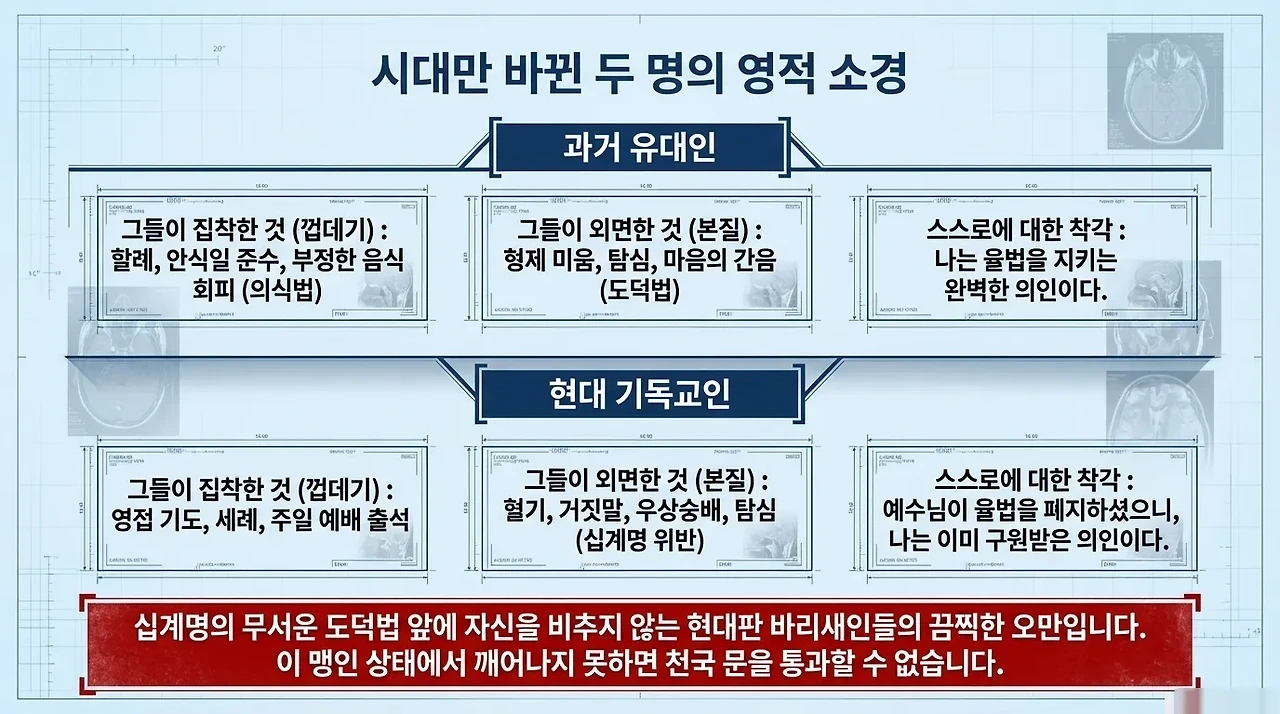
The Jews of the past misunderstood the structure of the Law and lived under a painful misconception. They brazenly turned a blind eye to the true essence of the Ten Commandments—the deep sins of the moral law, such as murder, which is hating one’s brother, and adultery, which is lusting in one’s heart. Instead, they considered themselves “righteous” based solely on the outward observance of ceremonial laws—such as being circumcised on the eighth day, strictly keeping the Sabbath, and avoiding unclean foods. Mistaking these ceremonial laws, which were merely types, for the conditions of salvation, they were spiritually blind, their hearts filled with all manner of wickedness.
Surprisingly, countless Protestants today may also be living under the exact same—or perhaps even more serious—delusion. They boast, “I have accepted Jesus, been baptized, and attend Sunday worship, so I am already a righteous person who has been saved.” Yet within their hearts and lives, idolatry, greed, anger, and lies that violate the Ten Commandments still remain. This terrible arrogance—the belief that “since Jesus abolished the entire Law, I can be saved even if I do not keep the Ten Commandments”—seems to be the quintessential portrait of modern-day Pharisees who fail to examine themselves in light of the Ten Commandments’ fearsome moral law. Yet if they cannot awaken from this state of spiritual blindness on their own, they will never be able to pass through the gates of heaven.
7. In light of the two functions of the Law (the moral law and the ceremonial law), in what ways is Jesus Christ revealed to us in each?
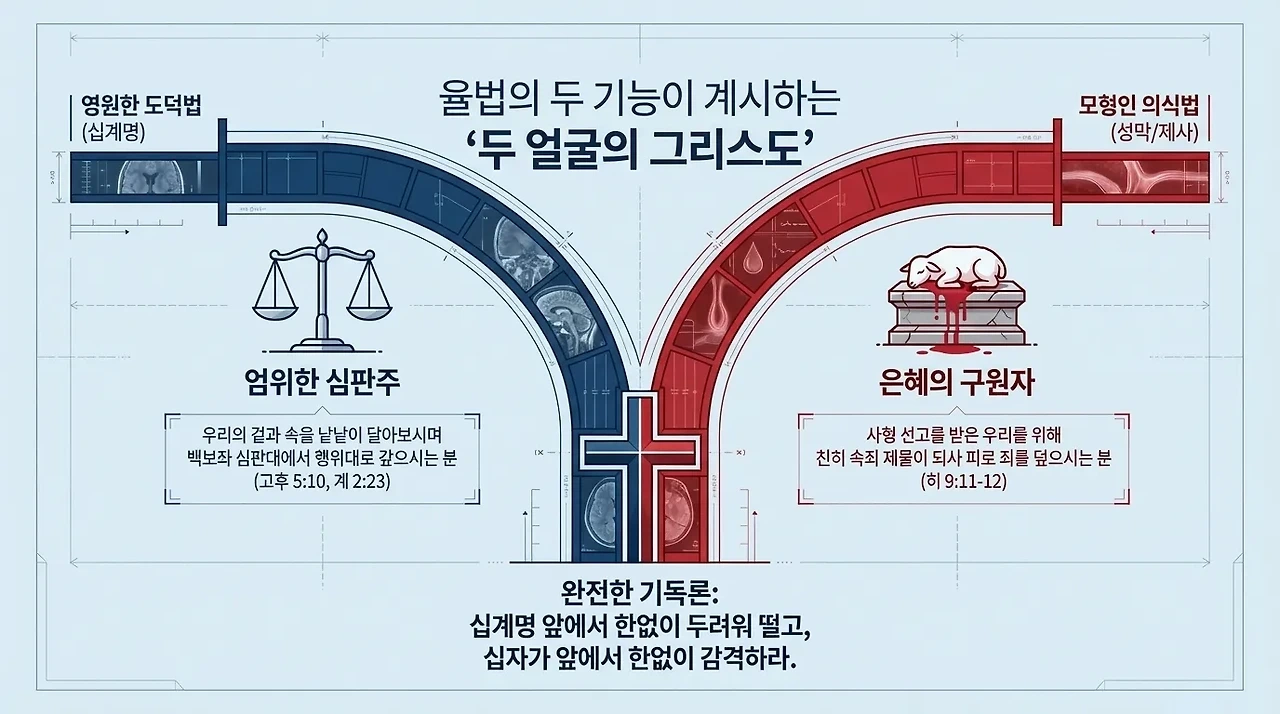
What exactly do the Law of Moses (Torah), the Writings of the Prophets (Nevi’im), and the Writings (Ketuvim) in the Old Testament teach us? Whether it be the Law of Moses, the Writings of the Prophets, the Writings, or even the beautiful songs of the Song of Songs, the entire Old Testament was written to testify to Jesus Christ alone (John 5:39). However, through the two functions of the Law—the moral law and the ceremonial law—Jesus Christ is revealed to us in two contrasting yet perfect forms.
First, through the Ten Commandments—the eternal moral law—Jesus stands as the awe-inspiring “Judge” who weighs every one of our sins (2 Cor. 5:10). He examines not only our outward appearance but also the deepest motives of our hearts (Rev. 2:23), and at the Great White Throne Judgment, He will judge all our deeds by the standard of the Ten Commandments (Rev. 20:11–15).
“For we must all appear before the judgment seat of Christ, so that each one may receive what is due for what he has done in the body, whether good or evil” (2 Corinthians 5:10).
6. 과거 유대인들은 율법에 대해 어떤 뼈아픈 착각을 저질렀으며, 이는 오늘날 우리에게 어떤 경고를 주는가?
과거 유대인들은 이 율법의 구조를 오해하여 뼈아픈 착각 속에 빠져 살았다. 그들은 십계명의 참된 본질, 즉 형제를 미워하는 살인과 속으로 음욕을 품는 마음의 간음 같은 도덕법의 깊은 죄악들은 뻔뻔하게 외면했다. 그리고는 껍데기뿐인 의식법, 즉 난 지 8일 만에 할례를 받고 철저히 안식일을 지키며 부정한 음식을 피했다는 사실 하나만으로 자신들을 ‘의인’이라 여겼다. 모형에 불과한 의식법을 구원의 조건으로 착각한 채, 마음은 온갖 악독으로 가득했던 영적 소경들이었다.
놀랍게도 오늘날 수많은 개신교인 역시 이와 똑같은, 아니 어쩌면 더 심각한 착각 속에 살아가고 있는지도 모른다. "나는 예수를 영접하고 세례를 받았으며 주일 예배를 지키고 있으니, 나는 이미 구원받은 의인이다"라고 자부하는 것이다. 그러나 그들의 내면과 삶 속에는 여전히 십계명을 어기는 우상 숭배와 탐심, 혈기와 거짓말이 들어있다. "예수님이 율법을 다 폐지하셨으니, 나는 이제 십계명을 안 지켜도 구원받는다"는 이 끔찍한 오만은, 십계명의 무서운 도덕법 앞에 자신을 비추어 보지 않는 현대판 바리새인들의 전형적인 모습이 아닌가 싶다. 그러나 만약 이러한 영적 맹인 상태에서 스스로 깨어나지 못한다면 결코 천국 문을 통과할 수 없을 것이다.
7. 율법의 두 가지 기능(도덕법과 의식법)에 비추어 볼 때, 예수 그리스도는 우리에게 각각 어떤 모습으로 계시되는가?
구약에 나오는 모세의 율법(토라)과 선지자의 글들(느비임), 그리고 성문서들(케투빔)은 과연 무엇을 말씀하고 있는가? 구약성경은 그것이 모세의 율법이 되었든지, 선지자의 글들이 되었든지 그리고 성문서가 되었든지, 심지어 아가서의 아름다운 노래에 이르기까지 구약 성경 전체는 모두가 예수 그리스도 한 분을 증언하기 위해 기록된 책들이다(요 5:39). 그러나 율법의 두 가지 기능인 도덕법과 의식법을 통해, 예수 그리스도는 우리에게 두 가지 상반되지만 완벽한 모습으로 계시된다.
첫째, 영원한 도덕법인 십계명을 통해 예수님은 우리의 죄를 낱낱이 달아보시는 엄위한 ‘심판주’로 서 계신다(고후 5:10). 그분은 우리의 겉모습뿐만 아니라 마음의 깊은 동기까지 살펴보고 계시며(계 2:23), 백보좌 심판대에서 우리의 모든 행위를 십계명의 잣대로 심판하실 것이다(계 20:11-15).
"이는 우리가 다 반드시 그리스도의 심판대 앞에 나타나게 되어 각각 선악간에 그 몸으로 행한 것을 따라 받으려 함이라" (고린도후서5:10)
“I will strike her children dead. Then all the churches will know that I am the one who searches hearts and minds, and I will repay each of you according to your deeds.” (Revelation 2:23)
Second, through the ceremonial laws—which were types and shadows (such as the tabernacle and sacrificial laws)—Jesus appears as the gracious “Savior” who delivers us from sin. He Himself, as the Savior, became the atoning sacrifice on the cross to cover and resolve our sins with His blood, thereby fulfilling the death sentence He had pronounced as the Judge (Hebrews 9:11–12).
“But when Christ came as high priest of the good things to come, he entered the greater and more perfect tabernacle not made with hands—that is to say, not of this creation—and did not enter by means of the blood of goats and calves, but by his own blood, thus securing eternal redemption. He entered the Most Holy Place once for all” (Hebrews 9:11–12).
In this way, when we study the Law deeply, we recover a complete Christology that causes us to tremble with fear before the Ten Commandments, yet weep with overwhelming joy before the cross, which is the substance of the sacrificial system.
8. What is the final spiritual weapon we must hold fast to until the day we die in order to overcome the limitations of the law—which cannot give life—and finally enter the kingdom of heaven?
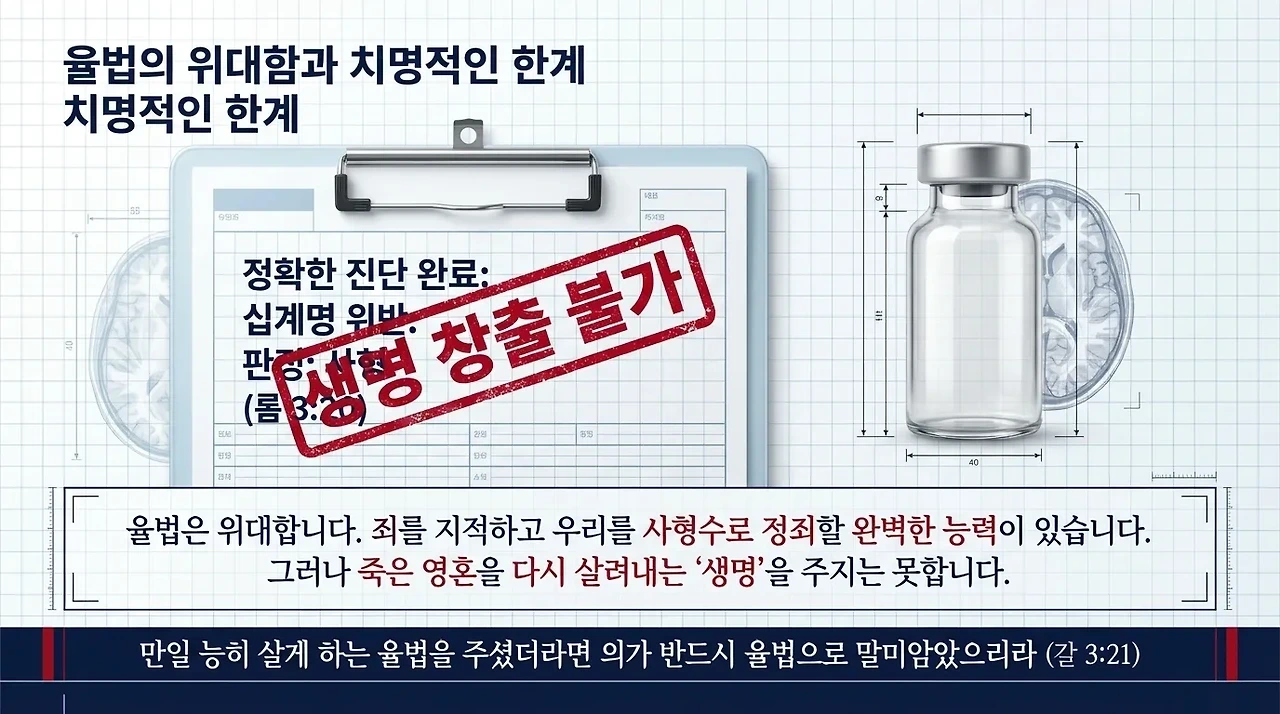
The law is great, but it also has a decisive limitation. While the law can point out sin and condemn it, it cannot give the “life” that revives a dead soul.
“Is the law, then, contrary to the promises of God? By no means! For if a law had been given that could impart life, then righteousness would indeed come by the law” (Galatians 3:21).
Therefore, since humans do not possess the ability to keep all ten commandments perfectly, all of humanity is nothing but condemned to death under the law. Consequently, even the saints of the Old Testament received the covering of their sins through the sacrifices of the Law, but since they had not yet received life until Jesus became the firstfruits of the resurrection and gave them life, they had to remain in Paradise (Luke 23:43, 2 Corinthians 12:4, Revelation 2:7). Only when we believe in Jesus Christ, who died on the cross and was resurrected, and the “life-giving Spirit (the Holy Spirit, the Comforter)” enters us do we, as believers, receive true life (1 Cor. 15:45).
“Just as it is written that the first man Adam became a living being, so also the last Adam became a life-giving Spirit” (1 Corinthians 15:45)
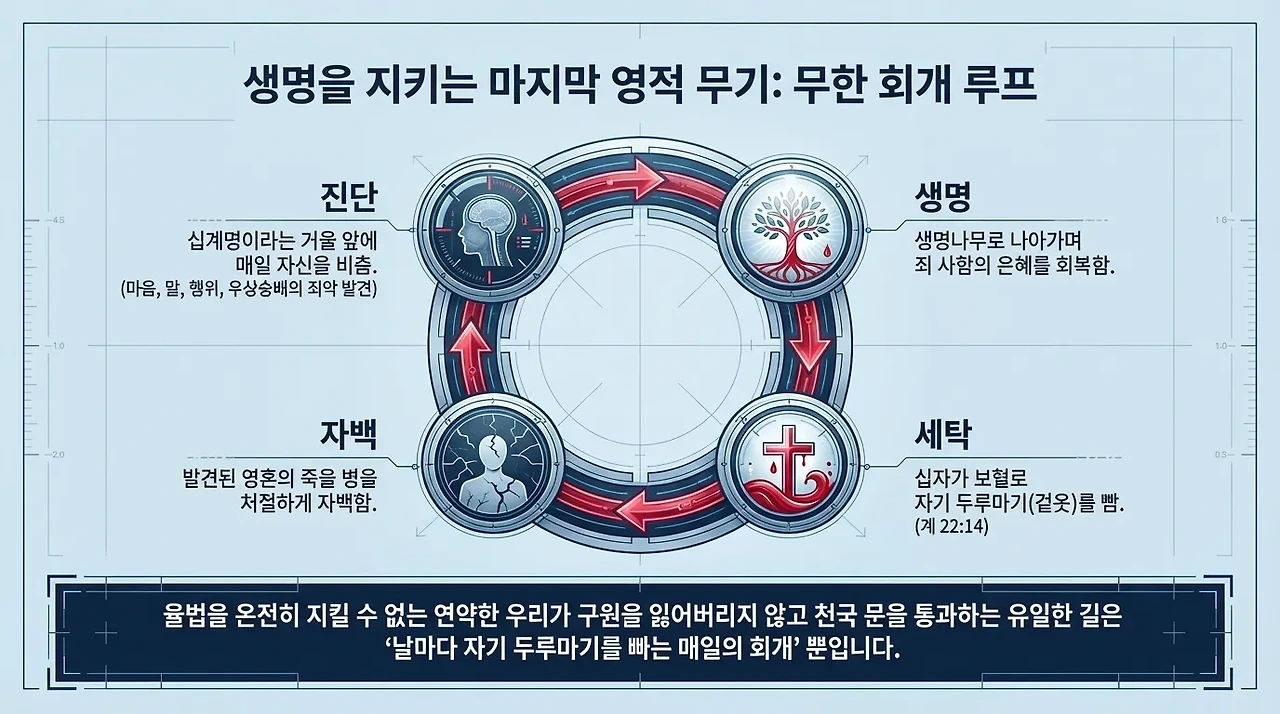
For us who have received life, there is a single path and weapon by which we can firmly preserve our salvation until the very end on this earth. It is none other than “thorough repentance every single day” (Revelation 22:14).
“Blessed are those who wash their robes, that they may have the right to the tree of life and may enter by the gates into the city” (Revelation 22:14)
It is absolutely essential to hold a mirror of the Ten Commandments up to ourselves, examine our hearts, words, and deeds, and wash away the sins we have committed—as well as the sins of idolatry inherited from our ancestors (the serpents coiled within us)—through the blood of the cross. Therefore, since we are weak and unable to keep all the righteous demands of the Law, in order for us to pass through the gates of heaven, we must ‘daily examine our scrolls’
"또 내가 사망으로 그의 자녀를 죽이리니 모든 교회가 나는 사람의 뜻과 마음을 살피는 자인 줄 알지라 내가 너희 각 사람의 행위대로 갚아 주리라" (요한계시록 2:23)
둘째, 모형과 그림자인 의식법(성막, 제사법 등)을 통해 예수님은 우리를 죄에서 건지시는 은혜로운 ‘구원자’로 나타나신다. 심판주로서 내리신 사형 선고를, 구원자이신 예수님 본인이 친히 십자가의 속죄 제물이 되사 당신의 피로 우리의 죄를 덮어주시고 해결해 주시는 것이다(히 9:11-12).
"그리스도께서는 장래 좋은 일의 대제사장으로 오사 손으로 짓지 아니한 것 곧 이 창조에 속하지 아니한 더 크고 온전한 장막으로 말미암아 염소와 송아지의 피로 하지 아니하고 오직 자기의 피로 영원한 속죄를 이루사 단번에 성소에 들어가셨느니라" (히브리서 9:11-12)
이처럼 율법을 깊이 연구할 때, 우리는 십계명 앞에서 한없이 두려워 떨지만, 제사법의 실체이신 십자가 앞에서 한없이 감격하며 울게 되는 온전한 기독론을 회복하게 되는 것이다.
8. 생명을 주지 못하는 율법의 한계를 극복하고 마침내 천국에 입성하기 위해, 우리가 죽는 날까지 붙들어야 할 마지막 영적 무기는 무엇인가?
율법은 위대하지만 또한 결정적인 한계가 있다. 율법은 죄를 지적하여 정죄할 수는 있어도, 죽은 영혼을 다시 살려내는 ‘생명’을 주지는 못한다.
"그러면 율법이 하나님의 약속들과 반대되는 것이냐? 결코 그럴 수 없느니라. 만일 능히 살게 하는 율법을 주셨더라면 의가 반드시 율법으로 말미암았으리라" (갈라디아서 3:21)
그러므로 인간은 십계명을 온전히 다 지켜낼 능력을 가지고 있기 않기에, 율법 아래서 모든 인류는 다 사형수일 뿐이다. 그러므로 구약의 성도들조차 율법의 제사를 통해 죄 덮음은 받았지만, 예수께서 부활의 첫 열매가 되어 생명을 주시기 전까지 그들은 여전히 생명을 얻지 못했기에 낙원에 머물러야 했다(눅 23:43, 고후12:4, 계2:7). 오직 십자가에서 죽으시고 부활하신 예수 그리스도를 믿어 ‘생명 주는 영(보혜사 성령)’이 우리 안에 들어올 때, 우리 성도들은 참된 생명을 얻게 된다(고전 15:45).
"기록된 바 첫 사람 아담은 생령이 되었다 함과 같이 마지막 아담은 살려 주는(생명주는) 영이 되었나니" (고린도전서15:45)
생명을 얻은 우리가 이 땅에서 마지막까지 구원을 잃어버리지 않고 굳게 지켜내는 유일한 통로요 무기가 있다. 그것은 바로 ‘매일매일의 철저한 회개’ 뿐이다(계 22:14).
"자기[의] 두루마기(겉옷)를 빠는 자들은 복이 있으니 이는 그들이 생명나무에 나아가며 문들을 통하여 성에 들어갈 권세를 받으려 함이로다" (요한계시록 22:14)
십계명이라는 거울 앞에 나를 비추어, 내 마음과 내 말과 내 행위로 지은 죄, 그리고 조상 대대로 물려받은 우상 숭배의 죄악(내 속에 똬리를 튼 뱀들)을 십자가의 피로 씻어내는 회개의 작업이 필수적으로 필요한 것이다. 그러므로 율법의 의로운 요구를 전부다 다 지킬 수 없는 연약한 우리가 천국의 문을 통과하기 위해서는 ‘날마다 자기의 두루마기(겉옷)를 빠는 회개’가 있어야 한다. 최종적으로 회개없이는 천국문을 통과하기가 어려운 것이다.
9. Conclusion
We have clearly examined the misconceptions that New Testament believers hold regarding the Law, as well as how a Salvationist-style faith is driving them into spiritual ruin. What Jesus abolished by fulfilling on the cross were the ceremonial laws. In other words, what Jesus brought to an end on the cross through His fulfillment were only the old ceremonial laws, such as the laws of circumcision, the Sabbath, sacrifices (priestly laws), festivals, purity, and dietary regulations. However, in contrast, God’s holy moral law, the “Ten Commandments,” remains alive and well. Therefore, until the day the Lord returns, the Ten Commandments will pierce our hearts and innermost being like a sharp, gleaming sword, condemning us.
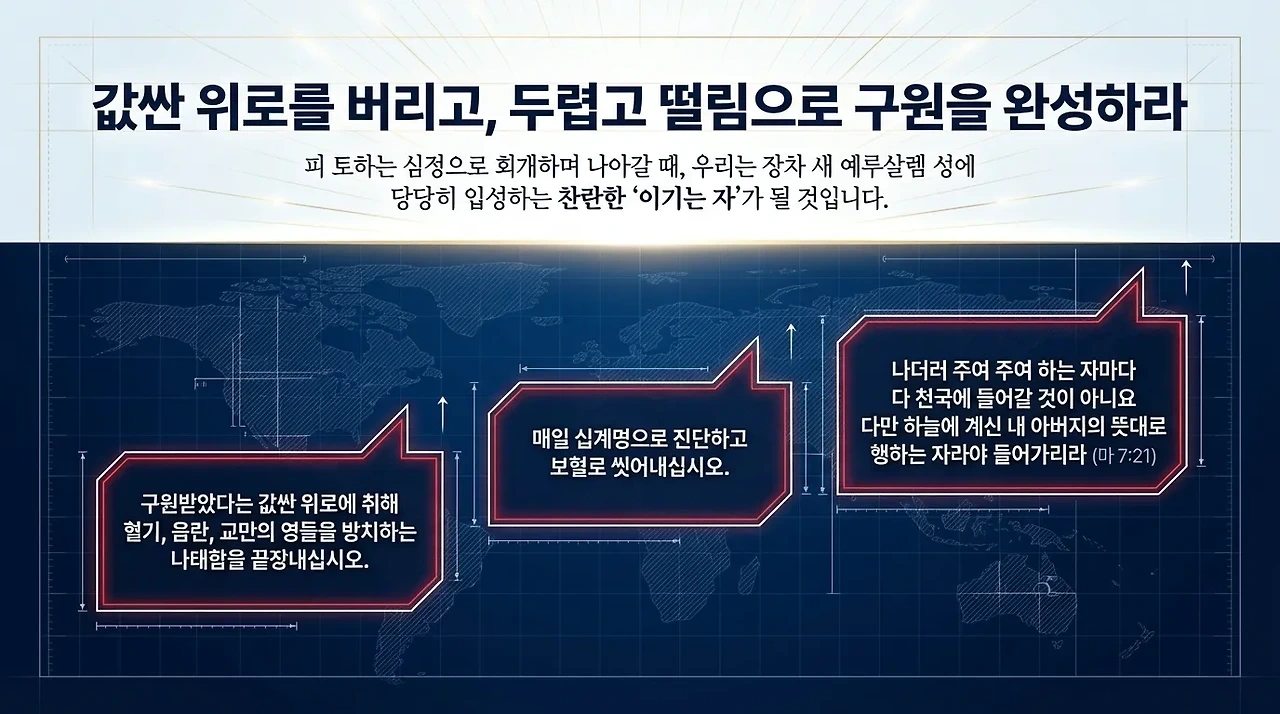
Therefore, we must now fall prostrate before Jesus’ stern warning: “Not everyone who says to me, ‘Lord, Lord,’ will enter the kingdom of heaven, but only the one who does the will of my Father in heaven” (Matthew 7:21). We must put an end to the laziness of living while intoxicated by the cheap comfort of being “saved,” our bodies filled to the brim with the spirits of lust, immorality, and pride. Today, too, we must diagnose the fatal illness of our souls daily through the Ten Commandments, come before Jesus Christ, the Lamb of God, and confess and repent with all our hearts, covering ourselves with His precious blood and receiving it. Only when we repent with a heart that vomits out the demons and evil spirits hiding within us—those that lead us into curses—will we finally complete our salvation with fear and trembling, and become the glorious “overcomers” who will one day enter the New Jerusalem with confidence.
Thursday, March 12, 2026
Pastor Jeong Bo-bae
9. 나오며
우리는 지금까지 신약의 성도들이 갖게 되는 율법에 대한 그릇된 오해와 구원파적 신앙이 얼마나 그들을 영적인 사지로 몰아넣고 있는지를 적나라하게 살펴보았다. 예수께서 십자가에서 완성하심으로 폐지하신 것은 의식법들이다. 즉 예수께서 완성하심으로 십자가에서 끝내신 것은 할례법, 안식일법, 제사법(제사장법), 절기법, 정결법, 음식법 등의 낡은 의식법들뿐이다. 그러나 반대로 하나님의 거룩한 도덕법인 '십계명'은 여전히 살아있다. 그래서 십계명은 주님이 오시는 그날까지 시퍼렇게 날이 선 검처럼 우리의 폐부와 심장을 찌르며 우리를 정죄할 것이다.
그러므로 이제 우리는 "나더러 주여 주여 하는 자마다 다 천국에 들어갈 것이 아니요 다만 하늘에 계신 내 아버지의 뜻대로 행하는 자라야 들어가리라"(마 7:21)하신 예수님의 엄중한 경고 앞에 납작 엎드려야 한다. 구원받았다는 값싼 위로에 취해 혈기와 음란, 교만의 영들을 내 몸에 가득 채워둔 채 살아가는 나태함을 끝장내어야 한다. 오늘도 십계명을 통해 매일 내 영혼의 죽을 병을 진단하고, 속죄양 되신 예수 그리스도 앞으로 나아가 처절하게 자백하고 회개하여 예수님의 보혈을 자신을 덮고 받아들여야 한다. 그래서 속에 숨어서 우리를 저주 가운데로 이끄는 귀신과 악한 영들을 피 토하는 심정으로 회개할 때에, 비로소 우리는 두렵고 떨림으로 구원을 완성하며, 장차 새 예루살렘 성에 당당히 입성하는 찬란한 ‘이기는 자’가 되어있을 것이다.
2026년 03월 12일(목)
정보배 목사
[Sermon Highlights]
This sermon is a message by Pastor Jeong Bo-bae based on the Book of Galatians, explaining the essential functions and limitations of the Law revealed through Moses in Exodus, as well as its relationship to Christ. This sermon cautions against the modern Protestant tendency to misunderstand the Law as simply abolished, leading to moral laxity. It distinguishes the Law broadly into the “Moral Law” (the Ten Commandments) and the “Ceremonial Law” (centered on sacrifices), defining the former as a standard of judgment valid until the Lord’s return and the latter as a model of salvation foreshadowing Christ. In particular, it warns that human deeds can be erased from the Book of Life and emphasizes that once obtained, salvation is not definitive but conditional; therefore, believers must continually work out their salvation through a life of repentance and holiness. In conclusion, this sermon aims to encourage listeners to recognize their sinfulness through the Law and to rely solely on Christ’s atonement and the life of the Holy Spirit to triumph in the spiritual battle until the very end.
This sermon warns against the danger of “salvationist antinomianism”—a view the modern church is prone to fall into—and emphasizes the restoration of a biblical view of the law. The author explains that, unlike the ceremonial law which was fulfilled and abolished by the cross, the moral law of the Ten Commandments remains a valid standard of judgment and a tool for recognizing sin. Pointing out the complacency of believing that a single confession of faith guarantees eternal salvation, the author reminds believers that they too will stand before the judgment seat of Christ. Therefore, salvation is not something maintained mechanically, but a process that is completed with fear and trembling, bearing the fruits of thorough repentance and love in daily life.
[설교핵심]
본 설교는 정보배 목사가 갈라디아서를 바탕으로 하여 출애굽기에서 모세를 통해 계시된 율법의 본질적 기능과 한계, 그리고 그리스도와의 상관관계를 설명한 메시지입니다. 번 설교는 현대 개신교가 율법을 단순히 폐지된 것으로 오해하여 도덕적 해이에 빠지는 것을 경계하며, 율법을 크게 십계명인 '도덕법'과 제사 중심의 '의식법'으로 구분하여 전자는 주님 오실 때까지 유효한 심판의 잣대로, 후자는 그리스도를 예표하는 구원의 모형으로 정의합니다. 특히 인간의 행위가 생명책에서 지워질 수 있음을 경고하며, 한 번 얻은 구원은 확정적인 것이 아니라 유보적인 성격을 띠므로 신자는 끊임없이 회개와 성결의 삶을 통해 구원을 이루어가야 한다고 강조합니다. 결론적으로 이 설교는 율법을 통해 자신의 죄인 됨을 깨닫고, 오직 그리스도의 대속과 성령의 생명을 의지하여 마지막 순간까지 영적 싸움에서 승리할 것을 독려하는 목적을 지닙니다.
이 설교는 현대 교회가 빠지기 쉬운 '구원파적 율법 폐지론'의 위험성을 경고하며, 성경적 율법관의 회복을 강조합니다. 저자는 십자가로 완성되어 폐지된 의식법과 달리, 도덕법인 십계명은 여전히 유효한 심판의 잣대이자 죄를 깨닫게 하는 도구임을 설명합니다. 한 번의 믿음 고백이 영원한 구원을 보장한다는 안일함을 지적하며, 성도 또한 그리스도의 심판대 앞에 서게 됨을 상기시킵니다. 따라서 구원은 기계적으로 유지되는 것이 아니라, 삶 속에서 철저한 회개와 사랑의 열매를 맺으며 두렵고 떨림으로 완성해가는 과정임을 역설합니다. 결론적으로 율법을 통해 자신의 죄를 진단하고, 구원자이신 예수의 보혈로 매일 영혼의 옷을 빠는 자만이 참된 승리자가 될 수 있다고 조언합니다.
[출처] 회개와 천국복음 카페