What was the foreshadowing of Jesus Christ during the Flood judgment? (Genesis 6:13–22)
제목: [기독론(12)] 노아의 홍수 심판 때에 예수 그리스도의 예표는 무엇이었는가?(창6:13~22)
_동탄명성교회 정보배 목사
1. Introduction: Prosperity in the Age of AI—Is It a Blessing or a Harbinger of Judgment?
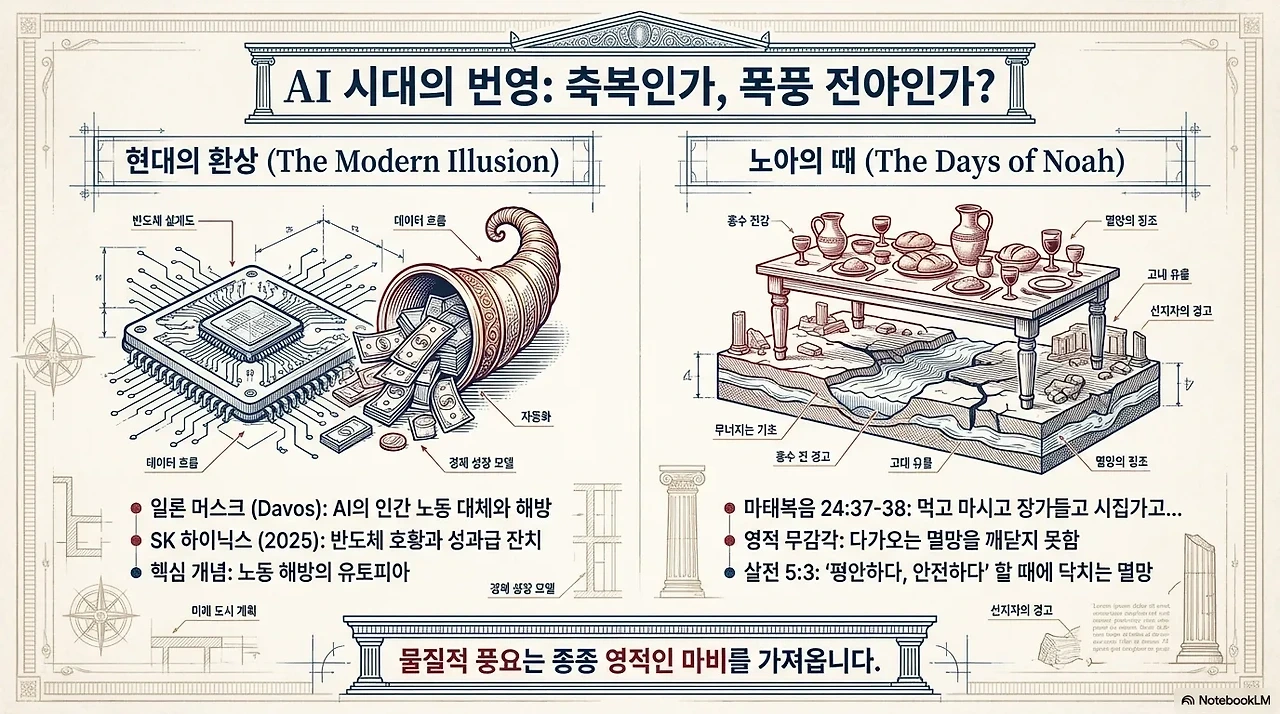
The world is currently swept up in a wave of artificial intelligence (AI) enthusiasm. Recently, Elon Musk, the American entrepreneur famous for his electric vehicles, made a shocking statement at the Davos Forum. “By the end of this year, AI will surpass humans in capability, and as AI gradually takes over human tasks, a world will emerge where human labor is no longer necessary.” He argued that if AI robots produce around the clock without rest, prices will fall, and a utopian world of “labor liberation”—where the state provides income to citizens who do not work—will finally arrive. The news that SK Hynix paid its employees massive bonuses at the end of 2025 due to the semiconductor boom makes it clear that this change is not a distant future.
But how does the Bible view this abundance and comfort? Jesus said that the last days would be like “the days of Noah” (Matthew 24:37). What were people doing just before the flood destroyed them? “They were eating and drinking, marrying and giving in marriage…” (Matt. 24:38). They were busy fulfilling the needs of the flesh. Their spiritual senses were numbed as they indulged in their daily lives and material comforts.
Yet the world that AI will bring may seem like paradise on the surface. However, it could be the calm before the storm. For when the world says, “Peace and safety,” then sudden destruction will come upon them (1 Thessalonians 5:3). We are living in the most dazzling yet most dangerous era in human history. What is the only lifeline we must truly hold onto at this time? Just as there was the ark in Noah’s time, we have Jesus Christ today. Therefore, in this session, we will uncover the mystery of Jesus Christ hidden within the story of the Flood of Noah and seek the wisdom to overcome the coming judgment.
2. During the Flood of Noah, is the true type of Jesus Christ “Noah” or the “ark”?
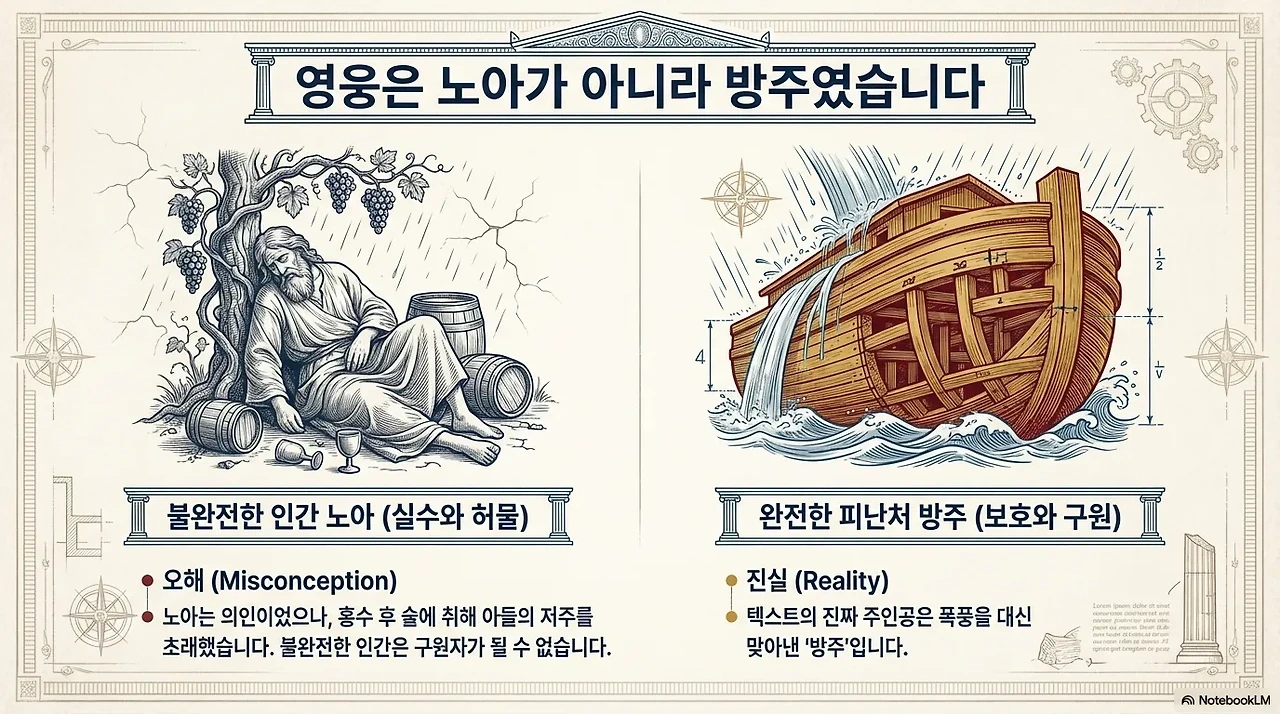
Many people consider Noah to be a type of Jesus. Of course, Noah was a righteous and blameless man of his time (Gen. 6:9), and he fulfilled his prophetic role well by preaching righteousness to a doomed world and saving his family. In that sense, he can be seen as a shadow of Jesus. However, Noah was imperfect. After the flood, he became intoxicated with wine and fell asleep naked, thereby providing the cause for his second son, Ham, to be cursed. Since Noah had this flaw, he cannot be a perfect type of the sinless Jesus.
1. 들어가며: AI 시대의 번영, 그것은 축복인가 심판의 전조인가?
지금 전 세계는 인공지능(AI) 열풍에 휩싸여 있다. 얼마 전 전기자동차로 유명한 미국의 일론 머스크는 다보스 포럼에서 충격적인 발언을 했다. "앞으로 올 해 연말 안에 인간보다 뛰어난 AI가 나올 것이며, 점차로 AI가 인간을 대신하여 일을 할 것이기 때문에, 인간의 노동은 더이상 필요 없는 세상이 올 것이다." AI로봇이 24시간 쉬지 않고 생산하면, 물가는 하락할 것이고, 국가는 일하지 않는 국민에게 돈을 주는 세상, 바야흐로 '노동 해방'의 유토피아 세상이 온다는 것이다. 2025년말 SK 하이닉스가 반도체 호황으로 직원들에게 엄청난 보너스를 지급했다는 소식은 이런 변화가 먼 미래가 아님을 실감케 한다.
그러나 성경은 이 풍요와 편안함을 어떻게 바라보는가? 예수님은 마지막 때를 '노아의 때'와 같다고 하셨다(마 24:37). 당시 홍수가 나서 멸망하기 직전까지 그때 사람들은 무엇을 하고 있었는가? "먹고 마시고 장가들고 시집가고 있으면서..."(마 24:38). 그들은 사람의 육체가 필요로 하는 것들을 하느라 바빴던 것이다. 일상적인 삶, 풍요로운 삶을 누리느라 영적인 감각이 마비되어 있었다.
그런데 AI가 가져다줄 세상은 겉보기엔 천국 같을지 모른다. 그러나 그것은 심판 직전의 고요함일 수 있다. 세상이 "평안하다, 안전하다" 할 그때에 멸망이 홀연히 닥칠 것이기 때문이다(살전 5:3). 우리는 지금 인류 역사상 가장 화려하지만 가장 위험한 시대를 살고 있다. 이때 우리가 진정 붙잡아야 할 유일한 구명줄은 무엇인가? 노아 시대에는 방주가 있었듯이, 오늘날 우리에게는 예수 그리스도가 있다. 그래서 이번 시간에는 노아 홍수 사건 속에 숨겨진 예수 그리스도의 비밀을 파헤치며, 다가올 심판을 이길 지혜를 찾고자 한다.
2. 노아의 홍수 때, 예수 그리스도의 진정한 예표는 '노아'인가 '방주'인가?
많은 사람들은 노아를 예수님의 예표라고 생각한다. 물론 노아는 당대의 의인이요 완전한 자로서(창 6:9), 멸망할 세상에 의를 전파하고 가족을 구원해 냄으로 선지자적 역할을 잘 감당했다. 그런 면에서 예수님의 그림자라 할 수 있다. 그러나 노아는 불완전했다. 홍수 이후 그는 포도주에 취해 벌거벗은 채 잠이 들었고, 그로 인해 둘째 아들 함이 저주를 받는 빌미를 제공했기 때문이다. 허물이 있었던 노아가 죄 없으신 예수님의 온전한 예표가 될 수는 없는 것이다.
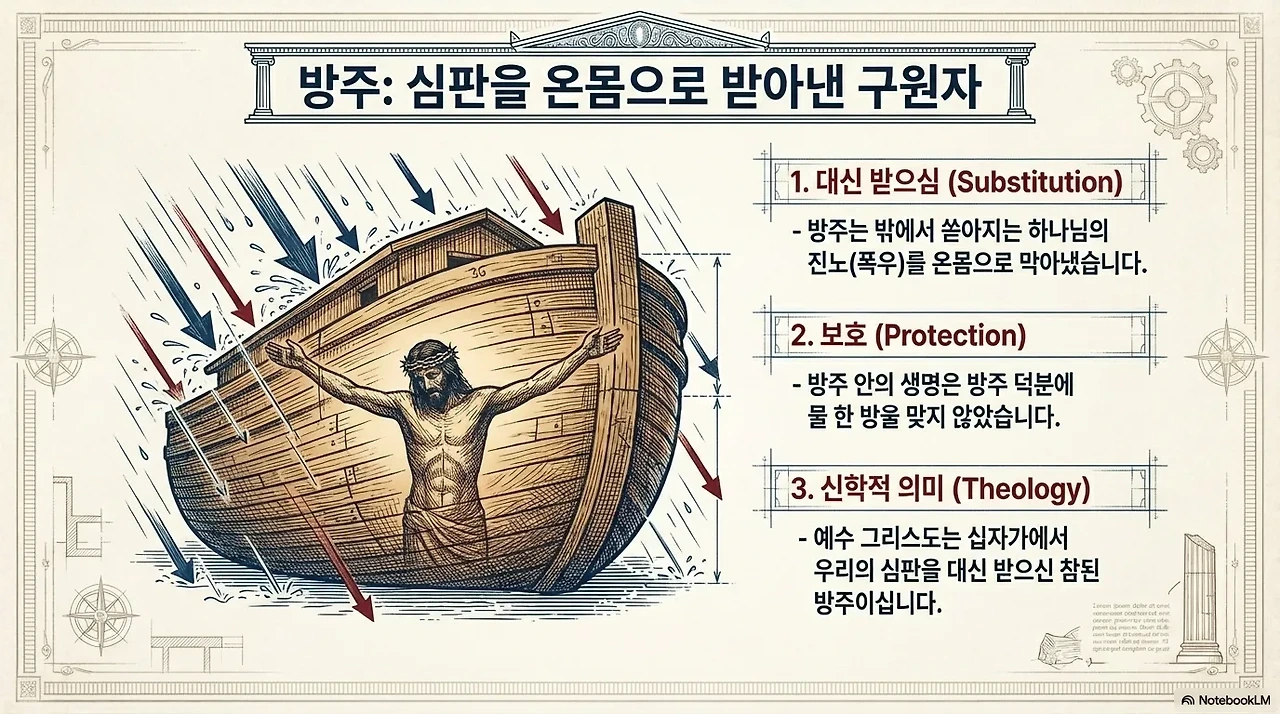
So what was the true type of Jesus Christ during the time of Noah’s Flood? It was none other than the “Ark.” The Ark was not built for its own sake. It existed solely to save the living creatures inside it. Therefore, the Ark had to withstand the raging storm and the floodwaters—which were a judgment—with its entire body. Thus, while the rain of death poured down outside, the inside of the Ark remained safe. Is this not a perfect illustration of the ministry of Jesus Christ? For Jesus bore the full brunt of God’s wrath and judgment upon His own body, thereby keeping us safe within Him. Therefore, the Ark should not be viewed merely as a wooden box, but as the embrace of Jesus, who holds us close to save and protect us.
3. What redemptive secrets lie in the “gopher wood” and “pitch” used to build the Ark?
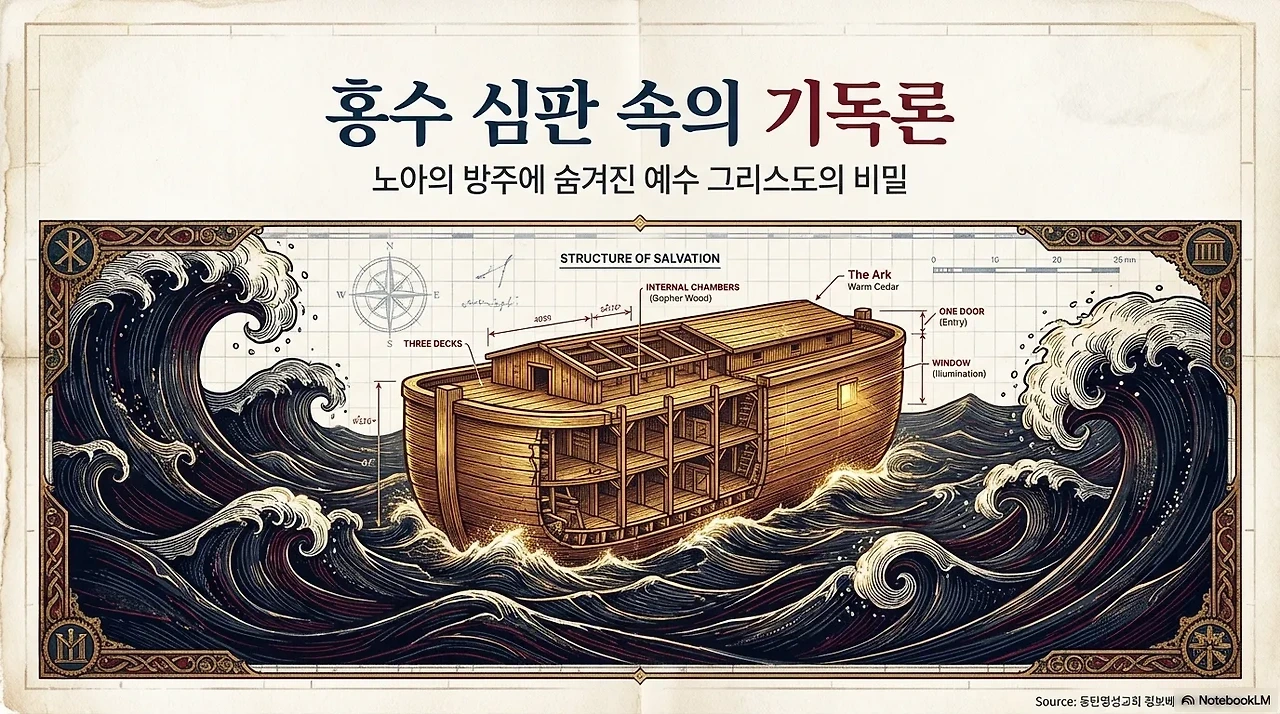
When God commanded the building of the ark, He specified the materials to be used in great detail. Look at Genesis 6:14. The Lord God told Noah, the righteous man of that generation, “Make yourself an ark of gopher wood; make rooms in the ark, and coat it with pitch inside and out.” Yet the core of Christology is contained within these words.
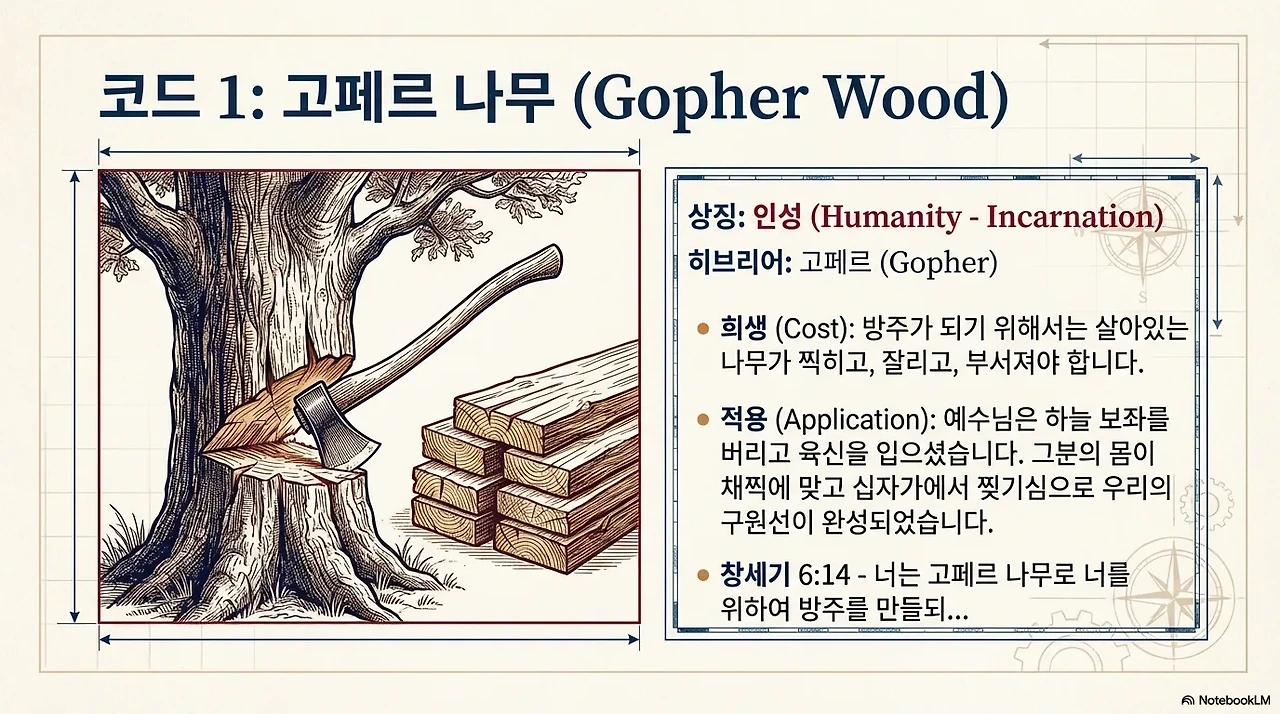
First, “gopher wood” symbolizes Jesus’ “humanity.” Scholars disagree on exactly what this wood is. In the past, it was translated as “pine,” but recently it has been translated literally as “gopher wood.” What is important is that this is a “cut-down tree.” A living tree must be felled, cut, and shaped to become an ark. Jesus abandoned His throne of glory to come to this earth, where He was beaten with whips and torn apart on the cross. It was through the breaking of His body that the ark into which we may enter was completed. Just as the acacia wood (timber) used in the Tabernacle symbolizes Jesus’ humanity, the gopher wood also represents Jesus, who took on flesh to save us.
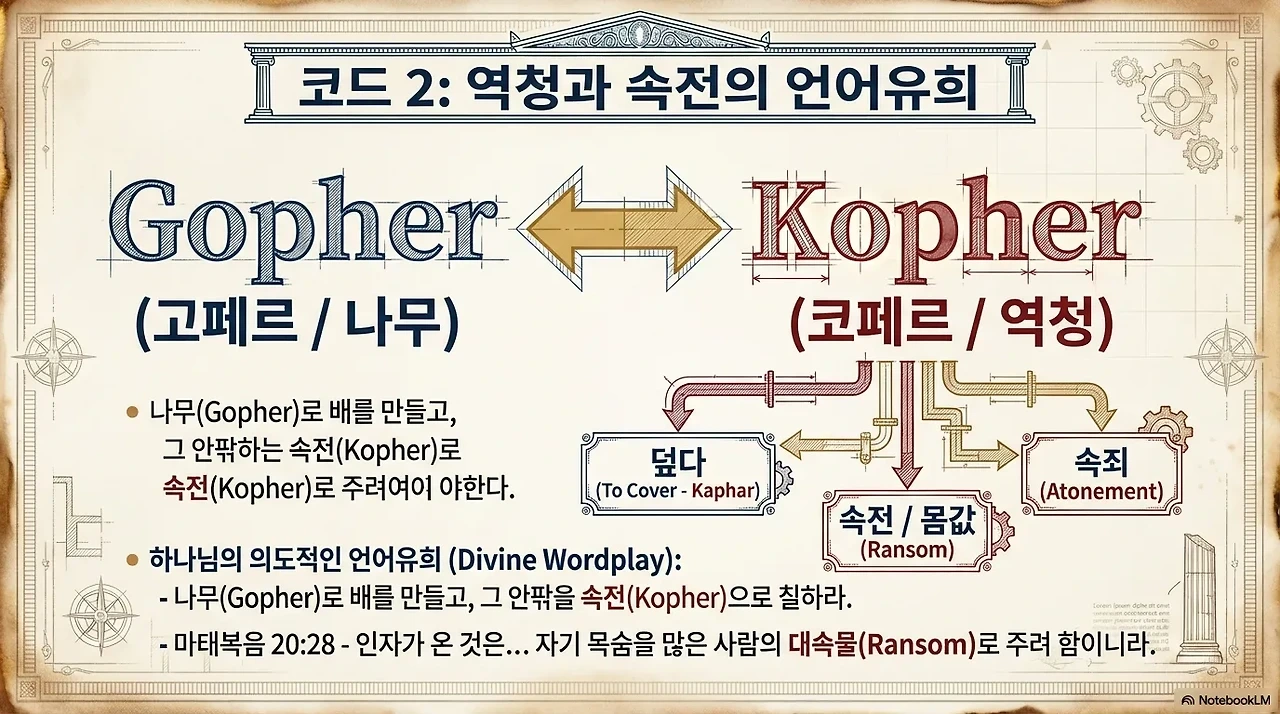
Second, “pitch” symbolizes Jesus’ “atonement.” When Noah built the ark, the method he used to prevent water from seeping through the cracks in the wood was to coat the ark with pitch. In Hebrew, pitch is called “kopher.” Remarkably, this word carries the meaning of “ransom” or “redemption price.” Furthermore, it is derived from the verb “kaphar,” which means “to atone.” God employed a deliberate wordplay here. “Build the ark of wood, and coat it inside and out with ‘ransom’.”
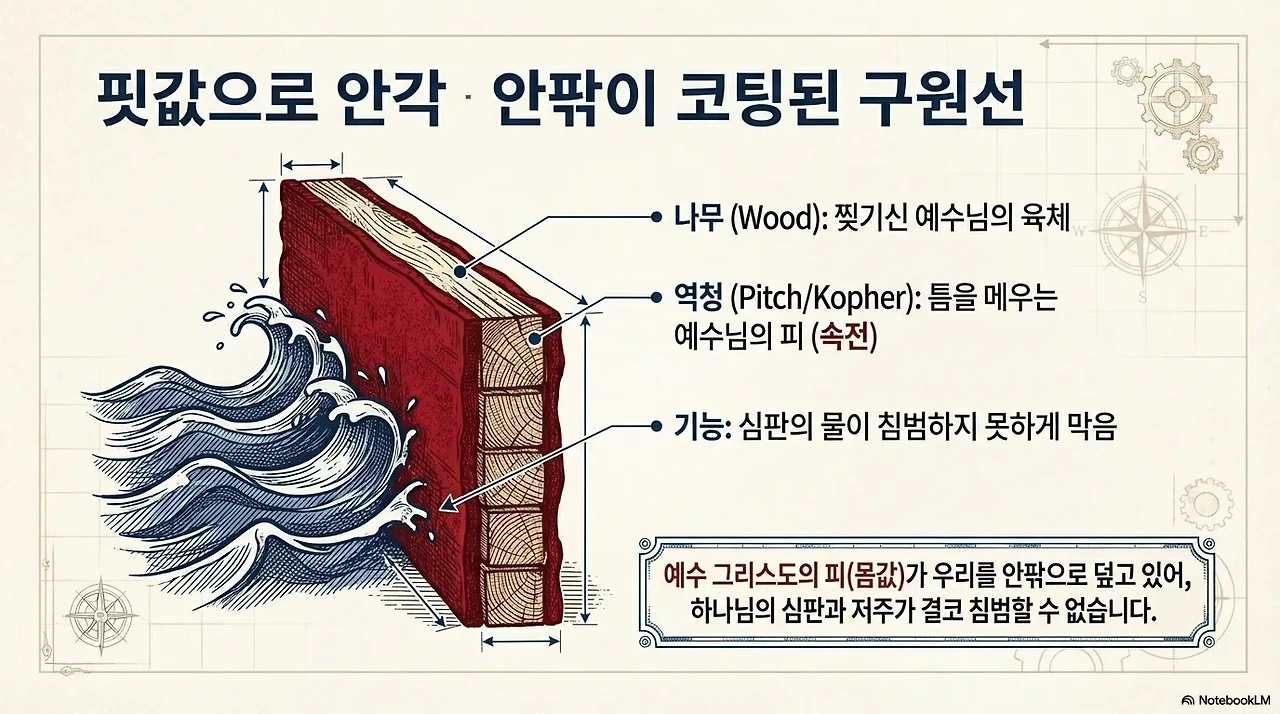
What does this mean? It means that Jesus Christ covered us with the price of His blood (ransom). Just as pitch must be applied to prevent water from penetrating, Jesus’ blood (ransom) must be applied so that God’s judgment and curse cannot invade us. The ark was not merely a boat, but a “giant vessel of salvation” coated inside and out with the blood of Jesus.
In Matthew 20:28, Jesus said, “He gave his life as a ransom for many.” The pitch of the ark was a foreshadowing of this very ransom.
그렇다면 노아 홍수 때에 진짜 예수 그리스도의 예표는 무엇인가? 그것은 바로 '방주(Ark)'다. 당시 방주는 스스로를 위해 만들어지지 않았다. 오직 그 안에 탄 생명체들을 살리기 위해 존재하고 있었다. 그러므로 방주는 거센 폭풍우와 심판으로서 홍수 물결을 온몸으로 막아내야 했다. 그러므로 밖에서는 죽음의 비가 쏟아지고 있었지만, 방주 안은 안전했다. 이것이야말로 예수 그리스도의 사역을 완벽하게 보여주는 그림이 아니겠는가! 예수님은 하나님의 진노와 심판을 당신의 몸으로 다 받아내시고, 그 안에 있는 우리를 안전하게 보호하고 계시기 때문이다. 고로 방주는 나무 상자로만 볼 것이 아니라, 우리를 품에 안으시어 구원하고 보호하시는 예수님의 품이었다.
3. 방주의 재료인 '고페르 나무'와 '역청'에는 어떤 구속사적 비밀이 있는가?
하나님은 방주를 만들 때 아주 구체적으로 무슨 재료를 사용하실 것인지를 지정하셨다. 창세기 6장 14절을 보라. 여호와 하나님께서는 당대의 의인이었던 노아에게, "너는 고페르 나무(Gopher wood)로 너를 위하여 방주를 만들되 그 안에 칸들을 막고 역청(Pitch=Kopher))을 그 안팎에 칠하라." 그런데 이 말씀 속에 기독론의 핵심이 다 들어 있다.
첫째, '고페르 나무'는 예수님의 '인성(Humanity)'을 상징하기 때문이다. 이 나무가 정확히 무엇인지는 학자들마다 의견이 분분하다. 과거에는 '잣나무'로 번역했으나, 최근에는 원어 그대로 '고페르 나무'라고 번역하고 있다. 중요한 것은 이것이 '베어낸 나무'라는 점이다. 살아있는 나무가 찍히고, 잘리고, 다듬어져야 방주가 된다. 예수님은 영광의 보좌를 버리고 이 땅에 오셔서, 채찍에 맞고 십자가에 달리심으로 찢기셨다. 그분의 육체가 깨어짐으로 우리가 들어갈 방주가 완성된 것이다. 성막의 재료인 아카시아 나무(조각목)가 예수님의 인성을 상징하듯, 고페르 나무 역시 우리를 구원하기 위해 육신을 입으신 예수님을 보여준다.
둘째, '역청'은 예수님의 '대속(Atonement)'을 상징하기 때문이다. 노아가 방주를 만들 때에 나무들 틈새로 물이 들어오지 못하게 막는 빙법은 방주에 역청을 바르는 것이었다. 히브리어로 역청이란 '코페르(Kopher)'이다. 그런데 놀랍게도 이 단어는 '속전(Ransom)', '몸값'이라는 뜻을 가지고 있다. 또한 이 단어는 '속죄하다'는 뜻의 동사 '카파르(Kaphar)'에서 유래했다. 하나님은 의도적인 언어유희(Wordplay)를 이때에 사용하신 것이다. "나무로 배를 만들고, 그 안팎을 '몸값(속전)'으로 칠하라."
이것은 무엇을 의미하는가? 예수 그리스도께서 당신의 핏값(몸값)으로 우리를 덮으셨다는 뜻이다. 역청이 발라져야 물이 침투하지 못하듯, 예수님의 피(속전)가 발라져야 하나님의 심판과 저주가 우리를 침범하지 못한다. 방주는 단순한 배가 아니라, 예수님의 피로 안팎이 코팅된 '거대한 구원선'이었다.
마태복음 20장 28절에서 예수님은 "자기 목숨을 많은 사람의 대속물(Ransom)로 주려 함이니라"고 하셨다. 방주의 역청은 바로 이 대속물을 미리 보여준 것이다.
4. What does the structure of the ark (the door, the three levels) tell us about salvation?
When we look at the structure of the ark, we can see that it also points precisely to Jesus.
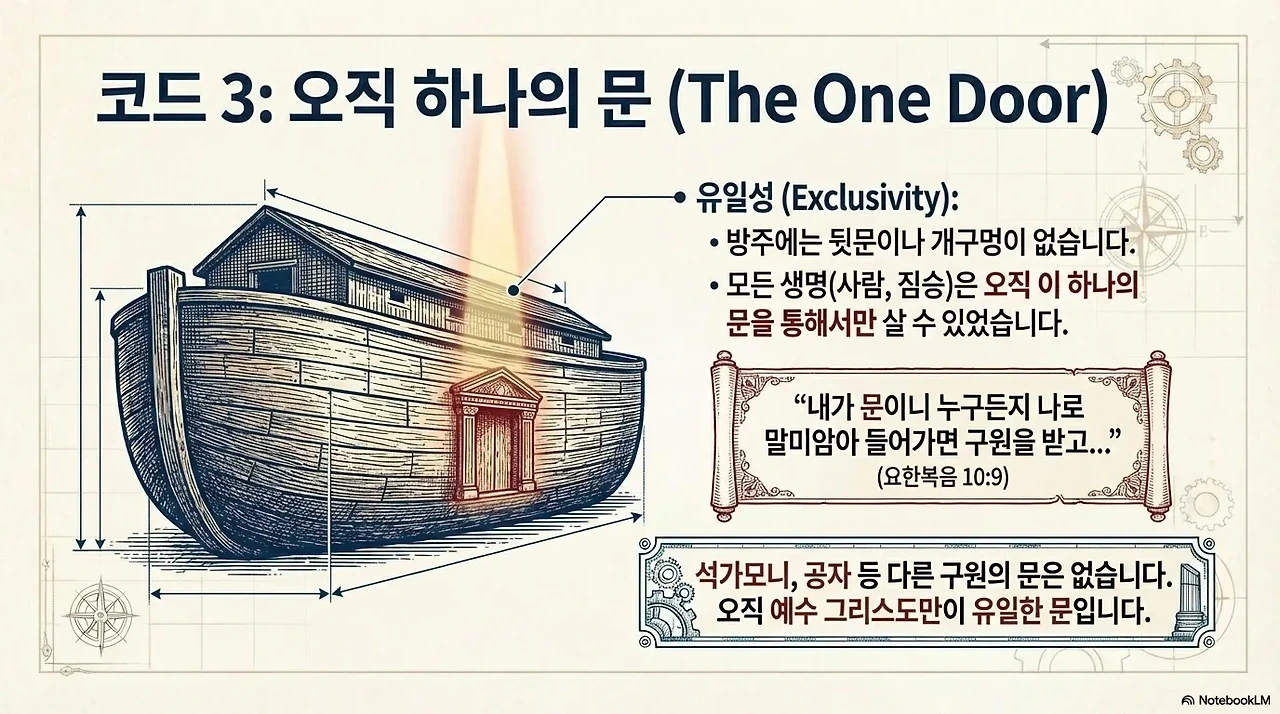
First, the ark had only “one door.” The door of the ark was a single door set on the side (Genesis 6:16). Therefore, Noah’s family of eight, as well as the elephants, lions, and rabbits, all had to enter and exit through that single door. There was no other opening. In John 10:9, Jesus said, **“I am the gate; whoever enters through me will be saved.”** There is no other name under heaven given to mankind by which we must be saved (Acts 4:12). Neither Siddhartha Gautama, nor Confucius, nor Muhammad can be the gate of salvation. Only by passing through the one and only gate—Jesus Christ—can one enter the ark (salvation).
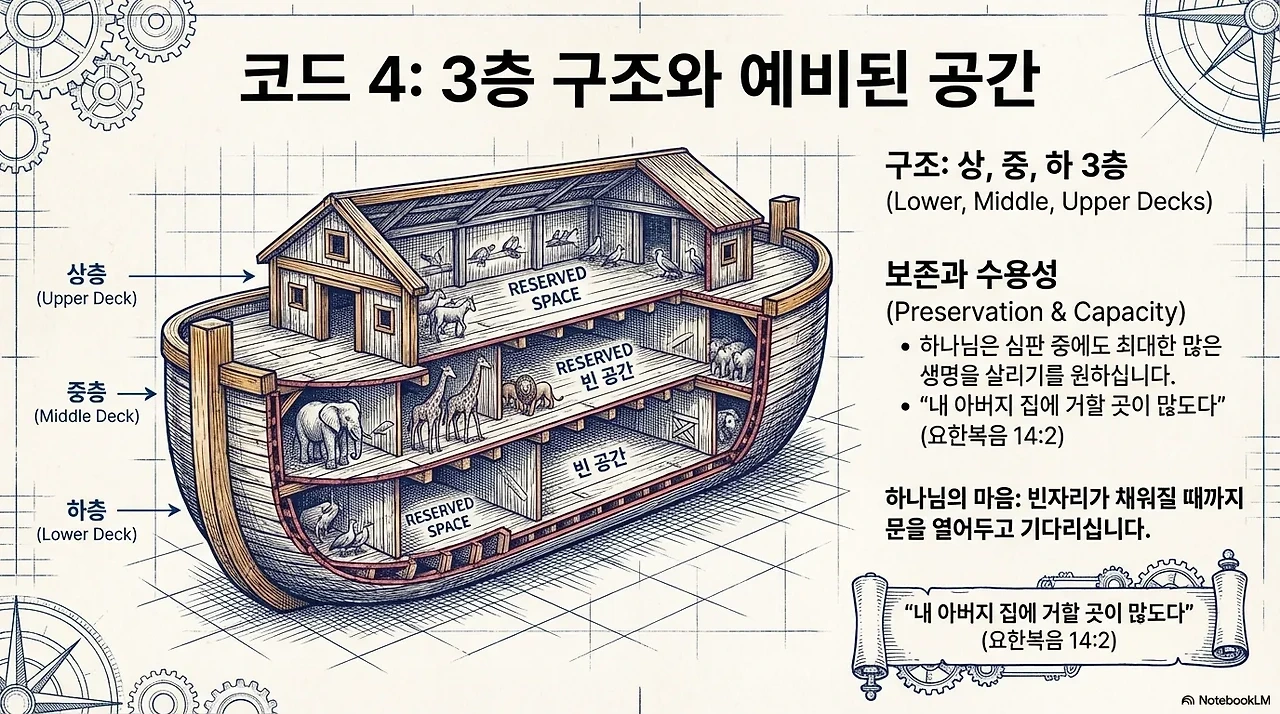
Second, the ark was composed of “three levels: upper, middle, and lower.” Why three levels? To carry as many animals as possible. God desired to save as many lives as possible. Some theologians interpret this as the saving work of the Triune God (Father, Son, and Holy Spirit), while others see it as the salvation of our spirit, soul, and body. What matters is God’s heart. Even in the midst of judgment, God did not forget mercy and prepared ample space. “In my Father’s house are many rooms” (John 14:2). Even now, Jesus keeps the door of the ark open, waiting to save even one more soul. This is precisely why we must evangelize. The door will not close until the empty seats are filled.
5. How have churches throughout history interpreted the ark? (The Cross vs. the Church vs. Christ)
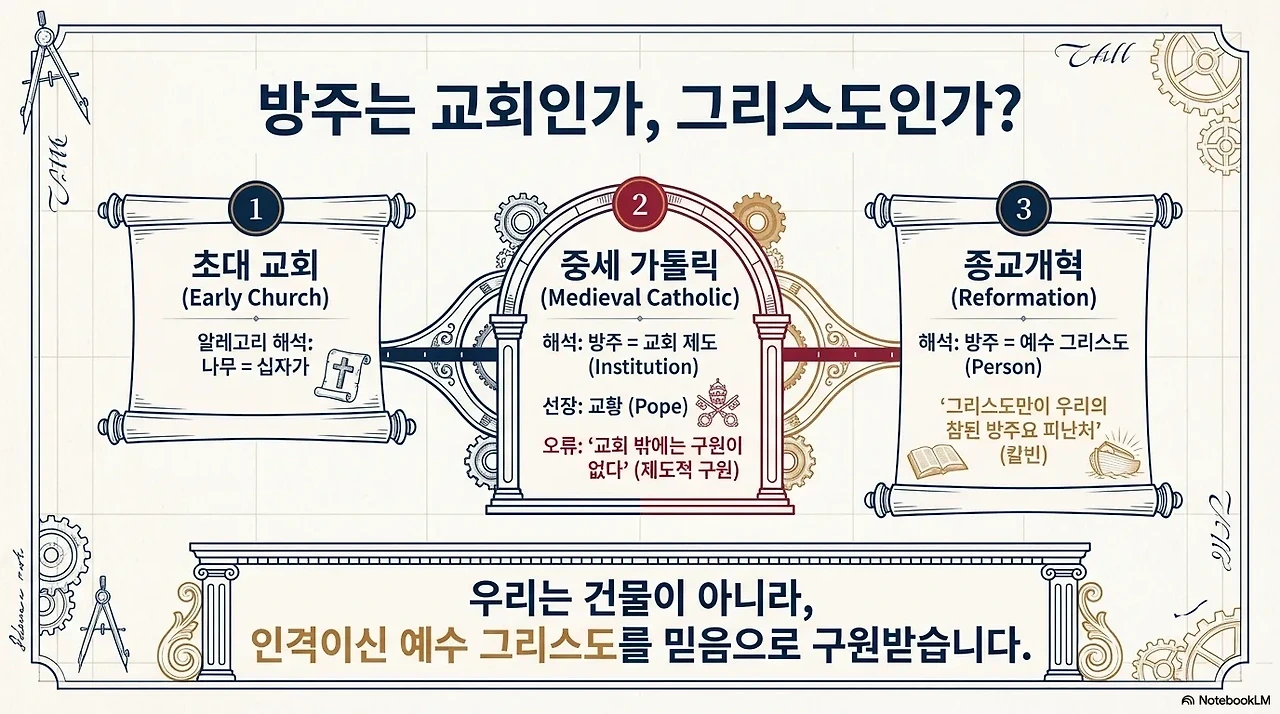
It is interesting to note that throughout church history, Noah’s ark has been interpreted slightly differently in each era. The early Church Fathers primarily interpreted it allegorically. Figures like Justin Martyr and Origen viewed the wood of the ark as the “cross.” While it is valid that wood symbolizes the cross, viewing the entire ark solely as a cross is a somewhat narrow interpretation.
Moving on to the medieval Catholic Church, the interpretation of the ark underwent a drastic transformation. They viewed the ark as the “Church” and claimed that the captain of the ark was the “Pope.” This is where the doctrine “Outside the [Catholic] Church there is no salvation (Extra Ecclesiam nulla salus)” originated. Just as one had to board Noah’s ark to survive, they argued that one must enter the institutional framework of the Catholic Church to be saved.
4. 방주의 구조(문, 3층)는 구원에 대해 무엇을 말해주는가?
방주의 구조를 보면 이것 역시 예수님을 정확하게 가리킴을 알 수 있다.
첫째, 방주에는 오직 '하나의 문'만 가지고 있었다. 방주의 문은 옆으로 달아낸 문 하나였다(창 6:16). 그러므로 노아의 8식구도, 코끼리도, 사자도, 토끼도 다 그 문으로만 들어가고 나와야 했다. 다른 개구멍은 없다. 예수님은 요한복음 10장 9절에서 **"내가 문이니 누구든지 나로 말미암아 들어가면 구원을 받고"**라고 하셨다. 천하 인간에 구원을 얻을 만한 다른 이름을 주신 일이 없다(행 4:12). 석가모니도, 공자도, 마호메트도 구원의 문이 될 수 없다. 오직 예수 그리스도라는 유일한 문을 통과해야만 방주(구원) 안으로 들어갈 수 있다.
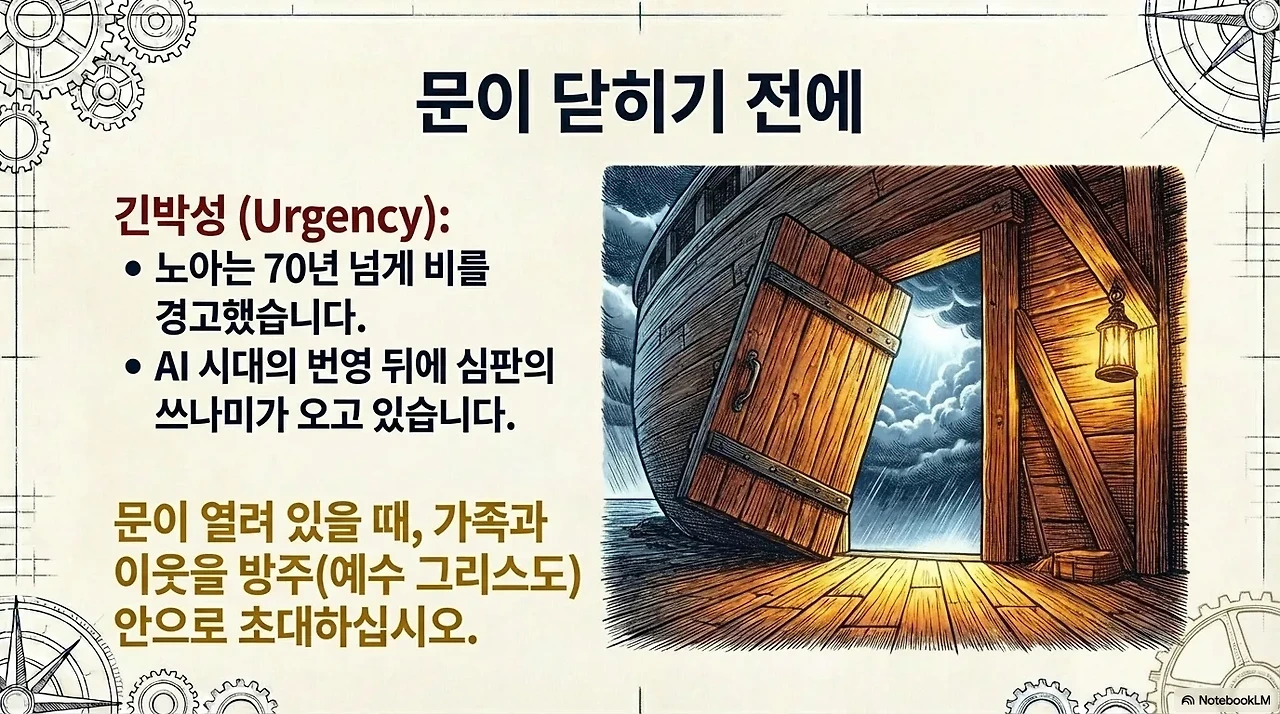
둘째, 방주는 '상, 중, 하 3층'으로 구성되어 있었다. 왜 3층일까? 많은 짐승을 태우기 위해서다. 하나님은 최대한 많은 생명을 살리기를 원하셨다. 어떤 신학자는 이것을 삼위일체 하나님(성부, 성자, 성령)의 구원 사역으로 해석하기도 하고, 우리의 영, 혼, 육의 구원으로 보기도 한다. 중요한 것은 하나님의 마음이다. 하나님은 심판 중에도 긍휼을 잊지 않으시고, 넉넉한 공간을 예비하셨다. "내 아버지 집에 거할 곳이 많도다"(요 14:2). 예수님은 지금도 한 영혼이라도 더 태우기 위해 방주의 문을 열어놓고 기다리신다. 우리가 전도해야 하는 이유가 바로 여기에 있다. 빈자리가 채워져야 문이 닫힌다.
5. 역사 속 교회들은 방주를 어떻게 해석해 왔는가? (십자가 vs 교회 vs 그리스도)
흥미로운 점은 교회사 속에서 이 노아의 방주가 시대마다 조금씩 다르게 해석되어 왔다는 사실이다. 초대 교회 교부들은 주로 '알레고리(Allegory, 풍유)'적으로 해석했다. 저스틴 마터나 오리겐 같은 이들은 방주의 나무를 '십자가'로 보았다. 물론 나무가 십자가를 상징한다는 것은 타당하지만, 방주 전체를 십자가로만 보는 것은 다소 좁은 해석일 것이다.
이제 중세 가톨릭 교회로 넘어오면서 방주에 대한 해석은 급격히 변형된다. 그들은 방주를 '교회(Church)'로 보았다. 그리고 그 방주의 선장을 '교황(Pope)'이라고 주장했다. 그래서 "[카톨릭] 교회 밖에는 구원이 없다(Extra Ecclesiam nulla salus)"는 교리가 여기서 나왔다. 노아의 방주에 타야 살 수 있었듯이, 가톨릭 교회라는 제도권 안에 들어와야만 구원받는다는 것이다.
This constituted a grave error, substituting the Pope and the Church organization for Jesus as the source of salvation.
However, this interpretation was corrected when it reached the Reformers. They declared that the ark was not the Church, but “Jesus Christ” Himself. The Church’s role is to proclaim Jesus Christ—the ark of salvation—so that people may believe in Him and abide in Him; it is not an institution that grants salvation in and of itself. That is why Calvin emphasized, “Christ alone is our true ark and refuge.” We stand upon the legacy of this Reformation. Therefore, what we believe in is neither a building nor a denomination. What we believe in is Jesus Christ alone—who became the gopher wood (flesh) for us and shed the pitch (blood)—for He alone is our only ark.
6. Is salvation a one-time event or a continuous preservation? (Remaining in the Ark)
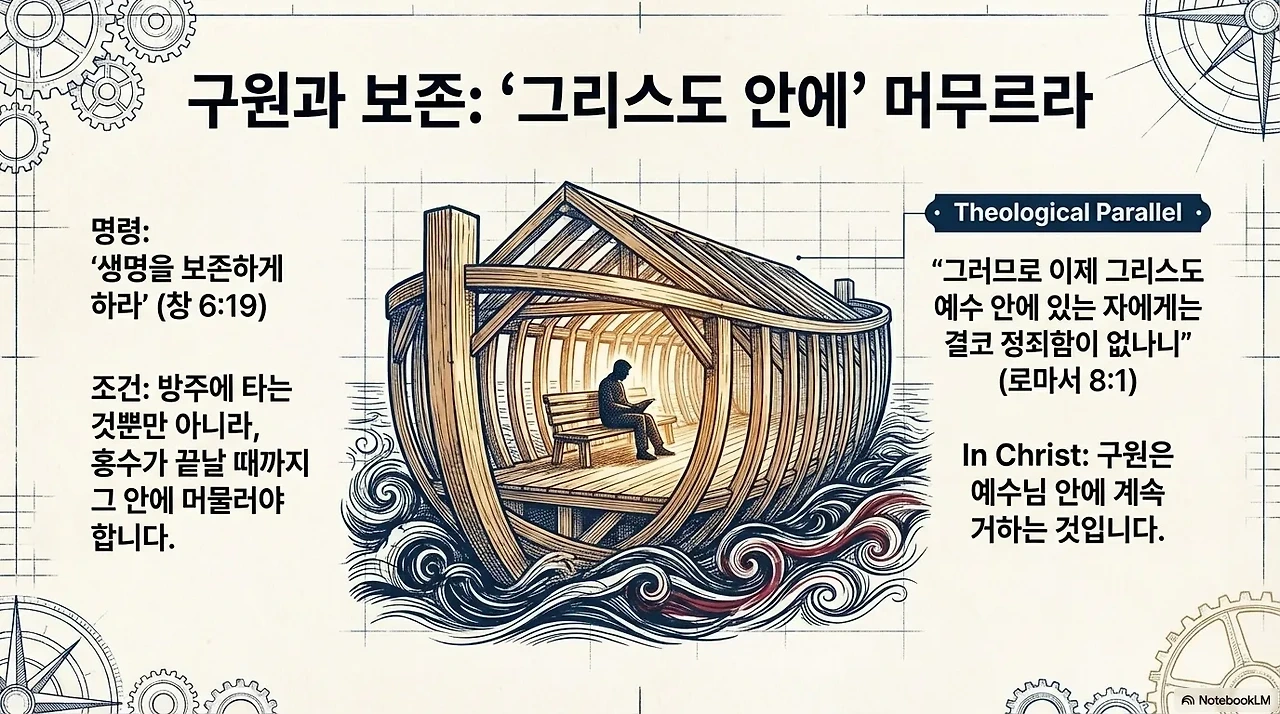
If the ark is Jesus, we must realize one important spiritual principle. The process of salvation does not end simply with “boarding” the ark. Once we board, we must “remain” there. This is because God commanded Noah to “preserve life” (Genesis 6:19). The concept of salvation involves both deliverance (Salvation) and preservation (Preservation). This is because even if you board the ark, jumping into the flood at will will result in death. You can only survive by staying put inside it until the flood is over.
Therefore, the New Testament apostle Paul expressed this with the phrase “in Christ,” emphasizing that we must go one step further than simply believing in Jesus and remain in Jesus Christ. Let us hear his words. In Romans 8, he said, “Therefore, there is now no condemnation for those who are in Christ Jesus” (Rom. 8:1). It is not enough to be freed from condemnation once through faith; one must remain in Him to be freed from condemnation forever. And he said, “If anyone is in Christ, he is a new creation” (2 Cor. 5:17). That is correct. By believing in Jesus, we become new people as those who have received the Holy Spirit.
However, we do not simply continue to exist as new people once we believe in Jesus; we must remain in Christ. This is similar to the principle of a branch of a vine that must remain attached to the vine to receive the sap from the roots and bear fruit. Therefore, we must understand that the moment we believe in and receive Jesus, we have boarded the ark. But we must not become complacent because of that. We must examine ourselves daily to see if we are truly abiding in Jesus. If we are swept away by the trends of the world and step outside the ark, we will inevitably be swept away by the waves of judgment once again. Therefore, Jesus also said that those who endure to the end will be saved (Matthew 24:13).
이것은 구원의 주체를 예수님이 아닌 교황과 조직으로 바꿔치기한 심각한 오류에 해당하는 것이었다.
그러나 이어 종교개혁자들에게 이르게 되었을 때에 이 해석은 바로잡힌다. 그들은 방주가 교회가 아니라 '예수 그리스도' 자신임을 천명했기 때문이다. 교회는 구원의 방주인 예수 그리스도를 전하여 믿게 하고 그분 안에 머물게 하는 것이지, 그 자체가 구원을 주는 기관은 아닌 것이다. 그래서 칼빈은 "그리스도만이 우리의 참된 방주요 피난처"라고 강조했다. 우리는 이 종교개혁의 유산 위에 서 있다. 고로 우리가 믿는 것은 건물도 아니요, 교파가 아니다. 우리가 믿는 것은 오직 우리를 위해 고페르 나무(육체)가 되시고 역청(피)을 흘리신 예수 그리스도, 그분만이 우리의 유일한 방주이신 것이다.
6. 구원은 단회적 사건인가, 지속적인 보존인가? (방주 안에 머무름)
방주가 예수님이라면, 우리는 한 가지 중요한 영적 원리를 깨달아야 한다. 구원의 과정은 단순히 방주에 '타는 것'으로 끝나지 않는다는 점이다. 탔으면 거기에 '머물러 있어야' 하기 때문이다. 왜냐하면 하나님께서는 노아에게 "생명을 보존(Preserve)하게 하라"(창 6:19)고 명령하셨기 때문이다. 구원의 개념은 건져냄(Salvation)과 함께 보존(Preservation)이 같이 있었던 것이다. 방주에 탔다고 해서 마음대로 홍수로 뛰어내리면 죽기 때문이다. 홍수가 끝날 때까지 그 안에 꼼짝 않고 붙어 있어야 살 수 있는 것이다.
그래서 신약의 사도 바울은 이를 "그리스도 안에(In Christ)"라는 말로 표현하여, 예수님을 믿는 것에서 한 걸음 더나아가 예수 그리스도 안에서 머물러 있어야 함을 강조하였다. 그의 말을 들어보자. 그는 로마서 8장에서 "그러므로 이제 그리스도 예수 안에 있는 자에게는 결코 정죄함이 없나니"(롬 8:1).고 했다. 한 번 믿음으로 정죄함에 벗어나는 것이 아니라 그분 안에 머물러야 정죄에서 영원히 벗어나는 것이다. 그리고 그는 "누구든지 그리스도 안에 있으면 새로운 피조물이라"(고후 5:17).고 했다. 그렇다. 예수님을 믿어서 우리는 성령을 받은 자로서 새 사람이 된다.
그러나 한 번 예수님을 믿어서 새 사람으로 계속 존속하는 것이 아니라 그리스도 안에 머물러 있어야 한다. 이는 마치 포도나무 가지가 포도나무에 붙어있어야 뿌리의 진액을 받아서 열매를 맺는 이치와 같다. 그러므로 우리는 알아야 한다. 우리가 예수님을 믿고 영접하는 순간 방주에 탄 것을 말이다. 그러나 그것으로 안심해서는 안 된다. 내가 과연 예수님 안에 머물러 있는지 날마다 점검해야 한다. 세상의 풍조에 휩쓸려 방주 밖으로 발을 내디딘다면, 우리는 금새 다시 심판의 파도에 휩쓸릴 수밖에 없을 것이다. 고로 예수께서도 역시 끝까지 견디는 자가 구원을 얻을 것이라고 말씀하셨다(마 24:13).
7. What is the secret to making our bodies into “little arks”? (Repentance and Blood)
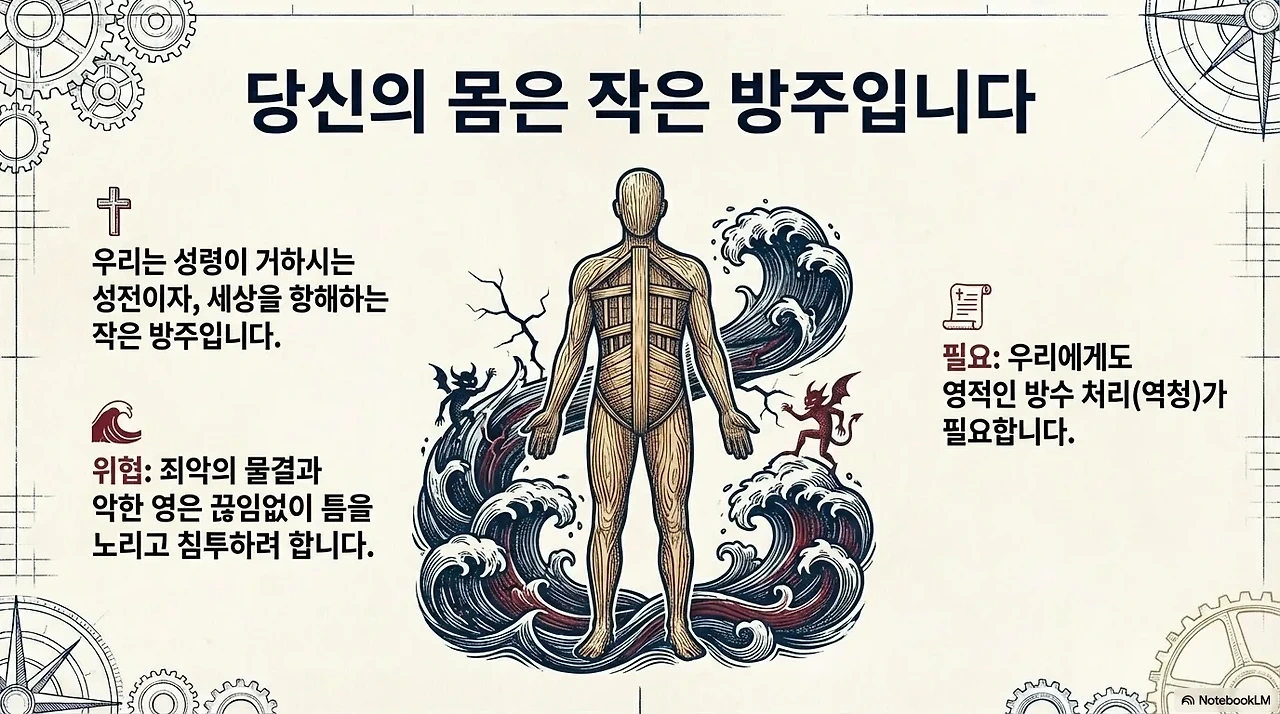
Finally, let’s apply the principle of this ark to ourselves. Our bodies are temples where the Holy Spirit dwells, and they are like little arks. What must we do to ensure this ark does not sink but reaches the harbor of heaven safely? The key to Noah’s ark lay in “pitch (kopher).” This is because the ark had to be coated with pitch both inside and out to prevent water from seeping in.
However, there is a remarkable play on words here. If we look at the original Hebrew text of Genesis 6:14, we see that after God commanded Noah to build the ark from gopher wood, He instructed him to coat it with kohper (pitch). Why did God command the use of gopher wood among all the trees, and why did He instruct that the joints be coated with kofar? There are two meanings here.
One is the command to build the ark out of wood, and the other is that it must be coated with kofar to prevent water from leaking into the ark. Therefore, the wood of the ark symbolizes Jesus Christ, who took on human nature, and the command to coat it with pitch signifies that, for this ark to be protected from the flood, Jesus had to offer Himself as a “kapar.” Here, the Hebrew word “kapar” carries the meanings of “to cover,” as well as “to atone,” “to give as a ransom,” “to offer as a redemption offering,” and “to pay the price.” Spiritually interpreted, this means that we are saved and kept safe because Jesus Christ, who took on human nature, shed His blood of atonement for us. Therefore, we must not only believe in Jesus Christ who came as a man but also receive the protection of “the blood of Jesus” and recognize that we are those who have been redeemed through the price of His blood.
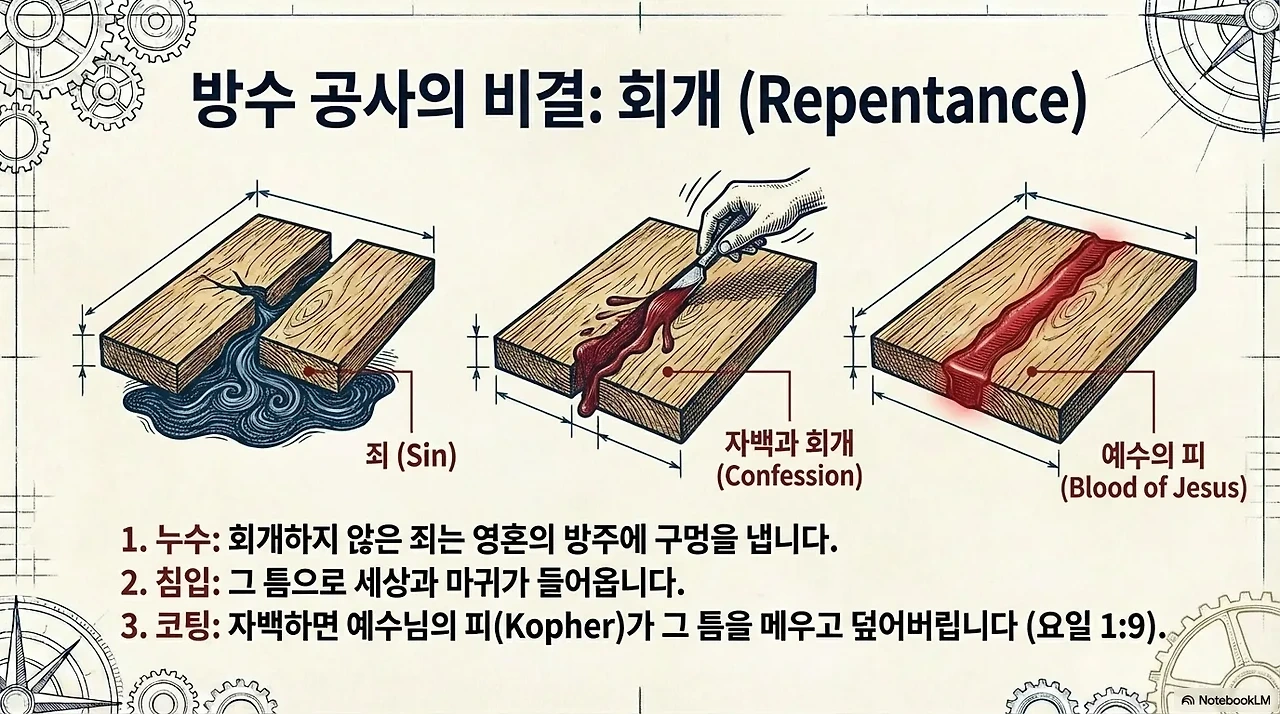
Therefore, believers who have been saved by faith must waterproof themselves to ward off the waves of this world’s filthy sin—that is, the attacks of evil spirits seeking to kill us. This is done by coating the ark with “copper.” In other words, we must anoint our bodies with the precious blood of Jesus. How can we apply this blood to our bodies? It is through “repentance”—confessing our sins (1 John 1:9) . This is because if we sin and do not repent, holes will be pierced in the ark of our souls. Through those gaps, demons (water) enter and cause us to sink. However, if we confess the sins we have committed, the blood of Jesus fills and covers those gaps (1 John 1:9). This is atonement (kappar).
I repent every day. This is because I must thoroughly wash away every sin committed in my thoughts, words, and deeds. This is not out of guilt, but rather repentance as a form of “waterproofing” to keep the ark of my soul safe. Therefore, anyone who becomes a repentant believer can be safe from the attacks of demons. This is because the devil cannot find a foothold in a person coated with the blood of Jesus. So, is my ark truly safe right now? I need to check. Could my ark have holes pierced by sin? I hope you will find those places and apply the tar of repentance immediately.
7. 우리 몸을 '작은 방주'로 만드는 비결은 무엇인가? (회개와 피)
마지막으로, 이 방주의 원리를 우리 개인에게 적용해 보자. 우리 몸은 성령이 거하시는 전이자 작은 방주와 같은 것이다. 이 방주가 침몰하지 않고 안전하게 천국 항구까지 가려면 어떻게 해야 하는가? 노아 방주의 핵심은 바로 '역청(코페르)'에 있었다. 왜냐하면 역청을 안팎에 칠해야 물이 새어 배 안으로 들어오지 않기 때문이다.
그런데 여기에 놀라운 언어유희가 있다. 왜냐하면 창세기 6장 14절을 히브리어 원문을 보면, 하나님께서 고페르 나무로 방주를 만든 후에 코페르(역청)로 칠하라고 말씀하셨기 때문이다. 왜 하나님께서는 많은 나무들 중에서 고페르 나무를 사용하라고 하셨고, 그 나무 사이사이를 코페르로 칠하고 하셨을까? 거기에는 2가지 의미가 있다.
하나는 방주를 나무를 만들라는 것이며 또 하나는 방주의 물이 새기 않게 하기 위해서는 코페르로 칠해야 한다는 것이다. 고로 방주의 나무는 인성을 취하신 예수 그리스도를 상징하고, 코페르로 칠하라고 한 것은 이 방주가 홍수로부터 보호되기 위해서는 예수께서 자신을 '카파르'로 내주어야 한다는 뜻이다. 여기서 '카파르'라는 히브리어는 '덮다'는 의미와 더불어 '속죄하다. 속전으로 주다, 속량물로 내주다, 몸값을 지불하다'는 뜻을 가졌다. 고로 이것을 영적으로 해석하면, 우리는 인성을 취하신 예수 그리스도께서 우리를 위해 속죄의 피를 흘려 주심으로 구원을 받으며 안전하게 지켜진다는 의미이다. 그러므로 우리는 사람으로 오신 예수 그리스도를 믿어야 할 뿐만 아니라 그분의 '예수의 피'의 보호를 받고, 그분의 핏값을 통해 사신 바 된 존재들인 것이다 .
그러므로 믿어서 구원받은 성도들은 이 세상의 더러운 죄악의 물결 곧 우리를 죽이려는 악한 영의 공격을 막아내기 위해서는 방수처리를 해야 하는데, 그것으 바로 '코페르'로 방주를 바르는 것이다. 곧 예수님의 보혈로 자신의 몸을 칠해야 하는 것이다. 어떻게 보혈을 우리 몸에 바를 수 있는가? 바로 자백하는 '회개(Repentance)'를 통해서다(요일 1:9). 왜냐하면 우리가 죄를 짓고 나서 회개하지 않으면, 우리 영혼의 방주에도 구멍이 뚫리기 때문이다. 그 틈으로 귀신(물)이 들어와 우리를 침몰시킨다. 그러나 우리가 지은 죄를 자백한다면, 예수의 피가 그 틈을 메우고 또한 덮어버린다(요일 1:9). 이것이 속죄(카파르)인 것이다.
필자는 매일 회개한다. 내 생각으로, 입술로, 행동으로 지은 죄를 낱낱이 씻어내야 하기 때문이다. 이것은 죄책감 때문이 아니라, 내 영혼의 방주를 안전하게 지키기 위한 '방수 공사'로서의 회개인 것이다. 그러므로 누구든지 회개하는 성도가 된다면 귀신의 공격으로부터 안전할 수 있다. 예수의 피가 코팅된 사람에는 마귀가 틈타지 못하기 때문이다. 그렇다면 지금 나의 방주는 과연 안전한가? 점검할 필요가 있다. 혹시 나의 방주는 죄로 인해 구멍이 뚫려 있지는 아니한가? 그곳을 찾아내서 지금 즉시 회개의 역청을 바르기를 바란다.
그것이 바로 악한 영이 계속해서 공격해오는 이 세상에서 살 수 있는 길이다.
9. Conclusion: The Only Way to Surpass the Waves of Judgment
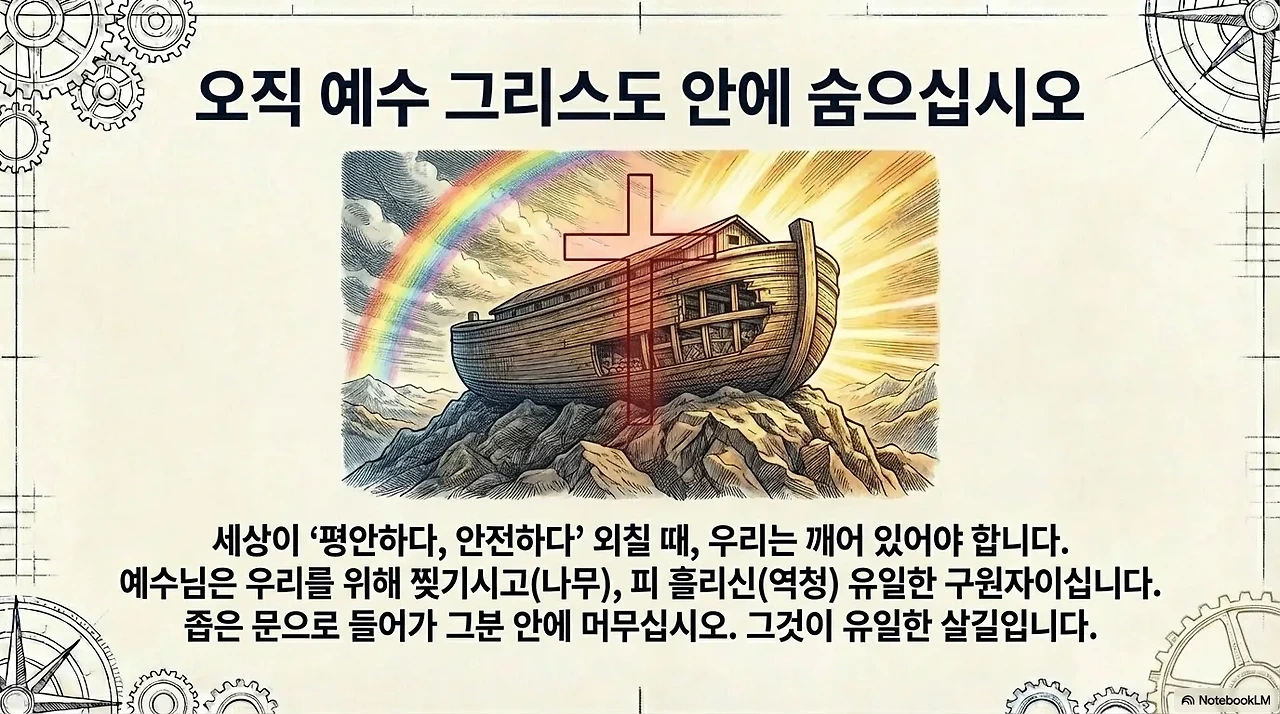
In this session, through the story of Noah’s Ark, we have encountered Jesus Christ, who rescues us from the judgment we face and protects us. In this treacherous world, how can we be saved and preserved from it? It is by believing in Jesus Christ and applying His precious blood to our bodies. For in this age, our Savior and Protector is none other than our Lord Jesus. Do not be intoxicated by the dazzling technology and abundance of AI. No matter how much the world improves and whispers, “All is peaceful, all is safe,” do not be deceived by such whispers. We must realize that behind such splendor lies a terrifying tsunami of judgment.
Therefore, there is only one place for us to take refuge now: inside the ark called “Jesus Christ.” He was nailed to the cross like a tree for our sake and shed the tar of His precious blood to cover us. Only in Him is there life, and only in Him is there rest. Therefore, seeking anyone else is in vain. And there is no other gate of salvation besides Jesus. We must enter through the narrow gate that is Jesus alone. And no matter how much the world may shake, we must not leave Him if we are to be saved.
Therefore, we must introduce this ark to our families and neighbors. “We have not yet seen the rain. But someday, it will rain for 40 days! The time is coming when our sins will be judged by water! Hurry and come into the ark!” Do we truly share the same sense of urgency that Noah proclaimed for over 70 years? If so, we must coat our hearts inside and out with the blood of Jesus and follow the guidance of the Holy Spirit. That day will be the very day we settle into that eternal new heaven and new earth. I earnestly pray that God’s peace may continue to rest upon all of us saints who never cease our journey of faith.
Thursday, January 28, 2026
Pastor Jung Bo-bae
9. 나오며: 심판의 파도를 넘는 유일한 길
이번 시간에 우리는 노아의 방주를 통해, 우리가 받는 심판으로부터 우리를 건져주시고 우리를 보호해주실 예수 그리스도를 만나게 되었다. 이 험악한 세상에서 어떻게 우리가 구원을 받으며 어떻게 이 세상으로부터 보전될 것인가? 그것은 예수 그리스도를 믿는 것이요 그분의 보혈을 우리 몸에 바르는 것이다. 지금 이 시대에 우리를 구원자와 보호자는 우리 주 예수님 뿐이기 때문이다. AI의 화려한 기술과 풍요로움에 취하지 말라. 아무리 세상이 좋아져서 "평안하다, 안전하다"를 하지만 그러한 속삭임에 넘어가지 말라. 우리는 알아야 한다. 그러한 화려함 뒤에 무서운 심판의 쓰나미가 있다는 사실을 말이다.
고로 지금 우리가 피할 곳은 오직 한 곳, '예수 그리스도'라는 방주 안이다. 그분은 우리를 위해 십자가에서 나무처럼 찍히셨고, 보혈의 역청을 흘려서 우리를 덮어주셨다. 그분 안에만 생명이 있고, 그분 안에만 안식이 있다. 그러므로 다른 분을 찾아서는 헛수고일 뿐이다. 그리고 예수님 이외에 다른 구원의 문은 없다. 오직 예수라는 좁은 문으로 들어가야 한다. 그리고 세상이 아무리 요동쳐도 그분 안에서 나오지 않아야 구원을 받을 수가 있다.
고로 우리는 가족과 이웃에게 이 방주를 소개해야 한다. "아직 우리는 비를 본 적이 없습니다. 그러나 앞으로 언젠가 40일간 비가 올 것입니다! 물로 우리의 죄악을 심판할 시간이 다가오고 있습니다! 어서 방주 안으로 들어오십시오!" 노아가 70년이상 동안 외쳤던 그 절박한 심정이 과연 우리에게도 있는가? 있다면 내 심령을 예수의 피로 안팎을 칠하고, 성령의 인도하심을 따라 가야 한다. 그때는 바로 우리가 저 영원한 새 하늘과 새 땅에 안착하는 그날이 될 것이다. 믿음의 항해를 멈추지 않는 우리 모든 성도들에게 하나님의 평강이 지속되기를 간절히 바란다.
2026년 1월 28일(목)
정보배 목사
[Sermon Highlights]
This sermon deeply analyzes the typological significance of Noah’s Ark in relation to Jesus Christ from a Christological perspective. Rather than focusing on the figure of Noah, this sermon centers on the Ark itself, emphasizing that it is the sole gateway of salvation rescuing humanity from God’s judgment and the means of preservation sustaining life. In particular, it explains that the gopher wood used to build the ark symbolizes the humanity of Jesus, who came in human form, while the pitch (kopher) used to seal the gaps symbolizes the blood and atoning sacrifice of Christ shed to atone for sin. In conclusion, this sermon urges believers not to stop at merely boarding the ark of salvation, but to maintain a faith of repentance and preservation, remaining in Christ and holding fast to their faith until the day of judgment.
[설교핵심]
본 설교는 기독론의 관점에서 노아의 방주가 지닌 예수 그리스도의 예표적 의미를 깊이 있게 분석합니다. 본 설교는 노아라는 인물보다 방주 자체에 주목하며, 그것이 하나님의 심판으로부터 인류를 건져내는 유일한 구원의 문이자 생명을 유지시키는 보존의 수단임을 강조합니다. 특히 방주의 재료인 고페르 나무는 인간의 몸을 입고 오신 예수님의 인성을, 틈을 메우는 역청(코페르)은 죄를 속하기 위해 흘리신 그리스도의 피와 대속적 희생을 상징한다고 설명합니다. 결론적으로 이 설교는 신자가 단순히 구원의 방주에 올라타는 것에 그치지 않고, 심판의 때까지 그리스도 안에 머물며 믿음을 지키는 회개와 보존의 신앙을 가진다는 것을 촉구합니다.