[[Rule]]IBC CODE (International Code for the Construction and Equipment of Ships Carrying Dangerous Chemicals in Bulk)
작성자제로드작성시간13.09.10조회수4,549 목록 댓글 0IBC CODE (International Code for the Construction and Equipment of Ships Carrying Dangerous Chemicals in Bulk. 위험화학품 산적운송선박의 구조 및 설비를 위한 국제코드)
▶관련RULE:
*SOLAS VII – CARRIAGE OF DANGEROUS GOODS
*MARPOL ANNEX II – RESOLUTIONS FOR THE CONTROL OF POLLUTION BY NOXIOUS LIQUID SUBSTANCE IN BULK
*RES. MEPC.19(22) - applies to ships built after 1 July 1986.
*IMO web site에 나오는 IBC CODE http://www.imo.org/OurWork/Environment/PollutionPrevention/ChemicalPollution/Pages/IBCCode.aspx
1. INDEX
Chap1 : General 일반사항
Chap.2 : Ship Survival Capability and Location of Cargo Tank 선박의 생존능력 및 화물탱크의 배치
Chap.3 : Ship Arrangements 선체배치
Chap.4 : Cargo Containment 화물격납설비
Chap.5 : Cargo Transfer 화물의 이송
Chap.6 : Materials of Construction, Protective Linings and Coatings 구조부의 재료, 보호 라이닝 및 도장
Chap.7 : Cargo Temperature Control 화물온도제어
Chap.8 : Cargo Tank Venting and Gas-Freeing Arrangements 화물탱크 벤트 및 가스프리장치
Chap.9 : Environmental Control 환경제어
Chap.10 : Electric Installation 전기설비
Chap.11 : Fire Protection and Fire Extinction 방화 및 소화
Chap.12 : Mechanical Ventilation in the Cargo Area 화물구역내의 기계식 통풍장치
Chap.13 : Instrumentation 계기
Chap.14 : Personnel Protection 인신보호
Chap.15 : Special Requirements 특별요건
Chap.16 : Operational Requirements 작업요건
Chap.17 : Summary of Mimimum Requirements 최저요건 일람표
Chap.18 : List of Chemicals to Which the Code Does Not Apply 이 코드의 적용을 받지 아니하는 화물 일람표
Chap.19 : Index of Products Carried in Bulk 산적 운송되는 화물 목록
Chap.20 : Transport of Liquid Chemical Wastes 액체화학 폐기물의 운송
Chap.21 : Criteria for Assigning Carriage Requirements for Products Subject to the IBC IBC CODE의 적용을 받는 화물에 대한 운송요건을 지정하는 기준
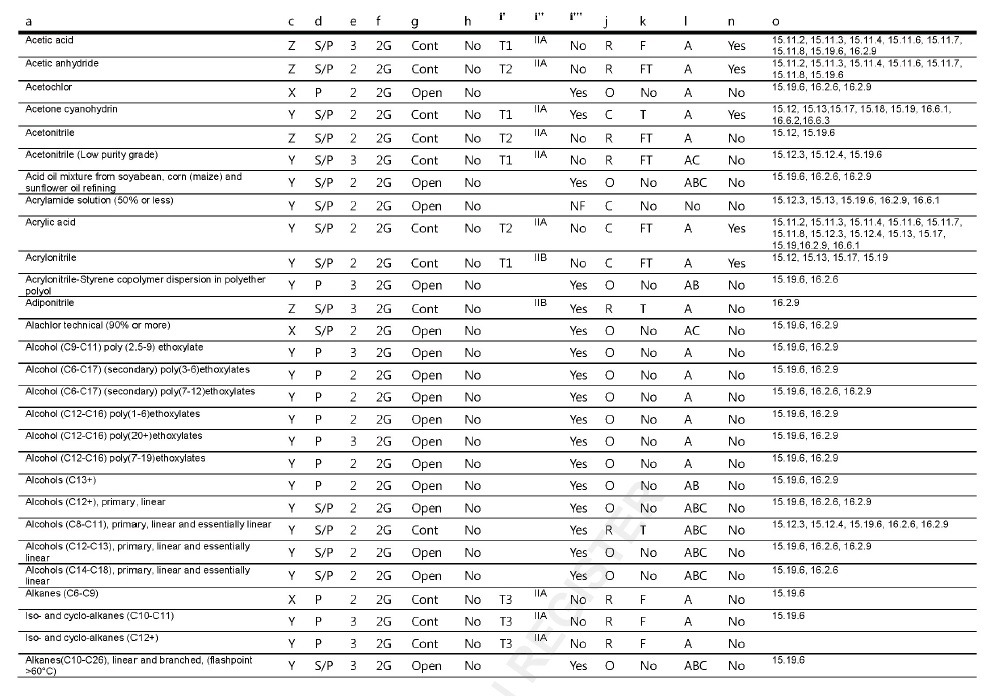
Chap.17 : Summary of Mimimum Requirements EXPLANATORY NOTES
| Product name (column a) | The product name shall be used in the shipping document for any cargo offered for bulk shipments. Any additional name may be included in brackets after the product name. In some cases, the product names are not identical with the names given in previous issues of the Code | |
| UN Number (column b) | Deleted | |
| Pollution Category (column c) | The letter X, Y, Z means the Pollution Category assigned to each product under MARPOL Annex II | |
| Hazards (column d) | "S" means that the product is included in the Code because of its safety hazards; "P" means that the product is included in the Code because of its pollution hazards; and "S/P" means that the product is included in the Code because of both its safety and pollution hazards | |
| Ship type (column e) | 1: ship type 1 (2.1.2.1) 2: ship type 2 (2.1.2.2) 3: ship type 3 (2.1.2.3) | |
| Tank type (column f) | 1: independent tank (4.1.1) 2: integral tank (4.1.2) G: gravity tank (4.1.3) P: pressure tank (4.1.4) | |
| Tank vents (column g) | Cont.: controlled venting Open: open venting | |
| Tank environmental control (column h) | Inert: inerting (9.1.2.1) Pad: liquid or gas padding (9.1.2.2) Dry: drying (9.1.2.3) Vent: natural or forced ventilation (9.1.2.4) No: no special requirements under this Code | |
| Electrical equipment (column i) | Temperature classes (i') Apparatus group (i'') Flashpoint (i''') | T1 to T6 ? indicates no requirements blank no information IIA, IIB or IIC: ? indicates no requirements blank no information Yes: flashpoint exceeding 60°C (10.1.6) No: flashpoint not exceeding 60°C (10.1.6) NF: non-flammable product (10.1.6) |
| Gauging (column j) | O: open gauging (13.1.1.1) R: restricted gauging (13.1.1.2) C: closed gauging (13.1.1.3) | |
| Vapour detection (column k) | F: flammable vapours T: toxic vapours No: indicates no special requirements under this Code | |
| Fire protection (column l) | A: alcohol-resistant foam or multi-purpose foam B: regular foam; encompasses all foams that are not of an alcohol-resistant type, including fluoro-protein and aqueous-film-forming foam (AFFF) C: water-spray D: dry chemical No: no special requirements under this Code | |
| Materials of construction (column m) | Deleted | |
| Emergency equipment (column n) | Yes: see 14.3.1 No: no special requirements under this Code | |
| Specific and operational requirements (column o) | When specific reference is made to chapters 15 and/or 16, these requirements shall be additional to the requirements in any other column | |
Categorization and listing of Noxious Liquid Substances and other substances from MARPOL Annex II
1 Category X: Noxious Liquid Substances which, if discharged into the sea from tank cleaning or deballasting operations, are deemed to present a major hazard to either marine resources or human health and, therefore, justify the prohibition of the discharge into the marine environment;
.2 Category Y: Noxious Liquid Substances which, if discharged into the sea from tank cleaning or deballasting operations, are deemed to present a hazard to either marine resources or human health or cause harm to amenities or other legitimate uses of the sea and therefore justify a limitation on the quality and quantity of the discharge into the marine environment;
.3 Category Z: Noxious Liquid Substances which, if discharged into the sea from tank cleaning or deballasting operations, are deemed to present a minor hazard to either marine resources or human health and therefore justify less stringent restrictions on the quality and quantity of the discharge into the marine environment;
Ships subject to the Code shall be designed to one of the following standards:
- A type 1 ship is a chemical tanker intended to transport chapter 17 products with very severe environmental and safety hazards which require maximum preventive measures to preclude an escape of such cargo.
- A type 2 ship is a chemical tanker intended to transport chapter 17 products with appreciably severe environmental and safety hazards which require significant preventive measures to preclude an escape of such cargo.
- A type 3 ship is a chemical tanker intended to transport chapter 17 products with sufficiently severe environmental and safety hazards which require a moderate degree of containment to increase survival capability in a damaged condition.
for 2013.09.16 교육자료.