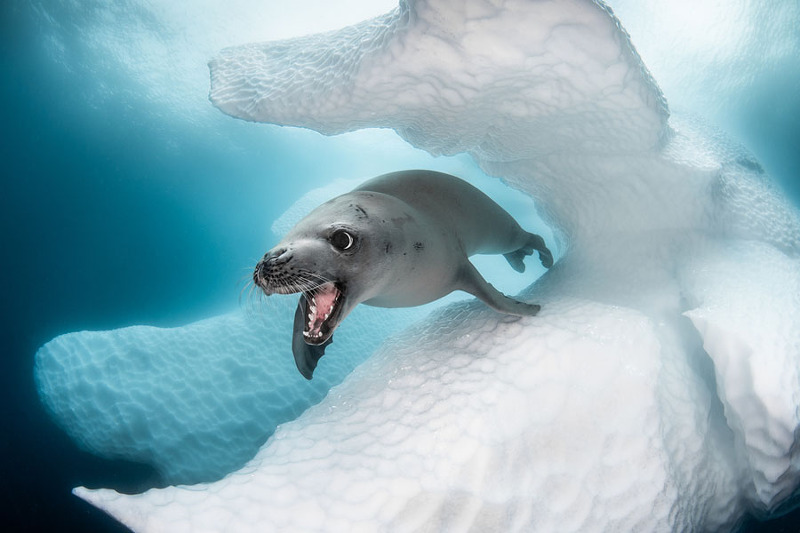
2019 해양 예술 수중사진 공모전의 수상작 Winners of the 2019 Ocean Art Underwater Photo Contest Alan Taylor January 14, 2020 24 Photos In Focus 수중 사진 가이드가 주최하는 제8회 해양 예술 수중 사진 공모전 심사가 마무리되었으며 수상한 이미지와 사진가가 발표되었다. 그렉 러커(Greg Lecoeur)는 남극 대륙에서 게잡이물범의 이미지로 공모전에서 우승을 차지했다. 공모전 주최측은 아래에 수중 사진의 16 부문에서 수상작과 가작을 공유했다. 표제는 개별 사진작가가 작성했으며 콘텐츠를 위해 약간 편집되었다. The judging for the eighth annual Ocean Art Underwater Photo Contest, organized by the Underwater Photography Guide, has wrapped up, and the winning images and photographers have been announced. Greg Lecoeur took Best in Show with his image of a crabeater seal in Antarctica. The contest organizers have shared with us some of the winners and honorable mentions below, from the 16 categories of underwater photography. Captions were written by the individual photographers and have been lightly edited for content. 1. Crabeater Seal: Best of Show and First Place, Coldwater. "During an expedition on a small sailboat, we explored the Antarctic Peninsula by diving below the surface. Although the conditions were extreme with a temperature of -1 degree Celsius, we documented extraordinary marine fauna at home in a fragile ecosystem, such as in this image: Crabeater Seal. Despite the name, crabeater seals don’t eat crabs. Krill make up to 95 percent of a crabeater seal’s diet. Crabeater seals have developed a sieve-shaped tooth structure that filters krill, much like whale baleen. They suck up water containing krill, close their jaws, and push the water between their specialized teeth, trapping the krill inside." # © Greg Lecoeur / Ocean Art 게잡이물범: 공모전 우승 및 냉수계(冷水界) 부문 1위. "작은 범선으로 탐험하는 동안 수면 아래에서 잠수하여 남극 반도를 탐험했다. 기온이 영하 1℃로 극한의 조건이었지만, 우리는 게잡이물범의 이미지처럼 취약한 생태계의 홈에서 특별한 해양 동물을 기록했다. 이름에도 불구하고 게잡이물범은 게를 먹지 않는다. 크릴은 게잡이물범 식단의 최대 95%를 구성한다. 게잡이물범은 고래수염과 아주 유사한 크릴을 걸러내는 체 모양의 치아 구조를 발달시켰다. 크릴을 함유한 물을 빨아들여 턱을 닫고 특수 치아 사이로 물을 밀어내어 크릴을 안에 가둔다."
2. Snaketooth Swallower: First Place, Blackwater. "This individual is called a snaketooth deep-sea swallower (Champsodontidae-Kali macrodon). It lives its adult life posed on the deep sediment, waiting for prey passing nearby. With a very large head and very developed pelvic and pectoral fins, it has a very different morphology from the adult." # © Fabien Michenet / Ocean Art 악어치(키아스모돈과 Family Chiasmodontidae): 블랙워터(黑水, 어두운 수중) 부문 1위. 이 개체는 심해 스왈어(악어치과) 악어치이다. 심해 퇴적물 층에서 먹이가 근처에 지나가기를 기다리며 성체로 살아간다. 머리가 매우 크고 배지느러미와 가슴 지느러미가 매우 발달하여 성체와 형태가 매우 다르다." ♣ 악어치속(Champsodon)은 에우페르카리아류 주걱치목에 속하는 조기어류 속의 한 종이다. 악어치과(Champsodontidae)의 유일속이다. 인도-태평양에서 발견된다. 악어치(Champsodon snyderi) 등을 포함하여 13종으로 이루어져있다.
3. The Blue Arch: Second Place, Novice Wide Angle. "A single sardine is small, but a school of sardines is tremendous—especially when the water is clear and blue. To find the right ocean conditions, we surveyed several dive shops and asked if they could provide early morning diving." # ©George Kuo-Wei Kao / Ocean Art 블루 아치: 초보 광각(廣角) 부문 2위. "단일 정어리는 작지만 정어리 떼는 특히 물이 맑고 푸를 때 엄청나다. 딱 맞는 바다 조건을 찾기 위해 여러 다이브 삽을 조사하여 이른 아침에 잠수를 할 수 있는지 물었다."
4. Treats from Maloolaba River: First Place, Nudibranchs. "The Mooloolah River is a rich treasure trove of nudibranchs. Over 350 species have been found along the 600-meter riverbank. The real challenge is to get a photograph that depicts the stunning form of these tiny creatures. I fell in love with Flabellina lotos in particular. I returned to the river every weekend for four months to try to achieve an image where the Flabellina's vivid purple cerata popped against a jet-black background." # ©Jenny Stock / Ocean Art 호주 마무라 강에서의 환대: 나새류(裸鰓類, 연체 동물) 부문 1위. 마무라 강은 나새류(裸鰓類)의 풍부한 보고(寶庫)이다. 350종 이상이 600m 강둑을 따라 발견되었다. 진짜 도전은 이 작은 생물의 놀라운 형태를 묘사한 사진을 얻는 것이다.
5. Toads: Third Place, Portrait. "In spring, this lake is filled with mating toads. I took this over-under shot with the intention of representing the pair of toads in their natural environment." Big Monticolo Lake, Bolzano, Italy. # ©Claudio Zori / Ocean Art 두꺼비: 얼굴 사진 부문 3위. "봄에 이 호수는 짝짓기 하는 두꺼비로 가득 차있다. 나는 자연 환경에서 한 쌍의 두꺼비를 나타낼 의도로 이 오버언더 샷(물 위와 아래의 장면)을 찍었다." 이탈리아 볼차노의 커다란 몬티콜로 호수.
6. Green Field: Fourth Place, Nudibranchs. Photographed in British Columbia, Canada. # ©Mauro Apuleo / Ocean Art 푸른 들판: 나새류(裸鰓類, 연체 동물) 부문 4위. 캐나다 브리티시 컬럼비아에서 촬영.
7. Icerock: Second Place, Coldwater. "We planned to dive underneath icebergs in Greenland, and made some holes into the frozen fjord next to some iceberg that were frozen in. The diver had some video lights on his camera so I used the opportunity to create some atmosphere with it." Tasiilaq Fjord, East Greenland. # ©Tobias Friedrich / Ocean Art 아이스록(氷巖): 냉수계(冷水界) 부문 2위. "그린란드의 빙산 아래에서 잠수를 계획하고 얼어붙은 빙산 옆에 얼음장 같은 피요르드에 구멍을 뚫었다. 다이버는 카메라에 비디오 조명이 있어서 분위기를 만들 기회를 얻었다." 이스트 그린란드의 타실락 피요르드.
8. Blanket Octopus: Second Place, Blackwater. "This image represents a blanket octopus (Tremoctopus spp.) pictured during a night blackwater dive in Anilao, Philippines. Blanket octopuses are elusive and quite hard to find. When threatened, the blanket octopus extends its fleshy curtains to look like a disco icon." # ©Paolo Bausani / Ocean Art 보라문어(Tremoctopus): 블랙워터(黑水, 어두운 수중) 부문 2위. "이 이미지는 필리핀의 아닐라오에서 야간 블랙워터(어두운 수중) 잠수하는 동안 촬영한 보라문어(Tremoctopus)를 보여준다. 보라문어는 눈에 띄지 않아 찾기가 매우 어렵다. 위협을 받으면 보라문어는 진한 커튼을 디스코 아이콘처럼 보이게 한다.
9. Plastic Soup: Third Place, Conservation. "It’s been almost three years since I moved to live in Indonesia on a small Island called Nusa Lembongan. On the neighboring island Penida, we have a healthy population of reef mantas all year around. This particular day out diving in Manta Bay was to become a dive I would never quite forget. It was the end of wet season so I was used to seeing clouds of trash float by after it's washed from the rivers around Indonesia into the sea. But this was something completely different than what I’d seen before. The mantas on this dive were attempting to filter feed in this plastic soup floating near the surface. Which obviously also contained the zooplankton they crave ... that is carried around by the same currents that brought the plastic. It was an immensely eye-opening moment for everyone I was diving with at the time." Nusa Penida, Bali, Indonesia. # ©Brooke Lori Pyke / Ocean Art 플라스틱 스프: (자연 환경·사적·천연 자원 등의) 보호 부문 3위. "누사 렘봉안이라는 작은 섬의 인도네시아로 이주한 지 거의 3년이 지나서였다. 인근 섬 페니다에는 일년 내내 건강한 암초대왕쥐가오리(Mobula alfredi)가 있다. 만타 베이(灣)에서의 이 특별한 날 잠수는 결코 잊을 수 없는 스쿠버 다이빙이 되었다.
10. Blended: First Place, Compact Wide Angle. "I had never seen or even heard of this magnificent king of camouflage prior to taking this shot, as it's a rare sighting that requires an equal balance of luck and persistence. The yellow-crested weedfish can be found deep among the kelp gardens of Shelly Beach, and is so similar in appearance to its environment that finding one requires active investigation. Its movements sway like the seaweed it buries itself in, its color almost identical, making it the ultimate master of disguise." Shelly Beach, Sydney, Australia. # ©Talia Greis / Ocean Art 혼합 : 소형 광각(廣角) 부문 1위. "이 촬영을 하기 전에 이 장엄한 위장왕을 보거나 들어본 적이 없었다. 행운과 끈기의 균형이 필요한 보기 힘든 발견이다. 노랑볏 미역치(쏨뱅이목 양볼락과)는 셸리의 다시마 정원 사이에서 찾을 수 있다. 해수면은 환경과 매우 유사하여 활발한 조사가 필요하다. 해초가 묻어있는 해초처럼 흔들리면서 그 색이 거의 같아 변장의 궁극적인 달인으로 만든다." 호주 시드니의 셸리 비치.
11. The Story: Second Place, Macro. "Pygmy lemon gobies inhabit a discarded beer bottle." Lembeh Strait, Indonesia. # ©Wu Yung-Sen / Ocean Art 스토리: 매크로(接寫) 부문 2위. "피그미 노랑새우망둑어(Cryptocentrus cinctus)는 버려진 맥주병에 서식한다." 인도네시아의 렘베 해협(海峽).
12. Spike fin Goby: Fourth Place, Supermacro. "This is a widespread but rarely found underwater animal. I was so excited when I came across her. It had been 11 years since I last saw her. The spikefin goby is very small, with a head about 5 millimeters wide and a body length of about 20 millimeters." Cebu, Philippines. # © Qing Lin / Ocean Art 스파이크핀 망둑어: 초매크로(超接寫) 부문 4위. "이 종은 널리 분포하지만 거의 발견되지 않는 수중 동물이다. 그녀를 만났을 때 너무 흥분했다. 마지막으로 그녀를 본 지 11년이 지났다. 스파이크핀 망둑어는 매우 작고 머리는 약 5mm이고 몸길이는 약 20mm이다." 필리핀의 세부.
13. Alciopid Worm: Honorable Mention, Blackwater. "During a drift dive off Tahiti, I came across this Alciopid worm. Theses worms are not uncommon offshore in open-ocean but most often have a threadlike body and are not very photogenic. This individual belongs to a species with a large and fleshy body that I have only encountered on rare occasions. He swam constantly, circling rapidly, and his body sparkled with electric-blue reflections. When it hit small crustaceans attracted by my lights, it sent small lures which emitted a particularly intense green bioluminescent light." Tahiti Island, French Polynesia. # ©Fabien Michenet / Ocean Art 독사연충(毒蛇蠕蟲, 알시오피드 웜): 블랙워터(黑水, 어두운 수중) 부문 가작. "타히티에서 조류(Drift) 다이빙(잠수)하는 동안 나는 이 독사연충(毒蛇蠕蟲, 알시오피드 웜)을 발견했다. 이 벌레는 바다에서 드문 것은 아니지만 대부분 실과 같은 몸을 가지고 있으며 발광성이 별로 없다.
14. Glass Fish Reef: Honorable Mention, Reefscapes. "As we descended onto the first pinnacle at the Four Kings dive site, we saw that the reef was covered in baitfish. Tuna and jacks were actively hunting, causing the cardinal fish to tightly hug the reef. I framed the shot with the seaman as the focal point, using the baitfish as the foreground and background. The extremely high density of fish was amazing to witness as they all moved as one mass to avoid predation." Raja Ampat, West Papua, Indonesia. # ©Nicholas More / Ocean Art 암초 창고기: 암초 경관 부문 가작. 훠 킹스 다이빙(潛水) 장소의 첫 번째 깎아지른 듯한 부분(絶頂)에 내려갈 때, 우리는 암초가 미끼용 물고기로 덮여있는 것을 보았다. 참치와 잭피쉬(전갱이)들이 적극적으로 사냥하면서, 열동가리돔이 암초를 단단히 잡고있도록 만들었다. ♣ 창고기(학명: Branchiostoma lanceolatum)는 창고기강 창고기목에 속하는 척추동물의 일종인 여과 섭식동물으로, 어류를 닮았으나 어강에 속하지 않는다. 창고기는 두삭동물아문에 속하는 대표적인 동물로, 보통 유두동물의 자매군으로 보고 있다. 활유어(蛞蝓魚)라고도 한다. 온대 또는 열대 지방 바다의 얕은 부분의 모래 속에서 발견되곤 한다. 플로리다창고기(Branchiostoma floridae)의 게놈 염기서열 분석이 완료되었다. 눈 대신 시세포가 있다.
15. Hungry: Third Place, Coldwater. "I had planned to go out with [a] boat on Shetland Islands to shoot Gannets but the sea was too rough outside the bird cliff. Improvising we managed to instead find a couple of large grey seals in an area protected from the waves. I decided to use a long shutter speed to not only show the speed of the seal but also to emphasize the face." Lerwick, Shetland Islands, Scotland. # ©Johan Sundelin / Ocean Art 허기(虛氣): 냉수계(冷水界) 부문 3위. "나는 북방가넷*을 찍기 위해 셰틀랜드 제도로 보트를 타고 가려 했지만 바다가 조류 절벽 밖에서 너무 거칠었다. 즉흥적으로 우리는 파도로부터 보호되는 지역에서 두 마리의 큰 회색물범*을 찾을 수 있었다. *북방가넷은 사다새목(Pelecaniformes) 부비과(Suledae)에 딸린 외양성(外洋性) 바다새. *회색물범은 북대서양 양쪽 해안에서 발견되는 물범의 일종이다. 물범과에 속하는 대형 기각류이다. 회색물범속의 유일종이다. 대서양바다표범으로도 알려져있다.
16. Seahorse Bus: First Place, Novice Macro. "Capturing six baby seahorses all facing in the same direction while sharing a piece of weed is an extremely challenging shot. These babies will often pull in different directions and face away from the camera. So I'm absolutely delighted to be able to share such a split second in time before this scene changed dramatically. Under Blairgowrie Marina has become a popular nursery for the birth of these baby short-head seahorses and also the bigbelly seahorses. I've seen as many as 20 babies sharing the same weed. You only have a short window of opportunity to capture this because their survival rate is so low." Blairgowrie Marina, Victoria, Australia. # ©Jules Casey / Ocean Art 해마(海馬) 버스: 초보 매크로(接寫) 부문 1위. "해초를 공유하면서 6마리의 새끼 해마(海馬)를 모두 같은 방향으로 향하게 하는 것은 매우 도전적인 샷이다. 이 새끼 해마들은 종종 다른 방향으로 당겨서 카메라에서 멀어지게 된다."
17. Sea Turtle Trapped: Fifth Place, Conservation. "A loggerhead sea turtle swims entangled in abandoned fishing gear, off the coast of El Hierro, Canary Islands. The loggerhead is classed as a ‘vulnerable’ species globally by the International Union for Conservation of Nature, but the northeast Atlantic subpopulation is listed as ‘endangered’. Entrapment in nets intended for other species, and in gear left abandoned by fishing boats, is the prime threat to marine turtles." El Hierro, Canary Islands, Spain. # ©Francis Perez / Ocean Art 갇힌 바다거북: (자연 환경·사적·천연 자원 등의) 보호 부문 5위. "카나리아 제도 엘이에로 해안에서 떨어져 버려진 어구(漁具)에 붉은 바다거북 이 걸려든 채 헤엄친다. 붉은 바다거북은 국제 자연 보존 협회에 의해 전 세계적으로 '취약한' 종으로 분류되지만 북동 대서양 특정 생물형군은 '멸종 위기' 종으로 등재되어있다. 다른 종에 대한 의도적인 그물의 포획과 어선에 의해 버려진 어구(漁具)에 갇히는 것은 바다거북에 대한 주요 위협이다. 스페인 카나리아 제도 엘이에로.
18. Egg Release: Honorable Mention, Marine Life Behavior. "During a recent dive trip to Bonaire I was very fortunate to be in the water doing a night dive when, all of a sudden, the entire reef came alive. Thousands of brittle stars began climbing to the tops of coral heads in a synchronized event and began releasing either their sperm or eggs into the water column, hoping they would meet by chance and fertilize. This incredible event occurs only a few times during the year and I felt incredibly privileged, not only to witness it, but also to be able to photograph it." Bonaire, Netherland Antilles. # ©Steven Kovacs / Ocean Art 알(난자) 방출: 해양생물 행동 부문 가작. "보네르섬*에서 최근 스쿠버 다이빙 여행을 하는 동안 나는 갑자기 모든 암초(산호초)가 살아났던 야간 스쿠버 다이빙하며 물에 있다는 것이 아주 행운이었다. 수천의 불가사리(사미류)들이 동시다발적으로 산호 머리 꼭대기로 올라가기 시작하더니, 그들이 우연히 만나 수정되길 바라면서 그들의 정자 또는 난자를 물기둥 속으로 방출하기 시작했다. 이 놀라운 사건은 연중 단 몇 차례 발생하는 데, 나는 그것을 목격할 뿐만 아니라 사진을 찍을 수 있는 엄청난 특권을 누렸다. *보네르섬은 카리브해에 위치한 네덜란드의 섬.
19. Eye of the Tornado: Third Place, Wide Angle. "I've long dreamt of Cabo Pulmo's jack tornado, since being inspired by an image from marine ecologist, Octavio Aburto, some years ago. It is difficult to plan dives in Cabo Pulmo, because the National Park implements a first-come, first-served quota system for the maximum number of divers allowed on each site per week. To my surprise, the most popular dive sites were already closed upon my arrival. On the second dive day, we lucked out and found the jacks. Descending from the surface, I immediately saw the largest school of fish I’ve ever seen. One moment, they were a massive wall, blocking out the sun. Next, they were a 'river' of fish flowing from the surface to the ocean floor. And then they transformed into a spinning tornado around my dive guide, Moctezuma, who could see the surface through the 'eye' of the tornado." Cabo Pulmo National Park, Baja, Mexico. # ©Adam Martin / Ocean Art 토네이도의 눈: 광각(廣角) 부문 3위. "수년 전 해양생태학자 옥타비오 아부토의 이미지에서 영감을 얻은 이후 카보 풀모에서 잭피쉬(전갱이) 토네이도를 오랫동안 꿈꿔왔다. 국립 공원은 매주 각 사이트에서 허용되는 최대 다이버 수에 대해 선착순 할당량 시스템을 구현하기 때문에 카보풀모에서 스쿠버 다이빙을 계획하기가 어렵다. 놀랍게도, 가장 인기있는 다이빙 사이트는 이미 내가 도착하자마자 닫혔다. 두 번째 잠수하던 날에, 우리는 운이 좋았고 잭피쉬(전갱이)를 찾았다. 표면에서 내려 오면서 나는 내가 본 것 중 가장 큰 물고기 떼를 바로 보았다. 한 순간, 그들은 거대한 벽이었고 태양을 막고 있었다. 다음으로, 그들은 표면에서 해저로 흐르는 물고기의 '강'이었습니다. 그리고 그들은 토네이도의 '눈'을 통해 표면을 볼 수있는 나의 스쿠버 다이빙 가이드 모크테수마를 중심으로 회전하는 토네이도로 변모했다. "멕시코 바하의 카보 풀모 국립공원.
20. The Sheep: Second Place, Nudibranchs. "This type of nudibranch, very common in Tulamben, is very small and lives on a small leaf that moves with the sea current so it is not very easy to photograph with the snoot." Melasti, Tulamben, Indonesia. # ©Andrea Pescarolo / Ocean Art 양(羊): 나새류(裸鰓類, 연체 동물) 부문 2위. 이 유형의 나새류(裸鰓類)는 툴람벤에서 매우 흔하며 해류(海流)와 함께 움직이는 작은 잎에 서식하기 때문에 나새류(裸鰓類, 연체 동물)는 스누트를 가지고 사진을 찍기가 쉽지 않다." 인도네시아 툴람벤의 멀라스티. ♣ 사진에서 스누트는 스튜디오 조명이나 휴대용 플래시에 맞는 튜브 또는 이와 유사한 물체이며 사진사가 광선의 방향과 반경을 제어할 수 있도록 한다. 이들은 원뿔형, 원통형 또는 직사각형일 수 있다. 스누드는 플래시를 사용할 때 피사체를 분리할 수도 있다.
21. Snooty: Honorable Mention, Portrait. "Snooty is a large female lemon shark inhabiting the wrecks in front of Jupiter, Florida. Her smile and her ease around divers have made her a local celebrity. She's always one of the first sharks to come ... greet you when diving the Bonaire and she stays close by until the end of the dive. On this particular dive, I was focused on trying to capture her 'smile,' enjoying her willingness to play along." Bonaire Wreck, Jupiter, Florida. # ©Galice Hoarau / Ocean Art 스누티(건방진): 얼굴 사진 부문 가작. "스누티는 플로리다州 주피터 앞 난파선에 서식하는 큰 암컷 레몬상어(학명: Negaprion brevirostris)이다. 그녀의 미소와 다이버 주위에서 편안함은 그녀를 현지 유명인사로 만들었다. 그녀는 항상 보네르에서 스쿠버 다이빙할 때 인사하러오는 최초의 상어 중 하나이고, 잠수가 끝날 때까지 가까이에 머문다. 이 특별한 스쿠버 다이빙에서 나는 기꺼이 함께 놀아주는 그녀와 즐기면서 그녀의 '미소'를 포착하는 데 집중했다." ♣ 레몬상어(학명: Negaprion brevirostris)는 흉상어과에 속하는 상어의 일종으로, 3m까지 자란다. '레몬상어'라는 이름은 겉모습 때문에 붙여졌다. 특정 깊이의 바닷속에서 레몬상어를 관찰하게 되면 빛 때문에 겉표면이 노르스름하고 울퉁불퉁한 것이 마치 레몬껍질같다고해서 지어진 것이다. 모습 전체적으로 노란기가 도는 회색빛을 띠며 몸에 다른 특별한 무늬는 가지고 있지 않다. 또한 두 번째 등지느러미가 첫 번째 등지느러미와 거의 크기가 같은 것이 특징이다. 분포 보통 아열대나 열대지역에서 서식한다. 북아메리카와 남아메리카의 연안, 그리고 아프리카의 대서양쪽 연안에서 발견되며 태평양 적도 근처의 섬에서 발견되기도 한다. 보통 그리 얕지도 깊지도 않은 수심에서 생활하며 빨판상어와 같이 있는 모습이 자주 발견된다. 번식 레몬상어는 태생성(viviparous)이라 알을 낳는 대신 한 번에 4~17마리의 살아있는 새끼상어를 낳는다. 대개 2년에 한 번씩 맹그로브 숲같이 따뜻하고 수심이 얕은 곳에서 새끼를 낳는다. 새끼들은 태어나서부터 알아서 먹이를 구하며 1.5 ~ 2m 정도의 크기로 다 성장할 때까지 12 ~ 15년 정도 맹그로브 숲을 떠나지 않는다. 이 밖의 번식습성에 대해서는 아직 자세하게 연구된 바가 없다.
22. Clownfish Eggs: First Place, Supermacro. "My friend and dive master Ajiex Dharma in Tulamben was able to find these clownfish eggs and assist me during the shoot, holding the snoot in the right position ." Tulamben, Bali, Indonesia. # ©Paolo Isgro / Ocean Art 흰동가리 알: 초매크로(超接寫) 부문 1위. "나의 친구이자 다이버 감독 투람벤의 아지엑스 다르마는 이 흰동가리 알을 발견할 수 있게 해주었고, 촬영하는 동안 나를 도와 똑 바른 위치로 스누트를 잡고 있었다. 인도네시아 발리의 툴람벤. ♣ 사진에서 스누트는 스튜디오 조명이나 휴대용 플래시에 맞는 튜브 또는 이와 유사한 물체이며 사진사가 광선의 방향과 반경을 제어할 수 있도록 한다. 이들은 원뿔형, 원통형 또는 직사각형일 수 있다. 스누드는 플래시를 사용할 때 피사체를 분리할 수도 있다.
23. Strange Encounters: Fourth Place, Marine Life Behavior. "Seeing cormorants hunting sardine is one of the many amazing experiences that a diver can experience at Los Lobos Islotes in La Paz, Mexico. While the dive site is most famous for its large sea lion colony, the cormorants can really steal the show! They are birds but are also extremely well-adapted to the underwater world. During a photo workshop that we hosted at the dive shop I work at, I was fortunate to spend a late-afternoon dive with them, focusing entirely on capturing this interesting behavior and the dappled light that many of us love so much in our pictures. The cormorant is speeding through the water column while the school of sardine breaks up, trying to make their escape. A matter of life and death." # ©Hannes Klostermann / Ocean Art 이상한 조우(遭遇): 행양생물 행동 부문 4위. "정어리를 사냥하는 가마우지들을 보는 것은 다이버가 멕시코 라파스의 로스 로보스 이스로테스(섬)에서 체험할 수 있는 많은 놀라운 경험 중 하나이다. 잠수 사이트는 커다란 바다사자 서식지로 유명하지만, 가마우지가 실제로 쇼를 훔칠 수 있다! 그들은 새이지만 수중 세계에 매우 잘 적응되어있다. 우리는 내가 일하는 다이브 삽에서 주최한 사진 워크삽 동안 나는 그들과 함께 늦은 오후 스쿠버 다이빙을 하면서 운이 좋았다. 우리들 중 많은 사람들이 사진에서 매우 좋아하는 (햇빛과 그림자 등으로) 아롱진 빛과 이 흥미로운 행동을 포착하는 데 전적으로 집중하고 있었다. 가마우지는 정어리 떼가 탈출하려고 시도하면서 흩어지는 동안 물기둥을 통과하여 속도를 내고 있다. 삶과 죽음의 문제."
24. The Choir: Fifth Place, Marine Life Behavior. "Two juvenile sea lions (Zalophus californianus) play under a shallow rocky ledge near Islote Los Lobos, La Paz, Mexico. While they seem to be singing in perfect harmony, I do not remember hearing anything!" # ©Pedro Carillo Montero / Ocean Art 합창(合唱): 해양생물 행동 부문 5위. 두 젊은 바다사자(캘리포니아바다사자)가 멕시코 라파스의 로스 로보스 섬 근처의 얕은 바위 투성이 암층 아래에서 놀고 있다. 그들이 완벽한 조화를 이루어 노래하는 것 같지만, 아무것도 들리지 않았던 것으로 기억한다!" |