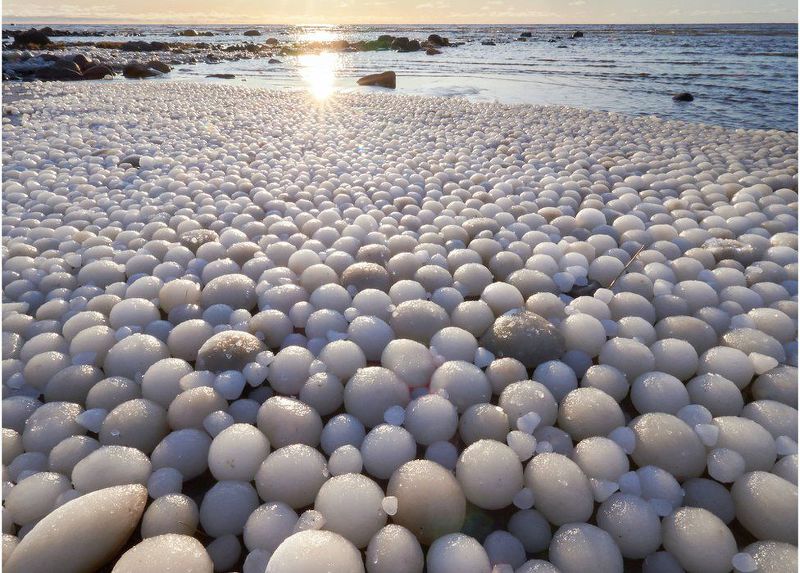
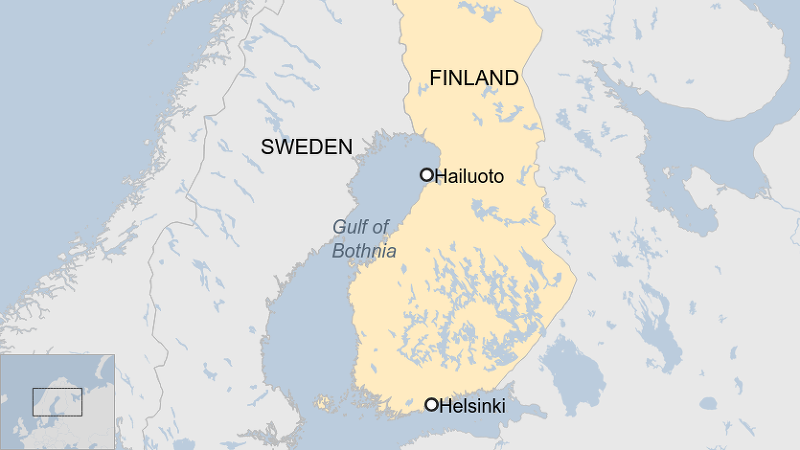
"달걀처럼 생긴 얼음" 덩어리가 특이한 기상현상으로 핀란드 해변을 덮어 'Ice eggs' cover Finland beach in rare weather event 7 November 2019 Risto Mattila photographed the "ice eggs" on Hailuoto Island on Sunday. # Risto Mattila 리스토 마틸라가 일요일에 핀란드 북부 하일루오토 섬에서 "얼음 달걀"을 찍었다. Thousands of egg-shaped balls of ice have covered a beach in Finland, the result of a rare weather phenomenon. 수천의 달걀처럼 생긴 얼음 덩어리들이 특이한 기상현상으로 핀란드의 해변을 덮었다. 아마추어 사진가 리스토 마틸라는 핀란드와 스웨덴 사이의 보트니아만(灣)에 위치한 하일루오토 섬에서 "얼음 달걀(아이스 에그)"을 발견한 사람들 중 하나였다. 전문가들은 그것이 작은 얼음 조각이 바람과 물에 의해 굴러다니는 특이한 과정에 의해 일어났다고 말한다. 인근 오울루市 출신 마틸라는 BBC 방송사에 이전에 그와 같은 어떤 것도 본적이 없다고 말했다. "나는 마르야니에미 해변에 나의 아내와 함께 있었다. 날씨는 약 영하 1℃(32℉) 정도로 맑았으며 바람이 부는 날이었다"고 그가 BBC 방송사에 말했다. "우리는 이 놀라운 현상을 발견했다. 물가 근처 해변을 따라 눈과 얼음 달걀이 있었다." * 스코틀랜드의 차가운 강에서 큰 "아이스 팬케이크"가 만들어진다. * 거대한 눈덩이가 러시아 해변에 나타난다. 마틸라는 얼음 공들이 약 300m(100ft) 지역을 덮었다고 말했다. 가장 작은 것은 달걀 크기였고, 가장 큰 것은 축구공 크기였다. "그것은 놀라운 광경이었다. 근처에 25년 동안 살면서 이런 것을 본 적이 없다”고 말했다. "내가 카메라를 가지고 있었기 때문에 나는 후손을 위해 이 특별한 광경을 보존하기로 결정했다." Amateur photographer Risto Mattila was among those who came across the "ice eggs" on Hailuoto Island in the Gulf of Bothnia between Finland and Sweden. Experts say it is caused by a rare process in which small pieces of ice are rolled over by wind and water. Mr Mattila, from the nearby city of Oulu, told the BBC he had never seen anything like it before. "I was with my wife at Marjaniemi beach. The weather was sunny, about -1C (32F) and it was quite a windy day," he told the BBC. "There we found this amazing phenomenon. There was snow and ice eggs along the beach near the water line." *Large 'ice pancake' forms on cold river in Scotland *Giant snowballs appear on Russian beach Mr Mattila said the balls of ice covered an area of about 30m (100ft). The smallest were the size of eggs and the biggest were the size of footballs. "That was an amazing view. I have never seen anything like this during 25 years living in the vicinity," Mr Mattila said. "Since I had a camera with me I decided to preserve this unusual sight for posterity." BBC의 기상 전문가 조지 굿펠로우는 기상 상태는 얼음 공이 형성되려면 추위와 약간의 바람이 필요하다고 말했다. "대략적인 그림은 그것들이 커다란 빙상(氷床)으로부터 형성되어 파도에 휩싸여 둥글게 되는 것"이라고 그는 말했다. "그들은 바닷물이 표면에 얼어붙어 자랄 수 있으며, 이것은 그들을 더 부드럽게 만드는 데 도움이 된다. 결과적으로 부드러운 얼음 덩어리가 해변으로 흘러들어가거나 바람이 불거나 또는 조수가 나갈 때 거기서 떠날 수 있다." 비슷한 광경이 러시아 등 시카고 근처 미시갠 호수에서 전에 보도되었다. 2016년에 시베리아의 "니다 마을" 주민들이 18km(11 마일) 뻗어있는 해안선을 덮고 있는 거대한 눈과 얼음 덩어리를 발견했다. 테니스공 크기에서 거의 직경 1m (3 피트)까지 다양했다. BBC Weather expert George Goodfellow said conditions needed to be cold and a bit windy for the ice balls to form. "The general picture is that they form from pieces of larger ice sheet which then get jostled around by waves, making them rounder," he said. "They can grow when sea water freezes on to their surfaces and this also helps to make them smoother. So the result is a ball of smooth ice which can then get deposited on to a beach, either blown there or getting left there when the tide goes out." Similar sights have been reported before, including in Russia and on Lake Michigan near Chicago. In 2016 residents of Nyda in Siberia found giant balls of ice and snow covering an 18km (11-mile) stretch of coastline. They ranged from the size of a tennis ball to almost 1m (3ft) across. The giant balls of ice and snow amazed villagers in Nyda, on the Yamal Peninsula in Siberia. # Ekaterina Chernykh 거대한 눈과 얼음 공들이 시베리아의 야말 반도에 위치한 니다 마을 사람들을 놀라게했다. |