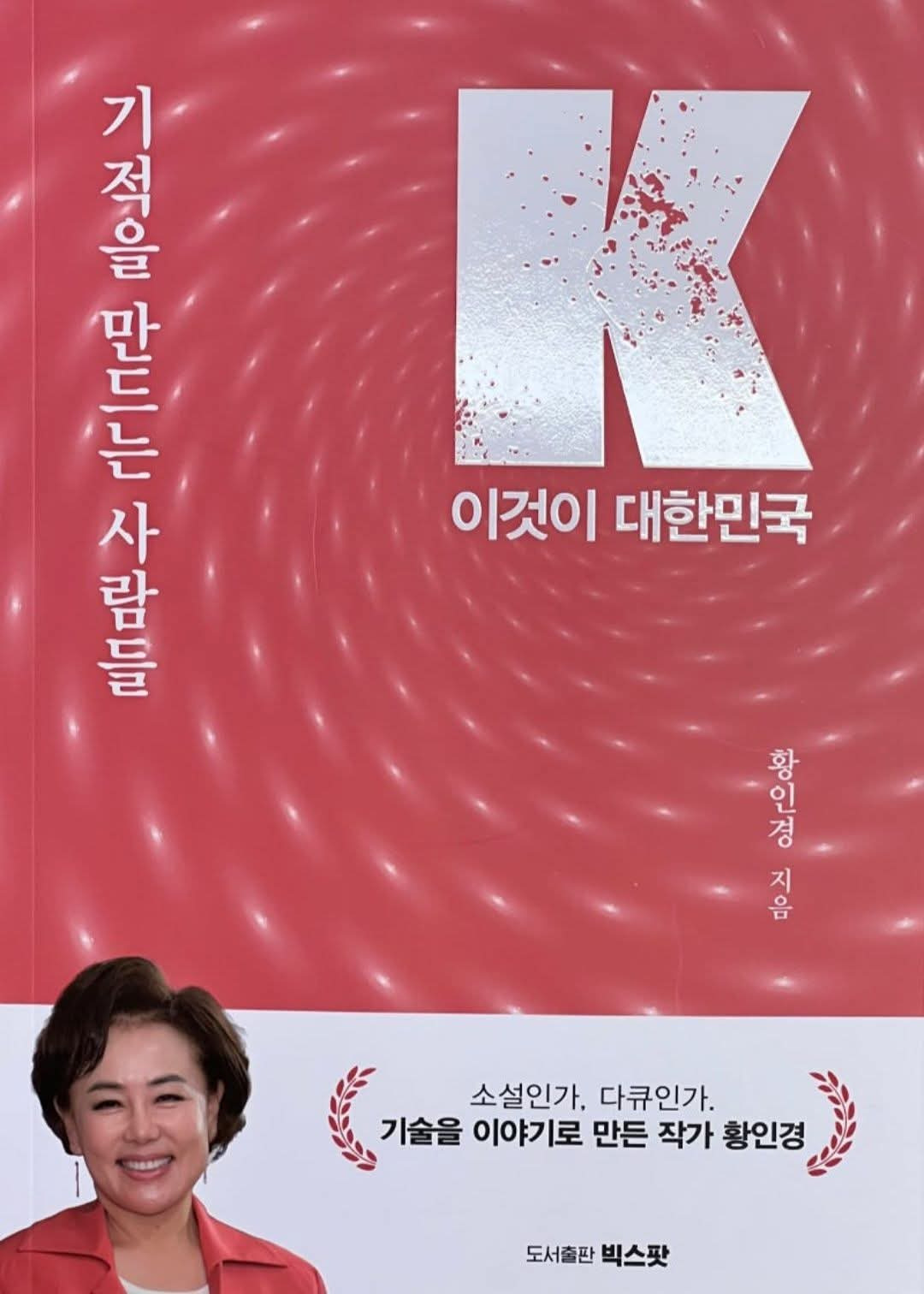
[Book Review]
'K-Humanity' Transformed into a Giant Neural Network: The Blazing Solidarity of Connecting Souls
— Mapping a Literary Milestone of Dialogue and Healing in Hwang In-kyung’s Epic Novel, K This is Korea -
The Miracle Makers —
By Isak-bit, Poet (Pen Name of Lee Mi-young)
Ph.D. in Literature · Adjunct Professor of Creative Writing at Northwest Samar State University (NwSSU) · Literary Critic / President of the Dong-yang Literature Association / Executive Director of Nobel Literature
Introduction: Literature as a Mirror Diagnosing the Times and Healing the Wounds
Literature serves both as an honest mirror of an era and a healing tongue that gently embraces the wounded inner self of humanity. Having previously revived the timeless humanist reform spirit of Dasan Jeong Yak-yong through the monumental masterpiece The Novel Mokmin Simseo, which achieved an astonishing record of 6.5 million copies sold, Hwang In-kyung—a titan of Korean literature and a prominent novelist nominated for the Nobel Prize in Literature—has returned. Her latest sweeping epic, K This is Korea - The Miracle Makers, pierces straight into the beating heart of modern technology.
While this novel unfolds against the backdrop of a national mandate—achieving technological self-reliance in the cold realm of nuclear energy—the ultimate core uncovered upon closing the book is a human drama of profound healing, centered on deep solidarity, communication, and the intricate weaving of "human-to-human connection." This review aims to analyze in depth how the author, a true literary grandmaster, sublimates the complex fractures of contemporary society into a magnificent work of art from a reader's perspective.
Expanded Narrative and Deep Character Reading: A Saga of Miracles Breaking Through Giant Barriers
This work is a compelling piece of faction (fact-based fiction) capturing the fierce, high-stakes chronicle surrounding the independent development of the "Man-Machine Interface System (MMIS)"—the absolute brain of South Korea’s nuclear power technology. The narrative ignites when global nuclear energy conglomerates, led by the United States, impose a ruthless embargo on core source codes and blueprints. Mocked by international cynics who scoffed, "How could Korea ever build the brain of a nuclear reactor with its current technology?" the protagonist, Yoon Na-ra, head of R&D at a private energy firm, launches a covert project from scratch, navigating the dark without a single line of technical guidance.
As the project advances, the story plunges into a swirling vortex of titanic conflicts. Yong Min-kyung, an environmental activist who threw herself into the anti-nuclear movement after witnessing a reactor fire during her studies in Japan, orchestrates fierce public protests and rallies societal pressure, pushing the project to the brink of cancellation. Compounding the crisis, international espionage rings relentlessly target the proprietary technology, and whispers of an internal leak push the tension to a breathtaking climax, straining the narrative's suspense to its absolute limit.
In this pitch-black hour of despair, Team Leader Yoon Na-ra forms a dramatic alliance with Go Ji-seok, a genius engineer who returns to the field to heal his own past traumas, and her estranged father, Dr. Yoon Ju-chul, a dedicated director at the Korea Atomic Energy Research Institute who sacrificed his family life for national technological autonomy. For over a decade, nameless researchers shed blood, sweat, and tears, coding tens of millions of lines deep into the night. Their sacrifice ultimately illuminates the once-dead circuits with the spark of success, delivering the monumental triumph of "Team Korea."
Throughout this journey, the characters' inner landscapes are painted with striking psychological depth. Yoon Na-ra evolves from a cold, corporate technocrat obsessed solely with a 100% success rate into a true leader who understands how to win people's hearts. Yong Min-kyung transcends blind ideological opposition; upon witnessing the researchers' sacred battle to secure absolute digital safety and sovereign control over the MMIS technology, she transforms into a pragmatic intellectual wrestling with the path of coexistence. The emotional reconciliation between Dr. Yoon Ju-chul, who gave his youth to his nation, and his daughter Na-ra, serves as a poignant validation of the true literary value of "communication" and "family," striking a deeply resonant chord in the reader's heart.
Metaphors and the Zeitgeist Piercing Through Korea's History
The history of South Korea has always been a trajectory of miracles, bending the impossible into reality. In his seminal text, The Country I Desire, the venerable independence leader Kim Gu famously wrote: "The only thing I desire in infinite abundance is the power of a highly developed culture. This is because the power of culture makes us happy ourselves, and in turn, brings happiness to others." Beneath the "K-Technology" captured by Hwang In-kyung’s pen lies this precise power of an elevated spiritual culture and the unyielding willpower of ordinary people who forge miracles.
The relentless tenacity that once pushed back against the absolute monopoly of Western powers to domesticate the world's most advanced, high-tier brain sciences and technologies directly mirrors the modern miracles we witness today: the global cultural ascendancy of K-pop and BTS, and the brilliant convergence of AI technology with physical technology. This grueling journey of innovation is a profound testament to human victory—a realization of the classical phrase 'Jutak Dongsi' (啐啄同時)—where the chick pecks from the inside out of sheer aspiration, while the mother hen pecks from the outside in absolute trust and solidarity, together breaking the shell.
To decode this text on a deeper level, one must look beyond the mere progression of the plot and capture the sweeping metaphors where technology and culture converge.
First, the history of South Korea is akin to a scorching hot spring bursting through a wall of solid ice. No matter how freezing the barrier erected by foreign technological blockades and geopolitical containment, the nation's internal dynamism and human-centered passion inevitably melt the ice to erupt into the world. This mirrors the author's own literary achievement, seamlessly fusing the rigid, documentary backbone of a ten-year scientific struggle with the exquisite alchemy of sublime human emotion.
Second, the MMIS nuclear technology in the novel serves as an invisible cultural thread—a metaphorical circuit—bridging the coldness of science with the warmth of K-culture. It is far more than an electronic array controlling a machine; it is a conduit of human dialogue that mends generational rifts, bridges environmentalism and science, and reconciles the friction between analog humanity and artificial intelligence (AI). Within the assembly of these cold components, the reader uncovers a beautifully structured symmetry showing how fractured human relationships find their healing.
The Historical Imperative of the Novel and Its Value for the Nobel Prize
Our contemporary world moans under the existential weight of a rapid AI upsurge, worsening climate crises, and extreme ideological polarization. At this critical juncture, the literary necessity of K This is Korea as a profound book review expands far beyond a mere national archive into a universal document for humanity. The reason this text commands recognition on the grandest stage of the Nobel Prize in Literature lies in its profound polyphonic depth (Polyphony) and urgent historical relevance.
Above all, this novel possesses a vital imperative: the restoration of humanity in an era of cold technocracy. Modern society faces a deep existential dread of being subjugated by machines and algorithms. By demonstrating that domesticating a complex digital control system in defiance of a massive global monopoly was ultimately achieved only through human tears and solidarity, the author delivers a solemn truth: the final fortress safeguarding us against the runaway train of technology is the warmth of the human soul. It brilliantly justifies why the humanities must exist in an age dominated by science.
Furthermore, the work offers a brilliant resolution to a global dilemma: the coexistence of ecology and development. The clash between the environmental activist and the nuclear engineers serves as a microcosm of the global struggle between carbon neutrality and energy security. Instead of trapping the narrative in a flat, one-dimensional defense or critique of nuclear energy, the author balances the voices of technocrats, elite scientists, and environmentalists with equal thematic weight. By building a "circuit of communication" where these isolated ideological voices move past discord toward a harmonious ensemble, the novel academically and practically demonstrates how literature can serve as a bridge across societal divides.
Lastly, one cannot overlook the anthropological value of the novel in recording the majesty of ordinary artisans lost to history. Just as Gabriel García Márquez—the Colombian master who sublimated historical tragedies into magical realism to win the 1982 Nobel Prize in Literature—or Aleksandr Solzhenitsyn, who exposed the horrors of the Soviet gulags to champion human dignity, illuminated individual sanctity amidst the crushing wheels of history, Hwang In-kyung elevates the youth and tears of nameless engineers above the shadows of capital and power, enshrining them as a glorious cultural asset for humanity. Much like how the music of BTS consoles the wounds of global youth, her literature tenderly embraces the souls of unsung heroes, radiantly restoring the dignity of the marginalized.
Conclusion: A Milestone Leaving a Haunting Echo in the Hearts of Global Readers
True to the grandmaster's conviction that "literature is the act of standing on the opposite side of all violence, serving as the final language that guards human dignity," K This is Korea - The Miracle Makers beautifully elevates a macroscopic discourse on science and culture into a sublime testament to individual lives and boundless humanity. From the sweat of engineers shattering a monopoly on core brain sciences to the onstage passion of BTS and the rise of advanced AI physical technologies, the miraculous odyssey of South Korea is seamlessly condensed within these pages.
Reflecting deeply on the sociological layers beneath the literary text, the true face of this novel reveals itself as a path of mutual prosperity for all mankind. As an epic of ordinary yet extraordinary souls who turned the impossible into reality, this work will undoubtedly serve as a defining milestone of our time, extending a hand of profound comfort and solidarity to global readers fractured by discord.
Moreover, the achievement of this work stands as a magnificent milestone continuing the literary journey of Han Kang, who became the first Asian woman to win the Nobel Prize in Literature by directly confronting historical traumas and caressing the fragility and sanctity of human existence with her poetic prose. While Han Kang gazed intensely into the abyss of history to heal the spirits of wounded individuals—introducing the aesthetic brilliance of Korean literature to the world—Hwang In-kyung uses those very eras of pain as a stepping stone, raising a grand epic to celebrate the fierce solidarity and communication of those who forged miracles out of a barren wasteland.
The literature of both titans is birthed from the unique temporal and spatial soil of Korea, yet both beautifully converge upon the sublime, universal values of healing trauma and restoring the human spirit. Inheriting the brilliant Renaissance glory of Korean literature unlocked by Han Kang, Hwang In-kyung’s sweeping narrative leap—which thoroughly proves the value of 'K-human dignity' and dialogue amidst a cold, advanced technological civilization—is fully equipped to captivate the global vision and deep intellect of the Swedish Academy. This magnificent literary footprint, piercing through the eras, will forever endure in the souls of global readers as an unquenchable flame of universal solidarity.