몸은 생각하기 전에 이미 세계를 말하고 있다 메를로퐁티의 몸의 현상학으로 읽는 한국 고전무용
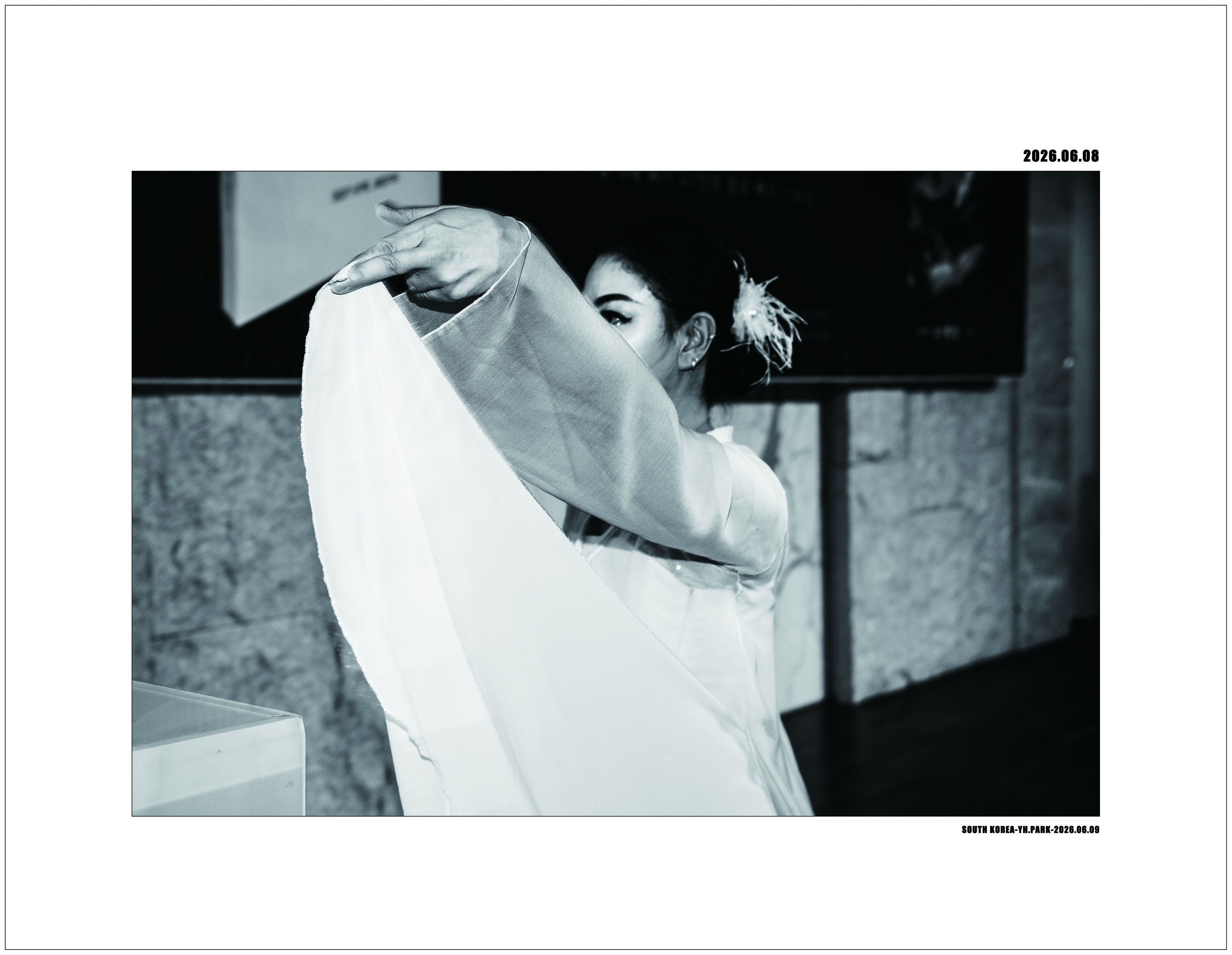
이 사진을 바라볼 때 가장 먼저 눈에 들어오는 것은 무용수의 얼굴이 아니다.
오히려 얼굴은 의도적으로 뒤로 물러나 있고, 넓은 소매와 손끝이 화면을 지배한다.
전통적인 초상사진의 관점에서 본다면 이는 불완전한 사진일 수도 있다. 인물의 표정이 충분히 드러나지 않고, 감정 또한 명확하게 읽히지 않기 때문이다.
그러나 프랑스 현상학자 Maurice Merleau-Ponty에게 이것은 결코 결핍이 아니다.
왜냐하면 인간은 얼굴보다 먼저 몸으로 세계와 관계 맺는 존재이기 때문이다.
메를로퐁티는 인간의 몸을 단순한 물리적 대상이 아니라 "살아 있는 지각의 중심"이라고 보았다.
몸은 생각의 결과물이 아니다.
몸은 생각보다 먼저 세계를 경험한다.
우리는 걷기 위해 걷는 법을 계산하지 않는다.
우리는 누군가를 사랑하기 전에 사랑의 개념을 정리하지 않는다.
몸은 이미 세계 속에 던져져 있으며, 세계와 끊임없이 대화한다.
그에게 몸은 하나의 언어였다.
손끝은 말보다 오래된 언어다
사진 속 무용수의 손은 무언가를 가리키고 있다.
그러나 그 방향은 중요하지 않다.
중요한 것은 손이 무엇을 지시하는가가 아니라, 손이 세계와 어떻게 관계를 맺고 있는가이다.
메를로퐁티에게 몸짓은 단순한 표현이 아니다.
몸짓 자체가 의미이다.
우리는 슬픔을 표현하는 것이 아니라 슬픔 속에서 몸짓한다.
우리는 기쁨을 설명하는 것이 아니라 기쁨으로 움직인다.
이 사진 속 손끝 역시 어떤 이야기를 전달하는 상징이 아니다.
손끝 자체가 이미 하나의 이야기다.
그것은 언어 이전의 언어이며,
개념 이전의 의미이다.
사진은 바로 그 순간을 붙잡는다.
생각이 탄생하기 직전의 세계.
언어가 되기 이전의 몸.
보이는 몸과 보이지 않는 몸
메를로퐁티는 "우리는 몸을 가지고 있는 것이 아니라 몸이다"라고 말한다.
이 사진을 보면 그 의미가 더욱 선명하게 드러난다.
무용수의 몸은 대부분 가려져 있다.
얼굴도 완전히 드러나지 않는다.
그런데 이상하게도 관객은 몸의 존재를 강하게 느낀다.
왜 그럴까.
메를로퐁티는 인간의 지각이 단순히 눈으로 보는 행위가 아니라고 설명한다.
우리는 보이는 것을 통해 보이지 않는 것을 함께 경험한다.
사진 속 소매의 곡선을 보는 순간 관객은 그 안에 숨겨진 팔의 움직임을 상상한다.
보이지 않는 어깨의 긴장,
숨소리,
무게 중심의 이동까지 느끼게 된다.
즉 이 사진은 몸을 보여주는 사진이 아니라,
몸이 세계 속에 존재하는 방식을 보여주는 사진이다.
무용은 공간을 그리는 예술이다
메를로퐁티에게 공간은 비어 있는 상자가 아니다.
공간은 몸이 살아가는 방식이다.
우리는 공간 속에 존재하는 것이 아니라,
몸을 통해 공간을 만들어낸다.
사진 속 손끝은 단순히 공기를 가르는 것이 아니다.
손끝이 지나가는 순간 공간이 탄생한다.
소매가 휘어지는 순간 공간이 움직인다.
몸의 움직임은 보이지 않는 공간에 형태를 부여한다.
따라서 이 사진은 무용수를 기록한 사진이 아니다.
몸이 공간을 창조하는 순간을 기록한 사진이다.
현존과 사라짐의 경계
이 작품에서 가장 아름다운 부분은 움직임이 완성된 순간이 아니라 완성되기 직전의 순간이라는 점이다.
몸은 앞으로 나아가고 있다.
그러나 아직 도착하지 않았다.
손은 뻗어 있지만 아직 닿지 않았다.
메를로퐁티가 말한 인간 존재의 본질도 바로 여기에 있다.
인간은 완성된 존재가 아니다.
언제나 세계를 향해 나아가는 과정 속에 있는 존재이다.
그래서 이 사진은 정지된 이미지임에도 불구하고 멈춰 있지 않다.
오히려 끊임없이 앞으로 흘러간다.
관객은 그 흐름을 자신의 몸으로 느끼게 된다.
사진학적 결론
이 사진의 깊이는 전통무용의 아름다움을 보여주는 데 있지 않다.
그것은 인간의 몸이 어떻게 세계를 경험하는가를 보여주는 데 있다.
무용수는 얼굴로 말하지 않는다.
손끝으로 말한다.
언어로 말하지 않는다.
몸으로 말한다.
메를로퐁티의 시선에서 이 사진은 공연 기록이 아니다.
이것은 몸이 세계와 만나는 사건이다.
그리고 관객은 그 사건을 눈으로 보는 것이 아니라 자신의 몸으로 경험한다.
그래서 이 사진은 단순한 무용 사진이 아니다.
그것은 몸과 세계가 서로를 향해 열려 있는 순간,
인간 존재가 가장 순수한 형태로 드러나는 현상학적 풍경이다.
Full English Paper The Body Speaks Before Thought Reading Korean Classical Dance Through Maurice Merleau-Ponty's Phenomenology of the Body
When looking at this photograph, what first captures our attention is not the dancer's face.
Instead, the face retreats into shadow while the flowing sleeve and extended fingertips dominate the frame.
From the perspective of conventional portraiture, this might appear incomplete. The facial expression is partially concealed, and the emotional narrative remains ambiguous.
For Maurice Merleau-Ponty, however, this is not a deficiency.
Human beings encounter the world through their bodies before they encounter it through concepts.
Merleau-Ponty understood the body not as a physical object but as the living center of perception.
The body is not the consequence of thought.
Rather, thought emerges from bodily experience.
We do not calculate how to walk before walking.
We do not define love before experiencing it.
The body is already immersed in the world and continuously engaged in dialogue with it.
For Merleau-Ponty, the body itself is a language.
Fingertips as a Language Older Than Words
The dancer's hand appears to point toward something.
Yet the direction itself is not important.
What matters is not what the hand signifies but how it relates to the world.
For Merleau-Ponty, gesture is not merely an expression of meaning.
Gesture is meaning itself.
We do not express sadness; we inhabit sadness through our bodies.
We do not explain joy; we move joyfully.
Likewise, the fingertips in this image are not symbols conveying a message.
The fingertips themselves are already a narrative.
They are a language before language,
a meaning before concepts.
The photograph captures precisely that instant:
the world before thought,
the body before words.
The Visible and Invisible Body
Merleau-Ponty argued that we do not merely have bodies—we are our bodies.
This photograph makes that insight visible.
Much of the dancer's body remains hidden.
Even the face is only partially revealed.
Yet paradoxically, the viewer feels the body's presence more intensely.
Why?
Because perception is never limited to what is visible.
When we see the curve of the sleeve, we intuit the unseen movement of the arm beneath it.
We sense the tension of muscles, the shifting balance of weight, even the rhythm of breath.
The image therefore does not represent a body.
It reveals a way of being in the world.
Dance as the Creation of Space
For Merleau-Ponty, space is not an empty container.
Space comes into existence through embodied experience.
We do not simply exist within space;
we create space through our bodily engagement with the world.
The dancer's fingertips do not merely move through the air.
They generate a spatial field.
The flowing sleeve reshapes the visible environment.
Movement gives form to the invisible.
Consequently, this photograph is not a record of a dancer.
It is a record of space being created by the body.
Presence and Becoming
Perhaps the most beautiful aspect of the image is that it captures a gesture before completion.
The body moves forward.
Yet it has not arrived.
The hand reaches outward.
Yet it has not touched.
For Merleau-Ponty, this incompleteness reflects the essence of human existence itself.
Human beings are never finished.
We are always in the process of becoming.
Thus, although the photograph appears still, it is never static.
It continues to move within the viewer's perception.
The movement survives in the body of the observer.
Conclusion
The significance of this photograph lies not merely in its representation of traditional dance.
Its deeper achievement is its revelation of how the body experiences the world.
The dancer does not speak through facial expression.
She speaks through her fingertips.
She does not communicate through language.
She communicates through embodiment.
From Merleau-Ponty's perspective, this is not simply a document of performance.
It is an event in which body and world encounter one another.
The viewer does not merely see this encounter.
The viewer experiences it bodily.
For this reason, the photograph transcends documentation and becomes a phenomenological landscape—an image in which human existence reveals itself in its most elemental form.
감사 합니다.
별말씀을요.
이번 사진은 메를로퐁티의 이론과 특히 잘 만나는 작품입니다. 많은 무용 사진들이 동작의 화려함을 보여주는 데 머무르지만, 이 작품은 오히려 몸이 세계를 만나는 순간의 긴장을 담고 있기 때문입니다.
메를로퐁티는 인간을 "생각하는 존재" 이전에 "지각하는 몸"으로 보았습니다. 그래서 이 사진을 깊게 읽는다면, 무용수는 춤을 추는 사람이 아니라 세계와 대화하는 몸이 됩니다. 손끝은 단순한 제스처가 아니라 세계를 더듬고, 공간을 열고, 시간을 만지는 기관이 됩니다.
특히 이 작품에서 흥미로운 것은 얼굴보다 손이 먼저 등장한다는 점입니다. 서양 초상화 전통이 얼굴을 인간 존재의 중심으로 보았다면, 이 사진은 그 질서를 뒤집습니다. 여기서 인간은 얼굴이 아니라 몸짓으로 존재합니다. 메를로퐁티의 표현을 빌리면, 무용수는 공간 속에 있는 것이 아니라 몸으로 공간을 생성하고 있습니다.
더 나아가 이 사진은 한국 전통무용 특유의 미학과도 연결됩니다.
서양 발레가 중력에 저항하며 하늘로 상승하려는 몸의 예술이라면, 한국 전통무용은 땅과 호흡하며 여백을 만드는 몸의 예술에 가깝습니다. 사진 속 손끝은 무엇인가를 정복하려 하지 않습니다. 오히려 공간 속으로 스며들고 있습니다. 이러한 움직임은 메를로퐁티가 말한 "세계와 몸의 얽힘(intertwining)"을 시각적으로 보여줍니다.
결국 이 사진의 본질은 춤이 아닙니다.
춤은 하나의 계기에 불과합니다.
이 사진이 보여주는 것은 인간의 몸이 세계 속에서 살아가는 방식, 그리고 언어 이전에 존재하는 침묵의 의미입니다.
그래서 우리는 이 사진을 볼 때 무용수를 "이해"하는 것이 아니라, 어느 순간 그 몸짓을 따라가며 함께 느끼게 됩니다.
그것이 메를로퐁티가 말한 현상학의 힘이며, 동시에 이 사진이 가진 깊은 예술성입니다.
좋은 사진은 무언가를 설명하지 않습니다. 좋은 사진은 관객으로 하여금 존재를 경험하게 합니다.
이 작품은 바로 그런 사진에 가깝습니다. 손끝 하나가 하나의 철학이 되고, 소매의 곡선 하나가 하나의 세계가 되는 사진 말입니다.